×

Cocos Islands🇨🇨 | national parksPulu Keeling National ParkRed-footed booby colony, enclosed lagoon, uninhabited atoll, permit-only landing | things to do and best time to go

Explore Home IslandExplore The Rip

Backpacking in Pulu Keeling
🏆 Top picknational park ranked #1
By Johan Kruseman 🇳🇱 | Updated October 22, 2026

Pulu Keeling National Park is a single, uninhabited coral atoll with no resident population, and landing on North Keeling needs a permit and a boat trip arranged through the park authority. It lies in the far north of the Cocos Islands, roughly 24 kilometers beyond the main atoll where everyone lives. The island is a ring of coral rubble and coconut palms around a shallow lagoon, home to the largest seabird colony in the Indian Ocean, including red-footed boobies, frigatebirds and the endemic Cocos buff-banded rail. There are no trails to speak of, no shops, no shade at the landing and no guaranteed access. Swells often cancel landings, and the reef passage is rough, so keep a spare day or two in your Cocos schedule and book early with a licensed operator. Bring all water and wear closed shoes for coral. Compared with South Keeling, where you can cycle, snorkel and eat dinner, Pulu Keeling is raw, quiet and strictly regulated.

Discover everything you want to know in the 📖 Cocos Islands Travel Guide.


example page 0 from our offline Travel Guide for Cocos Islands
example page 1 from our offline Travel Guide for Cocos Islands
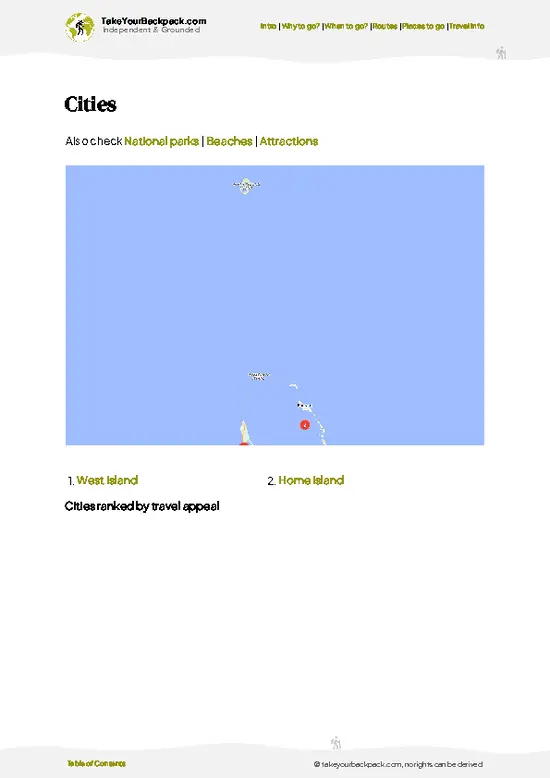
example page 2 from our offline Travel Guide for Cocos Islands
example page 3 from our offline Travel Guide for Cocos Islands
example page 4 from our offline Travel Guide for Cocos Islands
example page 5 from our offline Travel Guide for Cocos Islands
example page 6 from our offline Travel Guide for Cocos Islands
Loading the map 🌍
CLICK TO FILTER
cities
national parks
beaches
attractions
SHOW COUNTRY’S BESTSHOW ALL

✨ Why go?
Ranked #1 national park in Cocos Islands
Why Pulu Keeling should be on your travel list

Pulu Keeling National Park suits backpackers who care more about wildlife than comfort. The draw is the seabird colony, with thousands of red-footed boobies nesting in the canopy and great frigatebirds hanging overhead, a sight few places in the Indian Ocean match. It also protects the last natural stand of vegetation on the atoll, so you see what the islands looked like before coconut plantations. Visits are guided by permit conditions and tour operators, which keeps the island clean and removes any route planning. If you want independence, you get it in the form of time: you can wander the shoreline and watch birds without crowds, since only small groups land on any given day. The Cocos buff-banded rail, a flightless-leaning bird once nearly lost from the islands, is a reason in itself for … read more 👉
Pulu Keeling National Park suits backpackers who care more about wildlife than comfort. The draw is the seabird colony, with thousands of red-footed boobies nesting in the canopy and great frigatebirds hanging overhead, a sight few places in the Indian Ocean match. It also protects the last natural stand of vegetation on the atoll, so you see what the islands looked like before coconut plantations. Visits are guided by permit conditions and tour operators, which keeps the island clean and removes any route planning. If you want independence, you get it in the form of time: you can wander the shoreline and watch birds without crowds, since only small groups land on any given day. The Cocos buff-banded rail, a flightless-leaning bird once nearly lost from the islands, is a reason in itself for serious birders. Budget is mostly the boat fee, and you save by splitting a charter with other travelers. There is no camping on North Keeling, so expect a long day trip rather than an overnight.

💡 HighlightsPlaces and moments you shouldn't skip

  1. Seabird colony: The headline sight. Red-footed boobies nest in the island’s trees in large numbers, and frigatebirds and tropicbirds work the air above them.
  2. North Keeling lagoon: A shallow, enclosed lagoon with a tiny reef-gap entrance, visible from the shoreline and rich in juvenile fish and small reef sharks.
  3. Cocos buff-banded rail: A shy, ground-dwelling bird found only here in the group, reintroduced to South Keeling later. Look near the undergrowth at the edge of the palms.
  4. Native pisonia and coconut forest: The vegetation is largely intact, so the canopy is denser and more natural than on the plantation islands.
  5. Green turtle beaches: Green turtles nest on the sandy edges, and you may see tracks or animals in the shallows.
  6. Outer reef snorkeling: Clear water and coral gardens around the surrounding
… read more 👉
  1. Seabird colony: The headline sight. Red-footed boobies nest in the island’s trees in large numbers, and frigatebirds and tropicbirds work the air above them.
  2. North Keeling lagoon: A shallow, enclosed lagoon with a tiny reef-gap entrance, visible from the shoreline and rich in juvenile fish and small reef sharks.
  3. Cocos buff-banded rail: A shy, ground-dwelling bird found only here in the group, reintroduced to South Keeling later. Look near the undergrowth at the edge of the palms.
  4. Native pisonia and coconut forest: The vegetation is largely intact, so the canopy is denser and more natural than on the plantation islands.
  5. Green turtle beaches: Green turtles nest on the sandy edges, and you may see tracks or animals in the shallows.
  6. Outer reef snorkeling: Clear water and coral gardens around the surrounding reef, though currents and swell limit access to calm days.
  7. Boat crossing: The trip from the main atoll is part of the experience, with open ocean, flying fish and occasional dolphins or seabird flocks following the vessel.
Most visitors overlook the quiet shoreline rubble flats, where hermit crabs, coconut crabs and nesting terns are easier to watch than the crowded canopy.
Spotted a mistake or missing something? Contact us.

🌤️ When to go?When to go for the best experience

  • Dry Season (May to October): The best window for reaching North Keeling. Southeast trade winds blow steadily, rain is lighter, and temperatures sit around 24 to 30°C (75 to 86°F). Lagoon and ocean crossings are usually calmer, though the trade winds can still chop the water.
  • Wet Season (November to April): Warmer and stickier at 26 to 31°C (79 to 88°F), with squalls and a small cyclone risk from roughly January to March. Landings on the reef-fringed island get canceled more often.
  • Seabird Breeding: Red-footed boobies nest here year-round, and the park also holds frigatebirds and the rare Cocos buff-banded rail. Visits are tightly controlled, so birdlife is the draw in any month.
  • Daylight and Crowds: Near the equator the day runs about 12 hours all year. There are no crowds, since the park is
… read more 👉
  • Dry Season (May to October): The best window for reaching North Keeling. Southeast trade winds blow steadily, rain is lighter, and temperatures sit around 24 to 30°C (75 to 86°F). Lagoon and ocean crossings are usually calmer, though the trade winds can still chop the water.
  • Wet Season (November to April): Warmer and stickier at 26 to 31°C (79 to 88°F), with squalls and a small cyclone risk from roughly January to March. Landings on the reef-fringed island get canceled more often.
  • Seabird Breeding: Red-footed boobies nest here year-round, and the park also holds frigatebirds and the rare Cocos buff-banded rail. Visits are tightly controlled, so birdlife is the draw in any month.
  • Daylight and Crowds: Near the equator the day runs about 12 hours all year. There are no crowds, since the park is protected and trips are rare. Flights to the islands cost more around Australian school holidays.
Book a Cocos flight and any park access arrangements months ahead, and aim for the dry season.


source: climatestotravel.comJANJanuary: fair for travelingFEBFebruary: fair for travelingMARMarch: fair for travelingAPRApril: below average for travelingMAYMay: fair for travelingJUNJune: highly recommended for travelingJULJuly: highly recommended for travelingAUGAugust: highly recommended for travelingSEPSeptember: excellent for travelingOCTOctober: excellent for travelingNOVNovember: good for travelingDECDecember: excellent for traveling
when-to-go

✈️ The backpacker research shortcutCocos Islands Travel Guide

An offline-friendly backpacking guide with optimized travel routes, ranked highlights, transport advice, and the best areas to stay.
example page 0 from our offline Travel Guide for Cocos Islands
example page 1 from our offline Travel Guide for Cocos Islands
example page 2 from our offline Travel Guide for Cocos Islands
example page 3 from our offline Travel Guide for Cocos Islands
example page 4 from our offline Travel Guide for Cocos Islands
example page 5 from our offline Travel Guide for Cocos Islands
example page 6 from our offline Travel Guide for Cocos Islands
The digital guide (48 pages) contains:
✅ 5 highlights, ranked by travel appeal
✅ Optimized 5, 10 & 15-day travel routes
✅ Cities, national parks, landmarks, beaches
✅ How to get around
✅ Offline-friendly for travel without Wi-Fi
👉 Click to see all 30+ guide features

📅 Plan smarter in minutes, not weeks
✅ Month by month travel advice
✅ Festivals & national holidays
✅ Budget expectations

🗺️ Go to the right places, skip the overrated ones
✅ Honest pros & cons of destinations
✅ Top hikes, parks & viewpoints
✅ Lesser-known places most travelers miss
✅ Clear “worth it vs skip it” guidance

🛏️ Travel smoothly without rookie mistakes
✅ Best areas to stay
✅ Transport systems explained simply
✅ Common scams & safety advice
✅ SIM cards, money & practical tips

🌍 Understand the country, not just visit it
✅ Culture & traditions
✅ 52 Essential phrases & customs
✅ Festivals worth planning around
✅ Traveler-friendly historical context
✅ Insights that make places more meaningful

📱 Built for real travel conditions
✅ Fully downloadable PDF
✅ Works completely offline
✅ Optimized for phone use
✅ Useful in remote areas & buses
✅ Everything in one place
Stop searching, start planning
Get instant access to your full guide. 30‑day money-back guarantee.
+ Add another guide for just

By proceeding you agree to our terms.
Sent to your inbox immediately after payment • 100% Secure Checkout
Best Backpacking Travel Advisor 2025 tourism awardBest Backpacking
Travel Advisor
2025
What others say about Take Your Backpack Guides:
⭐⭐⭐⭐⭐
Fantastic, amazing amount of information!
⭐⭐⭐⭐⭐
My goodness this is amazing, it's what I've been looking for hats off too you!
⭐⭐⭐⭐⭐
I think this is absolutely BRILLIANT
⭐⭐⭐⭐
Very complete and informative. It's still missing places, but I gotta to commend you
⭐⭐⭐⭐⭐
This is truly amazing, thank you, can't wait to explore it with my kids!
⭐⭐⭐⭐⭐
Awesome resource, thank you!
⭐⭐⭐⭐⭐
This is amazing! Can't wait to explore the ones I haven't seen
⭐⭐⭐⭐
I love this! Well done, great idea.
⭐⭐⭐⭐⭐
Thanks for taking the time to make this gem!
⭐⭐⭐⭐⭐
This might be the best website I've ever seen.
⭐⭐⭐⭐⭐
Congratulations, and thank you so much for your work; it's incredibly valuable.
⭐⭐⭐⭐
In all seriousness I think you did a great job pointing out the important spots
⭐⭐⭐⭐⭐
10/10 very good
⭐⭐⭐⭐⭐
As someone who's only just starting to visit regularly this is awesome, thank you.
⭐⭐⭐⭐
Thank you very much! I'm going to visit my dad, it's going to be very useful!
⭐⭐⭐⭐⭐
This is really cool! We'll be travelling for the first time and this definitely come in handy.
⭐⭐⭐⭐⭐
You are now our minister of culture, congratulations 👨‍💼
⭐⭐⭐⭐⭐
Just wanted to tell you that this is a pearl! Going to follow your recommendations.
⭐⭐⭐⭐⭐
This is so cool. I'll definitely be using the resource for my travels soon.
⭐⭐⭐⭐⭐
This is very impressive! Good work.
⭐⭐⭐⭐⭐
This is an amazing and informative site. Very well done!

🛏️ Where to stay?How to pick the right area

There is nowhere to stay inside Pulu Keeling National Park. The island is an uninhabited nature reserve on North Keeling, about 24 km (15 miles) north of the main atoll, and camping or overnight stays are not allowed. Your base is the South Keeling atoll, which holds the two inhabited islands.

West Island is the main base. It has the airport, the small administrative center, a few self-catering holiday units and guesthouses, usually US$90 to 180 a night, and a small shop. Book early, since the number of beds is limited and flights arrive only a few times a week.

Home Island is the home of the … read more 👉
There is nowhere to stay inside Pulu Keeling National Park. The island is an uninhabited nature reserve on North Keeling, about 24 km (15 miles) north of the main atoll, and camping or overnight stays are not allowed. Your base is the South Keeling atoll, which holds the two inhabited islands.

West Island is the main base. It has the airport, the small administrative center, a few self-catering holiday units and guesthouses, usually US$90 to 180 a night, and a small shop. Book early, since the number of beds is limited and flights arrive only a few times a week.

Home Island is the home of the Cocos Malay community. Accommodation is scarce and mostly limited to a few homestay-style rooms. It is a short ferry hop from West Island and gives a more local feel.

There are no hostels and no dorm beds on the islands, so backpackers should expect to pay for a private unit and cook for themselves. Visiting North Keeling is only possible through a permitted tour or boat arranged from the atoll, so ask your host or local operator about it when you book your room.

👛 Costs (as of 22 October 2026)Travel costs and budget guide for Pulu Keeling

A realistic budget for reaching Pulu Keeling National Park from the atoll is about US$275 to 520 a day, because the only way there is a guided boat trip. The park itself charges little, but the cost is in the transport and the lodging on West Island. Travelers pay in Australian dollars, and prices below are converted to US dollars.
CategoryBudget RangeLocal Reality
Entrance and PermitUS$0 to 30Access is controlled and generally arranged through an approved operator or the park authority.
Guided Boat Trip to North KeelingUS$150 to 250Price depends on group size and sea conditions. Trips are infrequent and often canceled for swell.
Accommodation (High Season)US$90 to 150Self-catering units on West Island are the main option. There are no hostels or dorms.
Local TransportUS$10 to 40Bicycle or scooter
… read more 👉
A realistic budget for reaching Pulu Keeling National Park from the atoll is about US$275 to 520 a day, because the only way there is a guided boat trip. The park itself charges little, but the cost is in the transport and the lodging on West Island. Travelers pay in Australian dollars, and prices below are converted to US dollars.
CategoryBudget RangeLocal Reality
Entrance and PermitUS$0 to 30Access is controlled and generally arranged through an approved operator or the park authority.
Guided Boat Trip to North KeelingUS$150 to 250Price depends on group size and sea conditions. Trips are infrequent and often canceled for swell.
Accommodation (High Season)US$90 to 150Self-catering units on West Island are the main option. There are no hostels or dorms.
Local TransportUS$10 to 40Bicycle or scooter hire, or a short ferry to Home Island. The islands are small and flat.
Food and SuppliesUS$25 to 50Groceries are shipped in, so prices run well above the mainland. Cooking for yourself is the norm.
Total Daily BudgetUS$275 to 520Per person, per day, in high season.
⚠️ Prices can change and everyone travels differently, so take this as a rough guide. Hope it helps you plan your adventure!

🥾 TrailsPlan your hike in Pulu Keeling: routes, terrain, and sights

Pulu Keeling National Park has no marked trails, so walks here are short, guided wanders from the landing point rather than hiking in the usual sense. After the boat anchors off the reef, you land on the coral rubble shore and follow the beach and open forest edge for roughly one to three hours, depending on the surf and permit conditions.
  • Landing beach walk: Flat, loose coral rubble and sand, easy in difficulty but hard on ankles. Allow about an hour of slow walking and bird watching.
  • Forest edge: A short stroll along the canopy fringe, where boobies nest overhead. The ground is uneven and dotted
… read more 👉
Pulu Keeling National Park has no marked trails, so walks here are short, guided wanders from the landing point rather than hiking in the usual sense. After the boat anchors off the reef, you land on the coral rubble shore and follow the beach and open forest edge for roughly one to three hours, depending on the surf and permit conditions.
  • Landing beach walk: Flat, loose coral rubble and sand, easy in difficulty but hard on ankles. Allow about an hour of slow walking and bird watching.
  • Forest edge: A short stroll along the canopy fringe, where boobies nest overhead. The ground is uneven and dotted with roots and crab burrows, and nesting areas must be kept at a distance.
  • Lagoon viewpoint: A flat shoreline walk to see the enclosed lagoon and its channel. Expect glare and no shade, so bring a hat.
  • Wildlife: Red-footed boobies, frigatebirds, terns, hermit crabs and the rail are the main species. Disturbing nests is prohibited.
  • Difficulty: Easy distance but demanding conditions: heat, humidity, sun and a wet boat landing in swell.
Getting there depends entirely on a licensed tour or charter from the main atoll, as there is no public transport and the island is only reached by sea. Landings are weather-dependent and are often postponed, so keep flexible dates. Visits are small-group and controlled, so crowding is not an issue, and park access needs advance arrangement with the operator, who also handles any permit or fee. Bring closed shoes, plenty of water, sun protection and a dry bag for camera gear, because there are no facilities on the island at all.
⚠️ Hiking info can sometimes be outdated or inaccurate. Before you hit the trail, check the latest conditions with locals. If you do spot anything that's off, I'd love to hear from you, so I can update it for fellow travelers.

🛡️ SafetyTraveler Safety Guide

Pulu Keeling is a strict nature reserve, and the realistic hazards are the sea and the sun. Getting there means a boat trip across open ocean of roughly 24 km (15 miles), and landing on the reef edge depends entirely on swell. Operators cancel when conditions are poor, so keep a spare day in your schedule. Landings can involve wading over sharp coral, so wear closed reef shoes.

There is no shade on much of the shoreline, no water and no services. Bring all the water you need, a hat, long sleeves and strong sunscreen. Heat and dehydration catch first-timers out more than anything else.

The seabird colonies are the wildlife you will meet. Stay on any marked route, keep your distance from nesting boobies and frigatebirds, and never touch chicks or eggs. Do not bring food, plants or soil, since … read more 👉
Pulu Keeling is a strict nature reserve, and the realistic hazards are the sea and the sun. Getting there means a boat trip across open ocean of roughly 24 km (15 miles), and landing on the reef edge depends entirely on swell. Operators cancel when conditions are poor, so keep a spare day in your schedule. Landings can involve wading over sharp coral, so wear closed reef shoes.

There is no shade on much of the shoreline, no water and no services. Bring all the water you need, a hat, long sleeves and strong sunscreen. Heat and dehydration catch first-timers out more than anything else.

The seabird colonies are the wildlife you will meet. Stay on any marked route, keep your distance from nesting boobies and frigatebirds, and never touch chicks or eggs. Do not bring food, plants or soil, since the park protects its biosecurity. Sharks are present in the surrounding waters, so swimming should follow your guide’s advice. Go only with an approved guide.

FAQCommon questions from travelers

Plan on 3 to 5 days on the atoll to see Pulu Keeling National Park, though the park visit itself takes only a day. The boat trip to North Keeling takes several hours round trip, and weather can delay it, so a spare day helps. Add time on West Island and Home Island for snorkeling and the local community.
Visiting Pulu Keeling National Park without a car is the norm, since the atoll has almost no road network and the park lies about 24 km (15 miles) from West Island. You reach it only by a guided boat from the atoll, and you can get around West Island by bicycle or on foot. A ferry connects West Island to Home Island for a few dollars.
Pulu Keeling National Park is a protected reserve, so access is controlled and you should arrange it through an approved operator or the park authority. Fees are low or folded into the boat tour, which commonly costs about US$150 to 250 per person. Camping and overnight stays are not permitted, and landing depends on sea conditions.
⚠️ Things can change over time, so always validate details locally before you go.

Expanding your trip beyond this stop

Pulu Keeling isn’t the only highlight in Cocos Islands. Explore all what Cocos Islands has to offer.
Country photo of Cocos Islands

We 💚 feedbackIs it worth it?

Pulu Keeling National Park is for birders, photographers and patient travelers who enjoy wild places that make no effort to be convenient. If you need a guaranteed itinerary or comfortable facilities, spend the time on South Keeling instead. I would book the trip early in your stay, leaving spare days for swell, and bring a long lens and sturdy shoes.

✍️ Help improve this page!
The information on this page is based on in-depth research, insights shared by experienced travelers, and feedback from the local travel community in Cocos Islands. While every effort is made to keep the information accurate and current, conditions can change — so if you spot anything incorrect or outdated, please get in touch.


🙋‍♂️ Give feedback

👋 Meet the founderWho’s Behind Take Your Backpack?

Johan, backpacker and founder of TakeYourBackpackHi, I’m Johan (Netherlands 🇳🇱), the creator of TakeYourBackpack. Over the past 3 decades, I’ve backpacked through 90+ countries across six continents, gaining extensive experience with independent travel, long-term trips, and overland routes.

This site is built on a combination of firsthand travel experience and carefully curated insights from other backpackers. Many guides are based on places I’ve personally visited, while others bring together tips, observations, and practical advice shared by trusted travelers I’ve met along the way.

The goal is to provide realistic, experience-driven guidance — not generic itineraries — so you can explore destinations with better context, clearer expectations, and more confidence.