×

Côte d’Ivoire🇨🇮 | citiesAbidjanLagoon ferries, Plateau towers, Banco rainforest, maquis nights | things to do and best time to go

Explore San Pedro BeachExplore Bouaké

Backpacking in Abidjan
🏆 Top pickcity ranked #1
By Johan Kruseman 🇳🇱 | Updated October 22, 2026

Abidjan is not the official capital of Côte d’Ivoire, yet it runs the country: Yamoussoukro holds the title, while the ports, embassies, airline hubs and nightlife all sit here on the lagoon. The city lies in the south of Côte d’Ivoire, where the Ébrié Lagoon cuts it into islands and peninsulas. Expect glass towers in Plateau, diesel haze, orange taxis honking, charcoal smoke over grilled fish and a humid heat that sticks to your shirt by 9 a.m. It suits travelers who like big-city energy, live music and serious eating, and it will frustrate anyone wanting quiet or sights packed into one tidy core. Traffic is slow and distances are long. Taking cheap shared taxis and lagoon ferries costs a little more time but saves real money, while private cars save time but drain a budget fast, so the mix of both gives you the most. Unlike Accra, which feels walkable and compact, Abidjan sprawls and demands planning.

Discover everything you want to know in the 📖 Côte d’Ivoire Travel Guide.


example page 0 from our offline Travel Guide for Côte d’Ivoire
example page 1 from our offline Travel Guide for Côte d’Ivoire
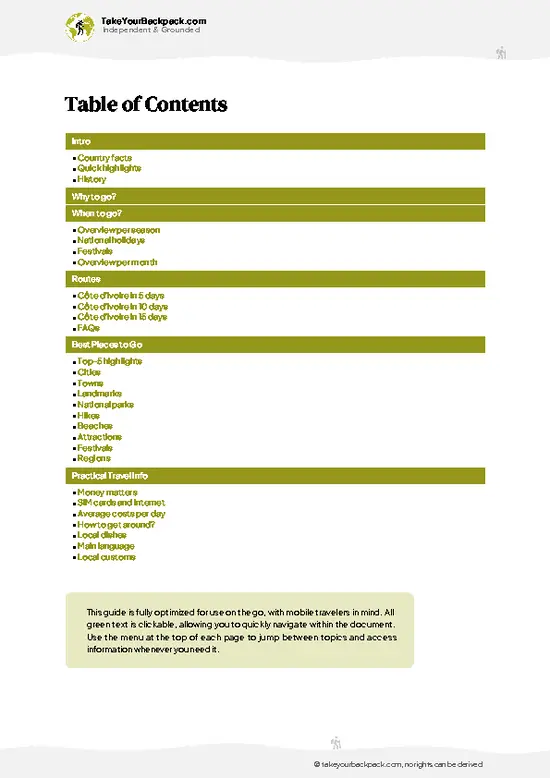
example page 2 from our offline Travel Guide for Côte d’Ivoire
example page 3 from our offline Travel Guide for Côte d’Ivoire
example page 4 from our offline Travel Guide for Côte d’Ivoire
example page 5 from our offline Travel Guide for Côte d’Ivoire
example page 6 from our offline Travel Guide for Côte d’Ivoire
example page 7 from our offline Travel Guide for Côte d’Ivoire
Loading the map 🌍
CLICK TO FILTER
cities
towns
landmarks
national parks
hikes
beaches
attractions
festivals
regions
SHOW COUNTRY’S BESTSHOW ALL

✨ Why go?
Ranked #1 city in Côte d’Ivoire
Why visitors keep coming back

Abidjan works as the logistical and social engine of a West African route. Flights and buses connect it to Ghana, Mali, Burkina Faso and Senegal, and visa paperwork for neighboring countries is easiest to sort here. Beyond transit, the city rewards time with a food scene built around maquis, the open-air grill restaurants where you pick fish or chicken, then eat it with attiéké under string lights. Nightlife is the other pull, from the Zone 4 and Marcory bars to the live coupé-décalé scene in Treichville. Hostels are few, so most backpackers use guesthouses or cheap apartments, which makes it a better fit for those comfortable improvising. It is also a sensible base for beach days on the coast. Walkability is poor, so choose one or two neighborhoods per day. Two to four days is enough for … read more 👉
Abidjan works as the logistical and social engine of a West African route. Flights and buses connect it to Ghana, Mali, Burkina Faso and Senegal, and visa paperwork for neighboring countries is easiest to sort here. Beyond transit, the city rewards time with a food scene built around maquis, the open-air grill restaurants where you pick fish or chicken, then eat it with attiéké under string lights. Nightlife is the other pull, from the Zone 4 and Marcory bars to the live coupé-décalé scene in Treichville. Hostels are few, so most backpackers use guesthouses or cheap apartments, which makes it a better fit for those comfortable improvising. It is also a sensible base for beach days on the coast. Walkability is poor, so choose one or two neighborhoods per day. Two to four days is enough for most travelers, longer if you are working or recovering from the road.

💡 HighlightsMust-see experiences and standout moments

  1. Basilique Notre-Dame de la Paix (Yamoussoukro) is outside the city, so skip it here. Instead start with Cathédrale Saint-Paul in Plateau: a modern concrete cathedral designed by an Italian architect, with a tall tapering spire and a huge stained-glass cross. Go in the morning when it is cooler. Free entry, 30 to 45 minutes.
  2. Plateau skyline walk: the business district has the Pyramide building and bank towers. Early morning or late afternoon is best for walking, and the area is free. Allow 1 to 2 hours.
  3. Musée des Civilisations de Côte d’Ivoire: masks, statues and textiles from the country’s many ethnic groups, in Plateau. Visit mid-morning on a weekday. Around €2 to 4, 1 to 2 hours.
  4. Parc National du Banco: a rainforest reserve within the city limits, with shaded trails, giant trees and monkeys.
… read more 👉
  1. Basilique Notre-Dame de la Paix (Yamoussoukro) is outside the city, so skip it here. Instead start with Cathédrale Saint-Paul in Plateau: a modern concrete cathedral designed by an Italian architect, with a tall tapering spire and a huge stained-glass cross. Go in the morning when it is cooler. Free entry, 30 to 45 minutes.
  2. Plateau skyline walk: the business district has the Pyramide building and bank towers. Early morning or late afternoon is best for walking, and the area is free. Allow 1 to 2 hours.
  3. Musée des Civilisations de Côte d’Ivoire: masks, statues and textiles from the country’s many ethnic groups, in Plateau. Visit mid-morning on a weekday. Around €2 to 4, 1 to 2 hours.
  4. Parc National du Banco: a rainforest reserve within the city limits, with shaded trails, giant trees and monkeys. Go early to avoid heat. Around €4 to 8 with a guide, 2 to 3 hours.
  5. Marché de Treichville: a loud, crowded market with fabric, spices, smoked fish and secondhand goods. Morning is best, and you should keep valuables close. Free to enter, 1 to 2 hours.
  6. Marché de Cocody: smaller and calmer, with crafts and fresh produce, good for souvenirs and a quick lunch. Free, about 1 hour.
  7. Lagoon ferry (bateau-bus): the cheapest way to see the city from the water, crossing between Plateau and Treichville. Late afternoon has the best light. Around €0.5 to 1, 20 to 30 minutes.
  8. Plage de Assinie or Bassam access point: this is outside the city, so instead visit the Marcory waterfront, where locals gather at lagoon-side bars at dusk. Drinks around €1.5 to 3, 1 to 2 hours.
Abidjan’s skyline walk and the cathedral are free, and the lagoon ferry costs the least of any paid activity. From Abidjan, easy day trips include the colonial beach town of Grand-Bassam (a UNESCO World Heritage site), the surf beaches at Assinie, and the lagoon village of Jacqueville.
Spotted a mistake or missing something? Contact us.

Things to do in Abidjan

Ratings based on Tripadvisor reviews. When you book through this link, you support our work at no extra cost to you.

🏘️ NeighborhoodsNeighborhood guide to Abidjan

Abidjan sprawls across lagoon-split peninsulas, so choosing where to spend your day matters more than choosing sights. Taxis eat time and money in the traffic, so I’d cluster each day in one area.
  • Plateau: The business center of glass towers, banks and ministries, with the Saint Paul Cathedral’s concrete bulk and the Sunday-quiet streets. It is walkable in a morning, hot and echoing with traffic, and food is mostly pricey lunch counters. Come for the Musée des Civilisations and leave by midafternoon.
  • Treichville: Across the Houphouët-Boigny bridge, this is the loud, grilled-fish, diesel-and-music Abidjan. The big market smells of smoked fish, spices and wet cement, and the maquis (open-air eateries) pump coupé-décalé after dark. Walk it by day with a small bag. It gives a backpacker the most
… read more 👉
Abidjan sprawls across lagoon-split peninsulas, so choosing where to spend your day matters more than choosing sights. Taxis eat time and money in the traffic, so I’d cluster each day in one area.
  • Plateau: The business center of glass towers, banks and ministries, with the Saint Paul Cathedral’s concrete bulk and the Sunday-quiet streets. It is walkable in a morning, hot and echoing with traffic, and food is mostly pricey lunch counters. Come for the Musée des Civilisations and leave by midafternoon.
  • Treichville: Across the Houphouët-Boigny bridge, this is the loud, grilled-fish, diesel-and-music Abidjan. The big market smells of smoked fish, spices and wet cement, and the maquis (open-air eateries) pump coupé-décalé after dark. Walk it by day with a small bag. It gives a backpacker the most flavor for the least money.
  • Marcory: A residential grid with cheap restaurants, bars and the lagoon-side Zone 4 strip, where you can eat well for little. Walking is fine in short stretches, and a short taxi hop links everything.
  • Cocody: Leafy and wealthy, with embassies, cafés, galleries and the Banco forest at its edge. It is spread out, so you will need taxis between spots, but air-conditioned cafés are a relief at noon. Nightlife is polished and costs more.
  • Yopougon: The huge working-class district known as “Yop City,” famed for its maquis rows, grilled chicken smoke and all-night music on Rue Princesse. It is far from the center and best visited with a local friend or by taxi both ways.
  • Grand-Bassam road and Riviera: Riviera Golf and Palmeraie have modern malls and quieter streets, useful for ATMs and calmer meals but short on character.

⌛️ 1 day1-day itinerary for Abidjan

This is a market-and-lagoon day, built around Abidjan's mix of food stalls, craft sellers and waterfront breezes, with one long taxi hop and a short ferry ride.
8:00 AM: Treichville Market
Start early, before the heat builds. The covered market is a maze of fabric, spices, smoked fish and piles of tomatoes, and the lanes are tight, so carry your phone in a front pocket. Eat a breakfast of fried egg sandwich with coffee from a stall at the edge, then take a taxi across Houphouët-Boigny Bridge toward the Plateau.
10:00 AM: Plateau and St. Paul's Cathedral
The Plateau is the skyscraper district, and walking its streets in the morning is easy. Head to the cathedral, a tall modern church with a huge concrete sweep and colorful stained glass that glows inside. Entry is free, and 30 to 45 minutes is … read more 👉
This is a market-and-lagoon day, built around Abidjan's mix of food stalls, craft sellers and waterfront breezes, with one long taxi hop and a short ferry ride.
8:00 AM: Treichville Market
Start early, before the heat builds. The covered market is a maze of fabric, spices, smoked fish and piles of tomatoes, and the lanes are tight, so carry your phone in a front pocket. Eat a breakfast of fried egg sandwich with coffee from a stall at the edge, then take a taxi across Houphouët-Boigny Bridge toward the Plateau.
10:00 AM: Plateau and St. Paul's Cathedral
The Plateau is the skyscraper district, and walking its streets in the morning is easy. Head to the cathedral, a tall modern church with a huge concrete sweep and colorful stained glass that glows inside. Entry is free, and 30 to 45 minutes is plenty. Dress modestly.
11:30 AM: Musée des Civilisations de Côte d'Ivoire
Walk or hop a short taxi to this museum for masks, textiles and carved figures from across the country's regions. Give it about an hour. It is the best quick way to understand what you will see for sale in the markets.
1:00 PM: Lunch at a maquis in Cocody or Plateau
Choose an open-air maquis and order grilled fish or chicken with attiéké and a spicy onion-tomato sauce. Portions are big, so share if you are not starving.
3:00 PM: Cocody Bay and Banco National Park edge
Take a taxi to the quieter Cocody side. Walk along the bay and watch fishermen mend nets. For something outside the usual loop, visit the edges of Banco National Park, a patch of rainforest inside the city where shade drops the temperature noticeably and the air smells of damp leaves. Go with a guide at the entrance, as trails can be slippery.
5:30 PM: Ferry on the lagoon
Back toward Plateau, ride one of the public lagoon boats (bateaux-bus) for the skyline view at golden hour. It is cheap, breezy and a little noisy with engines and chatter.
7:30 PM: Dinner and drinks in Marcory
Finish in Zone 4, where restaurants and bars spill onto the pavement. Grilled fish, cold local beer and loud music make a fair end to the day. Take a taxi back, and agree the fare before getting in.

🌤️ When to go?Seasonal considerations and timing

The long dry spell from December to March gives the easiest sightseeing, though the Harmattan haze can dull skies and dust the air.
  • Main Dry Season (December to March): Temperatures sit around 24 to 32°C (75 to 90°F), humid but manageable. Beaches and lagoon boats are at their best, and hostel prices and flights peak around Christmas.
  • Long Rains (April to July): Downpours flood streets, especially in June, and traffic crawls. Highs reach 30°C (86°F) with heavy humidity. Rooms are cheaper and crowds thin.
  • Short Dry Spell (August to September): A brief lull with cloudier, cooler days around 25 to 28°C (77 to 82°F). It suits city walking and day trips.
  • Short Rains (October to November): Storms return but are lighter, with around 12 hours of daylight all year.
  • Events: The Abidjan jazz and music festivals
… read more 👉
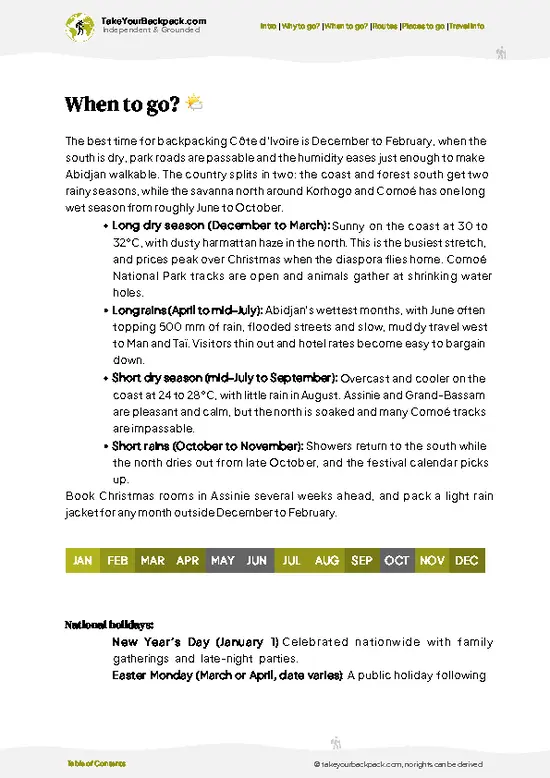
The long dry spell from December to March gives the easiest sightseeing, though the Harmattan haze can dull skies and dust the air.
  • Main Dry Season (December to March): Temperatures sit around 24 to 32°C (75 to 90°F), humid but manageable. Beaches and lagoon boats are at their best, and hostel prices and flights peak around Christmas.
  • Long Rains (April to July): Downpours flood streets, especially in June, and traffic crawls. Highs reach 30°C (86°F) with heavy humidity. Rooms are cheaper and crowds thin.
  • Short Dry Spell (August to September): A brief lull with cloudier, cooler days around 25 to 28°C (77 to 82°F). It suits city walking and day trips.
  • Short Rains (October to November): Storms return but are lighter, with around 12 hours of daylight all year.
  • Events: The Abidjan jazz and music festivals and the Grand-Bassam Fête de l’Abissa in autumn bring crowds.
Book beds early for December, or visit in September for easy rates and open roads.


source: climatestotravel.comJANJanuary: highly recommended for travelingFEBFebruary: highly recommended for travelingMARMarch: highly recommended for travelingAPRApril: fair for travelingMAYMay: fair for travelingJUNJune: fair for travelingJULJuly: fair for travelingAUGAugust: good for travelingSEPSeptember: good for travelingOCTOctober: good for travelingNOVNovember: highly recommended for travelingDECDecember: highly recommended for traveling
when-to-go

✈️ The backpacker research shortcutCôte d’Ivoire Travel Guide

An offline-friendly backpacking guide with optimized travel routes, ranked highlights, transport advice, and the best areas to stay.
example page 0 from our offline Travel Guide for Côte d’Ivoire
example page 1 from our offline Travel Guide for Côte d’Ivoire
example page 2 from our offline Travel Guide for Côte d’Ivoire
example page 3 from our offline Travel Guide for Côte d’Ivoire
example page 4 from our offline Travel Guide for Côte d’Ivoire
example page 5 from our offline Travel Guide for Côte d’Ivoire
example page 6 from our offline Travel Guide for Côte d’Ivoire
example page 7 from our offline Travel Guide for Côte d’Ivoire
The digital guide (279 pages) contains:
✅ 64 highlights, ranked by travel appeal
✅ Optimized 5, 10 & 15-day travel routes
✅ Cities, national parks, landmarks, beaches
✅ How to get around
✅ Offline-friendly for travel without Wi-Fi
👉 Click to see all 30+ guide features

📅 Plan smarter in minutes, not weeks
✅ Month by month travel advice
✅ Festivals & national holidays
✅ Budget expectations

🗺️ Go to the right places, skip the overrated ones
✅ Honest pros & cons of destinations
✅ Top hikes, parks & viewpoints
✅ Lesser-known places most travelers miss
✅ Clear “worth it vs skip it” guidance

🛏️ Travel smoothly without rookie mistakes
✅ Best areas to stay
✅ Transport systems explained simply
✅ Common scams & safety advice
✅ SIM cards, money & practical tips

🌍 Understand the country, not just visit it
✅ Culture & traditions
✅ 52 Essential phrases & customs
✅ Festivals worth planning around
✅ Traveler-friendly historical context
✅ Insights that make places more meaningful

📱 Built for real travel conditions
✅ Fully downloadable PDF
✅ Works completely offline
✅ Optimized for phone use
✅ Useful in remote areas & buses
✅ Everything in one place
Stop searching, start planning
Get instant access to your full guide. 30‑day money-back guarantee.
+ Add another guide for just

By proceeding you agree to our terms.
Sent to your inbox immediately after payment • 100% Secure Checkout
Best Backpacking Travel Advisor 2025 tourism awardBest Backpacking
Travel Advisor
2025
What others say about Take Your Backpack Guides:
⭐⭐⭐⭐⭐
Fantastic, amazing amount of information!
⭐⭐⭐⭐⭐
My goodness this is amazing, it's what I've been looking for hats off too you!
⭐⭐⭐⭐⭐
I think this is absolutely BRILLIANT
⭐⭐⭐⭐
Very complete and informative. It's still missing places, but I gotta to commend you
⭐⭐⭐⭐⭐
This is truly amazing, thank you, can't wait to explore it with my kids!
⭐⭐⭐⭐⭐
Awesome resource, thank you!
⭐⭐⭐⭐⭐
This is amazing! Can't wait to explore the ones I haven't seen
⭐⭐⭐⭐
I love this! Well done, great idea.
⭐⭐⭐⭐⭐
Thanks for taking the time to make this gem!
⭐⭐⭐⭐⭐
This might be the best website I've ever seen.
⭐⭐⭐⭐⭐
Congratulations, and thank you so much for your work; it's incredibly valuable.
⭐⭐⭐⭐
In all seriousness I think you did a great job pointing out the important spots
⭐⭐⭐⭐⭐
10/10 very good
⭐⭐⭐⭐⭐
As someone who's only just starting to visit regularly this is awesome, thank you.
⭐⭐⭐⭐
Thank you very much! I'm going to visit my dad, it's going to be very useful!
⭐⭐⭐⭐⭐
This is really cool! We'll be travelling for the first time and this definitely come in handy.
⭐⭐⭐⭐⭐
You are now our minister of culture, congratulations 👨‍💼
⭐⭐⭐⭐⭐
Just wanted to tell you that this is a pearl! Going to follow your recommendations.
⭐⭐⭐⭐⭐
This is so cool. I'll definitely be using the resource for my travels soon.
⭐⭐⭐⭐⭐
This is very impressive! Good work.
⭐⭐⭐⭐⭐
This is an amazing and informative site. Very well done!

🛏️ Where to stay?Best areas and accommodation options

Marcory (Zone 4) and Cocody are the best bases for a budget bed in Abidjan, with dorms and guesthouses mostly in the €10 to 25 range. Hostel options are limited in a city this size, so book ahead in December and January.
Marcory is the practical choice. Restaurants and bars sit within walking distance, so you can get dinner and a beer without paying for a taxi, and the streets stay lively into the evening. Night noise from bars and generators is normal, so pack earplugs. Taxis and woro-woro to Plateau and Treichville are quick and cheap outside rush hour.
Cocody, especially around Riviera and Deux … read more 👉
Marcory (Zone 4) and Cocody are the best bases for a budget bed in Abidjan, with dorms and guesthouses mostly in the €10 to 25 range. Hostel options are limited in a city this size, so book ahead in December and January.
Marcory is the practical choice. Restaurants and bars sit within walking distance, so you can get dinner and a beer without paying for a taxi, and the streets stay lively into the evening. Night noise from bars and generators is normal, so pack earplugs. Taxis and woro-woro to Plateau and Treichville are quick and cheap outside rush hour.
Cocody, especially around Riviera and Deux Plateaux, is calmer, greener and better for sleeping, with safer-feeling streets after dark and plenty of app taxis. Rooms cost a little more and there is less to walk to, so you will use rides more.
Plateau has few budget beds and empties after office hours, while Yopougon is too far out for a short visit. For a first stay, pick Marcory for convenience and Cocody for quiet. Both give easy road links to the airport and the long-distance bus stations.

🚌 Getting aroundGetting around like a local

Abidjan’s center, Plateau, can be walked in an hour or two, but beyond it distances, heat and lagoon bridges make walking pointless. Traffic jams build on the Houphouët-Boigny and De Gaulle bridges at rush hour, and the air smells of exhaust and frying oil. Most backpackers combine taxis with the occasional ferry, while public buses are crowded and slow.
  • Walking: Free, and good in Plateau, Zone 4 and central Treichville. Pavements are broken and shade is rare, so go early or after the afternoon heat.
  • Woro-woro: Shared taxis, color-coded by district (usually orange for Treichville and Marcory routes, other colors for other areas), cost about €0.30 to 0.80 per ride on fixed routes. They are the cheapest option and fast, but you squeeze in with three or four others and need to know the route.
  • Metered
… read more 👉
Abidjan’s center, Plateau, can be walked in an hour or two, but beyond it distances, heat and lagoon bridges make walking pointless. Traffic jams build on the Houphouët-Boigny and De Gaulle bridges at rush hour, and the air smells of exhaust and frying oil. Most backpackers combine taxis with the occasional ferry, while public buses are crowded and slow.
  • Walking: Free, and good in Plateau, Zone 4 and central Treichville. Pavements are broken and shade is rare, so go early or after the afternoon heat.
  • Woro-woro: Shared taxis, color-coded by district (usually orange for Treichville and Marcory routes, other colors for other areas), cost about €0.30 to 0.80 per ride on fixed routes. They are the cheapest option and fast, but you squeeze in with three or four others and need to know the route.
  • Metered and app taxis: Yango and Heetch rides across the city cost about €2 to 7 depending on distance and traffic, with fares agreed in advance on the app. Comfort and air conditioning make this the best option for most backpackers, particularly at night. Rides to the airport run about €10 to 15.
  • SOTRA buses: Big green city buses cost about €0.25 to 0.50 a ride and run from about 5 am to 9 pm. They are crowded and slow, but cheap for long hauls such as Yopougon.
  • Lagoon ferries (bateaux-bus): SOTRA boats cross between Plateau, Treichville, Cocody and Yopougon for about €0.50 to 1. The breeze, light on the water and the smell of brackish lagoon make it the best commute, and it avoids the jams.
My pick is woro-woro for short daytime hops and an app taxi after dark. Use the ferry once for the view.

👛 Costs (as of 22 October 2026)Travel costs and budget guide for Abidjan

Abidjan costs about €48 a day for a backpacker who sleeps in a dorm, eats at local maquis and uses shared taxis, and it is pricier than most of West Africa. Travelers pay in CFA francs, though prices below are in euros.
CategoryBudget RangeLocal Reality
Dorm accommodation (high season)€15 to 20Beds are few, so book early from December to March.
Dorm accommodation (off-season)€10 to 15Rains bring discounts and easier availability.
Meals€8 to 12Maquis plates cost €2 to 5, and street snacks are cheaper.
Local transport€4 to 8Woro-woro and occasional app taxis.
City transport pass€0No pass exists, so pay per ride on buses and ferries.
Basic activities/entry fees€5 to 10Museums and parks cost a few euros, and Banco needs a guide.
Miscellaneous€3 to 5Water, SIM data, beer and tips.
Total Daily Budget€48Roughly
… read more 👉
Abidjan costs about €48 a day for a backpacker who sleeps in a dorm, eats at local maquis and uses shared taxis, and it is pricier than most of West Africa. Travelers pay in CFA francs, though prices below are in euros.
CategoryBudget RangeLocal Reality
Dorm accommodation (high season)€15 to 20Beds are few, so book early from December to March.
Dorm accommodation (off-season)€10 to 15Rains bring discounts and easier availability.
Meals€8 to 12Maquis plates cost €2 to 5, and street snacks are cheaper.
Local transport€4 to 8Woro-woro and occasional app taxis.
City transport pass€0No pass exists, so pay per ride on buses and ferries.
Basic activities/entry fees€5 to 10Museums and parks cost a few euros, and Banco needs a guide.
Miscellaneous€3 to 5Water, SIM data, beer and tips.
Total Daily Budget€48Roughly €35 off-season with careful spending.
Eat where locals queue at lunchtime and take woro-woro instead of private taxis, which can halve your daily transport bill.


source: cotedivoiretourisme.ci
⚠️ Prices can change and everyone travels differently, so take this as a rough guide. Hope it helps you plan your adventure!

🚌 Day tripsWhere to go beyond the main area

Abidjan works well as a base because the coast, lagoon and forest all sit within a few hours by shared taxi or minibus, and you sleep in the same bed each night.Grand-Bassam: The old colonial capital and UNESCO site is about 45 minutes to an hour east. Crumbling French-era villas, a quiet beach and a small museum make it the classic outing. Shared taxis from Marcory or Treichville cost about €1.50 to 3, and a full day with lunch is about €15 to 25. Go on a weekday to dodge Sunday crowds and avoid swimming where the surf is strong, as the currents are dangerous.
👉 Explore Grand-BassamAssinie-Mafia: A sandbar between lagoon and ocean, about 1.5 to 2 hours east. Beach shacks serve grilled fish with the sea at your feet, and lagoon boat rides are possible. Expect €20 to 40 for transport, lunch … read more 👉
Abidjan works well as a base because the coast, lagoon and forest all sit within a few hours by shared taxi or minibus, and you sleep in the same bed each night.Grand-Bassam: The old colonial capital and UNESCO site is about 45 minutes to an hour east. Crumbling French-era villas, a quiet beach and a small museum make it the classic outing. Shared taxis from Marcory or Treichville cost about €1.50 to 3, and a full day with lunch is about €15 to 25. Go on a weekday to dodge Sunday crowds and avoid swimming where the surf is strong, as the currents are dangerous.
👉 Explore Grand-BassamAssinie-Mafia: A sandbar between lagoon and ocean, about 1.5 to 2 hours east. Beach shacks serve grilled fish with the sea at your feet, and lagoon boat rides are possible. Expect €20 to 40 for transport, lunch and a boat. December to March is best. First-timers often arrive late and leave in a rush, so start early.
👉 Explore Assinie-MafiaJacqueville: Cross the lagoon by ferry, about 1.5 hours total, to a fishing town with quiet sand and palm groves. The ferry itself is cheap, around €1 to 2, and a day costs about €10 to 20. It is calm and less crowded than the eastern beaches. Weekdays are best, as weekends fill with locals.
Banco National Park: A rainforest reserve inside the city’s north edge, about 30 to 45 minutes from the center. Giant trees, shaded trails and humid green air offer relief from the traffic. Entry and a guide run about €5 to 10. Wear closed shoes and go in the dry months when paths are firmer.
👉 Explore Banco National Park

🍲 FoodLocal Cuisine & Drinks

Abidjan is where Ivorian cooking gets loud and smoky, and the city’s signature is poisson braisé, whole tilapia or carp grilled over charcoal and served with onion, tomato and chili. It comes with attiéké, grated fermented cassava with a sour tang, and the lagoon-side version is the one to try. Alloco, fried ripe plantain with spicy sauce, is the classic street snack, often sold from roadside pans at dusk. Look also for kédjenou, slow-cooked chicken stewed in a sealed pot.
Most backpackers eat in a maquis, an open-air local restaurant with plastic chairs, a grill smoking at the door and music loud enough to compete with traffic. Treichville and Marcory’s Zone 4 are the best areas for these, and a plate typically costs about €2 to 5. Markets such as Treichville’s sell fresh fruit, smoked fish … read more 👉
Abidjan is where Ivorian cooking gets loud and smoky, and the city’s signature is poisson braisé, whole tilapia or carp grilled over charcoal and served with onion, tomato and chili. It comes with attiéké, grated fermented cassava with a sour tang, and the lagoon-side version is the one to try. Alloco, fried ripe plantain with spicy sauce, is the classic street snack, often sold from roadside pans at dusk. Look also for kédjenou, slow-cooked chicken stewed in a sealed pot.
Most backpackers eat in a maquis, an open-air local restaurant with plastic chairs, a grill smoking at the door and music loud enough to compete with traffic. Treichville and Marcory’s Zone 4 are the best areas for these, and a plate typically costs about €2 to 5. Markets such as Treichville’s sell fresh fruit, smoked fish and spices, and street stalls offer grilled brochettes late into the night.
To drink, order a cold Flag or Bock beer, or bissap, a tart hibiscus juice, and gnamankoudji, a ginger drink that is sharp and cold. Beer is about €1 to 2 in maquis. Sharing a table is normal and conversation comes easily.

🛡️ SafetyTraveler Safety Guide

Abidjan is a big, busy West African city where most problems are petty theft, and sensible habits keep trouble away. Phone snatching from taxi windows and bags lifted in crowded markets, especially Treichville and Adjamé, are the usual losses, so keep your phone out of sight and carry a small bag in front. Traffic stops are common, and police checkpoints can ask for ID, so carry a photocopy of your passport and stay polite. Avoid walking at night in Plateau, which empties after work, and take app taxis instead of hailing a street cab. Solo travelers, women included, do fine with this approach, though catcalls and persistent sellers happen. Agree prices before any ride or purchase, and withdraw cash from ATMs inside banks or malls. Ask your accommodation about any demonstrations or tension, since political events can close roads briefly.

FAQTraveler FAQ

Three days is enough for Abidjan, with one day for Plateau and Treichville, one for Cocody and the Banco forest, and one for lagoon or beach time. Add a fourth day for a trip to Grand-Bassam, about an hour east by shared taxi for roughly €1.50 to 3. If you like nightlife, an extra evening in Marcory or Yopougon is easy to fill.
Abidjan is manageable for solo backpackers who use common sense, though petty theft and phone snatching are the main risks. Use app taxis such as Yango after dark (about €2 to 7 across town), avoid walking empty Plateau streets at night and keep valuables out of sight in crowded Treichville. Solo women also travel here, and staying in Marcory or Cocody makes evenings easier.
Abidjan is known for its skyline of towers around Plateau, its lagoon setting and its nightlife of maquis and coupé-décalé music in Treichville, Marcory and Yopougon. It is West Africa’s big French-speaking business hub, and food such as poisson braisé with attiéké costs about €2 to 5 a plate. The colonial town of Grand-Bassam, an hour away, is the most popular escape.
⚠️ Things can change over time, so always validate details locally before you go.

Other Ivorian cities near Abidjan

Explore more nearby:

  • Adzopé—forest edge, local markets, transport crossroads| 89 km away
  • Aboisso—river port, colonial relics, cocoa plantations| 92 km away
  • Tiassalé—Bandama River, colonial bridge, fishing communities| 109 km away

💡 Not sure where to go next?
Create a personalized itinerary for Côte d’Ivoire including Abidjan and the places that fit your trip.

Generate my itinerary

👉 Discover all cities

Or checkout all Côte d’Ivoire has to offer (think cities, towns, villages, national parks, hikes, beaches, festivals)
Country photo of Côte d’Ivoire

We 💚 feedbackParting advice and final tips

Abidjan deserves three nights: one to adjust to the heat and traffic, one for markets and lagoon life, and one for music that runs past midnight. Stay longer only if you need onward visas or want the beaches nearby. I would book a place in Marcory or Cocody, carry small cash for taxis, and skip anything that needs a tight schedule.

✍️ Help improve this page!
The information on this page is based on in-depth research, insights shared by experienced travelers, and feedback from the local travel community in Côte d’Ivoire. While every effort is made to keep the information accurate and current, conditions can change — so if you spot anything incorrect or outdated, please get in touch.


🙋‍♂️ Give feedback

👋 Meet the founderWho’s Behind Take Your Backpack?

Johan, backpacker and founder of TakeYourBackpackHi, I’m Johan (Netherlands 🇳🇱), the creator of TakeYourBackpack. Over the past 3 decades, I’ve backpacked through 90+ countries across six continents, gaining extensive experience with independent travel, long-term trips, and overland routes.

This site is built on a combination of firsthand travel experience and carefully curated insights from other backpackers. Many guides are based on places I’ve personally visited, while others bring together tips, observations, and practical advice shared by trusted travelers I’ve met along the way.

The goal is to provide realistic, experience-driven guidance — not generic itineraries — so you can explore destinations with better context, clearer expectations, and more confidence.