×

Cuba🇨🇺 | beachesGuardalavacaPublic crescent, near-shore coral, Taíno burial museum, paladar lobster | things to do and best time to go

Explore Cayo SaetíaExplore Jibacoa

Backpacking in Guardalavaca
🏆 Top pickbeach ranked #6
By Johan Kruseman 🇳🇱 | Updated October 20, 2026

The sand squeaks under my sandals, fine and pale, and a few steps later I am standing in water so clear I can count my toes. I expected a resort wall to block the shore. Instead the beach is open, with locals selling grilled lobster plates from simple shacks. Guardalavaca beach sits on the north coast of Cuba, in Holguín province. The sea is calm and shallow, the reef lies close for easy snorkeling, and the sand is kept clean. Skip the all-inclusive strip if you are on a tight budget, since the hotels charge heavily for what the casas particulares in the village do better. Surf is minimal and nightlife is thin. Getting here from Holguín takes effort, but the payoff is easy beach days. Budget food comes from paladares and beach stands, and the last thing I notice each evening is the smell of charcoal smoke drifting over the shore.

Discover everything you want to know in the 📖 Cuba Travel Guide.


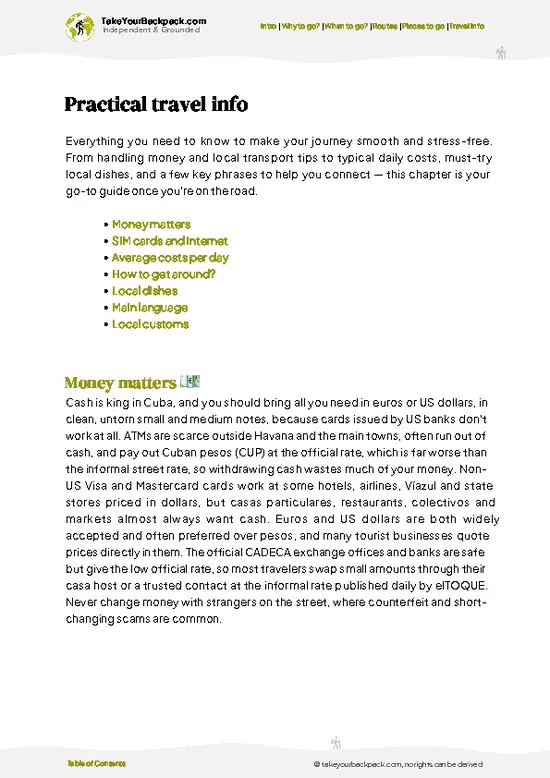
example page 0 from our offline Travel Guide for Cuba
example page 1 from our offline Travel Guide for Cuba
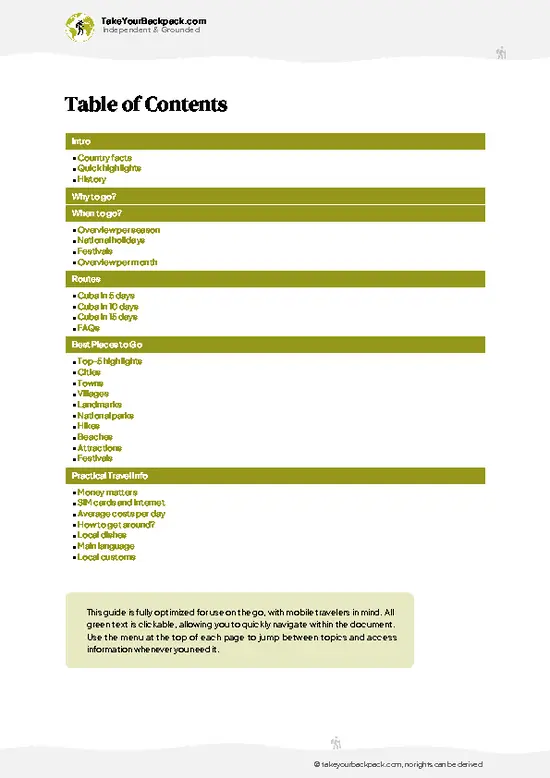
example page 2 from our offline Travel Guide for Cuba
example page 3 from our offline Travel Guide for Cuba
example page 4 from our offline Travel Guide for Cuba
example page 5 from our offline Travel Guide for Cuba
example page 6 from our offline Travel Guide for Cuba
example page 7 from our offline Travel Guide for Cuba
Loading the map 🌍
CLICK TO FILTER
cities
towns
villages
landmarks
national parks
hikes
beaches
attractions
festivals
SHOW COUNTRY’S BESTSHOW ALL

✨ Why go?
Ranked #6 beach in Cuba
What sets this place apart

Guardalavaca beach works for backpackers because it is one of the few places on Cuba’s north coast where you can sleep in a family-run casa particular and still walk to white sand in minutes. Most of the resort-heavy coast pushes independent travelers out, so that matters. The water is shallow and calm, and the reef a short swim from shore gives you real snorkeling without booking a boat. Gear can be rented on the beach.
The second draw is the social side. Because the village is small, you meet other travelers over beach-shack lunches and at the casas, and Cubans from Holguín crowd the sand on weekends, which adds music and conversation you will not get inside a hotel fence.
The third reason is the Chorro de Maíta burial site a short ride inland, which turns a pure beach stop into a pause with … read more 👉
Guardalavaca beach works for backpackers because it is one of the few places on Cuba’s north coast where you can sleep in a family-run casa particular and still walk to white sand in minutes. Most of the resort-heavy coast pushes independent travelers out, so that matters. The water is shallow and calm, and the reef a short swim from shore gives you real snorkeling without booking a boat. Gear can be rented on the beach.
The second draw is the social side. Because the village is small, you meet other travelers over beach-shack lunches and at the casas, and Cubans from Holguín crowd the sand on weekends, which adds music and conversation you will not get inside a hotel fence.
The third reason is the Chorro de Maíta burial site a short ride inland, which turns a pure beach stop into a pause with history. Guardalavaca beach also makes a sensible break between Holguín and the long road toward Baracoa or Santiago de Cuba.

💡 HighlightsTop highlights of Guardalavaca

  1. Playa Guardalavaca itself: The main crescent of pale sand is shallow and calm, with clear water that suits slow swimming. The public stretch stays open to everyone, so you can walk in without a hotel wristband.
  2. Snorkeling the near-shore reef: Coral heads and small reef fish sit just off the beach, within a short swim in calm conditions. Local operators rent masks and fins, which saves hauling your own.
  3. Chorro de Maíta archaeological museum: A pre-Columbian Taíno burial ground with skeletons preserved where they were found, and a reconstructed village beside it. Entry is a few dollars, and the visit takes about an hour.
  4. Playa Esmeralda: A nearby beach with a slightly wilder feel, backed by greenery and good for a quieter swim. Come in the morning before the tour groups arrive.
  5. Beach lobster and
… read more 👉
  1. Playa Guardalavaca itself: The main crescent of pale sand is shallow and calm, with clear water that suits slow swimming. The public stretch stays open to everyone, so you can walk in without a hotel wristband.
  2. Snorkeling the near-shore reef: Coral heads and small reef fish sit just off the beach, within a short swim in calm conditions. Local operators rent masks and fins, which saves hauling your own.
  3. Chorro de Maíta archaeological museum: A pre-Columbian Taíno burial ground with skeletons preserved where they were found, and a reconstructed village beside it. Entry is a few dollars, and the visit takes about an hour.
  4. Playa Esmeralda: A nearby beach with a slightly wilder feel, backed by greenery and good for a quieter swim. Come in the morning before the tour groups arrive.
  5. Beach lobster and fish lunch: Open-air stands and paladares near the sand grill the day’s catch over charcoal. Eating here lets you taste local cooking at prices well under hotel restaurants.
All of it fits comfortably into two days, with an afternoon each for the museum and the beaches.
Spotted a mistake or missing something? Contact us.

🌤️ When to go?Weather, crowds, and seasonal trade-offs

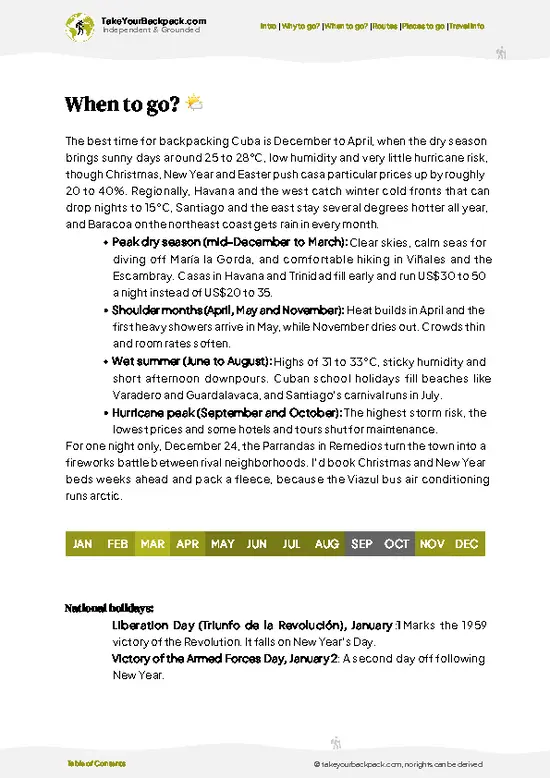
  • Dry Season (November to April): Guardalavaca gets its most reliable beach weather now, with highs of 27 to 30°C (81 to 86°F), cooler nights of 18 to 22°C (64 to 72°F), little rain and roughly 11 to 13 hours of daylight. Calm, clear water suits swimming and snorkeling over the offshore reef.
  • Peak Weeks (December to February, Easter): Canadian and European package groups fill the resorts, and casa particular rates rise by about US$5 to 15 a night. Book ahead.
  • Wet Season (May to October): Expect 30 to 33°C (86 to 91°F), high humidity and afternoon downpours that pass in an hour or two. Rooms are cheaper and the sand is emptier.
  • Hurricane Risk (August to October): Storms are most likely in September and October, and rough seas can close the water for days. Travel insurance is wise.
Late April and … read more 👉
  • Dry Season (November to April): Guardalavaca gets its most reliable beach weather now, with highs of 27 to 30°C (81 to 86°F), cooler nights of 18 to 22°C (64 to 72°F), little rain and roughly 11 to 13 hours of daylight. Calm, clear water suits swimming and snorkeling over the offshore reef.
  • Peak Weeks (December to February, Easter): Canadian and European package groups fill the resorts, and casa particular rates rise by about US$5 to 15 a night. Book ahead.
  • Wet Season (May to October): Expect 30 to 33°C (86 to 91°F), high humidity and afternoon downpours that pass in an hour or two. Rooms are cheaper and the sand is emptier.
  • Hurricane Risk (August to October): Storms are most likely in September and October, and rough seas can close the water for days. Travel insurance is wise.
Late April and early November give you dry skies, thin crowds and softer prices.


source: climatestotravel.comJANJanuary: excellent for travelingFEBFebruary: excellent for travelingMARMarch: excellent for travelingAPRApril: highly recommended for travelingMAYMay: highly recommended for travelingJUNJune: fair for travelingJULJuly: fair for travelingAUGAugust: fair for travelingSEPSeptember: below average for travelingOCTOctober: highly recommended for travelingNOVNovember: highly recommended for travelingDECDecember: excellent for traveling
cuba-beach-guardalavaca
© Google | Rafael Richtscheid

✈️ The backpacker research shortcutCuba Travel Guide

An offline-friendly backpacking guide with optimized travel routes, ranked highlights, transport advice, and the best areas to stay.
example page 0 from our offline Travel Guide for Cuba
example page 1 from our offline Travel Guide for Cuba
example page 2 from our offline Travel Guide for Cuba
example page 3 from our offline Travel Guide for Cuba
example page 4 from our offline Travel Guide for Cuba
example page 5 from our offline Travel Guide for Cuba
example page 6 from our offline Travel Guide for Cuba
example page 7 from our offline Travel Guide for Cuba
The digital guide (327 pages) contains:
✅ 113 highlights, ranked by travel appeal
✅ Optimized 5, 10 & 15-day travel routes
✅ Cities, national parks, landmarks, beaches
✅ How to get around
✅ Offline-friendly for travel without Wi-Fi
👉 Click to see all 30+ guide features

📅 Plan smarter in minutes, not weeks
✅ Month by month travel advice
✅ Festivals & national holidays
✅ Budget expectations

🗺️ Go to the right places, skip the overrated ones
✅ Honest pros & cons of destinations
✅ Top hikes, parks & viewpoints
✅ Lesser-known places most travelers miss
✅ Clear “worth it vs skip it” guidance

🛏️ Travel smoothly without rookie mistakes
✅ Best areas to stay
✅ Transport systems explained simply
✅ Common scams & safety advice
✅ SIM cards, money & practical tips

🌍 Understand the country, not just visit it
✅ Culture & traditions
✅ 52 Essential phrases & customs
✅ Festivals worth planning around
✅ Traveler-friendly historical context
✅ Insights that make places more meaningful

📱 Built for real travel conditions
✅ Fully downloadable PDF
✅ Works completely offline
✅ Optimized for phone use
✅ Useful in remote areas & buses
✅ Everything in one place
Stop searching, start planning
Get instant access to your full guide. 30‑day money-back guarantee.
+ Add another guide for just

By proceeding you agree to our terms.
Sent to your inbox immediately after payment • 100% Secure Checkout
Best Backpacking Travel Advisor 2025 tourism awardBest Backpacking
Travel Advisor
2025
What others say about Take Your Backpack Guides:
⭐⭐⭐⭐⭐
Fantastic, amazing amount of information!
⭐⭐⭐⭐⭐
My goodness this is amazing, it's what I've been looking for hats off too you!
⭐⭐⭐⭐⭐
I think this is absolutely BRILLIANT
⭐⭐⭐⭐
Very complete and informative. It's still missing places, but I gotta to commend you
⭐⭐⭐⭐⭐
This is truly amazing, thank you, can't wait to explore it with my kids!
⭐⭐⭐⭐⭐
Awesome resource, thank you!
⭐⭐⭐⭐⭐
This is amazing! Can't wait to explore the ones I haven't seen
⭐⭐⭐⭐
I love this! Well done, great idea.
⭐⭐⭐⭐⭐
Thanks for taking the time to make this gem!
⭐⭐⭐⭐⭐
This might be the best website I've ever seen.
⭐⭐⭐⭐⭐
Congratulations, and thank you so much for your work; it's incredibly valuable.
⭐⭐⭐⭐
In all seriousness I think you did a great job pointing out the important spots
⭐⭐⭐⭐⭐
10/10 very good
⭐⭐⭐⭐⭐
As someone who's only just starting to visit regularly this is awesome, thank you.
⭐⭐⭐⭐
Thank you very much! I'm going to visit my dad, it's going to be very useful!
⭐⭐⭐⭐⭐
This is really cool! We'll be travelling for the first time and this definitely come in handy.
⭐⭐⭐⭐⭐
You are now our minister of culture, congratulations 👨‍💼
⭐⭐⭐⭐⭐
Just wanted to tell you that this is a pearl! Going to follow your recommendations.
⭐⭐⭐⭐⭐
This is so cool. I'll definitely be using the resource for my travels soon.
⭐⭐⭐⭐⭐
This is very impressive! Good work.
⭐⭐⭐⭐⭐
This is an amazing and informative site. Very well done!

🛏️ Where to stay?How to pick the right area

The village of Guardalavaca, a short walk from the sand, is the best base for backpackers, because casas particulares sit within a few blocks of the main beach and cost roughly US$25 to 40 a night for a double. Staying with a host gives you the social side: breakfast tables, home-cooked dinners for US$8 to 12, and tips on which buses and shared taxis to catch. Most rooms are on quiet residential streets, so noise is rarely a problem and the walk back after dark is short and well used by locals.
For more space and fewer tourists, look at Playa Esmeralda, a few kilometers west. It is mostly large … read more 👉
The village of Guardalavaca, a short walk from the sand, is the best base for backpackers, because casas particulares sit within a few blocks of the main beach and cost roughly US$25 to 40 a night for a double. Staying with a host gives you the social side: breakfast tables, home-cooked dinners for US$8 to 12, and tips on which buses and shared taxis to catch. Most rooms are on quiet residential streets, so noise is rarely a problem and the walk back after dark is short and well used by locals.
For more space and fewer tourists, look at Playa Esmeralda, a few kilometers west. It is mostly large all-inclusive resorts, so independent rooms are scarce, and it works better as a day trip than a base.
Banes, about 45 minutes inland, is the other option. It has the cheapest casas, from about US$20 a night, plus a real Cuban town with a good museum, but you will need a taxi or bus each day to reach the coast. Solo travelers who want other backpackers around usually find them in Guardalavaca, since Banes sees far fewer foreigners.

🛡️ SafetyStaying Safe: What Travelers Should Know

Guardalavaca beach is one of the calmer, easier places to swim in eastern Cuba. A reef offshore breaks most of the swell, so the water is usually shallow, clear and gentle, with no meaningful rips on typical days. Conditions change after storms or strong northerly winds, when waves build and red flags go up at the resort sections. Follow them, and swim where other people are in the water.
Sea urchins live on the rocky patches and reef edges, so reef shoes are worth packing for snorkeling. Jellyfish are uncommon.
The Caribbean sun is strong here from late morning, so cover up between 11 and 3 and bring reef-safe sunscreen, since shade is limited on the sand. Petty theft is occasional. Keep your phone and cash with you rather than on a towel, and ignore persistent touts offering taxis or cigars.

FAQTraveler FAQ

Most backpackers reach Guardalavaca beach from Holguín, about 55 km away, by taxi (US$35 to 50 per car, around 1 hour) or on a Viazul or local bus when running. From Havana, Viazul serves Holguín in roughly 12 to 14 hours, and Holguín’s Frank País airport is the closest to the coast. Banes, about 30 km inland, is a cheaper starting point for shared taxis.
Guardalavaca beach is good for swimming and decent for snorkeling, but not for surfing. An offshore reef calms the water and keeps it shallow, which suits families and nervous swimmers, while waves rarely get big enough to ride. Snorkeling trips to the reef and nearby dive sites cost about US$25 to 40, and gear is often available on the sand. Visibility is best from November to April.
Yes, Guardalavaca beach is free to visit, and the public stretch by the village needs no ticket. Resort sections have their own areas, but you can walk through and use the sand. Sunbeds and umbrellas cost roughly US$3 to 5, and day passes to resorts, including food and drinks, run about US$40 to 70. Nearby sites such as the Chorro de Maíta museum charge a small entry fee of a few dollars.
⚠️ Things can change over time, so always validate details locally before you go.

Other Cuban beaches near Guardalavaca

Explore more nearby:

  • Playa Esmeralda—Emerald shallows, raked sand, sunset shore| 5 km away
  • Playa Yuraguanal—Resort-backed arc, sea grape shade, nearshore reef, Holguín coast| 7 km away
  • Playa Pesquero—Resort-lined shore, day passes, near-shore coral, village-side grills| 11 km away

💡 Not sure where to go next?
Create a personalized itinerary for Cuba including Guardalavaca and the places that fit your trip.

Generate my itinerary

👉 Discover all beaches

Or checkout all Cuba has to offer (think cities, towns, villages, national parks, hikes, beaches, festivals)
Country photo of Cuba

We 💚 feedbackKey takeaways before you go

Guardalavaca beach trips go wrong when travelers book a resort package and never leave the fence. I would sleep in a casa in the village instead, rent a mask for the reef, and take one morning to reach Chorro de Maíta before the heat builds.

✈️ When did I visit Cuba?
As part of my 1.5 year travel around the world trip, I visited Cuba for 6 weeks in February, March 2016, being extremely lucky that that coincided with the free concert of The Rolling Stones.

✍️ Help improve this page!
The information on this page is based on my own backpacking experience in Cuba, supplemented with up-to-date research and feedback from other travelers. Travel details can change, so if you notice anything outdated or incomplete, feel free to let me know.


🙋‍♂️ Give feedback

👋 Meet the founderWho’s Behind Take Your Backpack?

Johan, backpacker and founder of TakeYourBackpackHi, I’m Johan (Netherlands 🇳🇱), the creator of TakeYourBackpack. Over the past 3 decades, I’ve backpacked through 90+ countries across six continents, gaining extensive experience with independent travel, long-term trips, and overland routes.

This site is built on a combination of firsthand travel experience and carefully curated insights from other backpackers. Many guides are based on places I’ve personally visited, while others bring together tips, observations, and practical advice shared by trusted travelers I’ve met along the way.

The goal is to provide realistic, experience-driven guidance — not generic itineraries — so you can explore destinations with better context, clearer expectations, and more confidence.