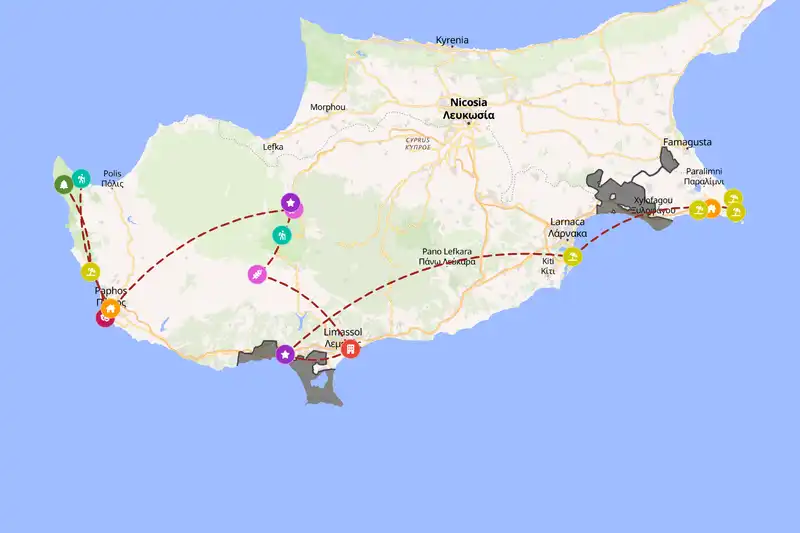
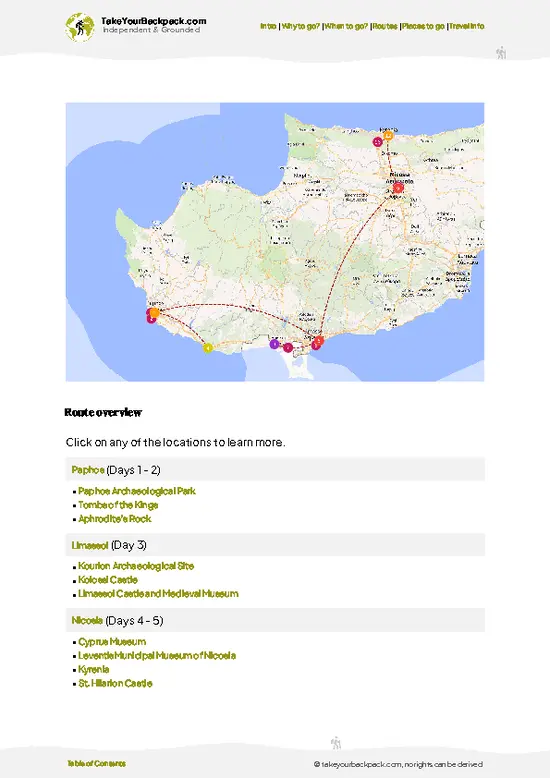
This five-day loop through Cyprus suits first-timers who want the island’s big names (Roman mosaics, a crusader-era castle, a divided capital and a harbor town in the north) without renting a car. The pace is steady but unhurried, with one move every day or two, and everything runs on intercity buses, local town buses, one shared minibus across the Green Line and a single short taxi ride.
Days 1-2: Paphos
Start in
Paphos, because its ancient sites sit within walking distance of the harbor and set the historical baseline for everything that follows. Give your first morning to the
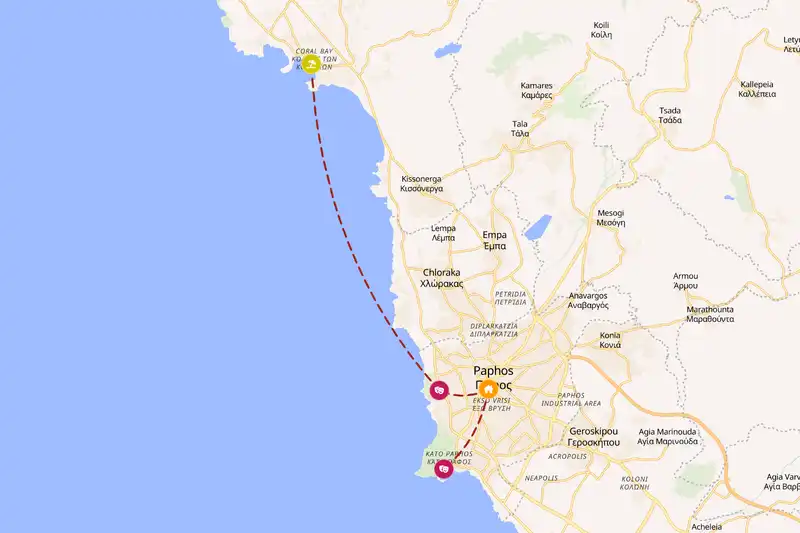
Paphos Archaeological Park, where the floor mosaics in the House of Dionysos still show grape harvests and drunken gods in tiny stone cubes. Go early, as there is almost no shade. In the afternoon, take a local bus or walk the seafront 2 km north to the
Tombs of the Kings, underground chambers cut into sandstone and lined with Doric columns, with no actual kings buried there.
On day two, catch the bus from Paphos …
read more 👉This five-day loop through Cyprus suits first-timers who want the island’s big names (Roman mosaics, a crusader-era castle, a divided capital and a harbor town in the north) without renting a car. The pace is steady but unhurried, with one move every day or two, and everything runs on intercity buses, local town buses, one shared minibus across the Green Line and a single short taxi ride.
Days 1-2: Paphos
Start in Paphos, because its ancient sites sit within walking distance of the harbor and set the historical baseline for everything that follows. Give your first morning to the Paphos Archaeological Park, where the floor mosaics in the House of Dionysos still show grape harvests and drunken gods in tiny stone cubes. Go early, as there is almost no shade. In the afternoon, take a local bus or walk the seafront 2 km north to the Tombs of the Kings, underground chambers cut into sandstone and lined with Doric columns, with no actual kings buried there.
On day two, catch the bus from Paphos harbor east along the coast to Aphrodite’s Rock, the sea stack where the goddess is said to have come ashore. Departures are limited to a few a day, so check the timetable the evening before. The pebbles are hard on bare feet but the water is clear, and a swim here before the ride back fills a slow, easy day.Day 3: Limassol, Kourion and Kolossi
The intercity bus to Limassol takes about an hour and costs €4 to 5. Drop your bag and head straight back out west on a local bus to the Kourion Archaeological Site, a Greco-Roman city on a cliff whose theater faces straight out over the sea. On the way back, stop at Kolossi Castle, a square 15th-century keep once run by the Knights Hospitaller, where sugar was refined from local cane. End the day in Limassol’s old town at the Limassol Castle and Medieval Museum, then eat in the lanes around it, where tavernas set tables on the pavement until late.Days 4-5: Nicosia and Kyrenia
The bus inland to Nicosia takes about an hour. This is the island’s cultural core, and its two museums explain what you have seen on the coast. The Cyprus Museum holds rows of terracotta figurines from Agia Irini and the best finds from Kourion and Paphos. The smaller Leventis Municipal Museum of Nicosia covers the city itself, from medieval tombstones to colonial-era street photos. In the evening, walk down Ledra Street and cross the checkpoint with your passport into the north, where the Büyük Han caravanserai serves Turkish coffee in its courtyard.
On day five, take a minibus from north Nicosia to Kyrenia, about 30 to 45 minutes over the Kyrenia mountains. The horseshoe harbor is lined with fish restaurants and fishing boats. A taxi up to St. Hilarion Castle takes about 20 minutes, and the climb through its towers ends at a viewpoint over the whole northern coast. Return to Nicosia for your last night. The airport shuttle to Larnaca takes about 45 minutes the next morning.
If you have an extra hour in Kyrenia, ride up to Bellapais village, where a roofless Gothic abbey looks down over olive groves to the sea.
 Best Backpacking