×

DR Congo🇨🇩 | regionsIdjwi IslandLake Kivu ferry landings, ridge walks, coffee terraces, two chiefdoms | things to do and best time to go

Explore ManiemaExplore Basankusu

Backpacking in Idjwi Island
🏆 Top pickregion ranked #1
By Johan Kruseman 🇳🇱 | Updated October 22, 2026

The ferry bumps into the landing stage, and before your pack is on your back a dozen kids are bargaining over who carries it, while the air smells of woodsmoke and drying coffee cherries. Idjwi Island sits in the middle of Lake Kivu, in the east of the Democratic Republic of the Congo, between Goma and Bukavu. It is long, hilly and almost entirely farmland, so don’t come for wildlife or lodges. Come for walking ridge tracks between banana groves and coffee terraces, with the lake flashing blue below you. Tourism barely exists, which means real conversations and a sense of being a rare visitor, but also basic beds, few signs and a need to arrange everything yourself. Skip anything that promises a resort feel. The better plan is to walk a village road, share a meal and leave with a bag of local coffee roasted by someone who grew it.

Discover everything you want to know in the 📖 DR Congo Travel Guide.
Safety warning

The current risk level for DR Congo is high. Check the advice before going.


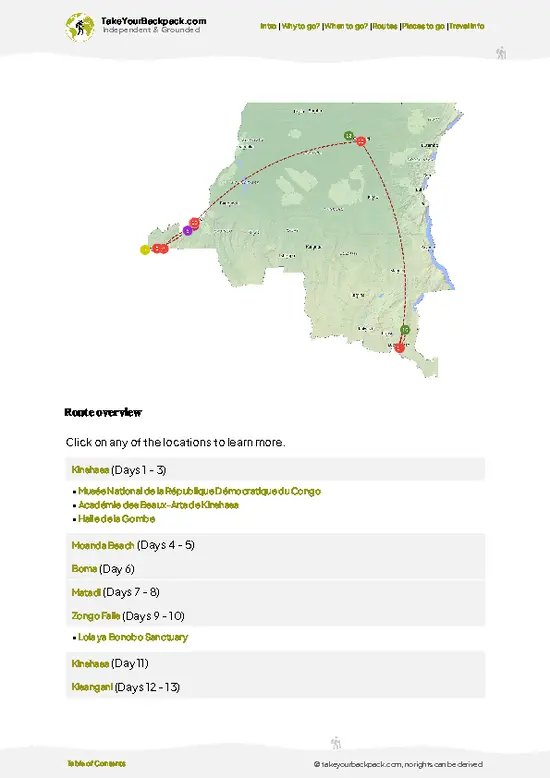
example page 0 from our offline Travel Guide for Democratic Republic of the Congo
example page 1 from our offline Travel Guide for Democratic Republic of the Congo
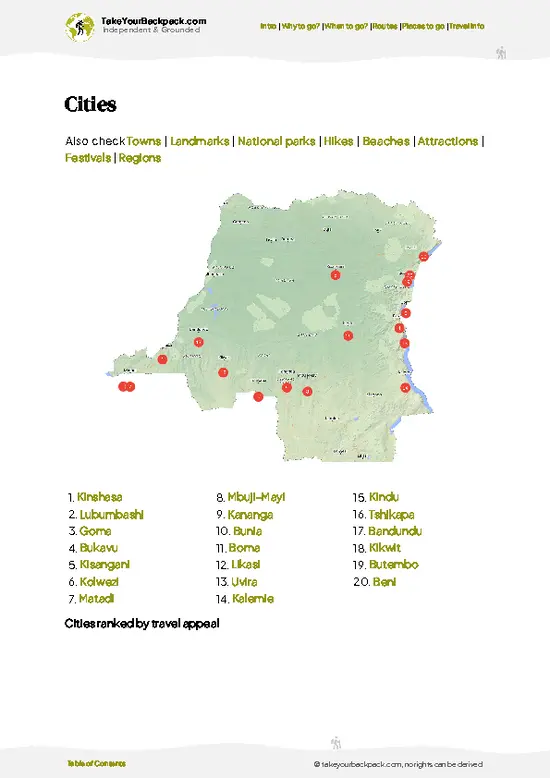
example page 2 from our offline Travel Guide for Democratic Republic of the Congo
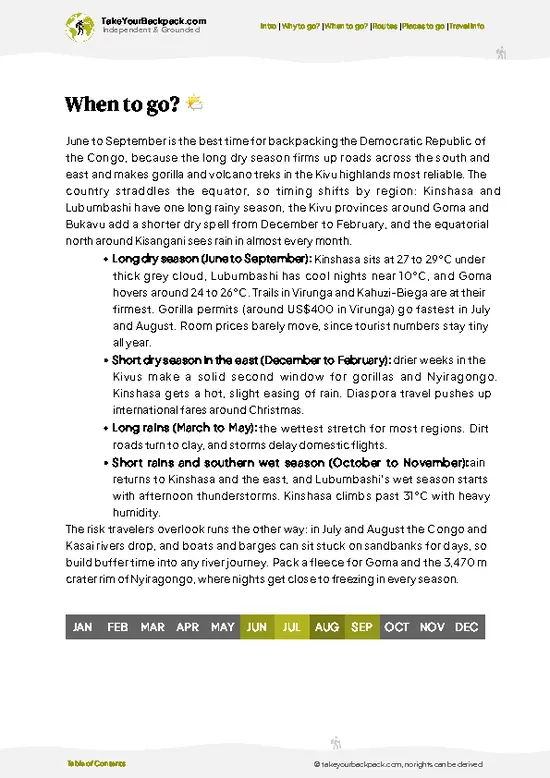
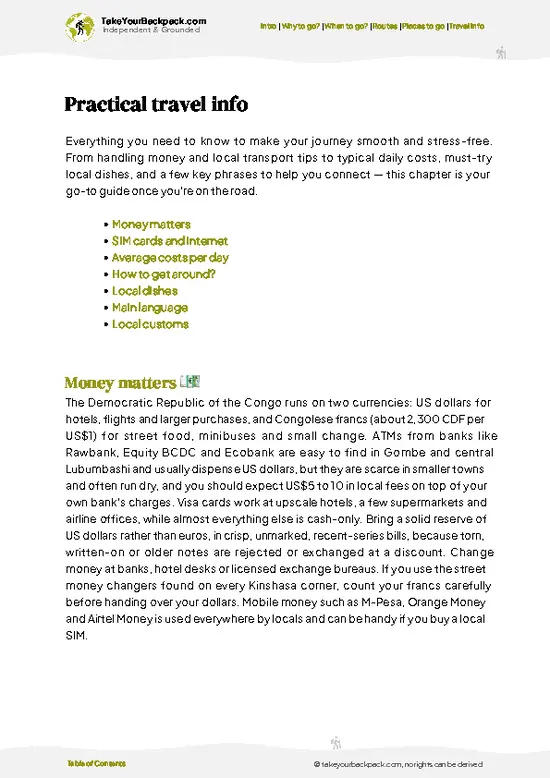
example page 3 from our offline Travel Guide for Democratic Republic of the Congo
example page 4 from our offline Travel Guide for Democratic Republic of the Congo
example page 5 from our offline Travel Guide for Democratic Republic of the Congo
example page 6 from our offline Travel Guide for Democratic Republic of the Congo
example page 7 from our offline Travel Guide for Democratic Republic of the Congo
Loading the map 🌍
CLICK TO FILTER
cities
towns
landmarks
national parks
hikes
beaches
attractions
festivals
regions
SHOW COUNTRY’S BESTSHOW ALL

✨ Why go?
Ranked #1 region in DR Congo
The unique appeal for travelers

Idjwi Island rewards backpackers who want a place where nobody is selling them anything. The first reason is the pace: the island is roughly 70 km long with its coffee hills in the middle, so you can cover the whole thing on foot, by motorbike taxi or by pirogue, and every village is a few steps from the shore. You see farming, fishing and chiefdom life up close rather than from a car window. The second is the two traditional chiefdoms, Bugarula and Rubenga, which still shape local life, so you get a living cultural thread instead of a staged show. The third is the Kivu Arabica coffee grown on the island’s slopes. You can see the whole chain, from picking to drying to sipping, in one afternoon, and it is the best-tasting souvenir in the east of the country. Add the lake itself, with calm water … read more 👉
Idjwi Island rewards backpackers who want a place where nobody is selling them anything. The first reason is the pace: the island is roughly 70 km long with its coffee hills in the middle, so you can cover the whole thing on foot, by motorbike taxi or by pirogue, and every village is a few steps from the shore. You see farming, fishing and chiefdom life up close rather than from a car window. The second is the two traditional chiefdoms, Bugarula and Rubenga, which still shape local life, so you get a living cultural thread instead of a staged show. The third is the Kivu Arabica coffee grown on the island’s slopes. You can see the whole chain, from picking to drying to sipping, in one afternoon, and it is the best-tasting souvenir in the east of the country. Add the lake itself, with calm water for swimming in some coves and a clear view of the mainland hills, and you get slow travel with almost no logistics beyond the ferry.

💡 HighlightsEssential experiences to have while visiting Idjwi Island

  1. Bugarula chiefdom seat: the northern traditional authority, where the mwami’s role still matters in local decisions. Visiting with a local guide and a polite greeting gives you a rare look at living Havu custom.
  2. Rubenga chiefdom seat: the southern counterpart, with a different feel and quieter roads. Seeing both chiefdoms explains why the island historically had two rulers.
  3. Lake Kivu ferry landings: arriving by boat, you step straight into the island’s daily trade of sacks, bicycles, goats and passengers. It is the most authentic introduction there is.
  4. Idjwi coffee terraces and cooperative washing stations: Arabica grows on the slopes, and during harvest you can watch cherries being sorted, floated and laid out to dry. Buy beans straight from producers.
  5. Night fishing on Lake Kivu: fishermen paddle
… read more 👉
  1. Bugarula chiefdom seat: the northern traditional authority, where the mwami’s role still matters in local decisions. Visiting with a local guide and a polite greeting gives you a rare look at living Havu custom.
  2. Rubenga chiefdom seat: the southern counterpart, with a different feel and quieter roads. Seeing both chiefdoms explains why the island historically had two rulers.
  3. Lake Kivu ferry landings: arriving by boat, you step straight into the island’s daily trade of sacks, bicycles, goats and passengers. It is the most authentic introduction there is.
  4. Idjwi coffee terraces and cooperative washing stations: Arabica grows on the slopes, and during harvest you can watch cherries being sorted, floated and laid out to dry. Buy beans straight from producers.
  5. Night fishing on Lake Kivu: fishermen paddle out in pirogues with lamps to catch small sambaza fish. Watching the string of lights from the shore is a quiet highlight, and you can eat the catch grilled the next day.
  6. Ridge walks through banana groves: footpaths along the island’s central spine give wide views over the water, the Rwandan shore and the Kalehe hills. Go early for cooler air and clear light.
  7. Local village markets: small weekly markets sell cassava, beans, bananas, dried fish and homemade banana drinks. They are the best places to hear Kihavu and Swahili at work and to try island snacks.
  8. Quiet shoreline coves: lesser-known stretches of pebbly beach and rock where locals swim, wash clothes and moor boats. They are not marked on maps, so ask at your guesthouse.
Nothing on Idjwi Island needs a ticket, but ferry seats and any guide are best arranged a day ahead.
Spotted a mistake or missing something? Contact us.

⌛️ 5 daysA smart one-week plan

Day 1: Bugarula: Arrive by ferry in the north and let the port set your pace. Boats run on their own schedules, so keep the first day empty. Drop your bag, greet the local authorities, and take a short afternoon walk through the coffee slopes behind the landing. Walking is the island’s default transport, and the first day teaches you how to read it.
Day 2: Ridge Walk: Hire a local guide and a motorbike taxi to carry you along the central ridge, then walk the downhill sections. Banana groves, coffee terraces and lake views follow one another, and a guide opens doors to cooperatives and village markets that you would pass otherwise. Stop in at a washing station to taste the coffee at the source.
Day 3: Lake Evening: Spend the day in a lakeside village. Swim in a quiet cove, then stay for the lamp-lit … read more 👉
Day 1: Bugarula: Arrive by ferry in the north and let the port set your pace. Boats run on their own schedules, so keep the first day empty. Drop your bag, greet the local authorities, and take a short afternoon walk through the coffee slopes behind the landing. Walking is the island’s default transport, and the first day teaches you how to read it.
Day 2: Ridge Walk: Hire a local guide and a motorbike taxi to carry you along the central ridge, then walk the downhill sections. Banana groves, coffee terraces and lake views follow one another, and a guide opens doors to cooperatives and village markets that you would pass otherwise. Stop in at a washing station to taste the coffee at the source.
Day 3: Lake Evening: Spend the day in a lakeside village. Swim in a quiet cove, then stay for the lamp-lit fishing boats at dusk. Eat grilled sambaza if the catch is good. Moving only a short way keeps the day relaxed, and the lake does most of the work.
Day 4: Rubenga: Head south by motorbike taxi on the island’s single main track, which makes the journey simple but slow. Visit the Rubenga chiefdom, compare it with the north, and find a market stall for lunch. Detour: take a pirogue along the shore between two villages for a view of the island’s cliffs and coves, an easy add-on that doesn’t disturb your route.
Day 5: Departure: Leave by the ferry you arranged earlier, with beans in your bag. If you only get one full day, make it Day 2: the ridge walk is where the island’s farms, lake and people all show up together.

🌤️ When to go?When to go for the best experience

  • Main Dry Season (June to August): Idjwi Island is easiest to visit now, with the least rain, firm dirt roads and clear views across Lake Kivu to the volcanoes near Goma. Days reach 25 to 28°C (77 to 82°F), nights drop to 15 to 17°C (59 to 63°F). Daylight lasts about 12 hours all year, so plan walks to finish by late afternoon.
  • Short Dry Spell (December to February): Rain eases and the lake is calm for boat crossings. Temperatures are similar to June, and the coffee harvest winds down. Local boat fares and lodging rarely change much through the year.
  • Long Rains (March to May): Downpours turn hill tracks to mud, and motorbike rides get slow and slippery. Expect 20 to 26°C (68 to 79°F), heavy cloud and the greenest hillsides. Boats still run, but delays are more common.
  • Short Rains (September to
… read more 👉
  • Main Dry Season (June to August): Idjwi Island is easiest to visit now, with the least rain, firm dirt roads and clear views across Lake Kivu to the volcanoes near Goma. Days reach 25 to 28°C (77 to 82°F), nights drop to 15 to 17°C (59 to 63°F). Daylight lasts about 12 hours all year, so plan walks to finish by late afternoon.
  • Short Dry Spell (December to February): Rain eases and the lake is calm for boat crossings. Temperatures are similar to June, and the coffee harvest winds down. Local boat fares and lodging rarely change much through the year.
  • Long Rains (March to May): Downpours turn hill tracks to mud, and motorbike rides get slow and slippery. Expect 20 to 26°C (68 to 79°F), heavy cloud and the greenest hillsides. Boats still run, but delays are more common.
  • Short Rains (September to November): Afternoon storms roll in over the lake, usually clearing by evening. The coffee and banana farms are lush, and you will see few other foreigners.
Plan crossings for the morning, since afternoon winds on the lake can make the water choppy.


source: climatestotravel.comJANJanuary: fair for travelingFEBFebruary: fair for travelingMARMarch: fair for travelingAPRApril: fair for travelingMAYMay: fair for travelingJUNJune: excellent for travelingJULJuly: excellent for travelingAUGAugust: excellent for travelingSEPSeptember: excellent for travelingOCTOctober: fair for travelingNOVNovember: fair for travelingDECDecember: fair for traveling
when-to-go

✈️ The backpacker research shortcutDR Congo Travel Guide

An offline-friendly backpacking guide with optimized travel routes, ranked highlights, transport advice, and the best areas to stay.
example page 0 from our offline Travel Guide for Democratic Republic of the Congo
example page 1 from our offline Travel Guide for Democratic Republic of the Congo
example page 2 from our offline Travel Guide for Democratic Republic of the Congo
example page 3 from our offline Travel Guide for Democratic Republic of the Congo
example page 4 from our offline Travel Guide for Democratic Republic of the Congo
example page 5 from our offline Travel Guide for Democratic Republic of the Congo
example page 6 from our offline Travel Guide for Democratic Republic of the Congo
example page 7 from our offline Travel Guide for Democratic Republic of the Congo
The digital guide (330 pages) contains:
✅ 76 highlights, ranked by travel appeal
✅ Optimized 7, 14 & 21-day travel routes
✅ Cities, national parks, landmarks, beaches
✅ How to get around
✅ Offline-friendly for travel without Wi-Fi
👉 Click to see all 30+ guide features

📅 Plan smarter in minutes, not weeks
✅ Month by month travel advice
✅ Festivals & national holidays
✅ Budget expectations

🗺️ Go to the right places, skip the overrated ones
✅ Honest pros & cons of destinations
✅ Top hikes, parks & viewpoints
✅ Lesser-known places most travelers miss
✅ Clear “worth it vs skip it” guidance

🛏️ Travel smoothly without rookie mistakes
✅ Best areas to stay
✅ Transport systems explained simply
✅ Common scams & safety advice
✅ SIM cards, money & practical tips

🌍 Understand the country, not just visit it
✅ Culture & traditions
✅ 52 Essential phrases & customs
✅ Festivals worth planning around
✅ Traveler-friendly historical context
✅ Insights that make places more meaningful

📱 Built for real travel conditions
✅ Fully downloadable PDF
✅ Works completely offline
✅ Optimized for phone use
✅ Useful in remote areas & buses
✅ Everything in one place
Stop searching, start planning
Get instant access to your full guide. 30‑day money-back guarantee.
+ Add another guide for just

By proceeding you agree to our terms.
Sent to your inbox immediately after payment • 100% Secure Checkout
Best Backpacking Travel Advisor 2025 tourism awardBest Backpacking
Travel Advisor
2025
What others say about Take Your Backpack Guides:
⭐⭐⭐⭐⭐
Fantastic, amazing amount of information!
⭐⭐⭐⭐⭐
My goodness this is amazing, it's what I've been looking for hats off too you!
⭐⭐⭐⭐⭐
I think this is absolutely BRILLIANT
⭐⭐⭐⭐
Very complete and informative. It's still missing places, but I gotta to commend you
⭐⭐⭐⭐⭐
This is truly amazing, thank you, can't wait to explore it with my kids!
⭐⭐⭐⭐⭐
Awesome resource, thank you!
⭐⭐⭐⭐⭐
This is amazing! Can't wait to explore the ones I haven't seen
⭐⭐⭐⭐
I love this! Well done, great idea.
⭐⭐⭐⭐⭐
Thanks for taking the time to make this gem!
⭐⭐⭐⭐⭐
This might be the best website I've ever seen.
⭐⭐⭐⭐⭐
Congratulations, and thank you so much for your work; it's incredibly valuable.
⭐⭐⭐⭐
In all seriousness I think you did a great job pointing out the important spots
⭐⭐⭐⭐⭐
10/10 very good
⭐⭐⭐⭐⭐
As someone who's only just starting to visit regularly this is awesome, thank you.
⭐⭐⭐⭐
Thank you very much! I'm going to visit my dad, it's going to be very useful!
⭐⭐⭐⭐⭐
This is really cool! We'll be travelling for the first time and this definitely come in handy.
⭐⭐⭐⭐⭐
You are now our minister of culture, congratulations 👨‍💼
⭐⭐⭐⭐⭐
Just wanted to tell you that this is a pearl! Going to follow your recommendations.
⭐⭐⭐⭐⭐
This is so cool. I'll definitely be using the resource for my travels soon.
⭐⭐⭐⭐⭐
This is very impressive! Good work.
⭐⭐⭐⭐⭐
This is an amazing and informative site. Very well done!

🛏️ Where to stay?Choosing the right base

Most backpackers stay in the villages along the island’s central and southern stretches, where a handful of guesthouses sit close to the lake and the main road. Idjwi has no hostel scene, so expect simple rooms, bucket showers and shared meals, at roughly US$10 to 30 a night. Social life comes from the people you meet rather than a common room.
The area around the main port towns is the most practical base. Boats from Goma and Bukavu land here, motorbike taxis wait at the shore, and small shops and phone credit sellers are within walking distance. You can hop from here to coffee cooperatives and … read more 👉
Most backpackers stay in the villages along the island’s central and southern stretches, where a handful of guesthouses sit close to the lake and the main road. Idjwi has no hostel scene, so expect simple rooms, bucket showers and shared meals, at roughly US$10 to 30 a night. Social life comes from the people you meet rather than a common room.
The area around the main port towns is the most practical base. Boats from Goma and Bukavu land here, motorbike taxis wait at the shore, and small shops and phone credit sellers are within walking distance. You can hop from here to coffee cooperatives and lake beaches without spending a whole day in transit.
For a quieter stay, choose a lakeside village away from the landing points. Mornings start with fishermen pushing off in dugouts, and evenings end with kids playing football on dirt pitches. Locals are curious and friendly, and a greeting in French or Swahili goes a long way. Ask the guesthouse owner or village chief to introduce you before wandering far, which is customary and makes walking around feel comfortable.
Solo travelers should arrive in daylight, since lighting is minimal and roads are unlit. Always check current security conditions on the mainland before you cross, because the situation around the Kivu lakeshore can shift quickly.

🚌 Getting aroundMoving around without the hassle

The villages on Idjwi Island are small enough to cross on foot, but walking stops making sense once you leave the main settlements, because the island is about 70 km (43 miles) long and its dirt road follows steep ridges. Most backpackers arrive by boat from Goma or Bukavu, then hire motorbike taxis for everything else. It works, but nothing runs on a timetable, so build in slack.
  • Motorbike taxi: The default way to cover the island, at roughly US$3 to 15 depending on distance and road state. Riding pillion on the ridge road gives you open views of coffee terraces dropping to the lake, though rain turns the surface greasy and the longest rides can take 2 to 3 hours.
  • Public boat from Goma or Bukavu: Crowded wooden or fiberglass boats and faster speedboats link the mainland to the island, for about
… read more 👉
The villages on Idjwi Island are small enough to cross on foot, but walking stops making sense once you leave the main settlements, because the island is about 70 km (43 miles) long and its dirt road follows steep ridges. Most backpackers arrive by boat from Goma or Bukavu, then hire motorbike taxis for everything else. It works, but nothing runs on a timetable, so build in slack.
  • Motorbike taxi: The default way to cover the island, at roughly US$3 to 15 depending on distance and road state. Riding pillion on the ridge road gives you open views of coffee terraces dropping to the lake, though rain turns the surface greasy and the longest rides can take 2 to 3 hours.
  • Public boat from Goma or Bukavu: Crowded wooden or fiberglass boats and faster speedboats link the mainland to the island, for about US$10 to 25 each way, with crossings of roughly 2 to 4 hours. Sitting among farmers hauling sacks of beans and cassava is the best look at daily island life you will get.
  • Private boat hire: Worth it only if you want to reach a quiet bay or the northern or southern tip without hours of bike time, at around US$50 to 150 per trip depending on distance. You get empty shoreline and calm water at the start of the day.
  • Walking: Skip it for transfers, since the hills are long and sun exposure is high. Do it for short village loops of 3 to 5 km (2 to 3 miles), where kids greet you and you pass drying coffee beans laid out on tarps.
Carry small US dollar bills in good condition and Congolese francs for local fares, and agree on a price with the rider before the bike starts moving. Leave the mainland early so you reach the island with daylight left to find your bed.

🍲 FoodEating & Drinking in Idjwi Island

Food on Idjwi Island is simple, filling and tied to the lake and hillside farms. The classic plate is fresh fish, often small sambaza or tilapia, fried until crisp and served with ugali (a firm maize or cassava paste) or boiled plantains. Add beans stewed with onion and palm oil, plus greens such as sombe (pounded cassava leaves), and you have a heavy, savory meal that costs about US$2 to 5.
The island is known for coffee, and you can taste it at the source. Cooperatives roast and brew small batches that come out dark, smoky and slightly fruity. Local banana beer and sorghum brews are common at gatherings, sour and cloudy, poured into shared bowls. Tangawizi, a sharp ginger drink, and bottled sodas fill the gaps.
Eat where locals do: roadside market stalls, small canteens with a pot or two on … read more 👉
Food on Idjwi Island is simple, filling and tied to the lake and hillside farms. The classic plate is fresh fish, often small sambaza or tilapia, fried until crisp and served with ugali (a firm maize or cassava paste) or boiled plantains. Add beans stewed with onion and palm oil, plus greens such as sombe (pounded cassava leaves), and you have a heavy, savory meal that costs about US$2 to 5.
The island is known for coffee, and you can taste it at the source. Cooperatives roast and brew small batches that come out dark, smoky and slightly fruity. Local banana beer and sorghum brews are common at gatherings, sour and cloudy, poured into shared bowls. Tangawizi, a sharp ginger drink, and bottled sodas fill the gaps.
Eat where locals do: roadside market stalls, small canteens with a pot or two on charcoal, and women grilling fish or cassava and peanuts by the landing points. Menus are rarely written, so ask what is cooked that day. Smoke, frying oil and lake air blend together at dusk.
Wash hands before eating, since many meals are shared from a common dish or eaten by hand. Accept a drink or snack when offered, as refusing can seem rude. Bring bottled or purified water, and eat food that is served hot.

FAQTraveler FAQ

Two to three days is enough to see Idjwi Island at a relaxed pace, plus travel time for the boat crossing of roughly 2 to 4 hours from Goma or Bukavu. That lets you visit a coffee cooperative, walk between lakeside villages and spend an evening watching fishing boats. Add a day if you want to ride to the far northern or southern ends, since motorbike transfers on the ridge road can take 2 to 3 hours.
On Idjwi Island, you get around by motorbike taxi, which costs roughly US$3 to 15 per ride depending on distance. Boats connect the island to Goma and Bukavu for about US$10 to 25 each way, and private boat hire runs about US$50 to 150 for a trip. Short village walks of 3 to 5 km work fine, but the island’s 70 km length makes walking between distant points impractical.
Idjwi Island is known for its coffee, grown on terraced hillsides and sold through small cooperatives, and for being one of the largest lake islands in Africa, roughly 70 km long in Lake Kivu. It is also known for its calm, rural pace compared with the mainland and for its fishing communities. Visitors come for coffee tastings, lake views, village walks and fresh fish meals that cost about US$2 to 5.
⚠️ Things can change over time, so always validate details locally before you go.

More places to explore across DR Congo

Idjwi Island isn’t the only highlight in DR Congo. Explore all what DR Congo has to offer.
Country photo of DR Congo

We 💚 feedbackIs it worth it?

The usual mistake on Idjwi Island is treating it as a day trip from the mainland, rushing between the port and a photo spot and leaving before the island has done anything. Do the opposite. Stay at least a couple of nights, hire a local guide, and bring small bills and a supply of patience for ferry timing. I would also carry a bag for roasted coffee, because you will want it.

✍️ Help improve this page!
The information on this page is based on in-depth research, insights shared by experienced travelers, and feedback from the local travel community in DR Congo. While every effort is made to keep the information accurate and current, conditions can change — so if you spot anything incorrect or outdated, please get in touch.


🙋‍♂️ Give feedback

👋 Meet the founderWho’s Behind Take Your Backpack?

Johan, backpacker and founder of TakeYourBackpackHi, I’m Johan (Netherlands 🇳🇱), the creator of TakeYourBackpack. Over the past 3 decades, I’ve backpacked through 90+ countries across six continents, gaining extensive experience with independent travel, long-term trips, and overland routes.

This site is built on a combination of firsthand travel experience and carefully curated insights from other backpackers. Many guides are based on places I’ve personally visited, while others bring together tips, observations, and practical advice shared by trusted travelers I’ve met along the way.

The goal is to provide realistic, experience-driven guidance — not generic itineraries — so you can explore destinations with better context, clearer expectations, and more confidence.