×

DR Congo🇨🇩 | regionsManiemaLualaba pirogues, Kindu markets, Swahili trading history, remote rainforest | things to do and best time to go

Explore Yangambi Biosphere ReserveExplore Idjwi Island

Backpacking in Maniema
👍 Recommendedregion ranked #2
By Johan Kruseman 🇳🇱 | Updated October 22, 2026

The pirogue slides off the muddy bank at Kindu, and the Lualaba is wide, brown and loud with paddles, with woodsmoke drifting from fishing camps on the shore. Maniema sits in the east of the Democratic Republic of the Congo, a forested province of rivers, with Kindu as its capital and Kasongo, an old Swahili-Arab trading town, farther up the river. Its appeal is plain: almost no tourists, real villages, rainforest that begins where the road ends and very little polish. The cost is just as plain. Roads turn to red mud, flights are irregular, and the infrastructure that tourists expect barely exists, so expect slow days and spend extra on a hired motorbike or boat if you want to reach anywhere beyond town. Skip trying to cover distance; it wastes your time and patience. Spend it on river life, markets and forest edges instead. Start your first day with an early walk through Kindu’s riverside market, then hire a local boatman for a few hours on the Lualaba.

Discover everything you want to know in the 📖 DR Congo Travel Guide.
Safety warning

The current risk level for DR Congo is high. Check the advice before going.


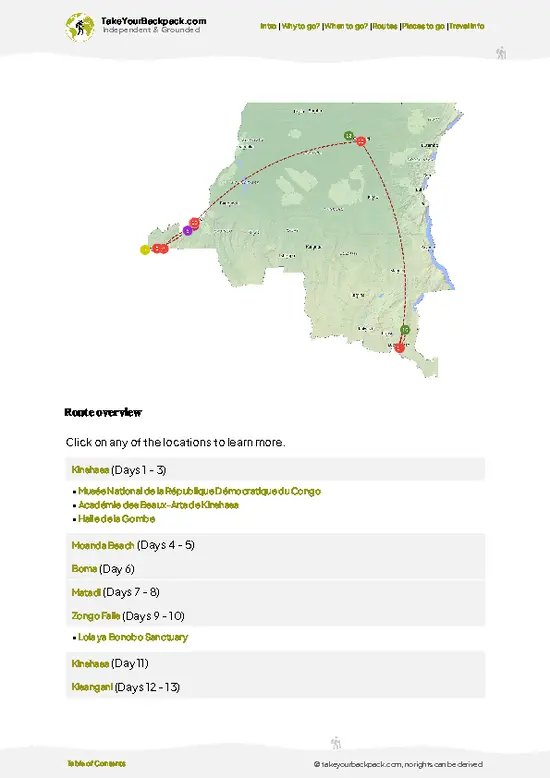
example page 0 from our offline Travel Guide for Democratic Republic of the Congo
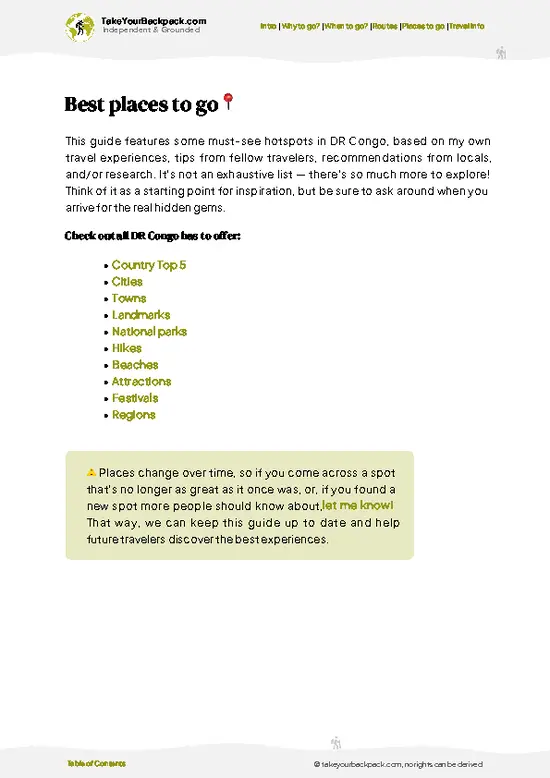
example page 1 from our offline Travel Guide for Democratic Republic of the Congo
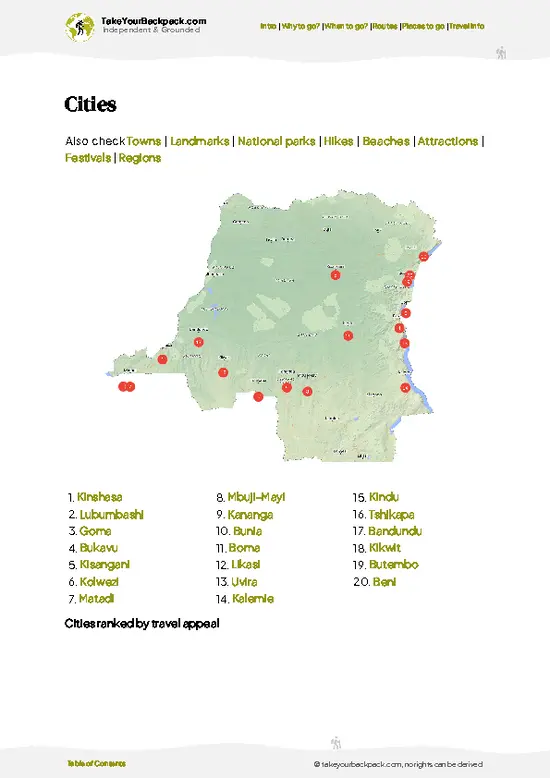
example page 2 from our offline Travel Guide for Democratic Republic of the Congo
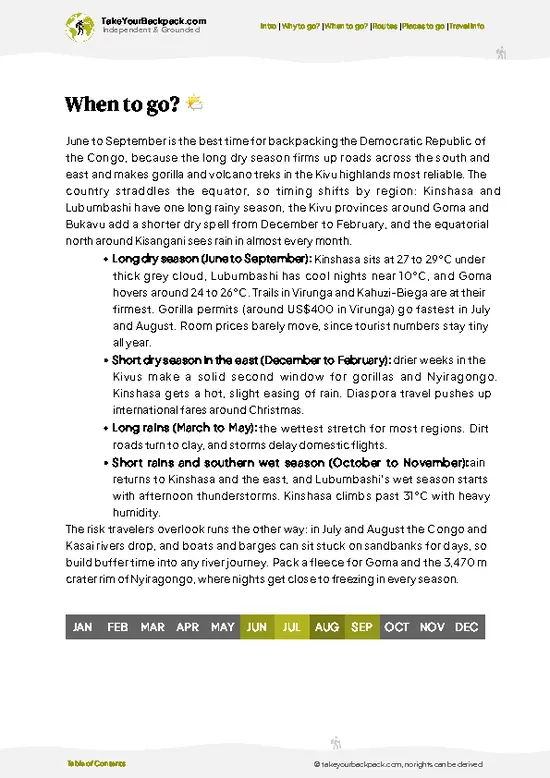
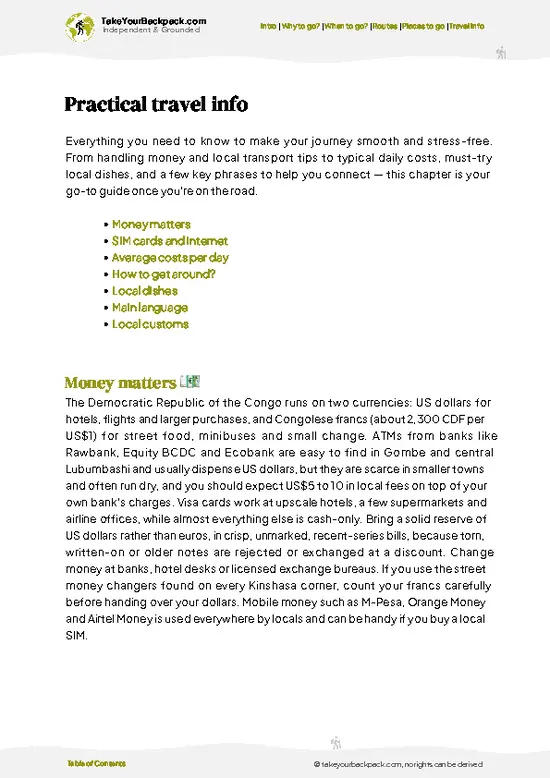
example page 3 from our offline Travel Guide for Democratic Republic of the Congo
example page 4 from our offline Travel Guide for Democratic Republic of the Congo
example page 5 from our offline Travel Guide for Democratic Republic of the Congo
example page 6 from our offline Travel Guide for Democratic Republic of the Congo
example page 7 from our offline Travel Guide for Democratic Republic of the Congo
Loading the map 🌍
CLICK TO FILTER
cities
towns
landmarks
national parks
hikes
beaches
attractions
festivals
regions
SHOW COUNTRY’S BESTSHOW ALL

✨ Why go?
Ranked #2 region in DR Congo
Reasons people choose to visit here

Maniema rewards backpackers who want Congo without the crowds, because the Lualaba River is still the main street for much of the province. Dugout canoes carry fish, charcoal and cassava between villages, and you see that working life from the bank in Kindu without any staging for visitors. Two reasons matter most here.
The first is the forest. Lomami National Park and Maiko National Park both reach into this part of the country, and they shelter okapi, forest elephants, Grauer’s gorillas and primates such as the lesula monkey, first described by scientists in the Lomami area. Reaching them takes planning, guides and patience, but the wildlife is the real draw for anyone chasing something truly remote.
The second is history. Arab-Swahili traders ran ivory and slave routes along the Lualaba, … read more 👉
Maniema rewards backpackers who want Congo without the crowds, because the Lualaba River is still the main street for much of the province. Dugout canoes carry fish, charcoal and cassava between villages, and you see that working life from the bank in Kindu without any staging for visitors. Two reasons matter most here.
The first is the forest. Lomami National Park and Maiko National Park both reach into this part of the country, and they shelter okapi, forest elephants, Grauer’s gorillas and primates such as the lesula monkey, first described by scientists in the Lomami area. Reaching them takes planning, guides and patience, but the wildlife is the real draw for anyone chasing something truly remote.
The second is history. Arab-Swahili traders ran ivory and slave routes along the Lualaba, and the old trading town of Kasongo still carries that story in its streets and people. You get river, rainforest and layered history in one slow trip, with no mass tourism to filter any of it.

💡 HighlightsDon't-miss highlights and experiences

  1. Kindu riverfront and port: The Lualaba landing is the best place to watch Maniema at work, with long pirogues unloading fish, palm oil and sacks of cassava flour. Go early, when the traffic is thickest.
  2. Kindu Grand Marché: A loud, practical market where forest products, river fish and cloth are sold side by side. Buy a pagne here if you want a cheap, useful souvenir.
  3. Lualaba pirogue trip: Hire a local paddler for a short stretch of river and see fishing traps, riverside hamlets and island sandbars from water level. It is the most direct way to understand the province.
  4. Kindu railway station: The old Kindu rail terminus recalls the line that once tied Maniema to Katanga and the Great Lakes. The faded platforms suit a quiet photo walk, and few visitors ever see them.
  5. Kasongo: This Lualaba town was
… read more 👉
  1. Kindu riverfront and port: The Lualaba landing is the best place to watch Maniema at work, with long pirogues unloading fish, palm oil and sacks of cassava flour. Go early, when the traffic is thickest.
  2. Kindu Grand Marché: A loud, practical market where forest products, river fish and cloth are sold side by side. Buy a pagne here if you want a cheap, useful souvenir.
  3. Lualaba pirogue trip: Hire a local paddler for a short stretch of river and see fishing traps, riverside hamlets and island sandbars from water level. It is the most direct way to understand the province.
  4. Kindu railway station: The old Kindu rail terminus recalls the line that once tied Maniema to Katanga and the Great Lakes. The faded platforms suit a quiet photo walk, and few visitors ever see them.
  5. Kasongo: This Lualaba town was a major base for Arab-Swahili traders in the 1800s, including Tippu Tip’s network. Locals can point you to its old quarters and tell the stories behind them.
  6. Lomami National Park: Established in 2016, it protects forest and savanna mosaic with okapi, bonobos and the lesula monkey. Visits need an expedition mindset and advance permission.
  7. Maiko National Park: One of the largest rainforest reserves in the country, home to Grauer’s gorillas and okapi. Only for serious, well-supported travelers.
  8. Kalima: A mining-era town with a rough, working feel, known for tin and gold activity in the surrounding hills. Go only with local advice on security.
  9. Kailo: A quieter river-and-road settlement where village life carries on away from Kindu’s crowds. Locals value it for fishing and farm produce.
  10. Punia: A forest-edge town in the north of the province, known for gold digging and as a jumping-off point toward Maiko. It is raw and remote, so seek local guidance first.
In Maniema, the Kindu riverfront at dawn and the Grand Marché a few hours later fit neatly into one day.
Spotted a mistake or missing something? Contact us.

⌛️ 5 daysHow to make the most of Maniema

Day 1: Kindu: Start at the riverfront, because everything in Maniema flows from the Lualaba, and the port is where you read the region’s rhythm, see which boats are heading upriver and meet people who know road conditions. Spend the afternoon in the Grand Marché, then settle the paperwork and local introductions you need for the days ahead.
Day 2: Kindu: Use a second day to hire a paddler for a pirogue trip and visit the old railway station. Flights are few and roads unreliable, so a buffer day here protects the rest of the plan and lets you confirm security and transport before leaving town.
Day 3: Kailo: This is the detour. Kailo adds quieter village life and a different stretch of the river without forcing a long overnight journey, and it works as a short loop out of Kindu. Go only if local … read more 👉
Day 1: Kindu: Start at the riverfront, because everything in Maniema flows from the Lualaba, and the port is where you read the region’s rhythm, see which boats are heading upriver and meet people who know road conditions. Spend the afternoon in the Grand Marché, then settle the paperwork and local introductions you need for the days ahead.
Day 2: Kindu: Use a second day to hire a paddler for a pirogue trip and visit the old railway station. Flights are few and roads unreliable, so a buffer day here protects the rest of the plan and lets you confirm security and transport before leaving town.
Day 3: Kailo: This is the detour. Kailo adds quieter village life and a different stretch of the river without forcing a long overnight journey, and it works as a short loop out of Kindu. Go only if local contacts confirm the road is passable, and return to Kindu to keep your base secure.
Day 4: Kasongo: Transport sets the pace here. Shared vehicles and river boats depart when full, not on a timetable, so one major town per day is realistic. Kasongo is the historical reason to push on, with its Arab-Swahili trading legacy and a river setting far from the usual Congo itineraries.
Day 5: Back on the Lualaba: Leave slack for the return, since delays are normal. If conditions are good, spend the morning on the water near Kasongo and head back toward Kindu in the afternoon.
If you can only justify one day, make it the second day on the Lualaba in a pirogue. Drifting past fishing camps with only paddles and birdsong around you is the moment that explains why anyone makes the effort to come to Maniema.

🌤️ When to go?Choosing the right time of year

  • Dry Season (June to August): Maniema’s clearest stretch, with highs of 28 to 31°C (82 to 88°F) and nights near 17 to 19°C (63 to 66°F). Dirt roads firm up, river crossings run smoother, and prices for motorbike hire and trucks sit at their lowest.
  • Long Wet Season (September to November, then mid-February to May): Rain falls most afternoons and sometimes all night, with daytime highs of 26 to 29°C (79 to 84°F). Tracks turn to red mud, trucks get stuck for a day or more, and fares climb 20 to 50 percent.
  • Short Dry Break (December to mid-February): Showers thin out and roads are passable, though not as reliable as in midyear. Temperatures hold at 27 to 30°C (81 to 86°F).
  • Daylight and Crowds: Day length barely shifts, close to 12 hours all year, so plan to be off the road by late afternoon. Visitors
… read more 👉
  • Dry Season (June to August): Maniema’s clearest stretch, with highs of 28 to 31°C (82 to 88°F) and nights near 17 to 19°C (63 to 66°F). Dirt roads firm up, river crossings run smoother, and prices for motorbike hire and trucks sit at their lowest.
  • Long Wet Season (September to November, then mid-February to May): Rain falls most afternoons and sometimes all night, with daytime highs of 26 to 29°C (79 to 84°F). Tracks turn to red mud, trucks get stuck for a day or more, and fares climb 20 to 50 percent.
  • Short Dry Break (December to mid-February): Showers thin out and roads are passable, though not as reliable as in midyear. Temperatures hold at 27 to 30°C (81 to 86°F).
  • Daylight and Crowds: Day length barely shifts, close to 12 hours all year, so plan to be off the road by late afternoon. Visitors are rare in every month.
Plan your overland legs for July, when the roads are at their best.


source: climatestotravel.comJANJanuary: fair for travelingFEBFebruary: fair for travelingMARMarch: fair for travelingAPRApril: fair for travelingMAYMay: fair for travelingJUNJune: highly recommended for travelingJULJuly: highly recommended for travelingAUGAugust: highly recommended for travelingSEPSeptember: excellent for travelingOCTOctober: fair for travelingNOVNovember: fair for travelingDECDecember: fair for traveling
when-to-go

✈️ The backpacker research shortcutDR Congo Travel Guide

An offline-friendly backpacking guide with optimized travel routes, ranked highlights, transport advice, and the best areas to stay.
example page 0 from our offline Travel Guide for Democratic Republic of the Congo
example page 1 from our offline Travel Guide for Democratic Republic of the Congo
example page 2 from our offline Travel Guide for Democratic Republic of the Congo
example page 3 from our offline Travel Guide for Democratic Republic of the Congo
example page 4 from our offline Travel Guide for Democratic Republic of the Congo
example page 5 from our offline Travel Guide for Democratic Republic of the Congo
example page 6 from our offline Travel Guide for Democratic Republic of the Congo
example page 7 from our offline Travel Guide for Democratic Republic of the Congo
The digital guide (330 pages) contains:
✅ 76 highlights, ranked by travel appeal
✅ Optimized 7, 14 & 21-day travel routes
✅ Cities, national parks, landmarks, beaches
✅ How to get around
✅ Offline-friendly for travel without Wi-Fi
👉 Click to see all 30+ guide features

📅 Plan smarter in minutes, not weeks
✅ Month by month travel advice
✅ Festivals & national holidays
✅ Budget expectations

🗺️ Go to the right places, skip the overrated ones
✅ Honest pros & cons of destinations
✅ Top hikes, parks & viewpoints
✅ Lesser-known places most travelers miss
✅ Clear “worth it vs skip it” guidance

🛏️ Travel smoothly without rookie mistakes
✅ Best areas to stay
✅ Transport systems explained simply
✅ Common scams & safety advice
✅ SIM cards, money & practical tips

🌍 Understand the country, not just visit it
✅ Culture & traditions
✅ 52 Essential phrases & customs
✅ Festivals worth planning around
✅ Traveler-friendly historical context
✅ Insights that make places more meaningful

📱 Built for real travel conditions
✅ Fully downloadable PDF
✅ Works completely offline
✅ Optimized for phone use
✅ Useful in remote areas & buses
✅ Everything in one place
Stop searching, start planning
Get instant access to your full guide. 30‑day money-back guarantee.
+ Add another guide for just

By proceeding you agree to our terms.
Sent to your inbox immediately after payment • 100% Secure Checkout
Best Backpacking Travel Advisor 2025 tourism awardBest Backpacking
Travel Advisor
2025
What others say about Take Your Backpack Guides:
⭐⭐⭐⭐⭐
Fantastic, amazing amount of information!
⭐⭐⭐⭐⭐
My goodness this is amazing, it's what I've been looking for hats off too you!
⭐⭐⭐⭐⭐
I think this is absolutely BRILLIANT
⭐⭐⭐⭐
Very complete and informative. It's still missing places, but I gotta to commend you
⭐⭐⭐⭐⭐
This is truly amazing, thank you, can't wait to explore it with my kids!
⭐⭐⭐⭐⭐
Awesome resource, thank you!
⭐⭐⭐⭐⭐
This is amazing! Can't wait to explore the ones I haven't seen
⭐⭐⭐⭐
I love this! Well done, great idea.
⭐⭐⭐⭐⭐
Thanks for taking the time to make this gem!
⭐⭐⭐⭐⭐
This might be the best website I've ever seen.
⭐⭐⭐⭐⭐
Congratulations, and thank you so much for your work; it's incredibly valuable.
⭐⭐⭐⭐
In all seriousness I think you did a great job pointing out the important spots
⭐⭐⭐⭐⭐
10/10 very good
⭐⭐⭐⭐⭐
As someone who's only just starting to visit regularly this is awesome, thank you.
⭐⭐⭐⭐
Thank you very much! I'm going to visit my dad, it's going to be very useful!
⭐⭐⭐⭐⭐
This is really cool! We'll be travelling for the first time and this definitely come in handy.
⭐⭐⭐⭐⭐
You are now our minister of culture, congratulations 👨‍💼
⭐⭐⭐⭐⭐
Just wanted to tell you that this is a pearl! Going to follow your recommendations.
⭐⭐⭐⭐⭐
This is so cool. I'll definitely be using the resource for my travels soon.
⭐⭐⭐⭐⭐
This is very impressive! Good work.
⭐⭐⭐⭐⭐
This is an amazing and informative site. Very well done!

🛏️ Where to stay?How to pick the right area

Kindu is the only practical base for backpackers in Maniema, and you should expect to sleep there before and after any trip into the province. It is the provincial capital on the Congo River, with the airport, a main market, banks and money changers, and the best choice of guesthouses and simple hotels, generally US$20 to 60 a night. Electricity and hot water are patchy, so favor places with a generator and a mosquito net.

The central districts near the river and market are the easiest to stay in. Everything is walkable, transport contacts are close, and you can find motorbike drivers and trucks … read more 👉
Kindu is the only practical base for backpackers in Maniema, and you should expect to sleep there before and after any trip into the province. It is the provincial capital on the Congo River, with the airport, a main market, banks and money changers, and the best choice of guesthouses and simple hotels, generally US$20 to 60 a night. Electricity and hot water are patchy, so favor places with a generator and a mosquito net.

The central districts near the river and market are the easiest to stay in. Everything is walkable, transport contacts are close, and you can find motorbike drivers and trucks early in the morning. Social life is quiet. You meet aid workers, missionaries and traders more than other backpackers, so evenings are for talking over a beer in a local bar.

Beyond Kindu, towns such as Kasongo and Kalima offer basic lodging, often a church guesthouse or a small family-run inn at around US$10 to 30. Facilities are limited, and it is best to arrive with local contacts and register with the authorities on arrival. Villages along the river can host travelers, but only with an introduction from a local you trust.

🚌 Getting aroundMoving around without the hassle

Maniema’s costliest mistake is booking a fixed schedule for overland legs, because a truck breakdown or washed-out bridge can erase two days of it. Treat any date as a rough target and keep a spare week. Roads are poor, scheduled services are almost nonexistent, and you move by whatever is heading your way.
  • Motorbike taxi: This is the workhorse between Kindu and nearby villages, at roughly US$10 to 30 a day depending on distance and mud. You get door-to-door flexibility and can reach places no truck goes, but expect a sore back and a soaked pack in the rains. For a backpacker, it gives the most for the money on short hops.
  • Cargo truck: Trucks carry passengers on top of the load along routes such as Kindu to Kasongo or toward Kalima. A seat on the cargo costs about US$15 to 40 and the trip can
… read more 👉
Maniema’s costliest mistake is booking a fixed schedule for overland legs, because a truck breakdown or washed-out bridge can erase two days of it. Treat any date as a rough target and keep a spare week. Roads are poor, scheduled services are almost nonexistent, and you move by whatever is heading your way.
  • Motorbike taxi: This is the workhorse between Kindu and nearby villages, at roughly US$10 to 30 a day depending on distance and mud. You get door-to-door flexibility and can reach places no truck goes, but expect a sore back and a soaked pack in the rains. For a backpacker, it gives the most for the money on short hops.
  • Cargo truck: Trucks carry passengers on top of the load along routes such as Kindu to Kasongo or toward Kalima. A seat on the cargo costs about US$15 to 40 and the trip can take one to four days. It is cheap and a good way to meet people, but uncomfortable and unpredictable. Use it only on routes with no alternative.
  • River boat on the Congo and Lualaba: Barges and pirogues link riverside towns when the water is high enough. Prices run about US$10 to 30 for a long leg, and speed is slow, but you can stretch out and sleep. This is worth the time only if you have flexibility and enjoy the pace.
  • Domestic flights: Small carriers serve Kindu from Kinshasa and Goma with unreliable schedules, costing about US$150 to 350 one way. It is the priciest choice, yet it saves days of difficult travel. Spend this money when you are short on time.
Ask local drivers and church or NGO contacts for the next departure, then confirm the day before and carry food, water and a tarp for the road.

🍲 FoodEating & Drinking in Maniema

Maniema’s table is built on fufu (a thick cassava or maize paste) served with pondu, the dark, garlicky cassava-leaf stew, and smoked river fish from the Congo and Lualaba. Fish arrives grilled over embers or simmered in palm oil with chili, with a smoky char that clings to your fingers. Look for chikwangue, cassava wrapped in leaves, and caterpillars or mushrooms in the rainy months, which locals cook with onion and tomato.

In Kindu, eat at the central market and the roadside maman stalls, where women ladle beans, rice, plantains and stew onto plates for about US$1 to 3. Small buvettes serve grilled goat, fish and chicken with cold beer for US$3 to 6. Cafés are rare, so carry snacks, including bread and peanuts, for trips outside town.

Beer is the social drink. Primus and Skol come in big … read more 👉
Maniema’s table is built on fufu (a thick cassava or maize paste) served with pondu, the dark, garlicky cassava-leaf stew, and smoked river fish from the Congo and Lualaba. Fish arrives grilled over embers or simmered in palm oil with chili, with a smoky char that clings to your fingers. Look for chikwangue, cassava wrapped in leaves, and caterpillars or mushrooms in the rainy months, which locals cook with onion and tomato.

In Kindu, eat at the central market and the roadside maman stalls, where women ladle beans, rice, plantains and stew onto plates for about US$1 to 3. Small buvettes serve grilled goat, fish and chicken with cold beer for US$3 to 6. Cafés are rare, so carry snacks, including bread and peanuts, for trips outside town.

Beer is the social drink. Primus and Skol come in big 72 cl bottles meant to be shared, and the bottle is often returned to the seller. Palm wine appears in villages in the morning, sweet and fizzy, turning sour by afternoon.

Eat with your right hand from a shared dish after washing at the basin offered. Guests are served first, and refusing food outright can offend, so take a small portion. Always agree on a price before ordering when no menu is posted.

FAQTraveler FAQ

Plan on 5 to 7 days for Kindu and a short trip along the river, and 2 to 3 weeks if you want to travel overland to Kasongo or Kalima. Kindu itself needs only 1 to 2 days for the market, the riverfront and arranging onward transport. Add a buffer week in the rainy months, since trucks can stall for days on muddy tracks.
Without a car, you rely on motorbike taxis (about US$10 to 30 a day), cargo trucks that carry passengers (US$15 to 40 per leg), and river boats on the Congo and Lualaba. Domestic flights into Kindu from Kinshasa or Goma cost roughly US$150 to 350 one way. Trucks can take 1 to 4 days per leg, so confirm departures locally and carry food and water.
Maniema is known for its forested interior, the Congo and Lualaba rivers and the provincial capital Kindu, a river port with an airport and busy market. It is also associated with smoked river fish, cassava-leaf stews and a history tied to river trade and, in the nineteenth century, the Swahili-Arab trader Tippu Tip, who operated around Kasongo. Travelers come rarely, and those who do usually arrive for remote overland adventure, with trips often lasting a week or more.
⚠️ Things can change over time, so always validate details locally before you go.

Ideas for continuing your journey

Maniema isn’t the only highlight in DR Congo. Explore all what DR Congo has to offer.
Country photo of DR Congo

We 💚 feedbackKey takeaways before you go

Maniema works best as the slow river chapter of a longer Congo route, paired with Kisangani or a flight onward toward Goma or Bukavu. I would build in two spare days for delays, carry cash in small US dollar bills, and hire a local guide before heading anywhere beyond Kindu.

✍️ Help improve this page!
The information on this page is based on in-depth research, insights shared by experienced travelers, and feedback from the local travel community in DR Congo. While every effort is made to keep the information accurate and current, conditions can change — so if you spot anything incorrect or outdated, please get in touch.


🙋‍♂️ Give feedback

👋 Meet the founderWho’s Behind Take Your Backpack?

Johan, backpacker and founder of TakeYourBackpackHi, I’m Johan (Netherlands 🇳🇱), the creator of TakeYourBackpack. Over the past 3 decades, I’ve backpacked through 90+ countries across six continents, gaining extensive experience with independent travel, long-term trips, and overland routes.

This site is built on a combination of firsthand travel experience and carefully curated insights from other backpackers. Many guides are based on places I’ve personally visited, while others bring together tips, observations, and practical advice shared by trusted travelers I’ve met along the way.

The goal is to provide realistic, experience-driven guidance — not generic itineraries — so you can explore destinations with better context, clearer expectations, and more confidence.