How many regions to visit: Two regions is the right number for most backpackers in DR Congo, and three is the ceiling. Each region needs its own permits, transport bookings and security check, and one canceled flight can consume a third of your time. A trip that tries to cover four or five regions mostly produces airport waiting rooms and a thin budget. Two regions in three weeks leaves slack for delays and lets you actually see something.
Which kind of region for which traveler: If wildlife and volcanoes are the goal, choose the
eastern highlands, but only if the security picture is open when you book and again when you leave home. If you want river life, markets and everyday Congo, pick the
capital and western river zone, which is the most reliable logistically. If you want rainforest and …
read more 👉 How many regions to visit: Two regions is the right number for most backpackers in DR Congo, and three is the ceiling. Each region needs its own permits, transport bookings and security check, and one canceled flight can consume a third of your time. A trip that tries to cover four or five regions mostly produces airport waiting rooms and a thin budget. Two regions in three weeks leaves slack for delays and lets you actually see something.
Which kind of region for which traveler: If wildlife and volcanoes are the goal, choose the
eastern highlands, but only if the security picture is open when you book and again when you leave home. If you want river life, markets and everyday Congo, pick the
capital and western river zone, which is the most reliable logistically. If you want rainforest and remote travel and have patience for improvised schedules, choose the
river interior. Skip the mining belt unless work or a border crossing takes you there, since it offers little a backpacker needs. Avoid any region that needs special military or NGO escorts unless you have a registered operator arranging them.
What it costs: Budget
US$80 to 150 a day for independent travel with simple hotels, local meals and shared transport. Add US$200 to 350 per domestic flight. Mid-range comfort in Kinshasa or Lubumbashi easily reaches US$150 to 250 a night for a room alone. Permit costs are separate: roughly US$400 for a gorilla visit and a few hundred dollars for a volcano climb, plus US$10 to 30 a day for porters and US$30 to 80 for local guides, depending on the area. Visa fees run about US$100 to 200 depending on type and speed. A realistic total for two regions over three weeks is US$2,500 to 4,500 before international flights.
The mistake that drains money fastest is
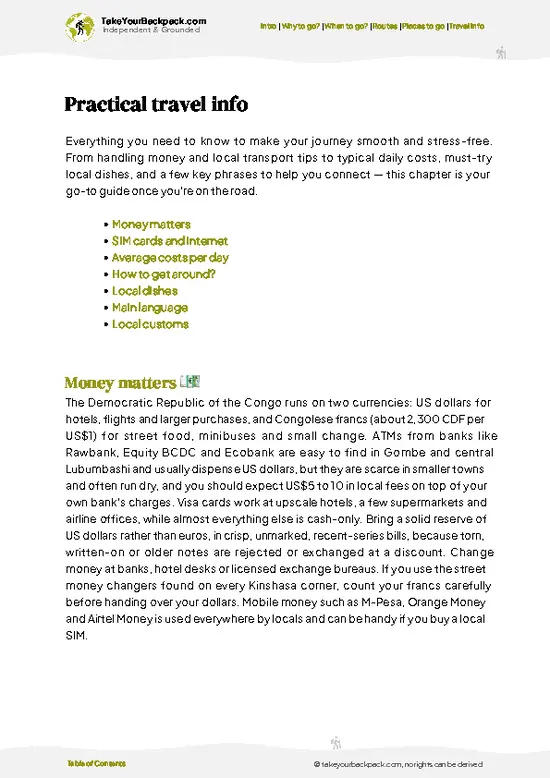
paying cash in the wrong notes. US dollars are accepted nearly everywhere, but notes older than about 2013 or with tears or marks are often refused or discounted. Bring crisp bills in mixed denominations. ATMs are scarce and unreliable outside large cities, and cards work only in a few hotels. Prices in Congolese francs are usually pegged informally to dollars, and rates shift, so confirm in dollars first.
Delays that catch people out: Visa processing, permit confirmation and domestic flights all slip. Apply for the visa weeks ahead and carry your yellow fever certificate in hand, since officials do ask for it. Book park permits only through the operator or authority listed on its official site, and keep email confirmations printed. Domestic airlines cancel and reshuffle often, so reconfirm 24 hours ahead and never plan a same-day international connection after a domestic leg. Keep two spare days at the end.
Safety and conduct: Security is the deciding factor. Armed groups remain active in parts of the east, and the situation has changed fast, closing airports and roads. Read government advisories and talk to a reputable local operator within the week before travel, and buy insurance that explicitly covers the regions you plan to enter. In cities, avoid walking after dark and use hotel-arranged taxis.
Police and soldiers at checkpoints may ask for papers, fees or gifts. Keep copies of your passport and visa, stay calm, be polite and never hand over originals. Photographing government buildings, airports, bridges and military sites can lead to detention, so ask first and keep cameras away. Ask permission before photographing people too, and expect some to refuse or ask for payment.
Greet before you ask for anything, a handshake and a few words of French, Lingala or Swahili go far. Dress modestly, particularly in rural and church-going communities, and avoid public displays of affection. Do not discuss politics or conflict casually with strangers. Carry a basic medical kit and malaria prophylaxis, and know that hospitals outside the capital are limited. Never drink untreated water. Spending extra on a trusted operator and a good driver is the one place where cutting costs usually backfires.

 Best Backpacking
 Hi, I’m Johan (Netherlands 🇳🇱), the creator of TakeYourBackpack. Over the past 3 decades, I’ve backpacked through 90+ countries across six continents, gaining extensive experience with independent travel, long-term trips, and overland routes.