×

DR Congo🇨🇩 | townsManonotin mining, ruined factories, lakeside setting | things to do and best time to go

Explore WambaExplore Kasumbalesa

Backpacking in Manono
🌟 Highlighttown ranked #4
By Johan Kruseman 🇳🇱 | Updated September 3, 2026

Most guides skip this: Manono, despite its battered mining-town reputation, is one of the rare places in DR Congo where the night sky actually glows—no city glare, just a sweep of stars and the low hum of the bush. You’ll find Manono in the southeast, in Tanganyika Province, a long way from the capital’s chaos. The town itself is raw and honest: red-dust roads, the metallic tang of old industry, and a river that’s more lifeline than postcard. It’s not a place for urban thrills—think more slow evenings, a few basic guesthouses, and the kind of market where you’ll haggle for cassava with a smile. Manono works best as a launchpad for river trips or as a necessary pause between the bigger, busier hubs like Kalemie or Kamina. Getting here is a test of patience—bumpy bush taxis, sometimes riverboats, rarely a straight shot. You’ll meet more aid workers than backpackers, but that means every traveler stands out, and locals are curious, not jaded. Costs are low, but logistics can eat time and energy. Compared to Kalemie, Manono is quieter, less scenic, but more real—if you want to see the bones of DR Congo, this is it.

Discover everything you want to know in the 📖 DR Congo Travel Guide.
Safety warning

The current risk level for DR Congo is high. Check the advice before going.


Get your DR Congo guide
95 ranked highlights, routes & tips, works offline (372 pages)
Loading the map 🌍
CLICK TO FILTER
cities
towns
landmarks
national parks
hikes
beaches
attractions
festivals
regions
SHOW COUNTRY’S BESTSHOW ALL

✨ Why go?
Ranked #4 town in DR Congo
Why visitors keep coming back

Backpackers flock to Manono in the DR Congo for its strategic location near stunning hikes and tranquil beaches. The walkable streets invite exploration, while small-scale guesthouses offer a cozy base to recharge. You’ll find local food stalls serving up hearty meals that reflect the region’s culture. Travelers often linger a few days, soaking in the friendly atmosphere and connecting with fellow adventurers. It’s a haven for slow travelers and solo explorers seeking a blend of nature and community. If you’re after a quick stop, you might miss the deeper connections waiting to be made.
Want to include Manono in your DR Congo route?
Create a personalized DR Congo itinerary that includes Manono and the places that fit your trip — based on your travel style, budget, and available time. Get your route in seconds.

Generate my trip

💡 HighlightsWhat this place is best known for

  • Marché central de Manono (the central market) — The best place to feel the town’s pulse: stalls selling fresh produce, dried fish, charcoal, second-hand clothes and the informal traders who keep the local economy moving. Great for people-watching, bargaining practice and picking up simple snacks for the road.
  • Remains of the colonial-era administrative quarter — A cluster of older masonry buildings, former offices and the town hall area bearing visible colonial-era architecture. Visiting these structures gives a sense of Manono’s history as an administrative and mining hub and is good for slow wandering and photography (ask locally before photographing officials).
  • Old tin-processing works and mine tailings — The derelict concentrator buildings, sluices and tailings piles on the edge of
read more 👉
  • Marché central de Manono (the central market) — The best place to feel the town’s pulse: stalls selling fresh produce, dried fish, charcoal, second-hand clothes and the informal traders who keep the local economy moving. Great for people-watching, bargaining practice and picking up simple snacks for the road.
  • Remains of the colonial-era administrative quarter — A cluster of older masonry buildings, former offices and the town hall area bearing visible colonial-era architecture. Visiting these structures gives a sense of Manono’s history as an administrative and mining hub and is good for slow wandering and photography (ask locally before photographing officials).
  • Old tin-processing works and mine tailings — The derelict concentrator buildings, sluices and tailings piles on the edge of town are a tangible reminder of the huge tin/coltan era. It’s a gritty, evocative place that tells the economic story of Manono — best seen with a local fixer for safety and context.
  • Artisanal mining zones near the town perimeter — Visiting small-scale miners and their pits (with permission and a guide) offers one of the most authentic and educational experiences: you’ll see how people extract and sort ore, get a raw look at local livelihoods, and can discuss the social and environmental trade-offs firsthand.
  • Main Catholic parish / mission compound — Like many towns in this part of the DRC, Manono’s mission compound remains an active social hub: church services, clinics or schools are often open to visitors. The compound gives insight into the role of faith-based institutions in healthcare and education here.
  • Manono airstrip and control shed — The small airstrip is a physical link to the outside world and makes for an interesting visit if you’re curious about regional transport. Watching arrivals and departures (and chatting with pilots or freight handlers) shows how goods and people still connect this remote town to larger centers.
  • Lukushi riverbank and local fishing spots — The nearby river edge inside the municipal area is where fishermen and women work in the mornings. It’s peaceful, photographic and gives a sense of local foodways — plus it’s a pleasant place to catch sunset light over the water.
  • Community meeting square / football pitch — Public life in Manono often centers on a dusty square or pitch where kids play, traders gather and informal meetings happen. Drop in on a match or a market-day crowd to see everyday social life in motion and to strike up conversations with residents.
  • Local artisan and metal-work workshops — Small welding shops, blacksmiths and tool-makers keep a lot of the town running. Watching a craftsman shape metal or repair equipment is an unglamorous but revealing way to understand local skills and the resourcefulness of people who live far from supply chains.
  • Older cemetery with colonial and communal graves — The town cemetery contains graves that reflect Manono’s layered history: missionary, colonial and local community burials. Visiting respectfully offers perspective on local genealogy and the passage of generations in a place shaped by mining booms and busts.
A few real, visitable highlights outside Manono that make good day trips: the wider Manono mine areas (Kitotolo/Manono deposit surrounds), nearby river villages along the Lukushi for fishing and village visits, and short drives to surrounding artisanal mining camps—each reachable with a local guide.
Spotted a mistake or missing something? Contact us.

🏘️ NeighborhoodsUnderstanding the local layout

Manono is a vibrant hub in DR Congo, offering a unique blend of local culture and accessibility for backpackers. Here’s how to navigate its neighborhoods:

Centre Ville: This is the heart of Manono. Expect a lively atmosphere with bustling markets and street vendors. It’s walkable, making it easy to explore on foot. Costs are moderate, and you’ll find a mix of budget accommodations. Nightlife is low-key, with local bars offering a taste of Congolese music.

Quartier Kasaï: A quieter area, perfect for longer stays. It has a more residential vibe, with fewer tourists. The cost of living is lower here, and you can find homestays that provide a genuine local experience. Public transport is accessible, but walking is best for soaking in the surroundings.

Quartier Ngaliema: This neighborhood is … read more 👉
Manono is a vibrant hub in DR Congo, offering a unique blend of local culture and accessibility for backpackers. Here’s how to navigate its neighborhoods:

Centre Ville: This is the heart of Manono. Expect a lively atmosphere with bustling markets and street vendors. It’s walkable, making it easy to explore on foot. Costs are moderate, and you’ll find a mix of budget accommodations. Nightlife is low-key, with local bars offering a taste of Congolese music.

Quartier Kasaï: A quieter area, perfect for longer stays. It has a more residential vibe, with fewer tourists. The cost of living is lower here, and you can find homestays that provide a genuine local experience. Public transport is accessible, but walking is best for soaking in the surroundings.

Quartier Ngaliema: This neighborhood is ideal for those seeking a balance of tranquility and convenience. It’s slightly more upscale, with better amenities and restaurants. While nightlife is minimal, the area is safe and great for evening strolls. Transport options are good, making it easy to venture further afield.

⌛️ 1 daySeeing the highlights in 24 hours

Manono, a small town in the heart of DR Congo, pulses with a unique blend of culture and history. Its vibrant markets and the warm smiles of locals create an inviting atmosphere that feels like a well-kept secret.

Start your morning at the bustling market in the center of town. The air is thick with the scent of fresh produce and spices. Engage with vendors selling everything from colorful fabrics to local delicacies. Grab a breakfast of *fufu* and *saka-saka*—a hearty way to fuel your day.

In the afternoon, head to the shores of Lake Tanganyika. The shimmering water reflects the sky, and you can rent a canoe for a few hours. Paddle out to enjoy the tranquility and catch glimpses of local fishermen at work. This is a slice of life that many tourists miss.

As evening approaches, stroll through … read more 👉
Manono, a small town in the heart of DR Congo, pulses with a unique blend of culture and history. Its vibrant markets and the warm smiles of locals create an inviting atmosphere that feels like a well-kept secret.

Start your morning at the bustling market in the center of town. The air is thick with the scent of fresh produce and spices. Engage with vendors selling everything from colorful fabrics to local delicacies. Grab a breakfast of *fufu* and *saka-saka*—a hearty way to fuel your day.

In the afternoon, head to the shores of Lake Tanganyika. The shimmering water reflects the sky, and you can rent a canoe for a few hours. Paddle out to enjoy the tranquility and catch glimpses of local fishermen at work. This is a slice of life that many tourists miss.

As evening approaches, stroll through the lively neighborhood of Kanyama. Street food vendors start to set up, filling the air with the aroma of grilled fish and fried plantains. Find a spot to sit, savor the flavors, and soak in the rhythm of the town as the sun sets, painting the sky in hues of orange and purple. This day in Manono isn’t just a visit; it’s an experience that connects you to the heart of DR Congo.
Turn your Manono visit into an DR Congo adventure
Build a complete DR Congo route with Manono, hidden gems, must-see destinations, and realistic travel times included.

Generate my trip

🌤️ When to go?Seasonal considerations and timing


  • Topic: Weather – Manono’s climate swings between a wet season from October to May and a dry season from June to September. The dry months bring clearer skies and less mud, making trails easier and the air less humid, which is a blessing for backpackers.

  • Topic: Temperature – Expect daytime highs around 28-30°C (82-86°F) during the dry season, with cooler nights dipping to 18-20°C (64-68°F). The wet season feels hotter and stickier, often pushing 32°C (90°F) with heavy, oppressive humidity.

  • Topic: Daylight Hours – Near the equator, daylight stays steady year-round, roughly 12 hours a day. This consistency means you can plan hikes and activities without worrying about early sunsets messing with your schedule.

  • Topic: Crowds – Manono isn’t a tourist hotspot, so crowds are minimal year-round.
read more 👉

  • Topic: Weather – Manono’s climate swings between a wet season from October to May and a dry season from June to September. The dry months bring clearer skies and less mud, making trails easier and the air less humid, which is a blessing for backpackers.

  • Topic: Temperature – Expect daytime highs around 28-30°C (82-86°F) during the dry season, with cooler nights dipping to 18-20°C (64-68°F). The wet season feels hotter and stickier, often pushing 32°C (90°F) with heavy, oppressive humidity.

  • Topic: Daylight Hours – Near the equator, daylight stays steady year-round, roughly 12 hours a day. This consistency means you can plan hikes and activities without worrying about early sunsets messing with your schedule.

  • Topic: Crowds – Manono isn’t a tourist hotspot, so crowds are minimal year-round. However, the dry season sees a slight uptick in local visitors and traders, adding a bit of lively atmosphere without overwhelming the town.

  • Topic: Seasonal Activities – The dry season is prime for exploring the surrounding landscapes and wildlife spotting. Wet months can flood paths and limit access, but they also bring lush greenery and fewer insects if you’re up for a wetter adventure.

  • Topic: Price Fluctuations – Prices for lodging and local transport tend to rise slightly during the dry season due to increased demand. The wet season offers better bargains but at the cost of comfort and accessibility.


Pro-tip: Aim for late dry season (August-September) when the air is crisp, trails are firm, and prices haven’t peaked—this window balances comfort, cost, and the full Manono experience.


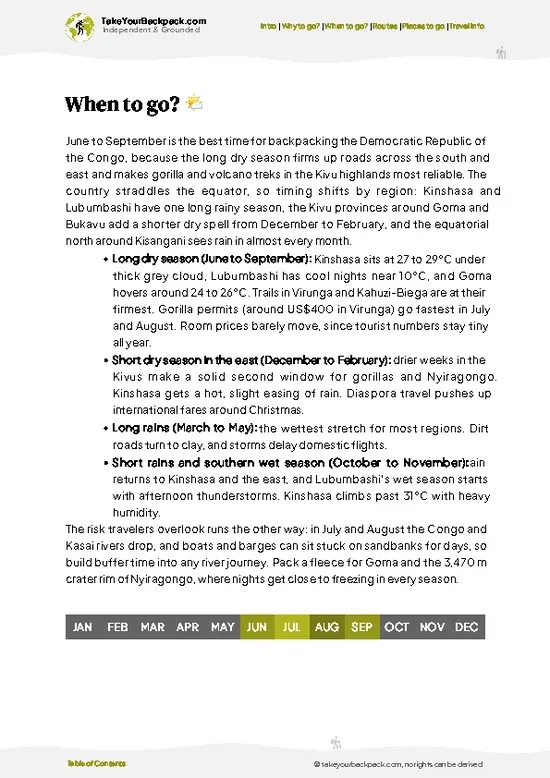
source: climatestotravel.comJANJanuary: fair for travelingFEBFebruary: fair for travelingMARMarch: fair for travelingAPRApril: fair for travelingMAYMay: fair for travelingJUNJune: highly recommended for travelingJULJuly: highly recommended for travelingAUGAugust: excellent for travelingSEPSeptember: excellent for travelingOCTOctober: good for travelingNOVNovember: fair for travelingDECDecember: fair for traveling
when-to-go

✈️ The backpacker research shortcutDR Congo Travel Guide

An offline-friendly backpacking guide with optimized travel routes, ranked highlights, transport advice, and the best areas to stay.
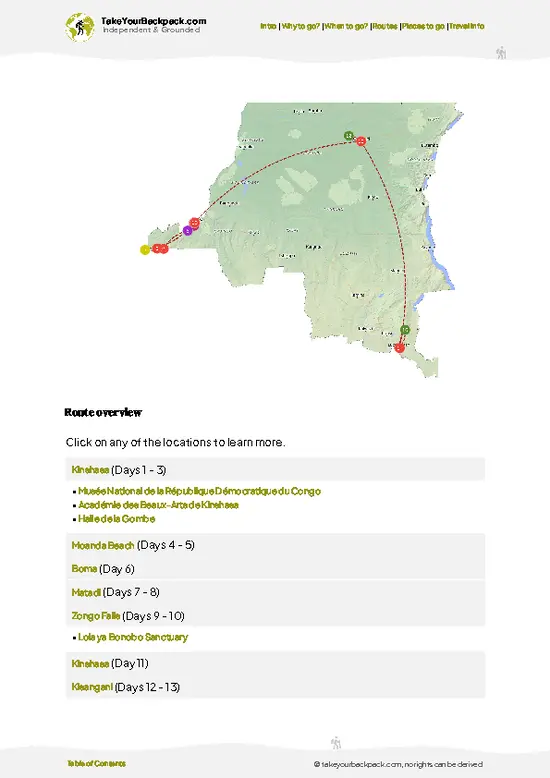
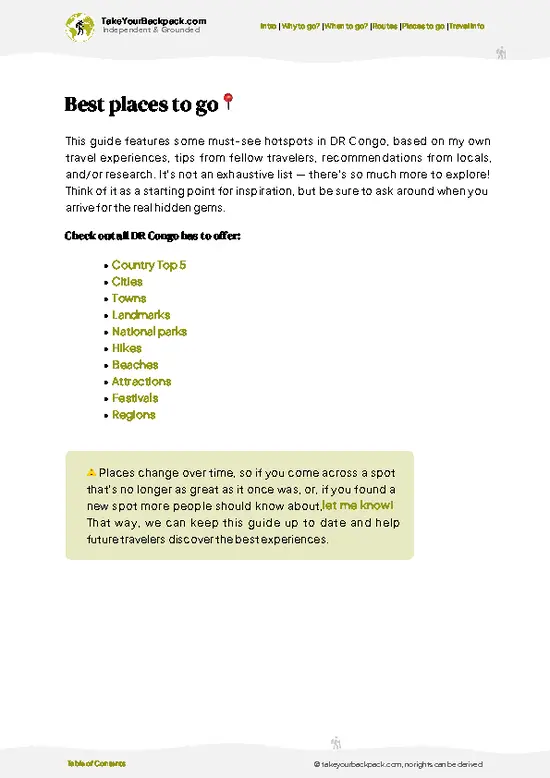
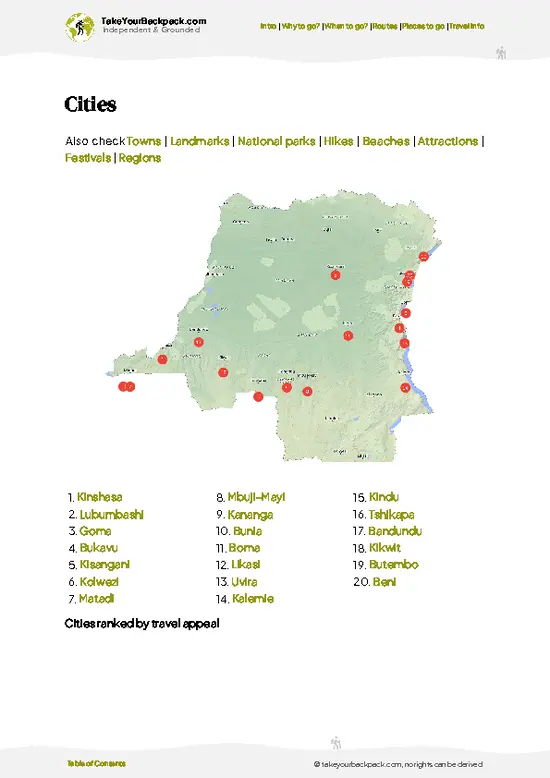
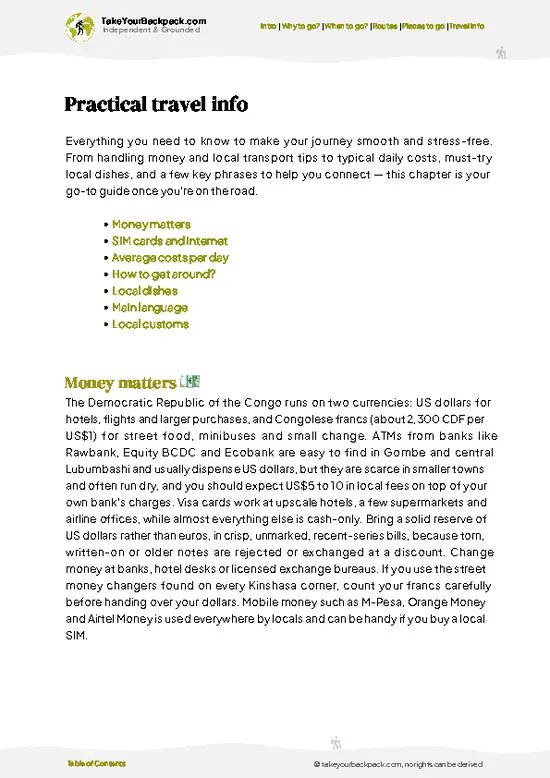
example page 0 from our offline Travel Guide for Democratic Republic of the Congo
example page 1 from our offline Travel Guide for Democratic Republic of the Congo
example page 2 from our offline Travel Guide for Democratic Republic of the Congo
example page 3 from our offline Travel Guide for Democratic Republic of the Congo
example page 4 from our offline Travel Guide for Democratic Republic of the Congo
example page 5 from our offline Travel Guide for Democratic Republic of the Congo
example page 6 from our offline Travel Guide for Democratic Republic of the Congo
example page 7 from our offline Travel Guide for Democratic Republic of the Congo
The digital guide (372 pages) contains:
95 highlights, ranked by travel appeal
Optimized 7, 14 & 21-day travel routes
Cities, national parks, landmarks, beaches
How to get around
Offline-friendly for travel without Wi-Fi
👉 Click to see all 30+ guide features

📅 Plan smarter in minutes, not weeks
Month by month travel advice
Festivals & national holidays
Budget expectations

🗺️ Go to the right places, skip the overrated ones
Honest pros & cons of destinations
Top hikes, parks & viewpoints
Lesser-known places most travelers miss
Clear “worth it vs skip it” guidance

🛏️ Travel smoothly without rookie mistakes
Best areas to stay
Transport systems explained simply
Common scams & safety advice
SIM cards, money & practical tips

🌍 Understand the country, not just visit it
Culture & traditions
52 Essential phrases & customs
Festivals worth planning around
Traveler-friendly historical context
Insights that make places more meaningful

📱 Built for real travel conditions
Fully downloadable PDF
Works completely offline
Optimized for phone use
Useful in remote areas & buses
Everything in one place
Save weeks of stressful planning
Get instant access to your full guide. 30‑day money-back guarantee.
+ Add another guide for just US$7.80

By proceeding you agree to our terms.
Sent to your inbox immediately after payment • 100% Secure Checkout
Best Backpacking Travel Advisor 2025 tourism awardBest Backpacking
Travel Advisor
2025
What others say about Take Your Backpack Guides:
⭐⭐⭐⭐⭐
Fantastic, amazing amount of information!
⭐⭐⭐⭐⭐
My goodness this is amazing, it's what I've been looking for hats off too you!
⭐⭐⭐⭐⭐
I think this is absolutely BRILLIANT
⭐⭐⭐⭐
Very complete and informative. It's still missing places, but I gotta to commend you
⭐⭐⭐⭐⭐
This is truly amazing, thank you, can't wait to explore it with my kids!
⭐⭐⭐⭐⭐
Awesome resource, thank you!
⭐⭐⭐⭐⭐
This is amazing! Can't wait to explore the ones I haven't seen
⭐⭐⭐⭐
I love this! Well done, great idea.
⭐⭐⭐⭐⭐
Thanks for taking the time to make this gem!
⭐⭐⭐⭐⭐
This might be the best website I've ever seen.
⭐⭐⭐⭐⭐
Congratulations, and thank you so much for your work; it's incredibly valuable.
⭐⭐⭐⭐
In all seriousness I think you did a great job pointing out the important spots
⭐⭐⭐⭐⭐
10/10 very good
⭐⭐⭐⭐⭐
As someone who's only just starting to visit regularly this is awesome, thank you.
⭐⭐⭐⭐
Thank you very much! I'm going to visit my dad, it's going to be very useful!
⭐⭐⭐⭐⭐
This is really cool! We'll be travelling for the first time and this definitely come in handy.
⭐⭐⭐⭐⭐
You are now our minister of culture, congratulations 👨‍💼
⭐⭐⭐⭐⭐
Just wanted to tell you that this is a pearl! Going to follow your recommendations.
⭐⭐⭐⭐⭐
This is so cool. I'll definitely be using the resource for my travels soon.
⭐⭐⭐⭐⭐
This is very impressive! Good work.
⭐⭐⭐⭐⭐
This is an amazing and informative site. Very well done!

🛏️ Where to stay?Choosing the right base

Manono’s town center is your best bet for backpackers craving safety and social buzz. This area hums with daily market life, where the scent of fresh cassava mingles with the earthy aroma of wet soil after a rain. Staying here means you’re steps away from local eateries and informal meeting spots where travelers and locals swap stories over strong, sweet coffee. The vibe is relaxed but alive—perfect for solo backpackers who want to connect without feeling lost.

Hostel options are limited but tend to cluster near the main square, offering basic, clean dorms that encourage mingling. Venturing outside … read more 👉
Manono’s town center is your best bet for backpackers craving safety and social buzz. This area hums with daily market life, where the scent of fresh cassava mingles with the earthy aroma of wet soil after a rain. Staying here means you’re steps away from local eateries and informal meeting spots where travelers and locals swap stories over strong, sweet coffee. The vibe is relaxed but alive—perfect for solo backpackers who want to connect without feeling lost.

Hostel options are limited but tend to cluster near the main square, offering basic, clean dorms that encourage mingling. Venturing outside this core, the streets get quieter but less secure after dark, with fewer fellow travelers around. The outskirts lack the pulse of the town center, making it harder to tap into the local rhythm or find affordable, sociable lodging. So, stick close to the heart of Manono—where the light filters through mango trees and the chatter of the market spills into the evening—if you want a genuine, grounded experience without unnecessary risk.

🚌 Getting aroundHow to get around Manono

Manono in DR Congo moves at its own rhythm—less about strict timetables and more about reading the pulse of the day. The sun’s angle shifts the mood; mornings bring a dusty calm with vendors setting up stalls, while afternoons thicken with the scent of cooking fires and the chatter of locals negotiating prices. This isn’t a place where you’ll find neat schedules pinned to walls. Instead, transport here is a dance of intuition, patience, and local know-how. Understanding this flow means you don’t just get from A to B—you glide through the town’s heartbeat, turning what could be a frustrating wait into a moment of connection.


  • Walking: The most reliable and immersive way to get around Manono. Streets are compact but uneven, so sturdy shoes are a must. Walking lets you catch the scent of fresh
read more 👉
Manono in DR Congo moves at its own rhythm—less about strict timetables and more about reading the pulse of the day. The sun’s angle shifts the mood; mornings bring a dusty calm with vendors setting up stalls, while afternoons thicken with the scent of cooking fires and the chatter of locals negotiating prices. This isn’t a place where you’ll find neat schedules pinned to walls. Instead, transport here is a dance of intuition, patience, and local know-how. Understanding this flow means you don’t just get from A to B—you glide through the town’s heartbeat, turning what could be a frustrating wait into a moment of connection.


  • Walking: The most reliable and immersive way to get around Manono. Streets are compact but uneven, so sturdy shoes are a must. Walking lets you catch the scent of fresh cassava bread and hear the rhythm of daily life up close, all at your own pace and zero cost.

  • Bicycle Taxi (Vélo-Taxi): These are the town’s unofficial speed demons, weaving through narrow lanes with surprising agility. Expect to pay around $0.50–$1 per ride. They operate from dawn until dusk but don’t expect a fixed schedule—flag one down when you see it, and be ready for a bumpy but quick ride.

  • Shared Minibus (Taxi-Brousse): For trips beyond the town center, these minibuses are your budget workhorse. They leave when full, which can mean waits ranging from minutes to hours. Fares are cheap, roughly $1–$2 depending on distance, but comfort is minimal and the ride can be noisy and crowded.

  • Motorcycle Taxi (Moto-Taxi): Faster and more flexible than bicycle taxis, these are perfect for squeezing through traffic or reaching spots off the beaten path. Prices hover around $1–$2. Helmets aren’t always standard, so hold on tight and brace for the dust and wind.

👛 Costs (as of 3 September 2026)Money, prices, and spending tips

Backpacking in Manono, DR Congo, means embracing a raw, off-the-grid vibe where costs stay modest but the experience is rich in local color and challenge. Here’s what you can expect to spend day-to-day:
  • Dorm Accommodation: Options are limited and basic, often guesthouses or small lodges with shared rooms. Expect to pay around €5 to €10 per night. These places rarely have fancy amenities, but they offer a clean bed and a chance to connect with locals or fellow travelers.
  • Meals: Street food and small local eateries dominate. A simple meal of grilled fish or chicken with rice or cassava will run you about €1 to €3. If you opt for something more substantial or a Western-style meal, prices can climb to €5, but that’s rare and usually in more tourist-focused spots.
  • Local Transport: Transport
read more 👉
Backpacking in Manono, DR Congo, means embracing a raw, off-the-grid vibe where costs stay modest but the experience is rich in local color and challenge. Here’s what you can expect to spend day-to-day:
  • Dorm Accommodation: Options are limited and basic, often guesthouses or small lodges with shared rooms. Expect to pay around €5 to €10 per night. These places rarely have fancy amenities, but they offer a clean bed and a chance to connect with locals or fellow travelers.
  • Meals: Street food and small local eateries dominate. A simple meal of grilled fish or chicken with rice or cassava will run you about €1 to €3. If you opt for something more substantial or a Western-style meal, prices can climb to €5, but that’s rare and usually in more tourist-focused spots.
  • Local Transport: Transport is mostly informal—shared taxis or motorbike taxis (boda-bodas). Short rides cost around €0.50 to €1. Longer trips within or near town might push up to €2. Walking is often the best way to soak in the atmosphere and save money.
  • Basic Activities/Entry Fees: Manono isn’t a hotspot for paid attractions. If you visit local markets or community events, entry is usually free or a small donation of less than €1. Any guided tours or special activities, if available, might cost €5 to €10, but these are rare and usually arranged locally.
  • Miscellaneous Expenses: This covers bottled water, snacks, phone credit, or small tips. Budget around €1 to €3 daily. Bottled water is essential due to limited safe drinking options, and phone credit is cheap but necessary for navigation or communication.

Overall, you’re looking at a daily budget roughly between €8 and €20. The low cost reflects the simplicity and limited infrastructure, but it’s exactly this stripped-back environment that lets you dive deep into the authentic rhythms of Manono life. The modest price tag is your ticket to a place where every euro stretches far, and every moment feels earned.


source: congotourisme.org
⚠️ Prices can change and everyone travels differently, so take this as a rough guide. Hope it helps you plan your adventure!

🚌 Day tripsEasy escapes and nearby places

Manono is a fantastic base for exploring the rich landscapes and cultures of the DR Congo. Here are some day trips that will elevate your experience.

Lake Tanganyika Adventure
Just a short boat ride from Manono, Lake Tanganyika offers stunning views and a chance to swim in its crystal-clear waters. Spend the day lounging on the sandy shores or exploring nearby fishing villages. The trip typically takes about 30 minutes, and you can expect to spend around $10 for the boat ride and snacks. The best time to visit is during the dry season, from May to September, when the weather is perfect. A common mistake is underestimating the sun; pack sunscreen and a hat to avoid a painful burn.
👉 Explore Lake Tanganyika

Katanga Mines Tour
Dive into the industrial heart of the region with a visit … read more 👉
Manono is a fantastic base for exploring the rich landscapes and cultures of the DR Congo. Here are some day trips that will elevate your experience.

Lake Tanganyika Adventure
Just a short boat ride from Manono, Lake Tanganyika offers stunning views and a chance to swim in its crystal-clear waters. Spend the day lounging on the sandy shores or exploring nearby fishing villages. The trip typically takes about 30 minutes, and you can expect to spend around $10 for the boat ride and snacks. The best time to visit is during the dry season, from May to September, when the weather is perfect. A common mistake is underestimating the sun; pack sunscreen and a hat to avoid a painful burn.
👉 Explore Lake Tanganyika

Katanga Mines Tour
Dive into the industrial heart of the region with a visit to the Katanga mines. This trip reveals the gritty reality of mineral extraction, showcasing both the challenges and the livelihoods it supports. It’s about an hour’s drive from Manono, costing around $15 for transport. Aim for early morning visits to beat the heat and catch the workers in action. Many first-timers overlook the importance of local guides; they provide invaluable context and ensure you respect the area.


Chikapa Waterfalls
A hike to Chikapa Waterfalls is a must for nature lovers. The journey takes about two hours, winding through lush greenery and vibrant wildlife. Expect to spend around $5 on transport and snacks. The rainy season, from October to April, makes the falls particularly impressive, but be cautious of slippery trails. Many backpackers miss the chance to bring a picnic; the view from the falls is the perfect backdrop for a meal.
Want to know what more DR Congo offers?
The DR Congo Travel Guide describes 95 highlights, from cities to national parks, from beaches to hikes

Get the Travel Guide -

🛡️ SafetyTraveler Safety Guide

Manono is generally safe, but staying aware enhances your experience. Stick to well-lit areas at night; the streets can feel empty, and a little caution goes a long way. Solo travelers should blend in—dress modestly and engage with locals to build rapport.

Watch for common scams, like overcharging for transport; always agree on a fare beforehand. Everyday annoyances, like persistent vendors, can be managed with a polite but firm “no, thank you.” Carry yourself confidently, and you’ll navigate the town smoothly.

FAQCommon questions from travelers

Manono is primarily a stopover rather than a destination for extended visits due to limited tourist infrastructure and attractions. It serves as a practical rest point for travelers moving through the region or those interested in local mining history.
You need 1 to 2 days in Manono to cover the main points of interest, including local markets and nearby mining sites. This timeframe allows for basic exploration without rushing, given the town's small size and limited activities.
No, Manono cannot be easily visited as a day trip from a nearby city because of poor road conditions and long travel times. The nearest larger town is several hours away, making overnight stays necessary for practical travel.
⚠️ Things can change over time, so always validate details locally before you go.

Other Congolese towns near Manono

Explore more nearby:

  • Kongolo—Lualaba River bridge, rail crossing, local markets| 217 km away
  • Kasumbalesa—major border crossing, customs zone, truck stop| 553 km away
  • Sakania—rail border crossing, copper belt, small town| 620 km away

💡 Not sure where to go next?
Create a personalized itinerary for DR Congo including Manono and the places that fit your trip.

Generate my itinerary

👉 Discover all towns

Or checkout all DR Congo has to offer (think cities, towns, villages, national parks, hikes, beaches, festivals)
Country photo of DR Congo

We 💚 feedbackWhat to keep in mind

Manono is raw and real, a place where the air hums with life. The surprise? The warmth of the locals; they’ll share stories over a simple meal. Just be ready for the heat—stay hydrated and embrace the slow pace. It’s worth it.

✍️ Help improve this page!
The information on this page is based on in-depth research, insights shared by experienced travelers, and feedback from the local travel community in DR Congo. While every effort is made to keep the information accurate and current, conditions can change — so if you spot anything incorrect or outdated, please get in touch.


🙋‍♂️ Give feedback

👋 Meet the founderWho’s Behind Take Your Backpack?

Johan, backpacker and founder of TakeYourBackpackHi, I’m Johan (Netherlands 🇳🇱), the creator of TakeYourBackpack. Over the past decade, I’ve backpacked through 80+ countries across six continents, gaining extensive experience with independent travel, long-term trips, and overland routes.

This site is built on a combination of firsthand travel experience and carefully curated insights from other backpackers. Many guides are based on places I’ve personally visited, while others bring together tips, observations, and practical advice shared by trusted travelers I’ve met along the way.

The goal is to provide realistic, experience-driven guidance — not generic itineraries — so you can explore destinations with better context, clearer expectations, and more confidence.

Get full DR Congo guide •
Instant download • 95 highlights • Full Offline guide