×

Djibouti🇩🇯 | national parksDay Forest National ParkJuniper and boxwood forest, Djibouti francolin, goat-track trails, Day village | things to do and best time to go

Explore Ghoubbet Bay TrailExplore Goda Mountains

Backpacking in Day Forest
🏆 Top picknational park ranked #1
By Johan Kruseman 🇳🇱 | Updated October 22, 2026

Day Forest National Park gives you a cool, shaded day in a country where most of the land is bare rock and heat. It sits in the Goda Mountains in the north of Djibouti, above the Gulf of Tadjoura. Here the road climbs into a highland of old juniper and boxwood, and the air smells of resin instead of salt. Trails are footpaths and goat tracks, often loose and stony underfoot, and they lead to rims where the land drops away toward the gulf. Baboons cross the paths, and with luck you may hear the Djibouti francolin, a rare local bird. Tracks to the park are rough, signage is thin, and you will do better with a local guide than a map. Crowds are almost nonexistent, which suits the quiet mood, though services are basic. Unlike the coastal marine parks of the Gulf of Tadjoura, which are about water and reef, Day Forest National Park is about shade, altitude and dry mountain woodland.

Discover everything you want to know in the 📖 Djibouti Travel Guide.


example page 0 from our offline Travel Guide for Djibouti
example page 1 from our offline Travel Guide for Djibouti
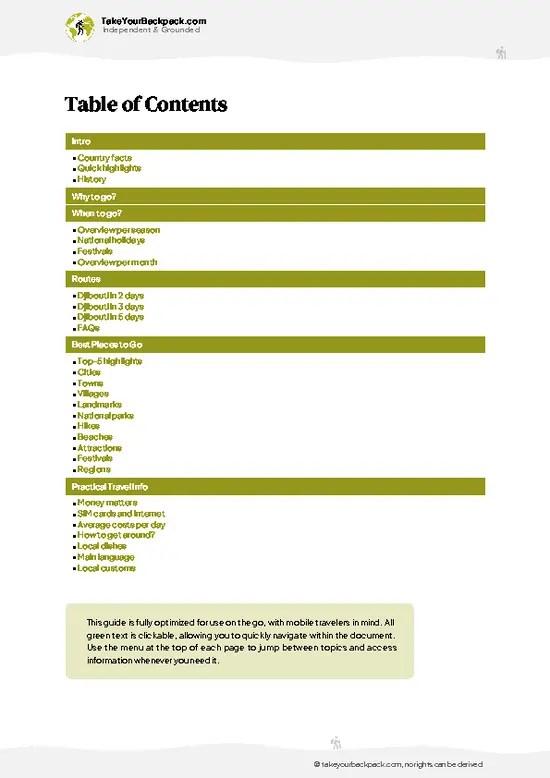
example page 2 from our offline Travel Guide for Djibouti
example page 3 from our offline Travel Guide for Djibouti
example page 4 from our offline Travel Guide for Djibouti
example page 5 from our offline Travel Guide for Djibouti
example page 6 from our offline Travel Guide for Djibouti
example page 7 from our offline Travel Guide for Djibouti
Loading the map 🌍
CLICK TO FILTER
cities
towns
villages
landmarks
national parks
hikes
beaches
attractions
festivals
regions
SHOW COUNTRY’S BESTSHOW ALL

✨ Why go?
Ranked #1 national park in Djibouti
What makes this national park worth exploring

Day Forest National Park is one of the few places in Djibouti where you can walk for hours without a flat desert horizon in front of you. Backpackers choose it for two reasons. The first is the climate: the Goda Mountains highland stays noticeably cooler than the coast and the lava plains, so a full day on foot is realistic rather than punishing. The second is the ecology. The park protects one of the last stands of African juniper and wild olive forest in the country, and it is home to the Djibouti francolin, a ground-dwelling bird found almost nowhere else, which keen birders come a long way to hear. The place suits independent walkers who are comfortable with loose, unmarked ground and a little improvisation. Villages such as Day and Randa are small, and the pace is set by the people who … read more 👉
Day Forest National Park is one of the few places in Djibouti where you can walk for hours without a flat desert horizon in front of you. Backpackers choose it for two reasons. The first is the climate: the Goda Mountains highland stays noticeably cooler than the coast and the lava plains, so a full day on foot is realistic rather than punishing. The second is the ecology. The park protects one of the last stands of African juniper and wild olive forest in the country, and it is home to the Djibouti francolin, a ground-dwelling bird found almost nowhere else, which keen birders come a long way to hear. The place suits independent walkers who are comfortable with loose, unmarked ground and a little improvisation. Villages such as Day and Randa are small, and the pace is set by the people who herd goats along the same ridges you are walking. You get a quiet, unpackaged look at the interior of the country, away from the tour-bus circuit around the salt lakes.

💡 HighlightsMust-see experiences and standout moments

  1. The juniper and boxwood forest: The park's defining feature is a high canopy of ancient African juniper mixed with boxwood, wild olive and tall shrubs. It is dark and cool under the trees, with a carpet of needles and lichen hanging from the branches, which is a sharp contrast to the volcanic country below.
  2. Djibouti francolin habitat: This critically endangered, ground-dwelling bird lives in the thickest parts of the forest. You are far more likely to hear its call than to see it, but even a short listen makes the effort feel worthwhile for birders.
  3. Goda Mountains ridge viewpoints: On clear days the rims open to wide views across the highland and down toward the Gulf of Tadjoura. The drop from forest to dry scrub below is abrupt and easy to read from the edge.
  4. Day village and its surroundings:
… read more 👉
  1. The juniper and boxwood forest: The park's defining feature is a high canopy of ancient African juniper mixed with boxwood, wild olive and tall shrubs. It is dark and cool under the trees, with a carpet of needles and lichen hanging from the branches, which is a sharp contrast to the volcanic country below.
  2. Djibouti francolin habitat: This critically endangered, ground-dwelling bird lives in the thickest parts of the forest. You are far more likely to hear its call than to see it, but even a short listen makes the effort feel worthwhile for birders.
  3. Goda Mountains ridge viewpoints: On clear days the rims open to wide views across the highland and down toward the Gulf of Tadjoura. The drop from forest to dry scrub below is abrupt and easy to read from the edge.
  4. Day village and its surroundings: A small settlement of stone and wood houses at the forest's edge, where goats and donkeys share the lanes. It is the practical starting point for most walks, and the place to find local walking companions.
  5. Hamadryas baboon troops: Baboons move through the rocks and trees in noisy groups, often easiest to spot along the rougher slopes at the park margins. They keep their distance, but they are loud and entertaining.
  6. The Goda summit slopes: The higher ground above the forest rises toward the Goda massif, among the highest terrain in Djibouti at around 1,700 meters. The walking here is steep and rocky, with sparse cover and a long view over the park.
  7. Randa and the road through the highlands: The drive up, with its switchbacks, cooler air and shifting vegetation, is itself a highlight. Randa is a small highland town with simple stops for tea and basic food.
Day Forest National Park has no single ticketed attraction, but a local guide for the forest walks is best arranged ahead through Randa, Day village or a Djibouti operator.
Spotted a mistake or missing something? Contact us.

Things to do near Day Forest National Park

Ratings based on Tripadvisor reviews. When you book through this link, you support our work at no extra cost to you.

🌤️ When to go?Choosing the right time of year

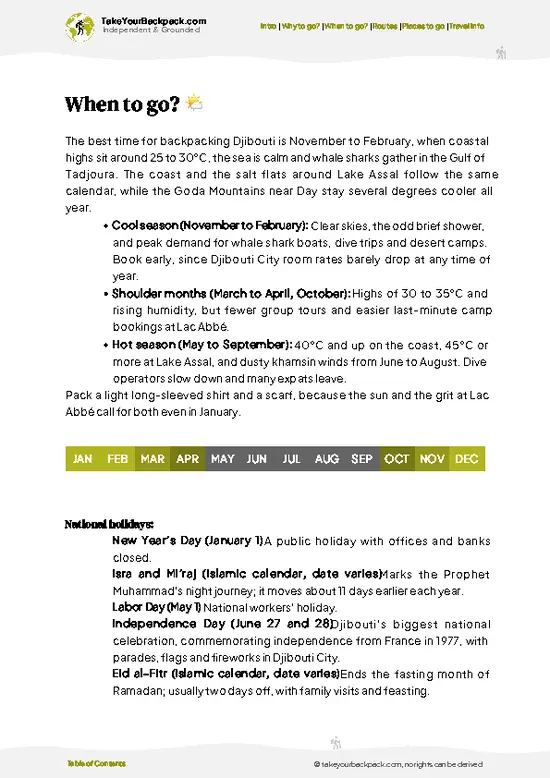
Day Forest National Park is best walked between November and March, when daytime highs in the Goda Mountains sit around 20 to 28°C (68 to 82°F).
  • Cool Season (November to March): Mornings on the plateau can drop to 12 to 16°C (54 to 61°F), and hiking is comfortable all day. Daylight runs roughly 11 to 12 hours. This is peak season, so expect more 4x4 tour groups and higher guide and vehicle rates, especially around December and January.
  • Hot Season (May to September): Lowland roads and the drive up from the coast reach 35 to 42°C (95 to 108°F). The forest at about 1,500 meters stays milder, around 25 to 32°C (77 to 90°F), but humidity and haze flatten the views. Prices soften and you may have trails to yourself.
  • Rains (sporadic, March to April and again in autumn): Showers are short and unreliable,
… read more 👉
Day Forest National Park is best walked between November and March, when daytime highs in the Goda Mountains sit around 20 to 28°C (68 to 82°F).
  • Cool Season (November to March): Mornings on the plateau can drop to 12 to 16°C (54 to 61°F), and hiking is comfortable all day. Daylight runs roughly 11 to 12 hours. This is peak season, so expect more 4x4 tour groups and higher guide and vehicle rates, especially around December and January.
  • Hot Season (May to September): Lowland roads and the drive up from the coast reach 35 to 42°C (95 to 108°F). The forest at about 1,500 meters stays milder, around 25 to 32°C (77 to 90°F), but humidity and haze flatten the views. Prices soften and you may have trails to yourself.
  • Rains (sporadic, March to April and again in autumn): Showers are short and unreliable, yet they can turn dirt tracks slick and bring out the juniper and boxwood smell. Wildlife viewing improves slightly.
Book a driver at least a few days ahead in December and January, and start walking soon after dawn whatever the month.


source: climatestotravel.comJANJanuary: excellent for travelingFEBFebruary: excellent for travelingMARMarch: good for travelingAPRApril: fair for travelingMAYMay: fair for travelingJUNJune: below average for travelingJULJuly: below average for travelingAUGAugust: below average for travelingSEPSeptember: fair for travelingOCTOctober: good for travelingNOVNovember: excellent for travelingDECDecember: excellent for traveling
djibouti-national-park-day-forest-national-park
© Google |

✈️ The backpacker research shortcutDjibouti Travel Guide

An offline-friendly backpacking guide with optimized travel routes, ranked highlights, transport advice, and the best areas to stay.
example page 0 from our offline Travel Guide for Djibouti
example page 1 from our offline Travel Guide for Djibouti
example page 2 from our offline Travel Guide for Djibouti
example page 3 from our offline Travel Guide for Djibouti
example page 4 from our offline Travel Guide for Djibouti
example page 5 from our offline Travel Guide for Djibouti
example page 6 from our offline Travel Guide for Djibouti
example page 7 from our offline Travel Guide for Djibouti
The digital guide (186 pages) contains:
✅ 44 highlights, ranked by travel appeal
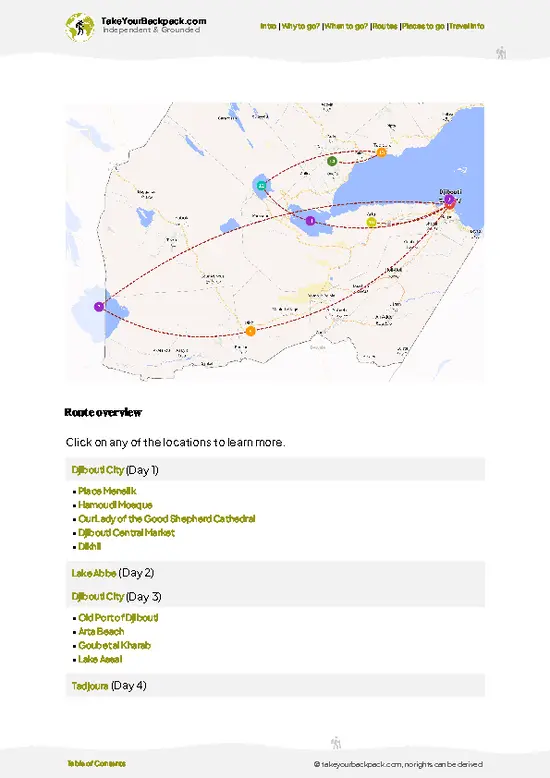
✅ Optimized 2, 3 & 5-day travel routes
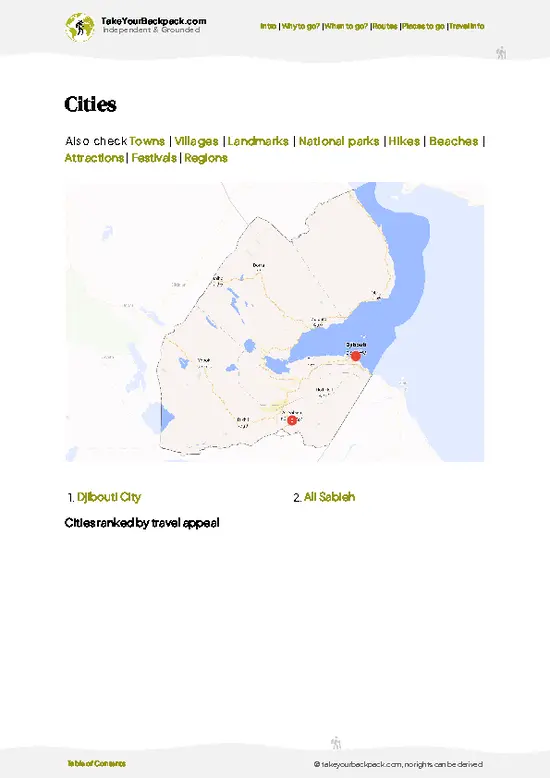
✅ Cities, national parks, landmarks, beaches
✅ How to get around
✅ Offline-friendly for travel without Wi-Fi
👉 Click to see all 30+ guide features

📅 Plan smarter in minutes, not weeks
✅ Month by month travel advice
✅ Festivals & national holidays
✅ Budget expectations

🗺️ Go to the right places, skip the overrated ones
✅ Honest pros & cons of destinations
✅ Top hikes, parks & viewpoints
✅ Lesser-known places most travelers miss
✅ Clear “worth it vs skip it” guidance

🛏️ Travel smoothly without rookie mistakes
✅ Best areas to stay
✅ Transport systems explained simply
✅ Common scams & safety advice
✅ SIM cards, money & practical tips

🌍 Understand the country, not just visit it
✅ Culture & traditions
✅ 52 Essential phrases & customs
✅ Festivals worth planning around
✅ Traveler-friendly historical context
✅ Insights that make places more meaningful

📱 Built for real travel conditions
✅ Fully downloadable PDF
✅ Works completely offline
✅ Optimized for phone use
✅ Useful in remote areas & buses
✅ Everything in one place
Stop searching, start planning
Get instant access to your full guide. 30‑day money-back guarantee.
+ Add another guide for just

By proceeding you agree to our terms.
Sent to your inbox immediately after payment • 100% Secure Checkout
Best Backpacking Travel Advisor 2025 tourism awardBest Backpacking
Travel Advisor
2025
What others say about Take Your Backpack Guides:
⭐⭐⭐⭐⭐
Fantastic, amazing amount of information!
⭐⭐⭐⭐⭐
My goodness this is amazing, it's what I've been looking for hats off too you!
⭐⭐⭐⭐⭐
I think this is absolutely BRILLIANT
⭐⭐⭐⭐
Very complete and informative. It's still missing places, but I gotta to commend you
⭐⭐⭐⭐⭐
This is truly amazing, thank you, can't wait to explore it with my kids!
⭐⭐⭐⭐⭐
Awesome resource, thank you!
⭐⭐⭐⭐⭐
This is amazing! Can't wait to explore the ones I haven't seen
⭐⭐⭐⭐
I love this! Well done, great idea.
⭐⭐⭐⭐⭐
Thanks for taking the time to make this gem!
⭐⭐⭐⭐⭐
This might be the best website I've ever seen.
⭐⭐⭐⭐⭐
Congratulations, and thank you so much for your work; it's incredibly valuable.
⭐⭐⭐⭐
In all seriousness I think you did a great job pointing out the important spots
⭐⭐⭐⭐⭐
10/10 very good
⭐⭐⭐⭐⭐
As someone who's only just starting to visit regularly this is awesome, thank you.
⭐⭐⭐⭐
Thank you very much! I'm going to visit my dad, it's going to be very useful!
⭐⭐⭐⭐⭐
This is really cool! We'll be travelling for the first time and this definitely come in handy.
⭐⭐⭐⭐⭐
You are now our minister of culture, congratulations 👨‍💼
⭐⭐⭐⭐⭐
Just wanted to tell you that this is a pearl! Going to follow your recommendations.
⭐⭐⭐⭐⭐
This is so cool. I'll definitely be using the resource for my travels soon.
⭐⭐⭐⭐⭐
This is very impressive! Good work.
⭐⭐⭐⭐⭐
This is an amazing and informative site. Very well done!

🛏️ Where to stay?How to pick the right area

The best base for Day Forest National Park is the small settlement of Day itself, with Djibouti City and Tadjoura as the larger fallback towns.
Inside the park, options are thin and simple. A few basic lodges and family-run guesthouses sit near the forest edge around Day village, offering rooms or shared huts with mattresses, plain meals and little else. Expect no reliable hot water and patchy electricity. Camping is possible with a guide’s approval, and it is the cheapest way to be on the trail at first light. Bring your own sleeping bag, since nights at roughly 1,500 meters turn cool.
Most backpackers … read more 👉
The best base for Day Forest National Park is the small settlement of Day itself, with Djibouti City and Tadjoura as the larger fallback towns.
Inside the park, options are thin and simple. A few basic lodges and family-run guesthouses sit near the forest edge around Day village, offering rooms or shared huts with mattresses, plain meals and little else. Expect no reliable hot water and patchy electricity. Camping is possible with a guide’s approval, and it is the cheapest way to be on the trail at first light. Bring your own sleeping bag, since nights at roughly 1,500 meters turn cool.
Most backpackers sleep in Djibouti City, about 2.5 to 3 hours away by road, and arrange a 4x4 and driver for a long day trip. This works, but you lose the quiet dawn hours in the forest. Guesthouses and budget hotels in the capital run about US$25 to 60 a night, and are the easiest place to find a driver, a shower and an ATM.
Tadjoura, on the Gulf coast, is another option. It is a sleepy whitewashed port with small hotels at roughly US$30 to 60, and the road to the forest climbs from there. Arrange a stay near the park through a tour operator in Djibouti City, because walk-in availability is unpredictable.

👛 Costs (as of 22 October 2026)Typical daily expenses

A realistic budget for Day Forest National Park is about US$115 to 165 per day, with the high-season total at US$130 once you add a driver and guide.
CategoryBudget RangeLocal Reality
Entrance and permitsUS$0 to 10Fees are informal or arranged through your guide or tour operator, so confirm what is included.
Accommodation (low season)US$20 to 40Simple guesthouse or hut near Day village, or a budget room in Djibouti City.
Accommodation (high season)US$30 to 50Beds fill faster from December to February, and prices rise in the capital.
Local transportUS$40 to 60A shared 4x4 and driver from Djibouti City is the practical option, so splitting it between several people cuts the cost sharply.
GuideUS$15 to 25A local guide helps with navigation and is worth hiring for forest walks.
Food and suppliesUS$10
… read more 👉
A realistic budget for Day Forest National Park is about US$115 to 165 per day, with the high-season total at US$130 once you add a driver and guide.
CategoryBudget RangeLocal Reality
Entrance and permitsUS$0 to 10Fees are informal or arranged through your guide or tour operator, so confirm what is included.
Accommodation (low season)US$20 to 40Simple guesthouse or hut near Day village, or a budget room in Djibouti City.
Accommodation (high season)US$30 to 50Beds fill faster from December to February, and prices rise in the capital.
Local transportUS$40 to 60A shared 4x4 and driver from Djibouti City is the practical option, so splitting it between several people cuts the cost sharply.
GuideUS$15 to 25A local guide helps with navigation and is worth hiring for forest walks.
Food and suppliesUS$10 to 20Rice, fish, flatbread and tea in village eateries. Bring snacks and water from the capital, where prices are lower.
Total Daily BudgetUS$115 to 165Based on high-season accommodation, a transport share, a guide and meals.
⚠️ Prices can change and everyone travels differently, so take this as a rough guide. Hope it helps you plan your adventure!

🥾 TrailsExploring Day Forest: trails, terrain, and views

Day Forest National Park offers walking on informal paths rather than signed, numbered routes, so most people go with a local guide who knows which tracks link the forest to the ridges. Walks start from Day village or the forest edge near Randa and follow goat trails into the trees.
  • Forest loop from Day village: A half-day walk of roughly 2 to 4 hours through juniper and boxwood on soft, needle-covered paths. Easy to moderate, with some uneven stretches. Shade is constant and baboons are common.
  • Ridge viewpoint walk: A moderate climb of about 3 to 5 hours return, leaving the trees for open rock
… read more 👉
Day Forest National Park offers walking on informal paths rather than signed, numbered routes, so most people go with a local guide who knows which tracks link the forest to the ridges. Walks start from Day village or the forest edge near Randa and follow goat trails into the trees.
  • Forest loop from Day village: A half-day walk of roughly 2 to 4 hours through juniper and boxwood on soft, needle-covered paths. Easy to moderate, with some uneven stretches. Shade is constant and baboons are common.
  • Ridge viewpoint walk: A moderate climb of about 3 to 5 hours return, leaving the trees for open rock on the Goda edge. The terrain is loose stone and dry grass, and the view takes in the highland and the gulf beyond.
  • Goda summit slopes: A longer, harder day on steep rocky ground above the tree line, suitable for confident walkers who are comfortable with route finding. Allow a full day and an early start.
  • Birdwatching walks: Slow, short outings through the densest forest, where listening matters more than distance. The Djibouti francolin is the target, though it is shy and rarely seen.
The terrain is a mix of leaf litter, dry streambeds and broken rock, with thorny scrub at the margins. Temperatures are lower than on the coast, but the sun is strong on the open ridges, so carry a hat and your own water; no refill points exist on the trails. Wildlife includes baboons, warthogs and a good range of birds, while larger mammals are rare and rarely encountered.

Getting to Day Forest National Park is easiest with a hired 4x4 and driver from Djibouti City or Tadjoura, since public transport to the highlands is limited and irregular. The final stretch is steep and rough. Visitors are few, so you will often have the trails to yourself. Entry arrangements are informal and handled locally, so carry small cash in Djiboutian francs and confirm any charge when you arrive.
⚠️ Hiking info can sometimes be outdated or inaccurate. Before you hit the trail, check the latest conditions with locals. If you do spot anything that's off, I'd love to hear from you, so I can update it for fellow travelers.

🛡️ SafetyTraveler Safety Guide

Day Forest National Park is a low-risk place to hike if you plan around heat, thin infrastructure and the lack of marked trails.
The plateau sits at around 1,500 meters, so it is cooler than the coast, but midday sun still drains you quickly. Start early, carry more water than you think you need (at least 3 liters per person), and wear a hat. There are no reliable water sources or shops on the trails.
Paths are dirt and rock, often unmarked, and it is easy to take a wrong fork among the junipers. Hire a local guide, which also supports the villagers and makes navigation simple. Wear sturdy shoes for loose, steep slopes.
Wildlife is shy. You may see baboons, and rarely the endangered Djibouti francolin. Keep distance, never feed animals and take your trash out.
Roads to the park are rough and sometimes … read more 👉
Day Forest National Park is a low-risk place to hike if you plan around heat, thin infrastructure and the lack of marked trails.
The plateau sits at around 1,500 meters, so it is cooler than the coast, but midday sun still drains you quickly. Start early, carry more water than you think you need (at least 3 liters per person), and wear a hat. There are no reliable water sources or shops on the trails.
Paths are dirt and rock, often unmarked, and it is easy to take a wrong fork among the junipers. Hire a local guide, which also supports the villagers and makes navigation simple. Wear sturdy shoes for loose, steep slopes.
Wildlife is shy. You may see baboons, and rarely the endangered Djibouti francolin. Keep distance, never feed animals and take your trash out.
Roads to the park are rough and sometimes slow, so go with a 4x4, carry a charged phone and a spare tire, and check current regional guidance before you set off.

FAQFrequently asked questions about Day Forest

Day Forest National Park needs one full day at minimum, and two days is better. A day trip from Djibouti City means roughly 2.5 to 3 hours each way, leaving four or five hours on the trails. Staying one night near Day village lets you hike at dawn around the juniper forest and the viewpoints over the Gulf of Tadjoura.
Day Forest National Park is hard to reach without a car, because no regular public buses run to the forest. Your realistic options are hiring a 4x4 with a driver in Djibouti City (about US$40 to 60 per day, split among passengers) or arranging a seat through a tour operator. Local minibuses reach Tadjoura, but you would still need a ride for the climb to the plateau.
Day Forest National Park has no strictly formal ticket system, but a small fee of around US$0 to 10 is usually handled through your guide or tour operator. Hiring a local guide is strongly advised and costs about US$15 to 25 a day. Check with your driver or operator in Djibouti City before you go, as arrangements can change.
⚠️ Things can change over time, so always validate details locally before you go.

Other Djiboutian national parks near Day Forest

Explore more nearby:

  • Goda Mountains—Goda summit ridge, Bankoualé valley, Afar herders, gulf lookouts| 16 km away
  • Moucha Island National Park—Beachside coral, fishing village, tidal-flat birds, whale shark season| 55 km away

💡 Not sure where to go next?
Create a personalized itinerary for Djibouti including Day Forest and the places that fit your trip.

Generate my itinerary

👉 Discover all national parks

Or checkout all Djibouti has to offer (think cities, towns, villages, national parks, hikes, beaches, festivals)
Country photo of Djibouti

We 💚 feedbackIs it worth it?

Day Forest National Park is easy to treat as a quick lookout stop, yet the real find is the sound. Stand still among the junipers and listen for the francolin and the wind moving through the dry canopy. I would bring a light jacket for the early hours, since the highland chill surprises people who packed only for the coast, and I would hire a local guide in Day village.

✍️ Help improve this page!
The information on this page is based on in-depth research, insights shared by experienced travelers, and feedback from the local travel community in Djibouti. While every effort is made to keep the information accurate and current, conditions can change — so if you spot anything incorrect or outdated, please get in touch.


🙋‍♂️ Give feedback

👋 Meet the founderWho’s Behind Take Your Backpack?

Johan, backpacker and founder of TakeYourBackpackHi, I’m Johan (Netherlands 🇳🇱), the creator of TakeYourBackpack. Over the past 3 decades, I’ve backpacked through 90+ countries across six continents, gaining extensive experience with independent travel, long-term trips, and overland routes.

This site is built on a combination of firsthand travel experience and carefully curated insights from other backpackers. Many guides are based on places I’ve personally visited, while others bring together tips, observations, and practical advice shared by trusted travelers I’ve met along the way.

The goal is to provide realistic, experience-driven guidance — not generic itineraries — so you can explore destinations with better context, clearer expectations, and more confidence.