×

Djibouti🇩🇯 | best national parksThe 3 Top national parks in Djibouti

National parks in Djibouti are few, remote and lightly managed, with no visitor-center infrastructure to speak of. The differences are regional: a cool highland forest in the north, volcanic rift desert and salt lakes in the southwest, and marine areas in the Gulf of Tadjoura. Independent travelers can reach most of them, but roads are rough, signage is minimal and a driver is usually needed. Crowds are close to nonexistent, while costs run high for the region.

By Johan Kruseman 🇳🇱 | Updated October 23, 2026
Explore the best hikes in Djibouti

Why go?Understanding Their Importance

Djibouti is a small, arid country on the meeting point of three tectonic plates, so its protected areas are shaped by geology and heat more than by wildlife density. Annual rainfall is typically under 150 mm in most places, which means sparse vegetation, few large mammals and landscapes of salt, basalt and bare rock. Highland pockets and coastal waters carry most of the biodiversity.

Protection exists mainly on paper in places, and the tourism infrastructure is thin: few marked trails, limited accommodation and no public transport to the sites. Most visits depend on a local driver or a tour operator, which makes Djibouti more expensive than neighboring countries per day. Travelers should expect a landscape and geology trip, not a game-viewing one. Marine encounters, where they occur, are seasonal. … read more 👉
Djibouti is a small, arid country on the meeting point of three tectonic plates, so its protected areas are shaped by geology and heat more than by wildlife density. Annual rainfall is typically under 150 mm in most places, which means sparse vegetation, few large mammals and landscapes of salt, basalt and bare rock. Highland pockets and coastal waters carry most of the biodiversity.

Protection exists mainly on paper in places, and the tourism infrastructure is thin: few marked trails, limited accommodation and no public transport to the sites. Most visits depend on a local driver or a tour operator, which makes Djibouti more expensive than neighboring countries per day. Travelers should expect a landscape and geology trip, not a game-viewing one. Marine encounters, where they occur, are seasonal. Road checkpoints are common near borders, so carry your passport at all times.
Why These Made the Cut
The list of best national parks in Djibouti is created based on landscapes, wildlife, adventure opportunities, facilities, and overall experience. If you feel a national park is missing in this list, please let us know.

When to go?Best Time to Visit Djibouti for national parks

Best months and the heat problem: The best months are November to February, when coastal daytime highs sit around 25 to 32°C instead of the 38 to 45°C common from May to September. Rain is scarce year-round, with the little there is falling in short bursts between October and March, and again in a minor spell around March to April. Shoulder seasons and regional differences: October, March and April are workable, though the lowlands around the salt lakes and the Lake Abbe basin stay hot, often above 35°C by midday. The northern highlands are noticeably cooler, usually in the low to mid 20s°C in winter. Marine wildlife viewing in the Gulf of Tadjoura is best from roughly October to February. Summer is the low season, with hotels and operators discounting little but crowds absent. Ramadan shifts … read more 👉
Best months and the heat problem: The best months are November to February, when coastal daytime highs sit around 25 to 32°C instead of the 38 to 45°C common from May to September. Rain is scarce year-round, with the little there is falling in short bursts between October and March, and again in a minor spell around March to April. Shoulder seasons and regional differences: October, March and April are workable, though the lowlands around the salt lakes and the Lake Abbe basin stay hot, often above 35°C by midday. The northern highlands are noticeably cooler, usually in the low to mid 20s°C in winter. Marine wildlife viewing in the Gulf of Tadjoura is best from roughly October to February. Summer is the low season, with hotels and operators discounting little but crowds absent. Ramadan shifts opening hours and meal availability for a month, so check its dates before booking.

national park hoppingHow to Combine national parks Into One Trip

How many days and in what order: A trip combining several parks needs 5 to 7 days, because distances are modest but roads and heat slow everything. Djibouti City is the hub for transport, supplies and 4x4 hire. Cluster the southwest (salt lakes and the Lake Abbe basin) into one loop of 2 to 3 days, and the north (Tadjoura and the highlands) into another of 2 days, with the capital or the Gulf of Tadjoura as a final stop for marine time. Drive times are roughly 4 to 5 hours from the capital to the Abbe area, and 2 hours by ferry or 3 to 4 hours by road to Tadjoura. Planning mistakes: The most common error is squeezing Lake Abbe into a day trip, which leaves little time at the site and a long drive back in the dark. Others are scheduling long drives at midday and ignoring checkpoints near the … read more 👉
How many days and in what order: A trip combining several parks needs 5 to 7 days, because distances are modest but roads and heat slow everything. Djibouti City is the hub for transport, supplies and 4x4 hire. Cluster the southwest (salt lakes and the Lake Abbe basin) into one loop of 2 to 3 days, and the north (Tadjoura and the highlands) into another of 2 days, with the capital or the Gulf of Tadjoura as a final stop for marine time. Drive times are roughly 4 to 5 hours from the capital to the Abbe area, and 2 hours by ferry or 3 to 4 hours by road to Tadjoura. Planning mistakes: The most common error is squeezing Lake Abbe into a day trip, which leaves little time at the site and a long drive back in the dark. Others are scheduling long drives at midday and ignoring checkpoints near the borders. Start at dawn, allow one buffer day, and book a driver in advance.

The ListThe Best national parks of Djibouti

1 Day Forest National Park

Juniper and boxwood forest, Djibouti francolin, goat-track trails, Day village

Climb into cool, resin-scented woodland above the Gulf of Tadjoura, follow stony footpaths with a local guide and listen for a rare ground-dwelling bird.

djibouti-national-park-day-forest-national-park
© Google |

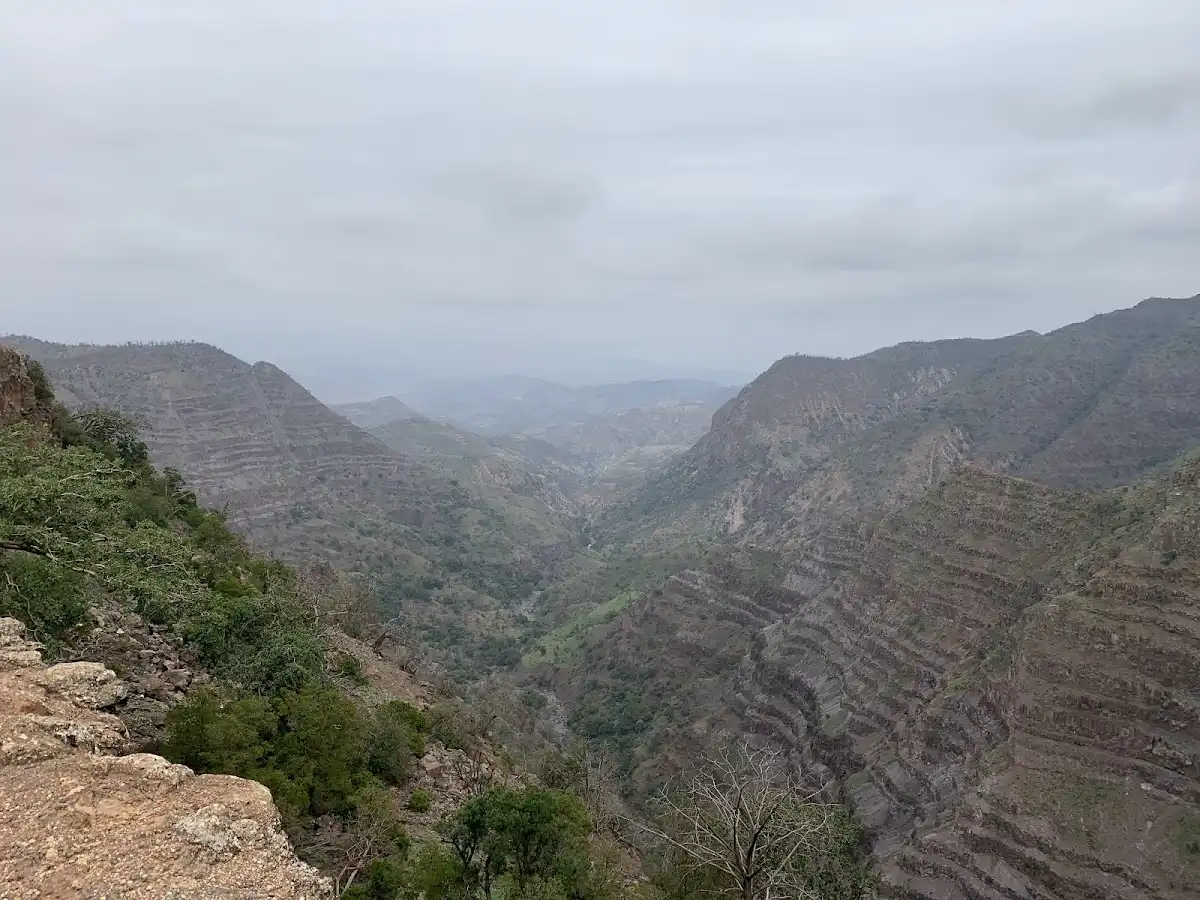
2 Goda Mountains

Goda summit ridge, Bankoualé valley, Afar herders, gulf lookouts

Hike the crest of the massif near 1,780 meters, drop into a palm-lined valley and look over rocky ravines toward the water.

djibouti-national-park-goda-mountains
© Google |

3 Moucha Island National Park

Beachside coral, fishing village, tidal-flat birds, whale shark season

Snorkel reefs a short swim from the sand, walk the pale shoreline past moored boats and fix your boat pickup before leaving the mainland.

djibouti-national-park-moucha-island-national-park
© Google |
Loading the map 🌍

Expert viewInsights from Locals and Experts

How many parks to visit: I would advise two or three, not more. Distances are long, roads are slow and each area needs a full day or more, so a fourth stop mostly means extra hours in a 4x4. Two or three leaves time to sit still at a viewpoint, which is where these places pay off.Which kind for which traveler: Geology-minded travelers should put the salt lakes and rift desert first: pale salt flats, steaming vents and limestone chimneys at dawn, lit orange and then white. Hikers who want cooler air should choose the highland forest, where juniper trees and birdsong replace the lowland glare. Snorkelers and divers should prioritize the marine zone, where a seasonal boat trip can put you in the water beside a whale shark.What it costs: Budget about US$90 to 160 a day (roughly 16,000 to 28,500 … read more 👉
How many parks to visit: I would advise two or three, not more. Distances are long, roads are slow and each area needs a full day or more, so a fourth stop mostly means extra hours in a 4x4. Two or three leaves time to sit still at a viewpoint, which is where these places pay off.Which kind for which traveler: Geology-minded travelers should put the salt lakes and rift desert first: pale salt flats, steaming vents and limestone chimneys at dawn, lit orange and then white. Hikers who want cooler air should choose the highland forest, where juniper trees and birdsong replace the lowland glare. Snorkelers and divers should prioritize the marine zone, where a seasonal boat trip can put you in the water beside a whale shark.What it costs: Budget about US$90 to 160 a day (roughly 16,000 to 28,500 DJF) when sharing a vehicle. Entry fees are small, typically a few US dollars. A driver with a 4x4 costs about US$120 to 250 a day per vehicle, split among passengers. Basic rooms or nomad-style huts near the sites run US$20 to 60 including meals, and marine boat trips about US$60 to 110. Cash in Djiboutian francs or US dollars is the safest payment.Safety and culture: Hire a local guide, because tracks are unmarked and mobile coverage drops out. Carry at least 4 liters of water per person per day, wear a hat and light long sleeves, and avoid hiking from late morning to mid-afternoon. Stay away from the Eritrean and Somaliland border zones and stop at checkpoints with passport in hand. The country is predominantly Muslim and Afar and Somali communities live around many sites. Dress modestly, ask before photographing people and do not wander from camp without telling your guide. The reward is a quiet landscape shared with almost no one.

✈️ The backpacker research shortcutDjibouti Travel Guide

An offline-friendly backpacking guide with optimized travel routes, ranked highlights, transport advice, and the best areas to stay.
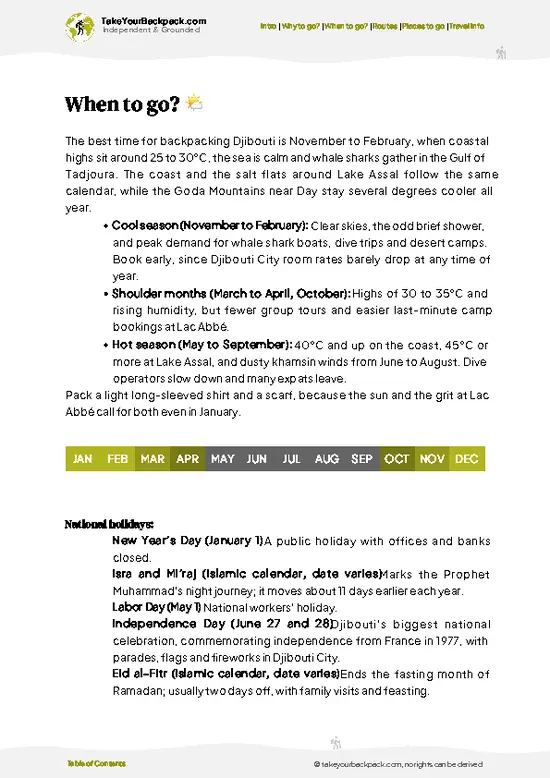
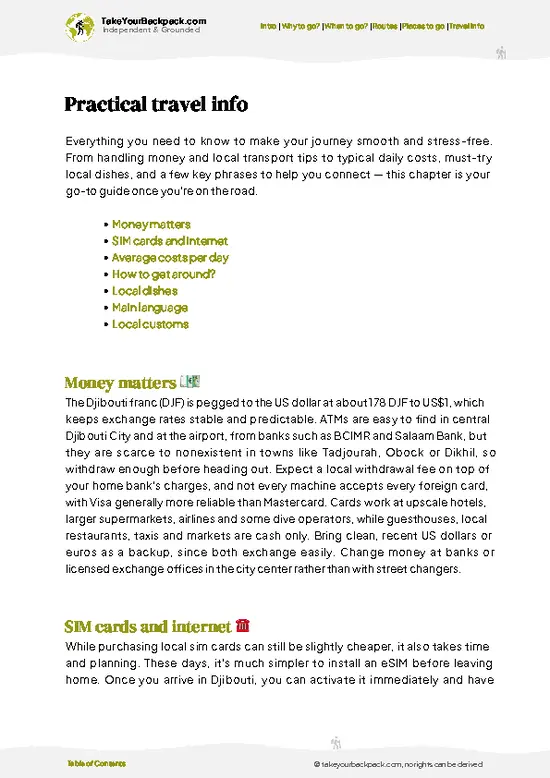
example page 0 from our offline Travel Guide for Djibouti
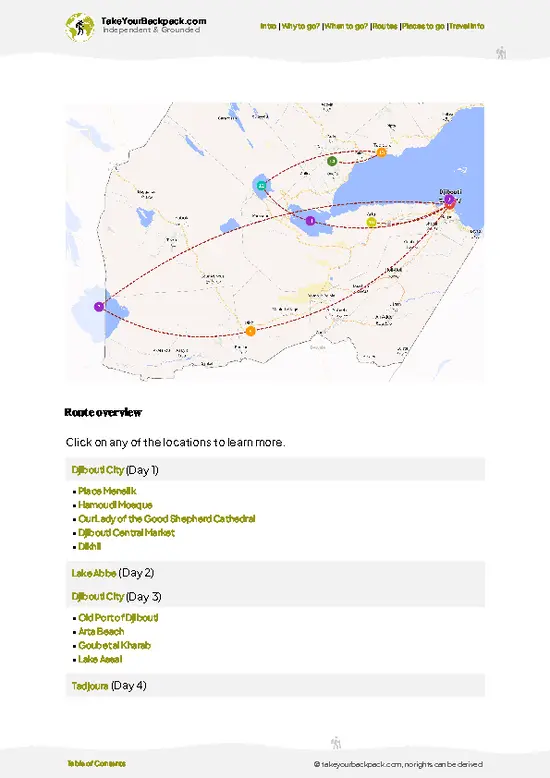
example page 1 from our offline Travel Guide for Djibouti
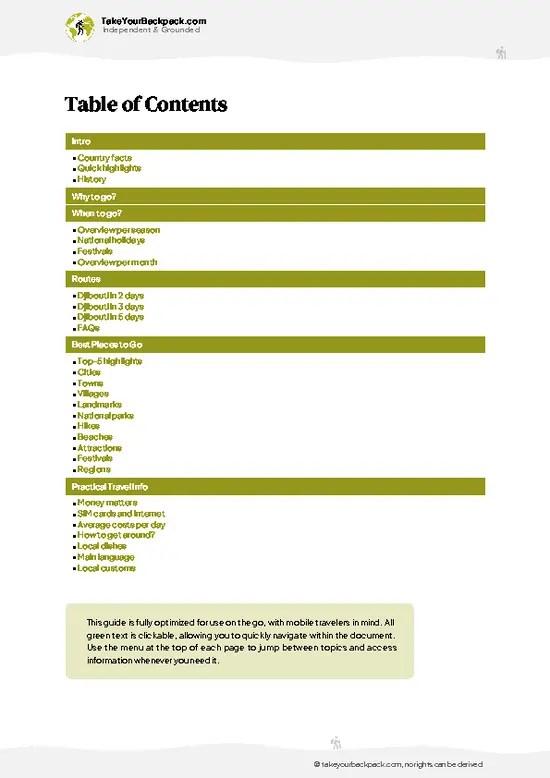
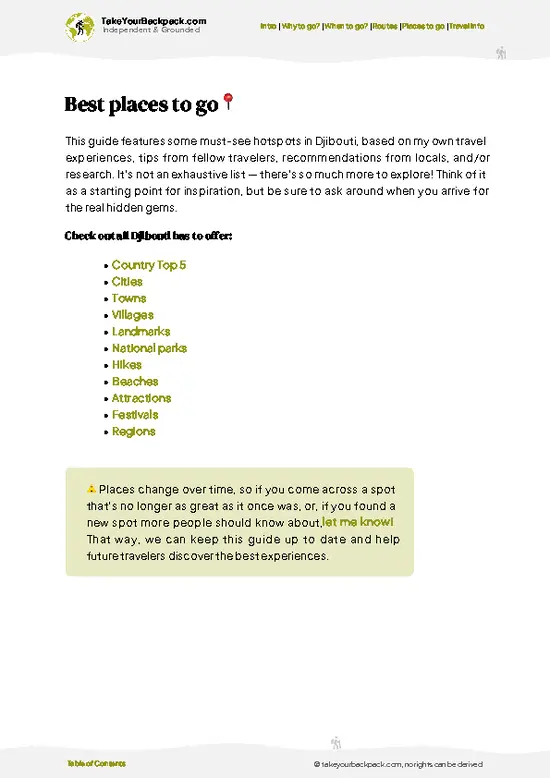
example page 2 from our offline Travel Guide for Djibouti
example page 3 from our offline Travel Guide for Djibouti
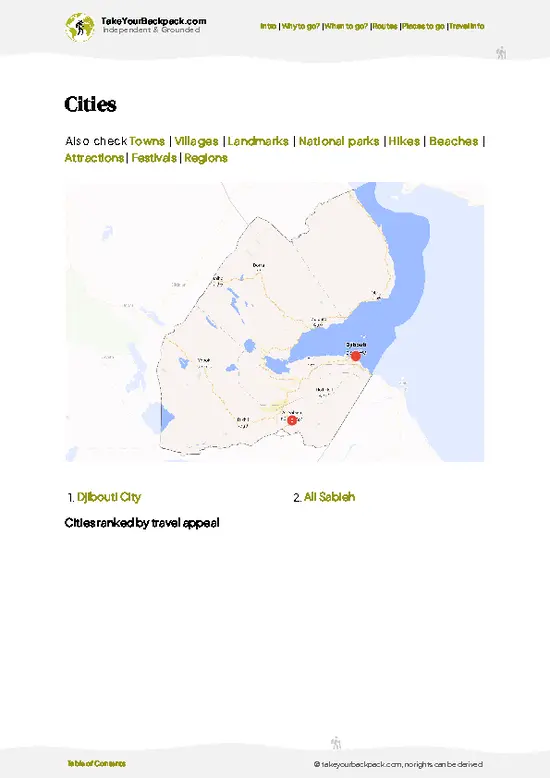
example page 4 from our offline Travel Guide for Djibouti
example page 5 from our offline Travel Guide for Djibouti
example page 6 from our offline Travel Guide for Djibouti
example page 7 from our offline Travel Guide for Djibouti
The digital guide (186 pages) contains:
✅ 44 highlights, ranked by travel appeal
✅ Optimized 2, 3 & 5-day travel routes
✅ Cities, national parks, landmarks, beaches
✅ How to get around
✅ Offline-friendly for travel without Wi-Fi
👉 Click to see all 30+ guide features

📅 Plan smarter in minutes, not weeks
✅ Month by month travel advice
✅ Festivals & national holidays
✅ Budget expectations

🗺️ Go to the right places, skip the overrated ones
✅ Honest pros & cons of destinations
✅ Top hikes, parks & viewpoints
✅ Lesser-known places most travelers miss
✅ Clear “worth it vs skip it” guidance

🛏️ Travel smoothly without rookie mistakes
✅ Best areas to stay
✅ Transport systems explained simply
✅ Common scams & safety advice
✅ SIM cards, money & practical tips

🌍 Understand the country, not just visit it
✅ Culture & traditions
✅ 52 Essential phrases & customs
✅ Festivals worth planning around
✅ Traveler-friendly historical context
✅ Insights that make places more meaningful

📱 Built for real travel conditions
✅ Fully downloadable PDF
✅ Works completely offline
✅ Optimized for phone use
✅ Useful in remote areas & buses
✅ Everything in one place
Stop searching, start planning
Get instant access to your full guide. 30‑day money-back guarantee.
+ Add another guide for just

By proceeding you agree to our terms.
Sent to your inbox immediately after payment • 100% Secure Checkout
Best Backpacking Travel Advisor 2025 tourism awardBest Backpacking
Travel Advisor
2025
What others say about Take Your Backpack Guides:
⭐⭐⭐⭐⭐
Fantastic, amazing amount of information!
⭐⭐⭐⭐⭐
My goodness this is amazing, it's what I've been looking for hats off too you!
⭐⭐⭐⭐⭐
I think this is absolutely BRILLIANT
⭐⭐⭐⭐
Very complete and informative. It's still missing places, but I gotta to commend you
⭐⭐⭐⭐⭐
This is truly amazing, thank you, can't wait to explore it with my kids!
⭐⭐⭐⭐⭐
Awesome resource, thank you!
⭐⭐⭐⭐⭐
This is amazing! Can't wait to explore the ones I haven't seen
⭐⭐⭐⭐
I love this! Well done, great idea.
⭐⭐⭐⭐⭐
Thanks for taking the time to make this gem!
⭐⭐⭐⭐⭐
This might be the best website I've ever seen.
⭐⭐⭐⭐⭐
Congratulations, and thank you so much for your work; it's incredibly valuable.
⭐⭐⭐⭐
In all seriousness I think you did a great job pointing out the important spots
⭐⭐⭐⭐⭐
10/10 very good
⭐⭐⭐⭐⭐
As someone who's only just starting to visit regularly this is awesome, thank you.
⭐⭐⭐⭐
Thank you very much! I'm going to visit my dad, it's going to be very useful!
⭐⭐⭐⭐⭐
This is really cool! We'll be travelling for the first time and this definitely come in handy.
⭐⭐⭐⭐⭐
You are now our minister of culture, congratulations 👨‍💼
⭐⭐⭐⭐⭐
Just wanted to tell you that this is a pearl! Going to follow your recommendations.
⭐⭐⭐⭐⭐
This is so cool. I'll definitely be using the resource for my travels soon.
⭐⭐⭐⭐⭐
This is very impressive! Good work.
⭐⭐⭐⭐⭐
This is an amazing and informative site. Very well done!

🛏️ Where to stay?Where to Stay: Djibouti Edition

Djibouti has no real hostel scene, so budget travel here means simple guesthouses and basic hotels in Djibouti City, where a double typically costs 7,000 to 12,000 DJF (US$40 to 70) a night. The European Quarter around Place Ménélik holds the most options, with cafés, restaurants and the few late-night bars within walking distance, though rooms there run noisier and pricier. The African Quarter just south, near the market streets, offers the cheapest rooms and lively street food but feels chaotic after dark, while Plateau du Héron is quiet and safe near the embassies and the waterfront, with few budget beds and a taxi ride to anything.

If you enjoy meeting fellow travelers, consider choosing … read more 👉
Djibouti has no real hostel scene, so budget travel here means simple guesthouses and basic hotels in Djibouti City, where a double typically costs 7,000 to 12,000 DJF (US$40 to 70) a night. The European Quarter around Place Ménélik holds the most options, with cafés, restaurants and the few late-night bars within walking distance, though rooms there run noisier and pricier. The African Quarter just south, near the market streets, offers the cheapest rooms and lively street food but feels chaotic after dark, while Plateau du Héron is quiet and safe near the embassies and the waterfront, with few budget beds and a taxi ride to anything.

If you enjoy meeting fellow travelers, consider choosing hostels with high ratings for atmosphere. On the other hand, if you prefer having your own space, a hotel might be a better option.

DjiboutiExplore Beyond This Category

👋 Meet the founderWho’s Behind Take Your Backpack?

Johan, backpacker and founder of TakeYourBackpackHi, I’m Johan (Netherlands 🇳🇱), the creator of TakeYourBackpack. Over the past 3 decades, I’ve backpacked through 90+ countries across six continents, gaining extensive experience with independent travel, long-term trips, and overland routes.

This site is built on a combination of firsthand travel experience and carefully curated insights from other backpackers. Many guides are based on places I’ve personally visited, while others bring together tips, observations, and practical advice shared by trusted travelers I’ve met along the way.

The goal is to provide realistic, experience-driven guidance — not generic itineraries — so you can explore destinations with better context, clearer expectations, and more confidence.