Yes, Dominica is easy to backpack independently if you accept a slower rhythm: English is the official language, locals are relaxed with visitors, and public minibuses reach every town on the main road network.
The real planning hurdle is accommodation. The island has very few dorm hostels, so budget US$30 to 70 (EC$80 to 190) a night for a basic guesthouse room in
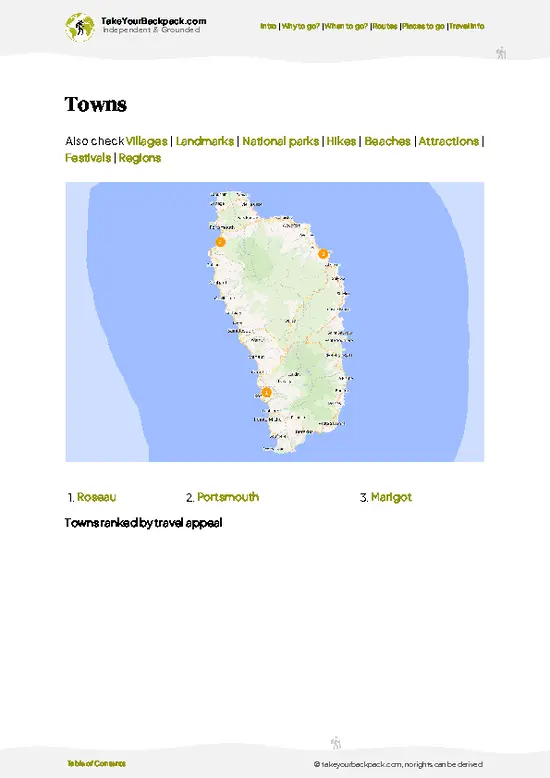
Roseau,
Calibishie or
Portsmouth. Minibus fares run EC$3 to 12 (about US$1 to 4.50), but services thin out after 6 pm and on Sundays. Most nature sites require a site pass, US$5 for a single site or US$12 for a week.
Five to seven days covers Dominica properly, giving you the south, the volcanic interior and the north coast without rushing; two days is the bare minimum and keeps you around Roseau.
With
2 days, base in
Roseau for
Trafalgar Falls (20 to 30 minutes by minibus),
Champagne Reef and
Scotts Head. A third day adds
Titou Gorge or the Atlantic side around
Calibishie. With
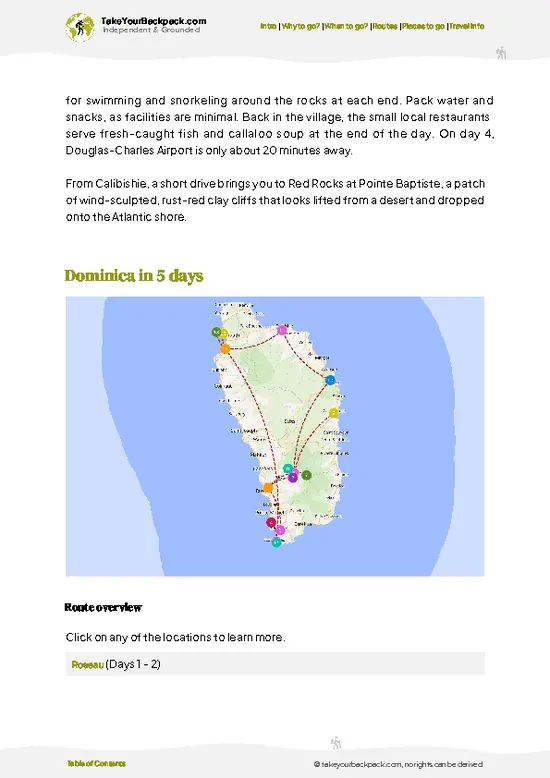
5 days you can fit a night in
Laudat for Middleham Falls, the
Kalinago Territory and
Portsmouth, 1 to 1.5 hours north of Roseau by bus. Hikers walking the full Waitukubuli National Trail, about 185 km in 14 segments, need two weeks or more.
Yes, you can get around Dominica without a car, using the privately run minibuses with H license plates plus the occasional taxi.
Buses leave from different stops in
Roseau depending on the destination and depart when full. Typical rides: Roseau to
Trafalgar or
Wotten Waven in 20 to 30 minutes for EC$3 to 4 (about US$1 to 1.50), Roseau to
Scotts Head in about 30 minutes, and Roseau to
Portsmouth in 1 to 1.5 hours for around EC$11 (US$4). The east coast, including the
Kalinago Territory, has sparse service, so a taxi is often the only practical option there. Expect few buses after 6 pm and on Sundays.
The must-visits in Dominica are Morne Trois Pitons National Park, Champagne Reef, Scotts Head, the Kalinago Territory and the north-coast village of Calibishie.
Inside
Morne Trois Pitons National Park,
Trafalgar Falls is a 15-minute walk from the parking area and
Titou Gorge is a short swim through a narrow canyon.
Champagne Reef, 20 to 30 minutes south of Roseau, lets you snorkel through warm volcanic bubbles. At
Scotts Head, a 10-minute climb reveals the Caribbean and Atlantic on either side of a thin isthmus. The
Kalinago Territory is home to around 3,000 Kalinago people, and
Calibishie pairs reef-calm water with nearby
Batibou Beach.
If you’re short on time in Dominica, skip the minor west-coast beaches and the remote northern reserves, and spend those hours on the south and the volcanic interior instead.
Salisbury Beach,
Portsmouth Beach and
Grand Bay are pleasant but gray-sand and far less memorable than
Batibou Beach or snorkeling at
Champagne Reef.
Morne Diablotin National Park and the
Syndicate Nature Reserve mainly suit parrot watchers and serious hikers, and the summit climb takes 4 to 6 hours round trip in deep mud.
Emerald Pool is small and crowded on cruise-ship days, so if you already have
Trafalgar Falls and
Titou Gorge planned, you lose little by dropping it.
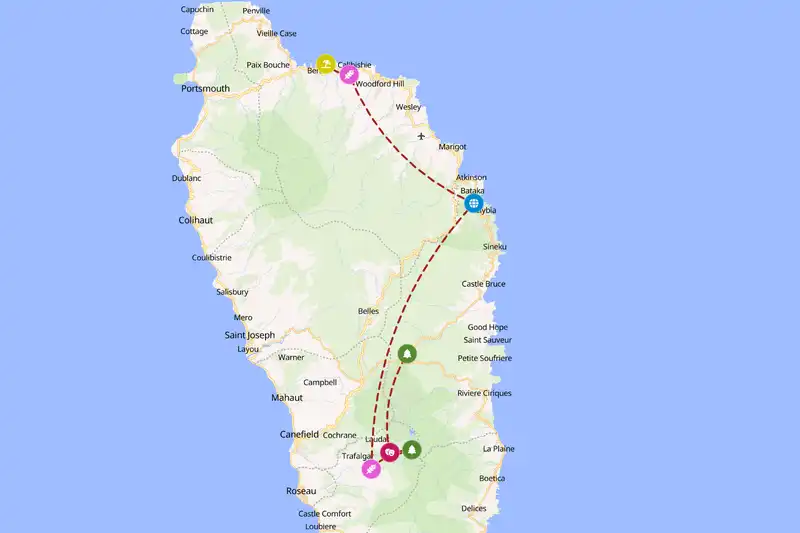
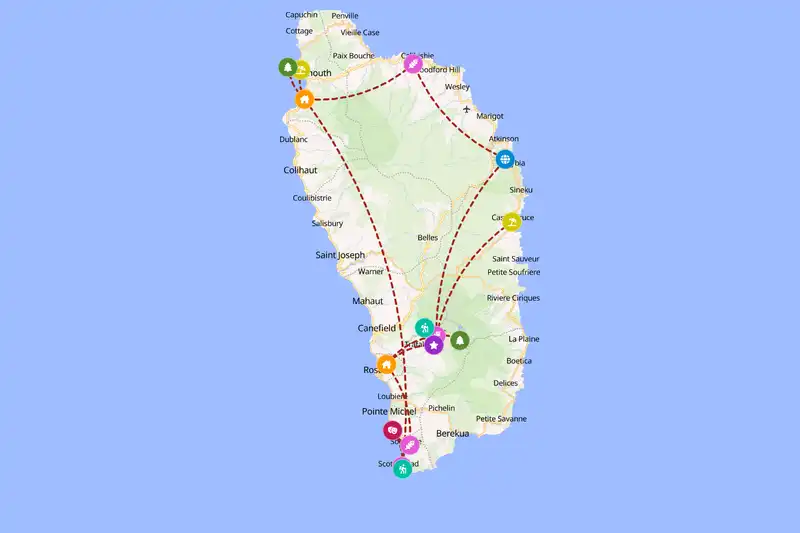
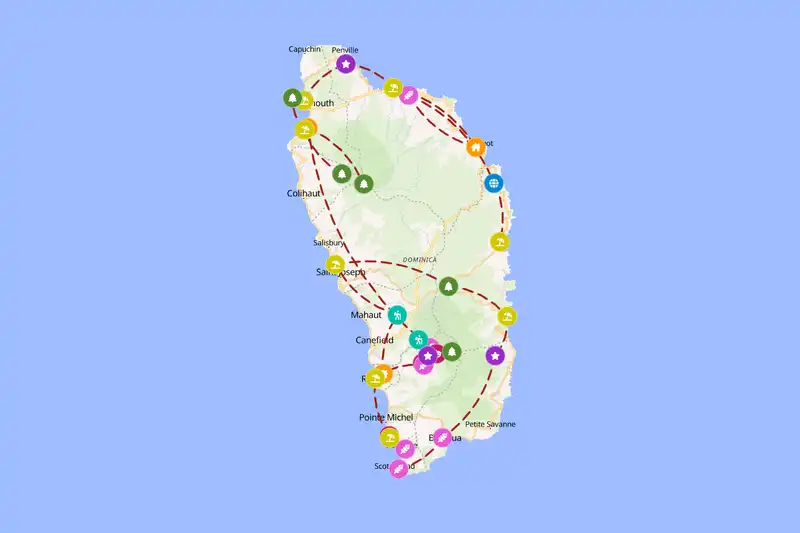
Yes, our itinerary-planner does exactly that. Set your trip length in days, give your interests and travel style, optionally give start- and end location and/or some mandatory stops you would like to include and the itinerary planner creates your personalized routes for Dominica in seconds. Try it out!
Try the itinerary plannerv2.webp)
 Best Backpacking