
×

Dominican Republic🇩🇴 | national parksÉbano Verde Scientific ReserveCloud forest, ébano verde trees, trogon and tody, misty ridge loops | things to do and best time to go

Explore Monte Cristi National ParkExplore Aniana Vargas National Park

Backpacking in Ébano Verde Scientific Reserve
👍 Recommendednational park ranked #11
By Johan Kruseman 🇳🇱 | Updated October 22, 2026

The decision here is whether to hire a guide or wing it, and the answer is that the reserve’s staff and rangers make the trails far easier than a lone attempt, so arrange it. Ébano Verde Scientific Reserve sits in the Cordillera Central in the center of the Dominican Republic, off the road to Constanza, between Constanza and Bonao. Expect cloud forest, cool mist, waterfalls, birdsong and mud, with few crowds and no beach. Roads in are decent, but signal is patchy and rain arrives uninvited. Arrive early, wear boots rather than flip-flops, and bring cash in pesos because cards rarely work.

Discover everything you want to know in the 📖 Dominican Republic Travel Guide.


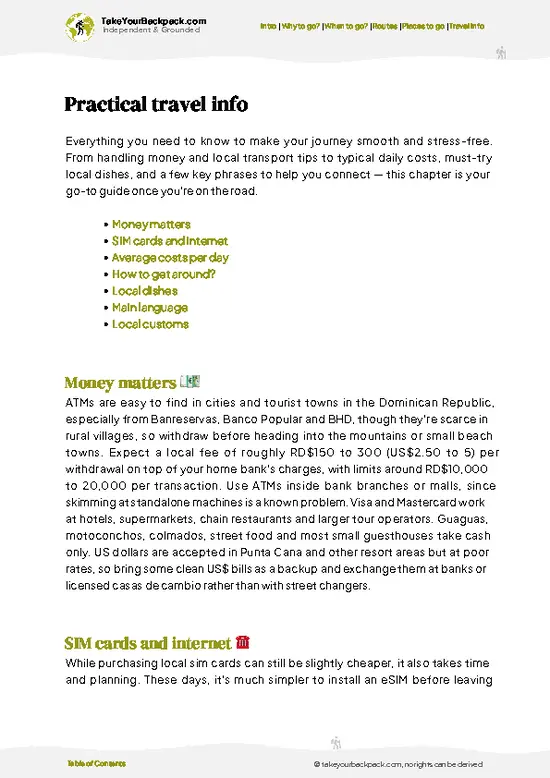
example page 0 from our offline Travel Guide for Dominican Republic
example page 1 from our offline Travel Guide for Dominican Republic
example page 2 from our offline Travel Guide for Dominican Republic
example page 3 from our offline Travel Guide for Dominican Republic
example page 4 from our offline Travel Guide for Dominican Republic
example page 5 from our offline Travel Guide for Dominican Republic
example page 6 from our offline Travel Guide for Dominican Republic
example page 7 from our offline Travel Guide for Dominican Republic
Loading the map 🌍
CLICK TO FILTER
cities
towns
landmarks
national parks
hikes
beaches
attractions
festivals
SHOW COUNTRY’S BESTSHOW ALL

✨ Why go?
Ranked #11 national park in Dominican Republic
Why visitors keep coming back

Ébano Verde Scientific Reserve rewards travelers who like thinking for themselves. It protects a cloud forest of roughly 23 square kilometers (about 9 square miles), named for the rare ébano verde tree, found almost nowhere else. You can take short waterfall trails on your own pace, or pair up with a ranger to spot endemic birds such as the Hispaniolan trogon and hear the forest explained plant by plant. Since the reserve is small and quiet, it works well as an easy overnight from the Jarabacoa area, with simple camping and cabin options nearby. Tour buses rarely come, so you get the forest without a crowd, and you keep control of your own schedule.

💡 HighlightsTop highlights of Ébano Verde Scientific Reserve

  1. Ébano Verde tree (Magnolia pallescens, locally “ébano verde”): The reserve exists to protect this endangered tree, a tall, glossy-leaved species that grows in the cloud forest and gives the place its name. Guides point out specimens along the main trails, and the dense, dripping canopy around them is the best argument for the reserve’s protection.
  2. Sendero Los Helechos: A short loop through the damp forest, where tree ferns and mossy trunks crowd the path. It is the easiest walk and a good introduction to the cloud forest’s layered vegetation.
  3. Sendero El Mirador: A steeper climb that rises to a viewpoint over forested ridges of the Cordillera Central. On clear mornings the valley view opens up, though mist often closes it in by midday.
  4. Hispaniolan trogon (papagayo): This bird is a prime target
… read more 👉
  1. Ébano Verde tree (Magnolia pallescens, locally “ébano verde”): The reserve exists to protect this endangered tree, a tall, glossy-leaved species that grows in the cloud forest and gives the place its name. Guides point out specimens along the main trails, and the dense, dripping canopy around them is the best argument for the reserve’s protection.
  2. Sendero Los Helechos: A short loop through the damp forest, where tree ferns and mossy trunks crowd the path. It is the easiest walk and a good introduction to the cloud forest’s layered vegetation.
  3. Sendero El Mirador: A steeper climb that rises to a viewpoint over forested ridges of the Cordillera Central. On clear mornings the valley view opens up, though mist often closes it in by midday.
  4. Hispaniolan trogon (papagayo): This bird is a prime target for birders. It is a colorful perch-sitter with a red belly and a metallic green back, and it is most often found in the quieter forest stretches early in the day.
  5. Broad-billed tody (barrancolí): A tiny, bright green bird with a red throat that nests in earthen banks. Its sharp, beeping calls help you find it along shaded trail edges.
  6. Rio Blanco headwaters and forest streams: Small creeks rising inside the reserve cross the trails in places, feeding the lower valleys. Cool, clear water over mossy stones makes a pleasant stop on a warm walk.
  7. Orchids and bromeliads: The humid air supports many epiphytes, with orchids and bromeliads clinging to branches above the path. Look up as much as you look ahead, because the best blooms sit high in the trees.
Ébano Verde Scientific Reserve is best first approached through the Sendero Los Helechos loop, since its gentle gradient and fern-filled forest show you the cloud forest and its birdlife without a hard climb.
Spotted a mistake or missing something? Contact us.

Things to do near Ébano Verde Scientific Reserve

Ratings based on Tripadvisor reviews. When you book through this link, you support our work at no extra cost to you.

🌤️ When to go?When to go for the best experience

  • Dry Season (December to March): Mornings in the cloud forest run 12-18°C (54-64°F), warming to 22-26°C (72-79°F) by afternoon, with the firmest trails and the clearest views toward the Cordillera Central. Weekends bring Dominican day-trippers.
  • Shoulder Months (April to June): Showers start in the afternoons, temperatures edge up to 24-28°C (75-82°F), and the trails are quiet.
  • Wet Season (July to November): Heavy downpours and hurricane-season storms turn paths to mud, and river fords near Jarabacoa rise. Humidity is high, but the forest is at its greenest.
  • Daylight: Roughly 11 to 13.5 hours across the year, so start hikes early.
Reserve a weekday morning in the dry season for the clearest trails and the fewest visitors.

source: climatestotravel.comJANJanuary: excellent for travelingFEBFebruary: excellent for travelingMARMarch: excellent for travelingAPRApril: highly recommended for travelingMAYMay: fair for travelingJUNJune: fair for travelingJULJuly: fair for travelingAUGAugust: fair for travelingSEPSeptember: fair for travelingOCTOctober: fair for travelingNOVNovember: fair for travelingDECDecember: highly recommended for traveling
when-to-go

✈️ The backpacker research shortcutDominican Republic Travel Guide

An offline-friendly backpacking guide with optimized travel routes, ranked highlights, transport advice, and the best areas to stay.
example page 0 from our offline Travel Guide for Dominican Republic
example page 1 from our offline Travel Guide for Dominican Republic
example page 2 from our offline Travel Guide for Dominican Republic
example page 3 from our offline Travel Guide for Dominican Republic
example page 4 from our offline Travel Guide for Dominican Republic
example page 5 from our offline Travel Guide for Dominican Republic
example page 6 from our offline Travel Guide for Dominican Republic
example page 7 from our offline Travel Guide for Dominican Republic
The digital guide (336 pages) contains:
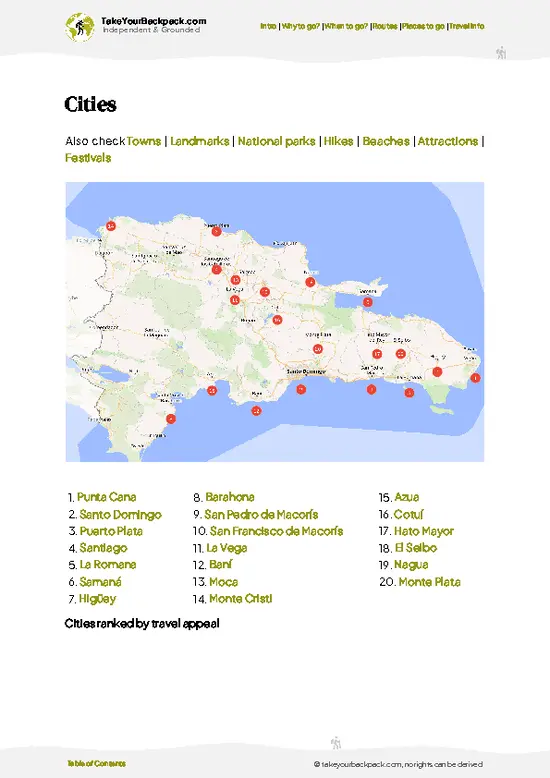
✅ 108 highlights, ranked by travel appeal
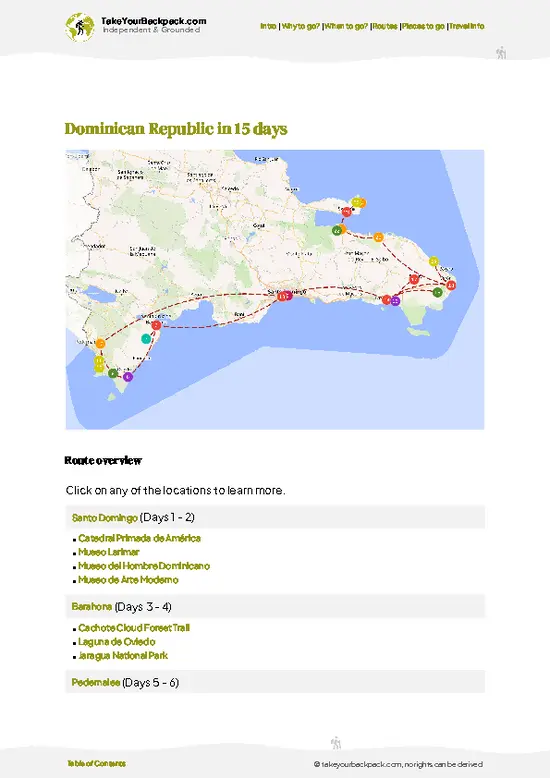
✅ Optimized 5, 10 & 15-day travel routes
✅ Cities, national parks, landmarks, beaches
✅ How to get around
✅ Offline-friendly for travel without Wi-Fi
👉 Click to see all 30+ guide features

📅 Plan smarter in minutes, not weeks
✅ Month by month travel advice
✅ Festivals & national holidays
✅ Budget expectations

🗺️ Go to the right places, skip the overrated ones
✅ Honest pros & cons of destinations
✅ Top hikes, parks & viewpoints
✅ Lesser-known places most travelers miss
✅ Clear “worth it vs skip it” guidance

🛏️ Travel smoothly without rookie mistakes
✅ Best areas to stay
✅ Transport systems explained simply
✅ Common scams & safety advice
✅ SIM cards, money & practical tips

🌍 Understand the country, not just visit it
✅ Culture & traditions
✅ 52 Essential phrases & customs
✅ Festivals worth planning around
✅ Traveler-friendly historical context
✅ Insights that make places more meaningful

📱 Built for real travel conditions
✅ Fully downloadable PDF
✅ Works completely offline
✅ Optimized for phone use
✅ Useful in remote areas & buses
✅ Everything in one place
Stop searching, start planning
Get instant access to your full guide. 30‑day money-back guarantee.
+ Add another guide for just

By proceeding you agree to our terms.
Sent to your inbox immediately after payment • 100% Secure Checkout
Best Backpacking Travel Advisor 2025 tourism awardBest Backpacking
Travel Advisor
2025
What others say about Take Your Backpack Guides:
⭐⭐⭐⭐⭐
Fantastic, amazing amount of information!
⭐⭐⭐⭐⭐
My goodness this is amazing, it's what I've been looking for hats off too you!
⭐⭐⭐⭐⭐
I think this is absolutely BRILLIANT
⭐⭐⭐⭐
Very complete and informative. It's still missing places, but I gotta to commend you
⭐⭐⭐⭐⭐
This is truly amazing, thank you, can't wait to explore it with my kids!
⭐⭐⭐⭐⭐
Awesome resource, thank you!
⭐⭐⭐⭐⭐
This is amazing! Can't wait to explore the ones I haven't seen
⭐⭐⭐⭐
I love this! Well done, great idea.
⭐⭐⭐⭐⭐
Thanks for taking the time to make this gem!
⭐⭐⭐⭐⭐
This might be the best website I've ever seen.
⭐⭐⭐⭐⭐
Congratulations, and thank you so much for your work; it's incredibly valuable.
⭐⭐⭐⭐
In all seriousness I think you did a great job pointing out the important spots
⭐⭐⭐⭐⭐
10/10 very good
⭐⭐⭐⭐⭐
As someone who's only just starting to visit regularly this is awesome, thank you.
⭐⭐⭐⭐
Thank you very much! I'm going to visit my dad, it's going to be very useful!
⭐⭐⭐⭐⭐
This is really cool! We'll be travelling for the first time and this definitely come in handy.
⭐⭐⭐⭐⭐
You are now our minister of culture, congratulations 👨‍💼
⭐⭐⭐⭐⭐
Just wanted to tell you that this is a pearl! Going to follow your recommendations.
⭐⭐⭐⭐⭐
This is so cool. I'll definitely be using the resource for my travels soon.
⭐⭐⭐⭐⭐
This is very impressive! Good work.
⭐⭐⭐⭐⭐
This is an amazing and informative site. Very well done!

🛏️ Where to stay?Best areas to stay in Dominican Republic

No lodging exists inside Ébano Verde Scientific Reserve, which is a day-use protected area, so you sleep in nearby towns. Jarabacoa, about 45 minutes to an hour away by road, is the practical base. It has hostels and guesthouses at roughly US$12 to 25 for a dorm or simple private room, plus mid-range mountain cabins around US$40 to 80, and a good choice of restaurants and tour operators. Constanza, further along the same highway, is cooler and quieter, with small hotels and cabins from about US$25 to 60, and suits those continuing into the high valleys. Book ahead for weekends and Dominican holidays, … read more 👉
No lodging exists inside Ébano Verde Scientific Reserve, which is a day-use protected area, so you sleep in nearby towns. Jarabacoa, about 45 minutes to an hour away by road, is the practical base. It has hostels and guesthouses at roughly US$12 to 25 for a dorm or simple private room, plus mid-range mountain cabins around US$40 to 80, and a good choice of restaurants and tour operators. Constanza, further along the same highway, is cooler and quieter, with small hotels and cabins from about US$25 to 60, and suits those continuing into the high valleys. Book ahead for weekends and Dominican holidays, when Jarabacoa fills with families from Santo Domingo.

👛 Costs (as of 22 October 2026)Typical daily expenses

A day at Ébano Verde Scientific Reserve costs roughly US$40 to 85 for most backpackers, with US$55 as a realistic total. The table below breaks it down, and you pay in Dominican pesos.
CategoryBudget RangeLocal Reality
Entrance feeUS$2 to 5Small fee paid at the ranger station, with guided hikes costing extra.
GuideUS$10 to 20Optional for the main trails, useful for birding and the longer routes.
Accommodation (high season)US$12 to 25Hostel or guesthouse in Jarabacoa, since there is no lodging in the reserve.
Local transportUS$8 to 20Shared minibus or bus along the highway, then a motorcycle taxi or private taxi to the entrance.
Food and suppliesUS$8 to 15Comedores serve rice, beans and meat for about US$4 to 6, and you should carry snacks and water.
Total Daily BudgetUS$40 to 85About US$55 for a typical day.
⚠️ Prices can change and everyone travels differently, so take this as a rough guide. Hope it helps you plan your adventure!

🥾 TrailsExploring Ébano Verde Scientific Reserve: trails, terrain, and views

Ébano Verde Scientific Reserve sits in the Cordillera Central, in a cloud forest zone of steep ridges, fern gullies and cool, damp air, and the walking here is on narrow forest paths rather than wide park roads. Expect mud, roots and slick rock after rain, and wear shoes with real grip. The reserve protects the ébano verde tree (Magnolia pallescens), along with orchids, tree ferns and a lot of birds.
  • Sendero El Mirador: A short, steady climb through dense forest to a viewpoint over the surrounding mountains. Plan on roughly 1 to 2 hours return. Difficulty is easy to moderate, with some steep, muddy
… read more 👉
Ébano Verde Scientific Reserve sits in the Cordillera Central, in a cloud forest zone of steep ridges, fern gullies and cool, damp air, and the walking here is on narrow forest paths rather than wide park roads. Expect mud, roots and slick rock after rain, and wear shoes with real grip. The reserve protects the ébano verde tree (Magnolia pallescens), along with orchids, tree ferns and a lot of birds.
  • Sendero El Mirador: A short, steady climb through dense forest to a viewpoint over the surrounding mountains. Plan on roughly 1 to 2 hours return. Difficulty is easy to moderate, with some steep, muddy stretches.
  • Sendero Los Helechos: A shaded loop among tree ferns and mossy trunks. Allow about 1 hour. Easy, though roots make footing tricky.
  • Waterfall path: A harder trail of about 6 km that ends at a pool below a small waterfall. Allow 2 to 3 hours return. Moderate, with a steep climb back out.
  • Wildlife: Birdwatching is the main draw, including the Hispaniolan trogon, the barrancolí (broad-billed tody) and the palmchat, the national bird. Go early, walk quietly and bring binoculars.
  • Terrain: Steep, uneven and often wet. Trail lengths and times vary with conditions, so ask the rangers for the current route.
Getting there is easiest with your own transport or a hired driver, since the reserve lies off the Constanza road and public buses do not go to the gate. Guided hikes are available at the entrance, and a local guide helps with bird identification and trail conditions. Weekdays are quiet and weekends bring small groups of Dominican visitors, though crowds never swell much. Bring water, rain gear and a light layer, because it gets cool. Visitors pay a modest entrance fee at the gate in pesos, roughly US$3 to 5.
⚠️ Hiking info can sometimes be outdated or inaccurate. Before you hit the trail, check the latest conditions with locals. If you do spot anything that's off, I'd love to hear from you, so I can update it for fellow travelers.

🛡️ SafetyScams, Hazards, and Annoyances

The trails in Ébano Verde Scientific Reserve are short, well-marked and manageable for most fit beginners. Paths climb through cloud forest and turn slick after rain, so wear shoes with real tread and carry a light rain jacket, since showers arrive quickly even in drier months. River crossings can swell after heavy rain, so turn back if water rises past your ankles. Cell signal fades under the canopy, so download an offline map and tell your lodging where you are going. Hike with a ranger-guide on longer routes, which also helps you spot endemic birds. There are no dangerous large animals, though mosquitoes are common, so bring repellent and water. Leave nothing behind and keep to marked paths to protect the fragile undergrowth.

FAQTraveler FAQ

Ébano Verde Scientific Reserve needs one full day, which covers the main trails and the pool below the small waterfall. Walks run from about 1 to 4 hours depending on the route. Add a second day if you want to combine it with Jarabacoa or Constanza.
Ébano Verde Scientific Reserve is reachable without a car, though it takes some effort. Take a bus toward Jarabacoa or Constanza from Santo Domingo or La Vega (2 to 3 hours), get off near the entrance on the highway, then use a motorcycle taxi or walk. Hiring a taxi from Jarabacoa for the day costs roughly US$30 to 50.
Ébano Verde Scientific Reserve charges a small entrance fee, generally around US$2 to 5, paid at the ranger station in Dominican pesos. No separate permit is normally needed for the standard trails. Guides cost extra, roughly US$10 to 20, and are worth it for longer hikes.
⚠️ Things can change over time, so always validate details locally before you go.

Other Dominican national parks near Ébano Verde Scientific Reserve

Explore more nearby:


💡 Not sure where to go next?
Create a personalized itinerary for Dominican Republic including Ébano Verde Scientific Reserve and the places that fit your trip.

Generate my itinerary

👉 Discover all national parks

Or checkout all Dominican Republic has to offer (think cities, towns, villages, national parks, hikes, beaches, festivals)
Country photo of Dominican Republic

We 💚 feedbackParting advice and final tips

Ébano Verde Scientific Reserve deserves one full day, ideally starting at dawn when the birds are loudest and the mist is still in the trees. I would stay a night in nearby Jarabacoa and do the reserve first, then plan a second morning elsewhere. Pack a rain jacket regardless of the forecast.

✍️ Help improve this page!
The information on this page is based on in-depth research, insights shared by experienced travelers, and feedback from the local travel community in Dominican Republic. While every effort is made to keep the information accurate and current, conditions can change — so if you spot anything incorrect or outdated, please get in touch.


🙋‍♂️ Give feedback

👋 Meet the founderWho’s Behind Take Your Backpack?

Johan, backpacker and founder of TakeYourBackpackHi, I’m Johan (Netherlands 🇳🇱), the creator of TakeYourBackpack. Over the past 3 decades, I’ve backpacked through 90+ countries across six continents, gaining extensive experience with independent travel, long-term trips, and overland routes.

This site is built on a combination of firsthand travel experience and carefully curated insights from other backpackers. Many guides are based on places I’ve personally visited, while others bring together tips, observations, and practical advice shared by trusted travelers I’ve met along the way.

The goal is to provide realistic, experience-driven guidance — not generic itineraries — so you can explore destinations with better context, clearer expectations, and more confidence.