×

Dominican Republic🇩🇴 | national parksLoma Quita Espuela Scientific ReserveCacao farms, cloud-forest ridge, muddy summit climb, farm stays | things to do and best time to go

Explore Aniana Vargas National ParkExplore Salto de la Jalda National Park

Backpacking in Loma Quita Espuela Scientific Reserve
👌 Worth visitingnational park ranked #15
By Johan Kruseman 🇳🇱 | Updated October 23, 2026

Your boots sink into red clay at 6 a.m. while a rooster you never met critiques your pace. That is Loma Quita Espuela Scientific Reserve, in the north of the Dominican Republic, between San Francisco de Macorís and Nagua. Cacao farms, wet forest and a cloud-hugging ridge reward the effort, and crowds are nearly absent. Trails are rough, signage is thin, and mud turns sneakers into regrets, so bring real boots and a local guide. Cell signal vanishes on the slopes, so download maps first. Start your first day with a morning farm walk, then a cacao tasting.

Discover everything you want to know in the 📖 Dominican Republic Travel Guide.


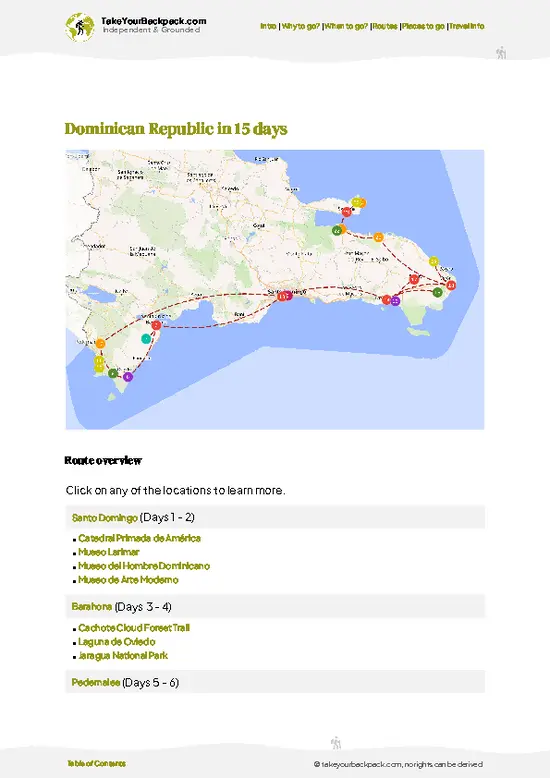
example page 0 from our offline Travel Guide for Dominican Republic
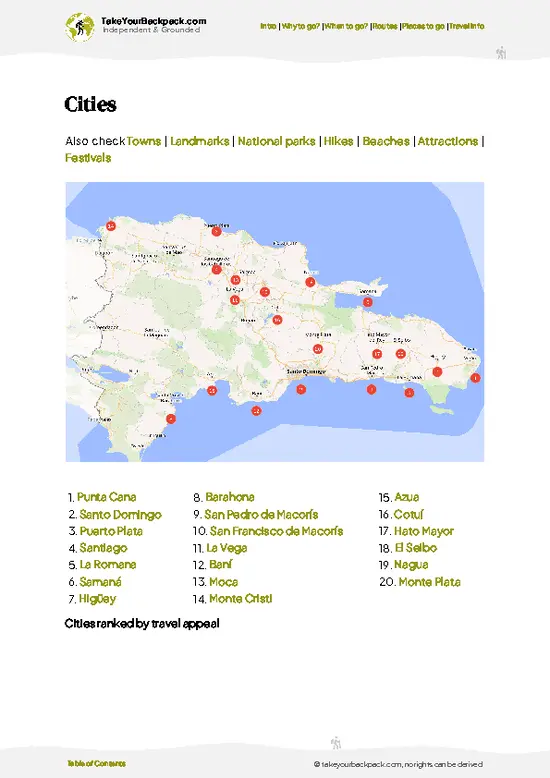
example page 1 from our offline Travel Guide for Dominican Republic
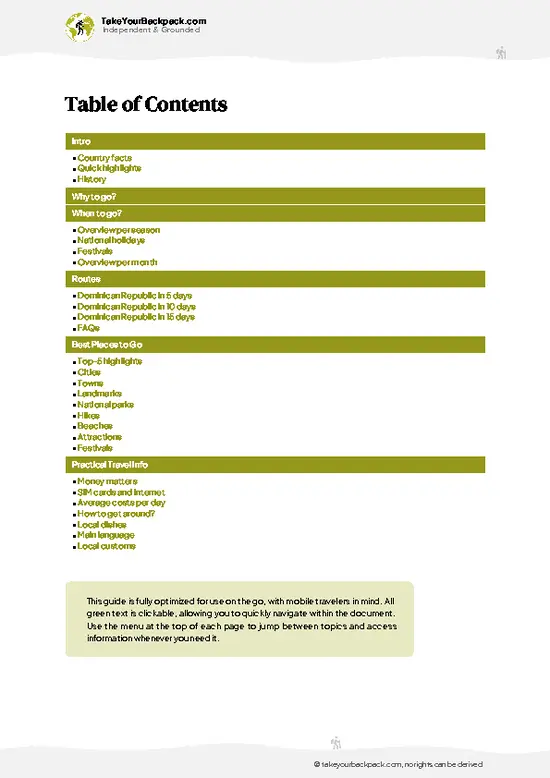
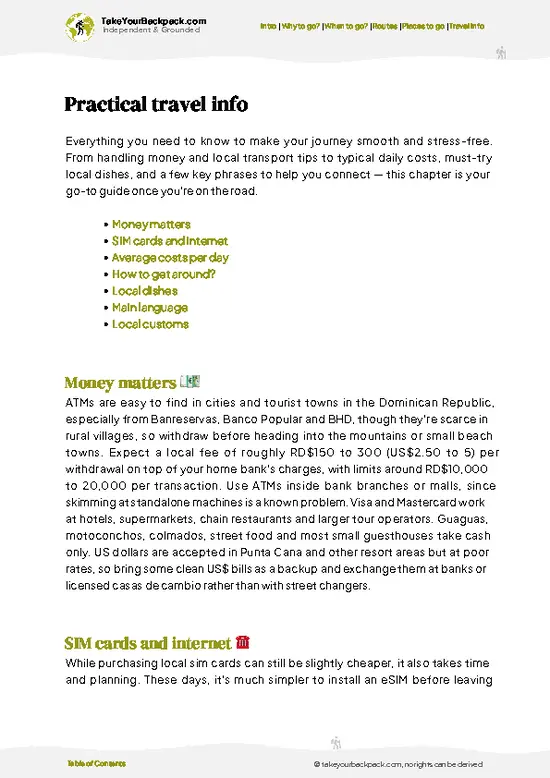
example page 2 from our offline Travel Guide for Dominican Republic
example page 3 from our offline Travel Guide for Dominican Republic
example page 4 from our offline Travel Guide for Dominican Republic
example page 5 from our offline Travel Guide for Dominican Republic
example page 6 from our offline Travel Guide for Dominican Republic
example page 7 from our offline Travel Guide for Dominican Republic
Loading the map 🌍
CLICK TO FILTER
cities
towns
landmarks
national parks
hikes
beaches
attractions
festivals
SHOW COUNTRY’S BESTSHOW ALL

✨ Why go?
Ranked #15 national park in Dominican Republic
Why Loma Quita Espuela Scientific Reserve should be on your travel list

Loma Quita Espuela Scientific Reserve suits travelers who like to arrange things directly with the people who live beside the forest. Community groups and farm families around the base run guided walks on foot or horseback, so your money lands in small households rather than big operators. The cacao farms on the lower slopes let you follow a bean from pod to chocolate in one morning. Higher up, the cloud forest around Loma Quita Espuela peak is cool, dripping and full of birdsong, a sharp contrast to the sticky coast an hour or so away. Trails are short enough to link into flexible days without a rigid tour schedule.

💡 HighlightsPlaces and moments you shouldn't skip

  1. Loma Quita Espuela summit trail: The signature climb, steep and muddy, through cloud forest with tree ferns, orchids and bromeliads, and broad views on clear mornings.
  2. Cacao farm visits: Family plantations on the lower slopes show harvesting, fermenting and drying, usually ending with fresh chocolate to taste.
  3. Birdwatching in the forest: Listen for the Hispaniolan trogon and the palmchat-like chatter of parrots; early morning gives the best activity.
  4. River swimming spots: Cool streams that run off the ridge make a welcome plunge after a muddy hike.
  5. Horseback rides through farmland: Local guides lead rides along ridge tracks past coffee, cacao and fruit trees, easier on the legs than the summit climb.
  6. Rural community stays and meals: Home-cooked plates of rice, beans and farm vegetables put you
… read more 👉
  1. Loma Quita Espuela summit trail: The signature climb, steep and muddy, through cloud forest with tree ferns, orchids and bromeliads, and broad views on clear mornings.
  2. Cacao farm visits: Family plantations on the lower slopes show harvesting, fermenting and drying, usually ending with fresh chocolate to taste.
  3. Birdwatching in the forest: Listen for the Hispaniolan trogon and the palmchat-like chatter of parrots; early morning gives the best activity.
  4. River swimming spots: Cool streams that run off the ridge make a welcome plunge after a muddy hike.
  5. Horseback rides through farmland: Local guides lead rides along ridge tracks past coffee, cacao and fruit trees, easier on the legs than the summit climb.
  6. Rural community stays and meals: Home-cooked plates of rice, beans and farm vegetables put you at a family table beside the forest.
Loma Quita Espuela Scientific Reserve has no ticket booth for most of this, but guided walks and farm visits are best arranged a day ahead through local community groups.
Spotted a mistake or missing something? Contact us.

Things to do near Loma Quita Espuela Scientific Reserve

Ratings based on Tripadvisor reviews. When you book through this link, you support our work at no extra cost to you.

🌤️ When to go?Seasonal considerations and timing

  • Dry Months (December to April): Trails are firmest and the cacao and coffee farms along the lower slopes are easiest to reach. Days run 27 to 31°C (81 to 88°F), nights in the hills drop to 17 to 20°C (63 to 68°F).
  • Wet Months (May to November): Afternoon downpours turn the clay paths slick and the Río Jamao crossings swell. Expect 24 to 30°C (75 to 86°F) and heavy humidity. Waterfalls look their best.
  • Hurricane Peak (August to October): Storms can close roads for days.
  • Crowds and Prices: Visitors are few year-round, though local guide and lodge rates edge up around Christmas and Easter. Daylight stays close to 11 to 13 hours.
Start hikes early, since cloud and rain usually build after midday.

source: climatestotravel.comJANJanuary: excellent for travelingFEBFebruary: excellent for travelingMARMarch: excellent for travelingAPRApril: excellent for travelingMAYMay: highly recommended for travelingJUNJune: fair for travelingJULJuly: fair for travelingAUGAugust: fair for travelingSEPSeptember: fair for travelingOCTOctober: good for travelingNOVNovember: highly recommended for travelingDECDecember: excellent for traveling
when-to-go

✈️ The backpacker research shortcutDominican Republic Travel Guide

An offline-friendly backpacking guide with optimized travel routes, ranked highlights, transport advice, and the best areas to stay.
example page 0 from our offline Travel Guide for Dominican Republic
example page 1 from our offline Travel Guide for Dominican Republic
example page 2 from our offline Travel Guide for Dominican Republic
example page 3 from our offline Travel Guide for Dominican Republic
example page 4 from our offline Travel Guide for Dominican Republic
example page 5 from our offline Travel Guide for Dominican Republic
example page 6 from our offline Travel Guide for Dominican Republic
example page 7 from our offline Travel Guide for Dominican Republic
The digital guide (336 pages) contains:
✅ 108 highlights, ranked by travel appeal
✅ Optimized 5, 10 & 15-day travel routes
✅ Cities, national parks, landmarks, beaches
✅ How to get around
✅ Offline-friendly for travel without Wi-Fi
👉 Click to see all 30+ guide features

📅 Plan smarter in minutes, not weeks
✅ Month by month travel advice
✅ Festivals & national holidays
✅ Budget expectations

🗺️ Go to the right places, skip the overrated ones
✅ Honest pros & cons of destinations
✅ Top hikes, parks & viewpoints
✅ Lesser-known places most travelers miss
✅ Clear “worth it vs skip it” guidance

🛏️ Travel smoothly without rookie mistakes
✅ Best areas to stay
✅ Transport systems explained simply
✅ Common scams & safety advice
✅ SIM cards, money & practical tips

🌍 Understand the country, not just visit it
✅ Culture & traditions
✅ 52 Essential phrases & customs
✅ Festivals worth planning around
✅ Traveler-friendly historical context
✅ Insights that make places more meaningful

📱 Built for real travel conditions
✅ Fully downloadable PDF
✅ Works completely offline
✅ Optimized for phone use
✅ Useful in remote areas & buses
✅ Everything in one place
Stop searching, start planning
Get instant access to your full guide. 30‑day money-back guarantee.
+ Add another guide for just

By proceeding you agree to our terms.
Sent to your inbox immediately after payment • 100% Secure Checkout
Best Backpacking Travel Advisor 2025 tourism awardBest Backpacking
Travel Advisor
2025
What others say about Take Your Backpack Guides:
⭐⭐⭐⭐⭐
Fantastic, amazing amount of information!
⭐⭐⭐⭐⭐
My goodness this is amazing, it's what I've been looking for hats off too you!
⭐⭐⭐⭐⭐
I think this is absolutely BRILLIANT
⭐⭐⭐⭐
Very complete and informative. It's still missing places, but I gotta to commend you
⭐⭐⭐⭐⭐
This is truly amazing, thank you, can't wait to explore it with my kids!
⭐⭐⭐⭐⭐
Awesome resource, thank you!
⭐⭐⭐⭐⭐
This is amazing! Can't wait to explore the ones I haven't seen
⭐⭐⭐⭐
I love this! Well done, great idea.
⭐⭐⭐⭐⭐
Thanks for taking the time to make this gem!
⭐⭐⭐⭐⭐
This might be the best website I've ever seen.
⭐⭐⭐⭐⭐
Congratulations, and thank you so much for your work; it's incredibly valuable.
⭐⭐⭐⭐
In all seriousness I think you did a great job pointing out the important spots
⭐⭐⭐⭐⭐
10/10 very good
⭐⭐⭐⭐⭐
As someone who's only just starting to visit regularly this is awesome, thank you.
⭐⭐⭐⭐
Thank you very much! I'm going to visit my dad, it's going to be very useful!
⭐⭐⭐⭐⭐
This is really cool! We'll be travelling for the first time and this definitely come in handy.
⭐⭐⭐⭐⭐
You are now our minister of culture, congratulations 👨‍💼
⭐⭐⭐⭐⭐
Just wanted to tell you that this is a pearl! Going to follow your recommendations.
⭐⭐⭐⭐⭐
This is so cool. I'll definitely be using the resource for my travels soon.
⭐⭐⭐⭐⭐
This is very impressive! Good work.
⭐⭐⭐⭐⭐
This is an amazing and informative site. Very well done!

🛏️ Where to stay?Where staying makes the most sense

Most backpackers sleep in San Francisco de Macorís, about 15 km southwest, or farther west in Salcedo, because the reserve itself has no formal lodging for visitors. Rooms in these towns run about US$15 to 35 a night and are basic, with fans or air conditioning. Salcedo is the handiest base for the Mirabal sisters museum and for hiring a motoconcho (motorbike taxi) to the trailheads. Some families and small eco-farms in the foothill communities around the reserve offer simple rooms or homestays, usually arranged through a local guide. For more choice and restaurants, Cabrera and the north coast … read more 👉
Most backpackers sleep in San Francisco de Macorís, about 15 km southwest, or farther west in Salcedo, because the reserve itself has no formal lodging for visitors. Rooms in these towns run about US$15 to 35 a night and are basic, with fans or air conditioning. Salcedo is the handiest base for the Mirabal sisters museum and for hiring a motoconcho (motorbike taxi) to the trailheads. Some families and small eco-farms in the foothill communities around the reserve offer simple rooms or homestays, usually arranged through a local guide. For more choice and restaurants, Cabrera and the north coast beaches around Río San Juan sit a couple of hours away by road, and Santiago is the larger hub with hostels and bus connections.

👛 Costs (as of 23 October 2026)Money, prices, and spending tips

A realistic budget for Loma Quita Espuela Scientific Reserve is about US$41 to 93 per day, including a guide and local transport.
CategoryBudget RangeLocal Reality
Entrance feeUS$0 to 3Little or no formal charge, with small contributions sometimes asked at community access points.
GuideUS$15 to 30Locally arranged and recommended for navigation and farm access.
Accommodation (high season)US$15 to 35Simple guesthouses in Salcedo or San Francisco de Macorís.
Local transportUS$3 to 10Shared guaguas between towns, plus motoconchos to trailheads.
Food and suppliesUS$8 to 15Pay in pesos for comedores serving rice, beans and chicken, plus fruit stands.
Total Daily BudgetUS$41 to 93Per person, per day, in high season.
⚠️ Prices can change and everyone travels differently, so take this as a rough guide. Hope it helps you plan your adventure!

🥾 TrailsExploring Loma Quita Espuela Scientific Reserve: trails, terrain, and views

Loma Quita Espuela Scientific Reserve offers short, steep, muddy walks rather than long marked circuits, and a local guide is the practical way to do them.
  • Summit climb: A half-day hike of roughly 3 to 5 hours return, moderate to hard, on slick clay and roots through cloud forest with tree ferns and orchids.
  • Cacao farm loops: Easy walks of 1 to 2 hours through shaded plantations on gentle slopes, ending with tasting.
  • Ridge horseback tracks: Rides of 2 to 3 hours past coffee, cacao and fruit trees, with views toward the Cibao valley.
  • Stream walks: Short, easy paths to cool pools, best after the climb.
… read more 👉
Loma Quita Espuela Scientific Reserve offers short, steep, muddy walks rather than long marked circuits, and a local guide is the practical way to do them.
  • Summit climb: A half-day hike of roughly 3 to 5 hours return, moderate to hard, on slick clay and roots through cloud forest with tree ferns and orchids.
  • Cacao farm loops: Easy walks of 1 to 2 hours through shaded plantations on gentle slopes, ending with tasting.
  • Ridge horseback tracks: Rides of 2 to 3 hours past coffee, cacao and fruit trees, with views toward the Cibao valley.
  • Stream walks: Short, easy paths to cool pools, best after the climb.
  • Wildlife: Expect birds, especially trogons and parrots, plus lizards, frogs and butterflies. Large mammals are absent.
Getting there is easiest from San Francisco de Macorís by motoconcho or taxi to the farming villages at the base. Public guaguas serve the main roads but not the trailheads. Visitors are few, so you will often have the trail to yourself. Entry is low-cost or arranged through guides, who are paid in pesos. Bring boots, rain gear and water, since showers arrive without warning.
⚠️ Hiking info can sometimes be outdated or inaccurate. Before you hit the trail, check the latest conditions with locals. If you do spot anything that's off, I'd love to hear from you, so I can update it for fellow travelers.

🛡️ SafetySafety Tips and Common Scams in Loma Quita Espuela Scientific Reserve

The reserve is a low-risk hike, but the terrain is steeper and muddier than it looks. Red clay turns slick within minutes of rain, so wear shoes with real tread and carry a trekking pole if you have one. Trails are lightly marked, which makes a local guide worth hiring for navigation and for access across private farmland. Streams rise quickly after storms, so skip crossings when water turns brown. There is no dangerous large wildlife, though mosquitoes are persistent, so bring repellent. Carry at least 2 liters of water, a rain jacket, and a charged phone, since signal fades in the valleys. Leave early so you finish before dark.

FAQCommon questions from travelers

Plan on one full day for Loma Quita Espuela Scientific Reserve, or two if you want to add a cacao farm visit and a waterfall hike. A guided day walk typically takes 4 to 6 hours. Two nights in Salcedo or San Francisco de Macorís lets you pair it with the Mirabal Sisters Museum in Ojo de Agua.
Yes, though it takes some improvising at Loma Quita Espuela Scientific Reserve. Guaguas (minibuses) run from Santiago or Santo Domingo to Salcedo and San Francisco de Macorís, roughly 2 to 3 hours from either, and motoconchos cover the last stretch for about US$2 to 6. Many hikers hire a guide with a motorbike to reach the trailheads.
Loma Quita Espuela Scientific Reserve has no strict ticketing system, and entry is free or very cheap, at most around US$3 at some community access points. A permit is not generally required for day hikes, but a local guide at US$15 to 30 is advised because trails cross private farmland. Ask in Salcedo or San Francisco de Macorís for contacts.
⚠️ Things can change over time, so always validate details locally before you go.

Other Dominican national parks near Loma Quita Espuela Scientific Reserve

Explore more nearby:


💡 Not sure where to go next?
Create a personalized itinerary for Dominican Republic including Loma Quita Espuela Scientific Reserve and the places that fit your trip.

Generate my itinerary

👉 Discover all national parks

Or checkout all Dominican Republic has to offer (think cities, towns, villages, national parks, hikes, beaches, festivals)
Country photo of Dominican Republic

We 💚 feedbackFinal thoughts on exploring Loma Quita Espuela Scientific Reserve

Loma Quita Espuela Scientific Reserve punishes travelers who show up in sneakers and expect a marked trail. Hire a local guide the day before, start at dawn before the clouds close in, and pack a dry change of socks. Your feet will thank you.

✍️ Help improve this page!
The information on this page is based on in-depth research, insights shared by experienced travelers, and feedback from the local travel community in Dominican Republic. While every effort is made to keep the information accurate and current, conditions can change — so if you spot anything incorrect or outdated, please get in touch.


🙋‍♂️ Give feedback

👋 Meet the founderWho’s Behind Take Your Backpack?

Johan, backpacker and founder of TakeYourBackpackHi, I’m Johan (Netherlands 🇳🇱), the creator of TakeYourBackpack. Over the past 3 decades, I’ve backpacked through 90+ countries across six continents, gaining extensive experience with independent travel, long-term trips, and overland routes.

This site is built on a combination of firsthand travel experience and carefully curated insights from other backpackers. Many guides are based on places I’ve personally visited, while others bring together tips, observations, and practical advice shared by trusted travelers I’ve met along the way.

The goal is to provide realistic, experience-driven guidance — not generic itineraries — so you can explore destinations with better context, clearer expectations, and more confidence.