×

Egypt🇪🇬 | townsWadi El NatrunCoptic monasteries, salt lakes, desert plain | things to do and best time to go

Explore RosettaExplore El-Tor

Backpacking in Wadi El Natrun
👌 Worth visitingtown ranked #13
By Johan Kruseman 🇳🇱 | Updated June 4, 2026

If you crave nightlife, glossy museums, or a city that hums after dark, Wadi El Natrun will feel like a monastery—because, in many ways, it is. But that’s the point. For backpackers, this low-slung town in Egypt’s Western Desert, halfway between Cairo and Alexandria, is a living lesson in stillness. The air smells faintly of salt and sun-baked earth; the monasteries—some of the oldest in Christendom—are the real draw, not the town itself. Wadi El Natrun works best as a contemplative stopover, a place to break up the highway monotony and recalibrate. Buses drop you nearby, but you’ll need a tuk-tuk or taxi to reach the monasteries. Hostels are rare, and evenings are quiet, but costs are low and safety is high. Compared to the bustle of Cairo or the Mediterranean pulse of Alexandria, Wadi El Natrun feels stripped down—more retreat than destination, best appreciated by those who value the journey as much as the arrival.

Discover everything you want to know in the 📖 Egypt Travel Guide.


Get your Egypt guide
116 ranked highlights, routes & tips, works offline (438 pages)
Loading the map 🌍
CLICK TO FILTER
cities
towns
landmarks
national parks
hikes
beaches
attractions
festivals
regions
SHOW COUNTRY’S BESTSHOW ALL

✨ Why go?
Ranked #13 town in Egypt
Reasons people choose to visit here

Wadi El Natrun draws backpackers for its strategic location along the route to the Western Desert and Cairo, making it a convenient stop. The town is a gateway to hiking trails and cultural sites, like ancient monasteries, where the scent of incense mingles with the warm desert air. You’ll find small-scale hostels and guesthouses that foster a friendly atmosphere, perfect for solo travelers or small groups looking to connect. The streets are walkable, inviting you to explore local eateries serving hearty, home-cooked meals. Most travelers stay briefly, often just a night or two, but those who linger appreciate the slow pace and the chance to soak in the authentic Egyptian vibe. If you’re after a quick stop with a touch of local charm, this town fits the bill.
Want to include Wadi El Natrun in your Egypt route?
Create a personalized Egypt itinerary that includes Wadi El Natrun and the places that fit your trip — based on your travel style, budget, and available time. Get your route in seconds.

Generate my trip

💡 HighlightsEssential experiences to have while visiting Wadi El Natrun

  • Monastery of Saint Macarius (Deir Abu Maqar) — The largest, oldest active monastery in Scetis: fortress-like walls, frescoed churches, relics and an on-site museum that give a real feel for four centuries of Egyptian monastic life.
  • Monastery of Saint Bishoy (Deir Anba Bishoi) — A compact, beautifully austere monastery famous for the cell and shrine of St. Bishoy; quiet courtyards, palm shade and a living monk community make it deeply atmospheric.
  • Deir el-Surian (the Syrian Monastery) — Known for its rare Syriac and Coptic manuscripts, distinctive icons and bilingual inscriptions; the library and painted interiors are a must for anyone into early Christian art and texts.
  • Paromeos / Deir al-Baramus Monastery — An impressive desert abbey with ancient basilica remains, thick defensive walls
read more 👉
  • Monastery of Saint Macarius (Deir Abu Maqar) — The largest, oldest active monastery in Scetis: fortress-like walls, frescoed churches, relics and an on-site museum that give a real feel for four centuries of Egyptian monastic life.
  • Monastery of Saint Bishoy (Deir Anba Bishoi) — A compact, beautifully austere monastery famous for the cell and shrine of St. Bishoy; quiet courtyards, palm shade and a living monk community make it deeply atmospheric.
  • Deir el-Surian (the Syrian Monastery) — Known for its rare Syriac and Coptic manuscripts, distinctive icons and bilingual inscriptions; the library and painted interiors are a must for anyone into early Christian art and texts.
  • Paromeos / Deir al-Baramus Monastery — An impressive desert abbey with ancient basilica remains, thick defensive walls and scattered hermit cells — great for wandering and imagining early desert ascetic life.
  • The Natron Lakes (salt pans) — Stark, reflective alkaline lakes and salt flats that give the valley its name; otherworldly photography, simple salt-harvesting activity and a direct link to the region’s industrial and ancient uses of natron.
  • Scetis Hermit-cell Ruins — The scattered stone cells, chapels and grave markers of early desert fathers — not a polished tourist site but profoundly evocative if you take a respectful, slow walk among the ruins.
  • Icon and Manuscript Collections (inside the monasteries) — Several monasteries (especially Deir el-Surian and St. Macarius) house small but important collections of icons, manuscripts and liturgical objects — excellent for close, quiet study of Coptic material culture.
  • Monastic Fortifications and Towers — The medieval defensive architecture that punctuates the valley — thick stone towers and gates that tell stories of raids, pilgrimage and monastic community life; fun to inspect up close.
  • Village Palm Groves and Local Market — Simple but rewarding: palm groves, date stalls, and a handful of tea shops where you can meet locals, buy hand-harvested natron or dates, and watch daily life away from the monasteries.
  • Desert Walks & Rim Viewpoints — Short hikes to the rim of the depression and across salt-crusted flats give great sunrise/sunset views, interesting geology and solitude — bring water and sun protection, and stick to visible paths.
A few easy day trips from Wadi El Natrun: the Ottoman town of Rosetta (Rashid) for its historic houses and fort, the Mediterranean sights of Alexandria, and nearby Lake Burullus for birdwatching and lagoonside scenery.
Spotted a mistake or missing something? Contact us.

Things to do near Wadi El Natrun

Ratings based on Tripadvisor reviews. When you book through this link, you support our work at no extra cost to you.

🏘️ NeighborhoodsKey areas and districts to know

Wadi El Natrun offers a unique blend of history and tranquility, perfect for backpackers seeking an authentic Egyptian experience.

Old Town: This area is steeped in history, with ancient monasteries and narrow, winding streets. The vibe is peaceful, ideal for those who appreciate quiet exploration. Costs are low, making it suitable for longer stays. Walkability is excellent, but nightlife is minimal—perfect for early nights and early mornings.

Market District: Bursting with local life, this neighborhood is where you can immerse yourself in the daily hustle. The scent of spices fills the air, and you’ll find affordable eateries. It’s walkable and vibrant, making it great for short stays. Expect some noise, but that’s part of the charm.

New Development Area: A contrast to the historical parts, … read more 👉
Wadi El Natrun offers a unique blend of history and tranquility, perfect for backpackers seeking an authentic Egyptian experience.

Old Town: This area is steeped in history, with ancient monasteries and narrow, winding streets. The vibe is peaceful, ideal for those who appreciate quiet exploration. Costs are low, making it suitable for longer stays. Walkability is excellent, but nightlife is minimal—perfect for early nights and early mornings.

Market District: Bursting with local life, this neighborhood is where you can immerse yourself in the daily hustle. The scent of spices fills the air, and you’ll find affordable eateries. It’s walkable and vibrant, making it great for short stays. Expect some noise, but that’s part of the charm.

New Development Area: A contrast to the historical parts, this area features modern amenities and cafes. It’s more expensive but offers a comfortable stay. Transport access is better here, making it easy to explore further afield. Ideal for those who want a mix of comfort and culture.

⌛️ 1 daySeeing the highlights in 24 hours

Wadi El Natrun, a serene oasis in Egypt, is a treasure trove of history and spirituality, home to ancient monasteries and a rich tapestry of Coptic culture. The air here carries a hint of incense, mingling with the earthy scent of the surrounding desert.

Start your morning at the Monastery of St. Macarius, where the soft light filters through ancient stone walls, illuminating centuries of devotion. Take your time exploring the tranquil grounds; the stillness invites reflection. Afterward, stroll through the nearby village, where you can sip strong, sweet tea from a local vendor. The warmth of the sun on your skin and the laughter of children playing nearby create a perfect backdrop.

In the afternoon, head to the lesser-known Monastery of St. Pishoy. This site often flies under the radar … read more 👉
Wadi El Natrun, a serene oasis in Egypt, is a treasure trove of history and spirituality, home to ancient monasteries and a rich tapestry of Coptic culture. The air here carries a hint of incense, mingling with the earthy scent of the surrounding desert.

Start your morning at the Monastery of St. Macarius, where the soft light filters through ancient stone walls, illuminating centuries of devotion. Take your time exploring the tranquil grounds; the stillness invites reflection. Afterward, stroll through the nearby village, where you can sip strong, sweet tea from a local vendor. The warmth of the sun on your skin and the laughter of children playing nearby create a perfect backdrop.

In the afternoon, head to the lesser-known Monastery of St. Pishoy. This site often flies under the radar but offers a more intimate experience. The vibrant murals and the sound of monks chanting echo through the halls, wrapping you in a sense of peace.

As the sun begins to set, wander through the narrow streets of the old town. The golden hour casts a warm glow on the mud-brick houses, and the aroma of spices wafts from small kitchens. Find a local eatery and savor a plate of koshari, a hearty mix of rice, lentils, and pasta, topped with a tangy tomato sauce.

End your day under the stars, where the quiet of the desert night invites you to reflect on the beauty of your journey.
Turn your Wadi El Natrun visit into an Egypt adventure
Build a complete Egypt route with Wadi El Natrun, hidden gems, must-see destinations, and realistic travel times included.

Generate my trip

🌤️ When to go?Weather, crowds, and seasonal trade-offs


  • Weather: Wadi El Natrun bakes under the Egyptian sun most of the year. The best window is from October to April when the desert air cools to a bearable 15-25°C (59-77°F), making hiking and exploring monasteries comfortable rather than a sweat-drenched slog.

  • Temperature: Summer highs soar above 40°C (104°F), turning the landscape into a furnace. Nights offer little relief, so avoid June to September unless you’re equipped for extreme heat and dehydration risks.

  • Daylight Hours: Winter months bring shorter days, roughly 10 hours of light, which means starting early is crucial to maximize your time outdoors without rushing through the experience.

  • Crowds: The cooler months attract more visitors, especially religious tourists, but Wadi El Natrun remains relatively quiet compared to Egypt’s
read more 👉

  • Weather: Wadi El Natrun bakes under the Egyptian sun most of the year. The best window is from October to April when the desert air cools to a bearable 15-25°C (59-77°F), making hiking and exploring monasteries comfortable rather than a sweat-drenched slog.

  • Temperature: Summer highs soar above 40°C (104°F), turning the landscape into a furnace. Nights offer little relief, so avoid June to September unless you’re equipped for extreme heat and dehydration risks.

  • Daylight Hours: Winter months bring shorter days, roughly 10 hours of light, which means starting early is crucial to maximize your time outdoors without rushing through the experience.

  • Crowds: The cooler months attract more visitors, especially religious tourists, but Wadi El Natrun remains relatively quiet compared to Egypt’s hotspots. Expect a peaceful vibe with occasional groups around key monasteries.

  • Seasonal Activities: Winter and early spring are ideal for witnessing local religious festivals and monastery events, adding cultural depth to your trek beyond the landscape itself.

  • Price Fluctuations: Accommodation and transport costs rise slightly during peak season (October-April) due to demand but remain reasonable compared to major cities, rewarding those who plan ahead.


Pro-tip: Aim for late autumn or early spring to catch mild weather, fewer crowds, and the soft golden light that makes the desert’s ochre tones glow—perfect for both trekking and photography.


source: climatestotravel.comJANJanuary: excellent for travelingFEBFebruary: excellent for travelingMARMarch: excellent for travelingAPRApril: highly recommended for travelingMAYMay: fair for travelingJUNJune: below average for travelingJULJuly: below average for travelingAUGAugust: below average for travelingSEPSeptember: fair for travelingOCTOctober: excellent for travelingNOVNovember: excellent for travelingDECDecember: excellent for traveling
when-to-go

✈️ The backpacker research shortcutEgypt Travel Guide

An offline-friendly backpacking guide with optimized travel routes, ranked highlights, transport advice, and the best areas to stay.
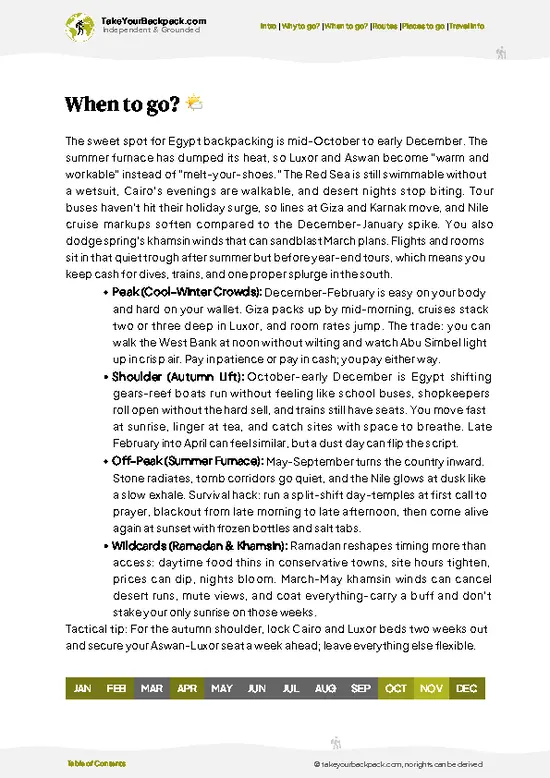
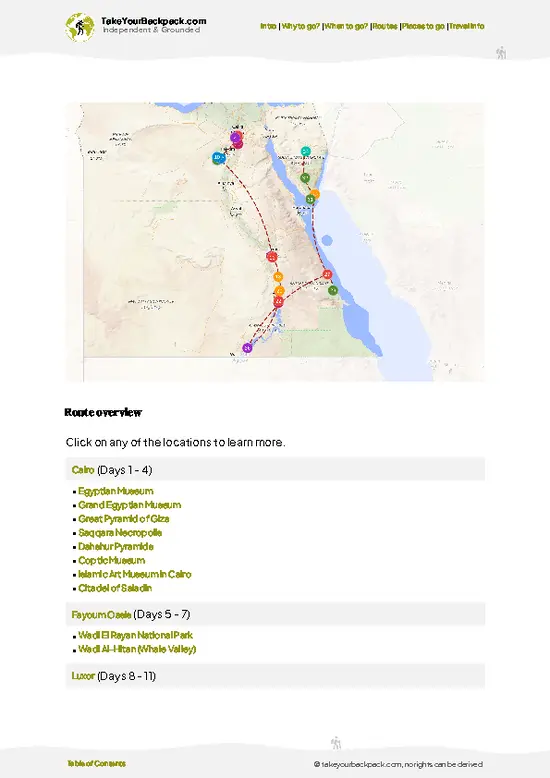
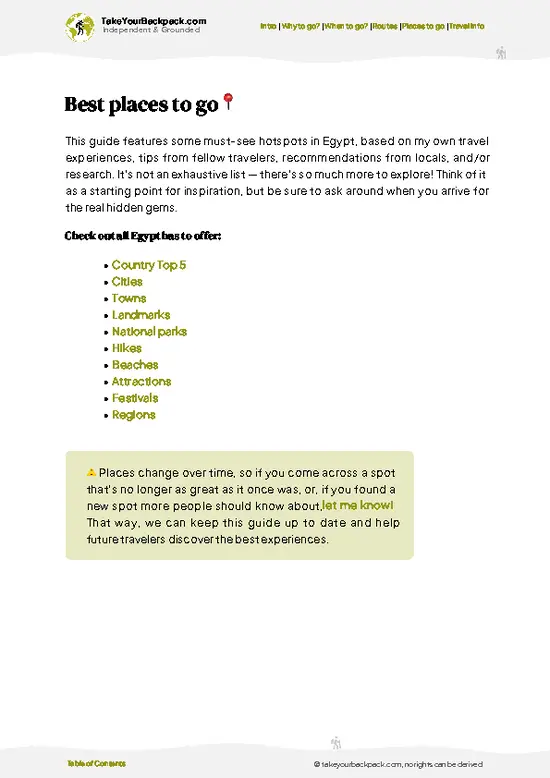
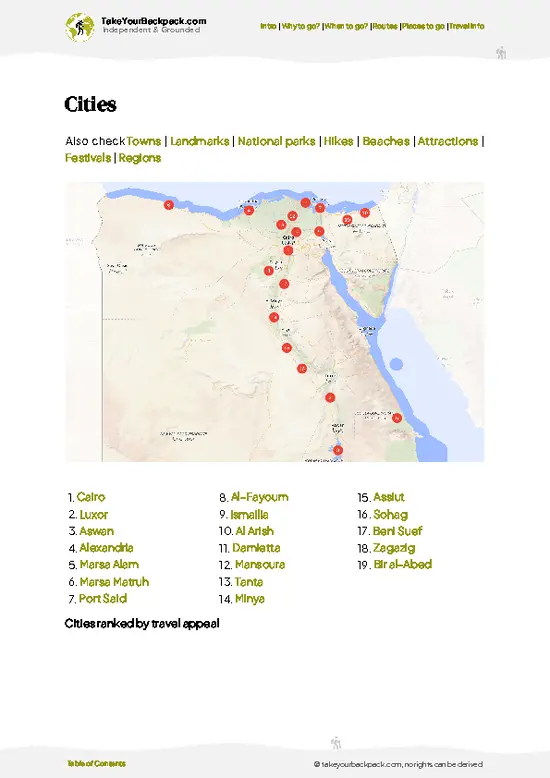
example page 0 from our offline Travel Guide for Egypt
example page 1 from our offline Travel Guide for Egypt
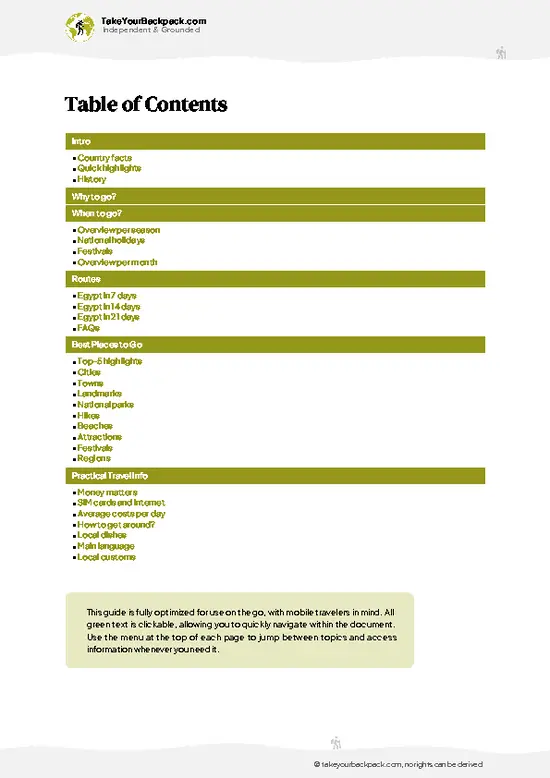
example page 2 from our offline Travel Guide for Egypt
example page 3 from our offline Travel Guide for Egypt
example page 4 from our offline Travel Guide for Egypt
example page 5 from our offline Travel Guide for Egypt
example page 6 from our offline Travel Guide for Egypt
example page 7 from our offline Travel Guide for Egypt
The digital guide (438 pages) contains:
116 highlights, ranked by travel appeal
Optimized 7, 14 & 21-day travel routes
Cities, national parks, landmarks, beaches
How to get around
Offline-friendly for travel without Wi-Fi
👉 Click to see all 30+ guide features

📅 Plan smarter in minutes, not weeks
Month by month travel advice
Festivals & national holidays
Budget expectations

🗺️ Go to the right places, skip the overrated ones
Honest pros & cons of destinations
Top hikes, parks & viewpoints
Lesser-known places most travelers miss
Clear “worth it vs skip it” guidance

🛏️ Travel smoothly without rookie mistakes
Best areas to stay
Transport systems explained simply
Common scams & safety advice
SIM cards, money & practical tips

🌍 Understand the country, not just visit it
Culture & traditions
52 Essential phrases & customs
Festivals worth planning around
Traveler-friendly historical context
Insights that make places more meaningful

📱 Built for real travel conditions
Fully downloadable PDF
Works completely offline
Optimized for phone use
Useful in remote areas & buses
Everything in one place
Save weeks of stressful planning
Get instant access to your full guide. 30‑day money-back guarantee.


By proceeding you agree to our terms.
Sent to your inbox immediately after payment • 100% Secure Checkout
Best Backpacking Travel Advisor 2025 tourism awardBest Backpacking
Travel Advisor
2025
What others say about Take Your Backpack Guides:
⭐⭐⭐⭐⭐
Fantastic, amazing amount of information!
⭐⭐⭐⭐⭐
My goodness this is amazing, it's what I've been looking for hats off too you!
⭐⭐⭐⭐⭐
I think this is absolutely BRILLIANT
⭐⭐⭐⭐
Very complete and informative. It's still missing places, but I gotta to commend you
⭐⭐⭐⭐⭐
This is truly amazing, thank you, can't wait to explore it with my kids!
⭐⭐⭐⭐⭐
Awesome resource, thank you!
⭐⭐⭐⭐⭐
This is amazing! Can't wait to explore the ones I haven't seen
⭐⭐⭐⭐
I love this! Well done, great idea.
⭐⭐⭐⭐⭐
Thanks for taking the time to make this gem!
⭐⭐⭐⭐⭐
This might be the best website I've ever seen.
⭐⭐⭐⭐⭐
Congratulations, and thank you so much for your work; it's incredibly valuable.
⭐⭐⭐⭐
In all seriousness I think you did a great job pointing out the important spots
⭐⭐⭐⭐⭐
10/10 very good
⭐⭐⭐⭐⭐
As someone who's only just starting to visit regularly this is awesome, thank you.
⭐⭐⭐⭐
Thank you very much! I'm going to visit my dad, it's going to be very useful!
⭐⭐⭐⭐⭐
This is really cool! We'll be travelling for the first time and this definitely come in handy.
⭐⭐⭐⭐⭐
You are now our minister of culture, congratulations 👨‍💼
⭐⭐⭐⭐⭐
Just wanted to tell you that this is a pearl! Going to follow your recommendations.
⭐⭐⭐⭐⭐
This is so cool. I'll definitely be using the resource for my travels soon.
⭐⭐⭐⭐⭐
This is very impressive! Good work.
⭐⭐⭐⭐⭐
This is an amazing and informative site. Very well done!

🛏️ Where to stay?Best areas and accommodation options

Wadi El Natrun is a small town, so your best bet is to stay near the town center where the main road hums with local life. This area offers a practical mix of safety and social energy, crucial for solo backpackers who want to feel connected without the overwhelm of a big city. The streets here are lined with small shops and cafés where you can catch the scent of fresh bread and strong coffee—perfect for easing into the slower pace of Egyptian desert life.

Hostel options are limited but tend to cluster around this central zone, making it easier to meet fellow travelers and swap stories over shared … read more 👉
Wadi El Natrun is a small town, so your best bet is to stay near the town center where the main road hums with local life. This area offers a practical mix of safety and social energy, crucial for solo backpackers who want to feel connected without the overwhelm of a big city. The streets here are lined with small shops and cafés where you can catch the scent of fresh bread and strong coffee—perfect for easing into the slower pace of Egyptian desert life.

Hostel options are limited but tend to cluster around this central zone, making it easier to meet fellow travelers and swap stories over shared meals. Compared to the quieter outskirts, the town center’s vibe is more dynamic, with enough foot traffic to feel secure after dark but not so much that you lose the town’s intimate charm. Staying here means you’re close to transport links and the monasteries, so you can dive into the spiritual history without wasting time or energy.

🚌 Getting aroundMoving around without the hassle

Wadi El Natrun moves at its own rhythm—less a clock-driven town and more a place where the sun’s angle and the slow shuffle of locals set the pace. Dust swirls in the dry air, carrying the faint scent of salt from the nearby lakes, while the occasional call to prayer punctuates the stillness. This isn’t a place where you’ll find strict timetables or polished transit hubs. Instead, it’s about reading the flow: when a shared taxi fills up, when the old bus rumbles in, or when the heat softens enough to walk without wilting. Understanding this rhythm means you don’t just get from A to B—you glide through the town’s pulse, making your journey part of the experience.


  • Shared Taxis (Microbuses): These are the backbone of local transit, leaving only when full, so timing is flexible but unpredictable.
read more 👉
Wadi El Natrun moves at its own rhythm—less a clock-driven town and more a place where the sun’s angle and the slow shuffle of locals set the pace. Dust swirls in the dry air, carrying the faint scent of salt from the nearby lakes, while the occasional call to prayer punctuates the stillness. This isn’t a place where you’ll find strict timetables or polished transit hubs. Instead, it’s about reading the flow: when a shared taxi fills up, when the old bus rumbles in, or when the heat softens enough to walk without wilting. Understanding this rhythm means you don’t just get from A to B—you glide through the town’s pulse, making your journey part of the experience.


  • Shared Taxis (Microbuses): These are the backbone of local transit, leaving only when full, so timing is flexible but unpredictable. Expect to pay around 10-15 EGP for trips to nearby towns. They’re cramped but fast, weaving through dusty roads with a sense of urgency that contrasts the town’s slow vibe.


  • Local Buses: Operate roughly from 6 AM to 6 PM, with fares under 10 EGP. They’re slower and less frequent but offer a more comfortable ride than shared taxis. The buses stop on request, so flag them down early to avoid waiting in the sun.


  • Walking: The best way to soak in Wadi El Natrun’s quiet charm. Distances between key sites are manageable, but midday heat can be brutal—early morning or late afternoon strolls reveal the landscape’s subtle colors and the salt flats’ shimmer.


  • Private Taxis: Negotiate fares upfront; expect to pay 50-100 EGP for short trips. They offer comfort and flexibility but can strain a budget. Ideal if you’re carrying gear or traveling in a group.

👛 Costs (as of 27 January 2026)Travel costs and budget guide for Wadi El Natrun

Backpacking in Wadi El Natrun, Egypt, means stepping into a quiet, off-the-beaten-path town where costs stay low but the experience feels rich in history and atmosphere. Here’s what you can expect to spend daily, broken down by essentials:
  • Dorm Accommodation: Options are limited and basic, often in small guesthouses or monasteries offering simple dorm beds or shared rooms. Expect to pay around $5 to $10 per night. The rooms are no-frills but clean, with the scent of dry desert air filtering through open windows.
  • Meals: Local eateries serve hearty Egyptian staples like ful medames and ta’ameya for about $2 to $4 per meal. Street food and small cafés keep costs low, and fresh bread and local fruits add to the flavor without inflating the bill. Budget around $6 to $10 daily if you stick to
read more 👉
Backpacking in Wadi El Natrun, Egypt, means stepping into a quiet, off-the-beaten-path town where costs stay low but the experience feels rich in history and atmosphere. Here’s what you can expect to spend daily, broken down by essentials:
  • Dorm Accommodation: Options are limited and basic, often in small guesthouses or monasteries offering simple dorm beds or shared rooms. Expect to pay around $5 to $10 per night. The rooms are no-frills but clean, with the scent of dry desert air filtering through open windows.
  • Meals: Local eateries serve hearty Egyptian staples like ful medames and ta’ameya for about $2 to $4 per meal. Street food and small cafés keep costs low, and fresh bread and local fruits add to the flavor without inflating the bill. Budget around $6 to $10 daily if you stick to local joints.
  • Local Transport: Wadi El Natrun is small enough to explore mostly on foot, but for longer trips or to nearby monasteries, minibuses and shared taxis cost roughly $1 to $3 per ride. A daily transport budget of $2 to $5 covers getting around comfortably without rushing.
  • Basic Activities/Entry Fees: Visiting the ancient monasteries is the main draw. Entry fees are modest, typically $1 to $3 per site. Hiring a local guide for deeper insight might cost $10 to $15, but it’s optional. Plan for about $3 to $10 daily if you’re exploring a couple of sites.
  • Miscellaneous Expenses: This includes bottled water, snacks, occasional phone top-ups, or small souvenirs. Around $2 to $5 daily keeps you covered without surprises.

All told, a realistic daily budget for backpacking in Wadi El Natrun falls between $18 and $40. This range lets you experience the town’s quiet charm without cutting corners on comfort or local flavor. The modest costs reflect the town’s slow pace and simple lifestyle, making every dollar stretch while you soak in the desert light and centuries-old monastic calm.


source: egymonuments.gov.eg
⚠️ Prices can change and everyone travels differently, so take this as a rough guide. Hope it helps you plan your adventure!

🚌 Day tripsExploring the surroundings

Wadi El Natrun is a perfect launchpad for exploring Egypt’s rich tapestry of history and culture. With its strategic location, you can dive into some truly rewarding day trips that balance adventure and authenticity.

Day Trip to the Monasteries of Wadi El Natrun
Just a short ride from town, the ancient monasteries here are a must-see. These spiritual havens, dating back to the 4th century, offer a glimpse into early Christian life. The scent of incense wafts through the air as you wander the tranquil grounds, and the sound of monks chanting fills the silence. Plan for about 30 minutes of travel time and a modest entry fee. Early morning is best to avoid the heat and crowds. Many first-timers overlook the rich stories behind the frescoes; take a moment to chat with the monks if you can. … read more 👉
Wadi El Natrun is a perfect launchpad for exploring Egypt’s rich tapestry of history and culture. With its strategic location, you can dive into some truly rewarding day trips that balance adventure and authenticity.

Day Trip to the Monasteries of Wadi El Natrun
Just a short ride from town, the ancient monasteries here are a must-see. These spiritual havens, dating back to the 4th century, offer a glimpse into early Christian life. The scent of incense wafts through the air as you wander the tranquil grounds, and the sound of monks chanting fills the silence. Plan for about 30 minutes of travel time and a modest entry fee. Early morning is best to avoid the heat and crowds. Many first-timers overlook the rich stories behind the frescoes; take a moment to chat with the monks if you can.


Day Trip to the Nile Delta
A bit further afield, the Nile Delta is a vibrant ecosystem teeming with life. Expect a 1.5-hour bus ride, but the lush landscapes and bustling local markets make it worthwhile. You can grab a hearty meal for under $5 and soak in the local culture. Spring is ideal, with wildflowers blooming and temperatures just right. A common mistake is sticking to the main roads; venture into the smaller villages for a more authentic experience.


Day Trip to El Alamein
History buffs will appreciate a trip to El Alamein, about two hours away. This site of a pivotal WWII battle is home to poignant memorials and museums. The journey is scenic, with coastal views that make the ride enjoyable. Entry fees are minimal, and you can easily find lunch for around $7. Fall is a great time to visit, as the weather is cooler. Many overlook the small museum; it’s packed with fascinating artifacts that bring the history to life.


Day Trip to Alexandria
Alexandria, with its Mediterranean charm, is just a two-hour train ride from Wadi El Natrun. The city buzzes with energy, from the salty sea breeze to the vibrant street food scene. Expect to spend around $10 for a round-trip ticket and a few bucks for a meal. Late afternoon is perfect for exploring the Corniche and catching the sunset. First-timers often miss the local cafes; don’t skip the chance to sip mint tea while watching the world go by.
👉 Explore Alexandria
Want to know what more Egypt offers?
The Egypt Travel Guide describes 116 highlights, from cities to national parks, from beaches to hikes

Get the Travel Guide -

🛡️ SafetySafety Tips and Common Scams in Wadi El Natrun

Wadi El Natrun is generally safe, but a few practical tips can enhance your experience. Stay aware in crowded areas, especially near markets where pickpockets might lurk. If you’re solo, avoid wandering too far after dark; the streets can feel deserted, and it’s best to stick to well-lit paths.

Common scams are rare, but some locals might offer unsolicited help, expecting a tip. Politely decline and keep your plans close to your chest. Carry yourself confidently, and engage with locals when it feels right; their warmth often outweighs any minor annoyances. Enjoy the serenity, and let the atmosphere guide your journey.

Other Egyptian towns near Wadi El Natrun

Explore more nearby:

  • Rosetta—Ottoman mansions, Nile mouth, stone workshops| 104 km away
  • El-Tor—Sinai capital, hot springs, government hub| 408 km away
  • Taba—Sinai border, mountain views, Gulf of Aqaba| 458 km away

💡 Not sure where to go next?
Create a personalized itinerary for Egypt including Wadi El Natrun and the places that fit your trip.

Generate my itinerary

👉 Discover all towns

Or checkout all Egypt has to offer (think cities, towns, villages, national parks, hikes, beaches, festivals)
Country photo of Egypt

We 💚 feedbackFinal thoughts on visiting Wadi El Natrun

Wadi El Natrun is a breath of fresh air amid Egypt’s chaos. The stillness here is palpable, almost sacred. Don’t miss the ancient monasteries; they’re steeped in history and surprisingly serene. Just be ready for the heat—early mornings are your best friend. Embrace the quiet; it’s where the real magic happens.

✍️ Help improve this page!
The information on this page is based on in-depth research, insights shared by experienced travelers, and feedback from the local travel community in Egypt. While every effort is made to keep the information accurate and current, conditions can change — so if you spot anything incorrect or outdated, please get in touch.


🙋‍♂️ Give feedback

👋 Meet the founderWho’s Behind Take Your Backpack?

Johan, backpacker and founder of TakeYourBackpackHi, I’m Johan (Netherlands 🇳🇱), the creator of TakeYourBackpack. Over the past decade, I’ve backpacked through 80+ countries across six continents, gaining extensive experience with independent travel, long-term trips, and overland routes.

This site is built on a combination of firsthand travel experience and carefully curated insights from other backpackers. Many guides are based on places I’ve personally visited, while others bring together tips, observations, and practical advice shared by trusted travelers I’ve met along the way.

The goal is to provide realistic, experience-driven guidance — not generic itineraries — so you can explore destinations with better context, clearer expectations, and more confidence.

Get full Egypt guide •
Instant download • 116 highlights • Full Offline guide