×

Equatorial Guinea🇬🇶 | villagesNsorkFang road town, morning market, Spanish signage, rainforest edge | things to do and best time to go

Explore Pico de Santa IsabelExplore Moka Wildlife Center

Backpacking in Nsork
🏆 Top pickvillage ranked #1
By Johan Kruseman 🇳🇱 | Updated October 22, 2026

Nsork is a small Fang town in mainland Río Muni, close enough to the Gabon frontier that many assume it is a Gabonese settlement, but it sits in the east of Equatorial Guinea, in Wele-Nzas province south of Mongomo. Expect a quiet road town of low concrete houses, church compounds, small shops and forest closing in on every side. There are no formal sights, no hostel scene and little tourist infrastructure. What you get is a look at everyday Fang life, Spanish-language signage, and rainforest country that few outsiders see. Evenings are calm: bars with warm beer, early nights, and almost no chance of meeting other backpackers. Plan on conversation with locals, who will often ask for your documents or purpose, so carry your visa and passport copies. It works as a pause on an overland route through the east of the country. It suits patient travelers who like unhurried, low-key places and speak some Spanish. It will frustrate anyone who needs nightlife, ready-made activities or easy connections.

Discover everything you want to know in the 📖 Equatorial Guinea Travel Guide.


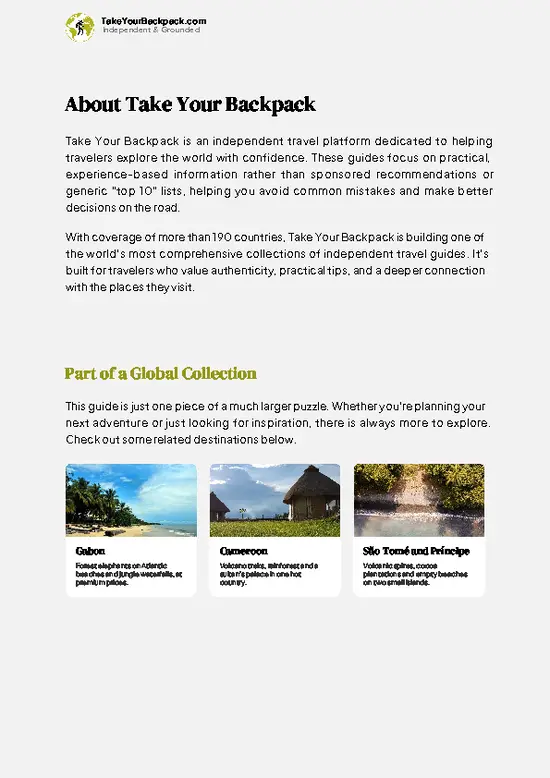
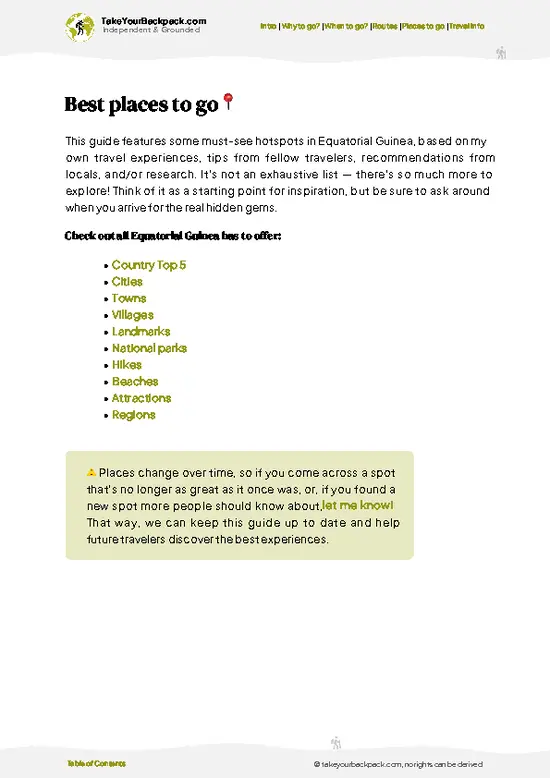
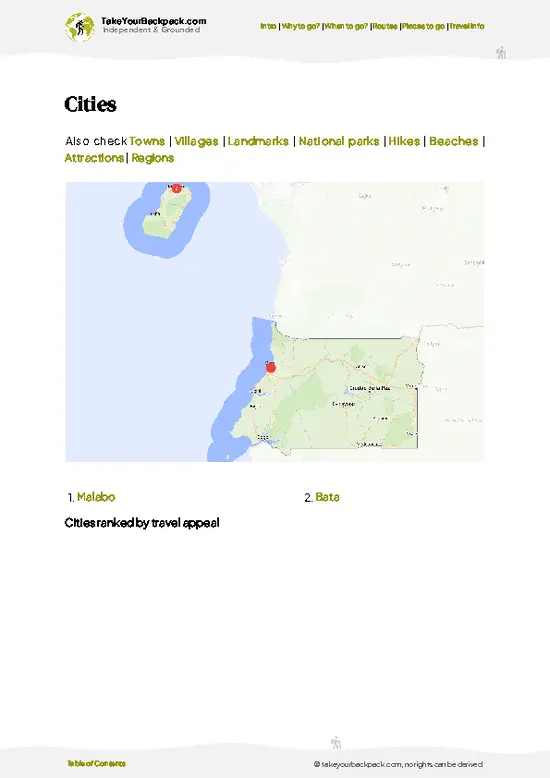
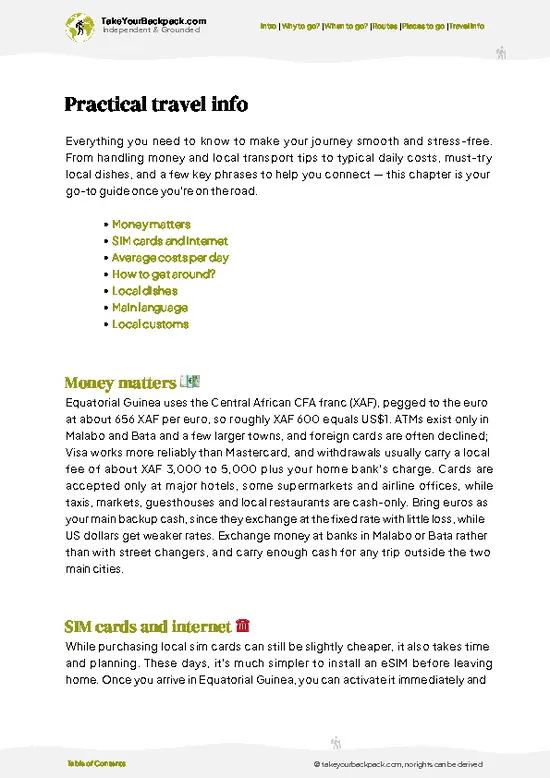
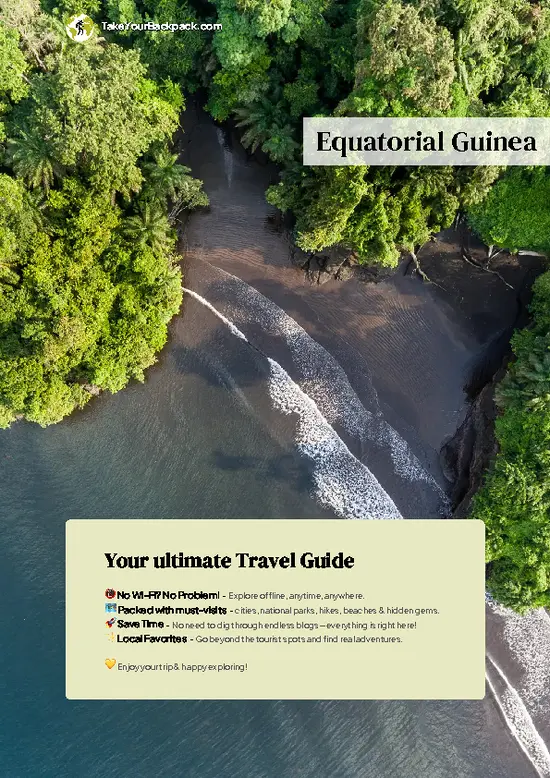
example page 0 from our offline Travel Guide for Equatorial Guinea
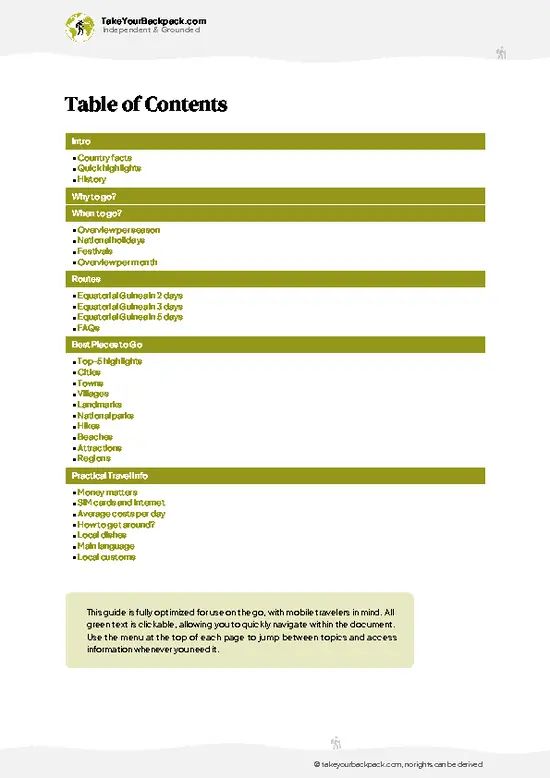
example page 1 from our offline Travel Guide for Equatorial Guinea
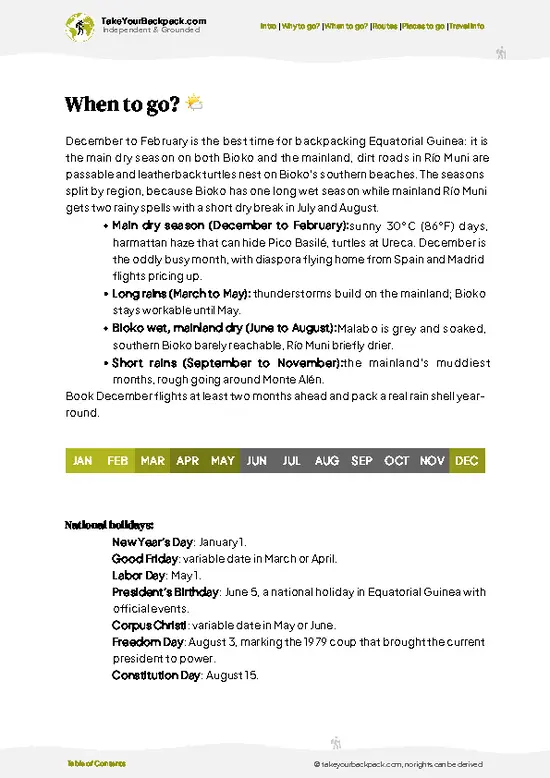
example page 2 from our offline Travel Guide for Equatorial Guinea
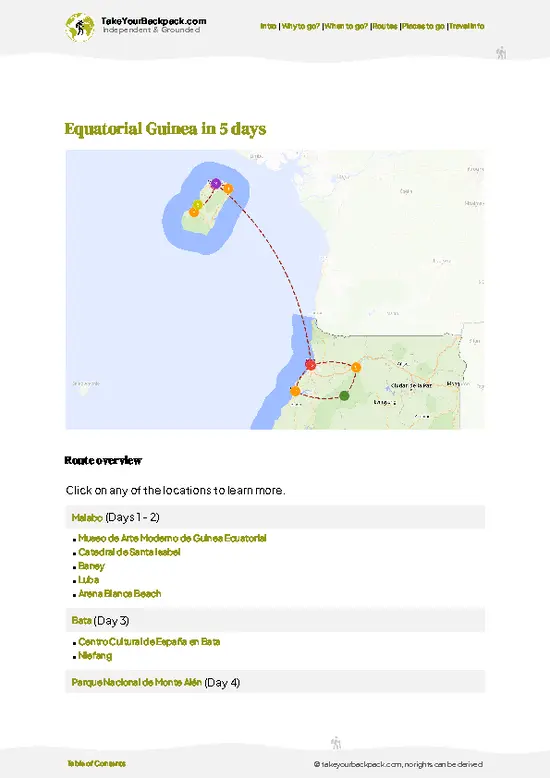
example page 3 from our offline Travel Guide for Equatorial Guinea
example page 4 from our offline Travel Guide for Equatorial Guinea
example page 5 from our offline Travel Guide for Equatorial Guinea
example page 6 from our offline Travel Guide for Equatorial Guinea
example page 7 from our offline Travel Guide for Equatorial Guinea
Loading the map 🌍
CLICK TO FILTER
cities
towns
villages
landmarks
national parks
hikes
beaches
attractions
regions
SHOW COUNTRY’S BESTSHOW ALL

✨ Why go?
Ranked #1 village in Equatorial Guinea
The unique appeal for travelers

Nsork gives you a stretch of eastern Equatorial Guinea that sits well away from the oil-funded gloss of Malabo and Bata. People stop here because it breaks a long overland journey through the interior, and because it shows the Fang heartland of Wele-Nzas at ordinary speed. The pull is the road itself, the forest on both sides, and the chance to sit in a small town where a foreign face is still a novelty. Most travelers stay one night, a few stretch to two if they want to walk the village edges and talk with people at the market or in the evening bars. It is not social in the backpacker sense. You will likely be the only visitor, which suits solo travelers who are comfortable with attention and a little Spanish or French. Combine it with the grand Mongomo basilica nearby for a fuller loop. … read more 👉
Nsork gives you a stretch of eastern Equatorial Guinea that sits well away from the oil-funded gloss of Malabo and Bata. People stop here because it breaks a long overland journey through the interior, and because it shows the Fang heartland of Wele-Nzas at ordinary speed. The pull is the road itself, the forest on both sides, and the chance to sit in a small town where a foreign face is still a novelty. Most travelers stay one night, a few stretch to two if they want to walk the village edges and talk with people at the market or in the evening bars. It is not social in the backpacker sense. You will likely be the only visitor, which suits solo travelers who are comfortable with attention and a little Spanish or French. Combine it with the grand Mongomo basilica nearby for a fuller loop. Skip it if you need variety, reliable food choices or company on the road.

💡 HighlightsThe experiences that define the visit

  1. Nsork town center and local market: The main road and the small market are the heart of the place. You will see farm produce such as cassava, plantains and forest greens, plus phone credit sellers and shopkeepers chatting in Fang and Spanish. Morning is the liveliest time, before the heat builds. Entry is free, allow one to two hours, and carry small change if you want snacks or a drink (€1 to 3). Ask before photographing people or stalls, and keep your passport copy on you.
Nothing else in Nsork itself has the verified detail to list, so this is a short walk-through stop rather than a sightseeing destination. Use the extra time to rest, eat and talk to residents.
From Nsork, the most rewarding day trips are the monumental Basílica de la Inmaculada Concepción in Mongomo, one of the largest churches … read more 👉
  1. Nsork town center and local market: The main road and the small market are the heart of the place. You will see farm produce such as cassava, plantains and forest greens, plus phone credit sellers and shopkeepers chatting in Fang and Spanish. Morning is the liveliest time, before the heat builds. Entry is free, allow one to two hours, and carry small change if you want snacks or a drink (€1 to 3). Ask before photographing people or stalls, and keep your passport copy on you.
Nothing else in Nsork itself has the verified detail to list, so this is a short walk-through stop rather than a sightseeing destination. Use the extra time to rest, eat and talk to residents.
From Nsork, the most rewarding day trips are the monumental Basílica de la Inmaculada Concepción in Mongomo, one of the largest churches in Africa and a surprise among the surrounding forest towns, and the busy border market town of Ebebiyín to the north. Neither needs a ticket, and nothing in Nsork requires booking ahead.
Spotted a mistake or missing something? Contact us.

🌤️ When to go?Seasonal considerations and timing

  • Main Dry Season (December to February): Nsork sees its firmest roads and clearest skies, with highs of 28 to 31 °C (82 to 88 °F) and nights around 20 to 22 °C (68 to 72 °F). Daylight stays near 12 hours all year. This is the easiest window for overland hopping, though lodging in the region costs slightly more.
  • Short Dry Spell (June to August): Cloud cover keeps afternoons at 25 to 28 °C (77 to 82 °F). Showers thin out, red-dirt tracks to outlying villages stay passable, and prices hold steady.
  • Wet Months (March to May and September to November): Heavy afternoon downpours are normal, the forest turns loud and green, and humidity is high. October is usually the wettest. Muddy side roads can cancel plans, but rooms are easy to find and rates drop a little.
Aim for late December or January, when … read more 👉
  • Main Dry Season (December to February): Nsork sees its firmest roads and clearest skies, with highs of 28 to 31 °C (82 to 88 °F) and nights around 20 to 22 °C (68 to 72 °F). Daylight stays near 12 hours all year. This is the easiest window for overland hopping, though lodging in the region costs slightly more.
  • Short Dry Spell (June to August): Cloud cover keeps afternoons at 25 to 28 °C (77 to 82 °F). Showers thin out, red-dirt tracks to outlying villages stay passable, and prices hold steady.
  • Wet Months (March to May and September to November): Heavy afternoon downpours are normal, the forest turns loud and green, and humidity is high. October is usually the wettest. Muddy side roads can cancel plans, but rooms are easy to find and rates drop a little.
Aim for late December or January, when shared taxis run reliably and you can still count on dry boots.


source: climatestotravel.comJANJanuary: fair for travelingFEBFebruary: fair for travelingMARMarch: fair for travelingAPRApril: fair for travelingMAYMay: fair for travelingJUNJune: highly recommended for travelingJULJuly: excellent for travelingAUGAugust: excellent for travelingSEPSeptember: highly recommended for travelingOCTOctober: fair for travelingNOVNovember: fair for travelingDECDecember: fair for traveling
when-to-go

✈️ The backpacker research shortcutEquatorial Guinea Travel Guide

An offline-friendly backpacking guide with optimized travel routes, ranked highlights, transport advice, and the best areas to stay.
example page 0 from our offline Travel Guide for Equatorial Guinea
example page 1 from our offline Travel Guide for Equatorial Guinea
example page 2 from our offline Travel Guide for Equatorial Guinea
example page 3 from our offline Travel Guide for Equatorial Guinea
example page 4 from our offline Travel Guide for Equatorial Guinea
example page 5 from our offline Travel Guide for Equatorial Guinea
example page 6 from our offline Travel Guide for Equatorial Guinea
example page 7 from our offline Travel Guide for Equatorial Guinea
The digital guide (174 pages) contains:
✅ 36 highlights, ranked by travel appeal
✅ Optimized 2, 3 & 5-day travel routes
✅ Cities, national parks, landmarks, beaches
✅ How to get around
✅ Offline-friendly for travel without Wi-Fi
👉 Click to see all 30+ guide features

📅 Plan smarter in minutes, not weeks
✅ Month by month travel advice
✅ Festivals & national holidays
✅ Budget expectations

🗺️ Go to the right places, skip the overrated ones
✅ Honest pros & cons of destinations
✅ Top hikes, parks & viewpoints
✅ Lesser-known places most travelers miss
✅ Clear “worth it vs skip it” guidance

🛏️ Travel smoothly without rookie mistakes
✅ Best areas to stay
✅ Transport systems explained simply
✅ Common scams & safety advice
✅ SIM cards, money & practical tips

🌍 Understand the country, not just visit it
✅ Culture & traditions
✅ 52 Essential phrases & customs
✅ Festivals worth planning around
✅ Traveler-friendly historical context
✅ Insights that make places more meaningful

📱 Built for real travel conditions
✅ Fully downloadable PDF
✅ Works completely offline
✅ Optimized for phone use
✅ Useful in remote areas & buses
✅ Everything in one place
Stop searching, start planning
Get instant access to your full guide. 30‑day money-back guarantee.
+ Add another guide for just

By proceeding you agree to our terms.
Sent to your inbox immediately after payment • 100% Secure Checkout
Best Backpacking Travel Advisor 2025 tourism awardBest Backpacking
Travel Advisor
2025
What others say about Take Your Backpack Guides:
⭐⭐⭐⭐⭐
Fantastic, amazing amount of information!
⭐⭐⭐⭐⭐
My goodness this is amazing, it's what I've been looking for hats off too you!
⭐⭐⭐⭐⭐
I think this is absolutely BRILLIANT
⭐⭐⭐⭐
Very complete and informative. It's still missing places, but I gotta to commend you
⭐⭐⭐⭐⭐
This is truly amazing, thank you, can't wait to explore it with my kids!
⭐⭐⭐⭐⭐
Awesome resource, thank you!
⭐⭐⭐⭐⭐
This is amazing! Can't wait to explore the ones I haven't seen
⭐⭐⭐⭐
I love this! Well done, great idea.
⭐⭐⭐⭐⭐
Thanks for taking the time to make this gem!
⭐⭐⭐⭐⭐
This might be the best website I've ever seen.
⭐⭐⭐⭐⭐
Congratulations, and thank you so much for your work; it's incredibly valuable.
⭐⭐⭐⭐
In all seriousness I think you did a great job pointing out the important spots
⭐⭐⭐⭐⭐
10/10 very good
⭐⭐⭐⭐⭐
As someone who's only just starting to visit regularly this is awesome, thank you.
⭐⭐⭐⭐
Thank you very much! I'm going to visit my dad, it's going to be very useful!
⭐⭐⭐⭐⭐
This is really cool! We'll be travelling for the first time and this definitely come in handy.
⭐⭐⭐⭐⭐
You are now our minister of culture, congratulations 👨‍💼
⭐⭐⭐⭐⭐
Just wanted to tell you that this is a pearl! Going to follow your recommendations.
⭐⭐⭐⭐⭐
This is so cool. I'll definitely be using the resource for my travels soon.
⭐⭐⭐⭐⭐
This is very impressive! Good work.
⭐⭐⭐⭐⭐
This is an amazing and informative site. Very well done!

🛏️ Where to stay?Best areas to stay in Equatorial Guinea

Nsork has very few formal lodgings, so most backpackers use a simple guesthouse in town or sleep in nearby Mongomo, where proper hotels cluster. Expect basic rooms in Nsork at roughly €15 to 30 a night, usually with a fan, a bucket shower or a shared bathroom, and sometimes a generator that only runs in the evening. Bring cash in Central African francs from a bigger town, because cards and ATMs are not something to count on here, and ask your driver or a local on arrival about which house has rooms free. Booking ahead is rarely possible, so arrive before mid-afternoon to leave time to look around. … read more 👉
Nsork has very few formal lodgings, so most backpackers use a simple guesthouse in town or sleep in nearby Mongomo, where proper hotels cluster. Expect basic rooms in Nsork at roughly €15 to 30 a night, usually with a fan, a bucket shower or a shared bathroom, and sometimes a generator that only runs in the evening. Bring cash in Central African francs from a bigger town, because cards and ATMs are not something to count on here, and ask your driver or a local on arrival about which house has rooms free. Booking ahead is rarely possible, so arrive before mid-afternoon to leave time to look around.
Mongomo, about an hour or so by road, has the better choice of mid-range hotels at around €45 to 90 a night, with air conditioning and more dependable power and water. If you want a hot shower and Wi-Fi after days on rough roads, that is the place to book. A mosquito net is worth carrying in either place, as is a headlamp for outages. Eat at the small local stalls and cookshops near the market, where a plate of rice or plantain with fish or chicken runs about €2 to 5.

🚌 Day tripsBest day trips from Nsork

Nsork works as a quiet, low-cost base for day trips, though public transport is thin and you will often rely on shared taxis or a hired driver, so start early.
Mongomo and Its Basilica:
The road north to Mongomo takes about an hour or a little more, with shared cars costing around €3 to 6 each way. The big domed basilica is the main sight, a surprisingly huge building for a town this size, and the surrounding streets give a look at the wide avenues of a town shaped by government investment. Go in the morning when it is cooler, and carry your passport, since you may be asked to show it at checkpoints. First-timers often forget cash for the ride back. Budget about €10 to 15 for the day with a meal.
👉 Explore Mongomo
Evinayong:
Evinayong is a longer outing of around two hours each way on the road … read more 👉
Nsork works as a quiet, low-cost base for day trips, though public transport is thin and you will often rely on shared taxis or a hired driver, so start early.
Mongomo and Its Basilica:
The road north to Mongomo takes about an hour or a little more, with shared cars costing around €3 to 6 each way. The big domed basilica is the main sight, a surprisingly huge building for a town this size, and the surrounding streets give a look at the wide avenues of a town shaped by government investment. Go in the morning when it is cooler, and carry your passport, since you may be asked to show it at checkpoints. First-timers often forget cash for the ride back. Budget about €10 to 15 for the day with a meal.
👉 Explore Mongomo
Evinayong:
Evinayong is a longer outing of around two hours each way on the road west, so leave at dawn. The trip rewards you with a larger market, a calmer town on a green hill, and cooler evening air. Transport is irregular, so agree on a return time with your driver before you leave, or you could end up stuck for the night. Count on €20 to 35 for a round trip with food. Dry months from December to February make the road easiest.
👉 Explore Evinayong
Forest Villages Around Nsork:
Short walks or motorbike rides from town lead to farming hamlets and forest edges where cocoa, cassava and plantain are grown. This is a half-day outing costing roughly €3 to 8 if you pay a local guide or a rider. Go in the drier months, since the tracks turn to thick mud in the rains. A common mistake is wandering off alone without telling anyone, so find a local who knows the paths and ask permission in each village.

FAQFrequently asked questions about Nsork

Nsork lies in the mainland Rio Muni region, so you reach it by flying into Bata, then continuing by road to Mongomo and south from there. Bata to Mongomo is roughly 5 to 7 hours by shared taxi or minibus at about €15 to 30, and Mongomo to Nsork is about an hour more for a few euros. Roads are mostly paved but expect police and army checkpoints, so keep your passport, visa and vaccination card handy.
Nsork is worth it if you want a quiet corner of Equatorial Guinea with forest, farming villages and almost no other foreigners, but it has few formal attractions. Most travelers pair it with the basilica in Mongomo and with a stop in Evinayong over two to three days. Plan on about €25 to 50 a day with basic rooms and simple meals, and bring cash since services are limited.
Yes, Nsork can be done as a long day from Mongomo, which is about an hour away by shared car for roughly €3 to 6 each way. Coming from Bata is a poor idea, since the road alone takes 5 to 7 hours each direction. If you do go for the day, leave by early morning and plan to be back on the road by mid-afternoon, because shared taxis thin out after that.
⚠️ Things can change over time, so always validate details locally before you go.

More places to explore across Equatorial Guinea

Nsork isn’t the only highlight in Equatorial Guinea. Explore all what Equatorial Guinea has to offer.
Country photo of Equatorial Guinea

We 💚 feedbackIs it worth it?

Nsork will suit travelers who enjoy long, slow overland days, speak some Spanish and are happy being the only foreigner in the bar. I would bring cash, passport copies and snacks, and treat it as a one-night stop on the way through the east. Skip it if you want guesthouse company or a list of things to tick off.

✍️ Help improve this page!
The information on this page is based on in-depth research, insights shared by experienced travelers, and feedback from the local travel community in Equatorial Guinea. While every effort is made to keep the information accurate and current, conditions can change — so if you spot anything incorrect or outdated, please get in touch.


🙋‍♂️ Give feedback

👋 Meet the founderWho’s Behind Take Your Backpack?

Johan, backpacker and founder of TakeYourBackpackHi, I’m Johan (Netherlands 🇳🇱), the creator of TakeYourBackpack. Over the past 3 decades, I’ve backpacked through 90+ countries across six continents, gaining extensive experience with independent travel, long-term trips, and overland routes.

This site is built on a combination of firsthand travel experience and carefully curated insights from other backpackers. Many guides are based on places I’ve personally visited, while others bring together tips, observations, and practical advice shared by trusted travelers I’ve met along the way.

The goal is to provide realistic, experience-driven guidance — not generic itineraries — so you can explore destinations with better context, clearer expectations, and more confidence.