×

Eritrea🇪🇷 | landmarksDebre Bizen MonasterySummit monastery, steep foot ascent, illuminated manuscripts, monks’ meals | things to do and best time to go

Explore SegeneitiExplore Adulis

Backpacking in Debre Bizen Monastery
👌 Worth visitingunique site ranked #5
By Johan Kruseman 🇳🇱 | Updated October 22, 2026

The path ends at a wall of rock, and the only sound is a goat bell and your own breath as the monks’ cliff-top compound comes into view. Debre Bizen Monastery sits on a mountain of the same name in the north of Eritrea, on the escarpment above the Red Sea coast, inland from Massawa. Getting there takes effort: a rough road, then a steep climb on foot, and women are not admitted inside the monastery, which is a firm rule that shapes who can enter. Crowds are close to nonexistent, and costs are modest, though you need a permit for travel outside Asmara and local help. In return you get a fourteenth-century hilltop community, cool mountain air, and a library of old manuscripts. Unlike Debre Libanos or the lowland Orthodox churches nearby, Debre Bizen is an isolated monks’ settlement on a summit.

Discover everything you want to know in the 📖 Eritrea Travel Guide.


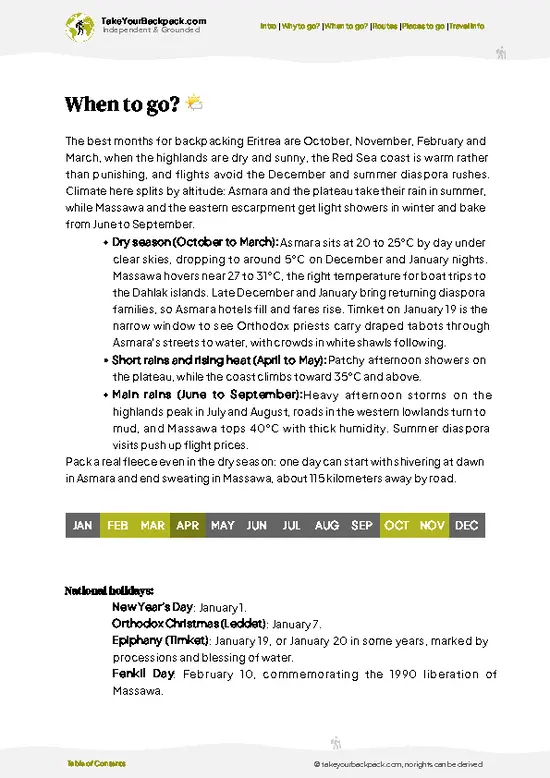
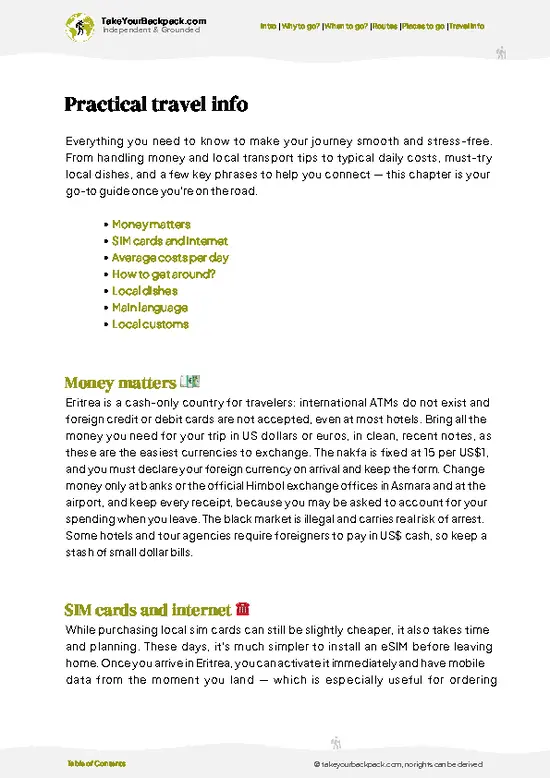
example page 0 from our offline Travel Guide for Eritrea
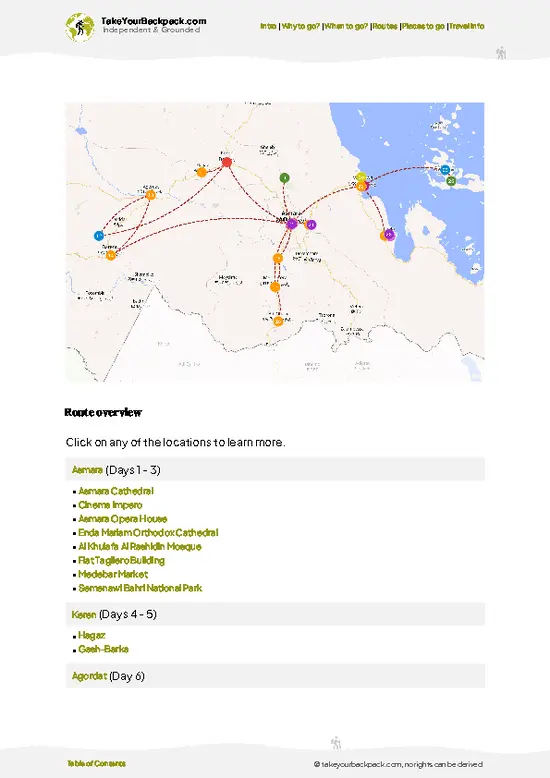
example page 1 from our offline Travel Guide for Eritrea
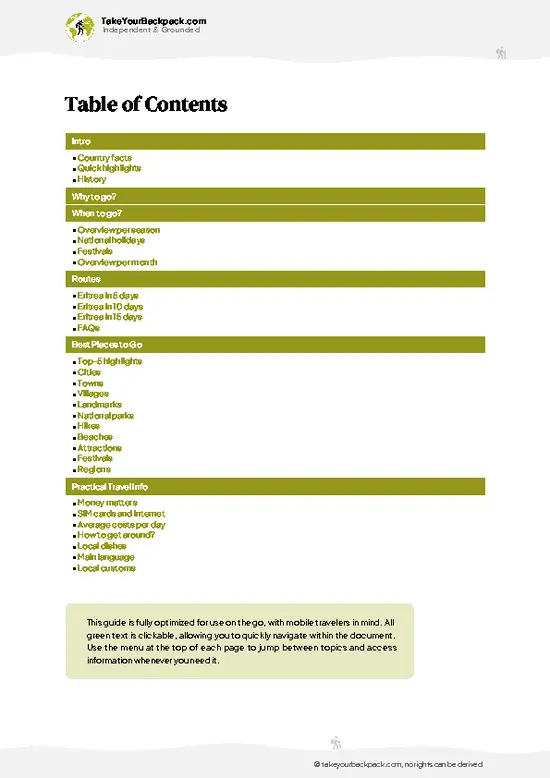
example page 2 from our offline Travel Guide for Eritrea
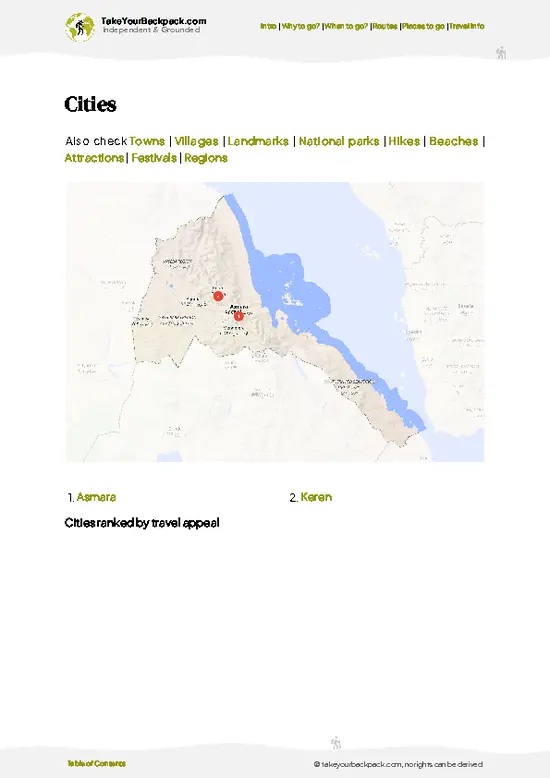
example page 3 from our offline Travel Guide for Eritrea
example page 4 from our offline Travel Guide for Eritrea
example page 5 from our offline Travel Guide for Eritrea
example page 6 from our offline Travel Guide for Eritrea
example page 7 from our offline Travel Guide for Eritrea
Loading the map 🌍
CLICK TO FILTER
cities
towns
villages
landmarks
national parks
hikes
beaches
attractions
festivals
regions
SHOW COUNTRY’S BESTSHOW ALL

✨ Why go?
Ranked #5 unique site in Eritrea
Why visitors keep coming back

Debre Bizen Monastery rewards the traveler who wants Eritrea beyond Asmara’s Art Deco avenues. The climb itself is the point: you leave the humid coast behind and reach a mountaintop at roughly 2,400 meters, where the air turns cool and the view runs toward the Red Sea on a clear morning. The site is also rare in a practical sense. Few places in the Horn of Africa let you see a working fourteenth-century monastic community with almost no other visitors around.
It fits well into a loop that begins in Asmara, drops down the famous escarpment road toward Massawa, and passes through highland villages along the way. The monks keep ancient manuscripts and church treasures, and meeting them is often the most memorable part of the trip. Go if you like quiet, steep paths and religious history. Skip it if you need easy logistics or comfort.

💡 HighlightsPlaces and moments you shouldn't skip

  1. The Monastery Compound: the stone church and monks’ cells perch on the summit, built in a style tied to the Ethiopian Orthodox tradition. It is the reason people make the climb.
  2. The Ascent Path: a steep, rocky route up the mountain that takes a few hours on foot, with shifting views of the escarpment and the lowlands below.
  3. Manuscript and Treasure Collection: the monastery is known for old illuminated manuscripts, crosses and church objects, shown at the monks’ discretion.
  4. The Monks’ Hospitality: visitors are usually offered simple food and a place to sit. Eating with the community gives a feel for the daily routine.
  5. The Summit Viewpoint: on clear mornings the drop toward the Red Sea coast is visible, and the cool air is a sharp contrast to the heat below.
  6. The Surrounding Highland Landscape: juniper
… read more 👉
  1. The Monastery Compound: the stone church and monks’ cells perch on the summit, built in a style tied to the Ethiopian Orthodox tradition. It is the reason people make the climb.
  2. The Ascent Path: a steep, rocky route up the mountain that takes a few hours on foot, with shifting views of the escarpment and the lowlands below.
  3. Manuscript and Treasure Collection: the monastery is known for old illuminated manuscripts, crosses and church objects, shown at the monks’ discretion.
  4. The Monks’ Hospitality: visitors are usually offered simple food and a place to sit. Eating with the community gives a feel for the daily routine.
  5. The Summit Viewpoint: on clear mornings the drop toward the Red Sea coast is visible, and the cool air is a sharp contrast to the heat below.
  6. The Surrounding Highland Landscape: juniper and wild olive grow on the slopes, and birdlife is good for anyone with binoculars.
The summit viewpoint and the manuscript collection combine well in one day at Debre Bizen Monastery, since both sit within a short walk of the church.
Spotted a mistake or missing something? Contact us.

Things to do near Debre Bizen Monastery

Ratings based on Tripadvisor reviews. When you book through this link, you support our work at no extra cost to you.

🌤️ When to go?Weather, crowds, and seasonal trade-offs

  • Dry Season (October to May): Debre Bizen Monastery sits at about 2,400 meters on a mountain above the Red Sea escarpment, so days stay pleasant at 18 to 26°C (64 to 79°F) and nights fall to 8 to 14°C (46 to 57°F). The climb and the views are clearest now.
  • Short Rains (March to April): Occasional showers turn the path slick, but the slopes green up and haze is rare. Expect similar temperatures.
  • Main Rains (June to September): Mist and heavy afternoon downpours can wrap the summit in cloud, with temperatures of 15 to 22°C (59 to 72°F). Trails become muddy and views vanish.
  • Religious Feasts: Orthodox holidays such as Meskel in September and Timkat in January bring pilgrims and fuller grounds. Eritrea sees few tourists in any month, so lodging prices barely shift.
Plan to start walking at dawn in … read more 👉
  • Dry Season (October to May): Debre Bizen Monastery sits at about 2,400 meters on a mountain above the Red Sea escarpment, so days stay pleasant at 18 to 26°C (64 to 79°F) and nights fall to 8 to 14°C (46 to 57°F). The climb and the views are clearest now.
  • Short Rains (March to April): Occasional showers turn the path slick, but the slopes green up and haze is rare. Expect similar temperatures.
  • Main Rains (June to September): Mist and heavy afternoon downpours can wrap the summit in cloud, with temperatures of 15 to 22°C (59 to 72°F). Trails become muddy and views vanish.
  • Religious Feasts: Orthodox holidays such as Meskel in September and Timkat in January bring pilgrims and fuller grounds. Eritrea sees few tourists in any month, so lodging prices barely shift.
Plan to start walking at dawn in any season, since daylight runs close to 12 hours all year and the climb is easier before midday.


source: climatestotravel.comJANJanuary: excellent for travelingFEBFebruary: excellent for travelingMARMarch: excellent for travelingAPRApril: excellent for travelingMAYMay: fair for travelingJUNJune: below average for travelingJULJuly: below average for travelingAUGAugust: below average for travelingSEPSeptember: fair for travelingOCTOctober: highly recommended for travelingNOVNovember: excellent for travelingDECDecember: excellent for traveling
when-to-go

✈️ The backpacker research shortcutEritrea Travel Guide

An offline-friendly backpacking guide with optimized travel routes, ranked highlights, transport advice, and the best areas to stay.
example page 0 from our offline Travel Guide for Eritrea
example page 1 from our offline Travel Guide for Eritrea
example page 2 from our offline Travel Guide for Eritrea
example page 3 from our offline Travel Guide for Eritrea
example page 4 from our offline Travel Guide for Eritrea
example page 5 from our offline Travel Guide for Eritrea
example page 6 from our offline Travel Guide for Eritrea
example page 7 from our offline Travel Guide for Eritrea
The digital guide (245 pages) contains:
✅ 56 highlights, ranked by travel appeal
✅ Optimized 5, 10 & 15-day travel routes
✅ Cities, national parks, landmarks, beaches
✅ How to get around
✅ Offline-friendly for travel without Wi-Fi
👉 Click to see all 30+ guide features

📅 Plan smarter in minutes, not weeks
✅ Month by month travel advice
✅ Festivals & national holidays
✅ Budget expectations

🗺️ Go to the right places, skip the overrated ones
✅ Honest pros & cons of destinations
✅ Top hikes, parks & viewpoints
✅ Lesser-known places most travelers miss
✅ Clear “worth it vs skip it” guidance

🛏️ Travel smoothly without rookie mistakes
✅ Best areas to stay
✅ Transport systems explained simply
✅ Common scams & safety advice
✅ SIM cards, money & practical tips

🌍 Understand the country, not just visit it
✅ Culture & traditions
✅ 52 Essential phrases & customs
✅ Festivals worth planning around
✅ Traveler-friendly historical context
✅ Insights that make places more meaningful

📱 Built for real travel conditions
✅ Fully downloadable PDF
✅ Works completely offline
✅ Optimized for phone use
✅ Useful in remote areas & buses
✅ Everything in one place
Stop searching, start planning
Get instant access to your full guide. 30‑day money-back guarantee.
+ Add another guide for just

By proceeding you agree to our terms.
Sent to your inbox immediately after payment • 100% Secure Checkout
Best Backpacking Travel Advisor 2025 tourism awardBest Backpacking
Travel Advisor
2025
What others say about Take Your Backpack Guides:
⭐⭐⭐⭐⭐
Fantastic, amazing amount of information!
⭐⭐⭐⭐⭐
My goodness this is amazing, it's what I've been looking for hats off too you!
⭐⭐⭐⭐⭐
I think this is absolutely BRILLIANT
⭐⭐⭐⭐
Very complete and informative. It's still missing places, but I gotta to commend you
⭐⭐⭐⭐⭐
This is truly amazing, thank you, can't wait to explore it with my kids!
⭐⭐⭐⭐⭐
Awesome resource, thank you!
⭐⭐⭐⭐⭐
This is amazing! Can't wait to explore the ones I haven't seen
⭐⭐⭐⭐
I love this! Well done, great idea.
⭐⭐⭐⭐⭐
Thanks for taking the time to make this gem!
⭐⭐⭐⭐⭐
This might be the best website I've ever seen.
⭐⭐⭐⭐⭐
Congratulations, and thank you so much for your work; it's incredibly valuable.
⭐⭐⭐⭐
In all seriousness I think you did a great job pointing out the important spots
⭐⭐⭐⭐⭐
10/10 very good
⭐⭐⭐⭐⭐
As someone who's only just starting to visit regularly this is awesome, thank you.
⭐⭐⭐⭐
Thank you very much! I'm going to visit my dad, it's going to be very useful!
⭐⭐⭐⭐⭐
This is really cool! We'll be travelling for the first time and this definitely come in handy.
⭐⭐⭐⭐⭐
You are now our minister of culture, congratulations 👨‍💼
⭐⭐⭐⭐⭐
Just wanted to tell you that this is a pearl! Going to follow your recommendations.
⭐⭐⭐⭐⭐
This is so cool. I'll definitely be using the resource for my travels soon.
⭐⭐⭐⭐⭐
This is very impressive! Good work.
⭐⭐⭐⭐⭐
This is an amazing and informative site. Very well done!

🛏️ Where to stay?Where staying makes the most sense

Stay in Massawa or Asmara, because the monastery has no visitor lodging for backpackers and the nearest base is the town of Nefasit, about 20 kilometers from Asmara. Asmara is the practical choice. Its center around Harnet Avenue and the Cathedral has small guesthouses and budget pensions, plenty of cafes serving pastries and macchiato, and walkable streets where evening strolling is a local habit. It is safe at night by regional standards, and other travelers are easy to meet in the cafes. From there you can arrange a driver or transport toward the foot of the mountain and return the same day. … read more 👉
Stay in Massawa or Asmara, because the monastery has no visitor lodging for backpackers and the nearest base is the town of Nefasit, about 20 kilometers from Asmara. Asmara is the practical choice. Its center around Harnet Avenue and the Cathedral has small guesthouses and budget pensions, plenty of cafes serving pastries and macchiato, and walkable streets where evening strolling is a local habit. It is safe at night by regional standards, and other travelers are easy to meet in the cafes. From there you can arrange a driver or transport toward the foot of the mountain and return the same day.
Nefasit itself is the closest village and has very limited, simple accommodation. It suits those who want a pre-dawn start and quiet nights, though food options are few, so bring supplies. Massawa on the coast is hot and humid, with older guesthouses on the island of Batsi, and works better if you are combining the Red Sea with the highlands.
Travel permits are required for movement outside Asmara, so arrange them before you leave the capital and confirm your route with your host.

👛 Costs (as of 22 October 2026)Money, prices, and spending tips

Visiting Debre Bizen Monastery costs roughly US$58 to 120 a day, with most of that going to a hired vehicle and permit logistics. Prices are set in a tightly controlled economy, and travelers typically pay in cash. Women are generally not permitted inside the monastery grounds, which affects who can make the trip.
CategoryBudget RangeLocal Reality
Accommodation (high season)US$20 to 40Simple guesthouses in Asmara, basic rooms in Nefasit
Travel permitUS$3 to 10Required for travel outside the capital, issued in Asmara
TransportUS$20 to 40Hired car with driver for the round trip from Asmara, shared if you find others
Monastery donationUS$2 to 5Voluntary offering to the monks, no fixed ticket
FoodUS$8 to 15Injera with stew in local restaurants, bring snacks for the climb
GuideUS$5 to 10Helpful for the
… read more 👉
Visiting Debre Bizen Monastery costs roughly US$58 to 120 a day, with most of that going to a hired vehicle and permit logistics. Prices are set in a tightly controlled economy, and travelers typically pay in cash. Women are generally not permitted inside the monastery grounds, which affects who can make the trip.
CategoryBudget RangeLocal Reality
Accommodation (high season)US$20 to 40Simple guesthouses in Asmara, basic rooms in Nefasit
Travel permitUS$3 to 10Required for travel outside the capital, issued in Asmara
TransportUS$20 to 40Hired car with driver for the round trip from Asmara, shared if you find others
Monastery donationUS$2 to 5Voluntary offering to the monks, no fixed ticket
FoodUS$8 to 15Injera with stew in local restaurants, bring snacks for the climb
GuideUS$5 to 10Helpful for the steep trail and for introductions to the monks
Total Daily BudgetUS$58 to 120Lower end needs shared transport
⚠️ Prices can change and everyone travels differently, so take this as a rough guide. Hope it helps you plan your adventure!

🛡️ SafetyTraveler Safety Guide

Debre Bizen National Park offers a rewarding experience, but it’s essential to be prepared. Weather can shift quickly, so layering is key. Mornings might be cool, while afternoons can heat up, especially at higher altitudes.

The trails are generally well-maintained, but expect steep sections and rocky footing. Navigation can be tricky; a good map and compass are your best friends. Pay attention to trail markers, and don’t hesitate to ask locals for directions if you feel uncertain.

Wildlife encounters are rare, but it’s wise to respect their space. If you spot animals, observe quietly from a distance.

First-time visitors often underestimate the importance of hydration and snacks. Carry enough water and energy bars to keep your energy up. Timing your hikes for early morning or late afternoon … read more 👉
Debre Bizen National Park offers a rewarding experience, but it’s essential to be prepared. Weather can shift quickly, so layering is key. Mornings might be cool, while afternoons can heat up, especially at higher altitudes.

The trails are generally well-maintained, but expect steep sections and rocky footing. Navigation can be tricky; a good map and compass are your best friends. Pay attention to trail markers, and don’t hesitate to ask locals for directions if you feel uncertain.

Wildlife encounters are rare, but it’s wise to respect their space. If you spot animals, observe quietly from a distance.

First-time visitors often underestimate the importance of hydration and snacks. Carry enough water and energy bars to keep your energy up. Timing your hikes for early morning or late afternoon can help you avoid the heat and enjoy the park’s beauty without feeling rushed.

FAQFrequently asked questions about Debre Bizen Monastery

Debre Bizen Monastery is an Eritrean Orthodox monastery founded in the 14th century on a mountaintop at about 2,400 meters, overlooking the Red Sea. It is known for its collection of ancient manuscripts and a reputation for strict monastic life. Access is restricted for women, and visitors should dress modestly and arrive with permission.
Plan a full day for Debre Bizen Monastery, including the drive from Asmara and the climb. The steep hike up usually takes 3 to 5 hours depending on fitness, and the descent takes 2 to 3 hours. An overnight stay nearby makes for a more relaxed pace, though lodging is very basic.
To reach Debre Bizen Monastery, travel by road from Asmara toward the escarpment and Nefasit, roughly 2 to 3 hours depending on conditions. From the trailhead you continue on foot up the mountain. A hired driver and a travel permit from Asmara are the practical way to do it, costing roughly US$25 to 50 in total.
⚠️ Things can change over time, so always validate details locally before you go.

Other Eritrean landmarks near Debre Bizen Monastery

Explore more nearby:

  • Asmara Cathedral—Red brick Romanesque facade, freestanding bell tower, arcaded courtyard, Sunday Mass| 16 km away
  • Adulis—Aksumite port ruins, basilica foundations, Gulf of Zula plain, potsherd-strewn mounds| 62 km away
  • Qohaito—Safira rock-cut reservoir, Adi Alauti paintings, rift escarpment edge, Aksumite tombs| 62 km away

💡 Not sure where to go next?
Create a personalized itinerary for Eritrea including Debre Bizen Monastery and the places that fit your trip.

Generate my itinerary

👉 Discover all landmarks

Or checkout all Eritrea has to offer (think cities, towns, villages, national parks, hikes, beaches, festivals)
Country photo of Eritrea

We 💚 feedbackParting advice and final tips

Debre Bizen Monastery is best seen early, and many first-timers overlook the cool, damp air on the summit. I would bring a warm layer and a proper head covering, since the wind picks up at the top. Arrive with respect and patience, and the monks tend to open up.

✍️ Help improve this page!
The information on this page is based on in-depth research, insights shared by experienced travelers, and feedback from the local travel community in Eritrea. While every effort is made to keep the information accurate and current, conditions can change — so if you spot anything incorrect or outdated, please get in touch.


🙋‍♂️ Give feedback

👋 Meet the founderWho’s Behind Take Your Backpack?

Johan, backpacker and founder of TakeYourBackpackHi, I’m Johan (Netherlands 🇳🇱), the creator of TakeYourBackpack. Over the past 3 decades, I’ve backpacked through 90+ countries across six continents, gaining extensive experience with independent travel, long-term trips, and overland routes.

This site is built on a combination of firsthand travel experience and carefully curated insights from other backpackers. Many guides are based on places I’ve personally visited, while others bring together tips, observations, and practical advice shared by trusted travelers I’ve met along the way.

The goal is to provide realistic, experience-driven guidance — not generic itineraries — so you can explore destinations with better context, clearer expectations, and more confidence.