×

Eswatini🇸🇿 | attractionsGone RuralCoiled lutindzi grass, plant-dyed baskets, weaver-owned income, fixed prices | things to do and best time to go

Explore Yebo! Art GalleryExplore Nsangwini Rock Art Site

Backpacking in Gone Rural
👌 Worth visitingattraction ranked #6
By Johan Kruseman 🇳🇱 | Updated October 22, 2026

Buying at Gone Rural means the money goes to the weavers who made the piece, and you can see where it was made. Gone Rural sits in the Malkerns Valley, in the middle of Eswatini, a short drive from Manzini. The shop is small, so there are no queues and no crowds, and that suits a calm browse. Handwoven goods are priced for hours of hand labor, so bargaining is not the custom here, and a fixed price is fair. Hand luggage space is limited when backpacking, so pick flat items like placemats or small baskets, which pack easily. Payment is normally in local currency or by card, so carry a little cash. The grass used in the weaving is lutindzi, dried and dyed in earthy tones.

Discover everything you want to know in the 📖 Eswatini Travel Guide.


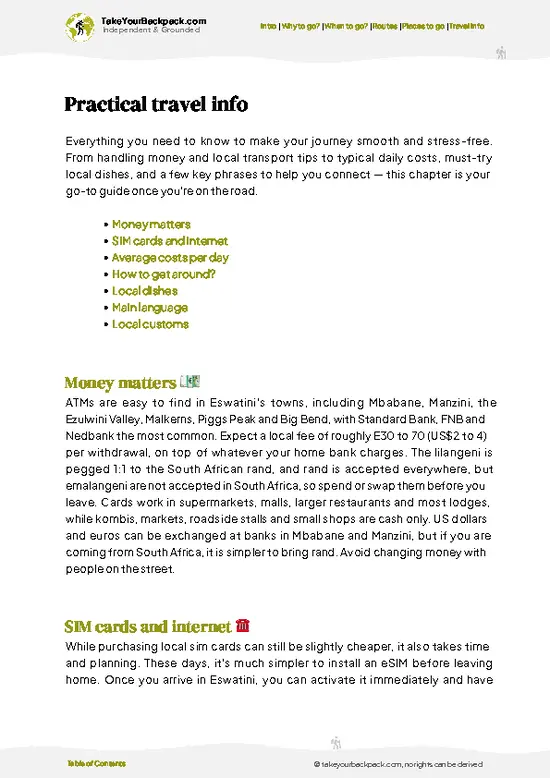
example page 0 from our offline Travel Guide for Eswatini
example page 1 from our offline Travel Guide for Eswatini
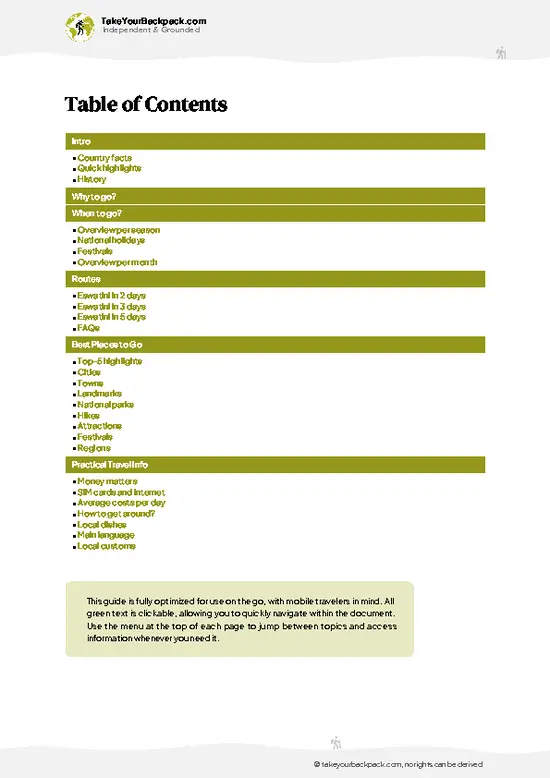
example page 2 from our offline Travel Guide for Eswatini
example page 3 from our offline Travel Guide for Eswatini
example page 4 from our offline Travel Guide for Eswatini
example page 5 from our offline Travel Guide for Eswatini
example page 6 from our offline Travel Guide for Eswatini
example page 7 from our offline Travel Guide for Eswatini
Loading the map 🌍
CLICK TO FILTER
cities
towns
landmarks
national parks
hikes
attractions
festivals
regions
SHOW COUNTRY’S BESTSHOW ALL

✨ Why go?
Ranked #6 attraction in Eswatini
Reasons people choose to visit here

Gone Rural gives you a way to spend money in Eswatini that reaches rural women directly. The enterprise has worked since the early 1990s with Swazi weavers who turn lutindzi grass and sisal into baskets, mats and homewares, using techniques passed between families. Seeing the finished pieces next to the people and materials behind them changes how you look at the craft stalls you meet elsewhere in the country.
The Malkerns Valley also makes a natural pause between Mbabane and Manzini, with a cluster of craft makers, a lively market and places to eat within easy reach. If you want a souvenir that is not a mass-produced carving, this is where the better choices are. A small purchase still counts, and you will carry home something durable that actually came from Eswatini hands. For a backpacker with limited space, that is hard to beat.

💡 HighlightsPlaces and moments you shouldn't skip

  1. The Gone Rural shop. The main reason to come: shelves of handwoven baskets, table mats, coasters and other homewares in natural and dyed grass, with each piece showing slight differences in pattern.
  2. Lutindzi grass weaving. The signature material is a fine, golden grass that is coiled and stitched into tight, durable forms. Look closely at the stitching to see why the work takes so long.
  3. Natural dye colors. Browns, rusts, soft greens and deep reds come from plant-based dyes, giving the range a muted, earthy palette rather than bright tourist colors.
  4. Sisal and woven mats. Heavier sisal pieces, including rugs and storage baskets, show a different side of the craft, sturdier and more geometric.
  5. The story of the weavers. The enterprise works with rural women who earn an income at home, and staff can
… read more 👉
  1. The Gone Rural shop. The main reason to come: shelves of handwoven baskets, table mats, coasters and other homewares in natural and dyed grass, with each piece showing slight differences in pattern.
  2. Lutindzi grass weaving. The signature material is a fine, golden grass that is coiled and stitched into tight, durable forms. Look closely at the stitching to see why the work takes so long.
  3. Natural dye colors. Browns, rusts, soft greens and deep reds come from plant-based dyes, giving the range a muted, earthy palette rather than bright tourist colors.
  4. Sisal and woven mats. Heavier sisal pieces, including rugs and storage baskets, show a different side of the craft, sturdier and more geometric.
  5. The story of the weavers. The enterprise works with rural women who earn an income at home, and staff can explain how the pieces are made and who makes them.
  6. Riverbend setting. The grounds lie along a quiet valley road with garden surroundings, a pleasant place to slow down after the highway between the cities.
  7. Nearby Malkerns Valley makers. Within a short drive are other craft studios and the local market, so you can compare styles and see how Gone Rural stands apart.
Gone Rural itself takes about an hour to browse thoroughly, or a relaxed half day if you add the neighboring makers and a meal.
Spotted a mistake or missing something? Contact us.

🌤️ When to go?Seasonal considerations and timing

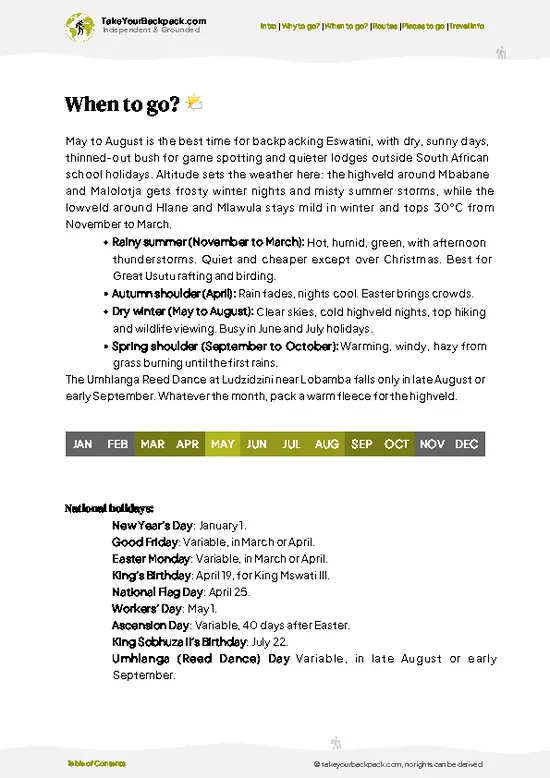
  • Winter (May to August): Dry, sunny days of 20 to 25°C (68 to 77°F) and cold nights that can drop to 3 to 8°C (37 to 46°F). Daylight runs roughly 10.5 to 11 hours. Walking is comfortable, the hillsides turn golden brown, and the Ezulwini Valley sees its steadiest visitor flow.
  • Spring (September to October): Warming days of 24 to 30°C (75 to 86°F) and the first rains. Fewer crowds, longer light, and the jacaranda trees bloom.
  • Summer (November to March): Hot and humid at 27 to 32°C (81 to 90°F), with afternoon thunderstorms. Dirt roads turn slick, but the hills are green and rates are lowest. Daylight stretches to about 14 hours.
  • Autumn (April): Mild at 22 to 27°C (72 to 81°F), drier, and quiet.
Book around the Umhlanga Reed Dance in late August or early September, when rooms in the valley fill fast.

source: climatestotravel.comJANJanuary: fair for travelingFEBFebruary: fair for travelingMARMarch: fair for travelingAPRApril: fair for travelingMAYMay: highly recommended for travelingJUNJune: excellent for travelingJULJuly: excellent for travelingAUGAugust: excellent for travelingSEPSeptember: highly recommended for travelingOCTOctober: fair for travelingNOVNovember: fair for travelingDECDecember: fair for traveling
eswatini-attraction-gone-rural v1
© Google |

✈️ The backpacker research shortcutEswatini Travel Guide

An offline-friendly backpacking guide with optimized travel routes, ranked highlights, transport advice, and the best areas to stay.
example page 0 from our offline Travel Guide for Eswatini
example page 1 from our offline Travel Guide for Eswatini
example page 2 from our offline Travel Guide for Eswatini
example page 3 from our offline Travel Guide for Eswatini
example page 4 from our offline Travel Guide for Eswatini
example page 5 from our offline Travel Guide for Eswatini
example page 6 from our offline Travel Guide for Eswatini
example page 7 from our offline Travel Guide for Eswatini
The digital guide (151 pages) contains:
✅ 33 highlights, ranked by travel appeal
✅ Optimized 2, 3 & 5-day travel routes
✅ Cities, national parks, landmarks, beaches
✅ How to get around
✅ Offline-friendly for travel without Wi-Fi
👉 Click to see all 30+ guide features

📅 Plan smarter in minutes, not weeks
✅ Month by month travel advice
✅ Festivals & national holidays
✅ Budget expectations

🗺️ Go to the right places, skip the overrated ones
✅ Honest pros & cons of destinations
✅ Top hikes, parks & viewpoints
✅ Lesser-known places most travelers miss
✅ Clear “worth it vs skip it” guidance

🛏️ Travel smoothly without rookie mistakes
✅ Best areas to stay
✅ Transport systems explained simply
✅ Common scams & safety advice
✅ SIM cards, money & practical tips

🌍 Understand the country, not just visit it
✅ Culture & traditions
✅ 52 Essential phrases & customs
✅ Festivals worth planning around
✅ Traveler-friendly historical context
✅ Insights that make places more meaningful

📱 Built for real travel conditions
✅ Fully downloadable PDF
✅ Works completely offline
✅ Optimized for phone use
✅ Useful in remote areas & buses
✅ Everything in one place
Stop searching, start planning
Get instant access to your full guide. 30‑day money-back guarantee.
+ Add another guide for just

By proceeding you agree to our terms.
Sent to your inbox immediately after payment • 100% Secure Checkout
Best Backpacking Travel Advisor 2025 tourism awardBest Backpacking
Travel Advisor
2025
What others say about Take Your Backpack Guides:
⭐⭐⭐⭐⭐
Fantastic, amazing amount of information!
⭐⭐⭐⭐⭐
My goodness this is amazing, it's what I've been looking for hats off too you!
⭐⭐⭐⭐⭐
I think this is absolutely BRILLIANT
⭐⭐⭐⭐
Very complete and informative. It's still missing places, but I gotta to commend you
⭐⭐⭐⭐⭐
This is truly amazing, thank you, can't wait to explore it with my kids!
⭐⭐⭐⭐⭐
Awesome resource, thank you!
⭐⭐⭐⭐⭐
This is amazing! Can't wait to explore the ones I haven't seen
⭐⭐⭐⭐
I love this! Well done, great idea.
⭐⭐⭐⭐⭐
Thanks for taking the time to make this gem!
⭐⭐⭐⭐⭐
This might be the best website I've ever seen.
⭐⭐⭐⭐⭐
Congratulations, and thank you so much for your work; it's incredibly valuable.
⭐⭐⭐⭐
In all seriousness I think you did a great job pointing out the important spots
⭐⭐⭐⭐⭐
10/10 very good
⭐⭐⭐⭐⭐
As someone who's only just starting to visit regularly this is awesome, thank you.
⭐⭐⭐⭐
Thank you very much! I'm going to visit my dad, it's going to be very useful!
⭐⭐⭐⭐⭐
This is really cool! We'll be travelling for the first time and this definitely come in handy.
⭐⭐⭐⭐⭐
You are now our minister of culture, congratulations 👨‍💼
⭐⭐⭐⭐⭐
Just wanted to tell you that this is a pearl! Going to follow your recommendations.
⭐⭐⭐⭐⭐
This is so cool. I'll definitely be using the resource for my travels soon.
⭐⭐⭐⭐⭐
This is very impressive! Good work.
⭐⭐⭐⭐⭐
This is an amazing and informative site. Very well done!

🛏️ Where to stay?Best areas and accommodation options

The Ezulwini Valley, between Mbabane and Manzini, is the most practical area for backpackers visiting Gone Rural, a short drive from the valley floor. Most budget beds, craft markets, and cafés cluster here, and you can share a ride with other guests to reach the workshops.
Matsapha, near Manzini, suits those who want cheaper dorms and easy minibus links across the country. It is industrial and less atmospheric, but the transport hub nearby makes onward travel simple.
Mbabane, the capital, has a handful of budget guesthouses, plenty of food stalls, and the busiest minibus rank. Expect to pay roughly … read more 👉
The Ezulwini Valley, between Mbabane and Manzini, is the most practical area for backpackers visiting Gone Rural, a short drive from the valley floor. Most budget beds, craft markets, and cafés cluster here, and you can share a ride with other guests to reach the workshops.
Matsapha, near Manzini, suits those who want cheaper dorms and easy minibus links across the country. It is industrial and less atmospheric, but the transport hub nearby makes onward travel simple.
Mbabane, the capital, has a handful of budget guesthouses, plenty of food stalls, and the busiest minibus rank. Expect to pay roughly US$12 to 25 for a dorm or basic private room across all three areas, with dorms at the low end.
Lobamba, near the royal village and the national museum, is quieter and more local. It works well for slow mornings and gives easy access to the Mlilwane Wildlife Sanctuary, where rest camps offer budget bunks and safe, social evenings around a fire.
Whichever you choose, stay in the valley rather than far out in the hills, because evening transport thins out quickly.

👛 Costs (as of 22 October 2026)What things cost and how to budget

Gone Rural costs a backpacker about US$38 a day, with entry to the craft workshops free and most of the money going to a bed, food, and rides. Prices are paid in emalangeni, though US dollars are often accepted at tourist spots.
CategoryBudget RangeLocal Reality
EntryUS$0Browsing the workshops and showroom is free.
Accommodation (high season)US$12 to 18Dorm bed or basic room in the Ezulwini Valley; rates rise slightly in winter and around the Reed Dance.
Accommodation (low season)US$9 to 14Summer months bring discounts and quieter dorms.
FoodUS$7 to 12Street stalls and bakery meals are cheapest; a café lunch costs more.
Local transportUS$2 to 6Shared minibuses along the valley cost under US$1 a hop; a taxi for the last stretch costs more.
Crafts and souvenirsUS$3 to 10Candles, glass, and woven items
… read more 👉
Gone Rural costs a backpacker about US$38 a day, with entry to the craft workshops free and most of the money going to a bed, food, and rides. Prices are paid in emalangeni, though US dollars are often accepted at tourist spots.
CategoryBudget RangeLocal Reality
EntryUS$0Browsing the workshops and showroom is free.
Accommodation (high season)US$12 to 18Dorm bed or basic room in the Ezulwini Valley; rates rise slightly in winter and around the Reed Dance.
Accommodation (low season)US$9 to 14Summer months bring discounts and quieter dorms.
FoodUS$7 to 12Street stalls and bakery meals are cheapest; a café lunch costs more.
Local transportUS$2 to 6Shared minibuses along the valley cost under US$1 a hop; a taxi for the last stretch costs more.
Crafts and souvenirsUS$3 to 10Candles, glass, and woven items are priced fairly; a small purchase supports the makers.
Total Daily BudgetUS$38Based on high-season lodging and moderate spending.
⚠️ Prices can change and everyone travels differently, so take this as a rough guide. Hope it helps you plan your adventure!

FAQFrequently asked questions about Gone Rural

Plan on one to two hours at Gone Rural if you only want to see the craft workshops and showroom. Pair it with the Ezulwini Valley markets or Mlilwane Wildlife Sanctuary and it fills half a day. Staying a night nearby lets you see the valley in softer morning light.
Yes, because Gone Rural charges nothing to browse the workshops, so the only spend is on what you choose to buy. Candles, glass, and woven pieces typically run US$3 to 20. Buying directly supports the local makers and often costs less than the tourist stalls along the main road.
Take a shared minibus from Mbabane or Manzini into the Ezulwini Valley, which costs roughly US$1 to 2 and takes 20 to 40 minutes. From the valley road, a short taxi ride or walk covers the final stretch for about US$3 to 6. Renting a car from Mbabane gives the most flexibility, and the drive takes under 30 minutes.
⚠️ Things can change over time, so always validate details locally before you go.

Other Swazi attractions near Gone Rural

Explore more nearby:

  • Malolotja Canopy Tour—Gorge ziplines, forest platforms, tree ferns, small groups| 14 km away
  • Yebo! Art Gallery—Swazi contemporary art, Ezulwini minibus stop, direct-from-artist pieces, small works| 27 km away
  • Mantenga Cultural Village—Beehive huts, Swazi dance arena, guided homestead, Mantenga Falls| 28 km away

💡 Not sure where to go next?
Create a personalized itinerary for Eswatini including Gone Rural and the places that fit your trip.

Generate my itinerary

👉 Discover all attractions

Or checkout all Eswatini has to offer (think cities, towns, villages, national parks, hikes, beaches, festivals)
Country photo of Eswatini

We 💚 feedbackKey takeaways before you go

Many travelers rush into Gone Rural expecting a market where haggling is part of the fun, then feel awkward when prices are fixed. Skip the bargaining. The cost reflects weeks of weaving, and the fair price is the point. Pick a small piece that fits your pack, and keep your visit unhurried, because the details of the stitching deserve a proper look.

✍️ Help improve this page!
The information on this page is based on in-depth research, insights shared by experienced travelers, and feedback from the local travel community in Eswatini. While every effort is made to keep the information accurate and current, conditions can change — so if you spot anything incorrect or outdated, please get in touch.


🙋‍♂️ Give feedback

👋 Meet the founderWho’s Behind Take Your Backpack?

Johan, backpacker and founder of TakeYourBackpackHi, I’m Johan (Netherlands 🇳🇱), the creator of TakeYourBackpack. Over the past 3 decades, I’ve backpacked through 90+ countries across six continents, gaining extensive experience with independent travel, long-term trips, and overland routes.

This site is built on a combination of firsthand travel experience and carefully curated insights from other backpackers. Many guides are based on places I’ve personally visited, while others bring together tips, observations, and practical advice shared by trusted travelers I’ve met along the way.

The goal is to provide realistic, experience-driven guidance — not generic itineraries — so you can explore destinations with better context, clearer expectations, and more confidence.