×

Ethiopia🇪🇹 | festivalsAshendaSinging girls, embroidered skirts, tela, evening dances | things to do and best time to go

Explore TimkatExplore Hidar Tsion

Backpacking in Ashenda
👍 Recommendedfestival ranked #6
By Johan Kruseman 🇳🇱 | Updated October 22, 2026

A cup of tela, the home-brewed honey beer, arrives in a cloudy glass for about US$0.50, sour and faintly smoky, while girls in embroidered skirts stamp past with grass skirts swishing and drums thudding down the street. That was my first ten minutes. Ashenda is a late-summer girls’ festival celebrated mainly in Tigray and parts of Amhara in the north of Ethiopia, and the festivities are also held in Addis Ababa, where the version near this location is smaller and more urban. It runs about three days in August, with singing, dancing, hair braiding and groups collecting small gifts from neighbors. Expect families, local students and a handful of travelers, with no tickets and no stage. Dress modestly, carry small bills, and accept invitations. A first day could mean a coffee at dawn, a street procession by mid-morning, and injera at a family’s table by evening.

Discover everything you want to know in the 📖 Ethiopia Travel Guide.
Safety warning

The current risk level for Ethiopia is high. Check the advice before going.


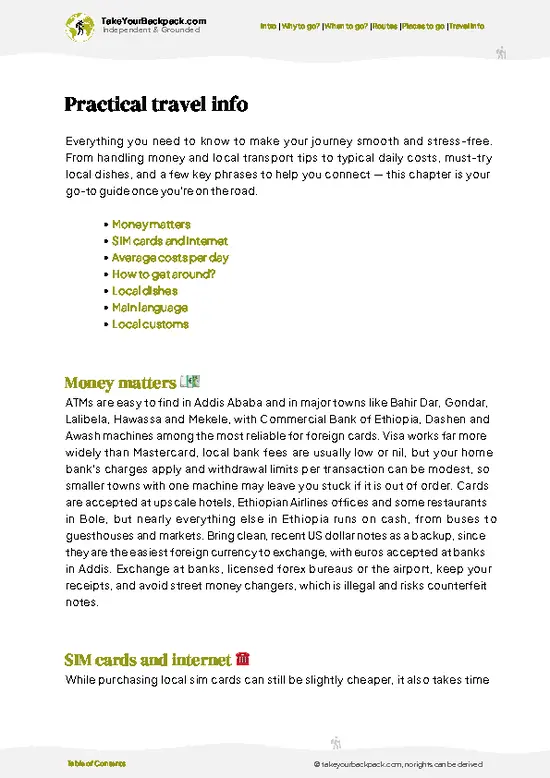
example page 0 from our offline Travel Guide for Ethiopia
example page 1 from our offline Travel Guide for Ethiopia
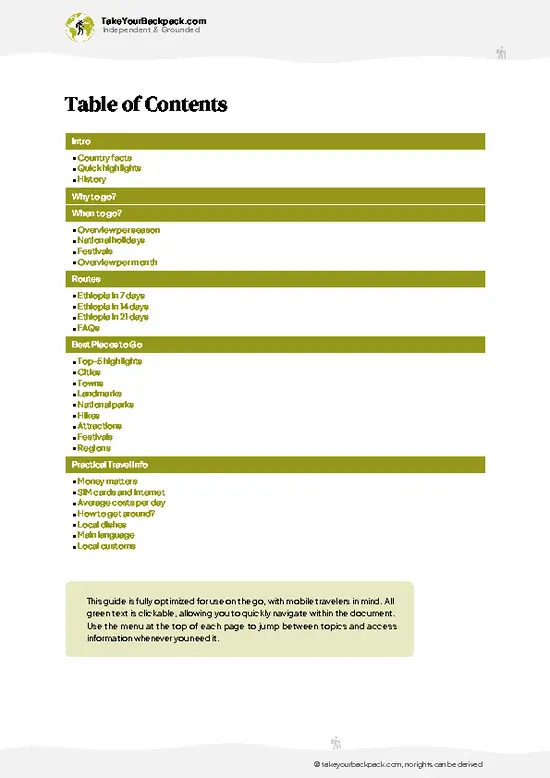
example page 2 from our offline Travel Guide for Ethiopia
example page 3 from our offline Travel Guide for Ethiopia
example page 4 from our offline Travel Guide for Ethiopia
example page 5 from our offline Travel Guide for Ethiopia
example page 6 from our offline Travel Guide for Ethiopia
example page 7 from our offline Travel Guide for Ethiopia
Loading the map 🌍
CLICK TO FILTER
cities
towns
landmarks
national parks
hikes
attractions
festivals
regions
SHOW COUNTRY’S BESTSHOW ALL

✨ Why go?
Ranked #6 festival in Ethiopia
What sets this place apart

Ashenda pulls backpackers north because it is one of the few Ethiopian celebrations run entirely by girls and young women, so you watch a tradition rather than a show. The social energy is the draw: groups of friends in layered embroidered dresses and grass skirts sing call-and-response songs, stop at doorways and collect gifts, and strangers get pulled into the circle within minutes. Nobody is charging admission, so the festival is very cheap compared with a ticketed music event, and you spend only on food, local beer and transport. It also fits a longer northern loop, since it lands during the rainy season when crowds are thin, and you can pair it with the rock churches of Tigray or the Lalibela region. Learn a few Amharic or Tigrinya greetings and you will be fed more than you can finish.

💡 HighlightsMust-see experiences and standout moments

  1. Street processions of singing girls: Groups of girls in decorated dresses walk neighborhood to neighborhood, singing and dancing to drums. This is the heart of Ashenda and the sight everyone comes for.
  2. Traditional costumes and braided hair: Look for long embroidered skirts, beaded jewelry, and elaborate hair braiding, often done the morning of the festival. Many girls will happily show you the details.
  3. Door-to-door gift collecting: Girls stop at homes and shops to sing for small gifts, usually money or food. Carry small notes and join in respectfully if invited.
  4. Home-brewed tela and shared meals: Families offer injera with stews, and tela is poured freely. Accepting a plate is the easiest way into a household.
  5. Evening gatherings and dancing: As night comes, groups gather in open squares to dance,
… read more 👉
  1. Street processions of singing girls: Groups of girls in decorated dresses walk neighborhood to neighborhood, singing and dancing to drums. This is the heart of Ashenda and the sight everyone comes for.
  2. Traditional costumes and braided hair: Look for long embroidered skirts, beaded jewelry, and elaborate hair braiding, often done the morning of the festival. Many girls will happily show you the details.
  3. Door-to-door gift collecting: Girls stop at homes and shops to sing for small gifts, usually money or food. Carry small notes and join in respectfully if invited.
  4. Home-brewed tela and shared meals: Families offer injera with stews, and tela is poured freely. Accepting a plate is the easiest way into a household.
  5. Evening gatherings and dancing: As night comes, groups gather in open squares to dance, with clapping, shoulder movements and singing that continue late. It is the friendliest moment to meet locals.
Ashenda is best experienced first through the street processions, where you can watch for free and be pulled in naturally.
Spotted a mistake or missing something? Contact us.

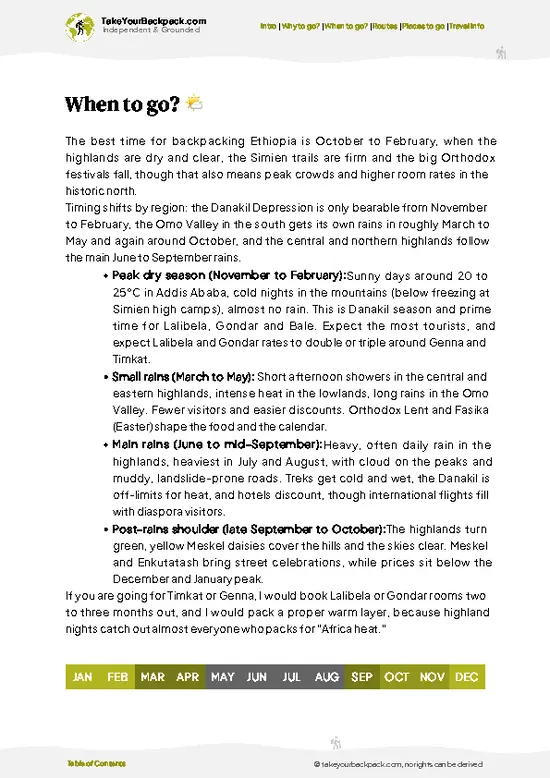
🌤️ When to go?When is the celebration of Ashenda?

Ashenda is held every August, running about three days from 16 to 18 (some years the dates shift slightly), and the girls’ singing and dancing fill the streets of Addis Ababa, though the festival is far larger in Tigray and parts of Amhara. The festival follows the end of the Filseta fast, which sets its date on the Ethiopian calendar.
  • Best day: Go on the first day, when groups of girls in embroidered skirts and braided hair start processions, with the second day busy too. The last day is quieter and often the best time for photos.
  • Weather: August is the peak of the rainy season, with highs of 20 to 23°C (68 to 73°F) and lows near 11°C (52°F). Afternoon downpours are common, so bring a rain jacket, waterproof shoes and a dry bag for your camera.
  • Booking: Reserve beds two to four weeks ahead.
… read more 👉
Ashenda is held every August, running about three days from 16 to 18 (some years the dates shift slightly), and the girls’ singing and dancing fill the streets of Addis Ababa, though the festival is far larger in Tigray and parts of Amhara. The festival follows the end of the Filseta fast, which sets its date on the Ethiopian calendar.
  • Best day: Go on the first day, when groups of girls in embroidered skirts and braided hair start processions, with the second day busy too. The last day is quieter and often the best time for photos.
  • Weather: August is the peak of the rainy season, with highs of 20 to 23°C (68 to 73°F) and lows near 11°C (52°F). Afternoon downpours are common, so bring a rain jacket, waterproof shoes and a dry bag for your camera.
  • Booking: Reserve beds two to four weeks ahead. Prices commonly rise 20 to 50 percent around the festival.
  • Crowds: Arrive the evening before, since main roads and minibuses jam from midday. Leave early on the final day or wait until the evening.
Carry small bills, because girls collect tips and the crowds make change hard to find.


source: climatestotravel.comJANJanuary: not recommended for travelingFEBFebruary: not recommended for travelingMARMarch: not recommended for travelingAPRApril: not recommended for travelingMAYMay: not recommended for travelingJUNJune: not recommended for travelingJULJuly: not recommended for travelingAUGAugust: excellent for travelingSEPSeptember: not recommended for travelingOCTOctober: not recommended for travelingNOVNovember: not recommended for travelingDECDecember: not recommended for traveling

✈️ The backpacker research shortcutEthiopia Travel Guide

An offline-friendly backpacking guide with optimized travel routes, ranked highlights, transport advice, and the best areas to stay.
example page 0 from our offline Travel Guide for Ethiopia
example page 1 from our offline Travel Guide for Ethiopia
example page 2 from our offline Travel Guide for Ethiopia
example page 3 from our offline Travel Guide for Ethiopia
example page 4 from our offline Travel Guide for Ethiopia
example page 5 from our offline Travel Guide for Ethiopia
example page 6 from our offline Travel Guide for Ethiopia
example page 7 from our offline Travel Guide for Ethiopia
The digital guide (380 pages) contains:
✅ 98 highlights, ranked by travel appeal
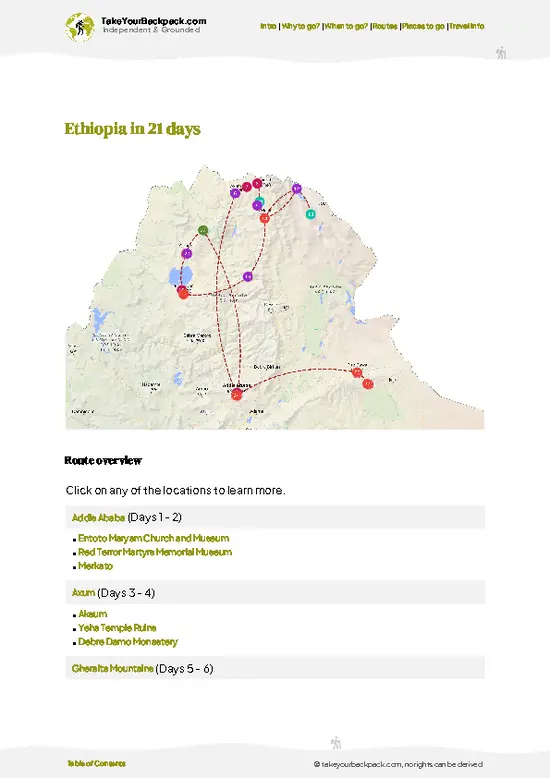
✅ Optimized 7, 14 & 21-day travel routes
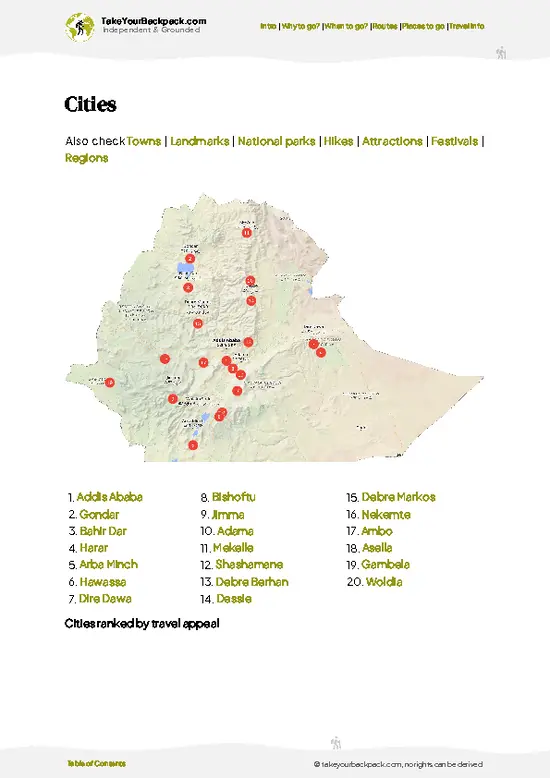
✅ Cities, national parks, landmarks, beaches
✅ How to get around
✅ Offline-friendly for travel without Wi-Fi
👉 Click to see all 30+ guide features

📅 Plan smarter in minutes, not weeks
✅ Month by month travel advice
✅ Festivals & national holidays
✅ Budget expectations

🗺️ Go to the right places, skip the overrated ones
✅ Honest pros & cons of destinations
✅ Top hikes, parks & viewpoints
✅ Lesser-known places most travelers miss
✅ Clear “worth it vs skip it” guidance

🛏️ Travel smoothly without rookie mistakes
✅ Best areas to stay
✅ Transport systems explained simply
✅ Common scams & safety advice
✅ SIM cards, money & practical tips

🌍 Understand the country, not just visit it
✅ Culture & traditions
✅ 52 Essential phrases & customs
✅ Festivals worth planning around
✅ Traveler-friendly historical context
✅ Insights that make places more meaningful

📱 Built for real travel conditions
✅ Fully downloadable PDF
✅ Works completely offline
✅ Optimized for phone use
✅ Useful in remote areas & buses
✅ Everything in one place
Stop searching, start planning
Get instant access to your full guide. 30‑day money-back guarantee.
+ Add another guide for just

By proceeding you agree to our terms.
Sent to your inbox immediately after payment • 100% Secure Checkout
Best Backpacking Travel Advisor 2025 tourism awardBest Backpacking
Travel Advisor
2025
What others say about Take Your Backpack Guides:
⭐⭐⭐⭐⭐
Fantastic, amazing amount of information!
⭐⭐⭐⭐⭐
My goodness this is amazing, it's what I've been looking for hats off too you!
⭐⭐⭐⭐⭐
I think this is absolutely BRILLIANT
⭐⭐⭐⭐
Very complete and informative. It's still missing places, but I gotta to commend you
⭐⭐⭐⭐⭐
This is truly amazing, thank you, can't wait to explore it with my kids!
⭐⭐⭐⭐⭐
Awesome resource, thank you!
⭐⭐⭐⭐⭐
This is amazing! Can't wait to explore the ones I haven't seen
⭐⭐⭐⭐
I love this! Well done, great idea.
⭐⭐⭐⭐⭐
Thanks for taking the time to make this gem!
⭐⭐⭐⭐⭐
This might be the best website I've ever seen.
⭐⭐⭐⭐⭐
Congratulations, and thank you so much for your work; it's incredibly valuable.
⭐⭐⭐⭐
In all seriousness I think you did a great job pointing out the important spots
⭐⭐⭐⭐⭐
10/10 very good
⭐⭐⭐⭐⭐
As someone who's only just starting to visit regularly this is awesome, thank you.
⭐⭐⭐⭐
Thank you very much! I'm going to visit my dad, it's going to be very useful!
⭐⭐⭐⭐⭐
This is really cool! We'll be travelling for the first time and this definitely come in handy.
⭐⭐⭐⭐⭐
You are now our minister of culture, congratulations 👨‍💼
⭐⭐⭐⭐⭐
Just wanted to tell you that this is a pearl! Going to follow your recommendations.
⭐⭐⭐⭐⭐
This is so cool. I'll definitely be using the resource for my travels soon.
⭐⭐⭐⭐⭐
This is very impressive! Good work.
⭐⭐⭐⭐⭐
This is an amazing and informative site. Very well done!

🛏️ Where to stay?How to pick the right area

Bole is the easiest area for backpackers during Ashenda in Addis Ababa, with the most guesthouses, cafes and late-night options, plus easy taxi access from the airport. It is safe, walkable, and full of other travelers, which makes it good for solo visitors who want company at dinner. The Piassa and Arat Kilo area suits you better if you want to be close to the older streets where neighborhood girls’ groups often dance and sing. It is louder and rougher around the edges, so keep valuables tucked away at night and use a taxi after dark. Kazanchis is a solid middle option, with a central position, … read more 👉
Bole is the easiest area for backpackers during Ashenda in Addis Ababa, with the most guesthouses, cafes and late-night options, plus easy taxi access from the airport. It is safe, walkable, and full of other travelers, which makes it good for solo visitors who want company at dinner. The Piassa and Arat Kilo area suits you better if you want to be close to the older streets where neighborhood girls’ groups often dance and sing. It is louder and rougher around the edges, so keep valuables tucked away at night and use a taxi after dark. Kazanchis is a solid middle option, with a central position, plenty of restaurants and quick rides to either side of the city. Many budget places there have shared lounges where people swap plans for the next day. Book early, since festival weekends fill the cheapest dorms and private rooms quickly. If you plan to follow the celebrations in the north, Mekelle is the main base, but rooms there tighten fast, so confirm your bed a few weeks ahead and arrive the day before the parades start.

👛 Costs (as of 22 October 2026)Money, prices, and spending tips

Ashenda costs most backpackers about US$25 to 67 a day, with free attendance and spending driven by beds and food.
CategoryBudget RangeLocal Reality
Festival ticketsUS$0Street parades and dancing are free to watch. Tipping the girls is customary.
AccommodationUS$12 to 35 (dorm or basic guesthouse, high season)Prices rise around the festival, and northern towns see the largest jumps.
Local transportUS$2 to 6Minibus and shared taxi rides are cheap, while private taxis cost more during road closures.
Food & drinksUS$8 to 18Local meals, coffee and tej are inexpensive, and festival meat dishes cost more.
Miscellaneous expensesUS$3 to 8Small tips for dancers, bottled water and a rain cover.
Total Daily BudgetUS$25 to 67Roughly US$40 to 75 for comfortable independent travel.
⚠️ Prices can change and everyone travels differently, so take this as a rough guide. Hope it helps you plan your adventure!

🍲 FoodLocal Flavors for Backpackers

Street food during Ashenda is simple and social. Around the parades you will find vendors selling sambusa, roasted kolo (barley snacks), and roasted corn, while nearby cafes pour strong buna (coffee) with a small plate of popcorn. Because the festival follows the end of the Filseta fast, families return to meat with enthusiasm, so tibs and kitfo are everywhere in restaurants and homes. Try tej, the honey wine, if you want something authentic, and ask for tella, the home-brewed beer, for a rougher, smokier taste.

Plan on paying in cash, in small bills, as stalls rarely take cards and vendors may not have change for large notes. Portions of meat dishes are made to share, so order one plate with new friends rather than separate ones. If a family offers you food, accepting a bite is polite, and … read more 👉
Street food during Ashenda is simple and social. Around the parades you will find vendors selling sambusa, roasted kolo (barley snacks), and roasted corn, while nearby cafes pour strong buna (coffee) with a small plate of popcorn. Because the festival follows the end of the Filseta fast, families return to meat with enthusiasm, so tibs and kitfo are everywhere in restaurants and homes. Try tej, the honey wine, if you want something authentic, and ask for tella, the home-brewed beer, for a rougher, smokier taste.

Plan on paying in cash, in small bills, as stalls rarely take cards and vendors may not have change for large notes. Portions of meat dishes are made to share, so order one plate with new friends rather than separate ones. If a family offers you food, accepting a bite is polite, and eating from the same plate is normal. Lines are informal, so step forward politely and make eye contact with the seller. Carry water and a few snacks, as parade routes close roads and food can be a walk away.

FAQCommon questions from travelers

Ashenda is held each year starting on August 16 and lasts up to three days, with the timing tied to the end of the Filseta fast. The biggest celebrations are in Tigray towns such as Mekelle, though girls also parade in Addis Ababa neighborhoods. Day one is the liveliest.
Watching Ashenda costs nothing, since the street parades are free. Budget US$12 to 35 a night for accommodation and US$8 to 18 for daily food, plus a few dollars in small bills for tipping the dancers. A typical day runs US$40 to 75.
Ashenda needs no tickets, as it is an open-air street festival with no entry gates. What you should book in advance is a bed, ideally a few weeks ahead, especially in Mekelle where rooms fill and prices rise. Arrive the day before the parades begin.
⚠️ Things can change over time, so always validate details locally before you go.

Other Ethiopian festivals near Ashenda

Explore more nearby:

  • Meskel—bonfire ceremony, cross discovery, Demera procession| 3 km away
  • Irreecha—Oromo thanksgiving, riverbank gatherings, grass offerings| 35 km away
  • Fichee-Chambalaalla—Sidama calendar, communal meals, reconciliation gatherings| 220 km away

💡 Not sure where to go next?
Create a personalized itinerary for Ethiopia including Ashenda and the places that fit your trip.

Generate my itinerary

👉 Discover all festivals

Or checkout all Ethiopia has to offer (think cities, towns, villages, national parks, hikes, beaches, festivals)
Country photo of Ethiopia

We 💚 feedbackFinal thoughts on celebrating the Ashenda

Ashenda is a short, loud celebration, so plan around the three days of the festival itself. I would arrive the evening before to settle in, then give the full run to the girls’ singing and dancing in the streets, because a single day only gives you a taste and leaves you chasing the crowd. Skip adding extra days in town unless you pair it with the north.

✈️ When did I visit Ethiopia?
Ethiopia I visited back in October 2017. I combined the trip with a visit to Sudan. Ethiopia was a pure surprise with the magical scenery like the Danakil Depression and the Simien Mountains.

✍️ Help improve this page!
The information on this page is based on my own backpacking experience in Ethiopia, supplemented with up-to-date research and feedback from other travelers. Travel details can change, so if you notice anything outdated or incomplete, feel free to let me know.


🙋‍♂️ Give feedback

👋 Meet the founderWho’s Behind Take Your Backpack?

Johan, backpacker and founder of TakeYourBackpackHi, I’m Johan (Netherlands 🇳🇱), the creator of TakeYourBackpack. Over the past 3 decades, I’ve backpacked through 90+ countries across six continents, gaining extensive experience with independent travel, long-term trips, and overland routes.

This site is built on a combination of firsthand travel experience and carefully curated insights from other backpackers. Many guides are based on places I’ve personally visited, while others bring together tips, observations, and practical advice shared by trusted travelers I’ve met along the way.

The goal is to provide realistic, experience-driven guidance — not generic itineraries — so you can explore destinations with better context, clearer expectations, and more confidence.