×

Ethiopia🇪🇹 | national parksMago National ParkMursi lip plates, Neri River, Omo banks, Ari highlands | things to do and best time to go

Explore Kafa Biosphere ReserveExplore Nechisar National Park

Backpacking in Mago
🌟 Highlightnational park ranked #6
By Johan Kruseman 🇳🇱 | Updated October 22, 2026

Mago National Park gives you one of the few places in Ethiopia where the Mursi and Ari highlands meet open savanna, and you can see all of it without a crowd. It lies in the Omo Valley of southern Ethiopia, west of the Omo River. Roads are rough, so hire a local guide and a 4x4 at Jinka, because the dirt tracks wash out and the park requires an armed scout anyway. I rode in on a shared truck from Jinka. The driver stopped so a boy could herd goats off the red dust, and the cab filled with the smell of woodsmoke and diesel. Expect buffalo, giraffe and elephant if you are lucky, plus thick heat, tsetse flies and almost no marked trails. Mornings end with the Neri River running brown beside acacia scrub.

Discover everything you want to know in the 📖 Ethiopia Travel Guide.
Safety warning

The current risk level for Ethiopia is high. Check the advice before going.


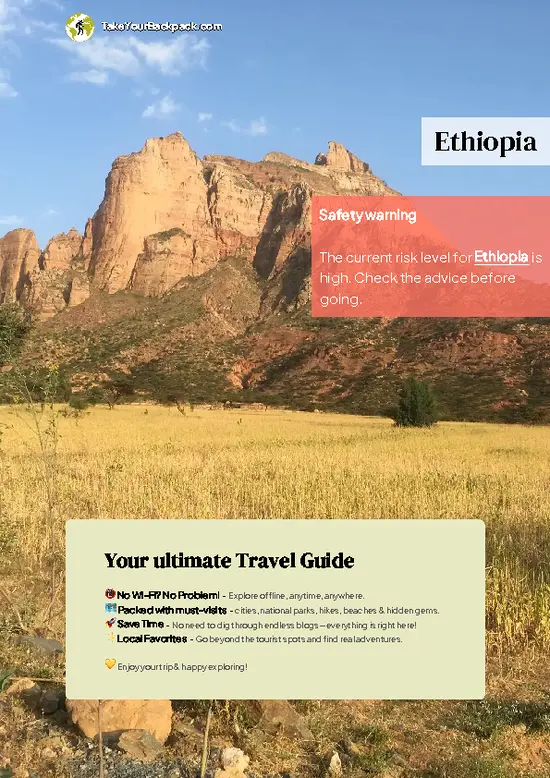
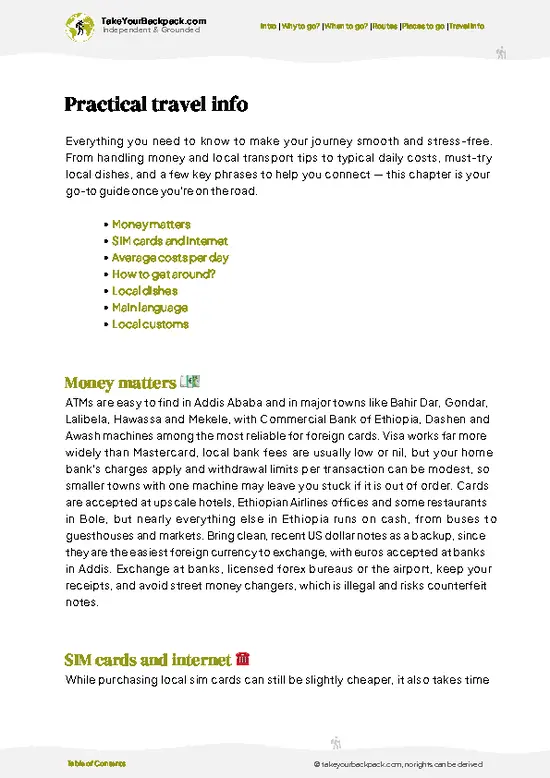
example page 0 from our offline Travel Guide for Ethiopia
example page 1 from our offline Travel Guide for Ethiopia
example page 2 from our offline Travel Guide for Ethiopia
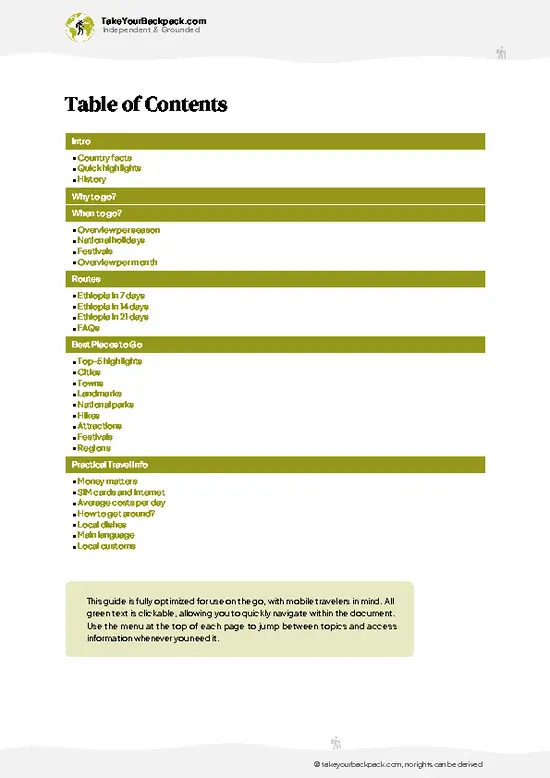
example page 3 from our offline Travel Guide for Ethiopia
example page 4 from our offline Travel Guide for Ethiopia
example page 5 from our offline Travel Guide for Ethiopia
example page 6 from our offline Travel Guide for Ethiopia
example page 7 from our offline Travel Guide for Ethiopia
Loading the map 🌍
CLICK TO FILTER
cities
towns
landmarks
national parks
hikes
attractions
festivals
regions
SHOW COUNTRY’S BESTSHOW ALL

✨ Why go?
Ranked #6 national park in Ethiopia
What makes this national park worth exploring

Mago National Park suits backpackers who want raw, self-directed travel rather than a polished park circuit. Almost nobody else is there, so you share the savanna with Mursi villages and herds of buffalo instead of a line of safari vans. Jinka, the nearest town, has cheap guesthouses, and you can arrange a scout, a driver and a camp spot yourself in a morning, which beats paying a Addis operator a premium for the same thing. The second pull is the Omo River and Neri River valleys, where the landscape shifts from woodland to open grass within a few hours of walking. Tours are easy to buy, but they rarely stop for long. Going independently lets you linger at a waterhole, change plans when a road floods and talk with the Mursi and Ari people on your own terms.

💡 HighlightsMust-see experiences and standout moments

  1. Mursi Villages: The Mursi live on the park's edge and are known for the clay lip plates worn by women. Visits are paid and negotiated, so agree on a price with your guide first.
  2. Omo River Banks: A broad, muddy river lined with fig trees and crocodiles. It marks the park's eastern edge and makes a good place to watch birds at dawn.
  3. Neri River: Slow brown water running through the central plains. Buffalo and waterbuck come to drink at its edges in the dry months.
  4. Mago Savanna Plains: Open grassland with scattered acacia, where giraffe, elephant and eland can show up. You walk or drive with a scout.
  5. Ari Highland Views: The road up from Jinka climbs through coffee and enset farms, with wide views over the park toward the Omo lowlands.
  6. Birdlife: Over 200 bird species have been recorded, including hornbills,
… read more 👉
  1. Mursi Villages: The Mursi live on the park's edge and are known for the clay lip plates worn by women. Visits are paid and negotiated, so agree on a price with your guide first.
  2. Omo River Banks: A broad, muddy river lined with fig trees and crocodiles. It marks the park's eastern edge and makes a good place to watch birds at dawn.
  3. Neri River: Slow brown water running through the central plains. Buffalo and waterbuck come to drink at its edges in the dry months.
  4. Mago Savanna Plains: Open grassland with scattered acacia, where giraffe, elephant and eland can show up. You walk or drive with a scout.
  5. Ari Highland Views: The road up from Jinka climbs through coffee and enset farms, with wide views over the park toward the Omo lowlands.
  6. Birdlife: Over 200 bird species have been recorded, including hornbills, bee-eaters and kingfishers along the rivers, best at first light.
  7. Camping in the Bush: Sleeping near the Neri River means hearing hyenas and frogs after dark, with a sky free of light pollution.
Mago National Park pairs the Neri River at dawn with a Mursi village visit in the late morning, since both sit within the same stretch of track.
Spotted a mistake or missing something? Contact us.

Things to do near Mago National Park

Ratings based on Tripadvisor reviews. When you book through this link, you support our work at no extra cost to you.

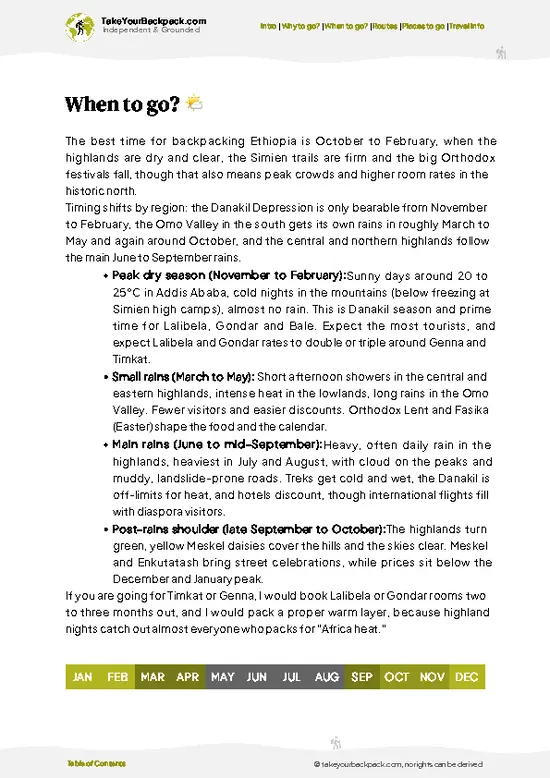
🌤️ When to go?Best time to explore Mago

  • Main Dry Season (December to February): Mago’s clearest stretch, with hot days of 30 to 36°C (86 to 97°F) and nights of 18 to 22°C (64 to 72°F). Tracks are firm, rivers low, and wildlife gathers near water. Most Mursi and Ari village visits happen now, and lodging prices peak.
  • Short Dry Spell (July to August): Cooler and cloudier at 28 to 32°C (82 to 90°F), with patchy showers. Fewer visitors and some room for bargaining.
  • Long Rains (March to May): Heavy downpours cut off the Omo River crossings and turn black cotton soil into sticky mud. Many lodges discount, but access is unreliable.
  • Short Rains (October to November): Showers come mostly in the afternoon. The landscape is green, and the tracks are passable most days.
Daylight stays close to 12 hours all year. Book a 4x4 and a guide for January, … read more 👉
  • Main Dry Season (December to February): Mago’s clearest stretch, with hot days of 30 to 36°C (86 to 97°F) and nights of 18 to 22°C (64 to 72°F). Tracks are firm, rivers low, and wildlife gathers near water. Most Mursi and Ari village visits happen now, and lodging prices peak.
  • Short Dry Spell (July to August): Cooler and cloudier at 28 to 32°C (82 to 90°F), with patchy showers. Fewer visitors and some room for bargaining.
  • Long Rains (March to May): Heavy downpours cut off the Omo River crossings and turn black cotton soil into sticky mud. Many lodges discount, but access is unreliable.
  • Short Rains (October to November): Showers come mostly in the afternoon. The landscape is green, and the tracks are passable most days.
Daylight stays close to 12 hours all year. Book a 4x4 and a guide for January, and expect a haggling advantage if you travel in late July.


source: climatestotravel.comJANJanuary: excellent for travelingFEBFebruary: excellent for travelingMARMarch: excellent for travelingAPRApril: good for travelingMAYMay: good for travelingJUNJune: fair for travelingJULJuly: below average for travelingAUGAugust: below average for travelingSEPSeptember: fair for travelingOCTOctober: good for travelingNOVNovember: excellent for travelingDECDecember: excellent for traveling
when-to-go

✈️ The backpacker research shortcutEthiopia Travel Guide

An offline-friendly backpacking guide with optimized travel routes, ranked highlights, transport advice, and the best areas to stay.
example page 0 from our offline Travel Guide for Ethiopia
example page 1 from our offline Travel Guide for Ethiopia
example page 2 from our offline Travel Guide for Ethiopia
example page 3 from our offline Travel Guide for Ethiopia
example page 4 from our offline Travel Guide for Ethiopia
example page 5 from our offline Travel Guide for Ethiopia
example page 6 from our offline Travel Guide for Ethiopia
example page 7 from our offline Travel Guide for Ethiopia
The digital guide (380 pages) contains:
✅ 98 highlights, ranked by travel appeal
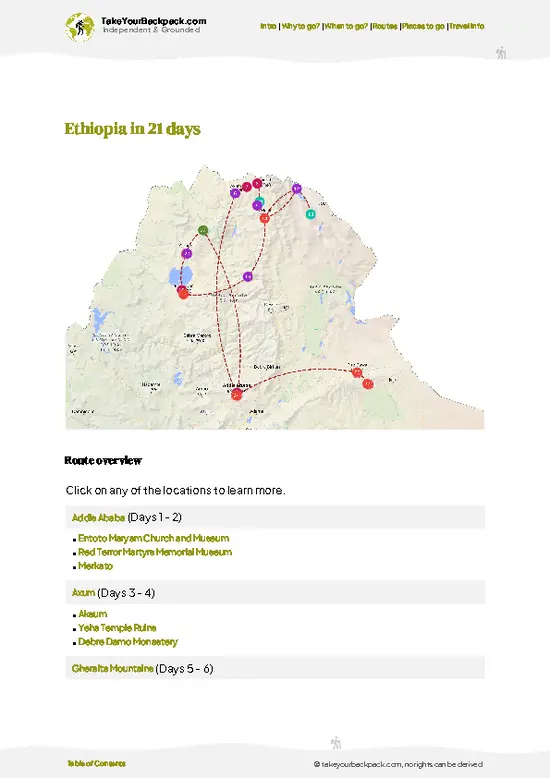
✅ Optimized 7, 14 & 21-day travel routes
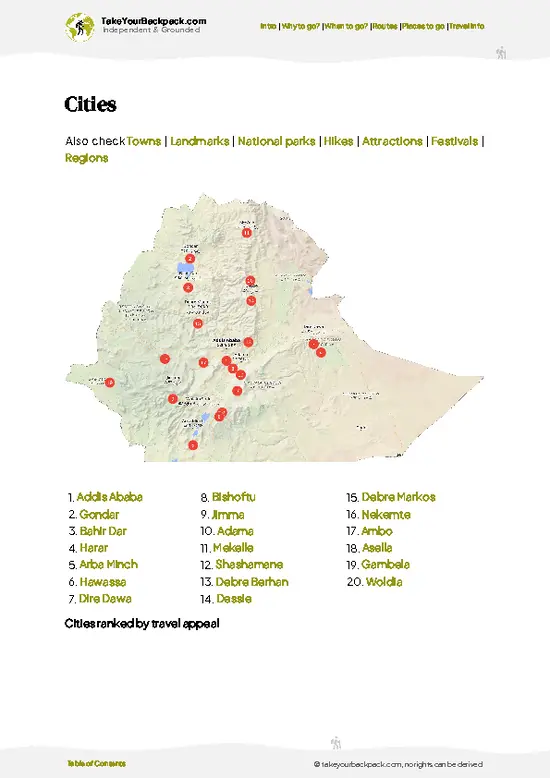
✅ Cities, national parks, landmarks, beaches
✅ How to get around
✅ Offline-friendly for travel without Wi-Fi
👉 Click to see all 30+ guide features

📅 Plan smarter in minutes, not weeks
✅ Month by month travel advice
✅ Festivals & national holidays
✅ Budget expectations

🗺️ Go to the right places, skip the overrated ones
✅ Honest pros & cons of destinations
✅ Top hikes, parks & viewpoints
✅ Lesser-known places most travelers miss
✅ Clear “worth it vs skip it” guidance

🛏️ Travel smoothly without rookie mistakes
✅ Best areas to stay
✅ Transport systems explained simply
✅ Common scams & safety advice
✅ SIM cards, money & practical tips

🌍 Understand the country, not just visit it
✅ Culture & traditions
✅ 52 Essential phrases & customs
✅ Festivals worth planning around
✅ Traveler-friendly historical context
✅ Insights that make places more meaningful

📱 Built for real travel conditions
✅ Fully downloadable PDF
✅ Works completely offline
✅ Optimized for phone use
✅ Useful in remote areas & buses
✅ Everything in one place
Stop searching, start planning
Get instant access to your full guide. 30‑day money-back guarantee.
+ Add another guide for just

By proceeding you agree to our terms.
Sent to your inbox immediately after payment • 100% Secure Checkout
Best Backpacking Travel Advisor 2025 tourism awardBest Backpacking
Travel Advisor
2025
What others say about Take Your Backpack Guides:
⭐⭐⭐⭐⭐
Fantastic, amazing amount of information!
⭐⭐⭐⭐⭐
My goodness this is amazing, it's what I've been looking for hats off too you!
⭐⭐⭐⭐⭐
I think this is absolutely BRILLIANT
⭐⭐⭐⭐
Very complete and informative. It's still missing places, but I gotta to commend you
⭐⭐⭐⭐⭐
This is truly amazing, thank you, can't wait to explore it with my kids!
⭐⭐⭐⭐⭐
Awesome resource, thank you!
⭐⭐⭐⭐⭐
This is amazing! Can't wait to explore the ones I haven't seen
⭐⭐⭐⭐
I love this! Well done, great idea.
⭐⭐⭐⭐⭐
Thanks for taking the time to make this gem!
⭐⭐⭐⭐⭐
This might be the best website I've ever seen.
⭐⭐⭐⭐⭐
Congratulations, and thank you so much for your work; it's incredibly valuable.
⭐⭐⭐⭐
In all seriousness I think you did a great job pointing out the important spots
⭐⭐⭐⭐⭐
10/10 very good
⭐⭐⭐⭐⭐
As someone who's only just starting to visit regularly this is awesome, thank you.
⭐⭐⭐⭐
Thank you very much! I'm going to visit my dad, it's going to be very useful!
⭐⭐⭐⭐⭐
This is really cool! We'll be travelling for the first time and this definitely come in handy.
⭐⭐⭐⭐⭐
You are now our minister of culture, congratulations 👨‍💼
⭐⭐⭐⭐⭐
Just wanted to tell you that this is a pearl! Going to follow your recommendations.
⭐⭐⭐⭐⭐
This is so cool. I'll definitely be using the resource for my travels soon.
⭐⭐⭐⭐⭐
This is very impressive! Good work.
⭐⭐⭐⭐⭐
This is an amazing and informative site. Very well done!

🛏️ Where to stay?Choosing the right base

No hotels sit inside Mago National Park, so most backpackers sleep in Jinka, the zonal capital about 30 to 40 kilometers north of the park headquarters. Jinka has the widest range, from basic guesthouses at US$8 to 15 a night to mid-range lodges around US$40 to 70. Eco Omo Lodge and Orit Hotel are the familiar names, and the lodges sit on a ridge with views over the Neri valley. Rooms in the cheapest places have cold showers and patchy power, so bring a headlamp and a charged power bank.

Inside the park, official campsites exist near the Mago River and at the Omo River, usually organized through … read more 👉
No hotels sit inside Mago National Park, so most backpackers sleep in Jinka, the zonal capital about 30 to 40 kilometers north of the park headquarters. Jinka has the widest range, from basic guesthouses at US$8 to 15 a night to mid-range lodges around US$40 to 70. Eco Omo Lodge and Orit Hotel are the familiar names, and the lodges sit on a ridge with views over the Neri valley. Rooms in the cheapest places have cold showers and patchy power, so bring a headlamp and a charged power bank.

Inside the park, official campsites exist near the Mago River and at the Omo River, usually organized through the park office in Jinka. You need your own tent, food, and water filter, and rangers are normally required to accompany you. Camping costs roughly US$10 to 15 per night plus ranger and vehicle fees.

Turmi and Key Afer are smaller bases for the wider South Omo area. Key Afer has simple guesthouses and a Thursday market. Most travelers stay in Jinka and make day trips to the park.

👛 Costs (as of 22 October 2026)Typical daily expenses

Mago National Park costs a backpacker roughly US$79 to 122 a day once the required guide, ranger, and vehicle are counted. Prices are paid in Ethiopian birr, and the figures below are converted to US dollars.
CategoryBudget RangeLocal Reality
Entrance feeUS$5 to 10Charged per person per 24 hours, with a small extra fee for each vehicle.
Guide and rangerUS$15 to 25Both are mandatory. Ranger fees are per group, so splitting helps.
Accommodation (high season)US$8 to 20Jinka guesthouses are cheapest. Mid-range lodges run US$40 to 70 and camping about US$10 to 15.
4x4 and fuelUS$30 to 45Per day from Jinka, per vehicle. Sharing among four people cuts the cost sharply.
Food and waterUS$6 to 12Local restaurants in Jinka serve meals for US$2 to 4. Pack supplies for park days.
Village visit feesUS$5 to 10Cultural
… read more 👉
Mago National Park costs a backpacker roughly US$79 to 122 a day once the required guide, ranger, and vehicle are counted. Prices are paid in Ethiopian birr, and the figures below are converted to US dollars.
CategoryBudget RangeLocal Reality
Entrance feeUS$5 to 10Charged per person per 24 hours, with a small extra fee for each vehicle.
Guide and rangerUS$15 to 25Both are mandatory. Ranger fees are per group, so splitting helps.
Accommodation (high season)US$8 to 20Jinka guesthouses are cheapest. Mid-range lodges run US$40 to 70 and camping about US$10 to 15.
4x4 and fuelUS$30 to 45Per day from Jinka, per vehicle. Sharing among four people cuts the cost sharply.
Food and waterUS$6 to 12Local restaurants in Jinka serve meals for US$2 to 4. Pack supplies for park days.
Village visit feesUS$5 to 10Cultural visits and photography are charged separately, usually in small bills.
Total Daily BudgetUS$79 to 122About US$90 for a typical solo traveler using shared transport.
⚠️ Prices can change and everyone travels differently, so take this as a rough guide. Hope it helps you plan your adventure!

🥾 TrailsBest hikes in Mago national park

Mago National Park has no signed, named trails, so walking here means following animal tracks and river edges with an armed scout. Most people start from the park gate or a camp near the Neri River and loop through savanna for two to five hours.
  • River walks: Follow the Neri River for roughly 2 to 3 hours on flat, sandy ground, with fig trees, kingfishers and the occasional buffalo trail. Easy, but hot.
  • Savanna loops: Tracks of 5 to 10 km cross open grass and acacia, with giraffe, kudu and warthog common. Moderate, since there is little shade and no marked path.
  • Village visits: Short walks of about
… read more 👉
Mago National Park has no signed, named trails, so walking here means following animal tracks and river edges with an armed scout. Most people start from the park gate or a camp near the Neri River and loop through savanna for two to five hours.
  • River walks: Follow the Neri River for roughly 2 to 3 hours on flat, sandy ground, with fig trees, kingfishers and the occasional buffalo trail. Easy, but hot.
  • Savanna loops: Tracks of 5 to 10 km cross open grass and acacia, with giraffe, kudu and warthog common. Moderate, since there is little shade and no marked path.
  • Village visits: Short walks of about an hour from the road lead to Mursi settlements, where you can watch daily life. Expect to pay an entry fee to the community, and ask before photographing anyone.
Wildlife includes buffalo, elephant, lion and leopard, though sightings are far less certain than at Kenya's parks. Tsetse flies are common, so wear long sleeves in a light color. Mago National Park is reached from Jinka by 4x4, a drive of a couple of hours on rough dirt, and there is no regular public transport inside the park. A park entry fee applies, along with a compulsory scout fee and a vehicle fee, and all three are paid at the park office or arranged through your Jinka guide. Visitor numbers are very low, and the dry months make roads easier and animals easier to find near water.
⚠️ Hiking info can sometimes be outdated or inaccurate. Before you hit the trail, check the latest conditions with locals. If you do spot anything that's off, I'd love to hear from you, so I can update it for fellow travelers.

🛡️ SafetyTraveler Safety Guide

Mago is straightforward if you go with the guide and ranger that the park requires, and the main issues are heat, distance, and rough tracks. Daytime temperatures often reach 35°C (95°F) with little shade, so start before 7 a.m., carry at least 3 liters of water per person, and wear a hat. Tracks turn to slick black mud after rain, and a 4x4 with a spare tire is the only sensible vehicle. Navigation is not obvious, so do not walk off alone.

Wildlife includes buffalo, elephants, lions, and leopards, but encounters are uncommon on foot. Follow your ranger’s lead, keep your voice low, and never approach an animal. Hippos and crocodiles live along the Omo, so stay back from the water’s edge. Malaria is present, so bring prophylaxis and repellent. Cell coverage fades fast, and cash is needed for every fee.

FAQFrequently asked questions about Mago

Two to three days is enough for Mago National Park, with a full day for the park itself. Jinka is the usual base, and the drive to the park gate takes about 1 to 1.5 hours on rough tracks. Add a day for a Mursi village visit and a second for the Omo River and Ari markets if you have time.
Mago National Park is very hard to visit without a car, since there is no public transport inside the park and distances are long. You can take a bus from Addis Ababa to Jinka, a trip of roughly two days with an overnight stop at Arba Minch or Konso, then hire a 4x4 with driver for about US$100 to 150 per day. Splitting with other travelers brings that down considerably.
Yes, Mago National Park charges an entrance fee of about US$5 to 10 per person per day, plus vehicle and mandatory ranger fees of roughly US$15 to 25. You pay at the park office in Jinka or at the gate, in cash in birr. Camping and village visits cost extra, and a guide is needed for any walking.
⚠️ Things can change over time, so always validate details locally before you go.

Other Ethiopian national parks near Mago

Explore more nearby:


💡 Not sure where to go next?
Create a personalized itinerary for Ethiopia including Mago and the places that fit your trip.

Generate my itinerary

👉 Discover all national parks

Or checkout all Ethiopia has to offer (think cities, towns, villages, national parks, hikes, beaches, festivals)
Country photo of Ethiopia

We 💚 feedbackKey takeaways before you go

Mago National Park rewards patience more than a checklist. Travelers rush to the Mursi and overlook the slow river mornings, when the Neri's banks fill with birds and tracks. I would pay for an extra night at a camp near the water, and bring a head net for the flies.

✈️ When did I visit Ethiopia?
Ethiopia I visited back in October 2017. I combined the trip with a visit to Sudan. Ethiopia was a pure surprise with the magical scenery like the Danakil Depression and the Simien Mountains.

✍️ Help improve this page!
The information on this page is based on my own backpacking experience in Ethiopia, supplemented with up-to-date research and feedback from other travelers. Travel details can change, so if you notice anything outdated or incomplete, feel free to let me know.


🙋‍♂️ Give feedback

👋 Meet the founderWho’s Behind Take Your Backpack?

Johan, backpacker and founder of TakeYourBackpackHi, I’m Johan (Netherlands 🇳🇱), the creator of TakeYourBackpack. Over the past 3 decades, I’ve backpacked through 90+ countries across six continents, gaining extensive experience with independent travel, long-term trips, and overland routes.

This site is built on a combination of firsthand travel experience and carefully curated insights from other backpackers. Many guides are based on places I’ve personally visited, while others bring together tips, observations, and practical advice shared by trusted travelers I’ve met along the way.

The goal is to provide realistic, experience-driven guidance — not generic itineraries — so you can explore destinations with better context, clearer expectations, and more confidence.