×

Falkland Islands🇫🇰 | regionsEast FalklandStanley base, Volunteer Point kings, gravel tracks, 1982 battlefields | things to do and best time to go

Explore Carcass IslandExplore Pebble Island

Backpacking in East Falkland
🏆 Top pickregion ranked #1
By Johan Kruseman 🇳🇱 | Updated October 22, 2026

Decades ago East Falkland was a sheep-farming outpost where wool set the rhythm and a visitor was a rarity. Today it still runs on farms and gravel, but a modest stream of travelers arrives for penguins, elephant seals and war history. East Falkland lies in the east of the Falkland Islands, and Stanley, the capital, sits on its northeastern coast. Most of the island is empty moorland, so Stanley is where you stock up. Roads beyond town are mostly gravel, and the rocky surface chews tires and rattles windshields, so an experienced traveler books a guided 4x4 trip or hires a local driver instead of pushing a rental hard. Wildlife sites such as Volunteer Point sit on private farmland and need a long, rough drive, so you go with a tour or arrange access first. The reward is colonies you can approach on open sand with almost no crowds. Battlefields from 1982 add somber depth. Unlike West Falkland, which is quieter and has fewer roads and settlements, East Falkland has the main airport, the shops and the busiest wildlife circuit.

Discover everything you want to know in the 📖 Falkland Islands Travel Guide.


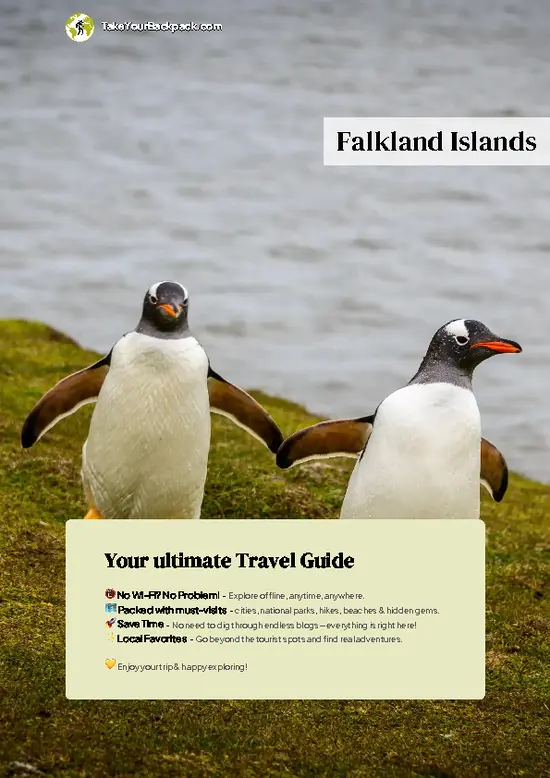
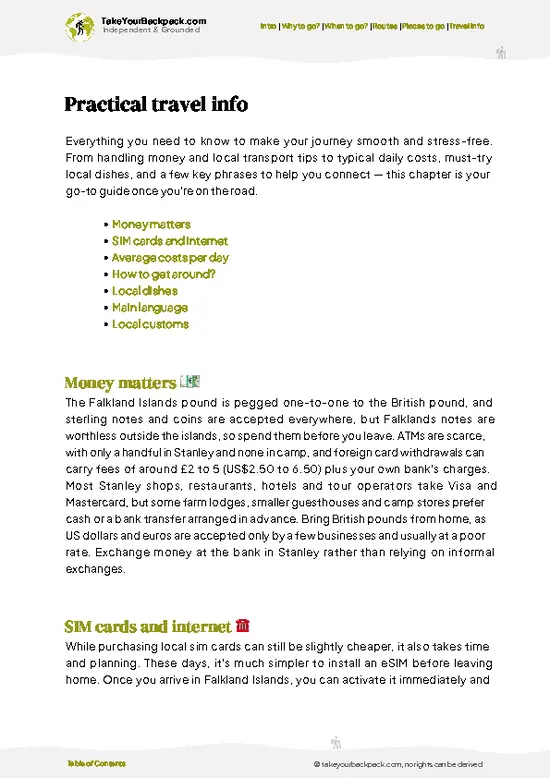
example page 0 from our offline Travel Guide for Falkland Islands
example page 1 from our offline Travel Guide for Falkland Islands
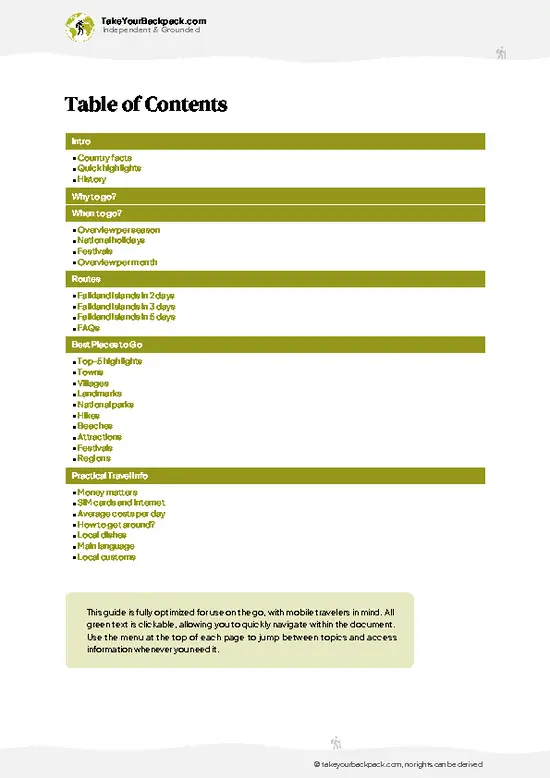
example page 2 from our offline Travel Guide for Falkland Islands
example page 3 from our offline Travel Guide for Falkland Islands
example page 4 from our offline Travel Guide for Falkland Islands
example page 5 from our offline Travel Guide for Falkland Islands
example page 6 from our offline Travel Guide for Falkland Islands
example page 7 from our offline Travel Guide for Falkland Islands
Loading the map 🌍
CLICK TO FILTER
towns
villages
landmarks
national parks
hikes
beaches
attractions
festivals
regions
SHOW COUNTRY’S BESTSHOW ALL

✨ Why go?
Ranked #1 region in Falkland Islands
What sets this place apart

East Falkland suits backpackers because so much sits within reach of one base. From Stanley you can reach Gypsy Cove on foot or by short taxi, then arrange a day toward Volunteer Point, where King penguins stand in the thousands on open grass. That means almost no packing and unpacking, which matters when every transfer needs a vehicle or a flight. The second draw is history you can walk through. The 1982 battlefields around Mount Tumbledown and Goose Green are open ground with plaques, wrecks and old trenches, and they make more sense on foot than in any book. Add the farm settlements, where a night in a self-catering cottage puts you among people who run the land, and East Falkland gives you wildlife, war memory and rural life in one island with a single main road network.

💡 HighlightsKey sights and experiences for travelers

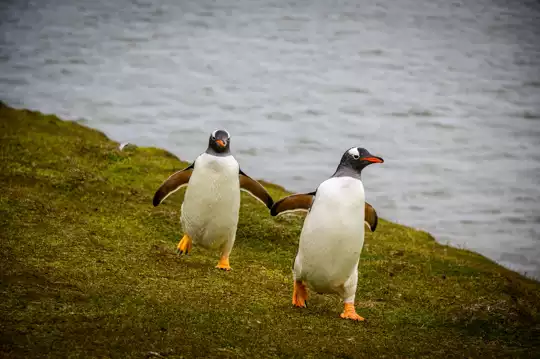
  1. Volunteer Point: the best-known wildlife stop, with a large King penguin colony plus Gentoo and Magellanic penguins on a long white beach. It sits on private farmland, so go with a guide or arrange permission.
  2. Gypsy Cove: Magellanic penguins burrow in the dunes near Stanley, and the coastal path lets you see them without a long drive.
  3. Stanley Christ Church Cathedral and Whalebone Arch: the southernmost Anglican cathedral stands beside an arch of jawbones from blue whales, a compact reminder of the islands’ whaling past.
  4. Falkland Islands Museum (Historic Dockyard Museum): covers settlers, shipwrecks, wartime and daily island life in restored dockyard buildings. Small entry fee.
  5. Mount Tumbledown: a rocky ridge where the 1982 fighting was fierce. The climb is steady and the view over Stanley explains
… read more 👉
  1. Volunteer Point: the best-known wildlife stop, with a large King penguin colony plus Gentoo and Magellanic penguins on a long white beach. It sits on private farmland, so go with a guide or arrange permission.
  2. Gypsy Cove: Magellanic penguins burrow in the dunes near Stanley, and the coastal path lets you see them without a long drive.
  3. Stanley Christ Church Cathedral and Whalebone Arch: the southernmost Anglican cathedral stands beside an arch of jawbones from blue whales, a compact reminder of the islands’ whaling past.
  4. Falkland Islands Museum (Historic Dockyard Museum): covers settlers, shipwrecks, wartime and daily island life in restored dockyard buildings. Small entry fee.
  5. Mount Tumbledown: a rocky ridge where the 1982 fighting was fierce. The climb is steady and the view over Stanley explains the tactics at once.
  6. Goose Green and Darwin: the site of a major battle, with a memorial and cemetery. The settlement is still a working sheep farm.
  7. Bluff Cove: a Gentoo and King penguin site with a quieter feel than Volunteer Point, reached on farm tracks.
  8. Sea Lion Island: a short flight south of Stanley, with elephant seals, sea lions, orcas offshore and nesting birds along a small, walkable island. Lodge stays book out early.
  9. Cape Pembroke Lighthouse: a lesser-known coastal walk east of Stanley, with wrecks, sea birds and a 1855 lighthouse that few day-trippers bother with.
  10. Fitzroy and Bluff Cove farm settlements: lesser-known stops where locals still gather for sheep shearing and Sunday drives, with plain landscapes and little traffic.
For a first visit, Volunteer Point is the one to prioritize, because it gives you King penguins in numbers you will not find anywhere else in reach.
Spotted a mistake or missing something? Contact us.

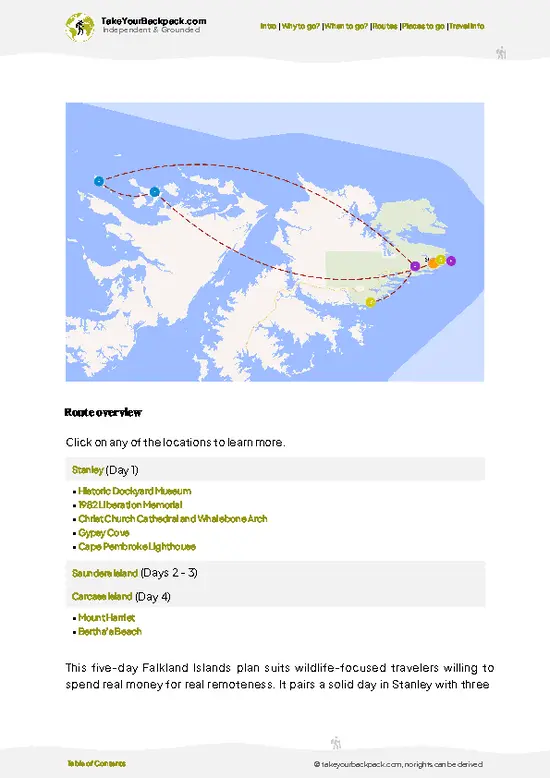
⌛️ 5 daysSeeing the highlights in 5 days

Day 1: Stanley: A museum and harbor day suits arrival, because flights and ferries rarely line up with early starts. Walk the waterfront, the cathedral and the dockyard museum, then collect a vehicle or confirm your guide. Everything beyond town depends on a 4x4, so sorting this first keeps the rest flexible.
Day 2: Gypsy Cove: Walk the coast to the penguin burrows, then continue to Cape Pembroke Lighthouse if the wind allows. Stay near Stanley because the weather can change the track conditions overnight.
Day 3: Volunteer Point: Make this the full day. The tracks are rough and slow, so leave early and carry food and water. The King penguin colony is the reason the trip is worth the cost.
Day 4: Mount Tumbledown and Goose Green: Climb Tumbledown in the morning, then drive on to Darwin and Goose … read more 👉
Day 1: Stanley: A museum and harbor day suits arrival, because flights and ferries rarely line up with early starts. Walk the waterfront, the cathedral and the dockyard museum, then collect a vehicle or confirm your guide. Everything beyond town depends on a 4x4, so sorting this first keeps the rest flexible.
Day 2: Gypsy Cove: Walk the coast to the penguin burrows, then continue to Cape Pembroke Lighthouse if the wind allows. Stay near Stanley because the weather can change the track conditions overnight.
Day 3: Volunteer Point: Make this the full day. The tracks are rough and slow, so leave early and carry food and water. The King penguin colony is the reason the trip is worth the cost.
Day 4: Mount Tumbledown and Goose Green: Climb Tumbledown in the morning, then drive on to Darwin and Goose Green. Reading the ground first, then the memorials, tells the story better than reversing it.
Day 5: Bluff Cove: Finish with a gentler farm track to the penguins, leaving buffer time before onward travel.
For a detour, take the short flight to Sea Lion Island instead of Day 5. It adds elephant seals and orca watching without touching the rest of the road plan, though it needs advance booking. The one day that justifies the whole trip is Day 3 at Volunteer Point.

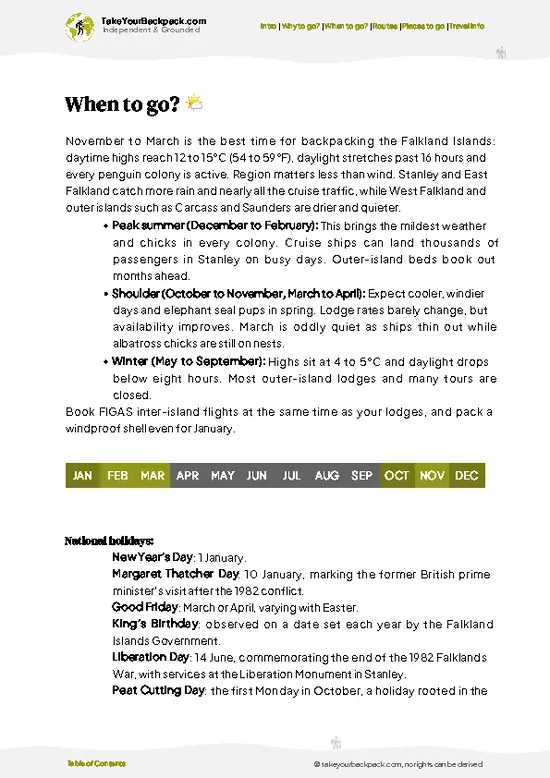
🌤️ When to go?When to go for the best experience

  • Summer (December to February): Highs of 12 to 16°C (54 to 61°F) and light until late evening make this the easiest season for hiking and wildlife. Penguin chicks, elephant seal pups and nesting albatross draw the biggest crowds, and flights and lodging cost the most.
  • Autumn (March to May): Temperatures sit around 6 to 11°C (43 to 52°F), wind is steady, and the settlements are quiet. Penguins start leaving by April, and prices ease.
  • Winter (June to August): Expect 0 to 5°C (32 to 41°F), frost, occasional snow and only about 8 hours of daylight. Peat fires and quiet farm settlements replace wildlife viewing, and many outlying lodges close.
  • Spring (September to November): Highs of 5 to 11°C (41 to 52°F) and lengthening days bring returning gentoo and rockhopper penguins from October. Crowds stay
… read more 👉
  • Summer (December to February): Highs of 12 to 16°C (54 to 61°F) and light until late evening make this the easiest season for hiking and wildlife. Penguin chicks, elephant seal pups and nesting albatross draw the biggest crowds, and flights and lodging cost the most.
  • Autumn (March to May): Temperatures sit around 6 to 11°C (43 to 52°F), wind is steady, and the settlements are quiet. Penguins start leaving by April, and prices ease.
  • Winter (June to August): Expect 0 to 5°C (32 to 41°F), frost, occasional snow and only about 8 hours of daylight. Peat fires and quiet farm settlements replace wildlife viewing, and many outlying lodges close.
  • Spring (September to November): Highs of 5 to 11°C (41 to 52°F) and lengthening days bring returning gentoo and rockhopper penguins from October. Crowds stay thin until December.
Book flights and Stanley accommodation several months ahead for December and January, and aim for November if you want wildlife without the peak rates.


source: climatestotravel.comJANJanuary: excellent for travelingFEBFebruary: excellent for travelingMARMarch: highly recommended for travelingAPRApril: good for travelingMAYMay: fair for travelingJUNJune: below average for travelingJULJuly: below average for travelingAUGAugust: below average for travelingSEPSeptember: fair for travelingOCTOctober: good for travelingNOVNovember: highly recommended for travelingDECDecember: excellent for traveling
falkland-islands-region-east-falkland
© Google |

✈️ The backpacker research shortcutFalkland Islands Travel Guide

An offline-friendly backpacking guide with optimized travel routes, ranked highlights, transport advice, and the best areas to stay.
example page 0 from our offline Travel Guide for Falkland Islands
example page 1 from our offline Travel Guide for Falkland Islands
example page 2 from our offline Travel Guide for Falkland Islands
example page 3 from our offline Travel Guide for Falkland Islands
example page 4 from our offline Travel Guide for Falkland Islands
example page 5 from our offline Travel Guide for Falkland Islands
example page 6 from our offline Travel Guide for Falkland Islands
example page 7 from our offline Travel Guide for Falkland Islands
The digital guide (108 pages) contains:
✅ 25 highlights, ranked by travel appeal
✅ Optimized 2, 3 & 5-day travel routes
✅ Cities, national parks, landmarks, beaches
✅ How to get around
✅ Offline-friendly for travel without Wi-Fi
👉 Click to see all 30+ guide features

📅 Plan smarter in minutes, not weeks
✅ Month by month travel advice
✅ Festivals & national holidays
✅ Budget expectations

🗺️ Go to the right places, skip the overrated ones
✅ Honest pros & cons of destinations
✅ Top hikes, parks & viewpoints
✅ Lesser-known places most travelers miss
✅ Clear “worth it vs skip it” guidance

🛏️ Travel smoothly without rookie mistakes
✅ Best areas to stay
✅ Transport systems explained simply
✅ Common scams & safety advice
✅ SIM cards, money & practical tips

🌍 Understand the country, not just visit it
✅ Culture & traditions
✅ Local customs
✅ Festivals worth planning around
✅ Traveler-friendly historical context
✅ Insights that make places more meaningful

📱 Built for real travel conditions
✅ Fully downloadable PDF
✅ Works completely offline
✅ Optimized for phone use
✅ Useful in remote areas & buses
✅ Everything in one place
Stop searching, start planning
Get instant access to your full guide. 30‑day money-back guarantee.
+ Add another guide for just

By proceeding you agree to our terms.
Sent to your inbox immediately after payment • 100% Secure Checkout
Best Backpacking Travel Advisor 2025 tourism awardBest Backpacking
Travel Advisor
2025
What others say about Take Your Backpack Guides:
⭐⭐⭐⭐⭐
Fantastic, amazing amount of information!
⭐⭐⭐⭐⭐
My goodness this is amazing, it's what I've been looking for hats off too you!
⭐⭐⭐⭐⭐
I think this is absolutely BRILLIANT
⭐⭐⭐⭐
Very complete and informative. It's still missing places, but I gotta to commend you
⭐⭐⭐⭐⭐
This is truly amazing, thank you, can't wait to explore it with my kids!
⭐⭐⭐⭐⭐
Awesome resource, thank you!
⭐⭐⭐⭐⭐
This is amazing! Can't wait to explore the ones I haven't seen
⭐⭐⭐⭐
I love this! Well done, great idea.
⭐⭐⭐⭐⭐
Thanks for taking the time to make this gem!
⭐⭐⭐⭐⭐
This might be the best website I've ever seen.
⭐⭐⭐⭐⭐
Congratulations, and thank you so much for your work; it's incredibly valuable.
⭐⭐⭐⭐
In all seriousness I think you did a great job pointing out the important spots
⭐⭐⭐⭐⭐
10/10 very good
⭐⭐⭐⭐⭐
As someone who's only just starting to visit regularly this is awesome, thank you.
⭐⭐⭐⭐
Thank you very much! I'm going to visit my dad, it's going to be very useful!
⭐⭐⭐⭐⭐
This is really cool! We'll be travelling for the first time and this definitely come in handy.
⭐⭐⭐⭐⭐
You are now our minister of culture, congratulations 👨‍💼
⭐⭐⭐⭐⭐
Just wanted to tell you that this is a pearl! Going to follow your recommendations.
⭐⭐⭐⭐⭐
This is so cool. I'll definitely be using the resource for my travels soon.
⭐⭐⭐⭐⭐
This is very impressive! Good work.
⭐⭐⭐⭐⭐
This is an amazing and informative site. Very well done!

🛏️ Where to stay?Best areas to stay in Falkland Islands

Stanley is the place to stay, because it holds nearly all of East Falkland’s beds, shops, restaurants and tour operators within a few streets. Expect guesthouses and self-catering cottages at roughly US$70 to 150 a night, with shared rooms rare and campsites limited. It is also very safe, with the kind of low crime where people leave doors unlocked and strike up conversations at the pub.

The harbor front and the streets just behind it put you within a ten-minute walk of the museum, cathedral, supermarkets and the pubs where locals, soldiers and fishing crews mix. Solo travelers meet others at … read more 👉
Stanley is the place to stay, because it holds nearly all of East Falkland’s beds, shops, restaurants and tour operators within a few streets. Expect guesthouses and self-catering cottages at roughly US$70 to 150 a night, with shared rooms rare and campsites limited. It is also very safe, with the kind of low crime where people leave doors unlocked and strike up conversations at the pub.

The harbor front and the streets just behind it put you within a ten-minute walk of the museum, cathedral, supermarkets and the pubs where locals, soldiers and fishing crews mix. Solo travelers meet others at breakfast tables in guesthouses and on the tour minibuses, which tends to be the social glue here. Staying east of the center toward Gypsy Cove gives you quieter evenings and penguins a short walk away, though you give up the pub scene.

Outside the capital, farm settlements such as Darwin and Goose Green offer lodges and self-catering houses with a more rural feel, roughly US$80 to 160 a night. Darwin suits anyone who wants to walk the battlefield history and coastline in near silence. Bleaker Island and Sea Lion Island, reached by small plane, have lodges aimed at wildlife stays, and they fill early in summer. For most backpackers, Stanley as a base with day trips is the practical and affordable choice.

🚌 Getting aroundMoving around without the hassle

A ride in a Stanley taxi costs roughly US$7 to 15 within town and is paid in cash, either Falkland pounds or sterling, since cards are rarely taken in cabs. Most backpackers lean on lifts, tours or a rental vehicle, because there is no public bus network beyond Stanley and the roads outside the capital are mostly gravel and peat track. That is by design: the population is small, distances are long, and nobody runs a service that would sit empty. Plan on arranging transport before you arrive, not on the day.
  • Taxis: Fares in and around Stanley run about US$7 to 15, and airport transfers cost more at roughly US$30 to 40 for the 55 km (34 mi) trip. Experienced travelers book the airport run ahead and share it, since drivers have few cars and fares are per vehicle.
  • Rental vehicles: A four-wheel-drive
… read more 👉
A ride in a Stanley taxi costs roughly US$7 to 15 within town and is paid in cash, either Falkland pounds or sterling, since cards are rarely taken in cabs. Most backpackers lean on lifts, tours or a rental vehicle, because there is no public bus network beyond Stanley and the roads outside the capital are mostly gravel and peat track. That is by design: the population is small, distances are long, and nobody runs a service that would sit empty. Plan on arranging transport before you arrive, not on the day.
  • Taxis: Fares in and around Stanley run about US$7 to 15, and airport transfers cost more at roughly US$30 to 40 for the 55 km (34 mi) trip. Experienced travelers book the airport run ahead and share it, since drivers have few cars and fares are per vehicle.
  • Rental vehicles: A four-wheel-drive costs around US$90 to 150 a day. Rentals are limited and sell out in summer, so reserve early. Gravel and soft peat punish two-wheel-drive cars.
  • Guided tours: Day trips to Volunteer Point cost about US$150 to 250 per person, often shared. The track is rough and crosses private land, so most visitors go with a guide, who also knows when the tides and peat allow passage.
  • Hitching and local lifts: Residents commonly stop for walkers on the Stanley to airport road, and the habit is part of rural life. Offer fuel money or conversation, and carry water and layers because a wait in the wind can run long.
  • Light aircraft: Flights from Stanley to West Falkland and outer islands cost roughly US$100 to 200 one way. Seats are few and weight limits are strict, so pack soft bags.
Fill the fuel tank in Stanley before heading out, as stations are scarce beyond town.

🍲 FoodEating & Drinking in East Falkland

Mutton and lamb carry the menu, raised on the island’s own farms, and a roast with gravy and peat-smoked flavor in a farm kitchen is worth seeking out. Fish is the other staple: Falkland calamari, toothfish and fresh mullet or kelp-caught mussels taste of cold South Atlantic water. Try diddle-dee jam, a tart, dark berry preserve spread on scones, and the strong tea that arrives with a cake plate at every gathering.

In Stanley, backpackers eat in a few cafés serving soup, sandwiches and pastries, in pubs with fish and chips and burgers, and in small restaurants that take reservations. Supermarkets stock imported produce on a shipping schedule, so shelves can look bare before the supply ship or flight arrives, and self-catering is the cheapest route. Expect meals at roughly US$12 to 25 in cafés … read more 👉
Mutton and lamb carry the menu, raised on the island’s own farms, and a roast with gravy and peat-smoked flavor in a farm kitchen is worth seeking out. Fish is the other staple: Falkland calamari, toothfish and fresh mullet or kelp-caught mussels taste of cold South Atlantic water. Try diddle-dee jam, a tart, dark berry preserve spread on scones, and the strong tea that arrives with a cake plate at every gathering.

In Stanley, backpackers eat in a few cafés serving soup, sandwiches and pastries, in pubs with fish and chips and burgers, and in small restaurants that take reservations. Supermarkets stock imported produce on a shipping schedule, so shelves can look bare before the supply ship or flight arrives, and self-catering is the cheapest route. Expect meals at roughly US$12 to 25 in cafés and pubs.

The most distinctive ritual is smoko, the mid-morning tea break that farm workers and families observe sharply at about 10 a.m., with cake or biscuits. Locals drink strong tea, and pubs pour pints of British ales and lagers, along with a local Falkland beer brewed in Stanley. Tipping is not expected. Alcohol and fresh food prices run high, and cooking and baking from scratch is a source of pride, so a home-baked offering will be welcomed.

FAQTraveler FAQ

Four to five days covers East Falkland well. Spend one day in Stanley for the museum and the cathedral, another at Gypsy Cove, a third at Volunteer Point (about 3 hours each way by 4x4), and one more for Darwin and Goose Green, roughly 1.5 hours from Stanley.
Public buses do not run outside Stanley, so you rely on taxis, guided tours and hitching. A taxi from the airport to Stanley costs about US$30 to 40, and day tours to Volunteer Point run around US$150 to 250 per person. Most visitors in East Falkland pair walking around Stanley with one or two pre-booked tours, since gravel tracks and peat are tough for ordinary cars.
East Falkland is known for its penguin colonies, with king, gentoo and Magellanic penguins at Volunteer Point and Gypsy Cove. It is also known for the 1982 war, with battlefields at Goose Green, Mount Tumbledown and Wireless Ridge, and for Stanley, the capital with a British feel. Elephant seals, sea lions, sheep farming and wide treeless moorland shape the landscape.
⚠️ Things can change over time, so always validate details locally before you go.

Other Falkland Islander regions near East Falkland

Explore more nearby:

  • Bleaker Island—Rockhopper clifftops, Sandy Bay gentoos, empty white sand, Cassard Point wreck site| 88 km away
  • Sea Lion Island—Orca lookouts, elephant seal shores, one lodge, grass airstrip| 117 km away
  • Pebble Island—Cape Tamar rockhoppers, quartz pebbles, dune burrows, northern lagoons| 130 km away

💡 Not sure where to go next?
Create a personalized itinerary for Falkland Islands including East Falkland and the places that fit your trip.

Generate my itinerary

👉 Discover all regions

Or checkout all Falkland Islands has to offer (think cities, towns, villages, national parks, hikes, beaches, festivals)
Country photo of Falkland Islands

We 💚 feedbackFinal thoughts on visiting East Falkland

First-time visitors overlook the farm gates. On East Falkland, tracks cross private land, and closing every gate behind you is the courtesy that keeps access open for everyone. Carry cash for farm entry fees and small settlement shops, and keep a day free for weather, because plans here bend around the wind.

✍️ Help improve this page!
The information on this page is based on in-depth research, insights shared by experienced travelers, and feedback from the local travel community in Falkland Islands. While every effort is made to keep the information accurate and current, conditions can change — so if you spot anything incorrect or outdated, please get in touch.


🙋‍♂️ Give feedback

👋 Meet the founderWho’s Behind Take Your Backpack?

Johan, backpacker and founder of TakeYourBackpackHi, I’m Johan (Netherlands 🇳🇱), the creator of TakeYourBackpack. Over the past 3 decades, I’ve backpacked through 90+ countries across six continents, gaining extensive experience with independent travel, long-term trips, and overland routes.

This site is built on a combination of firsthand travel experience and carefully curated insights from other backpackers. Many guides are based on places I’ve personally visited, while others bring together tips, observations, and practical advice shared by trusted travelers I’ve met along the way.

The goal is to provide realistic, experience-driven guidance — not generic itineraries — so you can explore destinations with better context, clearer expectations, and more confidence.