×

Falkland Islands🇫🇰 | regionsBleaker IslandRockhopper clifftops, Sandy Bay gentoos, empty white sand, Cassard Point wreck site | things to do and best time to go

Explore Saunders IslandExplore Carcass Island

Backpacking in Bleaker Island
👀 For curious travelersregion ranked #7
By Johan Kruseman 🇳🇱 | Updated October 22, 2026

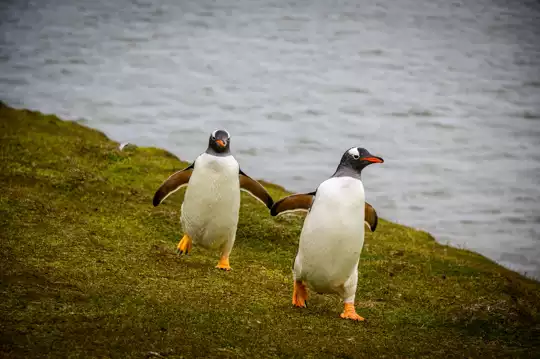
Bleaker Island was a working sheep farm for generations, and it still carries about 1,000 sheep, but most visitors now come for the penguins, shags and elephant seals instead of wool. It lies in the south-east of the Falkland Islands, a low, narrow strip about 20 km (12 miles) long off the southeast coast of Lafonia, with a handful of residents and a small settlement. Natural beauty is the whole draw: white sand beaches, calm turquoise water on a good day, and colonies close enough to watch without binoculars. Variety is limited, though. There are no shops, no pubs and no crowds, so the vibe is quiet and entirely self-reliant. Expect basic self-catering lodging and flights that cost more than a bus ever would. Staying two nights gives a backpacker the most for the money, since one night feels rushed. Compared with Sea Lion Island, Bleaker is flatter, less polished and gets far fewer visitors.

Discover everything you want to know in the 📖 Falkland Islands Travel Guide.


example page 0 from our offline Travel Guide for Falkland Islands
example page 1 from our offline Travel Guide for Falkland Islands
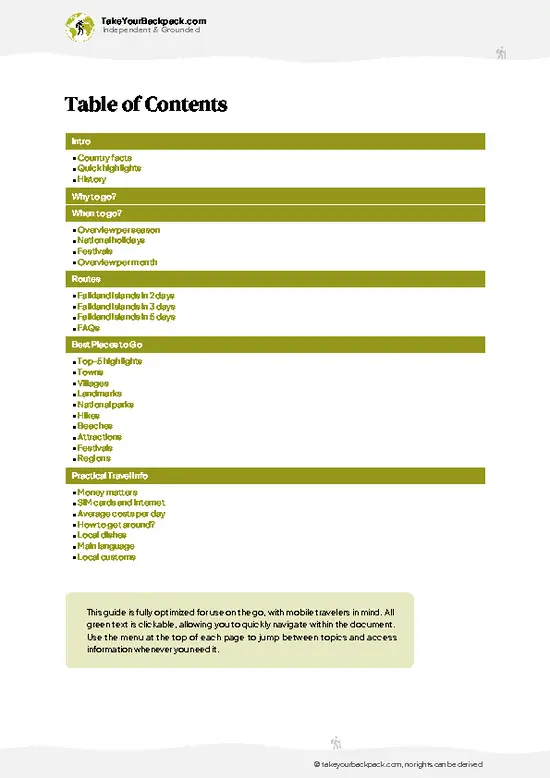
example page 2 from our offline Travel Guide for Falkland Islands
example page 3 from our offline Travel Guide for Falkland Islands
example page 4 from our offline Travel Guide for Falkland Islands
example page 5 from our offline Travel Guide for Falkland Islands
example page 6 from our offline Travel Guide for Falkland Islands
example page 7 from our offline Travel Guide for Falkland Islands
Loading the map 🌍
CLICK TO FILTER
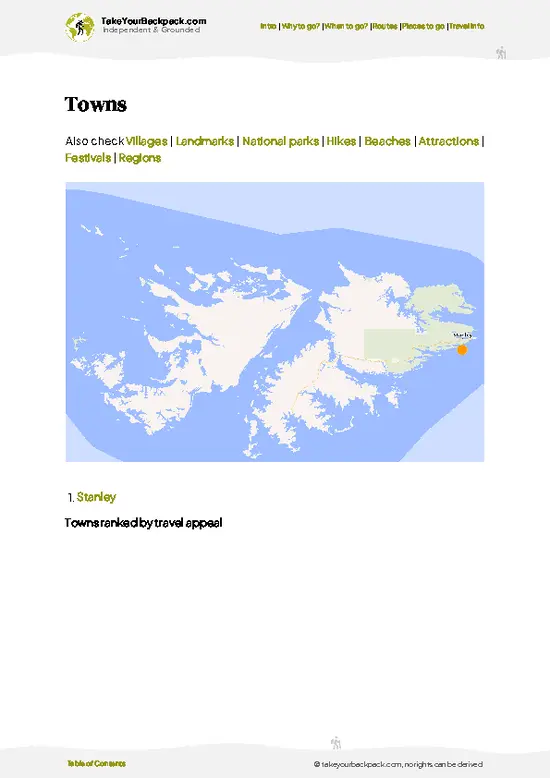
towns
villages
landmarks
national parks
hikes
beaches
attractions
festivals
regions
SHOW COUNTRY’S BESTSHOW ALL

✨ Why go?
Ranked #7 region in Falkland Islands
What sets this place apart

Bleaker Island gives backpackers a compact wildlife circuit that can be walked end to end without a vehicle. The strongest reason is the Gentoo and rockhopper penguin colonies along the southern coast, which sit within a few hours’ walk of the settlement and can be visited at a leisurely pace. Behind the dunes, the long beach at Sandy Bay lets you pair wildlife with long, empty stretches of shoreline, so a day mixes walking, photography and doing very little. Because the island is narrow and flat, you can see most of it on foot and still have time to sit with the animals. Transport is by light aircraft or a boat charter, so you settle in rather than hop around. That slow rhythm, with farm life carrying on around you, is the point.

💡 HighlightsWhat this place is best known for

  1. Penguin Walk and Rockhopper Colony: the southern clifftop path leads to rockhopper and gentoo nesting areas, plus king shags on the ledges nearby.
  2. Sandy Bay: a long white curve of sand, often entirely empty, good for walking at low tide.
  3. Bleaker Island Settlement: a small farm cluster with sheds, a farmhouse and the island’s lodging, giving a glimpse of working life.
  4. Sea lions and elephant seals: southern sea lions are found here in the summer months, and a few elephant seals visit. Keep a respectful distance.
  5. Imperial Shag Colony: a noisy cliff colony with nests built from seaweed and mud, active through the breeding season.
  6. The Dunes at Long Gulch: sandy ridges with oystercatchers and Magellanic penguin burrows, easy to miss without a local pointer.
  7. Cassard Point: named after the French sailing
… read more 👉
  1. Penguin Walk and Rockhopper Colony: the southern clifftop path leads to rockhopper and gentoo nesting areas, plus king shags on the ledges nearby.
  2. Sandy Bay: a long white curve of sand, often entirely empty, good for walking at low tide.
  3. Bleaker Island Settlement: a small farm cluster with sheds, a farmhouse and the island’s lodging, giving a glimpse of working life.
  4. Sea lions and elephant seals: southern sea lions are found here in the summer months, and a few elephant seals visit. Keep a respectful distance.
  5. Imperial Shag Colony: a noisy cliff colony with nests built from seaweed and mud, active through the breeding season.
  6. The Dunes at Long Gulch: sandy ridges with oystercatchers and Magellanic penguin burrows, easy to miss without a local pointer.
  7. Cassard Point: named after the French sailing ship Cassard, wrecked here in 1906, one of many ships lost on this low island.
  8. Freshwater Pond Shore: a still stretch where upland geese, ducks and the odd flightless steamer duck feed.
All of it fits comfortably into two full days of walking, with a third day adding space for slow watching.
Spotted a mistake or missing something? Contact us.

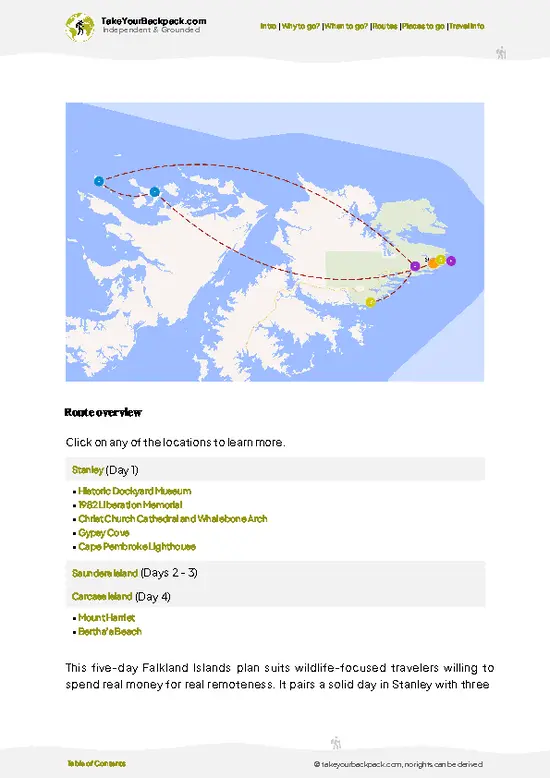
⌛️ 5 days5-day itinerary for Bleaker Island

A walking day on soft sand and clifftop grass sets the pace, because the only way across Bleaker Island is on foot and the flights set your arrival.
Day 1: Settlement: Aircraft land on the grass strip, so you arrive with the sun still high and a pack on your back. Drop your bags at the lodge, meet your hosts and take a short loop to learn the lay of the land. The farm sets your orientation, and a gentle evening walk to the nearest beach shows what is coming.
Day 2: Penguin Coast: Head south to the rockhopper and gentoo colonies. This is the long walking day, so carry water and food, and keep turning back as an option. The coast is flat, which makes distances deceptive, and wind does most of the work against you on the return.
Day 3: Sandy Bay: Spend a slower day on the beaches, watching seals … read more 👉
A walking day on soft sand and clifftop grass sets the pace, because the only way across Bleaker Island is on foot and the flights set your arrival.
Day 1: Settlement: Aircraft land on the grass strip, so you arrive with the sun still high and a pack on your back. Drop your bags at the lodge, meet your hosts and take a short loop to learn the lay of the land. The farm sets your orientation, and a gentle evening walk to the nearest beach shows what is coming.
Day 2: Penguin Coast: Head south to the rockhopper and gentoo colonies. This is the long walking day, so carry water and food, and keep turning back as an option. The coast is flat, which makes distances deceptive, and wind does most of the work against you on the return.
Day 3: Sandy Bay: Spend a slower day on the beaches, watching seals and sitting with the birds. Shorter hops mean you can adjust to tides and weather.
Day 4: North Point: Walk to the north end of the island, part of a National Nature Reserve, for a quiet day of open views and empty shoreline.
Day 5: Departure: Pack early, as the flight sets the schedule. The single best day is Day 2, when the penguin coast delivers the island’s whole argument in one walk.

🌤️ When to go?Weather, crowds, and seasonal trade-offs

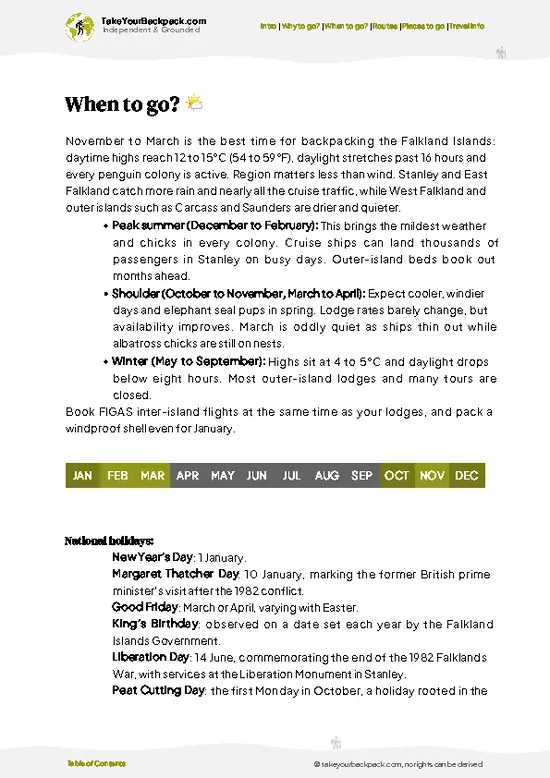
The best time for Bleaker Island is November to February, when penguins and cormorants are on their nests and the light lasts well into the evening.
  • Summer (Nov to Feb): Highs of 12 to 17°C (54 to 63°F), with 16 to 17 hours of daylight. Rockhopper, gentoo and Magellanic penguins are raising chicks, and flights and lodging are at their busiest and priciest.
  • Autumn (Mar to May): Highs of 6 to 11°C (43 to 52°F). Penguins molt and leave in April, crowds thin, and elephant seals haul out along the beaches.
  • Winter (Jun to Aug): Highs of 2 to 6°C (36 to 43°F), with about 8 hours of light. Frost and snow showers are common, the island is very quiet, and most visitors are gone.
  • Spring (Sep to Oct): Highs of 5 to 10°C (41 to 50°F). Birds return from late September, and wind is at its strongest.
Book flights … read more 👉
The best time for Bleaker Island is November to February, when penguins and cormorants are on their nests and the light lasts well into the evening.
  • Summer (Nov to Feb): Highs of 12 to 17°C (54 to 63°F), with 16 to 17 hours of daylight. Rockhopper, gentoo and Magellanic penguins are raising chicks, and flights and lodging are at their busiest and priciest.
  • Autumn (Mar to May): Highs of 6 to 11°C (43 to 52°F). Penguins molt and leave in April, crowds thin, and elephant seals haul out along the beaches.
  • Winter (Jun to Aug): Highs of 2 to 6°C (36 to 43°F), with about 8 hours of light. Frost and snow showers are common, the island is very quiet, and most visitors are gone.
  • Spring (Sep to Oct): Highs of 5 to 10°C (41 to 50°F). Birds return from late September, and wind is at its strongest.
Book flights and the island lodge several months ahead for December and January, since the planes are small.


source: climatestotravel.comJANJanuary: excellent for travelingFEBFebruary: excellent for travelingMARMarch: highly recommended for travelingAPRApril: fair for travelingMAYMay: below average for travelingJUNJune: below average for travelingJULJuly: below average for travelingAUGAugust: below average for travelingSEPSeptember: fair for travelingOCTOctober: good for travelingNOVNovember: highly recommended for travelingDECDecember: excellent for traveling
falkland-islands-region-bleaker-island
© Google |

✈️ The backpacker research shortcutFalkland Islands Travel Guide

An offline-friendly backpacking guide with optimized travel routes, ranked highlights, transport advice, and the best areas to stay.
example page 0 from our offline Travel Guide for Falkland Islands
example page 1 from our offline Travel Guide for Falkland Islands
example page 2 from our offline Travel Guide for Falkland Islands
example page 3 from our offline Travel Guide for Falkland Islands
example page 4 from our offline Travel Guide for Falkland Islands
example page 5 from our offline Travel Guide for Falkland Islands
example page 6 from our offline Travel Guide for Falkland Islands
example page 7 from our offline Travel Guide for Falkland Islands
The digital guide (108 pages) contains:
✅ 25 highlights, ranked by travel appeal
✅ Optimized 2, 3 & 5-day travel routes
✅ Cities, national parks, landmarks, beaches
✅ How to get around
✅ Offline-friendly for travel without Wi-Fi
👉 Click to see all 30+ guide features

📅 Plan smarter in minutes, not weeks
✅ Month by month travel advice
✅ Festivals & national holidays
✅ Budget expectations

🗺️ Go to the right places, skip the overrated ones
✅ Honest pros & cons of destinations
✅ Top hikes, parks & viewpoints
✅ Lesser-known places most travelers miss
✅ Clear “worth it vs skip it” guidance

🛏️ Travel smoothly without rookie mistakes
✅ Best areas to stay
✅ Transport systems explained simply
✅ Common scams & safety advice
✅ SIM cards, money & practical tips

🌍 Understand the country, not just visit it
✅ Culture & traditions
✅ Local customs
✅ Festivals worth planning around
✅ Traveler-friendly historical context
✅ Insights that make places more meaningful

📱 Built for real travel conditions
✅ Fully downloadable PDF
✅ Works completely offline
✅ Optimized for phone use
✅ Useful in remote areas & buses
✅ Everything in one place
Stop searching, start planning
Get instant access to your full guide. 30‑day money-back guarantee.
+ Add another guide for just

By proceeding you agree to our terms.
Sent to your inbox immediately after payment • 100% Secure Checkout
Best Backpacking Travel Advisor 2025 tourism awardBest Backpacking
Travel Advisor
2025
What others say about Take Your Backpack Guides:
⭐⭐⭐⭐⭐
Fantastic, amazing amount of information!
⭐⭐⭐⭐⭐
My goodness this is amazing, it's what I've been looking for hats off too you!
⭐⭐⭐⭐⭐
I think this is absolutely BRILLIANT
⭐⭐⭐⭐
Very complete and informative. It's still missing places, but I gotta to commend you
⭐⭐⭐⭐⭐
This is truly amazing, thank you, can't wait to explore it with my kids!
⭐⭐⭐⭐⭐
Awesome resource, thank you!
⭐⭐⭐⭐⭐
This is amazing! Can't wait to explore the ones I haven't seen
⭐⭐⭐⭐
I love this! Well done, great idea.
⭐⭐⭐⭐⭐
Thanks for taking the time to make this gem!
⭐⭐⭐⭐⭐
This might be the best website I've ever seen.
⭐⭐⭐⭐⭐
Congratulations, and thank you so much for your work; it's incredibly valuable.
⭐⭐⭐⭐
In all seriousness I think you did a great job pointing out the important spots
⭐⭐⭐⭐⭐
10/10 very good
⭐⭐⭐⭐⭐
As someone who's only just starting to visit regularly this is awesome, thank you.
⭐⭐⭐⭐
Thank you very much! I'm going to visit my dad, it's going to be very useful!
⭐⭐⭐⭐⭐
This is really cool! We'll be travelling for the first time and this definitely come in handy.
⭐⭐⭐⭐⭐
You are now our minister of culture, congratulations 👨‍💼
⭐⭐⭐⭐⭐
Just wanted to tell you that this is a pearl! Going to follow your recommendations.
⭐⭐⭐⭐⭐
This is so cool. I'll definitely be using the resource for my travels soon.
⭐⭐⭐⭐⭐
This is very impressive! Good work.
⭐⭐⭐⭐⭐
This is an amazing and informative site. Very well done!

🛏️ Where to stay?Choosing the right base

Stay in the Bleaker Island settlement, because it is the only place on the island with beds. A single lodge and self-catering cottages sit near the airstrip, and they cost roughly US$80 to 160 per person per night, depending on whether meals are included. Everything else is open sheep farmland, so there is no real choice of area.
The settlement works well as a base because the walks begin at the door. Within an hour on foot you can reach the gentoo colonies and beaches on the east side, and the rockhopper and cormorant areas lie in the south. Evenings are quiet. Expect to share meals and stories … read more 👉
Stay in the Bleaker Island settlement, because it is the only place on the island with beds. A single lodge and self-catering cottages sit near the airstrip, and they cost roughly US$80 to 160 per person per night, depending on whether meals are included. Everything else is open sheep farmland, so there is no real choice of area.
The settlement works well as a base because the walks begin at the door. Within an hour on foot you can reach the gentoo colonies and beaches on the east side, and the rockhopper and cormorant areas lie in the south. Evenings are quiet. Expect to share meals and stories with a handful of other guests, often birders and photographers, rather than find a hostel crowd.
If you want more nightlife or cheaper beds, base yourself in Stanley, the main town and the departure point for flights. It has pubs, guesthouses and a few hostel-style rooms, and it is easy to meet other travelers there before or after the island.

🚌 Getting aroundHow to get from A to B

Getting to Bleaker Island costs roughly US$120 to 170 each way on a small Falkland Islands Government Air Service plane from Stanley, and you pay by card or bank transfer when booking, with local pounds accepted on the ground. Once there, you walk. The island is about 20 kilometers (12 miles) long and narrow, with a single settlement, so most visitors stay close to the lodge and the tracks that run between the beaches and colonies. Flights are dependable but depend on wind and cloud, so a delay of a few hours is normal.
  • Island flight from Stanley: The flight takes about 30 to 40 minutes and lands on the grass airstrip near the settlement. It costs the most of any option, but it saves a long journey over water and gives you a good view of the sound. For a backpacker this is the only realistic
… read more 👉
Getting to Bleaker Island costs roughly US$120 to 170 each way on a small Falkland Islands Government Air Service plane from Stanley, and you pay by card or bank transfer when booking, with local pounds accepted on the ground. Once there, you walk. The island is about 20 kilometers (12 miles) long and narrow, with a single settlement, so most visitors stay close to the lodge and the tracks that run between the beaches and colonies. Flights are dependable but depend on wind and cloud, so a delay of a few hours is normal.
  • Island flight from Stanley: The flight takes about 30 to 40 minutes and lands on the grass airstrip near the settlement. It costs the most of any option, but it saves a long journey over water and gives you a good view of the sound. For a backpacker this is the only realistic way in, and the fare is the main cost of the trip.
  • Walking: Free, and the most useful way to see the island. The beaches, the penguin colonies and North Point are reachable in half a day to a full day on foot, across open ground with no shade. Boots and waterproofs matter more than any ticket.
  • Lodge or farm vehicle: The owners sometimes run guests between the airstrip, the settlement and farther points, usually for a modest fee or included in a package. It saves time and tired legs, though schedules are informal and arranged in advance.
  • Private charter flight: A charter costs far more than the scheduled seat and makes sense only for groups splitting the cost. It gives flexibility with timing, but offers no extra value for a solo traveler on a budget.
Book the return seat when you book the outbound one, and carry food and water for long walks, since nothing is sold beyond the settlement.

🍲 FoodLocal Cuisine & Drinks

Food on Bleaker Island is farm food, and it is good. Lamb and mutton from the island’s own sheep are the staple, roasted until the edges crisp and served with mashed potatoes and fresh vegetables from the settlement garden. Calafate berries sometimes turn up in jams and puddings, and homemade bread and cakes arrive with every pot of tea.
There are no cafés, markets or shops here. Meals are eaten at the lodge or cooked in the self-catering cottages, so you bring groceries from Stanley, where supermarkets and bakeries stock everything you need. Fresh produce and eggs are limited, so buy extras and pack them in your luggage allowance.
Dining is simple and communal. Guests often sit together at one table, and people tend to keep to set mealtimes, so tell the hosts early about dietary needs. Smoko, … read more 👉
Food on Bleaker Island is farm food, and it is good. Lamb and mutton from the island’s own sheep are the staple, roasted until the edges crisp and served with mashed potatoes and fresh vegetables from the settlement garden. Calafate berries sometimes turn up in jams and puddings, and homemade bread and cakes arrive with every pot of tea.
There are no cafés, markets or shops here. Meals are eaten at the lodge or cooked in the self-catering cottages, so you bring groceries from Stanley, where supermarkets and bakeries stock everything you need. Fresh produce and eggs are limited, so buy extras and pack them in your luggage allowance.
Dining is simple and communal. Guests often sit together at one table, and people tend to keep to set mealtimes, so tell the hosts early about dietary needs. Smoko, the mid-morning tea and cake break, is a local custom that is hard to refuse. Beer and spirits are usually available, but bring your own favorites if you have particular tastes. Tap water is safe to drink.

FAQFrequently asked questions about Bleaker Island

Two nights is enough for Bleaker Island, and three suits keen photographers. That gives you one full day for North Point and the penguin colonies, plus a second for the beaches and the settlement area. Flights from Stanley take about 30 to 40 minutes, so a day trip is possible but rushed.
You walk. Bleaker Island has no public transport, taxis or rental cars for visitors, and the island is about 20 kilometers (12 miles) long. You reach it by small plane from Stanley for roughly US$120 to 170 each way, and the lodge may occasionally drive guests between the airstrip and farther points.
Bleaker Island is known for its wildlife, especially rockhopper, gentoo and Magellanic penguins, and imperial cormorants that you can watch up close in summer. It also has long white beaches and a quiet sheep-farming settlement. Most visitors come between November and February, when chicks are on the nests and daylight lasts up to 17 hours.
⚠️ Things can change over time, so always validate details locally before you go.

Other Falkland Islander regions near Bleaker Island

Explore more nearby:

  • Sea Lion Island—Orca lookouts, elephant seal shores, one lodge, grass airstrip| 30 km away
  • East Falkland—Stanley base, Volunteer Point kings, gravel tracks, 1982 battlefields| 88 km away
  • West Falkland—Island-hopping lodges, Fox Bay, Port Howard, albatross cliffs| 99 km away

💡 Not sure where to go next?
Create a personalized itinerary for Falkland Islands including Bleaker Island and the places that fit your trip.

Generate my itinerary

👉 Discover all regions

Or checkout all Falkland Islands has to offer (think cities, towns, villages, national parks, hikes, beaches, festivals)
Country photo of Falkland Islands

We 💚 feedbackFinal thoughts on visiting Bleaker Island

Bleaker Island is best in the warm months of November to February, when chicks are on the beaches, and in the early morning, when the penguins are active and the wind is lower. Bring a windproof shell and waterproof boots, and stay a second night so you are not packing up just as the light settles.

✍️ Help improve this page!
The information on this page is based on in-depth research, insights shared by experienced travelers, and feedback from the local travel community in Falkland Islands. While every effort is made to keep the information accurate and current, conditions can change — so if you spot anything incorrect or outdated, please get in touch.


🙋‍♂️ Give feedback

👋 Meet the founderWho’s Behind Take Your Backpack?

Johan, backpacker and founder of TakeYourBackpackHi, I’m Johan (Netherlands 🇳🇱), the creator of TakeYourBackpack. Over the past 3 decades, I’ve backpacked through 90+ countries across six continents, gaining extensive experience with independent travel, long-term trips, and overland routes.

This site is built on a combination of firsthand travel experience and carefully curated insights from other backpackers. Many guides are based on places I’ve personally visited, while others bring together tips, observations, and practical advice shared by trusted travelers I’ve met along the way.

The goal is to provide realistic, experience-driven guidance — not generic itineraries — so you can explore destinations with better context, clearer expectations, and more confidence.