×

Falkland Islands🇫🇰 | regionsWest FalklandIsland-hopping lodges, Fox Bay, Port Howard, albatross cliffs | things to do and best time to go

Explore Weddell IslandExplore Stanley

Backpacking in West Falkland
🌟 Highlightregion ranked #2
By Johan Kruseman 🇳🇱 | Updated October 22, 2026

The Land Rover drops off the last gravel track and the wind carries the smell of peat smoke and wet sheep, while a Commerson’s dolphin rolls through the surf below the cliffs. West Falkland lies in the west of the Falkland Islands, across Falkland Sound from the capital, Stanley, and its settlements are mostly farms with a handful of houses each. Roads are mostly gravel or open camp tracks, so you get empty horizons and the sound of your own boots. Penguins, albatross and sea lions share the coast at Saunders, Carcass and Pebble, which are all reached by small planes or long drives. Pubs and cafés barely exist outside Port Howard and Fox Bay, so social life means farm kitchens and visitor lodges. Nothing here is built for crowds, which is its charm and its limit. Before going, book flights and lodging early, since seats and beds are few.

Discover everything you want to know in the 📖 Falkland Islands Travel Guide.


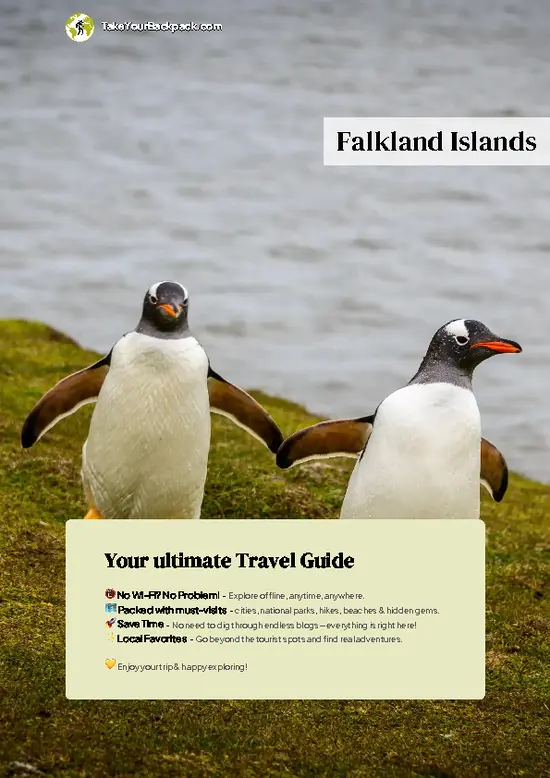
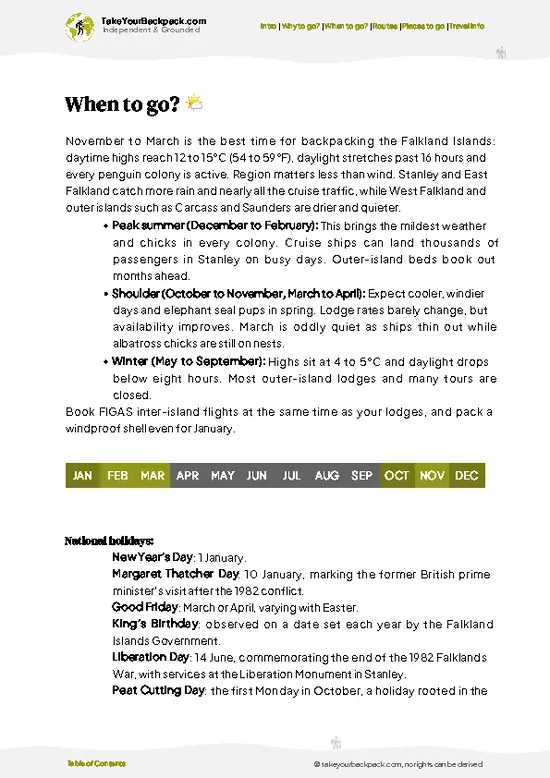
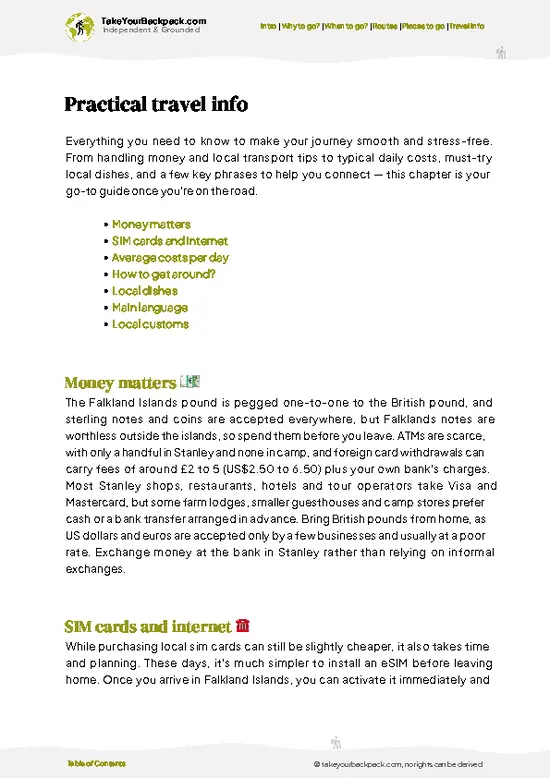
example page 0 from our offline Travel Guide for Falkland Islands
example page 1 from our offline Travel Guide for Falkland Islands
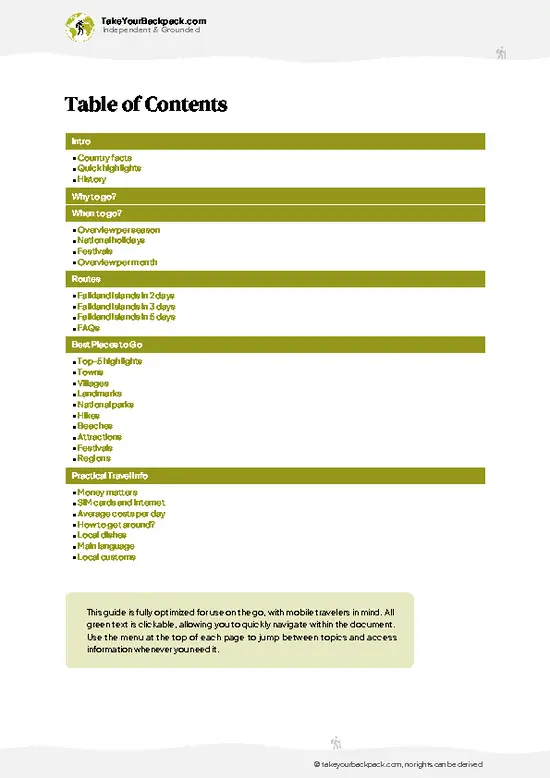
example page 2 from our offline Travel Guide for Falkland Islands
example page 3 from our offline Travel Guide for Falkland Islands
example page 4 from our offline Travel Guide for Falkland Islands
example page 5 from our offline Travel Guide for Falkland Islands
example page 6 from our offline Travel Guide for Falkland Islands
example page 7 from our offline Travel Guide for Falkland Islands
Loading the map 🌍
CLICK TO FILTER
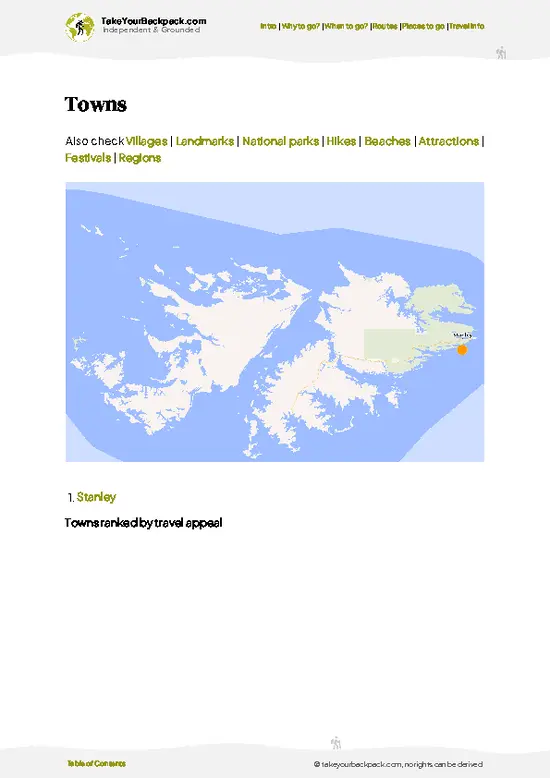
towns
villages
landmarks
national parks
hikes
beaches
attractions
festivals
regions
SHOW COUNTRY’S BESTSHOW ALL

✨ Why go?
Ranked #2 region in Falkland Islands
Why visitors keep coming back

West Falkland rewards backpackers who want wildlife without a queue. At Saunders Island you can stand a few paces from rockhopper, gentoo, king and Magellanic penguins on the same walk, and the Neck has an albatross colony close enough to hear the chicks. Few places let you see so much from one base. Settlements are small and farm-run, so you eat at the family table and hear how the camp works, from sheep shearing to peat cutting. That kind of contact is hard to find on larger, busier islands. Distances are long, but the internal flights are flexible and the tracks are good for self-drive. A Falkland Islands Government Air Service hop saves a full day of bumpy driving, and it gives you a view of the whole archipelago. Slow travel suits the place, because weather decides plans as much as any … read more 👉
West Falkland rewards backpackers who want wildlife without a queue. At Saunders Island you can stand a few paces from rockhopper, gentoo, king and Magellanic penguins on the same walk, and the Neck has an albatross colony close enough to hear the chicks. Few places let you see so much from one base. Settlements are small and farm-run, so you eat at the family table and hear how the camp works, from sheep shearing to peat cutting. That kind of contact is hard to find on larger, busier islands. Distances are long, but the internal flights are flexible and the tracks are good for self-drive. A Falkland Islands Government Air Service hop saves a full day of bumpy driving, and it gives you a view of the whole archipelago. Slow travel suits the place, because weather decides plans as much as any timetable. Give each stop two nights and the coast will do the rest.

💡 HighlightsWhat this place is best known for

  1. Saunders Island, The Neck: a narrow isthmus where king, gentoo, rockhopper and Magellanic penguins share beaches with black-browed albatross on the cliffs. It is the island’s best-known wildlife walk, and the entry is a lodge booking.
  2. Carcass Island: a quiet, tidy island with white sand beaches and Magellanic penguins, with tea and cake served at the settlement. Walkers get easy trails and many small birds.
  3. Pebble Island: long beaches, including the 6.4 km (4 mile) Elephant Beach, and a big rockhopper colony. The island is reached by air, and the lodge arranges tours.
  4. Keppel Island: a quiet island with sheep farms and history tied to the early missionary station of the Patagonian Mission. It suits travelers who like wandering ruins.
  5. Port Howard: a settlement with a small museum of local life and
… read more 👉
  1. Saunders Island, The Neck: a narrow isthmus where king, gentoo, rockhopper and Magellanic penguins share beaches with black-browed albatross on the cliffs. It is the island’s best-known wildlife walk, and the entry is a lodge booking.
  2. Carcass Island: a quiet, tidy island with white sand beaches and Magellanic penguins, with tea and cake served at the settlement. Walkers get easy trails and many small birds.
  3. Pebble Island: long beaches, including the 6.4 km (4 mile) Elephant Beach, and a big rockhopper colony. The island is reached by air, and the lodge arranges tours.
  4. Keppel Island: a quiet island with sheep farms and history tied to the early missionary station of the Patagonian Mission. It suits travelers who like wandering ruins.
  5. Port Howard: a settlement with a small museum of local life and the nearby Mount Maria trail. Expect wide views and a pub style lounge at the lodge.
  6. Hill Cove: a farm settlement on the north coast with a tree plantation, a rare sight on these islands. It is a pleasant stop on a drive.
  7. Fox Bay: the largest village on West Falkland, with a harbor, old wooden houses and a small museum. It is a practical base for local trips.
  8. Chartres: a quiet settlement known for good trout fishing in the river and for sweeping camp views. It is lesser known and mostly visited by anglers.
  9. Dunnose Head: a remote farm and headland on the west coast with sheep, rugged cliffs and rockhopper colonies. Few outsiders ever walk here.
  10. West Point Island: home to the Devil’s Nose and the Albatross Colony, where black-browed albatross and rockhoppers nest together on one cliff. The farm family serves tea at the house.
Allow about a week to see most of these, since flights and weather shape each day.
Spotted a mistake or missing something? Contact us.

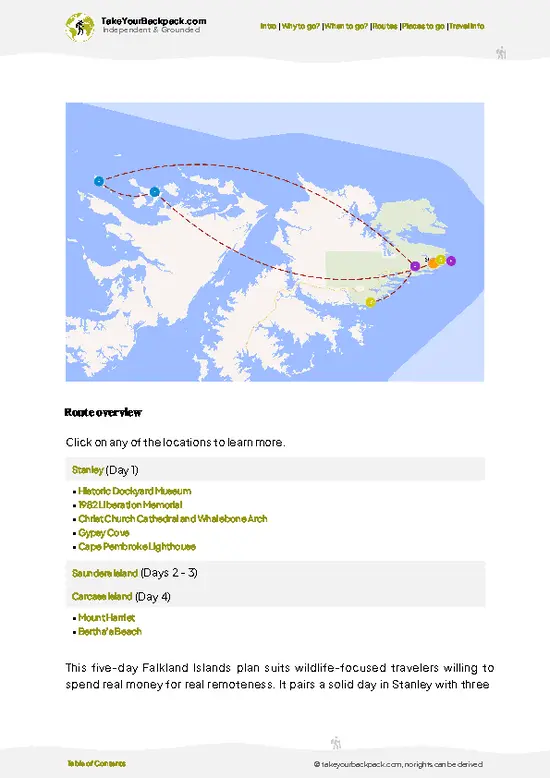
⌛️ 5 daysA smart one-week plan

Day 1: Fox Bay: Arrive by plane or ferry and settle in. Fox Bay is the largest village on West Falkland, so it has shops and a handy base to plan the rest of the days. Walk the shore road, look at the old wooden houses and pick up supplies, because stores are thin elsewhere. The local air service shapes everything after this, so confirm your flights now.
Day 2: Port Howard: Move north by air or road to Port Howard. The settlement sits below Mount Maria and has a small museum on farm life. Spend the afternoon on the hill, where views run across Falkland Sound, then eat at the lodge, where farm talk is part of dinner.
Day 3: Saunders Island: Fly to Saunders for two nights, since weather often delays small planes. Walk the Neck early, when penguins are busiest on the beach and the albatross colony … read more 👉
Day 1: Fox Bay: Arrive by plane or ferry and settle in. Fox Bay is the largest village on West Falkland, so it has shops and a handy base to plan the rest of the days. Walk the shore road, look at the old wooden houses and pick up supplies, because stores are thin elsewhere. The local air service shapes everything after this, so confirm your flights now.
Day 2: Port Howard: Move north by air or road to Port Howard. The settlement sits below Mount Maria and has a small museum on farm life. Spend the afternoon on the hill, where views run across Falkland Sound, then eat at the lodge, where farm talk is part of dinner.
Day 3: Saunders Island: Fly to Saunders for two nights, since weather often delays small planes. Walk the Neck early, when penguins are busiest on the beach and the albatross colony is calm. This day makes the whole trip worthwhile. Rockhoppers, gentoos, kings and Magellanics sit within one short hike, and the cliffs stay quiet.
Day 4: Carcass Island: Take the short hop to Carcass, a gentle island where you can walk at ease. Beaches are white, small birds are everywhere and the settlement serves tea and cake. A detour to West Point Island adds the Devil’s Nose albatross colony, and the farm family hosts visitors for tea, so it fits within the same flight loop.
Day 5: Hill Cove: Return to the mainland and finish at Hill Cove, where the plantation and the quiet farm make a soft landing. Spend the morning walking the coast, then connect to Stanley by road or air. Keep a buffer day if the wind is up, as flights run on weather and not on schedules.

🌤️ When to go?Seasonal considerations and timing

November to March is the best window for West Falkland, with the longest daylight and the easiest flying and hiking conditions.
  • Summer (Dec to Feb): Highs of 12 to 16°C (54 to 61°F), lows around 5°C (41°F), and daylight stretching to roughly 16 hours. Penguin chicks, sea lion pups and the full set of settlement farm stays are all in play. Flights and lodges fill early and prices peak.
  • Autumn (Mar to May): Temperatures slide to 6 to 11°C (43 to 52°F). Crowds thin, the light turns soft, and wind picks up. Some self-catering cottages drop their rates.
  • Winter (Jun to Aug): Highs of 3 to 6°C (37 to 43°F), nights near freezing, light snow on the hills and only about 7 to 8 hours of daylight. Quiet and cheapest, though fewer wildlife species remain.
  • Spring (Sep to Nov): Cool at 5 to 10°C (41 to 50°F),
… read more 👉
November to March is the best window for West Falkland, with the longest daylight and the easiest flying and hiking conditions.
  • Summer (Dec to Feb): Highs of 12 to 16°C (54 to 61°F), lows around 5°C (41°F), and daylight stretching to roughly 16 hours. Penguin chicks, sea lion pups and the full set of settlement farm stays are all in play. Flights and lodges fill early and prices peak.
  • Autumn (Mar to May): Temperatures slide to 6 to 11°C (43 to 52°F). Crowds thin, the light turns soft, and wind picks up. Some self-catering cottages drop their rates.
  • Winter (Jun to Aug): Highs of 3 to 6°C (37 to 43°F), nights near freezing, light snow on the hills and only about 7 to 8 hours of daylight. Quiet and cheapest, though fewer wildlife species remain.
  • Spring (Sep to Nov): Cool at 5 to 10°C (41 to 50°F), with birds returning to breed and daylight lengthening fast. Lodging is easy to find.
Book flights and accommodation a few months ahead for December and January, since seats on the small island planes are limited.


source: climatestotravel.comJANJanuary: excellent for travelingFEBFebruary: excellent for travelingMARMarch: highly recommended for travelingAPRApril: good for travelingMAYMay: fair for travelingJUNJune: below average for travelingJULJuly: below average for travelingAUGAugust: below average for travelingSEPSeptember: fair for travelingOCTOctober: good for travelingNOVNovember: highly recommended for travelingDECDecember: excellent for traveling
when-to-go

✈️ The backpacker research shortcutFalkland Islands Travel Guide

An offline-friendly backpacking guide with optimized travel routes, ranked highlights, transport advice, and the best areas to stay.
example page 0 from our offline Travel Guide for Falkland Islands
example page 1 from our offline Travel Guide for Falkland Islands
example page 2 from our offline Travel Guide for Falkland Islands
example page 3 from our offline Travel Guide for Falkland Islands
example page 4 from our offline Travel Guide for Falkland Islands
example page 5 from our offline Travel Guide for Falkland Islands
example page 6 from our offline Travel Guide for Falkland Islands
example page 7 from our offline Travel Guide for Falkland Islands
The digital guide (108 pages) contains:
✅ 25 highlights, ranked by travel appeal
✅ Optimized 2, 3 & 5-day travel routes
✅ Cities, national parks, landmarks, beaches
✅ How to get around
✅ Offline-friendly for travel without Wi-Fi
👉 Click to see all 30+ guide features

📅 Plan smarter in minutes, not weeks
✅ Month by month travel advice
✅ Festivals & national holidays
✅ Budget expectations

🗺️ Go to the right places, skip the overrated ones
✅ Honest pros & cons of destinations
✅ Top hikes, parks & viewpoints
✅ Lesser-known places most travelers miss
✅ Clear “worth it vs skip it” guidance

🛏️ Travel smoothly without rookie mistakes
✅ Best areas to stay
✅ Transport systems explained simply
✅ Common scams & safety advice
✅ SIM cards, money & practical tips

🌍 Understand the country, not just visit it
✅ Culture & traditions
✅ Local customs
✅ Festivals worth planning around
✅ Traveler-friendly historical context
✅ Insights that make places more meaningful

📱 Built for real travel conditions
✅ Fully downloadable PDF
✅ Works completely offline
✅ Optimized for phone use
✅ Useful in remote areas & buses
✅ Everything in one place
Stop searching, start planning
Get instant access to your full guide. 30‑day money-back guarantee.
+ Add another guide for just

By proceeding you agree to our terms.
Sent to your inbox immediately after payment • 100% Secure Checkout
Best Backpacking Travel Advisor 2025 tourism awardBest Backpacking
Travel Advisor
2025
What others say about Take Your Backpack Guides:
⭐⭐⭐⭐⭐
Fantastic, amazing amount of information!
⭐⭐⭐⭐⭐
My goodness this is amazing, it's what I've been looking for hats off too you!
⭐⭐⭐⭐⭐
I think this is absolutely BRILLIANT
⭐⭐⭐⭐
Very complete and informative. It's still missing places, but I gotta to commend you
⭐⭐⭐⭐⭐
This is truly amazing, thank you, can't wait to explore it with my kids!
⭐⭐⭐⭐⭐
Awesome resource, thank you!
⭐⭐⭐⭐⭐
This is amazing! Can't wait to explore the ones I haven't seen
⭐⭐⭐⭐
I love this! Well done, great idea.
⭐⭐⭐⭐⭐
Thanks for taking the time to make this gem!
⭐⭐⭐⭐⭐
This might be the best website I've ever seen.
⭐⭐⭐⭐⭐
Congratulations, and thank you so much for your work; it's incredibly valuable.
⭐⭐⭐⭐
In all seriousness I think you did a great job pointing out the important spots
⭐⭐⭐⭐⭐
10/10 very good
⭐⭐⭐⭐⭐
As someone who's only just starting to visit regularly this is awesome, thank you.
⭐⭐⭐⭐
Thank you very much! I'm going to visit my dad, it's going to be very useful!
⭐⭐⭐⭐⭐
This is really cool! We'll be travelling for the first time and this definitely come in handy.
⭐⭐⭐⭐⭐
You are now our minister of culture, congratulations 👨‍💼
⭐⭐⭐⭐⭐
Just wanted to tell you that this is a pearl! Going to follow your recommendations.
⭐⭐⭐⭐⭐
This is so cool. I'll definitely be using the resource for my travels soon.
⭐⭐⭐⭐⭐
This is very impressive! Good work.
⭐⭐⭐⭐⭐
This is an amazing and informative site. Very well done!

🛏️ Where to stay?Where staying makes the most sense

Port Howard is the best base for backpackers on West Falkland, with Fox Bay and Port Stephens as quieter alternatives. West Falkland has no hostel scene, so social life happens in settlements where everyone knows everyone.
Port Howard, on the Falkland Sound, has a lodge-style setup, a small shop and a settlement social room where guests and farm workers mix. It sits below Mount Maria and gives access to walks, rock runs and wartime history. Budget on roughly US$70 to 150 a night with meals often included.
Fox Bay, split into East and West, is the closest thing to a community hub, with a shop, a … read more 👉
Port Howard is the best base for backpackers on West Falkland, with Fox Bay and Port Stephens as quieter alternatives. West Falkland has no hostel scene, so social life happens in settlements where everyone knows everyone.
Port Howard, on the Falkland Sound, has a lodge-style setup, a small shop and a settlement social room where guests and farm workers mix. It sits below Mount Maria and gives access to walks, rock runs and wartime history. Budget on roughly US$70 to 150 a night with meals often included.
Fox Bay, split into East and West, is the closest thing to a community hub, with a shop, a pub-style social club and self-catering houses for about US$40 to 90 a night. It is easy to meet locals here, and flights land close by.
Port Stephens in the south-west is a remote sheep station with a settlement lodge and self-catering cottages, and Carcass Island, a short flight and boat hop away, offers more of the same with a very small number of guests, penguins and tea served in the kitchen.
Camping is possible with landowner permission and costs little or nothing, though bring a sturdy windproof tent. All areas are very safe. The company is friendly but low in numbers, so solo travelers should plan to chat with hosts over meals.

🚌 Getting aroundHow to get around West Falkland

The settlements of West Falkland are a few houses, a shop and a jetty, so walking covers each one in minutes, but between them the land is open moorland with no sealed roads to speak of. Walking stops making sense past the edge of the settlement, where the gravel tracks run for tens of kilometers across peat and stone runs. Most backpackers combine a short flight, a hired or shared vehicle and the occasional boat. Weather decides everything, so schedules bend, and locals treat that as normal.
  • Falkland Islands Government Air Service (FIGAS): Small Islander planes link Stanley with settlements such as Port Howard, Fox Bay and Pebble Island, roughly US$80 to 160 one way depending on the route. Flights take 20 to 45 minutes and are booked the day before, with seat times given the evening prior.
… read more 👉
The settlements of West Falkland are a few houses, a shop and a jetty, so walking covers each one in minutes, but between them the land is open moorland with no sealed roads to speak of. Walking stops making sense past the edge of the settlement, where the gravel tracks run for tens of kilometers across peat and stone runs. Most backpackers combine a short flight, a hired or shared vehicle and the occasional boat. Weather decides everything, so schedules bend, and locals treat that as normal.
  • Falkland Islands Government Air Service (FIGAS): Small Islander planes link Stanley with settlements such as Port Howard, Fox Bay and Pebble Island, roughly US$80 to 160 one way depending on the route. Flights take 20 to 45 minutes and are booked the day before, with seat times given the evening prior. You see the coastline, kelp beds and whole farms from low altitude, which is worth the fare alone.
  • Rental 4x4: Hire in Stanley runs around US$100 to 150 a day, and a ferry or flight is needed to bring it west. Tracks are rough gravel and peat, and speeds rarely pass 40 km/h (25 mph). The reward is reaching empty beaches and penguin colonies on your own schedule.
  • Ferry from East Falkland: The small vehicle ferry Concordia Bay crosses Falkland Sound between New Haven on East Falkland and Port Howard. Expect about 1.5 to 2 hours and fares in the tens of dollars, with limited sailings. You arrive at the water’s edge with seabirds trailing the boat.
  • Farm transfers and guided tours: Lodges and settlement hosts run Land Rover transfers and day trips, often US$40 to 120 per person. Drivers know which tracks flood and where the gentoos nest, so you reach the right beach instead of the nearest one.
  • Hiking: Coastal and ridge walks, such as around Port Stephens or Mount Adam, are free and open to anyone willing to ask the landowner first. Carry waterproofs and a map, since there are few signposts. You get quiet, wind and long views over the sound.
Ask your host to phone ahead to the next settlement, because that call arranges transfers, gate permissions and track conditions more reliably than any website.

🍲 FoodLocal Flavors for Backpackers

Lamb and mutton are the backbone of West Falkland cooking, raised on the same farms where you sleep. Expect roast mutton with gravy, lamb stew and slow-cooked joints, rich with the faint grassy smell of peat-fed grazing. Seafood shows up as calamari, mullet and king crab from the surrounding waters, usually fried or grilled with plain lemon.
Baking is a point of pride. Smoko is the mid-morning and mid-afternoon tea break, with warm scones, ginger cake, jam tarts and strong tea or coffee. It is a ritual, so expect to be invited in. Local honey and diddle-dee jam, tart and berry-sharp, are worth buying where they are made.
Eating out means settlement lodges serving set dinners at a shared table, a small shop for tinned goods, bread and fresh basics, and the social club bar for a pint and a plate … read more 👉
Lamb and mutton are the backbone of West Falkland cooking, raised on the same farms where you sleep. Expect roast mutton with gravy, lamb stew and slow-cooked joints, rich with the faint grassy smell of peat-fed grazing. Seafood shows up as calamari, mullet and king crab from the surrounding waters, usually fried or grilled with plain lemon.
Baking is a point of pride. Smoko is the mid-morning and mid-afternoon tea break, with warm scones, ginger cake, jam tarts and strong tea or coffee. It is a ritual, so expect to be invited in. Local honey and diddle-dee jam, tart and berry-sharp, are worth buying where they are made.
Eating out means settlement lodges serving set dinners at a shared table, a small shop for tinned goods, bread and fresh basics, and the social club bar for a pint and a plate of chips. Meals in lodges are around US$20 to 40, and bring your own supplies if self-catering, as shops stock limited items and close early or on Sundays.
Drinks are mostly Falkland beer from the Stanley brewery and imported spirits. Etiquette is relaxed. Take your boots off at the door, say yes to tea, and tell your host in advance about dietary needs, since menus come from what the farm has that week.

FAQTraveler FAQ

Four to six days is enough to see the main parts of West Falkland, with a week better if you want to visit more than one settlement. Port Howard and Fox Bay each deserve a night or two, and Carcass Island or Saunders add another day. Weather delays on the small FIGAS flights mean a spare day in your schedule is wise.
Without a car, you rely on FIGAS flights from Stanley (about US$80 to 160 one way, 20 to 45 minutes), the Falkland Sound ferry to Port Howard (about 1.5 to 2 hours), and transfers arranged by your lodge, typically US$40 to 120 per person. Settlements are walkable on foot, but distances between them are tens of kilometers of rough track. Flights are booked a day ahead through the air service.
West Falkland is known for rugged moorland, remote sheep farms and some of the best wildlife viewing in the archipelago, including gentoo, rockhopper and Magellanic penguins, black-browed albatross and sea lions. Carcass Island, Saunders Island and Port Stephens are popular wildlife stops, and Mount Adam is the high point at about 700 meters. It is also known for its settlement hospitality, with farm stays, smoko tea breaks and very few visitors outside December to February.
⚠️ Things can change over time, so always validate details locally before you go.

Other Falkland Islander regions near West Falkland

Explore more nearby:

  • Saunders Island—The Neck, albatross rookery, Port Egmont ruins, self-catering cottages| 52 km away
  • Weddell Island—Planted tree belts, western rockhoppers, Gull Harbour gentoos, farm tracks| 60 km away
  • Carcass Island—Leopard Beach, tame small birds, settlement garden, Mount Byng| 65 km away

💡 Not sure where to go next?
Create a personalized itinerary for Falkland Islands including West Falkland and the places that fit your trip.

Generate my itinerary

👉 Discover all regions

Or checkout all Falkland Islands has to offer (think cities, towns, villages, national parks, hikes, beaches, festivals)
Country photo of Falkland Islands

We 💚 feedbackKey takeaways before you go

West Falkland suits people who like wildlife, quiet farm kitchens and long, empty walks, and it will bore anyone who needs nightlife. I would book the small plane flights first and pack a waterproof shell and sturdy boots. Stay a night longer than planned, because weather often does the scheduling.

✍️ Help improve this page!
The information on this page is based on in-depth research, insights shared by experienced travelers, and feedback from the local travel community in Falkland Islands. While every effort is made to keep the information accurate and current, conditions can change — so if you spot anything incorrect or outdated, please get in touch.


🙋‍♂️ Give feedback

👋 Meet the founderWho’s Behind Take Your Backpack?

Johan, backpacker and founder of TakeYourBackpackHi, I’m Johan (Netherlands 🇳🇱), the creator of TakeYourBackpack. Over the past 3 decades, I’ve backpacked through 90+ countries across six continents, gaining extensive experience with independent travel, long-term trips, and overland routes.

This site is built on a combination of firsthand travel experience and carefully curated insights from other backpackers. Many guides are based on places I’ve personally visited, while others bring together tips, observations, and practical advice shared by trusted travelers I’ve met along the way.

The goal is to provide realistic, experience-driven guidance — not generic itineraries — so you can explore destinations with better context, clearer expectations, and more confidence.