×

Falkland Islands🇫🇰 | regionsSaunders IslandThe Neck, albatross rookery, Port Egmont ruins, self-catering cottages | things to do and best time to go

Explore Cape PembrokeExplore Bleaker Island

Backpacking in Saunders Island
🏆 Top pickregion ranked #2
By Johan Kruseman 🇳🇱 | Updated October 19, 2026

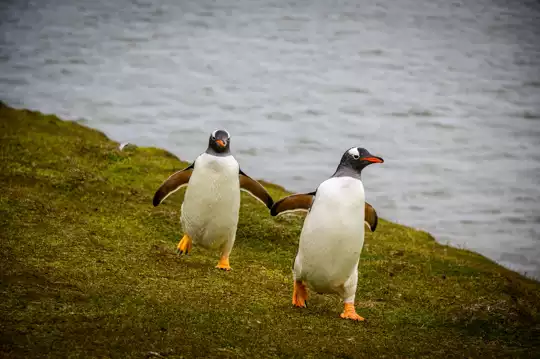
Gentoo, king, rockhopper and Magellanic penguins share one narrow stretch of Saunders Island called The Neck, and black-browed albatrosses nest on the cliffs beside them. What matters just as much, and gets less attention, is that this is a working sheep farm with a handful of self-catering cottages, so you stay among the wildlife and not a day trip away from it. Saunders Island lies off the northwest coast of West Falkland, in the Falkland Islands, a long way west of Stanley. On the ground it is wind, short tussock-edged grass, white sand beaches and Land Rover tracks that give way to open walking. The reward is a colony a few steps away with nobody between you and it. Be aware that the island has no shop, so bring your food and supplies with you before the small plane leaves.

Discover everything you want to know in the 📖 Falkland Islands Travel Guide.


example page 0 from our offline Travel Guide for Falkland Islands
example page 1 from our offline Travel Guide for Falkland Islands
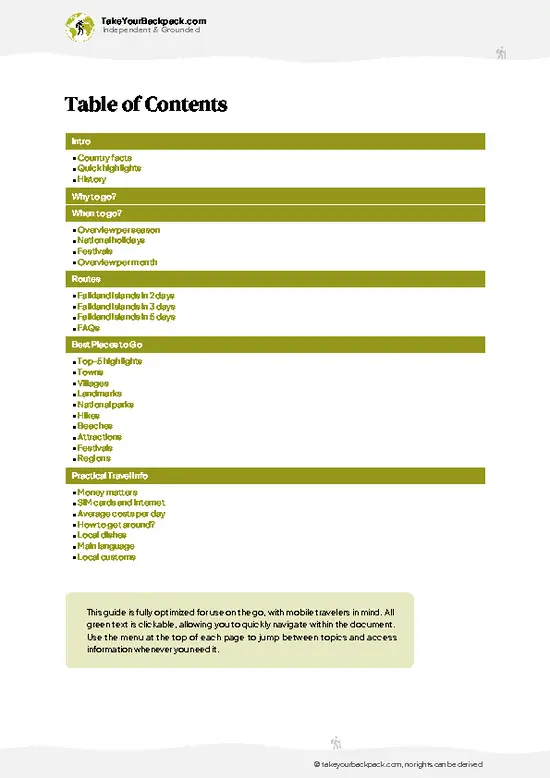
example page 2 from our offline Travel Guide for Falkland Islands
example page 3 from our offline Travel Guide for Falkland Islands
example page 4 from our offline Travel Guide for Falkland Islands
example page 5 from our offline Travel Guide for Falkland Islands
example page 6 from our offline Travel Guide for Falkland Islands
example page 7 from our offline Travel Guide for Falkland Islands
Loading the map 🌍
CLICK TO FILTER
towns
villages
landmarks
national parks
hikes
beaches
attractions
festivals
regions
SHOW COUNTRY’S BESTSHOW ALL

✨ Why go?
Ranked #2 region in Falkland Islands
Why visitors keep coming back

Saunders Island suits backpackers who want wildlife without a tour bus between them and the birds. The first reason is the density: The Neck puts four penguin species and an albatross colony within one day’s walking, so you stay put in one cottage and the animals come to you. Moving on every day is unnecessary here, and the slow rhythm suits the place. The second is the history underfoot. Port Egmont, the first British settlement in the Falklands, sits on the island’s northern shore, and you can walk to its ruins and garden walls past elephant seals and sea lions instead of reading about them in a museum. The third is the walking itself. Mount Richards is a modest summit, but it gives you a clear view across the whole island and the neighboring islands, and the paths are open farmland with … read more 👉
Saunders Island suits backpackers who want wildlife without a tour bus between them and the birds. The first reason is the density: The Neck puts four penguin species and an albatross colony within one day’s walking, so you stay put in one cottage and the animals come to you. Moving on every day is unnecessary here, and the slow rhythm suits the place. The second is the history underfoot. Port Egmont, the first British settlement in the Falklands, sits on the island’s northern shore, and you can walk to its ruins and garden walls past elephant seals and sea lions instead of reading about them in a museum. The third is the walking itself. Mount Richards is a modest summit, but it gives you a clear view across the whole island and the neighboring islands, and the paths are open farmland with no permits and no crowds. Add a farm family who will tell you where the animals are today, and the island makes sense for a long, quiet stay.

💡 HighlightsWhat this place is best known for

  1. The Neck: the narrow isthmus that joins the island’s two halves. Gentoo, king, rockhopper and Magellanic penguins nest within sight of each other, and the beaches on either side are wide and white.
  2. The Rookery: a cliff-top colony where black-browed albatrosses and rockhopper penguins nest together. Sit in the grass and watch the albatrosses glide in on the updraft, close enough to hear their wings.
  3. Mount Richards: at around 458 meters, the island’s high point. The climb is steady rather than steep, and the summit shows the whole island and the coast of West Falkland.
  4. Port Egmont ruins: the remains of the 1760s British outpost, with old foundations and the garden plot still visible in the turf. A short walk beyond the settlement on the northern coast, it sees almost no one.
  5. Saunders Settlement:
… read more 👉
  1. The Neck: the narrow isthmus that joins the island’s two halves. Gentoo, king, rockhopper and Magellanic penguins nest within sight of each other, and the beaches on either side are wide and white.
  2. The Rookery: a cliff-top colony where black-browed albatrosses and rockhopper penguins nest together. Sit in the grass and watch the albatrosses glide in on the updraft, close enough to hear their wings.
  3. Mount Richards: at around 458 meters, the island’s high point. The climb is steady rather than steep, and the summit shows the whole island and the coast of West Falkland.
  4. Port Egmont ruins: the remains of the 1760s British outpost, with old foundations and the garden plot still visible in the turf. A short walk beyond the settlement on the northern coast, it sees almost no one.
  5. Saunders Settlement: the farm buildings, shearing shed and cottages. Sheep work goes on around you, and the farm family are glad to point you toward whichever colony is busiest.
  6. Elephant Point: a rougher stretch of shore where elephant seals haul out. The beach is stony and the seals are huge, so keep your distance and let them be.
  7. The beaches beside The Neck: long, pale sand lines with surf on one side and calmer water on the other. Magellanic penguins burrow in the dunes behind them.
For a first visit, The Neck is the one to spend the most time on, because it puts the penguins, the albatrosses and the beaches into a single walk.
Spotted a mistake or missing something? Contact us.

⌛️ 5 daysHow to make the most of Saunders Island

Day 1: The Neck: Go straight to the isthmus the day you arrive, because the light is long and the colonies are active. The small plane from Stanley sets the pace for the whole stay, so you arrive, settle into the cottage and walk. Sit near the gentoo and king penguins first, then drift toward the beaches. There is no reason to hurry, since the penguins will not leave and the walking is flat.
Day 2: The Rookery: Spend a second day on the cliff-top colony where albatrosses and rockhoppers share the same grass. Morning wind is usually gentler, and you can watch the birds take off from the edge. Pack lunch and stay out for hours, since the farm gives you no shop to return to.
Day 3: Mount Richards: Climb on the clearest morning you get, since the summit view depends on visibility. The ascent is … read more 👉
Day 1: The Neck: Go straight to the isthmus the day you arrive, because the light is long and the colonies are active. The small plane from Stanley sets the pace for the whole stay, so you arrive, settle into the cottage and walk. Sit near the gentoo and king penguins first, then drift toward the beaches. There is no reason to hurry, since the penguins will not leave and the walking is flat.
Day 2: The Rookery: Spend a second day on the cliff-top colony where albatrosses and rockhoppers share the same grass. Morning wind is usually gentler, and you can watch the birds take off from the edge. Pack lunch and stay out for hours, since the farm gives you no shop to return to.
Day 3: Mount Richards: Climb on the clearest morning you get, since the summit view depends on visibility. The ascent is gradual, and from the top you can plan which headlands you want next. Coming down, drop toward the settlement and see how the farm is run.
Day 4: Port Egmont: Walk the northern coast to the ruins of the old British outpost. This is the detour that adds the most without upsetting the schedule, because it is a single out-and-back day from the settlement and the only addition is a longer boot-and-coast walk. Elephant seals and sea lions usually lie on the shoreline along the way, and the ruins give the island a history to go with its wildlife.
Day 5: Flexible day: Leave this open for weather, since flights cancel in high wind and the plane decides when you leave. If the sky is clear, go back to The Neck. It is the one day that justifies the whole trip, because the light on the beaches and colonies is at its best once you know where everything is.

🌤️ When to go?Seasonal considerations and timing

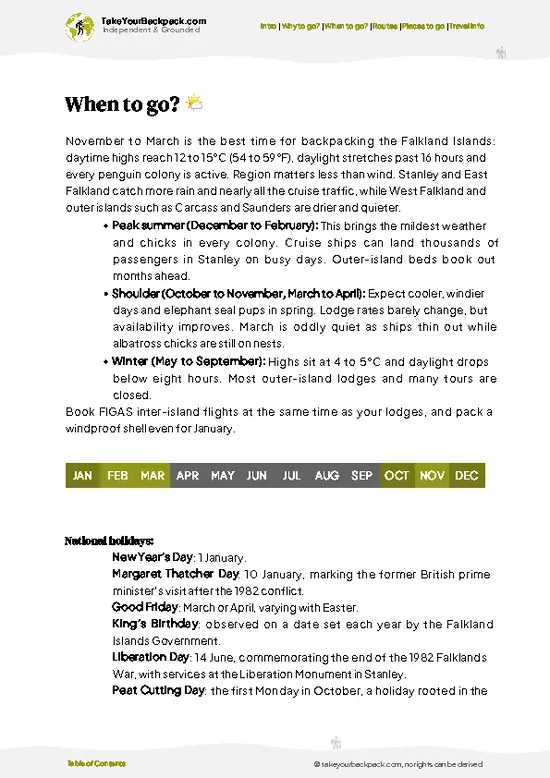
  • Summer (November to February): Saunders Island is at its best, with highs of 12 to 17°C (54 to 63°F) and around 16 to 17 hours of daylight in December. Gentoo and king penguin chicks, rockhopper nests and black-browed albatross colonies are all active. Flights and cottages fill early, so book months ahead.
  • Autumn (March to May): Highs fall to 6 to 11°C (43 to 52°F). Crowds thin, penguins molt on the beaches, and the light is low and clear. Gales become more frequent.
  • Winter (June to August): Highs are 2 to 6°C (36 to 43°F) with about 8 hours of daylight. Frost and sleet are common, most penguins are at sea, and few visitors come. Flights can be cancelled in bad wind.
  • Spring (September to October): Highs are 5 to 10°C (41 to 50°F). Birds return from late September, and the island is quiet and
… read more 👉
  • Summer (November to February): Saunders Island is at its best, with highs of 12 to 17°C (54 to 63°F) and around 16 to 17 hours of daylight in December. Gentoo and king penguin chicks, rockhopper nests and black-browed albatross colonies are all active. Flights and cottages fill early, so book months ahead.
  • Autumn (March to May): Highs fall to 6 to 11°C (43 to 52°F). Crowds thin, penguins molt on the beaches, and the light is low and clear. Gales become more frequent.
  • Winter (June to August): Highs are 2 to 6°C (36 to 43°F) with about 8 hours of daylight. Frost and sleet are common, most penguins are at sea, and few visitors come. Flights can be cancelled in bad wind.
  • Spring (September to October): Highs are 5 to 10°C (41 to 50°F). Birds return from late September, and the island is quiet and cheaper.
Aim for late November to early February for chicks, and book your flight and cottage together.


source: climatestotravel.comJANJanuary: excellent for travelingFEBFebruary: highly recommended for travelingMARMarch: good for travelingAPRApril: fair for travelingMAYMay: below average for travelingJUNJune: below average for travelingJULJuly: below average for travelingAUGAugust: below average for travelingSEPSeptember: fair for travelingOCTOctober: good for travelingNOVNovember: highly recommended for travelingDECDecember: excellent for traveling

✈️ The backpacker research shortcutFalkland Islands Travel Guide

An offline-friendly backpacking guide with optimized travel routes, ranked highlights, transport advice, and the best areas to stay.
example page 0 from our offline Travel Guide for Falkland Islands
example page 1 from our offline Travel Guide for Falkland Islands
example page 2 from our offline Travel Guide for Falkland Islands
example page 3 from our offline Travel Guide for Falkland Islands
example page 4 from our offline Travel Guide for Falkland Islands
example page 5 from our offline Travel Guide for Falkland Islands
example page 6 from our offline Travel Guide for Falkland Islands
example page 7 from our offline Travel Guide for Falkland Islands
The digital guide (108 pages) contains:
✅ 25 highlights, ranked by travel appeal
✅ Optimized 2, 3 & 5-day travel routes
✅ Cities, national parks, landmarks, beaches
✅ How to get around
✅ Offline-friendly for travel without Wi-Fi
👉 Click to see all 30+ guide features

📅 Plan smarter in minutes, not weeks
✅ Month by month travel advice
✅ Festivals & national holidays
✅ Budget expectations

🗺️ Go to the right places, skip the overrated ones
✅ Honest pros & cons of destinations
✅ Top hikes, parks & viewpoints
✅ Lesser-known places most travelers miss
✅ Clear “worth it vs skip it” guidance

🛏️ Travel smoothly without rookie mistakes
✅ Best areas to stay
✅ Transport systems explained simply
✅ Common scams & safety advice
✅ SIM cards, money & practical tips

🌍 Understand the country, not just visit it
✅ Culture & traditions
✅ Local customs
✅ Festivals worth planning around
✅ Traveler-friendly historical context
✅ Insights that make places more meaningful

📱 Built for real travel conditions
✅ Fully downloadable PDF
✅ Works completely offline
✅ Optimized for phone use
✅ Useful in remote areas & buses
✅ Everything in one place
Stop searching, start planning
Get instant access to your full guide. 30‑day money-back guarantee.
+ Add another guide for just

By proceeding you agree to our terms.
Sent to your inbox immediately after payment • 100% Secure Checkout
Best Backpacking Travel Advisor 2025 tourism awardBest Backpacking
Travel Advisor
2025
What others say about Take Your Backpack Guides:
⭐⭐⭐⭐⭐
Fantastic, amazing amount of information!
⭐⭐⭐⭐⭐
My goodness this is amazing, it's what I've been looking for hats off too you!
⭐⭐⭐⭐⭐
I think this is absolutely BRILLIANT
⭐⭐⭐⭐
Very complete and informative. It's still missing places, but I gotta to commend you
⭐⭐⭐⭐⭐
This is truly amazing, thank you, can't wait to explore it with my kids!
⭐⭐⭐⭐⭐
Awesome resource, thank you!
⭐⭐⭐⭐⭐
This is amazing! Can't wait to explore the ones I haven't seen
⭐⭐⭐⭐
I love this! Well done, great idea.
⭐⭐⭐⭐⭐
Thanks for taking the time to make this gem!
⭐⭐⭐⭐⭐
This might be the best website I've ever seen.
⭐⭐⭐⭐⭐
Congratulations, and thank you so much for your work; it's incredibly valuable.
⭐⭐⭐⭐
In all seriousness I think you did a great job pointing out the important spots
⭐⭐⭐⭐⭐
10/10 very good
⭐⭐⭐⭐⭐
As someone who's only just starting to visit regularly this is awesome, thank you.
⭐⭐⭐⭐
Thank you very much! I'm going to visit my dad, it's going to be very useful!
⭐⭐⭐⭐⭐
This is really cool! We'll be travelling for the first time and this definitely come in handy.
⭐⭐⭐⭐⭐
You are now our minister of culture, congratulations 👨‍💼
⭐⭐⭐⭐⭐
Just wanted to tell you that this is a pearl! Going to follow your recommendations.
⭐⭐⭐⭐⭐
This is so cool. I'll definitely be using the resource for my travels soon.
⭐⭐⭐⭐⭐
This is very impressive! Good work.
⭐⭐⭐⭐⭐
This is an amazing and informative site. Very well done!

🛏️ Where to stay?Best areas to stay in Falkland Islands

The best place to stay on Saunders Island is the settlement itself, because it is the only inhabited spot and the only place with beds, power and a radio link. Self-catering cottages run by the farm family usually cost around US$40 to 90 per person per night, and they suit solo backpackers who are happy to cook and share a kitchen. The evenings are social in a quiet way, with the farm family and a handful of other guests swapping bird lists over dinner. There is no nightlife, no shop crowd and no hostel dorm scene, and that is the appeal.

Camping is possible with the owners’ permission, and it … read more 👉
The best place to stay on Saunders Island is the settlement itself, because it is the only inhabited spot and the only place with beds, power and a radio link. Self-catering cottages run by the farm family usually cost around US$40 to 90 per person per night, and they suit solo backpackers who are happy to cook and share a kitchen. The evenings are social in a quiet way, with the farm family and a handful of other guests swapping bird lists over dinner. There is no nightlife, no shop crowd and no hostel dorm scene, and that is the appeal.

Camping is possible with the owners’ permission, and it puts you closer to the coast if you carry a tent that can handle gale-force gusts. Pitch in the lee of a building or dune, not out on open grass. There is no mobile coverage, so tell the farm your plans.

Stanley is where you should spend a night or two before and after the flight. It has the food shops where you stock up for the island, backpacker-friendly guesthouses, a few pubs and the FIGAS booking office. It is also safe and easy to walk around. Bring everything from there, as supplies on Saunders Island are limited.

🚌 Getting aroundHow to get around Saunders Island

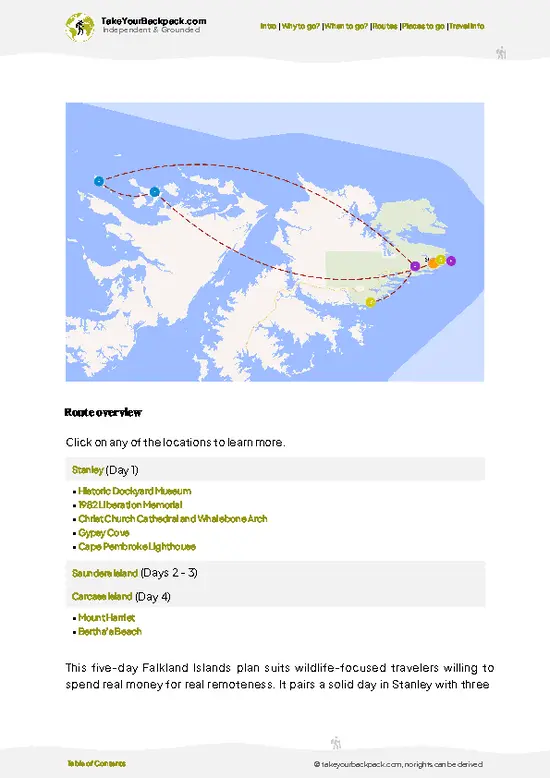
The easiest way to get around Saunders Island is to arrange a farm Land Rover transfer when you land, because the best wildlife sits several kilometers from the settlement and the tracks are rough, wet and unsigned. There are no roads in any sense a city traveler would recognize, no buses and no taxis. Getting to the island depends on a small government plane, which is reliable in good weather but is cancelled when the wind rises, so leave a spare day at the end of your trip.
  • FIGAS flight from Stanley: The Falkland Islands Government Air Service runs a small Islander plane on demand-based schedules, with a one-way fare of roughly US$120 to 200 and a flight of about an hour. You sit low over peat, kelp beds and white beaches, and you land on a grass strip near the settlement.
  • Farm Land Rover
… read more 👉
The easiest way to get around Saunders Island is to arrange a farm Land Rover transfer when you land, because the best wildlife sits several kilometers from the settlement and the tracks are rough, wet and unsigned. There are no roads in any sense a city traveler would recognize, no buses and no taxis. Getting to the island depends on a small government plane, which is reliable in good weather but is cancelled when the wind rises, so leave a spare day at the end of your trip.
  • FIGAS flight from Stanley: The Falkland Islands Government Air Service runs a small Islander plane on demand-based schedules, with a one-way fare of roughly US$120 to 200 and a flight of about an hour. You sit low over peat, kelp beds and white beaches, and you land on a grass strip near the settlement.
  • Farm Land Rover transfer and tours: The family that runs the island will drive you across the isthmus to The Neck for around US$40 to 90, depending on whether it is a drop-off or a guided visit. The track is bumpy and takes about 20 to 30 minutes each way. You arrive at a ridge where gentoo, king and Magellanic penguins share the same sand, with albatross on the cliffs behind.
  • Walking from the settlement: Free and slow. The route to The Neck is about 8 to 10 kilometers each way over open, windy grass and takes 2 to 3 hours one way. You earn the silence and the sea-lion grunts from the beach.
  • Coastal and Mount Richards walks: The hill climb is roughly 458 meters of tussac, stone runs and open heath, taking 3 to 4 hours round trip from the track. From the top you see both coasts and Keppel Island, and you will probably have the summit to yourself.
Carry a windproof jacket, food and water on every walk, and tell the farm where you are heading before you leave.

👛 Costs (as of 19 October 2026)Typical daily expenses

Visiting Saunders Island in the Falkland Islands can be a rewarding experience, but it’s essential to be aware of the costs involved to avoid surprises.

First, getting to the Falklands is a significant part of your budget. Flights from the UK typically range from $1,500 to $2,500 round-trip. This can vary based on the season and how early you book.

Once you arrive, transportation to Saunders Island is usually by boat or small aircraft. Expect to pay around $200 to $400 for a round-trip transfer, depending on the service you choose.

Accommodation on the island is limited. The main option is a basic lodge, with prices ranging from $100 to $150 per night. Meals are often included, but if not, budget an additional $30 to $50 per day for food.

Lastly, consider the cost of activities. Guided … read more 👉
Visiting Saunders Island in the Falkland Islands can be a rewarding experience, but it’s essential to be aware of the costs involved to avoid surprises.

First, getting to the Falklands is a significant part of your budget. Flights from the UK typically range from $1,500 to $2,500 round-trip. This can vary based on the season and how early you book.

Once you arrive, transportation to Saunders Island is usually by boat or small aircraft. Expect to pay around $200 to $400 for a round-trip transfer, depending on the service you choose.

Accommodation on the island is limited. The main option is a basic lodge, with prices ranging from $100 to $150 per night. Meals are often included, but if not, budget an additional $30 to $50 per day for food.

Lastly, consider the cost of activities. Guided tours, which are highly recommended for wildlife viewing, can range from $50 to $150 per person, depending on the length and type of tour.

In summary, a trip to Saunders Island can cost anywhere from $2,000 to $3,500 per person, factoring in flights, transfers, accommodation, meals, and activities. Planning ahead and budgeting wisely will help you focus on the experience rather than the expenses.


source: falklandislands.com
⚠️ Prices can change and everyone travels differently, so take this as a rough guide. Hope it helps you plan your adventure!

🍲 FoodLocal Flavors for Backpackers

Food on Saunders Island is farm food: Falklands mutton and lamb raised on the island’s own pasture, roasted until the fat crisps and the meat tastes faintly of grass and salt wind. Expect it with potatoes, homegrown vegetables where the season allows, and thick gravy. Sweet things lean on diddle-dee jam, a tart, deep red berry preserve spread on warm scones or home-baked bread.

There are no restaurants, cafés or street stalls. Most visitors cook in a self-catering kitchen, so buy your staples in Stanley before the flight: pasta, tinned goods, eggs, bread, cheese, coffee and anything you cannot live without. Some meals can sometimes be arranged with the farm family if you ask in advance. Carry a thermos and a snack on every walk, as nothing is sold on the trails.

The ritual to know is smoko, … read more 👉
Food on Saunders Island is farm food: Falklands mutton and lamb raised on the island’s own pasture, roasted until the fat crisps and the meat tastes faintly of grass and salt wind. Expect it with potatoes, homegrown vegetables where the season allows, and thick gravy. Sweet things lean on diddle-dee jam, a tart, deep red berry preserve spread on warm scones or home-baked bread.

There are no restaurants, cafés or street stalls. Most visitors cook in a self-catering kitchen, so buy your staples in Stanley before the flight: pasta, tinned goods, eggs, bread, cheese, coffee and anything you cannot live without. Some meals can sometimes be arranged with the farm family if you ask in advance. Carry a thermos and a snack on every walk, as nothing is sold on the trails.

The ritual to know is smoko, the mid-morning and mid-afternoon tea break that organizes the farm day. If you are invited in, say yes, take a seat and expect strong tea, cake or biscuits and slow talk about weather and wool. Drinks are simple: tea, instant coffee and a bottle of Falklands-brewed beer in the evening if you brought one. Pack out all your rubbish and be sparing with water.

🛡️ SafetyScams, Hazards, and Annoyances

Saunders Island offers a straightforward hiking experience, but a few realities can catch you off guard. The weather can shift rapidly; sunny skies can turn to rain in minutes. Layer your clothing and always pack a waterproof jacket.

The terrain is mostly manageable, but be prepared for some steep sections and uneven footing. Navigation is generally clear, but a good map and compass are essential, so don’t rely solely on your phone. River crossings can occur, especially after rain, so assess the water level before proceeding.

Wildlife encounters are a highlight, particularly with the local penguin colonies. Keep your distance; they’re curious but can be protective. Avoid feeding any animals; it disrupts their natural behavior.

First-timers often underestimate the wind. It can sap your … read more 👉
Saunders Island offers a straightforward hiking experience, but a few realities can catch you off guard. The weather can shift rapidly; sunny skies can turn to rain in minutes. Layer your clothing and always pack a waterproof jacket.

The terrain is mostly manageable, but be prepared for some steep sections and uneven footing. Navigation is generally clear, but a good map and compass are essential, so don’t rely solely on your phone. River crossings can occur, especially after rain, so assess the water level before proceeding.

Wildlife encounters are a highlight, particularly with the local penguin colonies. Keep your distance; they’re curious but can be protective. Avoid feeding any animals; it disrupts their natural behavior.

First-timers often underestimate the wind. It can sap your energy quickly, so pace yourself and take breaks. With the right preparation, you’ll preserve your energy and budget for the moments that truly matter on this beautiful island.

FAQFrequently asked questions about Saunders Island

Two nights is enough to see the main sights on Saunders Island, and three nights gives you slack for flight delays and wind. The Neck takes a full day, the Mount Richards climb adds half a day, and the settlement and Port Egmont history fit around them. Flights from Stanley take about an hour.
Without a car, you travel to Saunders Island on a FIGAS flight from Stanley, which costs roughly US$120 to 200 one way, then rely on the farm’s Land Rover transfer or your own legs. The walk from the settlement to The Neck is about 8 to 10 kilometers each way, and the vehicle ride takes 20 to 30 minutes. There are no buses or taxis.
Saunders Island is known for The Neck, where gentoo, king, rockhopper and Magellanic penguins nest within walking distance of black-browed albatross cliffs. It is also known for Mount Richards at about 458 meters, and for the ruins of Port Egmont, a British settlement dating from the 1760s. Self-catering cottages and a working sheep farm make it one of the few West Falkland islands set up for overnight visitors.
⚠️ Things can change over time, so always validate details locally before you go.

Other Falkland Islander regions near Saunders Island

Explore more nearby:

  • Carcass Island—Leopard Beach, tame small birds, settlement garden, Mount Byng| 32 km away
  • Pebble Island—Cape Tamar rockhoppers, quartz pebbles, dune burrows, northern lagoons| 34 km away
  • West Falkland—Island-hopping lodges, Fox Bay, Port Howard, albatross cliffs| 52 km away

💡 Not sure where to go next?
Create a personalized itinerary for Falkland Islands including Saunders Island and the places that fit your trip.

Generate my itinerary

👉 Discover all regions

Or checkout all Falkland Islands has to offer (think cities, towns, villages, national parks, hikes, beaches, festivals)
Country photo of Falkland Islands

We 💚 feedbackWhat to keep in mind

Saunders Island is for people who are happy sitting in grass for hours watching animals do their business. If you need nightlife, a café or a shop, skip it. Bring all your food, wear waterproof trousers, and leave a spare day in your plans in case the plane is grounded by wind.

✍️ Help improve this page!
The information on this page is based on in-depth research, insights shared by experienced travelers, and feedback from the local travel community in Falkland Islands. While every effort is made to keep the information accurate and current, conditions can change — so if you spot anything incorrect or outdated, please get in touch.


🙋‍♂️ Give feedback

👋 Meet the founderWho’s Behind Take Your Backpack?

Johan, backpacker and founder of TakeYourBackpackHi, I’m Johan (Netherlands 🇳🇱), the creator of TakeYourBackpack. Over the past 3 decades, I’ve backpacked through 90+ countries across six continents, gaining extensive experience with independent travel, long-term trips, and overland routes.

This site is built on a combination of firsthand travel experience and carefully curated insights from other backpackers. Many guides are based on places I’ve personally visited, while others bring together tips, observations, and practical advice shared by trusted travelers I’ve met along the way.

The goal is to provide realistic, experience-driven guidance — not generic itineraries — so you can explore destinations with better context, clearer expectations, and more confidence.