×

Falkland Islands🇫🇰 | regionsWeddell IslandPlanted tree belts, western rockhoppers, Gull Harbour gentoos, farm tracks | things to do and best time to go

Explore Sea Lion IslandExplore West Falkland

Backpacking in Weddell Island
👌 Worth visitingregion ranked #6
By Johan Kruseman 🇳🇱 | Updated October 22, 2026

Weddell Island is the third largest island in the Falkland Islands, yet it has a permanent population of only a handful of people and no shops, so you plan food and supplies before you arrive. It lies in the west of the Falkland Islands, a short flight from Stanley, and it is a working sheep farm with a settlement on the northeast coast. Tracks are farm tracks, and walking them brings you to rockhopper and gentoo penguin colonies, sea lion beaches and tussac grass shelter belts. Wildlife is the main draw, along with the quiet. A few historic buildings and old planted trees give the settlement a gentle character. Weather is changeable and distances between sights are long. Independent walkers who like solitude will enjoy it most. Anyone wanting nightlife, tours on tap or a quick ticked-off list will be disappointed.

Discover everything you want to know in the 📖 Falkland Islands Travel Guide.


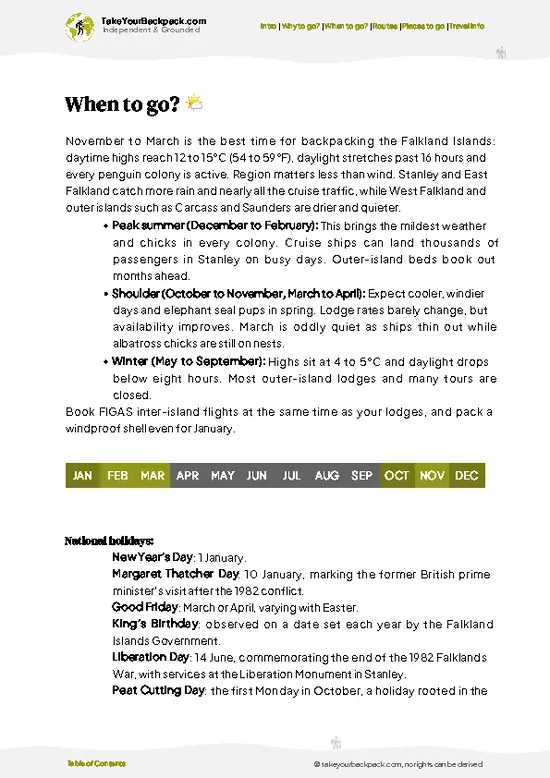
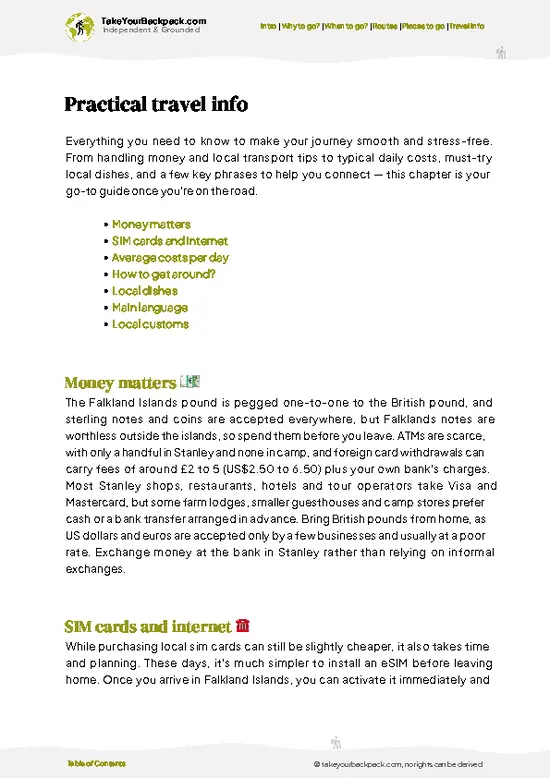
example page 0 from our offline Travel Guide for Falkland Islands
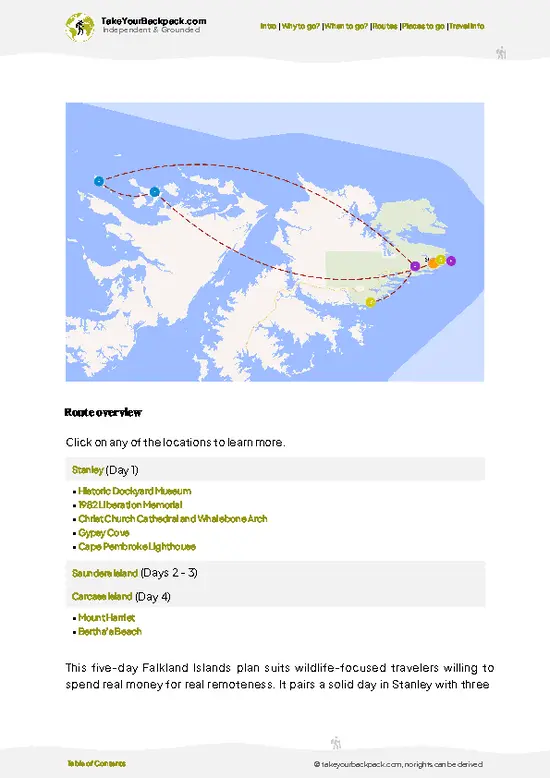
example page 1 from our offline Travel Guide for Falkland Islands
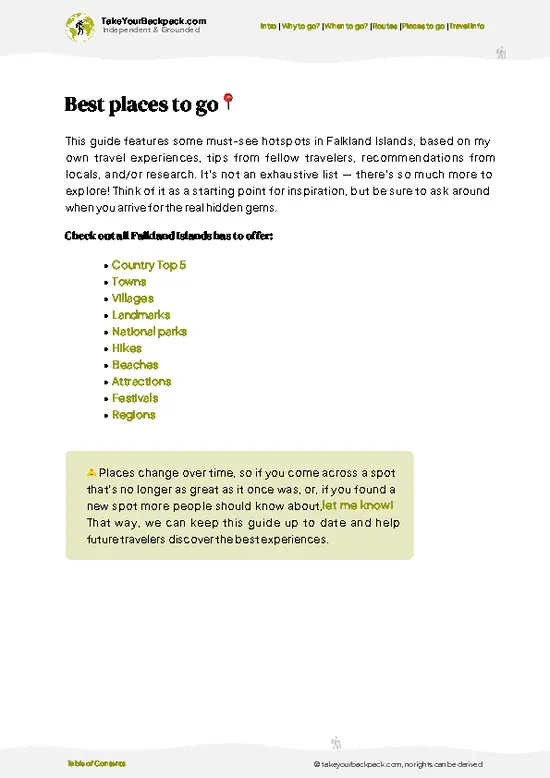
example page 2 from our offline Travel Guide for Falkland Islands
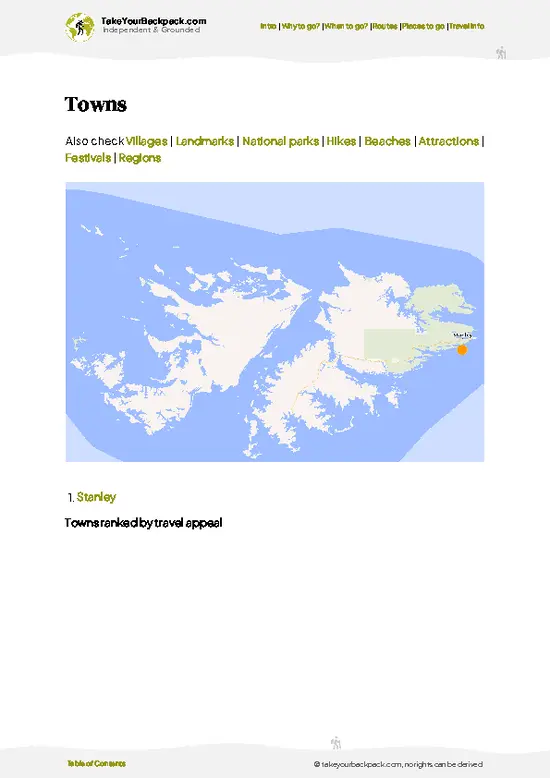
example page 3 from our offline Travel Guide for Falkland Islands
example page 4 from our offline Travel Guide for Falkland Islands
example page 5 from our offline Travel Guide for Falkland Islands
example page 6 from our offline Travel Guide for Falkland Islands
example page 7 from our offline Travel Guide for Falkland Islands
Loading the map 🌍
CLICK TO FILTER
towns
villages
landmarks
national parks
hikes
beaches
attractions
festivals
regions
SHOW COUNTRY’S BESTSHOW ALL

✨ Why go?
Ranked #6 region in Falkland Islands
What makes this region worth visiting

Weddell Island suits backpackers who want wildlife without a crowd and who can self-cater. The first reason is the variety packed into one farm: Rockhopper and gentoo penguin colonies, elephant seals, sea lions and Magellanic penguins all sit within walking or short vehicle range of the settlement, so you stay in one place and still see a lot. The second is the settlement and coastal walks, which let you mix coastline, old farm buildings and the odd planted woodland at a slow pace, with no timetable beyond the weather. The island also has its own character: the settlement carries a history of sheep farming and an experiment in planting trees that few other Falklands farms share. Moving on is simple, because the small plane is the one link and its schedule shapes your stay. Bring food, warm layers and patience.

💡 HighlightsThe experiences that define the visit

  1. Weddell Settlement: the farm hamlet on the northeast coast, with its tin-roofed houses, old planted trees and the island’s only real shelter from the wind.
  2. Rockhopper colony on the western cliffs: noisy ledges of penguins tucked among tussac, reached on a long coastal walk.
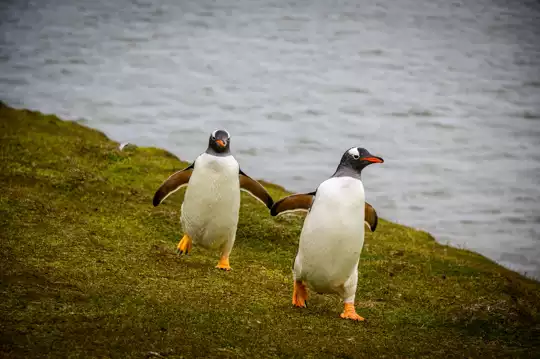
  3. Gentoo penguin rookeries: small, easy colonies where you can sit quietly while birds cross grassy slopes to the sea.
  4. Magellanic penguin burrows: sandy ground where the birds nest underground, best seen at dusk in the breeding season.
  5. Elephant seal beaches: bulky males hauled out on shingle, loud and smelly but easy to watch from a respectful distance.
  6. Sea lion colonies: rocky shores where pups and bulls share the sand, a short walk from the tracks.
  7. Gull Harbour and Mark Point: sandy beaches with a gentoo penguin colony, where
… read more 👉
  1. Weddell Settlement: the farm hamlet on the northeast coast, with its tin-roofed houses, old planted trees and the island’s only real shelter from the wind.
  2. Rockhopper colony on the western cliffs: noisy ledges of penguins tucked among tussac, reached on a long coastal walk.
  3. Gentoo penguin rookeries: small, easy colonies where you can sit quietly while birds cross grassy slopes to the sea.
  4. Magellanic penguin burrows: sandy ground where the birds nest underground, best seen at dusk in the breeding season.
  5. Elephant seal beaches: bulky males hauled out on shingle, loud and smelly but easy to watch from a respectful distance.
  6. Sea lion colonies: rocky shores where pups and bulls share the sand, a short walk from the tracks.
  7. Gull Harbour and Mark Point: sandy beaches with a gentoo penguin colony, where dolphins often swim offshore.
  8. Planted tree belts: a rare patch of planted conifers on a treeless archipelago, lesser known and worth a slow wander.
  9. Tussac grass shoreline: dense, head-high clumps that shelter birds and give a feel for the original Falklands coast.
  10. Old shearing shed and farm buildings: a look at working life on an isolated farm, usually quiet and overlooked by day visitors.
Combine the gentoo rookeries with the sea lion colonies in one day, since both sit along the same stretch of coast and need only a loose loop from the settlement.
Spotted a mistake or missing something? Contact us.

Things to do near Weddell Island

Ratings based on Tripadvisor reviews. When you book through this link, you support our work at no extra cost to you.

⌛️ 5 daysWhat you can realistically do in a week

Day 1: Weddell Settlement: Start with the settlement itself, because it is where you sort out food, farm advice and permission to walk. The flight in from Stanley sets the rhythm: planes are few, so you commit to staying several days rather than hopping on and off. Spend the afternoon around the buildings and tree belts to read the weather before heading farther.
Day 2 to 3: Coastal colonies: Use these days for the penguin and seal sites along the coast. Distances are long, and a single walk can take most of a day, so one major outing per day is realistic. Gentoos and sea lions come first, then the rockhopper ledges when the wind and visibility allow. A detour to Loop Head in the north-east adds sea lions in the tussac without changing where you sleep. Keep a flexible day in reserve because … read more 👉
Day 1: Weddell Settlement: Start with the settlement itself, because it is where you sort out food, farm advice and permission to walk. The flight in from Stanley sets the rhythm: planes are few, so you commit to staying several days rather than hopping on and off. Spend the afternoon around the buildings and tree belts to read the weather before heading farther.
Day 2 to 3: Coastal colonies: Use these days for the penguin and seal sites along the coast. Distances are long, and a single walk can take most of a day, so one major outing per day is realistic. Gentoos and sea lions come first, then the rockhopper ledges when the wind and visibility allow. A detour to Loop Head in the north-east adds sea lions in the tussac without changing where you sleep. Keep a flexible day in reserve because gusts can cancel a plan.
Day 4 to 5: Coast and farm: Slow down with the shoreline, the tussac edges and the old farm buildings, then pack for the plane. Leave a buffer, since the flight is the only exit and weather can delay it.
If you only have one day to justify the journey, make it the rockhopper day: a long, windy walk ending at a noisy cliff colony with nobody else in sight.

🌤️ When to go?Best time to visit Weddell Island

  • Summer (December to February): Weddell Island is at its easiest, with highs of 12 to 16°C (54 to 61°F) and about 16 to 17 hours of daylight. Penguin and albatross colonies are busy, and sheep-shearing season is underway on the farm.
  • Shoulder months (October to November, March to April): Expect 6 to 11°C (43 to 52°F), fewer visitors and easier lodging. Spring brings returning seabirds, and autumn brings fewer people and sharper light for photography.
  • Winter (May to September): Highs of 3 to 6°C (37 to 43°F), frost, and 7 to 8 hours of daylight. Flights are more often delayed by wind and low cloud, and some accommodation may close or run limited services.
Book flights and a bed several months ahead for December to February, when the few seats and rooms fill first.

source: climatestotravel.comJANJanuary: excellent for travelingFEBFebruary: excellent for travelingMARMarch: highly recommended for travelingAPRApril: fair for travelingMAYMay: below average for travelingJUNJune: below average for travelingJULJuly: below average for travelingAUGAugust: below average for travelingSEPSeptember: fair for travelingOCTOctober: good for travelingNOVNovember: highly recommended for travelingDECDecember: excellent for traveling
when-to-go

✈️ The backpacker research shortcutFalkland Islands Travel Guide

An offline-friendly backpacking guide with optimized travel routes, ranked highlights, transport advice, and the best areas to stay.
example page 0 from our offline Travel Guide for Falkland Islands
example page 1 from our offline Travel Guide for Falkland Islands
example page 2 from our offline Travel Guide for Falkland Islands
example page 3 from our offline Travel Guide for Falkland Islands
example page 4 from our offline Travel Guide for Falkland Islands
example page 5 from our offline Travel Guide for Falkland Islands
example page 6 from our offline Travel Guide for Falkland Islands
example page 7 from our offline Travel Guide for Falkland Islands
The digital guide (108 pages) contains:
✅ 25 highlights, ranked by travel appeal
✅ Optimized 2, 3 & 5-day travel routes
✅ Cities, national parks, landmarks, beaches
✅ How to get around
✅ Offline-friendly for travel without Wi-Fi
👉 Click to see all 30+ guide features

📅 Plan smarter in minutes, not weeks
✅ Month by month travel advice
✅ Festivals & national holidays
✅ Budget expectations

🗺️ Go to the right places, skip the overrated ones
✅ Honest pros & cons of destinations
✅ Top hikes, parks & viewpoints
✅ Lesser-known places most travelers miss
✅ Clear “worth it vs skip it” guidance

🛏️ Travel smoothly without rookie mistakes
✅ Best areas to stay
✅ Transport systems explained simply
✅ Common scams & safety advice
✅ SIM cards, money & practical tips

🌍 Understand the country, not just visit it
✅ Culture & traditions
✅ Local customs
✅ Festivals worth planning around
✅ Traveler-friendly historical context
✅ Insights that make places more meaningful

📱 Built for real travel conditions
✅ Fully downloadable PDF
✅ Works completely offline
✅ Optimized for phone use
✅ Useful in remote areas & buses
✅ Everything in one place
Stop searching, start planning
Get instant access to your full guide. 30‑day money-back guarantee.
+ Add another guide for just

By proceeding you agree to our terms.
Sent to your inbox immediately after payment • 100% Secure Checkout
Best Backpacking Travel Advisor 2025 tourism awardBest Backpacking
Travel Advisor
2025
What others say about Take Your Backpack Guides:
⭐⭐⭐⭐⭐
Fantastic, amazing amount of information!
⭐⭐⭐⭐⭐
My goodness this is amazing, it's what I've been looking for hats off too you!
⭐⭐⭐⭐⭐
I think this is absolutely BRILLIANT
⭐⭐⭐⭐
Very complete and informative. It's still missing places, but I gotta to commend you
⭐⭐⭐⭐⭐
This is truly amazing, thank you, can't wait to explore it with my kids!
⭐⭐⭐⭐⭐
Awesome resource, thank you!
⭐⭐⭐⭐⭐
This is amazing! Can't wait to explore the ones I haven't seen
⭐⭐⭐⭐
I love this! Well done, great idea.
⭐⭐⭐⭐⭐
Thanks for taking the time to make this gem!
⭐⭐⭐⭐⭐
This might be the best website I've ever seen.
⭐⭐⭐⭐⭐
Congratulations, and thank you so much for your work; it's incredibly valuable.
⭐⭐⭐⭐
In all seriousness I think you did a great job pointing out the important spots
⭐⭐⭐⭐⭐
10/10 very good
⭐⭐⭐⭐⭐
As someone who's only just starting to visit regularly this is awesome, thank you.
⭐⭐⭐⭐
Thank you very much! I'm going to visit my dad, it's going to be very useful!
⭐⭐⭐⭐⭐
This is really cool! We'll be travelling for the first time and this definitely come in handy.
⭐⭐⭐⭐⭐
You are now our minister of culture, congratulations 👨‍💼
⭐⭐⭐⭐⭐
Just wanted to tell you that this is a pearl! Going to follow your recommendations.
⭐⭐⭐⭐⭐
This is so cool. I'll definitely be using the resource for my travels soon.
⭐⭐⭐⭐⭐
This is very impressive! Good work.
⭐⭐⭐⭐⭐
This is an amazing and informative site. Very well done!

🛏️ Where to stay?Best areas to stay in Falkland Islands

Stay in Weddell Island’s main settlement, because it is the only place with beds, hot meals and a farm base for walking. Do not expect hostel dorms or a backpacker scene. Accommodation is limited to a few self-catering rooms and farmhouse-style lodging, typically US$60 to 130 per person a night depending on the room and meals. That means you will mostly meet the farm family, a few other guests and the occasional researcher, which makes for the most social evenings on the island: shared tables, talk about weather and wildlife, and local knowledge on where the penguins are nesting this week. The … read more 👉
Stay in Weddell Island’s main settlement, because it is the only place with beds, hot meals and a farm base for walking. Do not expect hostel dorms or a backpacker scene. Accommodation is limited to a few self-catering rooms and farmhouse-style lodging, typically US$60 to 130 per person a night depending on the room and meals. That means you will mostly meet the farm family, a few other guests and the occasional researcher, which makes for the most social evenings on the island: shared tables, talk about weather and wildlife, and local knowledge on where the penguins are nesting this week. The settlement is also the safest option, with no crime concerns to speak of, just the need to tell someone where you are walking each day. Solo travelers do well here because the hosts check in on you. If your budget is tight, base yourself in Stanley, the capital on East Falkland, where hostels, guesthouses and pubs offer more company, and treat Weddell Island as a night or two away.

🚌 Getting aroundHow to get from A to B

Assuming you can book a flight on the day you arrive is the error that costs the most, because Weddell Island has a handful of beds and a small airstrip served by the Falkland Islands Government Air Service (FIGAS) from Stanley, so seats must be reserved well ahead. Once you land, almost everything is reached on foot or by farm vehicle, and the weather decides more than any timetable does. Distances are modest, but the terrain is open, wet and windy.
  • FIGAS flight from Stanley: Roughly US$100 to 160 each way, about 1 hour in a small Islander plane, scheduled the evening before. You get a low-level view of Falkland Sound and the island’s long indented coast.
  • Walking: Tracks and open camp (farmland) link the settlement with the beaches and bays, and most walks take 2 to 5 hours. You cross springy
… read more 👉
Assuming you can book a flight on the day you arrive is the error that costs the most, because Weddell Island has a handful of beds and a small airstrip served by the Falkland Islands Government Air Service (FIGAS) from Stanley, so seats must be reserved well ahead. Once you land, almost everything is reached on foot or by farm vehicle, and the weather decides more than any timetable does. Distances are modest, but the terrain is open, wet and windy.
  • FIGAS flight from Stanley: Roughly US$100 to 160 each way, about 1 hour in a small Islander plane, scheduled the evening before. You get a low-level view of Falkland Sound and the island’s long indented coast.
  • Walking: Tracks and open camp (farmland) link the settlement with the beaches and bays, and most walks take 2 to 5 hours. You cross springy diddle-dee heath with penguins and sea lions often at the end.
  • Farm vehicle transfer: Hosts usually meet the plane and run guests to the settlement, a short ride on a gravel track, and may arrange drop-offs to farther points for a fee of roughly US$15 to 60. This saves a long wet walk and gets you to the colonies fresh.
  • Hired Land Rover or farm bike: Some hosts rent vehicles or take guests out for the day, roughly US$80 to 150. It opens up the far coast and inland ponds where waterfowl gather, with no one else around.
Pack for a full day outside regardless of the forecast, since flights and tracks both change with the wind, and leave a day of slack at the end of your stay so a delayed plane does not cost you your connecting international departure.

🍲 FoodEating & Drinking in Weddell Island

Meals on Weddell Island are farm food at its most honest: Falklands lamb and mutton roasted, stewed or turned into pies, often with root vegetables grown in the settlement’s garden. Expect the smell of peat or wood smoke, rich gravy and thick slices of fresh bread. Mutton is the local staple, darker and stronger than the lamb you may be used to. Sweets run to homemade cakes, scones and puddings, and smoko, the mid-morning tea break, is a fixture. Tea is strong and constant, and local beer and spirits are poured sparingly. There are no markets, cafés or street stalls. You eat where you sleep, either in the farmhouse dining room or from groceries you bring from Stanley if self-catering. Buy supplies there, because the island has no shop, and pack snacks for long walks. Meals are set times, so … read more 👉
Meals on Weddell Island are farm food at its most honest: Falklands lamb and mutton roasted, stewed or turned into pies, often with root vegetables grown in the settlement’s garden. Expect the smell of peat or wood smoke, rich gravy and thick slices of fresh bread. Mutton is the local staple, darker and stronger than the lamb you may be used to. Sweets run to homemade cakes, scones and puddings, and smoko, the mid-morning tea break, is a fixture. Tea is strong and constant, and local beer and spirits are poured sparingly. There are no markets, cafés or street stalls. You eat where you sleep, either in the farmhouse dining room or from groceries you bring from Stanley if self-catering. Buy supplies there, because the island has no shop, and pack snacks for long walks. Meals are set times, so let your hosts know about dietary needs when you book. Pay for food on departure in local currency or by arrangement, and take your boots off at the door.

FAQFrequently asked questions about Weddell Island

Two to three nights is enough for Weddell Island. That gives you time for walks to the penguin and sea lion colonies, a day out by vehicle to the far coast, and a buffer for flight delays. Flights from Stanley take about 1 hour.
Without a car, you rely on walking and on transfers arranged by your hosts. Fly in with FIGAS from Stanley (roughly US$100 to 160 each way), then walk the tracks of 2 to 5 hours to coastal colonies. Farm vehicle drop-offs cost about US$15 to 60.
Weddell Island is known for its wildlife and its working sheep farm. Rockhopper, gentoo and Magellanic penguins, elephant seals, sea lions and many bird species live along its coast. It is also one of the larger islands in the archipelago, reached by a short flight from Stanley, and its settlement offers lodging and farm meals.
⚠️ Things can change over time, so always validate details locally before you go.

Other Falkland Islander regions near Weddell Island

Explore more nearby:

  • West Falkland—Island-hopping lodges, Fox Bay, Port Howard, albatross cliffs| 60 km away
  • Carcass Island—Leopard Beach, tame small birds, settlement garden, Mount Byng| 74 km away
  • Saunders Island—The Neck, albatross rookery, Port Egmont ruins, self-catering cottages| 87 km away

💡 Not sure where to go next?
Create a personalized itinerary for Falkland Islands including Weddell Island and the places that fit your trip.

Generate my itinerary

👉 Discover all regions

Or checkout all Falkland Islands has to offer (think cities, towns, villages, national parks, hikes, beaches, festivals)
Country photo of Falkland Islands

We 💚 feedbackSumming up the experience

Weddell Island rewards self-sufficient walkers who like silence and unscripted days, and it will frustrate anyone who needs services or schedules. I would bring all your food, a good waterproof layer and a spare day in case the plane is delayed. Go for the penguins, stay for the quiet.

✍️ Help improve this page!
The information on this page is based on in-depth research, insights shared by experienced travelers, and feedback from the local travel community in Falkland Islands. While every effort is made to keep the information accurate and current, conditions can change — so if you spot anything incorrect or outdated, please get in touch.


🙋‍♂️ Give feedback

👋 Meet the founderWho’s Behind Take Your Backpack?

Johan, backpacker and founder of TakeYourBackpackHi, I’m Johan (Netherlands 🇳🇱), the creator of TakeYourBackpack. Over the past 3 decades, I’ve backpacked through 90+ countries across six continents, gaining extensive experience with independent travel, long-term trips, and overland routes.

This site is built on a combination of firsthand travel experience and carefully curated insights from other backpackers. Many guides are based on places I’ve personally visited, while others bring together tips, observations, and practical advice shared by trusted travelers I’ve met along the way.

The goal is to provide realistic, experience-driven guidance — not generic itineraries — so you can explore destinations with better context, clearer expectations, and more confidence.