

×

Fiji🇫🇯 | best hikesTop-Rated 3 hikes in Fiji

Hikes in Fiji are mostly village-led walks, not wilderness treks, so the experience depends on where you land. Viti Levu has the easiest access and the most day-hikers. Taveuni and Vanua Levu feel quieter and wetter. Independent travelers can usually reach trailheads by local bus, but expect a small village fee and a guide. Bring cash and leave early.

By Johan Kruseman 🇳🇱 | Updated October 20, 2026
Explore the best beaches in Fiji

Why go?Why These hike Stand Out

Fiji’s hiking comes down to land ownership. Nearly all land is held by indigenous clans (mataqali), so trails cross village property and access runs through the community, not a park gate. That means a guide, a small fee, and often a welcome ceremony, which is part of the appeal and not an add-on.

The terrain is volcanic and steep, with rainforest interiors on the big islands, so trails are humid, slippery and short rather than long and alpine. Few routes are signed, and maps are scarce, which makes local guides practical as well as cultural.

Before choosing Fiji for hiking, know that it suits half-day to full-day walks well and multi-day trekking poorly. Bring a sulu (sarong) or knee-covering shorts for village visits, and pack a rain layer year-round.
Our Approach to Ranking
The list of best hikes in Fiji is created based on scenery, challenge, trail quality, landmarks, and overall enjoyment. If you feel a hike is missing in this list, please let us know.

When to go?Best Time to Visit Fiji for hikes

Best months for hiking: The best months are May to October, the dry season, when days run about 25 to 29°C and trails are firmer and less slippery. Monthly rainfall on the drier western side of Viti Levu often stays well under 100 mm, while the wet east and Taveuni stay damp even then.

Shoulder and wet season: November to April is hot (30°C or more), humid and cyclone-prone, with the heaviest rain from about January to March. Streams swell, mud deepens and some village access roads can wash out. Shoulder months like April, May and November often give you lower prices and thinner crowds.

Crowds and prices: July to September and the Christmas weeks push resort and hostel rates up, though dorm beds stay modest. Start walks by 7 or 8 a.m. to beat the afternoon showers.

hike hoppingHow to Combine hikes Into One Trip

How many days you need: A trip combining several hikes in Fiji needs 7 to 12 days, enough for two or three regions without rushing.

Grouping regions: Start in Nadi or Suva on Viti Levu, where road links are best and hikes sit 1 to 3 hours from town by bus or carrier. Then fly or ferry to Taveuni (a short flight from Nadi via Suva or Nausori, or an overnight-plus ferry route via Savusavu) and work back. Flying out of Nadi last keeps your international connection safe.

Pacing and mistakes: Allow one full day per hike plus a rest day after every two or three. The common errors are cramming a hike into a ferry day and ignoring Fiji time, where boats and buses slip by hours. Leave a buffer day before your flight home, and book inter-island legs only once the weather looks settled.

The ListTop hikes of Fiji

1 Mount Tomanivi

Fiji’s highest point, Navai guide and kava, moss-covered cloud forest, steep clay scramble

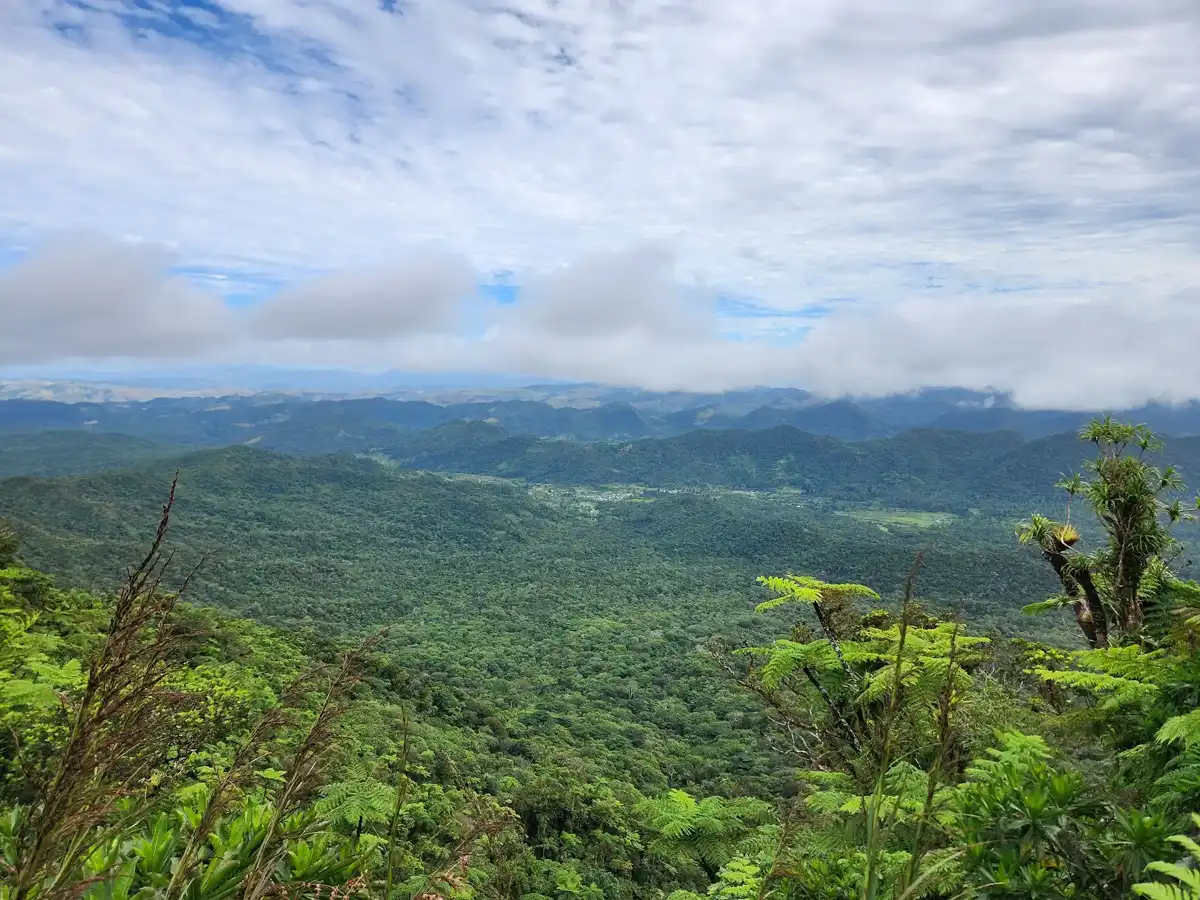
Climb from Navai village through dripping, moss-covered forest to a small clearing at 1,324 meters, best reached in the morning before cloud closes in.

fiji-hike-mount-tomanivi
© Google | Jacob Smeaton

2 Tavoro Waterfalls

Three stacked falls, swimming pools, Bouma rainforest track, muddy stairs

Follow one river past three waterfalls on Taveuni, swimming at the first pool and deciding at each stage whether the muddy climb continues.

fiji-hike-tavoro-waterfalls
© Google | Jiří Prokeš

3 Lavena Coastal Walk

Wainibau Falls, black sand shore, rope bridges, creek wading

Follow the shoreline through rainforest, cross swaying bridges and wade streams to reach a waterfall pool at the end of a narrow gorge.

Loading the map 🌍

Expert viewExpert Commentary on hikes

How many hikes to do: I advise three to five hikes. Fewer wastes the village access you have already paid to reach, while more than five in Fiji’s humidity brings fatigue and muddy gear, and the trails start to blur. One big day followed by a gentler one is a sound rhythm.

Which kind to prioritize: Budget travelers get the most from village-guided rainforest and waterfall walks: they cost little, run half a day, and put money straight into communities. Those who want views should pick a ridge or summit walk, which costs more in guides and transport and demands an early start, but gives the best landscape. Beach-based travelers can add a coastal walk on a resort island for almost nothing, yet it will be the least varied option.

What it costs: Expect US$35 to 70 a day with dorm beds, local … read more 👉
How many hikes to do: I advise three to five hikes. Fewer wastes the village access you have already paid to reach, while more than five in Fiji’s humidity brings fatigue and muddy gear, and the trails start to blur. One big day followed by a gentler one is a sound rhythm.

Which kind to prioritize: Budget travelers get the most from village-guided rainforest and waterfall walks: they cost little, run half a day, and put money straight into communities. Those who want views should pick a ridge or summit walk, which costs more in guides and transport and demands an early start, but gives the best landscape. Beach-based travelers can add a coastal walk on a resort island for almost nothing, yet it will be the least varied option.

What it costs: Expect US$35 to 70 a day with dorm beds, local buses and cheap meals. Village entry or sevusevu fees usually run FJD 10 to 30 (about US$5 to 14), and a guide often adds FJD 30 to 80 (US$14 to 36) per group. Local transport to trailheads is typically FJD 2 to 15 (US$1 to 7) each way, while a taxi can run FJD 40 to 100 (US$18 to 45). Over a whole trip, budget roughly US$80 to 200 for hiking alone.

Safety and culture: Dress modestly, remove hats in villages, and carry a small bundle of kava root for the chief where a guide advises it. Never walk on village land without permission. Rivers rise quickly after rain, so skip crossings when they run brown, and carry at least 2 liters of water, insect repellent and a rain shell. Cell coverage is patchy, so tell your hostel your return time.

✈️ The backpacker research shortcutFiji Travel Guide

An offline-friendly backpacking guide with optimized travel routes, ranked highlights, transport advice, and the best areas to stay.
example page 0 from our offline Travel Guide for Fiji
example page 1 from our offline Travel Guide for Fiji
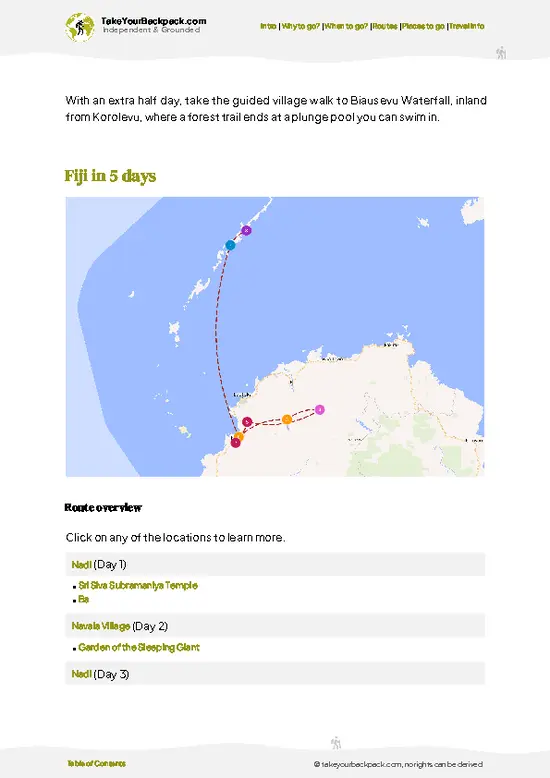
example page 2 from our offline Travel Guide for Fiji
example page 3 from our offline Travel Guide for Fiji
example page 4 from our offline Travel Guide for Fiji
example page 5 from our offline Travel Guide for Fiji
example page 6 from our offline Travel Guide for Fiji
example page 7 from our offline Travel Guide for Fiji
The digital guide (159 pages) contains:
✅ 41 highlights, ranked by travel appeal
✅ Optimized 2, 3 & 5-day travel routes
✅ Cities, national parks, landmarks, beaches
✅ How to get around
✅ Offline-friendly for travel without Wi-Fi
👉 Click to see all 30+ guide features

📅 Plan smarter in minutes, not weeks
✅ Month by month travel advice
✅ Festivals & national holidays
✅ Budget expectations

🗺️ Go to the right places, skip the overrated ones
✅ Honest pros & cons of destinations
✅ Top hikes, parks & viewpoints
✅ Lesser-known places most travelers miss
✅ Clear “worth it vs skip it” guidance

🛏️ Travel smoothly without rookie mistakes
✅ Best areas to stay
✅ Transport systems explained simply
✅ Common scams & safety advice
✅ SIM cards, money & practical tips

🌍 Understand the country, not just visit it
✅ Culture & traditions
✅ 52 Essential phrases & customs
✅ Festivals worth planning around
✅ Traveler-friendly historical context
✅ Insights that make places more meaningful

📱 Built for real travel conditions
✅ Fully downloadable PDF
✅ Works completely offline
✅ Optimized for phone use
✅ Useful in remote areas & buses
✅ Everything in one place
Stop searching, start planning
Get instant access to your full guide. 30‑day money-back guarantee.
+ Add another guide for just

By proceeding you agree to our terms.
Sent to your inbox immediately after payment • 100% Secure Checkout
Best Backpacking Travel Advisor 2025 tourism awardBest Backpacking
Travel Advisor
2025
What others say about Take Your Backpack Guides:
⭐⭐⭐⭐⭐
Fantastic, amazing amount of information!
⭐⭐⭐⭐⭐
My goodness this is amazing, it's what I've been looking for hats off too you!
⭐⭐⭐⭐⭐
I think this is absolutely BRILLIANT
⭐⭐⭐⭐
Very complete and informative. It's still missing places, but I gotta to commend you
⭐⭐⭐⭐⭐
This is truly amazing, thank you, can't wait to explore it with my kids!
⭐⭐⭐⭐⭐
Awesome resource, thank you!
⭐⭐⭐⭐⭐
This is amazing! Can't wait to explore the ones I haven't seen
⭐⭐⭐⭐
I love this! Well done, great idea.
⭐⭐⭐⭐⭐
Thanks for taking the time to make this gem!
⭐⭐⭐⭐⭐
This might be the best website I've ever seen.
⭐⭐⭐⭐⭐
Congratulations, and thank you so much for your work; it's incredibly valuable.
⭐⭐⭐⭐
In all seriousness I think you did a great job pointing out the important spots
⭐⭐⭐⭐⭐
10/10 very good
⭐⭐⭐⭐⭐
As someone who's only just starting to visit regularly this is awesome, thank you.
⭐⭐⭐⭐
Thank you very much! I'm going to visit my dad, it's going to be very useful!
⭐⭐⭐⭐⭐
This is really cool! We'll be travelling for the first time and this definitely come in handy.
⭐⭐⭐⭐⭐
You are now our minister of culture, congratulations 👨‍💼
⭐⭐⭐⭐⭐
Just wanted to tell you that this is a pearl! Going to follow your recommendations.
⭐⭐⭐⭐⭐
This is so cool. I'll definitely be using the resource for my travels soon.
⭐⭐⭐⭐⭐
This is very impressive! Good work.
⭐⭐⭐⭐⭐
This is an amazing and informative site. Very well done!

🛏️ Where to stay?Where to Base Yourself

Fiji has plenty of hostels, with dorm beds usually running FJ$30 to 60 (about US$13 to 27) a night, and the biggest cluster sits along Wailoaloa Beach in Nadi, roughly 10 minutes from the international airport. Wailoaloa is the easiest base for ferry departures to the Mamanuca Islands and Yasawa Islands and has a sociable bar scene, though the gray-sand beach is forgettable; out on the islands, budget resorts sell dorm beds with a compulsory meal plan, so expect FJ$100 to 200 per night with food included in exchange for clear water and very quiet evenings. On the main island, the Coral Coast near Sigatoka has calmer beachfront backpacker spots with little nightlife, while Suva offers a handful … read more 👉
Fiji has plenty of hostels, with dorm beds usually running FJ$30 to 60 (about US$13 to 27) a night, and the biggest cluster sits along Wailoaloa Beach in Nadi, roughly 10 minutes from the international airport. Wailoaloa is the easiest base for ferry departures to the Mamanuca Islands and Yasawa Islands and has a sociable bar scene, though the gray-sand beach is forgettable; out on the islands, budget resorts sell dorm beds with a compulsory meal plan, so expect FJ$100 to 200 per night with food included in exchange for clear water and very quiet evenings. On the main island, the Coral Coast near Sigatoka has calmer beachfront backpacker spots with little nightlife, while Suva offers a handful of cheap guesthouses and the liveliest weekend bars but more rain and more petty crime after dark.

If you enjoy meeting fellow travelers, consider choosing hostels with high ratings for atmosphere. On the other hand, if you prefer having your own space, a hotel might be a better option.

FijiExpand Your Journey

👋 Meet the founderWho’s Behind Take Your Backpack?

Johan, backpacker and founder of TakeYourBackpackHi, I’m Johan (Netherlands 🇳🇱), the creator of TakeYourBackpack. Over the past 3 decades, I’ve backpacked through 90+ countries across six continents, gaining extensive experience with independent travel, long-term trips, and overland routes.

This site is built on a combination of firsthand travel experience and carefully curated insights from other backpackers. Many guides are based on places I’ve personally visited, while others bring together tips, observations, and practical advice shared by trusted travelers I’ve met along the way.

The goal is to provide realistic, experience-driven guidance — not generic itineraries — so you can explore destinations with better context, clearer expectations, and more confidence.