×

Fiji🇫🇯 | best citiesTop-Rated cities in Fiji

Cities in Fiji are really towns by world standards, and that is the charm. The Viti Levu hubs run on bus fumes, market stalls and ferry timetables, while the northern Vanua Levu and island-hopping side feels slower and cheaper. For independent travel, pick by pace: big and practical, or small and sleepy. Hit the markets before 9 a.m. for the best produce and the shortest queues.

By Johan Kruseman 🇳🇱 | Updated October 20, 2026
Explore the best towns in Fiji

Why go?Why These city Stand Out

Fiji is a volcanic island nation of more than 300 islands, so urban life stays small and clings to a few coastal pockets. Most people live on Viti Levu and Vanua Levu, and the towns grew around colonial-era ports, sugar mills and government offices, which is why they feel working rather than polished. Indo-Fijian and indigenous Fijian communities share the streets, so you get Hindu temples, mosques, churches and curry roti shops within a few blocks.

Before choosing Fiji for its cities, know that sights are modest and the real draw is markets, food and people. Buses and carriers are cheap and frequent on the main islands, but ferries to outer islands can be canceled by weather. Plan cities as base camps for the sea, not as the whole show.
How the List Was Created
The list of best cities in Fiji is created based on culture, vibe, attractions, transport ease, and local charm. If you feel a city is missing in this list, please let us know.

When to go?Best Time to Visit Fiji for cities

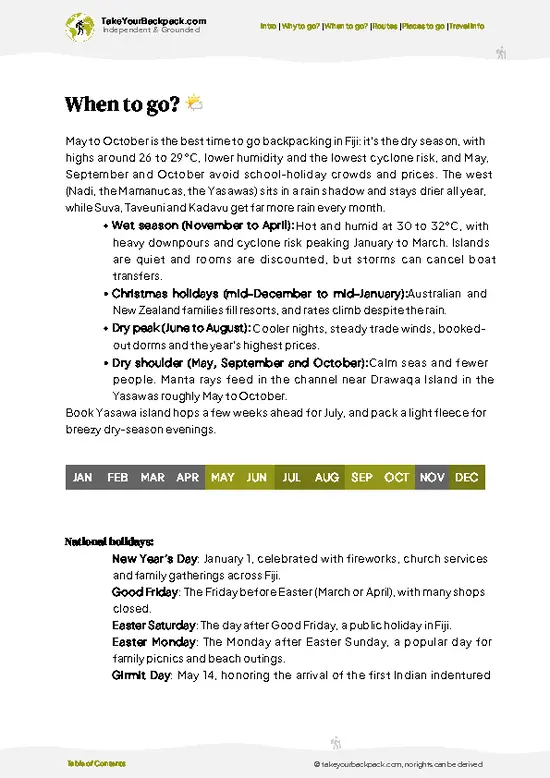
Best months: The best months for Fiji’s cities are May to October, when the dry season brings daytime highs around 26 to 29°C and far less rain than the wet months. Humidity drops, streets are walkable at midday, and ferries and flights run on time.
Shoulder and wet season: November to April is hotter (30 to 33°C), muggy and wetter, with heavy downpours and a cyclone risk from roughly December to April. The windward southeast of Viti Levu and Vanua Levu get the most rain, while the leeward west side around Nadi and Lautoka stays noticeably drier and sunnier. Prices dip in the wet season, with some rooms 20 to 30 percent cheaper.
Peak periods: July to August and the Christmas to New Year stretch push up room rates and fill ferries, so book boats and beds early. Diwali, usually October or November, closes many shops for a day or two.

city hoppingHow to Combine cities Into One Trip

How many days: A trip combining several Fiji cities needs 7 to 10 days, because distances look small on the map but transport is slow. Group the places on Viti Levu first, moving along the Queens Road between the west and the south, then add Vanua Levu only if you have a week or more to spare.
Pacing and transfers: Allow 2 to 3 nights per stop. Express buses on Viti Levu take about 3.5 to 4.5 hours between the west and the capital, while flights or ferries to Vanua Levu run roughly 1 hour by air or 8 to 10 hours by overnight ferry. Travel west to east, since international flights land in Nadi and the capital has the best onward options.
Common mistakes: Travelers cram in a city a day and lose half of it on buses. Skip that. Leave a buffer day before your flight home, and check ferry schedules the day before, since weather often shifts them.

The ListTop cities of Fiji

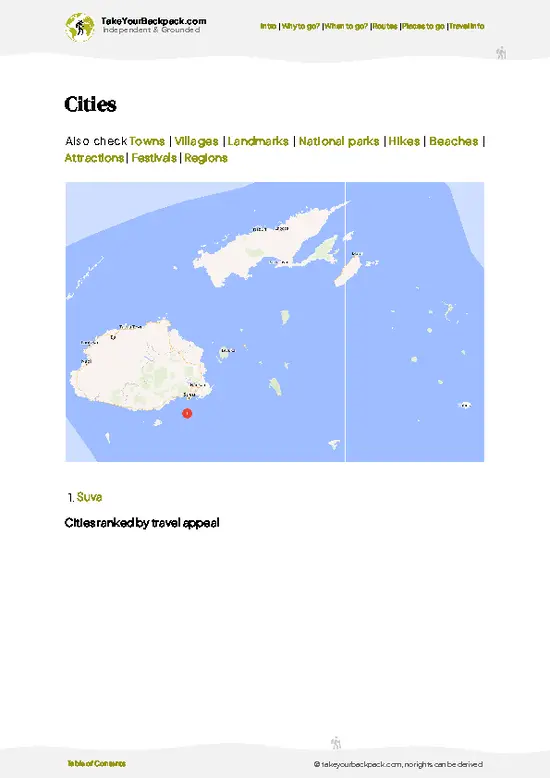
1 Suva

Capital base, Fiji Museum, municipal market, rainforest park

Sort out ferries and cash, then browse the museum, shop the Saturday market and hike to waterfall pools in Colo-i-Suva.

Loading the map 🌍

Expert viewExpert Commentary on cities

How many cities: I would advise two or three cities, no more. Fiji’s urban centers are small, with a morning at the market and an afternoon wandering often covering most of what a town offers, and each extra stop costs half a day on a bus. Two bases plus the islands is the best use of your time and money.
Choosing the kind: If you want practicality and food, pick a larger Viti Levu hub, where banks, supermarkets, buses and ferries cluster; you save money and time but give up quiet. If you want calm and culture, a smaller or northern town gives slower streets and friendlier prices, though transport costs more per kilometer and services are thinner. Backpackers on a tight budget get the most from a big hub, because cheap dorm beds and quick connections come together there.
What it costs: Budget … read more 👉
How many cities: I would advise two or three cities, no more. Fiji’s urban centers are small, with a morning at the market and an afternoon wandering often covering most of what a town offers, and each extra stop costs half a day on a bus. Two bases plus the islands is the best use of your time and money.
Choosing the kind: If you want practicality and food, pick a larger Viti Levu hub, where banks, supermarkets, buses and ferries cluster; you save money and time but give up quiet. If you want calm and culture, a smaller or northern town gives slower streets and friendlier prices, though transport costs more per kilometer and services are thinner. Backpackers on a tight budget get the most from a big hub, because cheap dorm beds and quick connections come together there.
What it costs: Budget about US$40 to 70 a day (roughly FJ$90 to 160) in the cities, covering a dorm bed at FJ$30 to 60, meals at FJ$8 to 20 from market stalls and curry shops, and local buses at FJ$1 to 5 a ride. Temple entry is usually free or a small donation, and guided cultural tours run about FJ$50 to 120. A typical city visit lands around US$25 to 45 above your daily spend if you add a tour and taxis.
Safety and culture: Cities are generally friendly, but petty theft and bag snatching happen after dark, so use taxis (FJ$5 to 10 across town) rather than walking at night. Dress modestly away from beaches, with shoulders and knees covered in town, and remove your shoes and hat when entering temples or a village. Sunday is quiet, with many shops shut and churches busy. Accept a kava invitation politely if offered, and bring a small sevusevu gift if heading to a village.

✈️ The backpacker research shortcutFiji Travel Guide

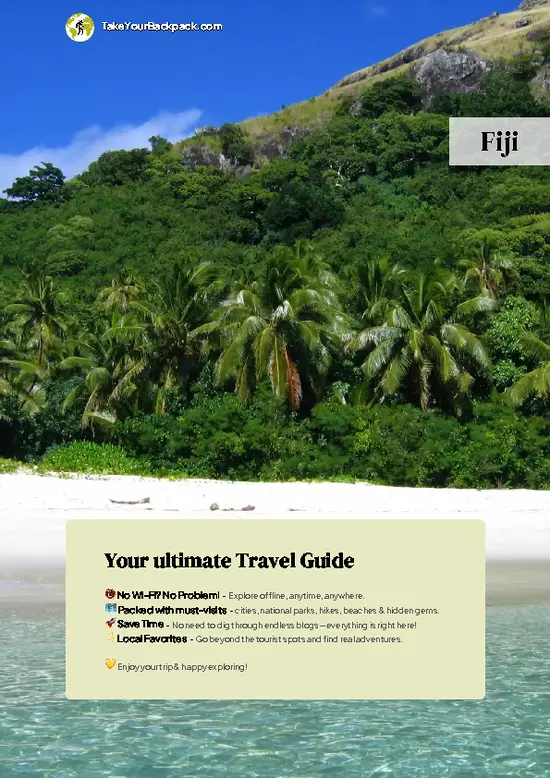
An offline-friendly backpacking guide with optimized travel routes, ranked highlights, transport advice, and the best areas to stay.
example page 0 from our offline Travel Guide for Fiji
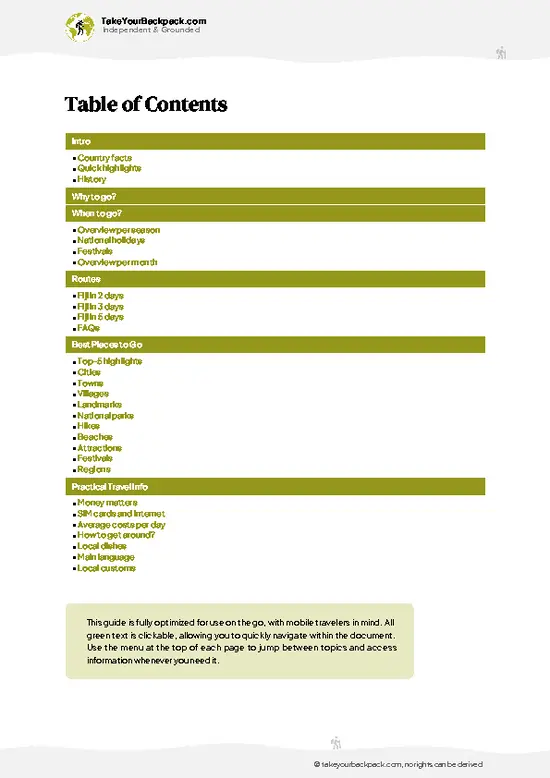
example page 1 from our offline Travel Guide for Fiji
example page 2 from our offline Travel Guide for Fiji
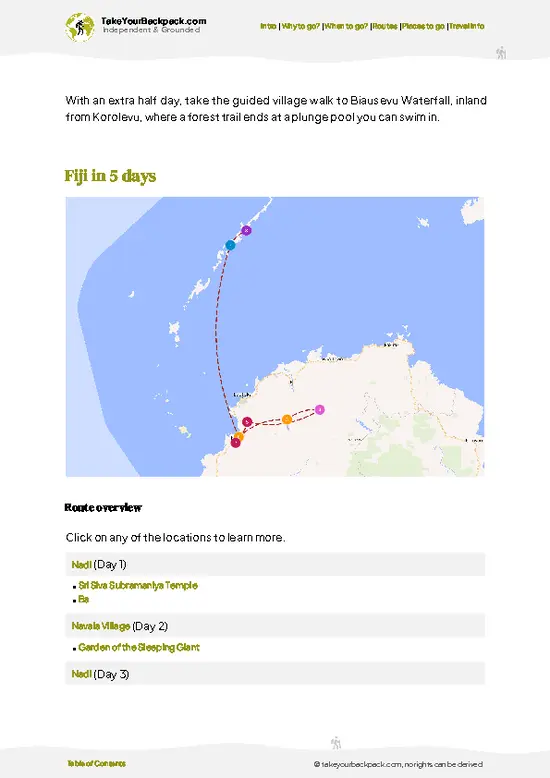
example page 3 from our offline Travel Guide for Fiji
example page 4 from our offline Travel Guide for Fiji
example page 5 from our offline Travel Guide for Fiji
example page 6 from our offline Travel Guide for Fiji
example page 7 from our offline Travel Guide for Fiji
The digital guide (159 pages) contains:
✅ 41 highlights, ranked by travel appeal
✅ Optimized 2, 3 & 5-day travel routes
✅ Cities, national parks, landmarks, beaches
✅ How to get around
✅ Offline-friendly for travel without Wi-Fi
👉 Click to see all 30+ guide features

📅 Plan smarter in minutes, not weeks
✅ Month by month travel advice
✅ Festivals & national holidays
✅ Budget expectations

🗺️ Go to the right places, skip the overrated ones
✅ Honest pros & cons of destinations
✅ Top hikes, parks & viewpoints
✅ Lesser-known places most travelers miss
✅ Clear “worth it vs skip it” guidance

🛏️ Travel smoothly without rookie mistakes
✅ Best areas to stay
✅ Transport systems explained simply
✅ Common scams & safety advice
✅ SIM cards, money & practical tips

🌍 Understand the country, not just visit it
✅ Culture & traditions
✅ 52 Essential phrases & customs
✅ Festivals worth planning around
✅ Traveler-friendly historical context
✅ Insights that make places more meaningful

📱 Built for real travel conditions
✅ Fully downloadable PDF
✅ Works completely offline
✅ Optimized for phone use
✅ Useful in remote areas & buses
✅ Everything in one place
Stop searching, start planning
Get instant access to your full guide. 30‑day money-back guarantee.
+ Add another guide for just

By proceeding you agree to our terms.
Sent to your inbox immediately after payment • 100% Secure Checkout
Best Backpacking Travel Advisor 2025 tourism awardBest Backpacking
Travel Advisor
2025
What others say about Take Your Backpack Guides:
⭐⭐⭐⭐⭐
Fantastic, amazing amount of information!
⭐⭐⭐⭐⭐
My goodness this is amazing, it's what I've been looking for hats off too you!
⭐⭐⭐⭐⭐
I think this is absolutely BRILLIANT
⭐⭐⭐⭐
Very complete and informative. It's still missing places, but I gotta to commend you
⭐⭐⭐⭐⭐
This is truly amazing, thank you, can't wait to explore it with my kids!
⭐⭐⭐⭐⭐
Awesome resource, thank you!
⭐⭐⭐⭐⭐
This is amazing! Can't wait to explore the ones I haven't seen
⭐⭐⭐⭐
I love this! Well done, great idea.
⭐⭐⭐⭐⭐
Thanks for taking the time to make this gem!
⭐⭐⭐⭐⭐
This might be the best website I've ever seen.
⭐⭐⭐⭐⭐
Congratulations, and thank you so much for your work; it's incredibly valuable.
⭐⭐⭐⭐
In all seriousness I think you did a great job pointing out the important spots
⭐⭐⭐⭐⭐
10/10 very good
⭐⭐⭐⭐⭐
As someone who's only just starting to visit regularly this is awesome, thank you.
⭐⭐⭐⭐
Thank you very much! I'm going to visit my dad, it's going to be very useful!
⭐⭐⭐⭐⭐
This is really cool! We'll be travelling for the first time and this definitely come in handy.
⭐⭐⭐⭐⭐
You are now our minister of culture, congratulations 👨‍💼
⭐⭐⭐⭐⭐
Just wanted to tell you that this is a pearl! Going to follow your recommendations.
⭐⭐⭐⭐⭐
This is so cool. I'll definitely be using the resource for my travels soon.
⭐⭐⭐⭐⭐
This is very impressive! Good work.
⭐⭐⭐⭐⭐
This is an amazing and informative site. Very well done!

🛏️ Where to stay?Where to Base Yourself

Fiji has plenty of hostels, with dorm beds usually running FJ$30 to 60 (about US$13 to 27) a night, and the biggest cluster sits along Wailoaloa Beach in Nadi, roughly 10 minutes from the international airport. Wailoaloa is the easiest base for ferry departures to the Mamanuca Islands and Yasawa Islands and has a sociable bar scene, though the gray-sand beach is forgettable; out on the islands, budget resorts sell dorm beds with a compulsory meal plan, so expect FJ$100 to 200 per night with food included in exchange for clear water and very quiet evenings. On the main island, the Coral Coast near Sigatoka has calmer beachfront backpacker spots with little nightlife, while Suva offers a handful … read more 👉
Fiji has plenty of hostels, with dorm beds usually running FJ$30 to 60 (about US$13 to 27) a night, and the biggest cluster sits along Wailoaloa Beach in Nadi, roughly 10 minutes from the international airport. Wailoaloa is the easiest base for ferry departures to the Mamanuca Islands and Yasawa Islands and has a sociable bar scene, though the gray-sand beach is forgettable; out on the islands, budget resorts sell dorm beds with a compulsory meal plan, so expect FJ$100 to 200 per night with food included in exchange for clear water and very quiet evenings. On the main island, the Coral Coast near Sigatoka has calmer beachfront backpacker spots with little nightlife, while Suva offers a handful of cheap guesthouses and the liveliest weekend bars but more rain and more petty crime after dark.

If you enjoy meeting fellow travelers, consider choosing hostels with high ratings for atmosphere. On the other hand, if you prefer having your own space, a hotel might be a better option.

FijiExpand Your Journey

👋 Meet the founderWho’s Behind Take Your Backpack?

Johan, backpacker and founder of TakeYourBackpackHi, I’m Johan (Netherlands 🇳🇱), the creator of TakeYourBackpack. Over the past 3 decades, I’ve backpacked through 90+ countries across six continents, gaining extensive experience with independent travel, long-term trips, and overland routes.

This site is built on a combination of firsthand travel experience and carefully curated insights from other backpackers. Many guides are based on places I’ve personally visited, while others bring together tips, observations, and practical advice shared by trusted travelers I’ve met along the way.

The goal is to provide realistic, experience-driven guidance — not generic itineraries — so you can explore destinations with better context, clearer expectations, and more confidence.