×

Fiji🇫🇯 | best landmarksTop-Rated 3 landmarks in Fiji

Landmarks in Fiji are mostly natural and cultural, not monumental: waterfalls, sacred caves, hilltop forts and village-run sites. The Viti Levu ones are cheap and bus-reachable, while the Yasawas and Taveuni need boats and planning. For independent travelers, go early, carry small cash for village fees, and expect quiet outside Nadi’s day-tour hours.

By Johan Kruseman 🇳🇱 | Updated October 20, 2026
Explore the best national parks in Fiji

Why go?Why These unique site Stand Out

Fiji’s landmarks are shaped by land ownership. Roughly 90 percent of land is held by indigenous Fijian clans (mataqali), so many sites sit on village ground and are run by the community, not a national park service. That means sevusevu, a kava gift presented to the village chief, often comes before entry, and small fees go straight to the people who look after the place.

The islands are volcanic and spread across a huge ocean, so sites range from rainforest to limestone caves to reef, and infrastructure thins fast beyond Viti Levu. Expect few signs, no museum-style interpretation, and guides who tell the stories. Come for living culture and landscape, not polished heritage sites. Also pack a sulu (sarong) for villages, since shoulders and knees should be covered.
Our Approach to Ranking
The list of best unique sites in Fiji is created based on history or culture, wow factor, atmosphere, quirks, and memorability. If you feel a unique site is missing in this list, please let us know.

When to go?Best Time to Visit Fiji for landmarks

Best months and weather: May to October is the best window for landmarks in Fiji, because the dry season brings 25 to 29°C days, lower humidity and far less mud on trails. Rain is lighter then, often 50 to 150 mm a month on the leeward sides, though the southeast of Viti Levu and Taveuni stay wetter all year.
Shoulder and peak seasons: November and April are the shoulder months, with warm sea, fewer crowds and some afternoon downpours. December to March is the wet season, with 28 to 32°C heat, heavy rain of 250 to 400 mm a month and cyclone risk, so river crossings and waterfall tracks can close. July and August plus school holidays push resort and boat prices up, often 15 to 30 percent. Book Yasawa passes early then, and aim for mornings, before heat and day-trip groups arrive.

unique site hoppingHow to Combine landmarks Into One Trip

How many days to plan: A trip linking several landmarks in Fiji needs 10 to 14 days, because the distances are short on the map but slow on the water. Viti Levu works as the hub: Nadi, the Coral Coast and Suva connect by bus or van in 3 to 4.5 hours between Nadi and Suva. Island groups such as the Yasawas, Mamanucas and Taveuni sit off that spine, reached by catamaran or domestic flight.
Direction and pacing: Start in Nadi, move along the Coral Coast toward Suva, then fly or ferry to Taveuni, finishing back west if you want the boats. Allow 1 to 2 days per mainland stop and 2 to 3 for island ones. The common mistakes are cramming too many stops into one day and ignoring ferry schedules, which often run once daily and can be canceled in rough weather. Build in a buffer day before any international flight.

The ListTop landmarks of Fiji

1 Sawa-i-Lau Caves

Boat-only island, open-roof pool, underwater swim-through, wall carvings

Climb down wet steps into a daylit pool, then swim a short submerged passage with a guide to reach the darker inner chamber.

2 Naihehe Caves

Guided headlamp walk, limestone stream chambers, warrior refuge, village-run

Wade a shallow stream through limestone chambers by headlamp, where a village guide explains how hill clans hid, kept watch and defended themselves.

fiji-unique-site-naihehe-caves
© Google | Andy Taylor

3 Tavuni Hill Fort

Tongan-built fortress, Sigatoka River view, defensive ditch, lali drum

Walk a short guided loop over grassy terraces and earthworks, then take in the valley and river from a summit chosen for defense.

Loading the map 🌍

Expert viewExpert Commentary on landmarks

How many landmarks are enough: Plan on four to six landmarks across a two-week trip, because Fiji’s distances are measured in ferry schedules and village protocol, not kilometers. Each stop eats half a day once you count boats, buses and the unhurried pace of island life. Cram in more and you spend the trip on a seat instead of at the place.
Which kind to prioritize: Cultural and historic sites suit travelers who want the country behind the resort strip, and they cost the least per hour of interest. Natural sites on the outer islands give the most dramatic payoff, but they cost more in boat fares, so choose one or two. If your budget is tight, favor sites reachable by local bus from the main island, where fares run about FJ$1 to 5 (US$0.45 to 2.25) a ride. If you have time and cash, spend it … read more 👉
How many landmarks are enough: Plan on four to six landmarks across a two-week trip, because Fiji’s distances are measured in ferry schedules and village protocol, not kilometers. Each stop eats half a day once you count boats, buses and the unhurried pace of island life. Cram in more and you spend the trip on a seat instead of at the place.
Which kind to prioritize: Cultural and historic sites suit travelers who want the country behind the resort strip, and they cost the least per hour of interest. Natural sites on the outer islands give the most dramatic payoff, but they cost more in boat fares, so choose one or two. If your budget is tight, favor sites reachable by local bus from the main island, where fares run about FJ$1 to 5 (US$0.45 to 2.25) a ride. If you have time and cash, spend it on one remote island trip instead of three rushed day tours.
What it costs: Budget about FJ$90 to 160 (US$40 to 70) a day, covering a dorm bed, local food and buses. Entry fees at most sites run FJ$10 to 40 (US$4.50 to 18). Village visits often come with a guide or a small community fee of FJ$10 to 30 (US$4.50 to 13). Ferries and small boats are the big swing, from FJ$30 to 200 (US$13 to 90) per leg. Guided tours cost more but save you hours of figuring out transport, which makes them the better value on remote sites. Independent buses win on the main island, where the route is simple.
Safety and respect: Fiji is generally easy and friendly, but customs matter at village-based landmarks. Bring a bundle of kava roots (sevusevu) as a gift to the village head, which usually costs FJ$20 to 40 (US$9 to 18). Remove hats and sunglasses, cover your shoulders and knees, and do not touch anyone’s head. Ask before photographing people or sacred places. Some areas are closed to visitors without permission, so follow your guide’s lead. Tides, currents and sudden rain can make coastal and reef sites risky, so check conditions locally and avoid swimming alone. Carry cash, because card machines vanish quickly outside the main towns. Keep valuables out of sight in towns after dark.

✈️ The backpacker research shortcutFiji Travel Guide

An offline-friendly backpacking guide with optimized travel routes, ranked highlights, transport advice, and the best areas to stay.
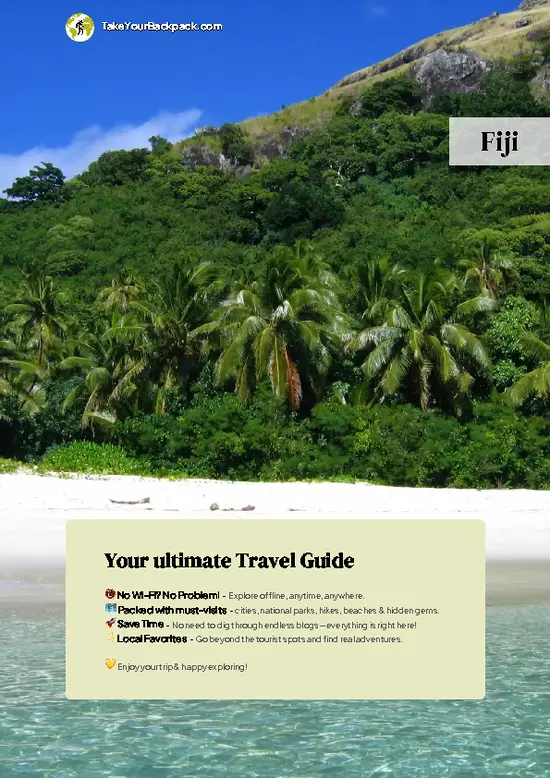
example page 0 from our offline Travel Guide for Fiji
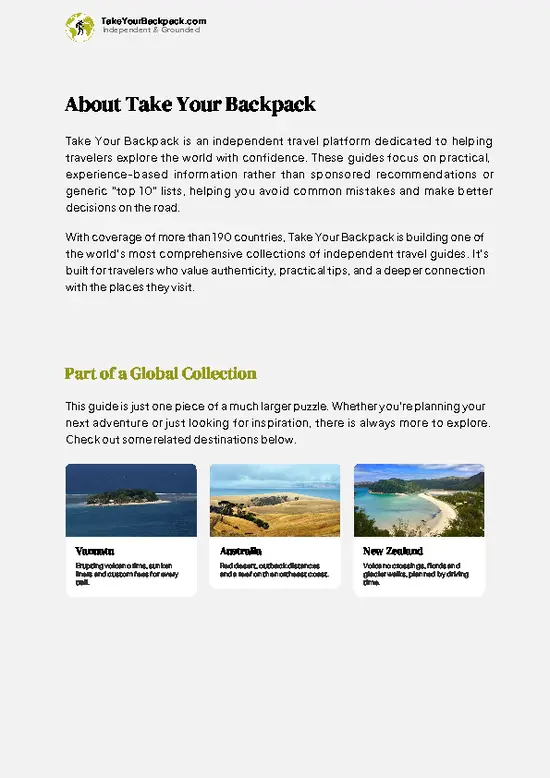
example page 1 from our offline Travel Guide for Fiji
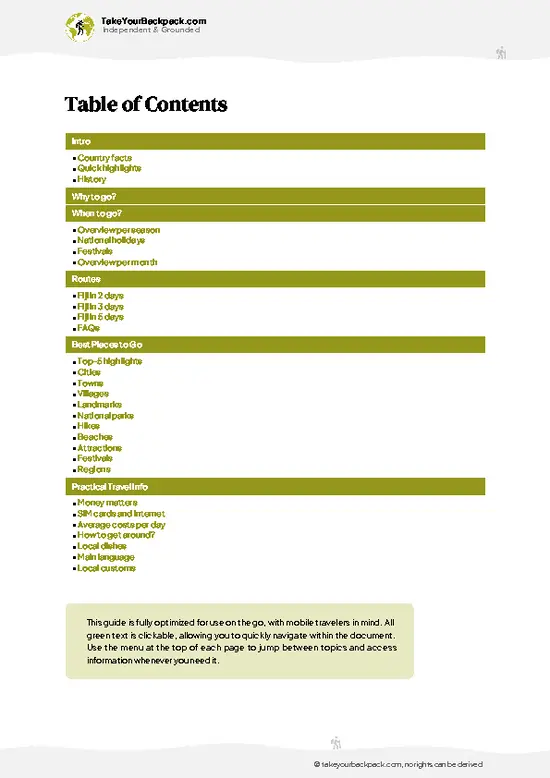
example page 2 from our offline Travel Guide for Fiji
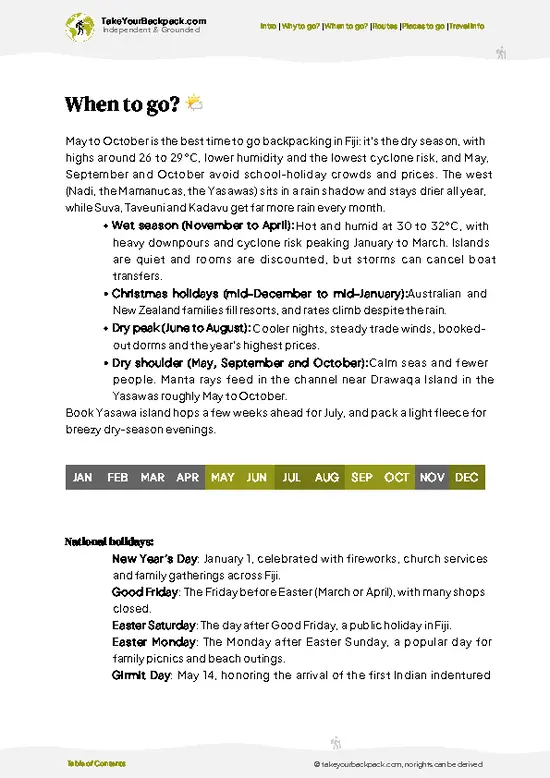
example page 3 from our offline Travel Guide for Fiji
example page 4 from our offline Travel Guide for Fiji
example page 5 from our offline Travel Guide for Fiji
example page 6 from our offline Travel Guide for Fiji
example page 7 from our offline Travel Guide for Fiji
The digital guide (159 pages) contains:
✅ 41 highlights, ranked by travel appeal
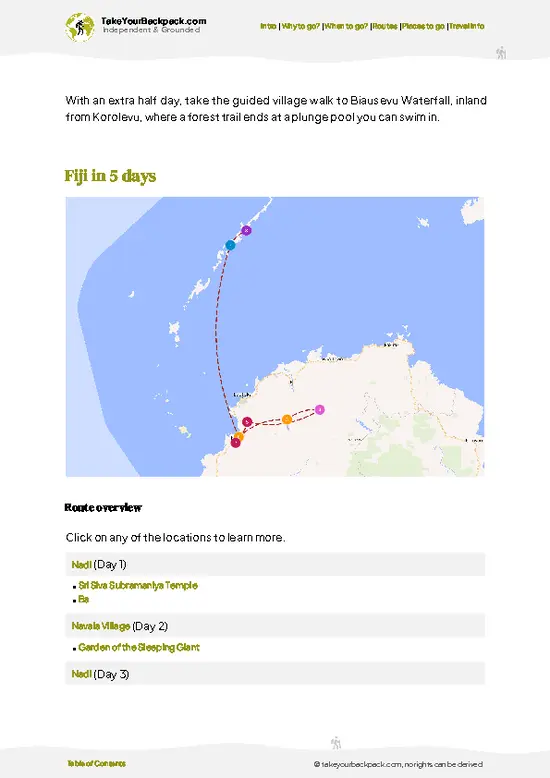
✅ Optimized 2, 3 & 5-day travel routes
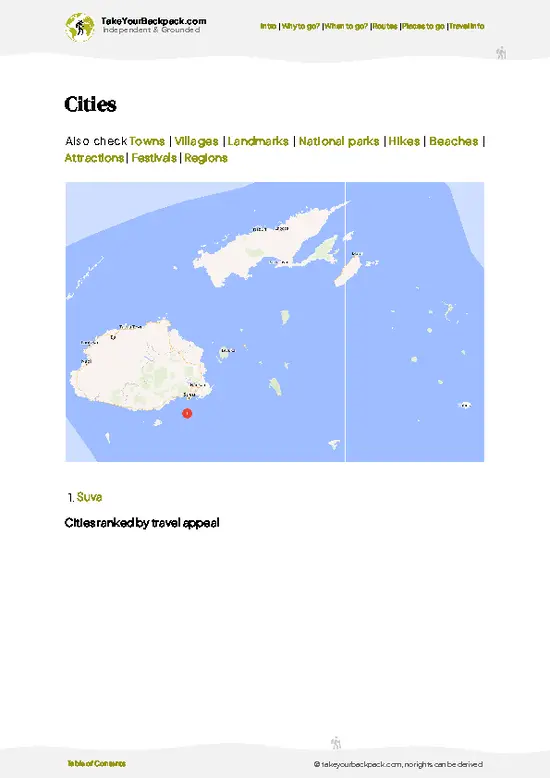
✅ Cities, national parks, landmarks, beaches
✅ How to get around
✅ Offline-friendly for travel without Wi-Fi
👉 Click to see all 30+ guide features

📅 Plan smarter in minutes, not weeks
✅ Month by month travel advice
✅ Festivals & national holidays
✅ Budget expectations

🗺️ Go to the right places, skip the overrated ones
✅ Honest pros & cons of destinations
✅ Top hikes, parks & viewpoints
✅ Lesser-known places most travelers miss
✅ Clear “worth it vs skip it” guidance

🛏️ Travel smoothly without rookie mistakes
✅ Best areas to stay
✅ Transport systems explained simply
✅ Common scams & safety advice
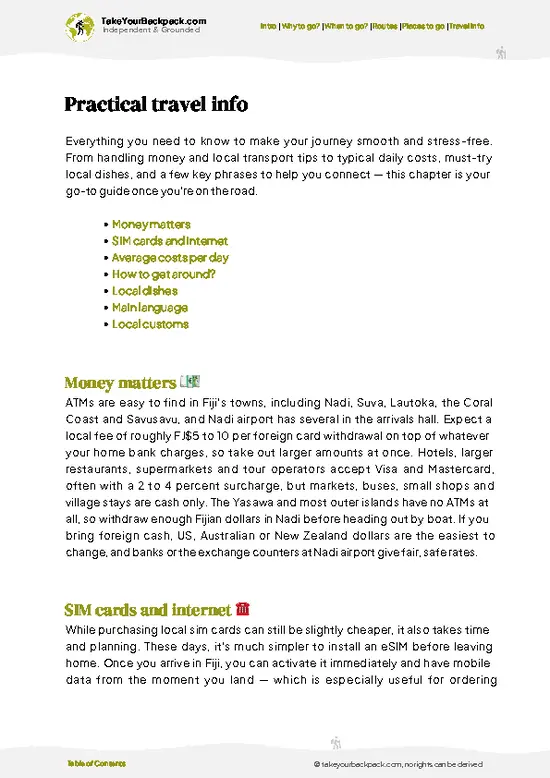
✅ SIM cards, money & practical tips

🌍 Understand the country, not just visit it
✅ Culture & traditions
✅ 52 Essential phrases & customs
✅ Festivals worth planning around
✅ Traveler-friendly historical context
✅ Insights that make places more meaningful

📱 Built for real travel conditions
✅ Fully downloadable PDF
✅ Works completely offline
✅ Optimized for phone use
✅ Useful in remote areas & buses
✅ Everything in one place
Stop searching, start planning
Get instant access to your full guide. 30‑day money-back guarantee.
+ Add another guide for just

By proceeding you agree to our terms.
Sent to your inbox immediately after payment • 100% Secure Checkout
Best Backpacking Travel Advisor 2025 tourism awardBest Backpacking
Travel Advisor
2025
What others say about Take Your Backpack Guides:
⭐⭐⭐⭐⭐
Fantastic, amazing amount of information!
⭐⭐⭐⭐⭐
My goodness this is amazing, it's what I've been looking for hats off too you!
⭐⭐⭐⭐⭐
I think this is absolutely BRILLIANT
⭐⭐⭐⭐
Very complete and informative. It's still missing places, but I gotta to commend you
⭐⭐⭐⭐⭐
This is truly amazing, thank you, can't wait to explore it with my kids!
⭐⭐⭐⭐⭐
Awesome resource, thank you!
⭐⭐⭐⭐⭐
This is amazing! Can't wait to explore the ones I haven't seen
⭐⭐⭐⭐
I love this! Well done, great idea.
⭐⭐⭐⭐⭐
Thanks for taking the time to make this gem!
⭐⭐⭐⭐⭐
This might be the best website I've ever seen.
⭐⭐⭐⭐⭐
Congratulations, and thank you so much for your work; it's incredibly valuable.
⭐⭐⭐⭐
In all seriousness I think you did a great job pointing out the important spots
⭐⭐⭐⭐⭐
10/10 very good
⭐⭐⭐⭐⭐
As someone who's only just starting to visit regularly this is awesome, thank you.
⭐⭐⭐⭐
Thank you very much! I'm going to visit my dad, it's going to be very useful!
⭐⭐⭐⭐⭐
This is really cool! We'll be travelling for the first time and this definitely come in handy.
⭐⭐⭐⭐⭐
You are now our minister of culture, congratulations 👨‍💼
⭐⭐⭐⭐⭐
Just wanted to tell you that this is a pearl! Going to follow your recommendations.
⭐⭐⭐⭐⭐
This is so cool. I'll definitely be using the resource for my travels soon.
⭐⭐⭐⭐⭐
This is very impressive! Good work.
⭐⭐⭐⭐⭐
This is an amazing and informative site. Very well done!

🛏️ Where to stay?Top Areas to Stay

Fiji has plenty of hostels, with dorm beds usually running FJ$30 to 60 (about US$13 to 27) a night, and the biggest cluster sits along Wailoaloa Beach in Nadi, roughly 10 minutes from the international airport. Wailoaloa is the easiest base for ferry departures to the Mamanuca Islands and Yasawa Islands and has a sociable bar scene, though the gray-sand beach is forgettable; out on the islands, budget resorts sell dorm beds with a compulsory meal plan, so expect FJ$100 to 200 per night with food included in exchange for clear water and very quiet evenings. On the main island, the Coral Coast near Sigatoka has calmer beachfront backpacker spots with little nightlife, while Suva offers a handful … read more 👉
Fiji has plenty of hostels, with dorm beds usually running FJ$30 to 60 (about US$13 to 27) a night, and the biggest cluster sits along Wailoaloa Beach in Nadi, roughly 10 minutes from the international airport. Wailoaloa is the easiest base for ferry departures to the Mamanuca Islands and Yasawa Islands and has a sociable bar scene, though the gray-sand beach is forgettable; out on the islands, budget resorts sell dorm beds with a compulsory meal plan, so expect FJ$100 to 200 per night with food included in exchange for clear water and very quiet evenings. On the main island, the Coral Coast near Sigatoka has calmer beachfront backpacker spots with little nightlife, while Suva offers a handful of cheap guesthouses and the liveliest weekend bars but more rain and more petty crime after dark.

If you enjoy meeting fellow travelers, consider choosing hostels with high ratings for atmosphere. On the other hand, if you prefer having your own space, a hotel might be a better option.

FijiDiscover the Country

👋 Meet the founderWho’s Behind Take Your Backpack?

Johan, backpacker and founder of TakeYourBackpackHi, I’m Johan (Netherlands 🇳🇱), the creator of TakeYourBackpack. Over the past 3 decades, I’ve backpacked through 90+ countries across six continents, gaining extensive experience with independent travel, long-term trips, and overland routes.

This site is built on a combination of firsthand travel experience and carefully curated insights from other backpackers. Many guides are based on places I’ve personally visited, while others bring together tips, observations, and practical advice shared by trusted travelers I’ve met along the way.

The goal is to provide realistic, experience-driven guidance — not generic itineraries — so you can explore destinations with better context, clearer expectations, and more confidence.