×

Fiji🇫🇯 | national parksBouma National Heritage ParkTavoro Falls, swimming pools, Vidawa forest hike, orange dove | things to do and best time to go

Explore Wainibau Falls TrailExplore Colo-i-Suva Forest Park

Backpacking in Bouma National Heritage Park
🏆 Top picknational park ranked #1
By Johan Kruseman 🇳🇱 | Updated October 15, 2026

The call most visitors face is whether to base on Taveuni and day-trip in, or to commit to a night at the park’s edge, and the answer depends on tides and weather: go by day if rain has been heavy, because the tracks turn to mud and the pools run brown. Bouma National Heritage Park sits on the northeast coast of Taveuni, in Fiji’s Northern Division, roughly 35 kilometers from the main town of Waiyevo. The payoff is rainforest, three waterfalls, a ridge walk with a view across to Qamea, and birds like the orange dove and the silktail. Costs and delays catch people out. Cash only at the gate, so bring small notes from Waiyevo. Buses are sparse and slow on Sundays, so arrive early. Wear shoes you can wet, since a pool swim comes with a river crossing. Compared with Lavena Coastal Walk further along the road, Bouma is easier, shorter and more crowded, with less shoreline and fewer kayak-and-swim moments.

Discover everything you want to know in the 📖 Fiji Travel Guide.


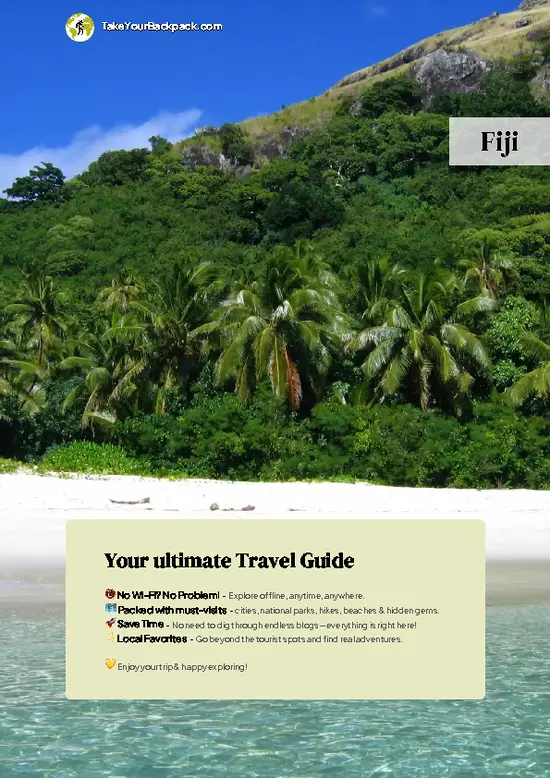
example page 0 from our offline Travel Guide for Fiji
example page 1 from our offline Travel Guide for Fiji
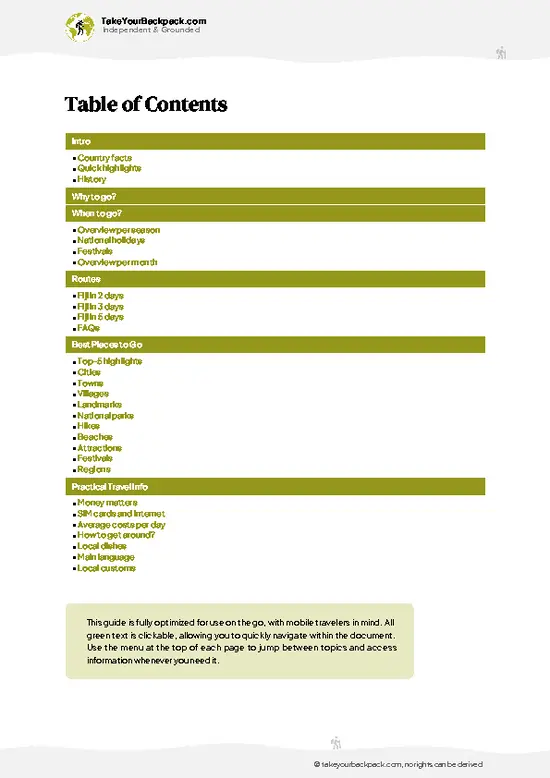
example page 2 from our offline Travel Guide for Fiji
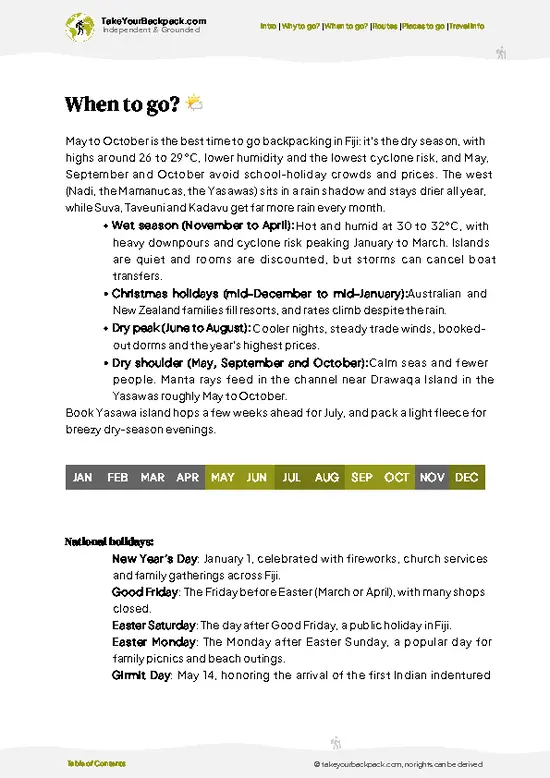
example page 3 from our offline Travel Guide for Fiji
example page 4 from our offline Travel Guide for Fiji
example page 5 from our offline Travel Guide for Fiji
example page 6 from our offline Travel Guide for Fiji
example page 7 from our offline Travel Guide for Fiji
Loading the map 🌍
CLICK TO FILTER
cities
towns
villages
landmarks
national parks
hikes
beaches
attractions
festivals
regions
SHOW COUNTRY’S BESTSHOW ALL

✨ Why go?
Ranked #1 national park in Fiji
Why visitors keep coming back

Backpackers choose Bouma because it is the easiest way on Taveuni to walk into real rainforest without a guide, a tour or a booking. You pay at the entrance, pick a track, and go at your own speed. The Tavoro Waterfalls are set up for exactly that, with a wide, well-kept path, picnic shelters and swimmable pools beneath the first fall. A second reason is the way the park rewards effort in layers. The lower fall takes minutes, while the Vidawa Rainforest Hike and the ridge toward the third fall stretch the day into half a morning or more. You can see the first fall and leave, or keep climbing. That flexibility suits travelers on tight schedules and those with time to burn alike. Add the fact that the park lies on the island Fiji is known for as the Garden Island, with a fern-heavy interior … read more 👉
Backpackers choose Bouma because it is the easiest way on Taveuni to walk into real rainforest without a guide, a tour or a booking. You pay at the entrance, pick a track, and go at your own speed. The Tavoro Waterfalls are set up for exactly that, with a wide, well-kept path, picnic shelters and swimmable pools beneath the first fall. A second reason is the way the park rewards effort in layers. The lower fall takes minutes, while the Vidawa Rainforest Hike and the ridge toward the third fall stretch the day into half a morning or more. You can see the first fall and leave, or keep climbing. That flexibility suits travelers on tight schedules and those with time to burn alike. Add the fact that the park lies on the island Fiji is known for as the Garden Island, with a fern-heavy interior and a long list of forest birds, and a self-guided day makes sense. The village-run setup also means your entry fee goes to the local landowners rather than a tour operator.

💡 HighlightsMust-see experiences and standout moments

  1. Tavoro Waterfalls: The park’s signature sight is a trio of falls reached along a maintained forest track. The first drops into a deep pool that is cold, clear and good for swimming, and the path to it is flat and short.
  2. Second and Third Falls: Beyond the first pool the track climbs and narrows, with stream crossings and tree roots underfoot. These falls are quieter, and the upper pool often has no one in it at all.
  3. Vidawa Rainforest Hike: A longer circuit through old forest, with giant buttress roots, tree ferns and a cultural stop at an old village site. Allow a good half day and bring water.
  4. Tavoro Lookout Ridge: The ridge path climbs above the canopy and opens a view over Qamea and, on clear days, as far as the Kaibu and Naitoba islands. On clear mornings it is the best photo on this side
… read more 👉
  1. Tavoro Waterfalls: The park’s signature sight is a trio of falls reached along a maintained forest track. The first drops into a deep pool that is cold, clear and good for swimming, and the path to it is flat and short.
  2. Second and Third Falls: Beyond the first pool the track climbs and narrows, with stream crossings and tree roots underfoot. These falls are quieter, and the upper pool often has no one in it at all.
  3. Vidawa Rainforest Hike: A longer circuit through old forest, with giant buttress roots, tree ferns and a cultural stop at an old village site. Allow a good half day and bring water.
  4. Tavoro Lookout Ridge: The ridge path climbs above the canopy and opens a view over Qamea and, on clear days, as far as the Kaibu and Naitoba islands. On clear mornings it is the best photo on this side of the island.
  5. Forest birdlife: The orange dove, Taveuni’s bright forest birds and the rare silktail live in the canopy here. Early morning, before tour groups arrive, gives the best chance of hearing and spotting them.
  6. Waitabu Marine Park: Just down the coast, this village-managed reef is known for protected coral and good snorkeling. It pairs well with a day in Bouma if you want salt water after the forest.
  7. Picnic shelters at the first pool: Simple thatched shelters sit beside the lower fall, and they are a decent place to wait out a shower and eat lunch.
Start with the first waterfall in the morning, while the light is soft, the pool is empty and your legs are fresh for the climb to the upper falls.
Spotted a mistake or missing something? Contact us.

🌤️ When to go?Weather, crowds, and seasonal trade-offs

May to October is the best window for Bouma, with the driest weather and the firmest trails on Taveuni.
  • Dry Season (May to October): Days run 24 to 28°C (75 to 82°F), nights drop to 18 to 21°C (64 to 70°F). Rain still falls on this windward coast, but tracks to the Tavoro Waterfalls stay passable. Daylight lasts about 11 to 12 hours, with sunset near 5:30 to 6 pm.
  • Wet Season (November to April): Expect 26 to 31°C (79 to 88°F), heavy humidity and downpours that turn the Lavena Coastal Walk muddy and swell its stream crossings. Cyclones are possible, mainly January to March. Days stretch to about 13 hours of light. Waterfalls are at their fullest, and lodgings often discount rooms.
  • School Holidays (July and December): Fijian families and Australian and New Zealand visitors fill the island, so book
… read more 👉
May to October is the best window for Bouma, with the driest weather and the firmest trails on Taveuni.
  • Dry Season (May to October): Days run 24 to 28°C (75 to 82°F), nights drop to 18 to 21°C (64 to 70°F). Rain still falls on this windward coast, but tracks to the Tavoro Waterfalls stay passable. Daylight lasts about 11 to 12 hours, with sunset near 5:30 to 6 pm.
  • Wet Season (November to April): Expect 26 to 31°C (79 to 88°F), heavy humidity and downpours that turn the Lavena Coastal Walk muddy and swell its stream crossings. Cyclones are possible, mainly January to March. Days stretch to about 13 hours of light. Waterfalls are at their fullest, and lodgings often discount rooms.
  • School Holidays (July and December): Fijian families and Australian and New Zealand visitors fill the island, so book transport and rooms ahead. Even then, Bouma stays quiet compared with the main islands.
  • Diving and Snorkeling: Water clarity off Taveuni is best in the drier months.
Start walks early, since afternoon showers are common even in the dry months.


source: climatestotravel.comJANJanuary: fair for travelingFEBFebruary: fair for travelingMARMarch: fair for travelingAPRApril: fair for travelingMAYMay: highly recommended for travelingJUNJune: highly recommended for travelingJULJuly: good for travelingAUGAugust: good for travelingSEPSeptember: highly recommended for travelingOCTOctober: highly recommended for travelingNOVNovember: fair for travelingDECDecember: fair for traveling
fiji-national-park-bouma-national-heritage-park
© Google | Jiří Prokeš

✈️ The backpacker research shortcutFiji Travel Guide

An offline-friendly backpacking guide with optimized travel routes, ranked highlights, transport advice, and the best areas to stay.
example page 0 from our offline Travel Guide for Fiji
example page 1 from our offline Travel Guide for Fiji
example page 2 from our offline Travel Guide for Fiji
example page 3 from our offline Travel Guide for Fiji
example page 4 from our offline Travel Guide for Fiji
example page 5 from our offline Travel Guide for Fiji
example page 6 from our offline Travel Guide for Fiji
example page 7 from our offline Travel Guide for Fiji
The digital guide (159 pages) contains:
✅ 41 highlights, ranked by travel appeal
✅ Optimized 2, 3 & 5-day travel routes
✅ Cities, national parks, landmarks, beaches
✅ How to get around
✅ Offline-friendly for travel without Wi-Fi
👉 Click to see all 30+ guide features

📅 Plan smarter in minutes, not weeks
✅ Month by month travel advice
✅ Festivals & national holidays
✅ Budget expectations

🗺️ Go to the right places, skip the overrated ones
✅ Honest pros & cons of destinations
✅ Top hikes, parks & viewpoints
✅ Lesser-known places most travelers miss
✅ Clear “worth it vs skip it” guidance

🛏️ Travel smoothly without rookie mistakes
✅ Best areas to stay
✅ Transport systems explained simply
✅ Common scams & safety advice
✅ SIM cards, money & practical tips

🌍 Understand the country, not just visit it
✅ Culture & traditions
✅ 52 Essential phrases & customs
✅ Festivals worth planning around
✅ Traveler-friendly historical context
✅ Insights that make places more meaningful

📱 Built for real travel conditions
✅ Fully downloadable PDF
✅ Works completely offline
✅ Optimized for phone use
✅ Useful in remote areas & buses
✅ Everything in one place
Stop searching, start planning
Get instant access to your full guide. 30‑day money-back guarantee.
+ Add another guide for just

By proceeding you agree to our terms.
Sent to your inbox immediately after payment • 100% Secure Checkout
Best Backpacking Travel Advisor 2025 tourism awardBest Backpacking
Travel Advisor
2025
What others say about Take Your Backpack Guides:
⭐⭐⭐⭐⭐
Fantastic, amazing amount of information!
⭐⭐⭐⭐⭐
My goodness this is amazing, it's what I've been looking for hats off too you!
⭐⭐⭐⭐⭐
I think this is absolutely BRILLIANT
⭐⭐⭐⭐
Very complete and informative. It's still missing places, but I gotta to commend you
⭐⭐⭐⭐⭐
This is truly amazing, thank you, can't wait to explore it with my kids!
⭐⭐⭐⭐⭐
Awesome resource, thank you!
⭐⭐⭐⭐⭐
This is amazing! Can't wait to explore the ones I haven't seen
⭐⭐⭐⭐
I love this! Well done, great idea.
⭐⭐⭐⭐⭐
Thanks for taking the time to make this gem!
⭐⭐⭐⭐⭐
This might be the best website I've ever seen.
⭐⭐⭐⭐⭐
Congratulations, and thank you so much for your work; it's incredibly valuable.
⭐⭐⭐⭐
In all seriousness I think you did a great job pointing out the important spots
⭐⭐⭐⭐⭐
10/10 very good
⭐⭐⭐⭐⭐
As someone who's only just starting to visit regularly this is awesome, thank you.
⭐⭐⭐⭐
Thank you very much! I'm going to visit my dad, it's going to be very useful!
⭐⭐⭐⭐⭐
This is really cool! We'll be travelling for the first time and this definitely come in handy.
⭐⭐⭐⭐⭐
You are now our minister of culture, congratulations 👨‍💼
⭐⭐⭐⭐⭐
Just wanted to tell you that this is a pearl! Going to follow your recommendations.
⭐⭐⭐⭐⭐
This is so cool. I'll definitely be using the resource for my travels soon.
⭐⭐⭐⭐⭐
This is very impressive! Good work.
⭐⭐⭐⭐⭐
This is an amazing and informative site. Very well done!

🛏️ Where to stay?Choosing the right base

Most backpackers sleep in or near Bouma village on Taveuni, or around Matei and Waiyevo, because there is no accommodation inside the park itself.
Near the park, a handful of family-run lodges and small resorts sit along the coast road within a few minutes of the Tavoro Waterfalls entrance. These suit hikers who want to be on the trail by 8 am. Dorm beds are rare here, so expect simple private rooms or bures, often with meals available because shops are few.
Lavena, at the end of the road about 14 km (9 miles) further south, has a basic lodge and a village-run campsite beside the start of the coastal … read more 👉
Most backpackers sleep in or near Bouma village on Taveuni, or around Matei and Waiyevo, because there is no accommodation inside the park itself.
Near the park, a handful of family-run lodges and small resorts sit along the coast road within a few minutes of the Tavoro Waterfalls entrance. These suit hikers who want to be on the trail by 8 am. Dorm beds are rare here, so expect simple private rooms or bures, often with meals available because shops are few.
Lavena, at the end of the road about 14 km (9 miles) further south, has a basic lodge and a village-run campsite beside the start of the coastal walk. It is quiet, with limited electricity and no restaurants beyond what the village prepares.
Matei, about 45 minutes by road to the northwest, is the best base for variety. It has the airstrip, guesthouses, a few small budget hostels and dive operators, plus the island’s best choice of places to eat.
Waiyevo, the administrative center, has more shops, banks, an ATM and the ferry connection, though fewer rooms with atmosphere.
Stock up on food and cash before heading to Bouma, as shops and card facilities are minimal. Book ahead in July and December.

👛 Costs (as of 15 October 2026)How expensive it really is

A day in Bouma National Heritage Park runs about US$22 to 24 for a backpacker who camps or uses a simple dorm, with the Total Daily Budget below at US$94 using high-season prices.
CategoryBudget RangeLocal Reality
Tavoro Waterfalls entryUS$22 to 24Paid at the ranger hut at the start of the Tavoro trail, usually bundled with a guide and access to the swimming pools. Payment is in Fijian dollars.
Lavena Coastal Walk entryUS$15 to 17Paid at the Lavena village side of the park, south of Bouma at the end of the east-coast road. Often done as a separate day.
Accommodation (high season)US$25 to 45Camping and basic dorm or bure beds are the budget options near Bouma, and rates rise in the dry months from May to October. Take US$30 as the working figure here.
Food and suppliesUS$15 to 30Lodges serve set
… read more 👉
A day in Bouma National Heritage Park runs about US$22 to 24 for a backpacker who camps or uses a simple dorm, with the Total Daily Budget below at US$94 using high-season prices.
CategoryBudget RangeLocal Reality
Tavoro Waterfalls entryUS$22 to 24Paid at the ranger hut at the start of the Tavoro trail, usually bundled with a guide and access to the swimming pools. Payment is in Fijian dollars.
Lavena Coastal Walk entryUS$15 to 17Paid at the Lavena village side of the park, south of Bouma at the end of the east-coast road. Often done as a separate day.
Accommodation (high season)US$25 to 45Camping and basic dorm or bure beds are the budget options near Bouma, and rates rise in the dry months from May to October. Take US$30 as the working figure here.
Food and suppliesUS$15 to 30Lodges serve set meals, and the few village stores near Bouma stock only basics such as noodles, tinned fish and biscuits. Bring extra supplies from Waiyevo or Matei.
Local transportUS$4 to 15Local buses on the east-coast road run infrequently, and carriers or shared taxis cost more per trip. Budget about US$7 for a typical day of hopping between trailheads.
Guides and extrasUS$0 to 12Guiding for the waterfall walk is covered by the fee, though a tip is welcome. Kayak or snorkel hire from lodges adds a little on top.
Total Daily BudgetUS$94Sum of the Tavoro entry (US$22), high-season accommodation (US$30), food (US$20), transport (US$7) and extras (US$15). Skipping extras and the second entry fee brings it nearer US$75.
⚠️ Prices can change and everyone travels differently, so take this as a rough guide. Hope it helps you plan your adventure!

🥾 TrailsHiking Bouma National Heritage Park national park: highlights and difficulty

Bouma’s walking is simple to plan, since the main tracks all start from the same entrance area and branch off a single path.
  • Tavoro Waterfalls Track: Roughly 2 kilometers return to the first fall, about 30 to 45 minutes each way at an easy pace. Easy grade, a wide gravel and dirt path through palms and ferns, ending at a swimming pool.
  • Second and Third Falls: The path continues on a steeper, rootier track with a few stream crossings. Count on 1.5 to 2 hours return from the entrance for the second fall, and a little more for the third. Moderate difficulty, slippery after rain.
  • Vidawa Rainforest Hike:
… read more 👉
Bouma’s walking is simple to plan, since the main tracks all start from the same entrance area and branch off a single path.
  • Tavoro Waterfalls Track: Roughly 2 kilometers return to the first fall, about 30 to 45 minutes each way at an easy pace. Easy grade, a wide gravel and dirt path through palms and ferns, ending at a swimming pool.
  • Second and Third Falls: The path continues on a steeper, rootier track with a few stream crossings. Count on 1.5 to 2 hours return from the entrance for the second fall, and a little more for the third. Moderate difficulty, slippery after rain.
  • Vidawa Rainforest Hike: A guided or self-led circuit of roughly 3 to 4 hours through primary forest. Moderate, with some uphill and muddy sections, and the best chance for forest birds and lizards.
  • Lookout Ridge: A short, steep branch of about 30 minutes up from the main path. Moderate, with a viewpoint across the strait.
Terrain is wet, green and muddy, and the humidity is high even on dry days. Wear shoes with grip, carry water, and pack insect repellent. Wildlife is mostly birds and geckos, with the odd frog near the water.
Getting here without a car means local buses from Waiyevo along the coast road, but services thin out and may skip Sundays, so many travelers share taxis or rent a car. There is an entrance fee, paid in cash at the gate, and it covers all the tracks. Crowds stay light, with small tour groups appearing late morning, so arriving early gives the quietest pools.
⚠️ Hiking info can sometimes be outdated or inaccurate. Before you hit the trail, check the latest conditions with locals. If you do spot anything that's off, I'd love to hear from you, so I can update it for fellow travelers.

🛡️ SafetySafety Tips and Common Scams in Bouma National Heritage Park

Bouma is a well-managed, straightforward park where the main issues are mud, heat and sudden rain rather than danger.
Trails to the three Tavoro Waterfalls are graded and mostly gentle, though rocks around the pools are slick, so wear shoes with grip and swim only where locals do. After heavy rain, streams rise quickly. Lavena’s coastal walk includes several stream crossings and a stretch along the shore that is best done at lower tide, so check conditions with the ranger and start early to be back before afternoon showers.
Wildlife is gentle. You will meet birds such as the orange dove and the rare, brilliant red-and-green shining parrot, plus occasional mosquitoes. Wear repellent, particularly at dawn and dusk, when dengue-carrying mosquitoes are active.
Carry at least 2 liters of water, a … read more 👉
Bouma is a well-managed, straightforward park where the main issues are mud, heat and sudden rain rather than danger.
Trails to the three Tavoro Waterfalls are graded and mostly gentle, though rocks around the pools are slick, so wear shoes with grip and swim only where locals do. After heavy rain, streams rise quickly. Lavena’s coastal walk includes several stream crossings and a stretch along the shore that is best done at lower tide, so check conditions with the ranger and start early to be back before afternoon showers.
Wildlife is gentle. You will meet birds such as the orange dove and the rare, brilliant red-and-green shining parrot, plus occasional mosquitoes. Wear repellent, particularly at dawn and dusk, when dengue-carrying mosquitoes are active.
Carry at least 2 liters of water, a rain layer, sunscreen and a small first-aid kit, since there are no shops on the trails. Mobile signal is patchy, so tell your host your route and return time. Dress modestly in villages and respect any local requests regarding swimming areas.

FAQCommon questions from travelers

Two to three days is enough for Bouma, though a full day can cover the main sights. Spend one morning at the three Tavoro Waterfalls, which takes about 2 to 3 hours if you swim at the second pool, and another day on the Lavena Coastal Walk, about 4 to 5 hours round trip. A third day suits snorkeling or kayaking and a rest on the coast.
Yes, you can reach Bouma without a car, but it takes planning. Buses run along Taveuni’s main road between Matei, Waiyevo and Bouma, roughly 45 to 90 minutes depending on where you start, though services are infrequent, so check return times. Taxis and carriers are the alternative, costing noticeably more, and staying near Bouma lets you walk to the Tavoro trails.
Yes, there are entrance fees, but no advance permit is usually needed. The Tavoro Waterfalls and the Lavena Coastal Walk each charge a per-person fee, about FJD 50 (US$22) for Tavoro and FJD 35 (US$16) for Lavena, paid at the visitor center or ranger stations. Bring cash in Fijian dollars, since card payment is not reliable, and ask about guide options at the same time.
⚠️ Things can change over time, so always validate details locally before you go.

Other Fijian national parks near Bouma National Heritage Park

Explore more nearby:


💡 Not sure where to go next?
Create a personalized itinerary for Fiji including Bouma National Heritage Park and the places that fit your trip.

Generate my itinerary

👉 Discover all national parks

Or checkout all Fiji has to offer (think cities, towns, villages, national parks, hikes, beaches, festivals)
Country photo of Fiji

We 💚 feedbackParting advice and final tips

Most visitors rush to the first waterfall, swim, and leave, never realizing the forest floor above it is where Bouma gets interesting. I would go up past the second fall and stop at the quiet bends of the stream, where the birds are louder and the crowds are gone. Bring a dry shirt to change into for the ride back.

✍️ Help improve this page!
The information on this page is based on in-depth research, insights shared by experienced travelers, and feedback from the local travel community in Fiji. While every effort is made to keep the information accurate and current, conditions can change — so if you spot anything incorrect or outdated, please get in touch.


🙋‍♂️ Give feedback

👋 Meet the founderWho’s Behind Take Your Backpack?

Johan, backpacker and founder of TakeYourBackpackHi, I’m Johan (Netherlands 🇳🇱), the creator of TakeYourBackpack. Over the past 3 decades, I’ve backpacked through 90+ countries across six continents, gaining extensive experience with independent travel, long-term trips, and overland routes.

This site is built on a combination of firsthand travel experience and carefully curated insights from other backpackers. Many guides are based on places I’ve personally visited, while others bring together tips, observations, and practical advice shared by trusted travelers I’ve met along the way.

The goal is to provide realistic, experience-driven guidance — not generic itineraries — so you can explore destinations with better context, clearer expectations, and more confidence.