
×

Fiji🇫🇯 | national parksVatu-i-Ra Conservation ParkTidal passage, soft coral walls, reef sharks, seabird islet | things to do and best time to go

Explore Sovi BasinExplore Coral Coast

Backpacking in Vatu-i-Ra Conservation Park
👍 Recommendednational park ranked #6
By Johan Kruseman 🇳🇱 | Updated October 15, 2026

Vatu-i-Ra Conservation Park is a reef and islet marine reserve with no trails, no campsites and no village, so the whole visit happens on or under the water. It sits in Fiji’s north, in Bligh Water between Viti Levu and Vanua Levu, and you reach it only by boat. That is the catch: it is a dive and snorkel destination, so hikers should look elsewhere. The reward is superb reef, big fish and seabirds around a tiny rock. Crowds are almost nonexistent. Book a liveaboard or a dive operator with the right permissions rather than hunting for a ferry, since none run here. Choose your dates early, because rough seas cancel trips and you lose a day, so leave a buffer before any flight home. A first day usually means an early boat, a briefing, and two dives on the walls before a late lunch aboard.

Discover everything you want to know in the 📖 Fiji Travel Guide.


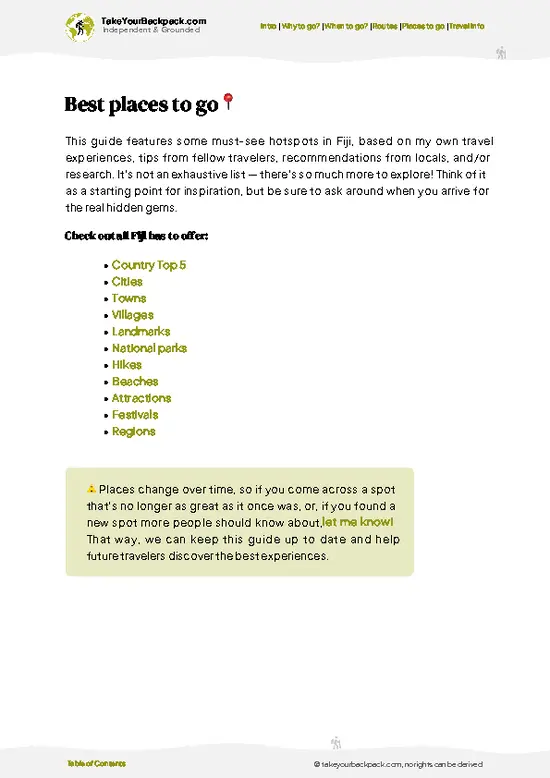
example page 0 from our offline Travel Guide for Fiji
example page 1 from our offline Travel Guide for Fiji
example page 2 from our offline Travel Guide for Fiji
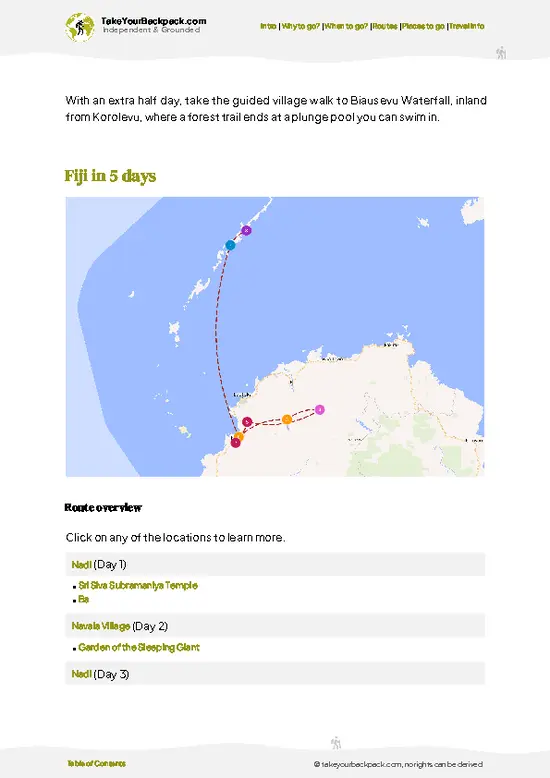
example page 3 from our offline Travel Guide for Fiji
example page 4 from our offline Travel Guide for Fiji
example page 5 from our offline Travel Guide for Fiji
example page 6 from our offline Travel Guide for Fiji
example page 7 from our offline Travel Guide for Fiji
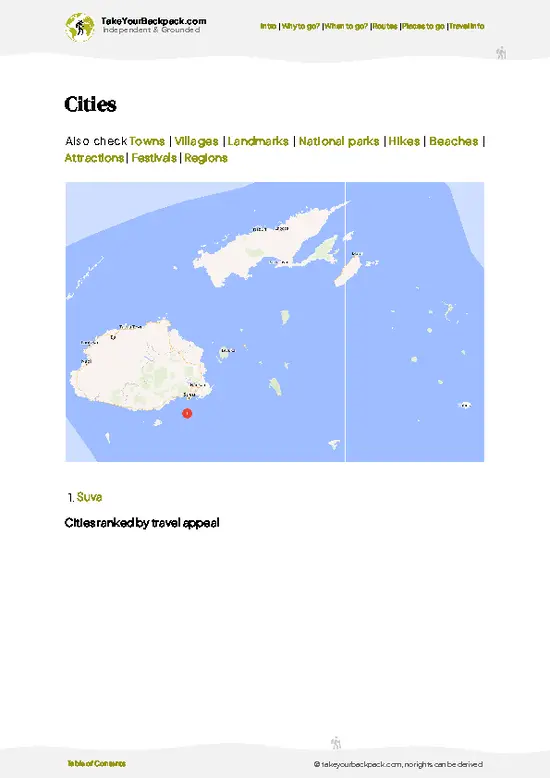
Loading the map 🌍
CLICK TO FILTER
cities
towns
villages
landmarks
national parks
hikes
beaches
attractions
festivals
regions
SHOW COUNTRY’S BESTSHOW ALL

✨ Why go?
Ranked #6 national park in Fiji
What makes this national park worth exploring

Backpackers come here for one reason: the reef. Vatu-i-Ra Passage funnels strong currents between Viti Levu and Vanua Levu, and that moving water feeds soft corals, sea fans and schools of fish you rarely see closer to the mainland. The area is also known for Vatu-i-Ra Island, a small rocky islet where seabirds nest, so you get birdlife above and reef below in one trip.

Independent exploring is limited. You cannot wander the park on foot, and you cannot simply turn up and hire a canoe. Trips run through dive operators and liveaboard boats, so the self-guided spirit shows up in how you plan rather than in how you move. Pair the trip with a few days of snorkeling or diving elsewhere in the north to share costs, and use a certified operator who knows the currents. If you want a wild, uncrowded … read more 👉
Backpackers come here for one reason: the reef. Vatu-i-Ra Passage funnels strong currents between Viti Levu and Vanua Levu, and that moving water feeds soft corals, sea fans and schools of fish you rarely see closer to the mainland. The area is also known for Vatu-i-Ra Island, a small rocky islet where seabirds nest, so you get birdlife above and reef below in one trip.

Independent exploring is limited. You cannot wander the park on foot, and you cannot simply turn up and hire a canoe. Trips run through dive operators and liveaboard boats, so the self-guided spirit shows up in how you plan rather than in how you move. Pair the trip with a few days of snorkeling or diving elsewhere in the north to share costs, and use a certified operator who knows the currents. If you want a wild, uncrowded dive site and accept being on someone else’s schedule, it is a fine place to spend a few days.

💡 HighlightsKey sights and experiences for travelers

  1. Vatu-i-Ra Passage: The channel is the main draw. Tidal currents sweep along its walls, bringing pelagic fish, reef sharks and dense coral growth.
  2. Vatu-i-Ra Island: A small rocky islet rising from the sea, used by nesting seabirds. Seen from the boat, it is the park’s landmark.
  3. Soft coral walls: Sea fans and soft corals cover the drop-offs in bright color, best seen on drift dives when the current is running.
  4. Reef shark encounters: Divers often meet grey reef and whitetip sharks cruising the current lines.
  5. Seabird colonies: Birds roost and nest on the islet, and you can watch them circling from the boat between dives.
  6. Snorkeling the shallows: Where conditions allow, the shallower reef edges give snorkelers clear water and plenty of reef fish without needing a dive certificate.
Do the first dive on … read more 👉
  1. Vatu-i-Ra Passage: The channel is the main draw. Tidal currents sweep along its walls, bringing pelagic fish, reef sharks and dense coral growth.
  2. Vatu-i-Ra Island: A small rocky islet rising from the sea, used by nesting seabirds. Seen from the boat, it is the park’s landmark.
  3. Soft coral walls: Sea fans and soft corals cover the drop-offs in bright color, best seen on drift dives when the current is running.
  4. Reef shark encounters: Divers often meet grey reef and whitetip sharks cruising the current lines.
  5. Seabird colonies: Birds roost and nest on the islet, and you can watch them circling from the boat between dives.
  6. Snorkeling the shallows: Where conditions allow, the shallower reef edges give snorkelers clear water and plenty of reef fish without needing a dive certificate.
Do the first dive on the passage itself, because it shows what the park is protecting and lets your guide judge the current before you try the rest.
Spotted a mistake or missing something? Contact us.

Things to do near Vatu-i-Ra Conservation Park

Ratings based on Tripadvisor reviews. When you book through this link, you support our work at no extra cost to you.

🌤️ When to go?When to go for the best experience

  • May to October (dry season): Calmest window for the crossing and diving. Days run 24 to 29°C (75 to 84°F), nights drop to about 20°C (68°F), and visibility on the reef often reaches 30 meters. Daylight lasts roughly 11 to 12 hours.
  • June to August: Cooler, breezier and busiest. Liveaboard and dive resort rates are at their highest and boats book out weeks ahead.
  • November to April (wet season): Hot and humid at 27 to 32°C (81 to 90°F), with heavy squalls and a cyclone risk from January to March. Daylight stretches to about 13.5 hours. Dive trips get canceled in rough seas, though rates soften.
  • September to November: Seas settle, rain is still light and prices sit below peak. Good for big fish action around the Vatu-i-Ra Passage.
Book a flexible window of several days, since wind decides whether boats cross to the reef.

source: climatestotravel.comJANJanuary: fair for travelingFEBFebruary: fair for travelingMARMarch: fair for travelingAPRApril: fair for travelingMAYMay: highly recommended for travelingJUNJune: excellent for travelingJULJuly: excellent for travelingAUGAugust: excellent for travelingSEPSeptember: excellent for travelingOCTOctober: highly recommended for travelingNOVNovember: fair for travelingDECDecember: fair for traveling
fiji-national-park-vatu-i-ra-conservation-park
© Google |

✈️ The backpacker research shortcutFiji Travel Guide

An offline-friendly backpacking guide with optimized travel routes, ranked highlights, transport advice, and the best areas to stay.
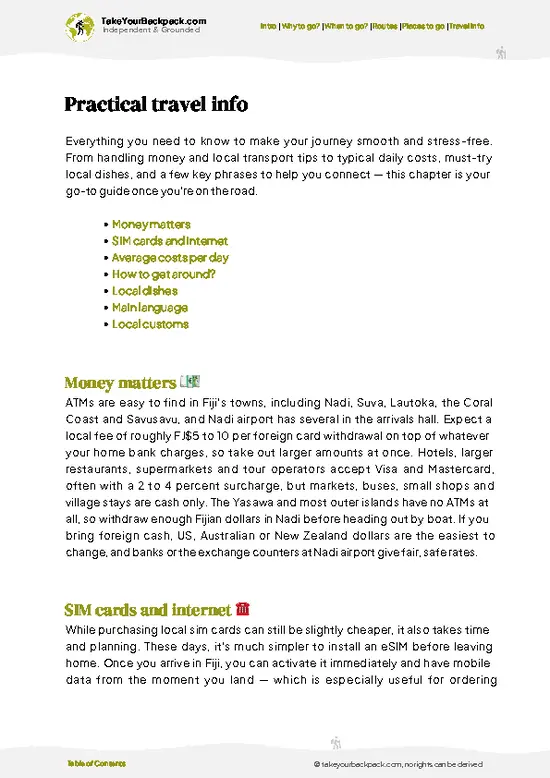
example page 0 from our offline Travel Guide for Fiji
example page 1 from our offline Travel Guide for Fiji
example page 2 from our offline Travel Guide for Fiji
example page 3 from our offline Travel Guide for Fiji
example page 4 from our offline Travel Guide for Fiji
example page 5 from our offline Travel Guide for Fiji
example page 6 from our offline Travel Guide for Fiji
example page 7 from our offline Travel Guide for Fiji
The digital guide (159 pages) contains:
✅ 41 highlights, ranked by travel appeal
✅ Optimized 2, 3 & 5-day travel routes
✅ Cities, national parks, landmarks, beaches
✅ How to get around
✅ Offline-friendly for travel without Wi-Fi
👉 Click to see all 30+ guide features

📅 Plan smarter in minutes, not weeks
✅ Month by month travel advice
✅ Festivals & national holidays
✅ Budget expectations

🗺️ Go to the right places, skip the overrated ones
✅ Honest pros & cons of destinations
✅ Top hikes, parks & viewpoints
✅ Lesser-known places most travelers miss
✅ Clear “worth it vs skip it” guidance

🛏️ Travel smoothly without rookie mistakes
✅ Best areas to stay
✅ Transport systems explained simply
✅ Common scams & safety advice
✅ SIM cards, money & practical tips

🌍 Understand the country, not just visit it
✅ Culture & traditions
✅ 52 Essential phrases & customs
✅ Festivals worth planning around
✅ Traveler-friendly historical context
✅ Insights that make places more meaningful

📱 Built for real travel conditions
✅ Fully downloadable PDF
✅ Works completely offline
✅ Optimized for phone use
✅ Useful in remote areas & buses
✅ Everything in one place
Stop searching, start planning
Get instant access to your full guide. 30‑day money-back guarantee.
+ Add another guide for just

By proceeding you agree to our terms.
Sent to your inbox immediately after payment • 100% Secure Checkout
Best Backpacking Travel Advisor 2025 tourism awardBest Backpacking
Travel Advisor
2025
What others say about Take Your Backpack Guides:
⭐⭐⭐⭐⭐
Fantastic, amazing amount of information!
⭐⭐⭐⭐⭐
My goodness this is amazing, it's what I've been looking for hats off too you!
⭐⭐⭐⭐⭐
I think this is absolutely BRILLIANT
⭐⭐⭐⭐
Very complete and informative. It's still missing places, but I gotta to commend you
⭐⭐⭐⭐⭐
This is truly amazing, thank you, can't wait to explore it with my kids!
⭐⭐⭐⭐⭐
Awesome resource, thank you!
⭐⭐⭐⭐⭐
This is amazing! Can't wait to explore the ones I haven't seen
⭐⭐⭐⭐
I love this! Well done, great idea.
⭐⭐⭐⭐⭐
Thanks for taking the time to make this gem!
⭐⭐⭐⭐⭐
This might be the best website I've ever seen.
⭐⭐⭐⭐⭐
Congratulations, and thank you so much for your work; it's incredibly valuable.
⭐⭐⭐⭐
In all seriousness I think you did a great job pointing out the important spots
⭐⭐⭐⭐⭐
10/10 very good
⭐⭐⭐⭐⭐
As someone who's only just starting to visit regularly this is awesome, thank you.
⭐⭐⭐⭐
Thank you very much! I'm going to visit my dad, it's going to be very useful!
⭐⭐⭐⭐⭐
This is really cool! We'll be travelling for the first time and this definitely come in handy.
⭐⭐⭐⭐⭐
You are now our minister of culture, congratulations 👨‍💼
⭐⭐⭐⭐⭐
Just wanted to tell you that this is a pearl! Going to follow your recommendations.
⭐⭐⭐⭐⭐
This is so cool. I'll definitely be using the resource for my travels soon.
⭐⭐⭐⭐⭐
This is very impressive! Good work.
⭐⭐⭐⭐⭐
This is an amazing and informative site. Very well done!

🛏️ Where to stay?How to pick the right area

Nobody sleeps on Vatu-i-Ra itself. It is a tiny uninhabited islet and reef system in the Bligh Water, so you stay on the mainland of Viti Levu or on a nearby island and go out by boat.
The easiest base is Nananu-i-Ra, a short boat hop from Ra Province’s Rakiraki. Backpacker spots like Safari Lodge and Betham’s Beach Cottages offer dorm beds from about FJ$35 to 60 (US$16 to 27) and private rooms from FJ$120 to 250 (US$55 to 115). Several run dive operations that head to the reef when conditions allow.
Rakiraki town has cheaper guesthouses and motels, plus markets and a bus connection along the Kings … read more 👉
Nobody sleeps on Vatu-i-Ra itself. It is a tiny uninhabited islet and reef system in the Bligh Water, so you stay on the mainland of Viti Levu or on a nearby island and go out by boat.
The easiest base is Nananu-i-Ra, a short boat hop from Ra Province’s Rakiraki. Backpacker spots like Safari Lodge and Betham’s Beach Cottages offer dorm beds from about FJ$35 to 60 (US$16 to 27) and private rooms from FJ$120 to 250 (US$55 to 115). Several run dive operations that head to the reef when conditions allow.
Rakiraki town has cheaper guesthouses and motels, plus markets and a bus connection along the Kings Road. Fewer travelers stay here, but it suits tight budgets.
Some visitors join multi-day liveaboards from Viti Levu or Taveuni that include the park. Cabins cost far more, but they cover the long open crossing without daily transfers.
In peak months, reserve dorms and dive spots at least two to four weeks ahead.

👛 Costs (as of 15 October 2026)Money, prices, and spending tips

A day around Vatu-i-Ra Conservation Park runs about US$215 to 300 per person, because the reef and islet sit offshore in the Bligh Water and are reached only by boat or dive operator, not by trail.
CategoryBudget RangeLocal Reality
Park access and reef feesUS$5 to 15No gate or ticket office. Dive and snorkel operators usually add a small marine or village levy to the trip price, paid in Fijian dollars.
Boat trip or diveUS$120 to 180Day trips from Viti Levu’s north coast or live-aboards run roughly US$120 to 180 per dive day. Snorkelers often pay less where space allows.
Accommodation (high season)US$25 to 60Dorm beds and simple guesthouses near Rakiraki and Nananu-i-Ra cost about US$25 to 60. Rates peak from June to September.
Local transportUS$10 to 20Buses along the Kings Road cost a few dollars,
… read more 👉
A day around Vatu-i-Ra Conservation Park runs about US$215 to 300 per person, because the reef and islet sit offshore in the Bligh Water and are reached only by boat or dive operator, not by trail.
CategoryBudget RangeLocal Reality
Park access and reef feesUS$5 to 15No gate or ticket office. Dive and snorkel operators usually add a small marine or village levy to the trip price, paid in Fijian dollars.
Boat trip or diveUS$120 to 180Day trips from Viti Levu’s north coast or live-aboards run roughly US$120 to 180 per dive day. Snorkelers often pay less where space allows.
Accommodation (high season)US$25 to 60Dorm beds and simple guesthouses near Rakiraki and Nananu-i-Ra cost about US$25 to 60. Rates peak from June to September.
Local transportUS$10 to 20Buses along the Kings Road cost a few dollars, and a taxi to a jetty or dive base adds a bit more.
Food and suppliesUS$15 to 25Roadside curries and cafe meals cost about US$4 to 8. Buy water and snacks on the mainland, since nothing is sold at the islet.
Total Daily BudgetUS$215 to 300Per person, per day, in high season.
⚠️ Prices can change and everyone travels differently, so take this as a rough guide. Hope it helps you plan your adventure!

🥾 TrailsExploring Vatu-i-Ra Conservation Park: trails, terrain, and views

There are no named hiking trails in Vatu-i-Ra Conservation Park. The park is a marine reserve around a small rocky islet, and the activities are water-based.
  • Drift diving: Dives along the walls of Vatu-i-Ra Passage, usually 40 to 60 minutes, with strong currents. Best for experienced divers who are comfortable with current.
  • Snorkeling: Possible on calmer, shallower reef edges, depending on tide and weather. Moderate swimming ability is needed.
  • Boat viewing: Circling the islet to watch nesting seabirds and the steep rock face. No landing is part of a typical trip.
  • Terrain: Underwater walls, coral slopes
… read more 👉
There are no named hiking trails in Vatu-i-Ra Conservation Park. The park is a marine reserve around a small rocky islet, and the activities are water-based.
  • Drift diving: Dives along the walls of Vatu-i-Ra Passage, usually 40 to 60 minutes, with strong currents. Best for experienced divers who are comfortable with current.
  • Snorkeling: Possible on calmer, shallower reef edges, depending on tide and weather. Moderate swimming ability is needed.
  • Boat viewing: Circling the islet to watch nesting seabirds and the steep rock face. No landing is part of a typical trip.
  • Terrain: Underwater walls, coral slopes and open water, with the islet above the surface.
Practical details: there is no public transport to the park. Access is by boat from Viti Levu or Vanua Levu, normally on a liveaboard or a dive operator’s charter, and the crossing can be rough. Crowds are minimal, usually only a boat or two at a time. Entry arrangements and any conservation fees are normally handled through your operator, so ask them when booking. Bring reef-safe sunscreen, motion sickness tablets and a dry bag.
⚠️ Hiking info can sometimes be outdated or inaccurate. Before you hit the trail, check the latest conditions with locals. If you do spot anything that's off, I'd love to hear from you, so I can update it for fellow travelers.

🛡️ SafetySafety Tips and Common Scams in Vatu-i-Ra Conservation Park

The main risk here is open water, since this is a remote reef in the Bligh Water, and nobody visits except by boat with an operator. Wind and swell can change within hours, so go only with a licensed dive or snorkel outfit and accept cancellations when the crew calls them.
Currents in the Vatu-i-Ra Passage can be strong. Dive with a guide, carry a surface marker buoy, and keep to the planned depth and time. Snorkelers should stay near the boat and wear a rash guard, as the sun at sea is fierce.
Sharks, rays and big schooling fish are common, and they are not aggressive when left alone. Keep your hands off the reef and never feed anything.
Bring seasickness tablets, because the crossing is often bumpy. Travel insurance that covers diving matters, as the nearest decompression chamber is far from here.

FAQFrequently asked questions about Vatu-i-Ra Conservation Park

Plan on 2 to 3 days. One day is the boat trip to the reef itself, weather permitting, and extra days give you a buffer for rough seas plus time on Nananu-i-Ra. Liveaboards that visit Vatu-i-Ra usually run 4 to 7 days.
Not realistically, since the park is a remote reef reached only by boat from places like Nananu-i-Ra, a short transfer from Rakiraki. You can reach Rakiraki without a car by bus or carrier along the Kings Road, roughly 3 hours from Nadi or 3.5 hours from Suva. Dive operators arrange the boat, so no vehicle is needed.
There is no formal permit for visitors on a guided trip, since the operator handles access. Some community or reef fees of about FJ$10 to 30 (US$5 to 14) may be added to your dive or boat price. Travelers should check this when booking, and independent boat access is not practical.
⚠️ Things can change over time, so always validate details locally before you go.

Other Fijian national parks near Vatu-i-Ra Conservation Park

Explore more nearby:


💡 Not sure where to go next?
Create a personalized itinerary for Fiji including Vatu-i-Ra Conservation Park and the places that fit your trip.

Generate my itinerary

👉 Discover all national parks

Or checkout all Fiji has to offer (think cities, towns, villages, national parks, hikes, beaches, festivals)
Country photo of Fiji

We 💚 feedbackParting advice and final tips

Treat Vatu-i-Ra as one stop on a northern Fiji dive loop rather than a trip of its own. I would pair it with the reefs of Bligh Water and some time on Vanua Levu, so a rough-sea cancellation does not leave you empty-handed. Bring seasickness tablets, and book a boat with spare days.

✍️ Help improve this page!
The information on this page is based on in-depth research, insights shared by experienced travelers, and feedback from the local travel community in Fiji. While every effort is made to keep the information accurate and current, conditions can change — so if you spot anything incorrect or outdated, please get in touch.


🙋‍♂️ Give feedback

👋 Meet the founderWho’s Behind Take Your Backpack?

Johan, backpacker and founder of TakeYourBackpackHi, I’m Johan (Netherlands 🇳🇱), the creator of TakeYourBackpack. Over the past 3 decades, I’ve backpacked through 90+ countries across six continents, gaining extensive experience with independent travel, long-term trips, and overland routes.

This site is built on a combination of firsthand travel experience and carefully curated insights from other backpackers. Many guides are based on places I’ve personally visited, while others bring together tips, observations, and practical advice shared by trusted travelers I’ve met along the way.

The goal is to provide realistic, experience-driven guidance — not generic itineraries — so you can explore destinations with better context, clearer expectations, and more confidence.