×

Fiji🇫🇯 | regionsCoral CoastFringing reef, tide-ruled swims, Queens Road, sand dunes | things to do and best time to go

Explore Vatu-i-Ra Conservation ParkExplore Nausori Highlands

Backpacking in Coral Coast
🌟 Highlightregion ranked #3
By Johan Kruseman 🇳🇱 | Updated October 15, 2026

Coral Coast is not one long stretch of swimmable sand; much of the shoreline is fringing reef, and at low tide the water can shrink to ankle-deep pools. It runs along the southern edge of Viti Levu in Fiji, on the Queens Road between Sigatoka and Pacific Harbour. The good: resort-free corners with local villages, reef snorkeling right off some beaches, warm water and quiet evenings. The bad: tides dictate everything, some beaches are rocky or weedy, and the strip is dominated by pricey resorts. Time your swim for high tide, check the tide chart each morning, and bring reef shoes. Budget guesthouses and dorm-style lodges exist, with cheap curry roti and market produce in nearby towns. Skip the resort-front photo stops and spend your time at village beaches and the reef. It suits snorkelers and slow-travelers best. Party seekers and anyone wanting surf-style waves will be bored.

Discover everything you want to know in the 📖 Fiji Travel Guide.


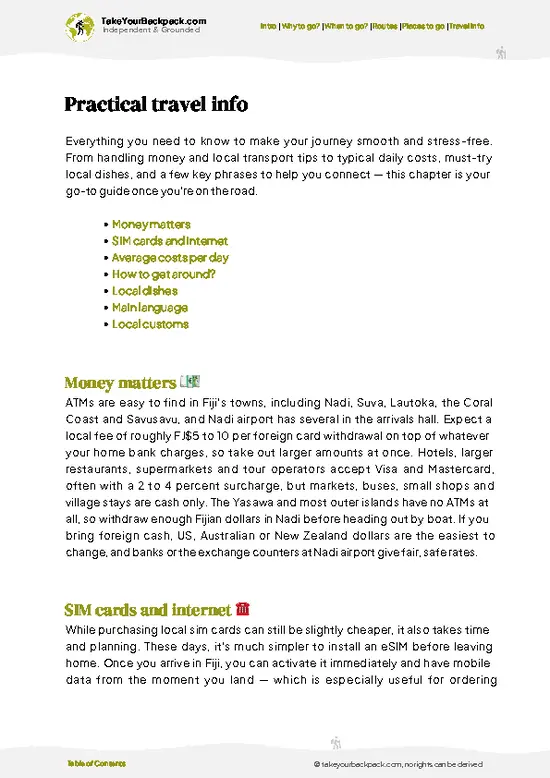
example page 0 from our offline Travel Guide for Fiji
example page 1 from our offline Travel Guide for Fiji
example page 2 from our offline Travel Guide for Fiji
example page 3 from our offline Travel Guide for Fiji
example page 4 from our offline Travel Guide for Fiji
example page 5 from our offline Travel Guide for Fiji
example page 6 from our offline Travel Guide for Fiji
example page 7 from our offline Travel Guide for Fiji
Loading the map 🌍
CLICK TO FILTER
cities
towns
villages
landmarks
national parks
hikes
beaches
attractions
festivals
regions
SHOW COUNTRY’S BESTSHOW ALL

✨ Why go?
Ranked #3 region in Fiji
What makes this region worth visiting

Most backpackers stop here because the reef does the work. At high tide you can walk into clear, calm water and snorkel over hard and soft corals without paying for a boat, which is rare on Viti Levu. The second reason is the road. The Queens Road hugs the coast, so the beaches double as an easy break between Nadi and Suva, with local buses stopping right at the turnoffs. You can hop off, swim, eat and hop on another bus within the same afternoon. The third pull is the village side of the coast. Places around Korotogo and Sigatoka Sand Dunes area give you contact with Fijian life that resort islands skip, from kava evenings to church singing on Sundays. A handful of hostels and homestays keep the social scene friendly without turning it into a party strip. Come for two or three slow days, not a long beach holiday.

💡 HighlightsEssential experiences to have while visiting Coral Coast

  1. Snorkeling the fringing reef at high tide: the reef sits just offshore along much of the coast, and at high tide you can swim out over coral heads with reef fish and the occasional sea star. At low tide the same spot is a mudflat, so plan around the tide.
  2. Sigatoka Sand Dunes National Park: a protected area of wind-shaped dunes at the mouth of the Sigatoka River, with walking trails up to ocean views. It also holds ancient Fijian burial grounds and pottery remains. There is a small entry fee, and a visit takes about two hours.
  3. Korotogo village beach walk: a low-tide walk along the shore to see locals gleaning shellfish and kids playing on the sand. Go at golden hour when the light turns the lagoon copper.
  4. Kula WILD Adventure Park: a wildlife park near Korotogo that is known for Fiji’s native birds,
… read more 👉
  1. Snorkeling the fringing reef at high tide: the reef sits just offshore along much of the coast, and at high tide you can swim out over coral heads with reef fish and the occasional sea star. At low tide the same spot is a mudflat, so plan around the tide.
  2. Sigatoka Sand Dunes National Park: a protected area of wind-shaped dunes at the mouth of the Sigatoka River, with walking trails up to ocean views. It also holds ancient Fijian burial grounds and pottery remains. There is a small entry fee, and a visit takes about two hours.
  3. Korotogo village beach walk: a low-tide walk along the shore to see locals gleaning shellfish and kids playing on the sand. Go at golden hour when the light turns the lagoon copper.
  4. Kula WILD Adventure Park: a wildlife park near Korotogo that is known for Fiji’s native birds, iguanas and turtle conservation. It has an entry fee, and a visit takes about one to two hours.
  5. Evening kava with a village host: many guesthouses can arrange a sevusevu welcome in a nearby village, where you sit on mats, clap and drink kava from a coconut bowl. It is a quiet night activity that replaces clubs, and a gift of kava roots is customary.
Together these fit comfortably into two relaxed days, with the dunes and the park taking half a day each and the reef swims fitted around the tide.
Spotted a mistake or missing something? Contact us.

Things to do around Coral Coast

Ratings based on Tripadvisor reviews. When you book through this link, you support our work at no extra cost to you.

⌛️ 5 daysWhat you can realistically do in a week

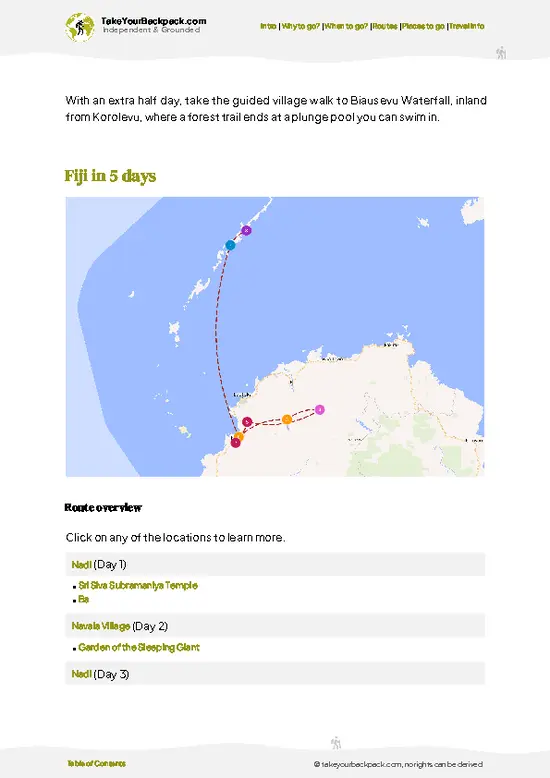
Day 1: Sigatoka: Start at the Sigatoka end, where the Queens Road runs the length of the coast and local buses and carriers stop at nearly every village. That one road sets your pace: flag a bus, ride, hop off, repeat. Spend the morning at the produce market, then walk the Sigatoka Sand Dunes at the river mouth, a short ride from town, where the ridges drop straight to the surf.Day 2: Korotogo: Move east to Korotogo, a compact beach strip where hostels and cafes sit within a few minutes’ walk of each other. Unpack once and stay put. Kula WILD Adventure Park is the draw here, with Fijian wildlife and a canopy walkway, and it fits neatly into a lazy afternoon after the beach.Day 3: Natadola: Take a morning bus back west for Natadola, the wide, pale beach that is the best swimming on this coast. … read more 👉
Day 1: Sigatoka: Start at the Sigatoka end, where the Queens Road runs the length of the coast and local buses and carriers stop at nearly every village. That one road sets your pace: flag a bus, ride, hop off, repeat. Spend the morning at the produce market, then walk the Sigatoka Sand Dunes at the river mouth, a short ride from town, where the ridges drop straight to the surf.Day 2: Korotogo: Move east to Korotogo, a compact beach strip where hostels and cafes sit within a few minutes’ walk of each other. Unpack once and stay put. Kula WILD Adventure Park is the draw here, with Fijian wildlife and a canopy walkway, and it fits neatly into a lazy afternoon after the beach.Day 3: Natadola: Take a morning bus back west for Natadola, the wide, pale beach that is the best swimming on this coast. Buses thin out in the afternoon, so go early and leave by mid-afternoon. A horse ride along the sand is the local splurge and worth it for the low tide light.Day 4: Pacific Harbour: Head east on the Queens Road to Pacific Harbour, the adventure hub. Book a Beqa Lagoon shark dive or a Navua River longboat trip into the gorge, since both operators pick up from town. Here the road swings inland through greener, wetter country, and the pace slows even more.Detour: Biausevu Waterfall: Spend a half-day inland on the village road toward Biausevu. A short jungle walk ends at a two-tier waterfall with a swimming pool at its foot. Go with a driver, as there is no regular bus, and pay the small village visitor fee.Day 5: Suva: Finish with the bus into Suva, where the coast gives way to the capital, its market and the museum.If you only have one day, make it Day 4. Navua’s gorge walls and the lagoon dive give you a sense of Fiji’s wild side that the beaches alone cannot.

🌤️ When to go?Choosing the right time of year

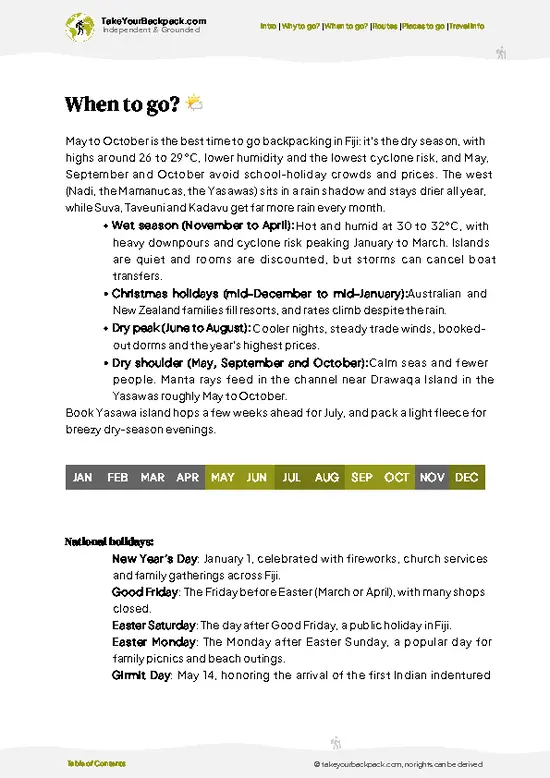
May to October is the window to aim for, with dry, sunny days and little rain along Viti Levu’s southern shore.
  • Dry Season (May to October): Days run 24 to 29°C (75 to 84°F), nights dip to 18 to 21°C (64 to 70°F), and humidity stays low. Sunrise is around 6:15 am and sunset near 5:45 pm. Resorts fill in July and August with Australian and New Zealand school holidays, so beds and rates climb.
  • Wet Season (November to April): Expect 26 to 32°C (79 to 90°F), heavy humidity, and afternoon downpours that can last for days. Cyclones are possible, mostly January to March. Daylight stretches to about 7 pm in December, and dorm prices drop, sometimes by a quarter or more.
  • Shoulder Months (May, June, October): Sea is warm, crowds are thin, and snorkeling visibility is good.
  • Activities: Humpback whales pass
… read more 👉
May to October is the window to aim for, with dry, sunny days and little rain along Viti Levu’s southern shore.
  • Dry Season (May to October): Days run 24 to 29°C (75 to 84°F), nights dip to 18 to 21°C (64 to 70°F), and humidity stays low. Sunrise is around 6:15 am and sunset near 5:45 pm. Resorts fill in July and August with Australian and New Zealand school holidays, so beds and rates climb.
  • Wet Season (November to April): Expect 26 to 32°C (79 to 90°F), heavy humidity, and afternoon downpours that can last for days. Cyclones are possible, mostly January to March. Daylight stretches to about 7 pm in December, and dorm prices drop, sometimes by a quarter or more.
  • Shoulder Months (May, June, October): Sea is warm, crowds are thin, and snorkeling visibility is good.
  • Activities: Humpback whales pass offshore between July and October, and surf at Natadola picks up with winter swells.
Book a bed in late June or early September, when school holiday crowds ease but the weather stays reliable.


source: climatestotravel.comJANJanuary: fair for travelingFEBFebruary: fair for travelingMARMarch: fair for travelingAPRApril: fair for travelingMAYMay: highly recommended for travelingJUNJune: excellent for travelingJULJuly: excellent for travelingAUGAugust: excellent for travelingSEPSeptember: highly recommended for travelingOCTOctober: excellent for travelingNOVNovember: fair for travelingDECDecember: fair for traveling
when-to-go

✈️ The backpacker research shortcutFiji Travel Guide

An offline-friendly backpacking guide with optimized travel routes, ranked highlights, transport advice, and the best areas to stay.
example page 0 from our offline Travel Guide for Fiji
example page 1 from our offline Travel Guide for Fiji
example page 2 from our offline Travel Guide for Fiji
example page 3 from our offline Travel Guide for Fiji
example page 4 from our offline Travel Guide for Fiji
example page 5 from our offline Travel Guide for Fiji
example page 6 from our offline Travel Guide for Fiji
example page 7 from our offline Travel Guide for Fiji
The digital guide (159 pages) contains:
✅ 41 highlights, ranked by travel appeal
✅ Optimized 2, 3 & 5-day travel routes
✅ Cities, national parks, landmarks, beaches
✅ How to get around
✅ Offline-friendly for travel without Wi-Fi
👉 Click to see all 30+ guide features

📅 Plan smarter in minutes, not weeks
✅ Month by month travel advice
✅ Festivals & national holidays
✅ Budget expectations

🗺️ Go to the right places, skip the overrated ones
✅ Honest pros & cons of destinations
✅ Top hikes, parks & viewpoints
✅ Lesser-known places most travelers miss
✅ Clear “worth it vs skip it” guidance

🛏️ Travel smoothly without rookie mistakes
✅ Best areas to stay
✅ Transport systems explained simply
✅ Common scams & safety advice
✅ SIM cards, money & practical tips

🌍 Understand the country, not just visit it
✅ Culture & traditions
✅ 52 Essential phrases & customs
✅ Festivals worth planning around
✅ Traveler-friendly historical context
✅ Insights that make places more meaningful

📱 Built for real travel conditions
✅ Fully downloadable PDF
✅ Works completely offline
✅ Optimized for phone use
✅ Useful in remote areas & buses
✅ Everything in one place
Stop searching, start planning
Get instant access to your full guide. 30‑day money-back guarantee.
+ Add another guide for just

By proceeding you agree to our terms.
Sent to your inbox immediately after payment • 100% Secure Checkout
Best Backpacking Travel Advisor 2025 tourism awardBest Backpacking
Travel Advisor
2025
What others say about Take Your Backpack Guides:
⭐⭐⭐⭐⭐
Fantastic, amazing amount of information!
⭐⭐⭐⭐⭐
My goodness this is amazing, it's what I've been looking for hats off too you!
⭐⭐⭐⭐⭐
I think this is absolutely BRILLIANT
⭐⭐⭐⭐
Very complete and informative. It's still missing places, but I gotta to commend you
⭐⭐⭐⭐⭐
This is truly amazing, thank you, can't wait to explore it with my kids!
⭐⭐⭐⭐⭐
Awesome resource, thank you!
⭐⭐⭐⭐⭐
This is amazing! Can't wait to explore the ones I haven't seen
⭐⭐⭐⭐
I love this! Well done, great idea.
⭐⭐⭐⭐⭐
Thanks for taking the time to make this gem!
⭐⭐⭐⭐⭐
This might be the best website I've ever seen.
⭐⭐⭐⭐⭐
Congratulations, and thank you so much for your work; it's incredibly valuable.
⭐⭐⭐⭐
In all seriousness I think you did a great job pointing out the important spots
⭐⭐⭐⭐⭐
10/10 very good
⭐⭐⭐⭐⭐
As someone who's only just starting to visit regularly this is awesome, thank you.
⭐⭐⭐⭐
Thank you very much! I'm going to visit my dad, it's going to be very useful!
⭐⭐⭐⭐⭐
This is really cool! We'll be travelling for the first time and this definitely come in handy.
⭐⭐⭐⭐⭐
You are now our minister of culture, congratulations 👨‍💼
⭐⭐⭐⭐⭐
Just wanted to tell you that this is a pearl! Going to follow your recommendations.
⭐⭐⭐⭐⭐
This is so cool. I'll definitely be using the resource for my travels soon.
⭐⭐⭐⭐⭐
This is very impressive! Good work.
⭐⭐⭐⭐⭐
This is an amazing and informative site. Very well done!

🛏️ Where to stay?Best areas and accommodation options

Base yourself around Sigatoka, Korotogo or Coral Coast’ Pacific Harbour side, because the beach strip is long and the budget beds cluster in a few spots.

Korotogo and the stretch of coast near Sigatoka suit most backpackers. Dorm-style stays here sit within a few steps of a lagoon, the local Coastal Highway has frequent buses, and small shops, cafés and a market in Sigatoka town are a short ride away. Solo travelers meet easily at communal dinners, kava nights and snorkel trips organized from the beach. Expect dorm beds around FJ$30 to 60 (US$13 to 27).

Head toward Natadola if you want a wide … read more 👉
Base yourself around Sigatoka, Korotogo or Coral Coast’ Pacific Harbour side, because the beach strip is long and the budget beds cluster in a few spots.

Korotogo and the stretch of coast near Sigatoka suit most backpackers. Dorm-style stays here sit within a few steps of a lagoon, the local Coastal Highway has frequent buses, and small shops, cafés and a market in Sigatoka town are a short ride away. Solo travelers meet easily at communal dinners, kava nights and snorkel trips organized from the beach. Expect dorm beds around FJ$30 to 60 (US$13 to 27).

Head toward Natadola if you want a wide white-sand beach and quieter evenings. It has fewer budget options, and you will need a bus or carrier to reach groceries, so it works best for a night or two.

Pacific Harbour, at the eastern end, is the base for diving, shark encounters and Pacific Harbour’s river trips. Rooms are scattered, so the social scene is smaller, but it is calmer and good for adventure travelers.

Stay at the lagoon-side areas rather than inland. Walking to the sand at night is easy and well-lit near resorts, and local taxis cost only a few Fijian dollars between neighboring bays.

🚌 Getting aroundGetting around like a local

The local bus along the Queens Road is the easiest way to get around the Coral Coast, because it runs the whole stretch from Sigatoka to Pacific Harbour with a stop every few hundred meters, and you just wave an arm to flag it down. Most backpackers base themselves in one beachside village and hop along the highway from there. Service is frequent and dependable in daylight, and it thins out after dark.

  • Local bus: Fares run about US$1 to 4 depending on distance, and the bus gives you the most for your money. Windows are open rather than air-conditioned, the seats are hard, and the ride between Sigatoka and Korotogo takes 20 to 30 minutes. Buses leave roughly every 15 to 30 minutes on weekdays, so you rarely wait long. Carry small coins, because drivers dislike breaking large notes.
  • Express
… read more 👉
The local bus along the Queens Road is the easiest way to get around the Coral Coast, because it runs the whole stretch from Sigatoka to Pacific Harbour with a stop every few hundred meters, and you just wave an arm to flag it down. Most backpackers base themselves in one beachside village and hop along the highway from there. Service is frequent and dependable in daylight, and it thins out after dark.

  • Local bus: Fares run about US$1 to 4 depending on distance, and the bus gives you the most for your money. Windows are open rather than air-conditioned, the seats are hard, and the ride between Sigatoka and Korotogo takes 20 to 30 minutes. Buses leave roughly every 15 to 30 minutes on weekdays, so you rarely wait long. Carry small coins, because drivers dislike breaking large notes.
  • Express coach: Coaches between Nadi, Sigatoka, Pacific Harbour and Suva cost about US$6 to 12 and are air-conditioned, which makes them worth the extra few dollars on a sticky afternoon. The Nadi to Pacific Harbour run takes around 3 hours. Some coaches also stop at resorts, so ask the driver before you board.
  • Taxi: Taxis cost roughly US$5 to 8 for a short hop between neighboring villages and US$40 to 70 for a long transfer such as Nadi airport to Korotogo. Agree on the fare before you get in, since meters are used inconsistently. Splitting a cab among three or four people turns an expensive option into a fair one, and it saves you after dark when the bus has stopped.
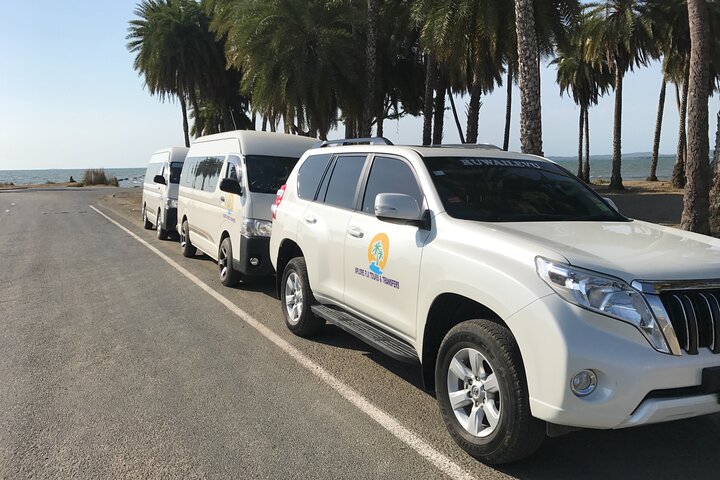
  • Carrier vans: Minivans run shorter routes and fill up with locals, with fares that sit a little above the bus. They are fast, a little cramped, and a good option when the bus is crowded.
  • Rental car or scooter: A small car costs from about US$50 to 80 a day, which only makes sense if you are splitting it. The highway is sealed, but watch for speed bumps in every village.

Buses thin out by late afternoon and Sunday service is limited, so do your longer hops in the morning and keep a taxi number saved for the evening.

🍲 FoodEating & Drinking in Coral Coast

Start with kokoda, Fiji’s answer to ceviche: fresh fish soaked in lime juice and swirled with coconut cream, chili, onion and tomato, served cold and tangy. Then try lovo feasts, where meat and cassava come out smoky and soft, often at village or resort nights for around US$20 to 40. Roti parcels and curries from the Indo-Fijian kitchens are the backpacker staple, filling and about US$3 to 6.

For the cheapest meals, head to the Sigatoka Market, where you can buy papaya, pineapple and fresh cassava, and eat at the small curry shops around the bus stand. Along the coast, beachside cafés and small village takeaways sell fish and chips, grilled fish and chilled coconuts. Order a fresh coconut straight from the tree, and sip kava if it is offered, an earthy, peppery, slightly numbing drink that … read more 👉
Start with kokoda, Fiji’s answer to ceviche: fresh fish soaked in lime juice and swirled with coconut cream, chili, onion and tomato, served cold and tangy. Then try lovo feasts, where meat and cassava come out smoky and soft, often at village or resort nights for around US$20 to 40. Roti parcels and curries from the Indo-Fijian kitchens are the backpacker staple, filling and about US$3 to 6.

For the cheapest meals, head to the Sigatoka Market, where you can buy papaya, pineapple and fresh cassava, and eat at the small curry shops around the bus stand. Along the coast, beachside cafés and small village takeaways sell fish and chips, grilled fish and chilled coconuts. Order a fresh coconut straight from the tree, and sip kava if it is offered, an earthy, peppery, slightly numbing drink that makes your tongue tingle. Locals clap once before taking the bowl and clap three times afterward.

Take off your shoes before entering a home. Meals run on island time, so relax and linger, and never rush the host.

🛡️ SafetyTraveler Safety Guide

Most of the Coral Coast is calm and easy, since a fringing reef holds the lagoon flat for much of the day.

Swim at mid to high tide. At low tide the water can drain to knee depth, leaving exposed coral and sea urchins that scrape bare feet, so reef shoes are worth packing. Currents run strongest through the reef passes, which locals avoid. Beyond the reef, swell can be heavy, particularly in winter.

Sun is the real hazard. The midday UV is intense year-round, and the lagoon’s shallow water reflects it, so reapply sunscreen after every swim. Stinging jellyfish are uncommon, but small cuts from coral can infect quickly, so clean them well.

Keep valuables out of sight on the sand, and do not leave bags unattended. Petty theft is occasional, not constant. Many stretches are private resort frontage, … read more 👉
Most of the Coral Coast is calm and easy, since a fringing reef holds the lagoon flat for much of the day.

Swim at mid to high tide. At low tide the water can drain to knee depth, leaving exposed coral and sea urchins that scrape bare feet, so reef shoes are worth packing. Currents run strongest through the reef passes, which locals avoid. Beyond the reef, swell can be heavy, particularly in winter.

Sun is the real hazard. The midday UV is intense year-round, and the lagoon’s shallow water reflects it, so reapply sunscreen after every swim. Stinging jellyfish are uncommon, but small cuts from coral can infect quickly, so clean them well.

Keep valuables out of sight on the sand, and do not leave bags unattended. Petty theft is occasional, not constant. Many stretches are private resort frontage, so ask permission before walking through. Avoid isolated beach walks after dark.

FAQFrequently asked questions about Coral Coast

Take a bus or taxi along the Queens Highway from Nadi or Suva. Express buses from Nadi to Sigatoka take about an hour, while the ride from Suva to Pacific Harbour is around 1.5 hours. Local buses cost roughly FJ$3 to 8 (US$1.50 to 3.50), and a taxi from Nadi airport to Korotogo runs about FJ$100 to 130 (US$45 to 60).
Swimming is best at high tide inside the lagoon, where the water is calm and warm at 24 to 29°C (75 to 84°F). Snorkeling is good off many resort beaches, though low tide exposes coral. Surfers head to Natadola or the reef breaks near Pacific Harbour by boat, with day trips costing about FJ$60 to 150 (US$27 to 68).
Public beach access is generally free, as Fijian law keeps foreshore open, but some stretches cross resort land or village property. Resorts may ask a day-use fee, often FJ$10 to 30 (US$4.50 to 14). At village beaches, ask for permission and offer a small sevusevu gift or a fee of around FJ$5 to 10 (US$2 to 4.50).
⚠️ Things can change over time, so always validate details locally before you go.

Other Fijian regions near Coral Coast

Explore more nearby:

  • Nausori Highlands—Cloud-filled valleys, sevusevu welcome, pine ridges, highland homestays| 45 km away
  • Beqa Island—Volcanic coastline, shark dive reef, firewalking villages, kava bowls| 51 km away
  • Waya Island—Ridge viewpoint, sheltered coves, kava villages, one-resort stays| 116 km away

💡 Not sure where to go next?
Create a personalized itinerary for Fiji including Coral Coast and the places that fit your trip.

Generate my itinerary

👉 Discover all regions

Or checkout all Fiji has to offer (think cities, towns, villages, national parks, hikes, beaches, festivals)
Country photo of Fiji

We 💚 feedbackSumming up the experience

This coast is best for slow snorkelers, people who like a village chat over a kava bowl, and anyone happy to plan the day around the tide. I would book a couple of nights at a small guesthouse, carry reef shoes, and skip the big resort day passes. If you need nightlife or reliable surf, keep going.

✍️ Help improve this page!
The information on this page is based on in-depth research, insights shared by experienced travelers, and feedback from the local travel community in Fiji. While every effort is made to keep the information accurate and current, conditions can change — so if you spot anything incorrect or outdated, please get in touch.


🙋‍♂️ Give feedback

👋 Meet the founderWho’s Behind Take Your Backpack?

Johan, backpacker and founder of TakeYourBackpackHi, I’m Johan (Netherlands 🇳🇱), the creator of TakeYourBackpack. Over the past 3 decades, I’ve backpacked through 90+ countries across six continents, gaining extensive experience with independent travel, long-term trips, and overland routes.

This site is built on a combination of firsthand travel experience and carefully curated insights from other backpackers. Many guides are based on places I’ve personally visited, while others bring together tips, observations, and practical advice shared by trusted travelers I’ve met along the way.

The goal is to provide realistic, experience-driven guidance — not generic itineraries — so you can explore destinations with better context, clearer expectations, and more confidence.