×

Fiji🇫🇯 | townsSavusavuSteaming shoreline, yacht marina, pearl farm, Saturday market | things to do and best time to go

Explore TaveuniExplore Ba

Backpacking in Savusavu
👍 Recommendedtown ranked #3
By Johan Kruseman 🇳🇱 | Updated October 16, 2026

Steam rises from cracks in the ground along the Savusavu waterfront, and locals boil corn, cassava and eggs in the hottest pools, so walk the shore just after dawn to catch it. This is the main town of the south coast of Vanua Levu, in the north of Fiji, on a sheltered bay with a working marina. The easy way in is a short domestic flight rather than a long ferry, because the boats are slow and run on tides and weather. Savusavu is small, friendly and quiet. Evenings mean a drink at the marina and early nights, and you will meet other travelers on dive boats and at the Saturday market, not in dorm-room crowds. Hostels are few, so book ahead. Go early to the market, since stalls thin out by midday. It suits slow travelers, divers and anyone using it as a launch pad for Taveuni. It won’t suit anyone chasing nightlife or white-sand beach days.

Discover everything you want to know in the 📖 Fiji Travel Guide.


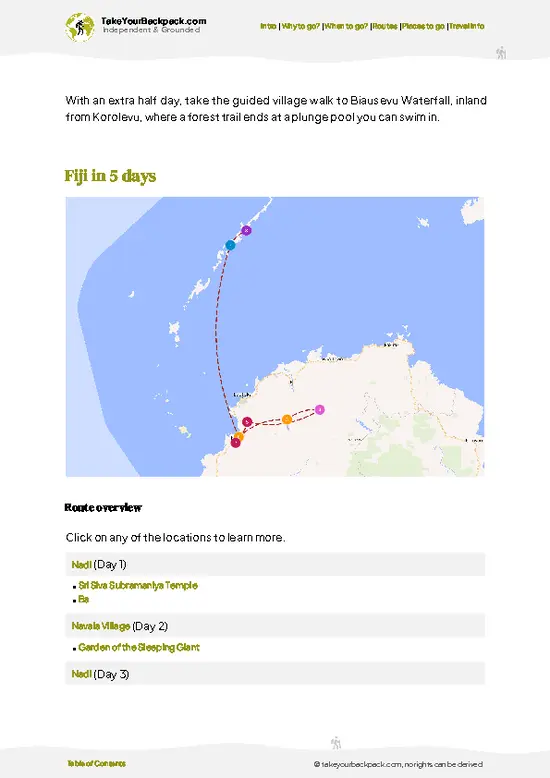
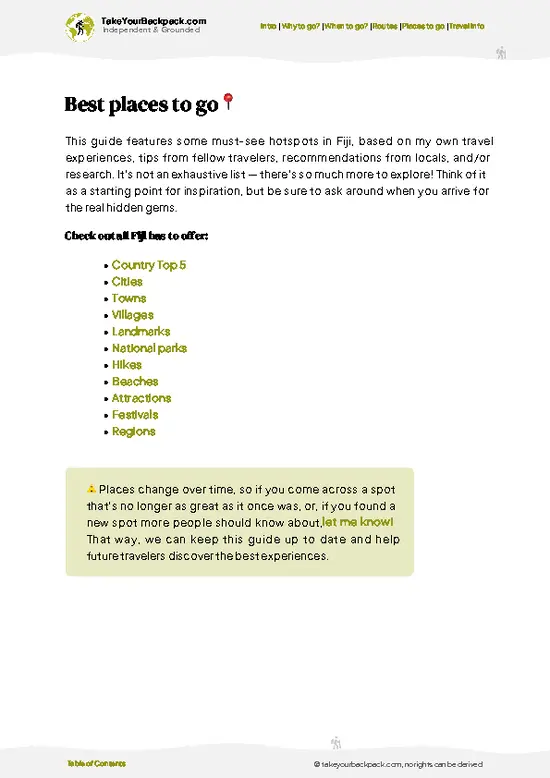
example page 0 from our offline Travel Guide for Fiji
example page 1 from our offline Travel Guide for Fiji
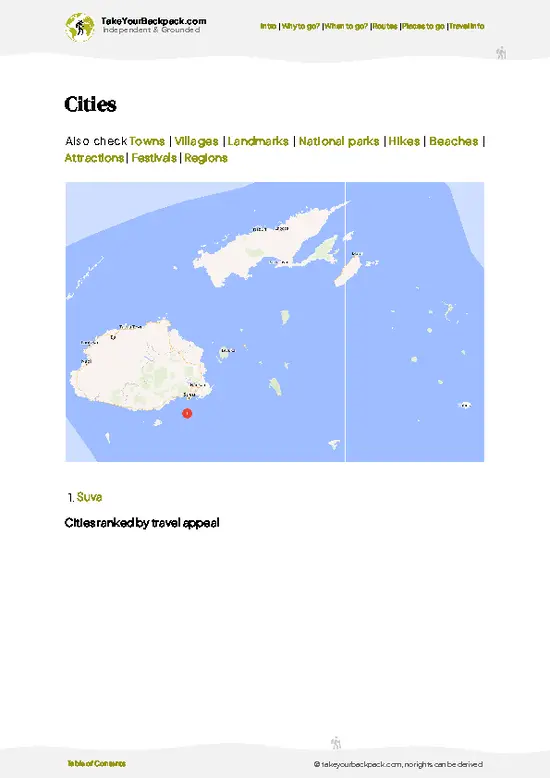
example page 2 from our offline Travel Guide for Fiji
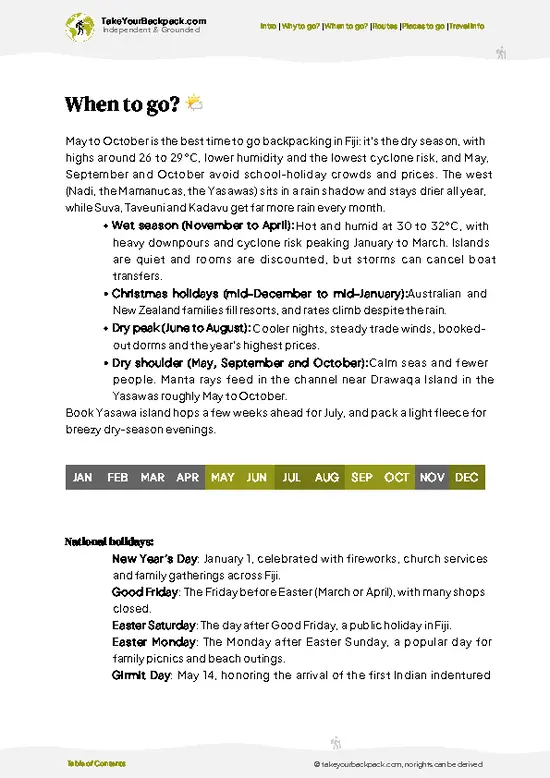
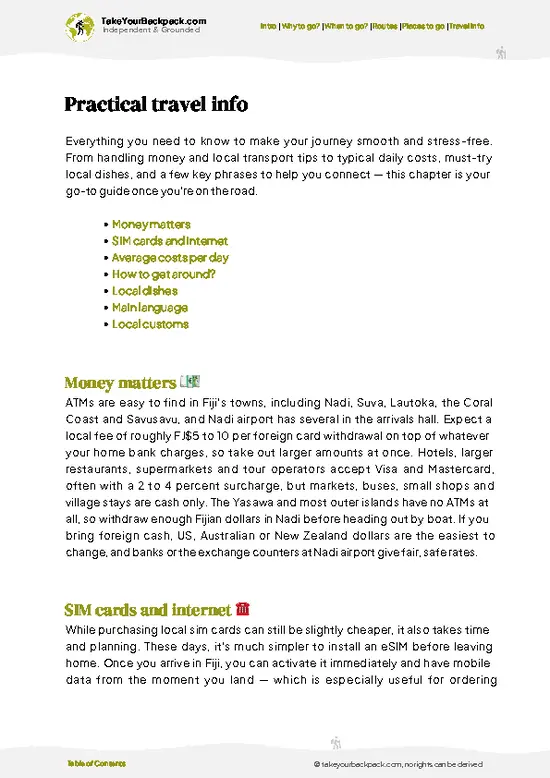
example page 3 from our offline Travel Guide for Fiji
example page 4 from our offline Travel Guide for Fiji
example page 5 from our offline Travel Guide for Fiji
example page 6 from our offline Travel Guide for Fiji
example page 7 from our offline Travel Guide for Fiji
Loading the map 🌍
CLICK TO FILTER
cities
towns
villages
landmarks
national parks
hikes
beaches
attractions
festivals
regions
SHOW COUNTRY’S BESTSHOW ALL

✨ Why go?
Ranked #3 town in Fiji
Reasons people choose to visit here

Savusavu earns its place as the gateway to Vanua Levu and Taveuni, and it is far more relaxed than the tourist hubs on the main island. Most backpackers stay two or three nights, then linger if the diving gets hold of them. The reason is the water: the Koro Sea and the Namena Marine Reserve sit offshore, and dive shops here run trips to reefs that see few visitors. On land, the town is walkable end to end, so you can sort out food, cash and a boat ticket on foot. Meals are simple and local, with curries from the Indo-Fijian community and fresh fish cooked at small cafés along the main street. The social scene is gentle. You will swap tips with yachties at the marina and share transport with other travelers rather than party with them. It fits divers, solo travelers and slow travelers who like … read more 👉
Savusavu earns its place as the gateway to Vanua Levu and Taveuni, and it is far more relaxed than the tourist hubs on the main island. Most backpackers stay two or three nights, then linger if the diving gets hold of them. The reason is the water: the Koro Sea and the Namena Marine Reserve sit offshore, and dive shops here run trips to reefs that see few visitors. On land, the town is walkable end to end, so you can sort out food, cash and a boat ticket on foot. Meals are simple and local, with curries from the Indo-Fijian community and fresh fish cooked at small cafés along the main street. The social scene is gentle. You will swap tips with yachties at the marina and share transport with other travelers rather than party with them. It fits divers, solo travelers and slow travelers who like a town they can read in an afternoon. If you want surf, nightlife or a long beach, put your time elsewhere. Think of the Copra Shed waterfront as your living room.

💡 HighlightsPlaces and moments you shouldn't skip

  1. Savusavu Hot Springs: Steam vents and bubbling pools sit along the shoreline and behind the waterfront, and locals still cook food in them. Early morning is best, when the steam is thickest and the town is quiet. Free to see, and 30 to 45 minutes is plenty. Keep your hands out of the hottest pools.
  2. Savusavu Market: The town’s main produce market is the place to see kava roots, cassava, taro, tropical fruit and bundles of spices laid out on tables. Saturday morning is the busiest and best. Entry is free, and food costs only a few Fiji dollars. Allow an hour.
  3. Copra Shed Marina: The old copra warehouse on the waterfront now holds cafés, a few shops and a view over moored yachts. Come around sunset for a drink and a chat with sailors who have crossed the Pacific. Free to wander, and an hour or two
… read more 👉
  1. Savusavu Hot Springs: Steam vents and bubbling pools sit along the shoreline and behind the waterfront, and locals still cook food in them. Early morning is best, when the steam is thickest and the town is quiet. Free to see, and 30 to 45 minutes is plenty. Keep your hands out of the hottest pools.
  2. Savusavu Market: The town’s main produce market is the place to see kava roots, cassava, taro, tropical fruit and bundles of spices laid out on tables. Saturday morning is the busiest and best. Entry is free, and food costs only a few Fiji dollars. Allow an hour.
  3. Copra Shed Marina: The old copra warehouse on the waterfront now holds cafés, a few shops and a view over moored yachts. Come around sunset for a drink and a chat with sailors who have crossed the Pacific. Free to wander, and an hour or two disappears easily.
  4. J. Hunter Pearls Fiji: Just outside town on the Lesiaceva Peninsula, this black pearl farm shows how Fijian pearls are seeded, grown and harvested. The showroom is free to enter. Go in the morning when staff have time to explain the process, and allow about an hour.
  5. Savusavu Bay waterfront walk: The shoreline road runs past mangroves, fishing boats and small jetties, with views across the bay toward the green hills. Late afternoon light is the softest. It costs nothing and takes 45 to 60 minutes at an easy pace.
Combine the market and the hot springs in one morning, then spend the afternoon at the pearl farm. For day trips, the Waisali Rainforest Reserve, the Hibiscus Highway along the coast, Namena Marine Reserve for diving and snorkeling, and Taveuni’s waterfalls and trails are all within reach.
Spotted a mistake or missing something? Contact us.

Things to do around Savusavu

Ratings based on Tripadvisor reviews. When you book through this link, you support our work at no extra cost to you.

🏘️ NeighborhoodsKey areas and districts to know

Savusavu is small enough to cover on foot in an afternoon, but the four areas below feel quite different, and knowing when to visit each saves you wasted trips.
  • Main Street and the waterfront: This is the whole town center, a single strip facing Nawi Islet and the bay, with banks, ATMs, pharmacies and cafés. Shops close early on Saturday afternoon and shut for Sunday, so do your errands before then. Walk it in ten minutes, and stop at the waterfront for a cold drink at sunset when the yachts light up.
  • Municipal Market and bus stand: The market runs all week and is liveliest on Friday and Saturday mornings. Go before 9 am, when the best fruit, root crops and fresh fish are still on the tables, and the kava (yaqona) sellers have their stock out. Hot curry and roti stalls nearby are the cheapest
… read more 👉
Savusavu is small enough to cover on foot in an afternoon, but the four areas below feel quite different, and knowing when to visit each saves you wasted trips.
  • Main Street and the waterfront: This is the whole town center, a single strip facing Nawi Islet and the bay, with banks, ATMs, pharmacies and cafés. Shops close early on Saturday afternoon and shut for Sunday, so do your errands before then. Walk it in ten minutes, and stop at the waterfront for a cold drink at sunset when the yachts light up.
  • Municipal Market and bus stand: The market runs all week and is liveliest on Friday and Saturday mornings. Go before 9 am, when the best fruit, root crops and fresh fish are still on the tables, and the kava (yaqona) sellers have their stock out. Hot curry and roti stalls nearby are the cheapest filling meals in town, and locals eat early, so lunch spots can run dry by 2 pm.
  • Copra Shed Marina and the western shore: A short stroll west brings you to the marina, yacht crews and a few restaurants. It is the quietest place for a beer in the evening, and the closest thing Savusavu has to nightlife. Most places stop serving by 10 pm, so arrive for dinner and not after it.
  • Hot springs flats: Steam rises from vents at the edge of town near the shore. Locals cook food in them, and you can too if you ask a resident politely. Visit in the morning, since the vents are easier to see in cooler air.

⌛️ 1 dayWhat you can realistically do in a day

A slow market-and-water day suits Savusavu, and it starts early.
7:00 AM, Hot springs shoreline: Walk the waterfront while the steam is thick and locals are cooking breakfast in the pools. It is a short stroll to the town center from here, and the light is gentle.
8:30 AM, Savusavu Market: Browse the produce stalls, then grab a hot roti or fresh fruit for breakfast. The market is busiest in the morning, so get there before the best items sell out.
10:30 AM, Main street and Copra Shed Marina: Wander past small shops and the bank, then sit at the marina for a coffee. Watch the yachts and chat with sailors. It is a good place to book dives or ask about boats.
12:30 PM, Lunch in town: Choose a small café on the main street for a fish dish or an Indo-Fijian curry. Locals eat early, so arrive before … read more 👉
A slow market-and-water day suits Savusavu, and it starts early.
7:00 AM, Hot springs shoreline: Walk the waterfront while the steam is thick and locals are cooking breakfast in the pools. It is a short stroll to the town center from here, and the light is gentle.
8:30 AM, Savusavu Market: Browse the produce stalls, then grab a hot roti or fresh fruit for breakfast. The market is busiest in the morning, so get there before the best items sell out.
10:30 AM, Main street and Copra Shed Marina: Wander past small shops and the bank, then sit at the marina for a coffee. Watch the yachts and chat with sailors. It is a good place to book dives or ask about boats.
12:30 PM, Lunch in town: Choose a small café on the main street for a fish dish or an Indo-Fijian curry. Locals eat early, so arrive before the crowd.
2:00 PM, J. Hunter Pearls: Take a taxi or local bus to the Lesiaceva Peninsula for the black pearl farm. The staff explain how pearls grow, and the showroom is free to enter. Afterward, walk the quiet peninsula road for bay views.
4:30 PM, Off-route mangrove edge: Return toward town and detour to the mangrove shoreline beyond the market, where fishermen mend nets and kids swim off the jetties. Few visitors stop here, and it is a good place to watch the evening tide.
6:00 PM, Sunset at the marina: End with a cold drink at the Copra Shed, watching the light fade over the yachts.

🌤️ When to go?When to go for the best experience

May to October is the easiest window for Savusavu, with the driest weather on Vanua Levu and the best visibility for diving.
  • Cooler Dry Season (May to October): Days reach 25 to 28°C (77 to 82°F) and nights dip to about 18 to 21°C (64 to 70°F). Daylight lasts roughly 11 hours. Rain still falls on this side of the island, but showers are short. Accommodation and dive trips cost the most from July to September, when Australian and New Zealand visitors arrive.
  • Wet Season (November to April): Expect 28 to 32°C (82 to 90°F), strong humidity and heavy downpours that can flood unsealed roads. Cyclone risk peaks from January to March. Daylight stretches to about 13 hours, and prices drop, with plenty of empty beds and cheaper dive deals.
  • Festivals: The Hibiscus Festival in Suva is not local, but Savusavu’s
… read more 👉
May to October is the easiest window for Savusavu, with the driest weather on Vanua Levu and the best visibility for diving.
  • Cooler Dry Season (May to October): Days reach 25 to 28°C (77 to 82°F) and nights dip to about 18 to 21°C (64 to 70°F). Daylight lasts roughly 11 hours. Rain still falls on this side of the island, but showers are short. Accommodation and dive trips cost the most from July to September, when Australian and New Zealand visitors arrive.
  • Wet Season (November to April): Expect 28 to 32°C (82 to 90°F), strong humidity and heavy downpours that can flood unsealed roads. Cyclone risk peaks from January to March. Daylight stretches to about 13 hours, and prices drop, with plenty of empty beds and cheaper dive deals.
  • Festivals: The Hibiscus Festival in Suva is not local, but Savusavu’s Christmas and Easter weeks fill ferries and buses with Fijian families.
Book ferries a week ahead if you travel during school holidays in December or January.


source: climatestotravel.comJANJanuary: fair for travelingFEBFebruary: fair for travelingMARMarch: fair for travelingAPRApril: fair for travelingMAYMay: highly recommended for travelingJUNJune: excellent for travelingJULJuly: excellent for travelingAUGAugust: excellent for travelingSEPSeptember: excellent for travelingOCTOctober: highly recommended for travelingNOVNovember: fair for travelingDECDecember: fair for traveling
when-to-go

✈️ The backpacker research shortcutFiji Travel Guide

An offline-friendly backpacking guide with optimized travel routes, ranked highlights, transport advice, and the best areas to stay.
example page 0 from our offline Travel Guide for Fiji
example page 1 from our offline Travel Guide for Fiji
example page 2 from our offline Travel Guide for Fiji
example page 3 from our offline Travel Guide for Fiji
example page 4 from our offline Travel Guide for Fiji
example page 5 from our offline Travel Guide for Fiji
example page 6 from our offline Travel Guide for Fiji
example page 7 from our offline Travel Guide for Fiji
The digital guide (159 pages) contains:
✅ 41 highlights, ranked by travel appeal
✅ Optimized 2, 3 & 5-day travel routes
✅ Cities, national parks, landmarks, beaches
✅ How to get around
✅ Offline-friendly for travel without Wi-Fi
👉 Click to see all 30+ guide features

📅 Plan smarter in minutes, not weeks
✅ Month by month travel advice
✅ Festivals & national holidays
✅ Budget expectations

🗺️ Go to the right places, skip the overrated ones
✅ Honest pros & cons of destinations
✅ Top hikes, parks & viewpoints
✅ Lesser-known places most travelers miss
✅ Clear “worth it vs skip it” guidance

🛏️ Travel smoothly without rookie mistakes
✅ Best areas to stay
✅ Transport systems explained simply
✅ Common scams & safety advice
✅ SIM cards, money & practical tips

🌍 Understand the country, not just visit it
✅ Culture & traditions
✅ 52 Essential phrases & customs
✅ Festivals worth planning around
✅ Traveler-friendly historical context
✅ Insights that make places more meaningful

📱 Built for real travel conditions
✅ Fully downloadable PDF
✅ Works completely offline
✅ Optimized for phone use
✅ Useful in remote areas & buses
✅ Everything in one place
Stop searching, start planning
Get instant access to your full guide. 30‑day money-back guarantee.
+ Add another guide for just

By proceeding you agree to our terms.
Sent to your inbox immediately after payment • 100% Secure Checkout
Best Backpacking Travel Advisor 2025 tourism awardBest Backpacking
Travel Advisor
2025
What others say about Take Your Backpack Guides:
⭐⭐⭐⭐⭐
Fantastic, amazing amount of information!
⭐⭐⭐⭐⭐
My goodness this is amazing, it's what I've been looking for hats off too you!
⭐⭐⭐⭐⭐
I think this is absolutely BRILLIANT
⭐⭐⭐⭐
Very complete and informative. It's still missing places, but I gotta to commend you
⭐⭐⭐⭐⭐
This is truly amazing, thank you, can't wait to explore it with my kids!
⭐⭐⭐⭐⭐
Awesome resource, thank you!
⭐⭐⭐⭐⭐
This is amazing! Can't wait to explore the ones I haven't seen
⭐⭐⭐⭐
I love this! Well done, great idea.
⭐⭐⭐⭐⭐
Thanks for taking the time to make this gem!
⭐⭐⭐⭐⭐
This might be the best website I've ever seen.
⭐⭐⭐⭐⭐
Congratulations, and thank you so much for your work; it's incredibly valuable.
⭐⭐⭐⭐
In all seriousness I think you did a great job pointing out the important spots
⭐⭐⭐⭐⭐
10/10 very good
⭐⭐⭐⭐⭐
As someone who's only just starting to visit regularly this is awesome, thank you.
⭐⭐⭐⭐
Thank you very much! I'm going to visit my dad, it's going to be very useful!
⭐⭐⭐⭐⭐
This is really cool! We'll be travelling for the first time and this definitely come in handy.
⭐⭐⭐⭐⭐
You are now our minister of culture, congratulations 👨‍💼
⭐⭐⭐⭐⭐
Just wanted to tell you that this is a pearl! Going to follow your recommendations.
⭐⭐⭐⭐⭐
This is so cool. I'll definitely be using the resource for my travels soon.
⭐⭐⭐⭐⭐
This is very impressive! Good work.
⭐⭐⭐⭐⭐
This is an amazing and informative site. Very well done!

🛏️ Where to stay?Best areas and accommodation options

Stay within a short walk of Main Street, because that is where the budget beds, shops and buses are concentrated. Savusavu has only a handful of dorms and basic guesthouses, so book ahead in July to September. Beds in the center are close to the market, restaurants and the waterfront, and the bus stand and ferry office are a few minutes away, so you do not need transport on arrival or departure. Night noise is mild, mostly roosters at dawn and a few voices from late dinners near the marina. The center is safe to walk after dark, though the lighting is thin on side roads.
The second option is the … read more 👉
Stay within a short walk of Main Street, because that is where the budget beds, shops and buses are concentrated. Savusavu has only a handful of dorms and basic guesthouses, so book ahead in July to September. Beds in the center are close to the market, restaurants and the waterfront, and the bus stand and ferry office are a few minutes away, so you do not need transport on arrival or departure. Night noise is mild, mostly roosters at dawn and a few voices from late dinners near the marina. The center is safe to walk after dark, though the lighting is thin on side roads.
The second option is the hillside and bay road toward Lesiaceva Point and the western shore. Here you get quieter nights, sea views and a calmer pace, but you will need a taxi (about F$5 to 10) or a long walk to reach the center, and buses are infrequent. This suits people who plan to stay a few days and want rest between dive trips. If you arrive late or rely on public transport, choose the center, and move out toward the bay only once you know your timetable.

🚌 Getting aroundTransportation options and practical tips

From the bus stand beside the municipal market, you can walk to everything in town in about five minutes, so there is no need for a taxi at arrival. Savusavu is compact, traffic is light, and the one main road is easy to follow. Beyond town, you rely on buses, carriers and taxis.
  • Walking: The center takes about 15 minutes end to end. Walk during the early morning or late afternoon, since midday sun is harsh and shade is scarce. Carry a small flashlight for returning after dark, as lighting thins out quickly outside Main Street.
  • Local buses: Buses leave from the stand beside the market and run along the Hibiscus Highway and toward Labasa. Fares typically run F$1 to 6 depending on distance, and the Labasa run takes roughly 2.5 to 3 hours. Services thin out after mid-afternoon and become rare on
… read more 👉
From the bus stand beside the municipal market, you can walk to everything in town in about five minutes, so there is no need for a taxi at arrival. Savusavu is compact, traffic is light, and the one main road is easy to follow. Beyond town, you rely on buses, carriers and taxis.
  • Walking: The center takes about 15 minutes end to end. Walk during the early morning or late afternoon, since midday sun is harsh and shade is scarce. Carry a small flashlight for returning after dark, as lighting thins out quickly outside Main Street.
  • Local buses: Buses leave from the stand beside the market and run along the Hibiscus Highway and toward Labasa. Fares typically run F$1 to 6 depending on distance, and the Labasa run takes roughly 2.5 to 3 hours. Services thin out after mid-afternoon and become rare on Sundays, so plan to ride in the morning and keep an eye on your return. Ask the driver where the last bus passes, because that is usually what limits your day.
  • Taxis: Cabs wait around the market and the waterfront. A ride within town costs about F$3 to 6, and a trip to the hot springs or the marina often costs F$5 to 10. Agree on a price before you get in, because meters are not always used. Share a cab with other travelers to split the cost on longer rides, such as to Namale or Lesiaceva Point.
  • Carriers and hitchhiking: Pickup trucks known as carriers take people along rural roads where buses do not run. Locals flag them and pay a small fare of around F$2 to 5. Experienced travelers ask at the market for who is heading your way, and it is common to stand by the road and wave.
  • Ferries: Boats link Savusavu with Suva and Taveuni, and the ferry timetable changes with weather, so confirm the day before at the ticket office on the waterfront. Fares usually cost F$60 to 120 for the longer crossings. Overnight services mean you save a night of accommodation, but bring a jacket, since the cabins can get cold.

👛 Costs (as of 16 October 2026)Typical daily expenses

Backpacking in Savusavu costs about US$62 a day in high season, with a dorm bed taking the biggest share. Prices are in Fijian dollars locally, but figures here are converted to US dollars.
CategoryBudget RangeLocal Reality
Dorm accommodationUS$16 to 25 (high season), US$12 to 18 (low season)Beds are few and many travelers take a basic private room for US$30 to 45 instead. Book ahead from June to September.
MealsUS$14 to 22Curry and rice or fish and cassava at the market cafes cost US$3 to 6. A sit-down dinner with fresh seafood runs US$10 to 16.
Local transportUS$2 to 6Local buses along the waterfront cost under US$1 per ride, and shared taxis around town cost US$1 to 3. A taxi to the outskirts runs US$4 to 8.
Basic activities/entry feesUS$6 to 15The hot springs by the waterfront are free to view.
… read more 👉
Backpacking in Savusavu costs about US$62 a day in high season, with a dorm bed taking the biggest share. Prices are in Fijian dollars locally, but figures here are converted to US dollars.
CategoryBudget RangeLocal Reality
Dorm accommodationUS$16 to 25 (high season), US$12 to 18 (low season)Beds are few and many travelers take a basic private room for US$30 to 45 instead. Book ahead from June to September.
MealsUS$14 to 22Curry and rice or fish and cassava at the market cafes cost US$3 to 6. A sit-down dinner with fresh seafood runs US$10 to 16.
Local transportUS$2 to 6Local buses along the waterfront cost under US$1 per ride, and shared taxis around town cost US$1 to 3. A taxi to the outskirts runs US$4 to 8.
Basic activities/entry feesUS$6 to 15The hot springs by the waterfront are free to view. Village visits and the Hot Springs Walk cost little, while snorkeling or diving trips cost US$40 to 120 and are best treated as occasional splurges.
Miscellaneous expensesUS$4 to 8Covers SIM data, drinking water, a Fiji Bitter beer at US$3 to 4, and kava at the market for a few dollars.
Total Daily BudgetUS$42 to 76About US$62 using a mid-range figure, including a high-season dorm bed.
Buy fruit, vegetables and fresh fish at the Savusavu market in the morning and cook at your accommodation if it has a kitchen. Self-catering can halve your food bill, and the market is open Monday to Saturday.
⚠️ Prices can change and everyone travels differently, so take this as a rough guide. Hope it helps you plan your adventure!

🚌 Day tripsBest day trips from Savusavu

Savusavu works well as a base for day trips, because buses and taxis cover the main sights on the Hibiscus Highway and the nearby bays within an hour or two.
Hot Springs and Waisali Rainforest Reserve:
The Waisali Reserve sits on the road toward Labasa, about 40 minutes from town by bus or taxi, and its forest trail gives you birdlife and shade for a modest entry fee of roughly F$10 to 15. Go in the dry months, when the path is less muddy, and bring insect repellent. Many first-timers go after midday and miss the last bus back, so leave in the morning.
👉 Explore Waisali Rainforest Reserve
Namenalala Island Snorkeling:
Boat trips to reefs offshore run in calm weather and cost roughly F$100 to 250 with a local operator. The water is clearest from May to October. Book through your guesthouse a day … read more 👉
Savusavu works well as a base for day trips, because buses and taxis cover the main sights on the Hibiscus Highway and the nearby bays within an hour or two.
Hot Springs and Waisali Rainforest Reserve:
The Waisali Reserve sits on the road toward Labasa, about 40 minutes from town by bus or taxi, and its forest trail gives you birdlife and shade for a modest entry fee of roughly F$10 to 15. Go in the dry months, when the path is less muddy, and bring insect repellent. Many first-timers go after midday and miss the last bus back, so leave in the morning.
👉 Explore Waisali Rainforest Reserve
Namenalala Island Snorkeling:
Boat trips to reefs offshore run in calm weather and cost roughly F$100 to 250 with a local operator. The water is clearest from May to October. Book through your guesthouse a day ahead, since boats leave early and small groups fill quickly.

Natewa Bay:
A taxi along the coast to the villages near Natewa Bay takes about an hour and costs about F$60 to 100 round trip, so share it with others. You see copra drying, rough roads and quiet beaches. Roads turn to mud after heavy rain, so avoid the wet season, and always ask permission before visiting a village.

Labasa:
The bus takes 2.5 to 3 hours each way and costs under F$10, so it is a long day. Labasa has a big market and a sugar-town feel, and is worthwhile if you want to see the island’s other side. Leave on the first bus, and check the last return time before you commit.

🛡️ SafetyStaying Safe: What Travelers Should Know

Savusavu is one of the calmer towns in Fiji, and most visitors have no trouble. Petty theft is the main concern, and it usually means a phone or bag left unattended on a beach, in a parked car or on a bus seat. Keep valuables out of sight and lock your room even when you pop out. Walking at night in the center is generally fine, but side roads and the road to the marina are dark, so carry a flashlight and take a taxi after 10 pm, particularly if you are alone. Solo women travelers should expect some staring and friendly attention; a firm, polite reply works. Touts are rare, though you may be asked to buy kava or souvenirs, and you can decline with a smile. Agree on taxi fares before you set off. Swim only where locals do, since currents near the point can be strong, and ask before entering any village or fishing ground.

FAQFrequently asked questions about Savusavu

Savusavu is worth visiting for its own sake, especially if you like diving, hot springs and a slow pace. Two or three days covers the market, the marina, the hot springs flats and a trip to the Waisali Rainforest Reserve. It is less suited to travelers who want nightlife or a packed itinerary, since most places close by 10 pm.
Plan three to four days to see the town and the best nearby sights without rushing. One day covers Main Street, the municipal market and the hot springs, and a second can go to Waisali or a snorkeling trip. Add a day if you want to dive or visit Natewa Bay, as boat trips depend on weather and tide.
Savusavu is not a realistic day trip from Suva or Nadi, because it lies on Vanua Levu and needs a flight or an overnight ferry. Flights from Nadi or Suva take about 45 to 60 minutes, so a same-day return is possible but costly and rushed. From Labasa, a bus takes 2.5 to 3 hours each way and costs under F$10, which makes a day visit possible but tiring.
⚠️ Things can change over time, so always validate details locally before you go.

Other Fijian towns near Savusavu

Explore more nearby:

  • Taveuni—Waterfall trails, Lavena coast, Des Voeux views, meridian line| 73 km away
  • Somosomo—Chiefly village, Methodist hymns, strait views, rock slide| 73 km away
  • Levuka—Beach Street seawall, wooden shopfronts, UNESCO waterfront, 199 Steps| 114 km away

💡 Not sure where to go next?
Create a personalized itinerary for Fiji including Savusavu and the places that fit your trip.

Generate my itinerary

👉 Discover all towns

Or checkout all Fiji has to offer (think cities, towns, villages, national parks, hikes, beaches, festivals)
Country photo of Fiji

We 💚 feedbackParting advice and final tips

Many travelers arrive on a Sunday or late Saturday and find the market closed and the town asleep. Plan your arrival for a weekday morning or early Saturday so you see Savusavu at its best. I would also carry cash in small bills, because ATMs are few and market stalls rarely have change.

✍️ Help improve this page!
The information on this page is based on in-depth research, insights shared by experienced travelers, and feedback from the local travel community in Fiji. While every effort is made to keep the information accurate and current, conditions can change — so if you spot anything incorrect or outdated, please get in touch.


🙋‍♂️ Give feedback

👋 Meet the founderWho’s Behind Take Your Backpack?

Johan, backpacker and founder of TakeYourBackpackHi, I’m Johan (Netherlands 🇳🇱), the creator of TakeYourBackpack. Over the past 3 decades, I’ve backpacked through 90+ countries across six continents, gaining extensive experience with independent travel, long-term trips, and overland routes.

This site is built on a combination of firsthand travel experience and carefully curated insights from other backpackers. Many guides are based on places I’ve personally visited, while others bring together tips, observations, and practical advice shared by trusted travelers I’ve met along the way.

The goal is to provide realistic, experience-driven guidance — not generic itineraries — so you can explore destinations with better context, clearer expectations, and more confidence.