×

France🇫🇷 | hikesChemin de Saint-Jacques (Le Puy Route)Pilgrim route, Romanesque churches, volcanic plateaus | things to do and best time to go

Explore Cathar Trail (Sentier Cathare)Explore Vercors Crossing

Backpacking in Chemin de Saint-Jacques (Le Puy Route)
👍 Recommendedhike ranked #6
By Johan Kruseman 🇳🇱 | Updated October 15, 2026

Most people only realize halfway through that the Le Puy route quietly trains you for bigger thru-hikes: daily ups and downs, real distance, but with French bakeries and beds instead of misery and blisters. The Chemin de Saint-Jacques (Via Podiensis) runs from Le Puy-en-Velay in south-central France, cutting southwest through the Massif Central and rural Occitanie toward the Pyrenees. It’s long—about 750 km to Saint-Jean-Pied-de-Port—rolling rather than alpine, but those first days out of Le Puy hit your legs with steep, honest climbs. Scenery swings from volcanic plateaus and cow pastures to old stone villages that feel frozen in time. Trains and buses make Le Puy easy to reach from Lyon or Paris. Compared to the Tour du Mont Blanc or GR20, this is less dramatic, more meditative—less “epic summit,” more “slow-burn satisfaction.”

Discover everything you want to know in the 📖 France Travel Guide.
Best time to go: April - October
Duration: 30 days
Distance: 730 kilometers
Total ascent: 14,000 meters


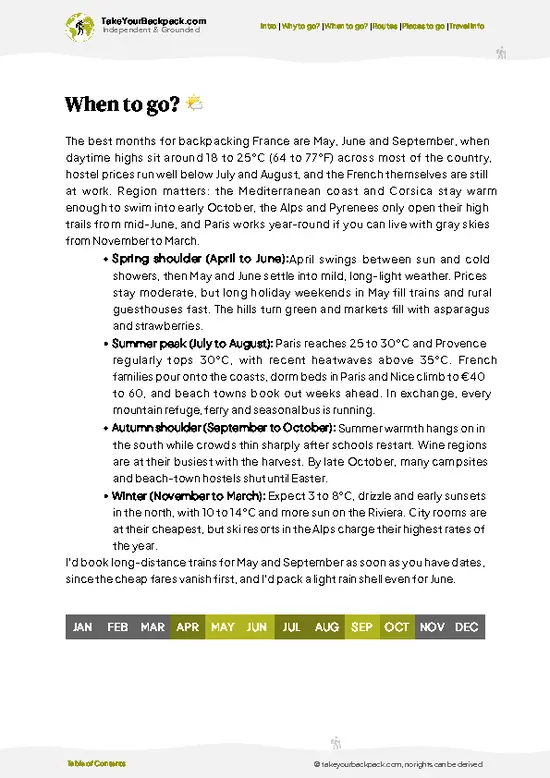
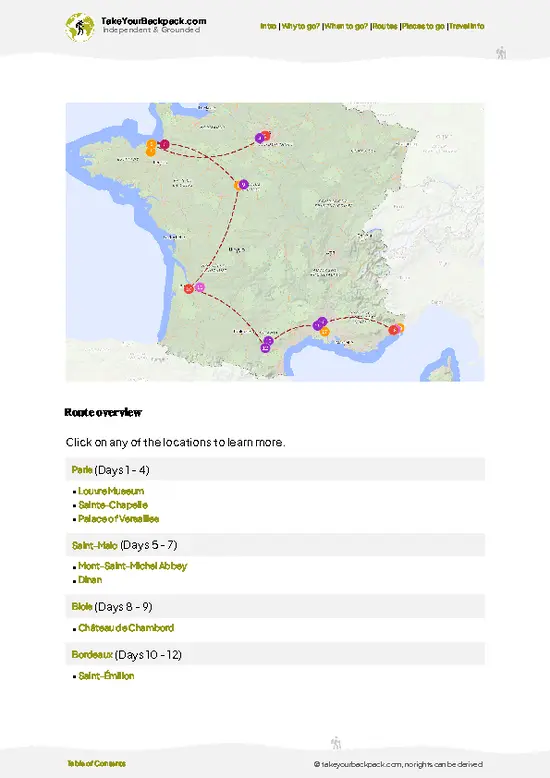
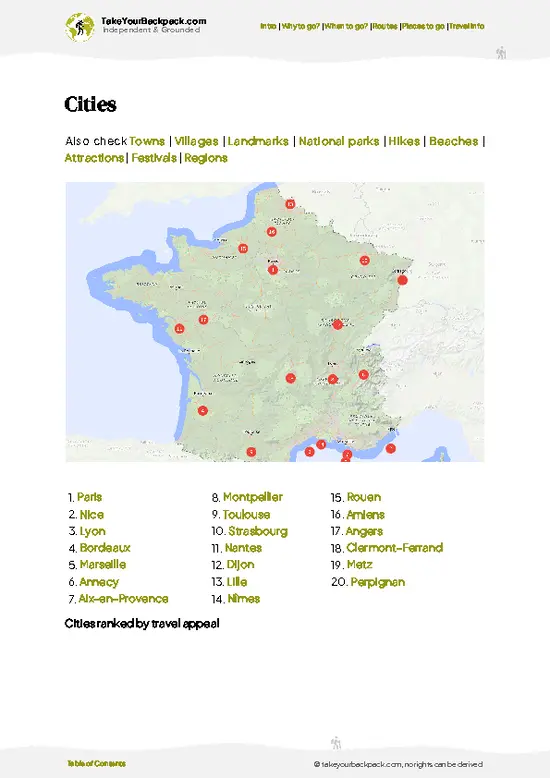
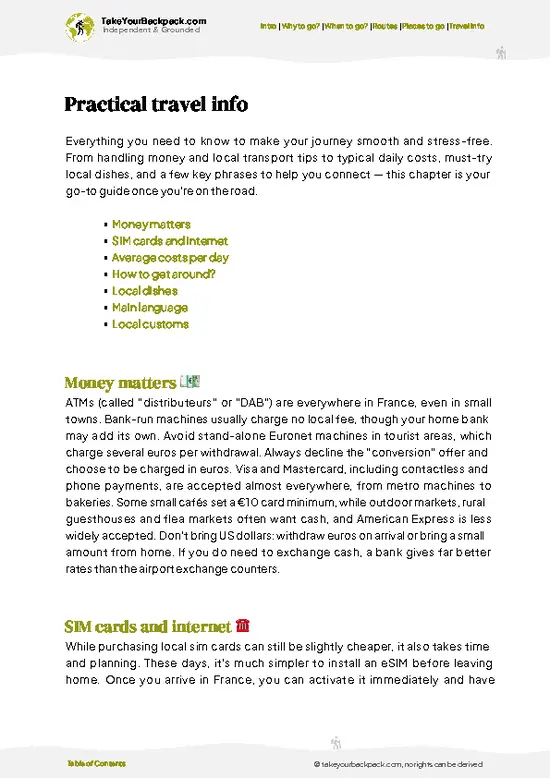
example page 0 from our offline Travel Guide for France
example page 1 from our offline Travel Guide for France
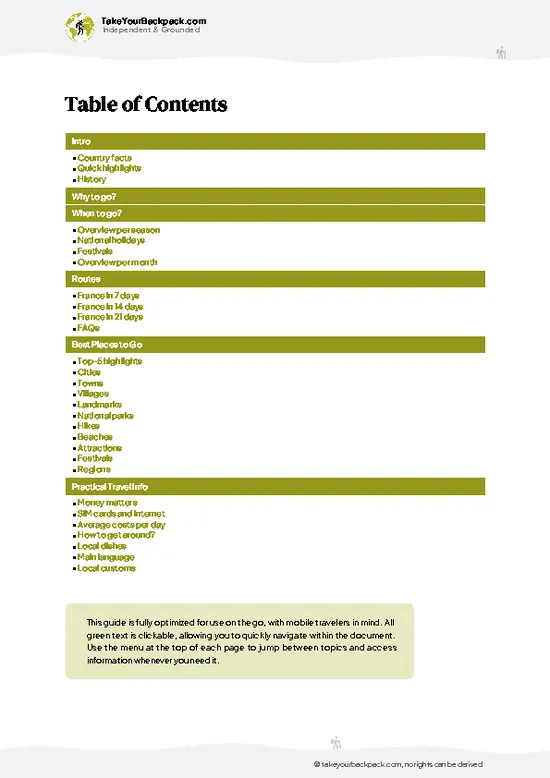
example page 2 from our offline Travel Guide for France
example page 3 from our offline Travel Guide for France
example page 4 from our offline Travel Guide for France
example page 5 from our offline Travel Guide for France
example page 6 from our offline Travel Guide for France
example page 7 from our offline Travel Guide for France
Loading the map 🌍
CLICK TO FILTER
cities
towns
villages
landmarks
national parks
hikes
beaches
attractions
festivals
regions
SHOW COUNTRY’S BESTSHOW ALL

✨ Why go?
Ranked #6 hike in France
Why Chemin de Saint-Jacques (Le Puy Route) should be on your travel list

The Chemin de Saint-Jacques (Le Puy Route) is a magnet for backpackers craving a blend of challenge and reward. This trail offers a scenery-to-effort ratio that’s hard to beat. You’ll trek through rolling hills, ancient villages, and vibrant fields, all while feeling the burn in your legs. Each step is a dance between exertion and the breathtaking views that unfold around every bend.

Access is a breeze, thanks to public transport options that drop you right at the trailhead. You can hop on a train or bus, making it easy to start your adventure without breaking the bank. Speaking of costs, this route is remarkably low-cost; you can find affordable accommodations and meals along the way, allowing you to stretch your budget.

What’s more, the flexible distances mean you can tailor your journey … read more 👉
The Chemin de Saint-Jacques (Le Puy Route) is a magnet for backpackers craving a blend of challenge and reward. This trail offers a scenery-to-effort ratio that’s hard to beat. You’ll trek through rolling hills, ancient villages, and vibrant fields, all while feeling the burn in your legs. Each step is a dance between exertion and the breathtaking views that unfold around every bend.

Access is a breeze, thanks to public transport options that drop you right at the trailhead. You can hop on a train or bus, making it easy to start your adventure without breaking the bank. Speaking of costs, this route is remarkably low-cost; you can find affordable accommodations and meals along the way, allowing you to stretch your budget.

What’s more, the flexible distances mean you can tailor your journey to fit your pace. Whether you want to tackle a few kilometers or push for a full day, it’s all up to you. Plus, it seamlessly integrates into a longer backpacking route, making it a perfect stop on your European adventure. The real payoff? That first cold beer at the end of a long day, savoring the journey you just conquered.

💡 HighlightsThe experiences that define the visit

  • Le Puy-en-Velay and its cathedral — The dramatic cathedral perched above the town is where most pilgrims kick off the route; its black Madonna, steep ancient streets and volcanic cliff setting give you that instant “you’ve started something old and real” vibe. Great views, lively markets, and the first proper pilgrim stamp make it worth lingering a day.
  • Volcanic landscape of the Velay (puys and basalt cones) — Unlike forested long-distance trails, this route threads through worn volcanic plugs, lava domes and terraced fields; the geology creates unexpected viewpoints and weird, photogenic rock formations. You’ll hike along ridgelines with wide, layered horizons — very different from the alpine or coastal Camino sections.
  • Romanesque churches and medieval villages (e.g., Conques on the variant)
… read more 👉
  • Le Puy-en-Velay and its cathedral — The dramatic cathedral perched above the town is where most pilgrims kick off the route; its black Madonna, steep ancient streets and volcanic cliff setting give you that instant “you’ve started something old and real” vibe. Great views, lively markets, and the first proper pilgrim stamp make it worth lingering a day.
  • Volcanic landscape of the Velay (puys and basalt cones) — Unlike forested long-distance trails, this route threads through worn volcanic plugs, lava domes and terraced fields; the geology creates unexpected viewpoints and weird, photogenic rock formations. You’ll hike along ridgelines with wide, layered horizons — very different from the alpine or coastal Camino sections.
  • Romanesque churches and medieval villages (e.g., Conques on the variant) — Tiny stone villages and ornate Romanesque abbeys pop up regularly; Conques’s Sainte-Foy church (if you choose that variant) is a UNESCO-level stop with carved tympanums you won’t forget. These places aren’t just pretty backdrops — they’re living pieces of pilgrimage history with relics, chapels and narrow lanes to wander between stages.
  • The Aubrac plateau and open highlands — Big, windswept pastures, slow-moving Aubrac cattle and horizon-to-horizon skies give the route a lonely, cinematic quality for stretches. It’s the kind of walking where weather and light matter — sunrise or late-afternoon shadows turn the plains into a huge, quiet photograph.
  • True pilgrimage culture and simple gîtes — What sets this trail apart is the human side: scallop-shell markers, daily pilgrim traffic, cheap communal dinners and family-run gîtes where you swap stories over bread and cheese. The mix of shared hospitality and centuries-old route markers makes you feel part of a long chain of walkers rather than just a tourist on a scenic trail.
Spotted a mistake or missing something? Contact us.

🌤️ When to go?Weather, crowds, and seasonal trade-offs

  • Weather: Spring and early autumn deliver the best balance—mild, dry days with fewer thunderstorms. Summer can scorch you with highs hitting 30-35°C (86-95°F), while winter chills drop below freezing, making some mountain passes treacherous.
  • Temperature: Late April to June offers comfortable hiking temps around 15-22°C (59-72°F), perfect for long days on the trail without overheating or freezing.
  • Daylight Hours: Peak daylight stretches from May to August, giving you up to 16 hours to push your pace or linger at scenic spots. Early spring and late autumn shrink daylight to 9-10 hours, forcing earlier starts and quicker stops.
  • Crowds: July and August pack the trail with pilgrims and tourists, turning quiet paths into social corridors. For solitude, aim for May, June, or September when the
… read more 👉
  • Weather: Spring and early autumn deliver the best balance—mild, dry days with fewer thunderstorms. Summer can scorch you with highs hitting 30-35°C (86-95°F), while winter chills drop below freezing, making some mountain passes treacherous.
  • Temperature: Late April to June offers comfortable hiking temps around 15-22°C (59-72°F), perfect for long days on the trail without overheating or freezing.
  • Daylight Hours: Peak daylight stretches from May to August, giving you up to 16 hours to push your pace or linger at scenic spots. Early spring and late autumn shrink daylight to 9-10 hours, forcing earlier starts and quicker stops.
  • Crowds: July and August pack the trail with pilgrims and tourists, turning quiet paths into social corridors. For solitude, aim for May, June, or September when the trail breathes easier.
  • Seasonal Activities: Spring bursts with wildflowers and local festivals celebrating the pilgrimage’s history, while autumn offers grape harvest events and crisp air that sharpens every view.
  • Price Fluctuations: Accommodation and transport costs spike in summer. Booking in shoulder seasons like May or September can save you a solid chunk of change without sacrificing the experience.
Pro-tip: Start your hike in late May—when the trail is waking up, the weather is steady, and you can savor the quiet moments before the summer rush swells.


source: climatestotravel.comJANJanuary: below average for travelingFEBFebruary: below average for travelingMARMarch: fair for travelingAPRApril: highly recommended for travelingMAYMay: excellent for travelingJUNJune: excellent for travelingJULJuly: good for travelingAUGAugust: good for travelingSEPSeptember: highly recommended for travelingOCTOctober: highly recommended for travelingNOVNovember: fair for travelingDECDecember: below average for traveling
france-hike-chemin-de-saint-jacques-le-puy-route
© Google |

✈️ The backpacker research shortcutFrance Travel Guide

An offline-friendly backpacking guide with optimized travel routes, ranked highlights, transport advice, and the best areas to stay.
example page 0 from our offline Travel Guide for France
example page 1 from our offline Travel Guide for France
example page 2 from our offline Travel Guide for France
example page 3 from our offline Travel Guide for France
example page 4 from our offline Travel Guide for France
example page 5 from our offline Travel Guide for France
example page 6 from our offline Travel Guide for France
example page 7 from our offline Travel Guide for France
The digital guide (501 pages) contains:
✅ 135 highlights, ranked by travel appeal
✅ Optimized 7, 14 & 21-day travel routes
✅ Cities, national parks, landmarks, beaches
✅ How to get around
✅ Offline-friendly for travel without Wi-Fi
👉 Click to see all 30+ guide features

📅 Plan smarter in minutes, not weeks
✅ Month by month travel advice
✅ Festivals & national holidays
✅ Budget expectations

🗺️ Go to the right places, skip the overrated ones
✅ Honest pros & cons of destinations
✅ Top hikes, parks & viewpoints
✅ Lesser-known places most travelers miss
✅ Clear “worth it vs skip it” guidance

🛏️ Travel smoothly without rookie mistakes
✅ Best areas to stay
✅ Transport systems explained simply
✅ Common scams & safety advice
✅ SIM cards, money & practical tips

🌍 Understand the country, not just visit it
✅ Culture & traditions
✅ 52 Essential phrases & customs
✅ Festivals worth planning around
✅ Traveler-friendly historical context
✅ Insights that make places more meaningful

📱 Built for real travel conditions
✅ Fully downloadable PDF
✅ Works completely offline
✅ Optimized for phone use
✅ Useful in remote areas & buses
✅ Everything in one place
Stop searching, start planning
Get instant access to your full guide. 30‑day money-back guarantee.
+ Add another guide for just

By proceeding you agree to our terms.
Sent to your inbox immediately after payment • 100% Secure Checkout
Best Backpacking Travel Advisor 2025 tourism awardBest Backpacking
Travel Advisor
2025
What others say about Take Your Backpack Guides:
⭐⭐⭐⭐⭐
Fantastic, amazing amount of information!
⭐⭐⭐⭐⭐
My goodness this is amazing, it's what I've been looking for hats off too you!
⭐⭐⭐⭐⭐
I think this is absolutely BRILLIANT
⭐⭐⭐⭐
Very complete and informative. It's still missing places, but I gotta to commend you
⭐⭐⭐⭐⭐
This is truly amazing, thank you, can't wait to explore it with my kids!
⭐⭐⭐⭐⭐
Awesome resource, thank you!
⭐⭐⭐⭐⭐
This is amazing! Can't wait to explore the ones I haven't seen
⭐⭐⭐⭐
I love this! Well done, great idea.
⭐⭐⭐⭐⭐
Thanks for taking the time to make this gem!
⭐⭐⭐⭐⭐
This might be the best website I've ever seen.
⭐⭐⭐⭐⭐
Congratulations, and thank you so much for your work; it's incredibly valuable.
⭐⭐⭐⭐
In all seriousness I think you did a great job pointing out the important spots
⭐⭐⭐⭐⭐
10/10 very good
⭐⭐⭐⭐⭐
As someone who's only just starting to visit regularly this is awesome, thank you.
⭐⭐⭐⭐
Thank you very much! I'm going to visit my dad, it's going to be very useful!
⭐⭐⭐⭐⭐
This is really cool! We'll be travelling for the first time and this definitely come in handy.
⭐⭐⭐⭐⭐
You are now our minister of culture, congratulations 👨‍💼
⭐⭐⭐⭐⭐
Just wanted to tell you that this is a pearl! Going to follow your recommendations.
⭐⭐⭐⭐⭐
This is so cool. I'll definitely be using the resource for my travels soon.
⭐⭐⭐⭐⭐
This is very impressive! Good work.
⭐⭐⭐⭐⭐
This is an amazing and informative site. Very well done!

🛏️ Where to stay?How to pick the right area

If you enjoy meeting fellow travelers, consider choosing hostels with high ratings for atmosphere. On the other hand, if you prefer having your own space, a hotel might be a better option.

🥾 Hike detailsRoute, distance, and difficulty explained

Total Distance: The Chemin de Saint-Jacques (Le Puy Route) stretches approximately 750 kilometers (about 466 miles) from Le Puy-en-Velay to the Spanish border at Santiago de Compostela.

Estimated Duration: Most hikers take around 30 to 35 days to complete the entire route, averaging about 20 to 25 kilometers (12 to 15 miles) a day, depending on your pace and how many rest days you take.

Difficulty Level: The trail is generally considered moderate. There are some steep sections and varied terrain, but it’s manageable for most hikers with a reasonable level of fitness.

Starting Point: The trail … read more 👉
Total Distance: The Chemin de Saint-Jacques (Le Puy Route) stretches approximately 750 kilometers (about 466 miles) from Le Puy-en-Velay to the Spanish border at Santiago de Compostela.

Estimated Duration: Most hikers take around 30 to 35 days to complete the entire route, averaging about 20 to 25 kilometers (12 to 15 miles) a day, depending on your pace and how many rest days you take.

Difficulty Level: The trail is generally considered moderate. There are some steep sections and varied terrain, but it’s manageable for most hikers with a reasonable level of fitness.

Starting Point: The trail kicks off in Le Puy-en-Velay. To get there by public transport, you can take a train from major cities like Lyon or Clermont-Ferrand. The train ride is scenic and offers a nice introduction to the region.

Major Landmarks Along the Route:
  • Le Puy-en-Velay: Famous for its stunning volcanic rock formations and the iconic statue of Notre-Dame de France.
  • Saint-Chély-d’Aubrac: A charming village known for its medieval architecture and picturesque surroundings.
  • Conques: A UNESCO World Heritage site, this village is renowned for its abbey and stunning stained glass windows.
  • Figeac: Offers a lovely old town and is a great spot to rest and explore local history.

Type of Terrain and Scenery: Expect a mix of rocky paths, grassy hills, and occasional forested areas. The scenery varies from lush green valleys to open plateaus, with stunning views of the surrounding countryside.

Typical Vegetation and Wildlife: You’ll see a variety of flora, including oak and beech trees, wildflowers, and crops as you pass through rural areas. Wildlife is pretty diverse too; keep an eye out for deer, foxes, and a variety of bird species.

This trail is a fantastic way to soak in the culture and natural beauty of France while also getting a good workout. Just make sure to pack light and enjoy the journey!
⚠️ Hiking info can sometimes be outdated or inaccurate. Before you hit the trail, check the latest conditions with locals. If you do spot anything that's off, I'd love to hear from you, so I can update it for fellow travelers.

🛡️ SafetyStaying Safe: What Travelers Should Know

The Chemin de Saint-Jacques (Le Puy Route) offers a blend of manageable challenges and rewarding vistas. Expect varied terrain: some stretches are smooth, while others demand careful footing on rocky paths or steep inclines. Navigation is straightforward, thanks to clear signage, but keep your map handy for those moments when the trail seems to twist unexpectedly.

Weather can shift quickly. Mornings may start crisp, but by afternoon, you could be sweating under the sun. Layering is key; a light rain jacket can save you from sudden showers.

Wildlife encounters are rare but possible. If you spot a deer or a wild boar, admire from a distance—no need to provoke.

Pace yourself, especially on longer days. Hydration is crucial; refill at villages along the way. The effort pays off when you finally … read more 👉
The Chemin de Saint-Jacques (Le Puy Route) offers a blend of manageable challenges and rewarding vistas. Expect varied terrain: some stretches are smooth, while others demand careful footing on rocky paths or steep inclines. Navigation is straightforward, thanks to clear signage, but keep your map handy for those moments when the trail seems to twist unexpectedly.

Weather can shift quickly. Mornings may start crisp, but by afternoon, you could be sweating under the sun. Layering is key; a light rain jacket can save you from sudden showers.

Wildlife encounters are rare but possible. If you spot a deer or a wild boar, admire from a distance—no need to provoke.

Pace yourself, especially on longer days. Hydration is crucial; refill at villages along the way. The effort pays off when you finally reach a summit or a quaint café for that first cold beer. Embrace the journey; it’s as much about the trail as it is about the destination.

FAQTraveler FAQ

The Chemin de Saint-Jacques (Le Puy Route) hike typically takes about 30 to 35 days to complete, covering approximately 750 kilometers from Le Puy-en-Velay to Saint-Jean-Pied-de-Port.
The hike is moderately difficult, with varied terrain including hills, mountains, and flat sections. Daily stages average 20 to 25 kilometers, requiring a good level of fitness and stamina.
No guide or permit is required to hike the Chemin de Saint-Jacques (Le Puy Route). However, pilgrims often carry a pilgrim passport (credencial) to access pilgrim accommodations and receive a certificate of completion at the end.
⚠️ Things can change over time, so always validate details locally before you go.

Other French hikes near Chemin de Saint-Jacques (Le Puy Route)

Explore more nearby:


💡 Not sure where to go next?
Create a personalized itinerary for France including Chemin de Saint-Jacques (Le Puy Route) and the places that fit your trip.

Generate my itinerary

👉 Discover all hikes

Or checkout all France has to offer (think cities, towns, villages, national parks, hikes, beaches, festivals)
Country photo of France

We 💚 feedbackFinal thoughts on hiking the Chemin de Saint-Jacques (Le Puy Route)

The Chemin de Saint-Jacques (Le Puy Route) is a feast for the senses. Picture this: you’re trudging through sun-dappled forests, the scent of wild herbs in the air, and then—bam!—you hit a ridge with a view that makes every step worthwhile. But here’s the kicker: it can get crowded, especially in peak season. If you’re seeking solitude, plan your timing wisely. Still, the journey’s grit and the camaraderie you find make it all worth it.

✈️ When did I visit France?
Being close to The Netherlands, my home base, I visited France many times.

✍️ Help improve this page!
The information on this page is based on my own backpacking experience in France, supplemented with up-to-date research and feedback from other travelers. Travel details can change, so if you notice anything outdated or incomplete, feel free to let me know.


🙋‍♂️ Give feedback

👋 Meet the founderWho’s Behind Take Your Backpack?

Johan, backpacker and founder of TakeYourBackpackHi, I’m Johan (Netherlands 🇳🇱), the creator of TakeYourBackpack. Over the past 3 decades, I’ve backpacked through 90+ countries across six continents, gaining extensive experience with independent travel, long-term trips, and overland routes.

This site is built on a combination of firsthand travel experience and carefully curated insights from other backpackers. Many guides are based on places I’ve personally visited, while others bring together tips, observations, and practical advice shared by trusted travelers I’ve met along the way.

The goal is to provide realistic, experience-driven guidance — not generic itineraries — so you can explore destinations with better context, clearer expectations, and more confidence.