
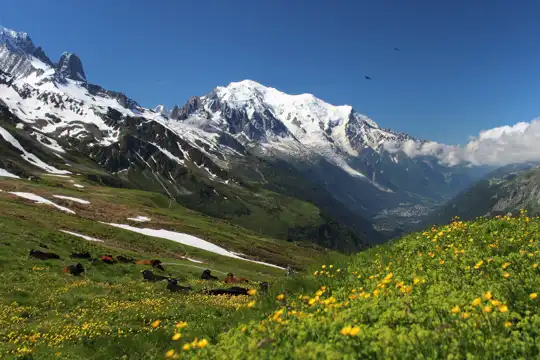
- Mont Blanc views from the Chamonix valley (Aiguille du Midi / Les Houches) — You get shockingly close-up, cathedral-like faces of the Mont Blanc massif right from the trailhead. The mix of glaciated peaks, cable-car drama (Aiguille du Midi), and bustling valley towns makes for a contrast you don’t see on many long-distance hikes: raw alpine walls one minute, espresso and gear shops the next.
- Lac Blanc — That perfectly framed, mirror-like mountain lake is the postcard shot of the Tour. On calm mornings it reflects the full Mont Blanc skyline and Aiguilles Rouges, so it’s a photogenic, almost theatrical stop that feels alpine and intimate in a way big ridgelines don’t.
- Réserve naturelle des Contamines-Montjoie — A surprisingly wild stretch with waterfalls, glacial cirques and flower-packed
- Mont Blanc views from the Chamonix valley (Aiguille du Midi / Les Houches) — You get shockingly close-up, cathedral-like faces of the Mont Blanc massif right from the trailhead. The mix of glaciated peaks, cable-car drama (Aiguille du Midi), and bustling valley towns makes for a contrast you don’t see on many long-distance hikes: raw alpine walls one minute, espresso and gear shops the next.
- Lac Blanc — That perfectly framed, mirror-like mountain lake is the postcard shot of the Tour. On calm mornings it reflects the full Mont Blanc skyline and Aiguilles Rouges, so it’s a photogenic, almost theatrical stop that feels alpine and intimate in a way big ridgelines don’t.
- Réserve naturelle des Contamines-Montjoie — A surprisingly wild stretch with waterfalls, glacial cirques and flower-packed meadows; it’s where the trail slows down and the landscape gets seriously diverse. The protected status means quieter trails and better chances to see alpine plants, ptarmigan or chamois compared with more trampled sections.
- Col de la Croix du Bonhomme and the high saddles — Those high, exposed cols give the Tour its “big mountain” feel: wide, empty horizons, long glacier-fed valleys below, and raw light that flattens distances. It’s the kind of place where the scale of the Alps sinks in—more space and solitude than the wooded lower stages.
- Pastoral life around Les Chapieux / Beaufortain (chalets, tarine cows, cheese) — The human side of the Alps: stone chalets, seasonal herds, tarine cows and Beaufort cheese signs everywhere. Cultural bites like refuge hospitality, mountain dairies and transhumance make this section feel lived-in and give real flavor you won’t get on a purely wilderness trek.
Spotted a mistake or missing something? Contact us.

Paragliding Tandem Flight in Chamonix - Take-off from Plan-Praz

paragliding discovery flight

Two-seater paragliding flight in Chamonix

Tandem Paragliding Flight to Chamonix Facing Mont Blanc

Paragliding Tandem Flight over Chamonix - From Plan de L'Aiguille

Private Photo Session with a Local Mountain Photographer

Rafting at the foot of Mont Blanc in Chamonix

Fly in Paragliding! Paragliding experience over Chamonix!

Private Professional Photoshoot in Chamonix

 Best Backpacking
 Hi, I’m Johan (Netherlands 🇳🇱), the creator of TakeYourBackpack. Over the past 3 decades, I’ve backpacked through 90+ countries across six continents, gaining extensive experience with independent travel, long-term trips, and overland routes.