v2.webp)
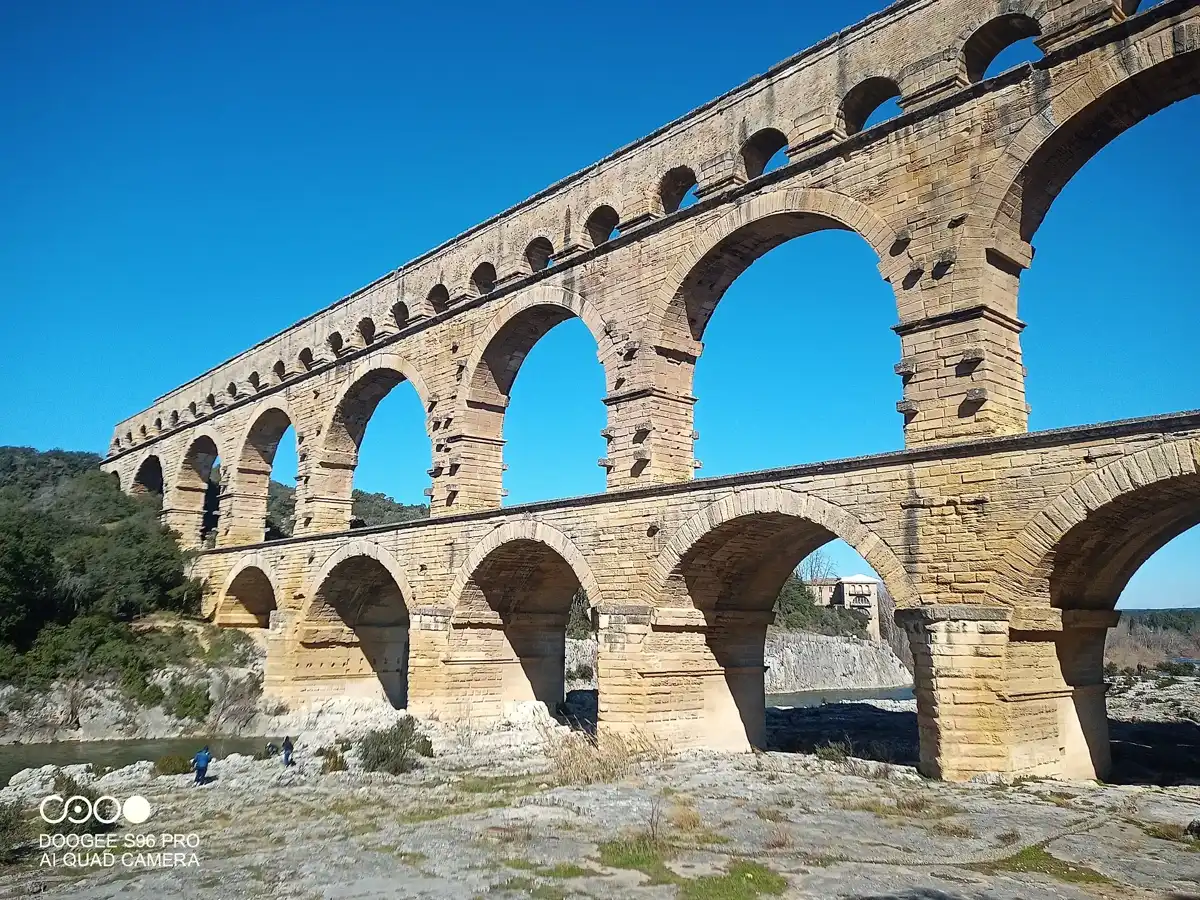
- The three-tiered arches: The obvious showstopper — a massive, perfectly balanced stone bridge rising in three stacked levels. It’s the best-preserved Roman aqueduct bridge in the world and seeing those huge limestone arches in person gives a real sense of ancient engineering muscle and elegance.
- The original purpose: water engineering: This wasn’t just a pretty ruin — it carried water 50 km from the Eure spring to Nîmes. The gentle slope, tight masonry and clever routing make it a textbook example of Roman hydraulic skill. Knowing it was a working piece of infrastructure makes the scale and precision more impressive.
- Immaculate Roman masonry up close: Walk close enough to study the precisely cut stones and tight joints — much of the structure was built without mortar, relying on perfect
- The three-tiered arches: The obvious showstopper — a massive, perfectly balanced stone bridge rising in three stacked levels. It’s the best-preserved Roman aqueduct bridge in the world and seeing those huge limestone arches in person gives a real sense of ancient engineering muscle and elegance.
- The original purpose: water engineering: This wasn’t just a pretty ruin — it carried water 50 km from the Eure spring to Nîmes. The gentle slope, tight masonry and clever routing make it a textbook example of Roman hydraulic skill. Knowing it was a working piece of infrastructure makes the scale and precision more impressive.
- Immaculate Roman masonry up close: Walk close enough to study the precisely cut stones and tight joints — much of the structure was built without mortar, relying on perfect cuts and weight. For anyone who likes how things were made, the craftsmanship is mesmerizing.
- River swimming and paddle trips: The Gardon river at the base is perfect for cooling off — swimming, canoeing or lazy floats are very popular in summer. It’s a simple, cheap way to turn a history visit into a full day outdoors (bring water shoes; the stones can be slippery).
- Panoramic viewpoints and photography spots: There are several vantage points along both riverbanks and up on the plateau that frame the bridge against the river and sky. Sunrise or late afternoon light is great for photos; the symmetry and reflections are addictively photogenic.
- Small museum and interpretation centre: A compact, well-presented space explains the aqueduct’s construction, route and archaeological finds. It’s short, affordable, and saves you from guessing what you’re looking at — perfect for budget travelers who want the highlights fast.
- Evening illuminations and cultural events: In summer the site sometimes hosts light shows, concerts and historical reenactments that bring the aqueduct to life after dark. If your trip lines up with an event, it’s a memorable way to see the monument lit up against the night sky.
Spotted a mistake or missing something? Contact us.

Provence Highlights Full-Day Tour from Avignon

Highlights of Provence in One Day

Provence in One Day Small Group Day Trip from Avignon

Nimes, Uzes & Pont du Gard Small Group FULL DAY Tour from Avignon

Half-Day Provence Pont du Gard and Wine Tasting Tour from Avignon

Provence Day Trip from Aix : Baux, Pont du Gard, Avignon and Wine

Full Day Best of Provence Tour from Avignon

Provence Day Trip from Marseille : Baux, Pont du Gard, Avignon

Saint Remy, Les Baux and Pont du Gard Small Group Half-Day Trip

 Best Backpacking
.jpg) Hi, I’m Johan (Netherlands 🇳🇱), the creator of TakeYourBackpack. Over the past decade, I’ve backpacked through 80+ countries across six continents, gaining extensive experience with independent travel, long-term trips, and overland routes.
Hi, I’m Johan (Netherlands 🇳🇱), the creator of TakeYourBackpack. Over the past decade, I’ve backpacked through 80+ countries across six continents, gaining extensive experience with independent travel, long-term trips, and overland routes.