×

France🇫🇷 | national parksPyrenees National Parkcirques, high passes, mountain lakes | things to do and best time to go

Explore Mercantour National ParkExplore Regional Nature Park of Corsica

Backpacking in Pyrenees
UNESCO World Heritage site
🌟 Highlightnational park ranked #3
By Johan Kruseman 🇳🇱 | Updated September 4, 2026

Most people online sell Pyrenees National Park as endless empty wilderness, but the truth is a lot of the classic valleys feel surprisingly managed and busy in peak season, more like a high-mountain village network than pure backcountry. You’re in southwest France, strung along the Spanish border between the Atlantic side near Gavarnie and the central range around Cauterets. For backpackers, it’s a trade: jaw-dropping cirques, real chances to see isards and vultures, and a dense web of trails and refuges, but also strict wild-camping rules, weather that turns fast, and valleys clogged with day-trippers in August. Access is easy by road and bus compared with Écrins or Mercantour, and there’s no entrance fee, but you’ll pay in refuge prices and sometimes in noise. I still prefer its rough, slightly workmanlike feel over the more polished vibe of Parc National des Cévennes; it feels like a park built for walkers first.

Discover everything you want to know in the 📖 France Travel Guide.


Get your France guide
142 ranked highlights, routes & tips, works offline (461 pages)
Loading the map 🌍
CLICK TO FILTER
cities
towns
villages
landmarks
national parks
hikes
beaches
attractions
festivals
regions
SHOW COUNTRY’S BESTSHOW ALL

✨ Why go?
Ranked #3 national park in France
The unique appeal for travelers

Backpackers flock to Pyrenees National Park for its blend of independent exploration and stunning landscapes. The park offers a variety of trails, from easy strolls to challenging hikes, catering to all skill levels. This diversity allows you to tailor your adventure without feeling rushed or confined to a tour group.

Budget-conscious travelers appreciate the nearby camping options and hostels that keep costs low. You can pitch a tent under the stars or find a cozy bunk, all while soaking in the natural beauty around you. This flexibility means you can spend more on experiences that matter, like a hearty meal at a local eatery or a guided excursion to a less-traveled area.

Self-guided exploration is the name of the game here. The well-marked trails and accessible maps empower you to navigate … read more 👉
Backpackers flock to Pyrenees National Park for its blend of independent exploration and stunning landscapes. The park offers a variety of trails, from easy strolls to challenging hikes, catering to all skill levels. This diversity allows you to tailor your adventure without feeling rushed or confined to a tour group.

Budget-conscious travelers appreciate the nearby camping options and hostels that keep costs low. You can pitch a tent under the stars or find a cozy bunk, all while soaking in the natural beauty around you. This flexibility means you can spend more on experiences that matter, like a hearty meal at a local eatery or a guided excursion to a less-traveled area.

Self-guided exploration is the name of the game here. The well-marked trails and accessible maps empower you to navigate at your own pace. Just be mindful of the weather; conditions can change rapidly. With a little preparation, you’ll preserve your energy and budget for the moments that truly count in this breathtaking park.
Want to include Pyrenees National Park in your France route?
Create a personalized France itinerary that includes Pyrenees National Park and the places that fit your trip — based on your travel style, budget, and available time. Get your route in seconds.

Generate my trip

💡 HighlightsMust-see experiences and standout moments

  • Cirque de Gavarnie — A colossal limestone amphitheatre crowned by the Gavarnie waterfall (one of Europe’s tallest). It’s dramatic, UNESCO-listed, and perfect for a relatively easy walk that still feels alpine and epic.
  • Vignemale (Pique-Longue) and Glacier d’Ossoue — The highest summit on the French side, with a remnant glacier and serious high-mountain routes. Classic objective for experienced hikers and climbers; the views over the surrounding cirques are brutal in the best way.
  • Cirque de Troumouse — Hugely wide and wild; less crowded than Gavarnie but just as impressive. Open meadows, huge cliffs and a real sense of space make it great for long walks and wild camping (where allowed).
  • Néouvielle Nature Reserve — A mosaic of granite peaks, larch forests and hundreds of glassy alpine lakes
read more 👉
  • Cirque de Gavarnie — A colossal limestone amphitheatre crowned by the Gavarnie waterfall (one of Europe’s tallest). It’s dramatic, UNESCO-listed, and perfect for a relatively easy walk that still feels alpine and epic.
  • Vignemale (Pique-Longue) and Glacier d’Ossoue — The highest summit on the French side, with a remnant glacier and serious high-mountain routes. Classic objective for experienced hikers and climbers; the views over the surrounding cirques are brutal in the best way.
  • Cirque de Troumouse — Hugely wide and wild; less crowded than Gavarnie but just as impressive. Open meadows, huge cliffs and a real sense of space make it great for long walks and wild camping (where allowed).
  • Néouvielle Nature Reserve — A mosaic of granite peaks, larch forests and hundreds of glassy alpine lakes (Les Lacs d’Aubert, Aumar, etc.). Superb for clear-water lake swims, reflective photos, and easy-to-moderate multi-day circuits.
  • Lac d’Oô — A compact, cinematic hike that ends at a turquoise lake beneath sheer rock faces and a thundering waterfall. Short but steep; popular for good reason — bring a picnic and a windproof layer.
  • Pont d’Espagne & Cauterets valley — Waterfalls, stone bridges and well-marked trails that serve as a gentle gateway into the high park. Great if you want spectacular scenery without committing to mountaineering.
  • Wildlife spotting (isard, marmots, bearded vulture, brown bear conservation) — The park is one of the best places to see Pyrenean isards (chamois), curious marmots, and soaring bearded vultures. Brown bears were reintroduced — sightings are rare, so enjoy the birds and chamois and take bear news as a bonus.
Spotted a mistake or missing something? Contact us.

Things to do near Pyrenees National Park

Ratings based on Tripadvisor reviews. When you book through this link, you support our work at no extra cost to you.

🌤️ When to go?Seasonal considerations and timing


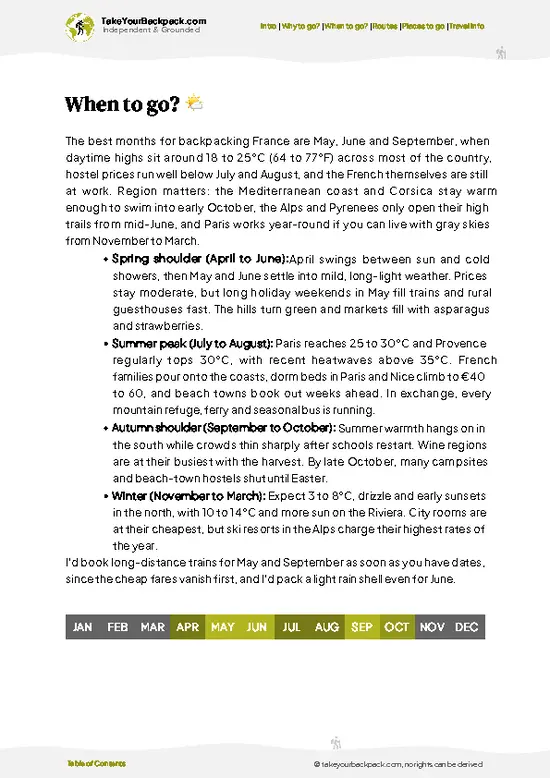
  • Weather: The Pyrenees National Park experiences cold, snowy winters with temperatures often below freezing, making backpacking challenging and requiring specialized gear. Summer months, from June to September, offer milder weather, with daytime highs ranging from 15°C to 25°C (59°F to 77°F), ideal for hiking.

  • Temperature: Spring and autumn bring fluctuating temperatures, sometimes dipping to near freezing at night (0°C to 10°C / 32°F to 50°F), so be ready for chilly evenings even if days feel warm. Summer days can be pleasant but occasionally hot in lower elevations.

  • Daylight Hours: Peak summer provides long daylight, up to 16 hours, maximizing hiking time. In contrast, winter days shrink to about 8 hours, limiting daylight for safe trekking.

  • Crowds: July and August attract the most
read more 👉

  • Weather: The Pyrenees National Park experiences cold, snowy winters with temperatures often below freezing, making backpacking challenging and requiring specialized gear. Summer months, from June to September, offer milder weather, with daytime highs ranging from 15°C to 25°C (59°F to 77°F), ideal for hiking.

  • Temperature: Spring and autumn bring fluctuating temperatures, sometimes dipping to near freezing at night (0°C to 10°C / 32°F to 50°F), so be ready for chilly evenings even if days feel warm. Summer days can be pleasant but occasionally hot in lower elevations.

  • Daylight Hours: Peak summer provides long daylight, up to 16 hours, maximizing hiking time. In contrast, winter days shrink to about 8 hours, limiting daylight for safe trekking.

  • Crowds: July and August attract the most visitors, which means busier trails and higher accommodation prices. Late spring (May-June) and early autumn (September) offer quieter paths and a more solitary experience.

  • Seasonal Activities: Summer is prime for hiking, wildflower spotting, and mountain biking. Winter shifts focus to skiing and snowshoeing, but backpackers should expect limited trail access and harsher conditions.

  • Price Fluctuations: Expect peak-season surcharges in summer, especially in popular villages and refuges. Shoulder seasons can offer better deals on lodging and fewer crowds, but some services may be limited.


Pro-tip: Aim for late June or early September to balance good weather, manageable crowds, and better prices—this window preserves your energy for the trails, not the hassle.


source: climatestotravel.comJANJanuary: below average for travelingFEBFebruary: below average for travelingMARMarch: fair for travelingAPRApril: good for travelingMAYMay: highly recommended for travelingJUNJune: excellent for travelingJULJuly: highly recommended for travelingAUGAugust: highly recommended for travelingSEPSeptember: excellent for travelingOCTOctober: good for travelingNOVNovember: fair for travelingDECDecember: below average for traveling
france-national-park-pyrenees-national-park
© Google | Ara Ara I Ara

✈️ The backpacker research shortcutFrance Travel Guide

An offline-friendly backpacking guide with optimized travel routes, ranked highlights, transport advice, and the best areas to stay.
example page 0 from our offline Travel Guide for France
example page 1 from our offline Travel Guide for France
example page 2 from our offline Travel Guide for France
example page 3 from our offline Travel Guide for France
example page 4 from our offline Travel Guide for France
example page 5 from our offline Travel Guide for France
example page 6 from our offline Travel Guide for France
example page 7 from our offline Travel Guide for France
The digital guide (461 pages) contains:
142 highlights, ranked by travel appeal
Optimized 7, 14 & 21-day travel routes
Cities, national parks, landmarks, beaches
How to get around
Offline-friendly for travel without Wi-Fi
👉 Click to see all 30+ guide features

📅 Plan smarter in minutes, not weeks
Month by month travel advice
Festivals & national holidays
Budget expectations

🗺️ Go to the right places, skip the overrated ones
Honest pros & cons of destinations
Top hikes, parks & viewpoints
Lesser-known places most travelers miss
Clear “worth it vs skip it” guidance

🛏️ Travel smoothly without rookie mistakes
Best areas to stay
Transport systems explained simply
Common scams & safety advice
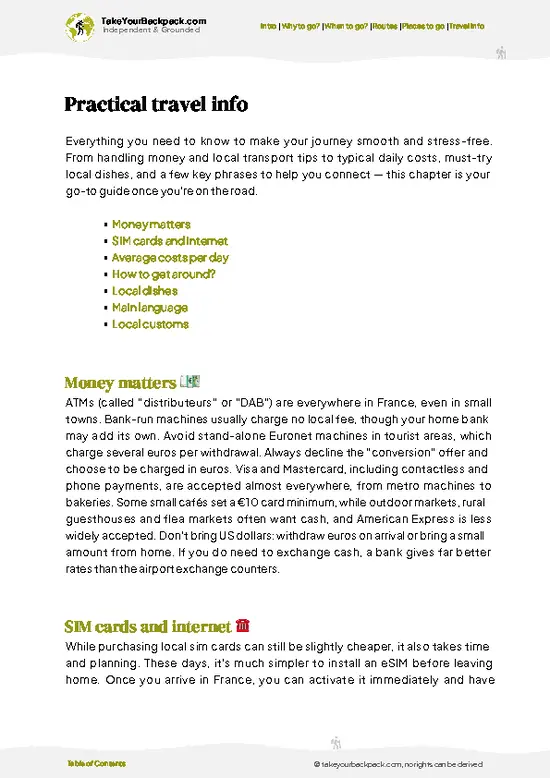
SIM cards, money & practical tips

🌍 Understand the country, not just visit it
Culture & traditions
52 Essential phrases & customs
Festivals worth planning around
Traveler-friendly historical context
Insights that make places more meaningful

📱 Built for real travel conditions
Fully downloadable PDF
Works completely offline
Optimized for phone use
Useful in remote areas & buses
Everything in one place
Save weeks of stressful planning
Get instant access to your full guide. 30‑day money-back guarantee.
+ Add another guide for just US$7.80

By proceeding you agree to our terms.
Sent to your inbox immediately after payment • 100% Secure Checkout
Best Backpacking Travel Advisor 2025 tourism awardBest Backpacking
Travel Advisor
2025
What others say about Take Your Backpack Guides:
⭐⭐⭐⭐⭐
Fantastic, amazing amount of information!
⭐⭐⭐⭐⭐
My goodness this is amazing, it's what I've been looking for hats off too you!
⭐⭐⭐⭐⭐
I think this is absolutely BRILLIANT
⭐⭐⭐⭐
Very complete and informative. It's still missing places, but I gotta to commend you
⭐⭐⭐⭐⭐
This is truly amazing, thank you, can't wait to explore it with my kids!
⭐⭐⭐⭐⭐
Awesome resource, thank you!
⭐⭐⭐⭐⭐
This is amazing! Can't wait to explore the ones I haven't seen
⭐⭐⭐⭐
I love this! Well done, great idea.
⭐⭐⭐⭐⭐
Thanks for taking the time to make this gem!
⭐⭐⭐⭐⭐
This might be the best website I've ever seen.
⭐⭐⭐⭐⭐
Congratulations, and thank you so much for your work; it's incredibly valuable.
⭐⭐⭐⭐
In all seriousness I think you did a great job pointing out the important spots
⭐⭐⭐⭐⭐
10/10 very good
⭐⭐⭐⭐⭐
As someone who's only just starting to visit regularly this is awesome, thank you.
⭐⭐⭐⭐
Thank you very much! I'm going to visit my dad, it's going to be very useful!
⭐⭐⭐⭐⭐
This is really cool! We'll be travelling for the first time and this definitely come in handy.
⭐⭐⭐⭐⭐
You are now our minister of culture, congratulations 👨‍💼
⭐⭐⭐⭐⭐
Just wanted to tell you that this is a pearl! Going to follow your recommendations.
⭐⭐⭐⭐⭐
This is so cool. I'll definitely be using the resource for my travels soon.
⭐⭐⭐⭐⭐
This is very impressive! Good work.
⭐⭐⭐⭐⭐
This is an amazing and informative site. Very well done!

🛏️ Where to stay?Best areas to stay in France

When it comes to staying in or near Pyrenees National Park, you have solid options that cater to backpackers without breaking the bank. Inside the park, the choices are limited but worthwhile. The Refuge de la Glère offers a cozy, rustic experience right in the heart of the mountains. It’s basic but clean, and the communal vibe is perfect for swapping stories with fellow hikers. Just remember to book ahead, especially in peak season.

If you prefer a bit more comfort, head to the nearby town of Cauterets. It’s a charming spot with several budget-friendly hostels and guesthouses. The Hôtel Les … read more 👉
When it comes to staying in or near Pyrenees National Park, you have solid options that cater to backpackers without breaking the bank. Inside the park, the choices are limited but worthwhile. The Refuge de la Glère offers a cozy, rustic experience right in the heart of the mountains. It’s basic but clean, and the communal vibe is perfect for swapping stories with fellow hikers. Just remember to book ahead, especially in peak season.

If you prefer a bit more comfort, head to the nearby town of Cauterets. It’s a charming spot with several budget-friendly hostels and guesthouses. The Hôtel Les Templiers is a solid pick, offering a friendly atmosphere and easy access to trails. Plus, you can stock up on supplies here before heading into the wilderness.

Another option is the town of Luz-Saint-Sauveur, which has a range of accommodations from campsites to budget hotels. It’s a great base for exploring the park and has a lively local scene. Just be cautious of peak tourist seasons; prices can spike, and availability can dwindle. Plan ahead to keep your energy and budget intact for the adventures that await.

👛 Costs (as of 4 September 2026)Typical daily expenses

Visiting Pyrenees National Park in France can be a rewarding experience, but it’s essential to be aware of the costs involved to avoid surprises.

Entrance to the park is free, which is a plus. However, if you plan to use specific facilities or guided tours, expect to pay. Guided hikes typically range from €20 to €50 per person, depending on the length and complexity of the trek.

Accommodation varies widely. Campsites are available for around €10 to €20 per night for a basic pitch. If you prefer a bit more comfort, budget hotels and guesthouses can range from €60 to €120 per night. Booking in advance can save you some cash, especially during peak seasons.

Food costs can add up. A meal at a local restaurant might set you back €15 to €30. If you’re cooking for yourself, grocery prices are … read more 👉
Visiting Pyrenees National Park in France can be a rewarding experience, but it’s essential to be aware of the costs involved to avoid surprises.

Entrance to the park is free, which is a plus. However, if you plan to use specific facilities or guided tours, expect to pay. Guided hikes typically range from €20 to €50 per person, depending on the length and complexity of the trek.

Accommodation varies widely. Campsites are available for around €10 to €20 per night for a basic pitch. If you prefer a bit more comfort, budget hotels and guesthouses can range from €60 to €120 per night. Booking in advance can save you some cash, especially during peak seasons.

Food costs can add up. A meal at a local restaurant might set you back €15 to €30. If you’re cooking for yourself, grocery prices are reasonable, with basic staples like bread, cheese, and pasta being quite affordable.

Transport is another factor. If you’re driving, fuel prices in France hover around €1.60 per liter. Public transport options are available, but they can be limited, especially in rural areas.

Plan for additional costs like parking fees, which can be around €5 to €10 per day in popular areas. Also, consider any entrance fees for specific attractions or activities within the park, which can vary.

Being aware of these costs will help you manage your budget effectively, allowing you to focus on enjoying the stunning landscapes and experiences the Pyrenees have to offer.


source: pyrenees-parcnational.fr
⚠️ Prices can change and everyone travels differently, so take this as a rough guide. Hope it helps you plan your adventure!

🥾 TrailsBest hikes in Pyrenees national park

The Pyrenees National Park is a hidden gem for hikers, offering a mix of stunning landscapes, diverse wildlife, and trails that range from easy strolls to challenging treks. You’ll find yourself surrounded by jagged peaks, lush valleys, and crystal-clear lakes, making it hard to put your camera down. Keep an eye out for wildlife like chamois and marmots; they’re the park’s unofficial mascots.

One of the standout trails is Cirque de Gavarnie. Here’s the scoop:
  • Length: 14 km
  • Estimated Duration: 4-5 hours
  • Difficulty Level: Moderate
  • Key Features: Stunning views of the Gavarnie Falls, impressive cliffs,
read more 👉
The Pyrenees National Park is a hidden gem for hikers, offering a mix of stunning landscapes, diverse wildlife, and trails that range from easy strolls to challenging treks. You’ll find yourself surrounded by jagged peaks, lush valleys, and crystal-clear lakes, making it hard to put your camera down. Keep an eye out for wildlife like chamois and marmots; they’re the park’s unofficial mascots.

One of the standout trails is Cirque de Gavarnie. Here’s the scoop:
  • Length: 14 km
  • Estimated Duration: 4-5 hours
  • Difficulty Level: Moderate
  • Key Features: Stunning views of the Gavarnie Falls, impressive cliffs, and a UNESCO World Heritage site.
  • Terrain: Well-marked paths, with some rocky sections and gentle inclines.

Another great option is Lac de Gaube:
  • Length: 8 km
  • Estimated Duration: 2-3 hours
  • Difficulty Level: Easy
  • Key Features: Beautiful lake surrounded by mountains, perfect for a picnic.
  • Terrain: Mostly flat with some gentle slopes, accessible for families.

Getting to the park is pretty straightforward. You can catch a train to Lourdes and then hop on a bus to various trailheads. As for crowds, it can get busy during peak season, especially around popular spots like Gavarnie, so aim for early mornings or weekdays if you can. Entrance to the park is free, which is a nice bonus for budget travelers. Just remember to pack some snacks and plenty of water, and you’re all set for a day in nature!
⚠️ Hiking info can sometimes be outdated or inaccurate. Before you hit the trail, check the latest conditions with locals. If you do spot anything that's off, I'd love to hear from you, so I can update it for fellow travelers.

🛡️ SafetyScams, Hazards, and Annoyances

In Pyrenees National Park, safety is about preparation and respect for the environment. Weather can shift quickly, so check forecasts before heading out. Dress in layers and be ready for rain or sun, even in summer.

The trails are generally well-marked, but some sections can be steep or rocky. Good footwear is essential; sturdy hiking boots will save you from slips and sore feet. Navigation skills are useful, especially in less trafficked areas.

Wildlife encounters are rare, but if you see animals like chamois or marmots, keep your distance. Feeding wildlife is a no-go; it disrupts their natural behavior.

Many first-timers underestimate the altitude. Take it slow, especially on ascents, and stay hydrated. River crossings can be tricky after heavy rains, so assess conditions carefully. … read more 👉
In Pyrenees National Park, safety is about preparation and respect for the environment. Weather can shift quickly, so check forecasts before heading out. Dress in layers and be ready for rain or sun, even in summer.

The trails are generally well-marked, but some sections can be steep or rocky. Good footwear is essential; sturdy hiking boots will save you from slips and sore feet. Navigation skills are useful, especially in less trafficked areas.

Wildlife encounters are rare, but if you see animals like chamois or marmots, keep your distance. Feeding wildlife is a no-go; it disrupts their natural behavior.

Many first-timers underestimate the altitude. Take it slow, especially on ascents, and stay hydrated. River crossings can be tricky after heavy rains, so assess conditions carefully. With these tips, you’ll preserve your energy and budget for the breathtaking views that await.

FAQTraveler FAQ

3 to 5 days is ideal to explore Pyrenees National Park thoroughly, allowing time for hiking, wildlife spotting, and visiting key sites like Gavarnie and the Cirque de Troumouse.
Yes, you can visit Pyrenees National Park without a car. Public buses and regional trains connect nearby towns such as Lourdes and Argelès-Gazost, and local shuttle services operate during peak seasons to access trailheads.
No entrance fee or permit is required to enter Pyrenees National Park. However, some specific activities like camping in designated areas or guided tours may have associated costs.
⚠️ Things can change over time, so always validate details locally before you go.

Other French national parks near Pyrenees

Explore more nearby:


💡 Not sure where to go next?
Create a personalized itinerary for France including Pyrenees and the places that fit your trip.

Generate my itinerary

👉 Discover all national parks

Or checkout all France has to offer (think cities, towns, villages, national parks, hikes, beaches, festivals)
Country photo of France

We 💚 feedbackFinal thoughts on exploring Pyrenees

The Pyrenees National Park is a treasure for those who crave raw nature. The trails offer breathtaking views and a sense of solitude that’s hard to find elsewhere. But be prepared: the weather can change on a dime. A sunny morning can morph into a stormy afternoon, so pack layers and check forecasts. Embrace the unpredictability; it’s part of the adventure. Just don’t let it catch you off guard.

✈️ When did I visit France?
Being close to The Netherlands, my home base, I visited France many times.

✍️ Help improve this page!
The information on this page is based on my own backpacking experience in France, supplemented with up-to-date research and feedback from other travelers. Travel details can change, so if you notice anything outdated or incomplete, feel free to let me know.


🙋‍♂️ Give feedback

👋 Meet the founderWho’s Behind Take Your Backpack?

Johan, backpacker and founder of TakeYourBackpackHi, I’m Johan (Netherlands 🇳🇱), the creator of TakeYourBackpack. Over the past decade, I’ve backpacked through 80+ countries across six continents, gaining extensive experience with independent travel, long-term trips, and overland routes.

This site is built on a combination of firsthand travel experience and carefully curated insights from other backpackers. Many guides are based on places I’ve personally visited, while others bring together tips, observations, and practical advice shared by trusted travelers I’ve met along the way.

The goal is to provide realistic, experience-driven guidance — not generic itineraries — so you can explore destinations with better context, clearer expectations, and more confidence.

Get full France guide •
Instant download • 142 highlights • Full Offline guide