×
Parc Amazonien de Guyane

French Guiana🇬🇫 | national parksParc Amazonien de GuyaneSaül trails, Maroni rapids, Wayana villages, Mont Itoupé | things to do and best time to go

Explore Nouragues Nature ReserveExplore Trésor Nature Reserve

Backpacking in Parc Amazonien de Guyane
🏆 Top picknational park ranked #1
By Johan Kruseman 🇳🇱 | Updated October 19, 2026

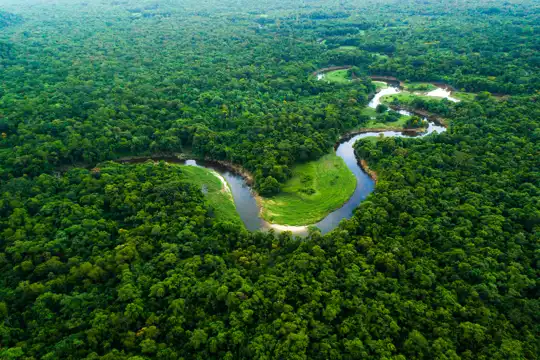
Parc Amazonien de Guyane is the largest national park in the European Union, roughly 3.4 million hectares of continuous rainforest in the southern interior of French Guiana. Expect a green wall, the whoop of howler monkeys before dawn, red mud that stays on your boots for days, and a close-up of the canopy that few places in the Americas still offer. Access is expensive by design. No roads reach the interior, so you fly from Cayenne to Saül or Maripasoula, or take a pirogue up the Maroni, and experienced travelers book those seats weeks ahead because planes are small and few. Trails around Saül are marked but muddy, and rain turns creeks into thigh-deep crossings. Carry a hammock and mosquito net rather than a tent, since the forest floor floods and crawls. Wildlife is rich but shy. This suits self-reliant hikers and river lovers who can live with heat and silence. It will frustrate anyone wanting crowds, comfort or fast results.

Discover everything you want to know in the 📖 French Guiana Travel Guide.


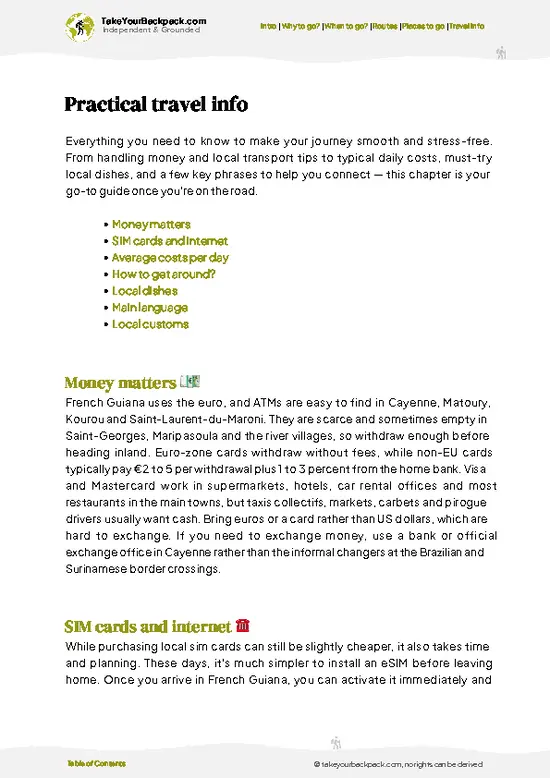
example page 0 from our offline Travel Guide for French Guiana
example page 1 from our offline Travel Guide for French Guiana
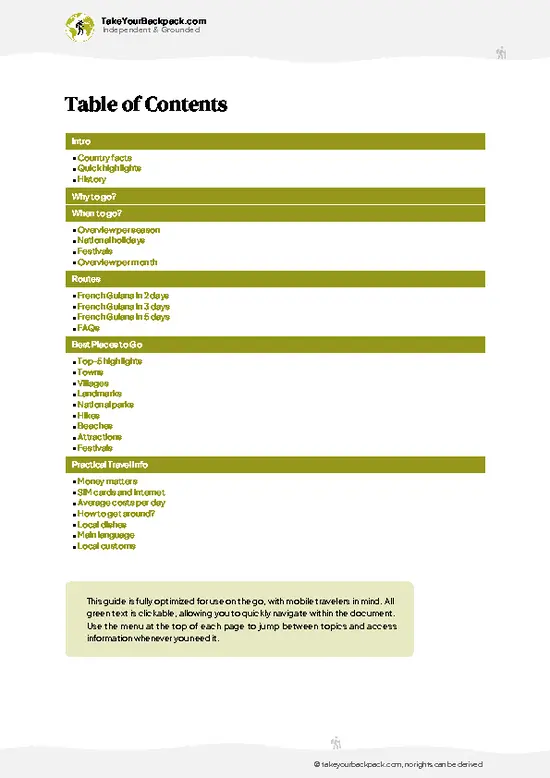
example page 2 from our offline Travel Guide for French Guiana
example page 3 from our offline Travel Guide for French Guiana
example page 4 from our offline Travel Guide for French Guiana
example page 5 from our offline Travel Guide for French Guiana
example page 6 from our offline Travel Guide for French Guiana
example page 7 from our offline Travel Guide for French Guiana
Loading the map 🌍
CLICK TO FILTER
towns
villages
landmarks
national parks
hikes
beaches
attractions
festivals
SHOW COUNTRY’S BESTSHOW ALL

✨ Why go?
Ranked #1 national park in French Guiana
Reasons people choose to explore here

Parc Amazonien de Guyane appeals to backpackers who want real jungle without a tour-bus layer. Around Saül, a village of a couple hundred people ringed by hills, you can walk straight from the grass airstrip onto marked forest paths and decide your own pace, sleeping in a hammock under a carbet shelter. Few places in South America let you do that with such little infrastructure between you and primary forest, and the mix of trail distances means a short loop one morning and a multi-day push the next.

The second draw is the Maroni River corridor around Maripasoula and Papaïchton, where travel means dugout pirogues passing rapids, Aluku and Wayana communities, and gold-country back channels. It is self-guided in spirit, though you will need local boatmen. For people who value solitude, wildlife … read more 👉
Parc Amazonien de Guyane appeals to backpackers who want real jungle without a tour-bus layer. Around Saül, a village of a couple hundred people ringed by hills, you can walk straight from the grass airstrip onto marked forest paths and decide your own pace, sleeping in a hammock under a carbet shelter. Few places in South America let you do that with such little infrastructure between you and primary forest, and the mix of trail distances means a short loop one morning and a multi-day push the next.

The second draw is the Maroni River corridor around Maripasoula and Papaïchton, where travel means dugout pirogues passing rapids, Aluku and Wayana communities, and gold-country back channels. It is self-guided in spirit, though you will need local boatmen. For people who value solitude, wildlife such as giant otters, macaws and the orange Guianan cock-of-the-rock, and a sense of genuine remoteness, the effort is the point.

💡 HighlightsMust-see experiences and standout moments

  1. Saül and its forest trails: The village sits almost at the geographic center of French Guiana, and its network of marked paths starts a few steps from the houses. Mossy hills, creek crossings and loud dawn choruses make it the easiest entry to the park's interior.
  2. Monts La Fumée: A demanding walk from Saül up through dense forest to granite-topped hills with views over an unbroken green canopy.
  3. Gros Arbre trail: A walk near Saül to a huge forest giant with buttress roots taller than a person. It is a good short outing for judging how tall this canopy really is.
  4. Cock-of-the-rock displays: Males of this bright orange bird gather at leks in the forest around Saül and call and dance in the early morning. Go with a local guide and arrive quietly before first light.
  5. The Maroni River by pirogue: Narrow
… read more 👉
  1. Saül and its forest trails: The village sits almost at the geographic center of French Guiana, and its network of marked paths starts a few steps from the houses. Mossy hills, creek crossings and loud dawn choruses make it the easiest entry to the park's interior.
  2. Monts La Fumée: A demanding walk from Saül up through dense forest to granite-topped hills with views over an unbroken green canopy.
  3. Gros Arbre trail: A walk near Saül to a huge forest giant with buttress roots taller than a person. It is a good short outing for judging how tall this canopy really is.
  4. Cock-of-the-rock displays: Males of this bright orange bird gather at leks in the forest around Saül and call and dance in the early morning. Go with a local guide and arrive quietly before first light.
  5. The Maroni River by pirogue: Narrow wooden boats run the river from Maripasoula and Papaïchton through rapids called sauts, past sandbanks, islets and riverside villages. Water levels change the experience hugely.
  6. Wayana villages of the Haut-Maroni: Communities such as Antecume Pata and Taluen hold painted roofs (tukusipan), basketry and a living culture. Visits should be arranged through local contacts and treated as visits to homes.
  7. Mont Itoupé: The second-highest summit in French Guiana, at about 830 meters, in cloud forest far from any road. Reaching it takes a committed expedition with logistics support.
Start with Saül, because its short loops let you test your gear, your feet and your tolerance for mud before committing to anything longer.
Spotted a mistake or missing something? Contact us.

Things to do near Parc Amazonien de Guyane

Ratings based on Tripadvisor reviews. When you book through this link, you support our work at no extra cost to you.

🌤️ When to go?Seasonal considerations and timing

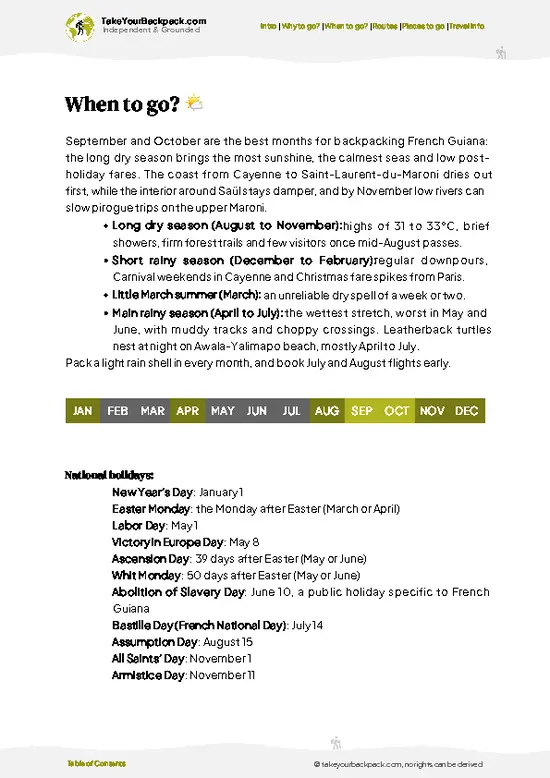
The best window is the long dry season from roughly August to November, when river levels still allow travel but rain rarely stops you for days.
  • Long Dry Season (Aug to Nov): Days run 30 to 34°C (86 to 93°F), nights 22 to 24°C (72 to 75°F). Rivers drop, so some rapids and portages get harder and pirogue trips run slower. Rain is occasional and short. Flights and pirogue seats fill early, and guides cost the most.
  • Wet Season (Dec to Jun): Heavy downpours arrive most days, with 25 to 31°C (77 to 88°F) and humidity near saturation. Rivers rise, making pirogue travel faster on some stretches, but trails turn to mud and insects multiply. Crowds are almost nonexistent and some operators reduce departures.
  • Short Dry Spell (Mar): A brief break in the rains, sometimes called the “little summer of March,
… read more 👉
The best window is the long dry season from roughly August to November, when river levels still allow travel but rain rarely stops you for days.
  • Long Dry Season (Aug to Nov): Days run 30 to 34°C (86 to 93°F), nights 22 to 24°C (72 to 75°F). Rivers drop, so some rapids and portages get harder and pirogue trips run slower. Rain is occasional and short. Flights and pirogue seats fill early, and guides cost the most.
  • Wet Season (Dec to Jun): Heavy downpours arrive most days, with 25 to 31°C (77 to 88°F) and humidity near saturation. Rivers rise, making pirogue travel faster on some stretches, but trails turn to mud and insects multiply. Crowds are almost nonexistent and some operators reduce departures.
  • Short Dry Spell (Mar): A brief break in the rains, sometimes called the “little summer of March,” gives a few drier weeks with fewer mosquitoes than peak wet months.
  • Daylight: Days stay close to 12 hours all year, so plan on dark by early evening in every season.
Book flights and boat transport for the park’s interior at least a month ahead if you travel in September or October.


source: climatestotravel.comJANJanuary: fair for travelingFEBFebruary: fair for travelingMARMarch: fair for travelingAPRApril: fair for travelingMAYMay: fair for travelingJUNJune: fair for travelingJULJuly: fair for travelingAUGAugust: highly recommended for travelingSEPSeptember: excellent for travelingOCTOctober: excellent for travelingNOVNovember: excellent for travelingDECDecember: fair for traveling
Brazil&Ecuador&Peru&Bolivia - Amazon Rainforest

✈️ The backpacker research shortcutFrench Guiana Travel Guide

An offline-friendly backpacking guide with optimized travel routes, ranked highlights, transport advice, and the best areas to stay.
example page 0 from our offline Travel Guide for French Guiana
example page 1 from our offline Travel Guide for French Guiana
example page 2 from our offline Travel Guide for French Guiana
example page 3 from our offline Travel Guide for French Guiana
example page 4 from our offline Travel Guide for French Guiana
example page 5 from our offline Travel Guide for French Guiana
example page 6 from our offline Travel Guide for French Guiana
example page 7 from our offline Travel Guide for French Guiana
The digital guide (130 pages) contains:
✅ 31 highlights, ranked by travel appeal
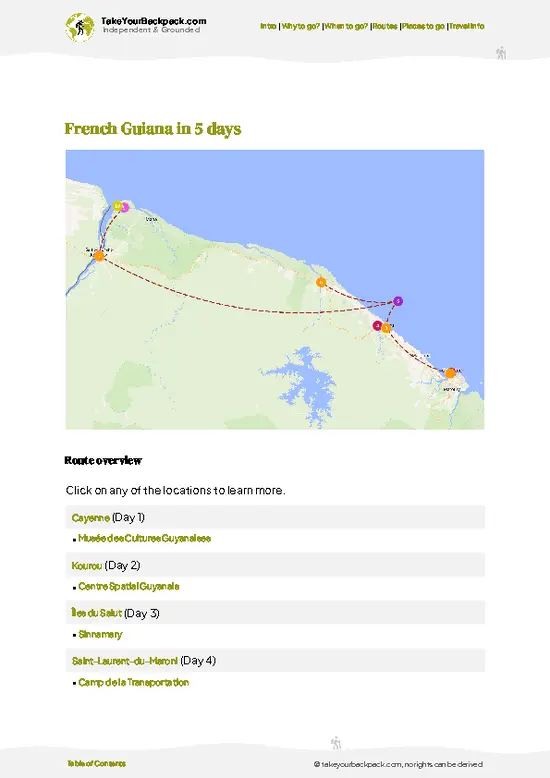
✅ Optimized 2, 3 & 5-day travel routes
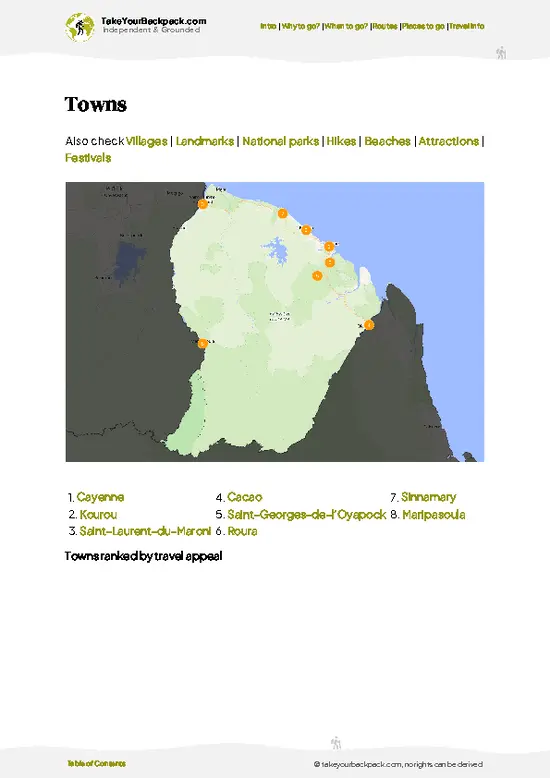
✅ Cities, national parks, landmarks, beaches
✅ How to get around
✅ Offline-friendly for travel without Wi-Fi
👉 Click to see all 30+ guide features

📅 Plan smarter in minutes, not weeks
✅ Month by month travel advice
✅ Festivals & national holidays
✅ Budget expectations

🗺️ Go to the right places, skip the overrated ones
✅ Honest pros & cons of destinations
✅ Top hikes, parks & viewpoints
✅ Lesser-known places most travelers miss
✅ Clear “worth it vs skip it” guidance

🛏️ Travel smoothly without rookie mistakes
✅ Best areas to stay
✅ Transport systems explained simply
✅ Common scams & safety advice
✅ SIM cards, money & practical tips

🌍 Understand the country, not just visit it
✅ Culture & traditions
✅ 52 Essential phrases & customs
✅ Festivals worth planning around
✅ Traveler-friendly historical context
✅ Insights that make places more meaningful

📱 Built for real travel conditions
✅ Fully downloadable PDF
✅ Works completely offline
✅ Optimized for phone use
✅ Useful in remote areas & buses
✅ Everything in one place
Stop searching, start planning
Get instant access to your full guide. 30‑day money-back guarantee.
+ Add another guide for just

By proceeding you agree to our terms.
Sent to your inbox immediately after payment • 100% Secure Checkout
Best Backpacking Travel Advisor 2025 tourism awardBest Backpacking
Travel Advisor
2025
What others say about Take Your Backpack Guides:
⭐⭐⭐⭐⭐
Fantastic, amazing amount of information!
⭐⭐⭐⭐⭐
My goodness this is amazing, it's what I've been looking for hats off too you!
⭐⭐⭐⭐⭐
I think this is absolutely BRILLIANT
⭐⭐⭐⭐
Very complete and informative. It's still missing places, but I gotta to commend you
⭐⭐⭐⭐⭐
This is truly amazing, thank you, can't wait to explore it with my kids!
⭐⭐⭐⭐⭐
Awesome resource, thank you!
⭐⭐⭐⭐⭐
This is amazing! Can't wait to explore the ones I haven't seen
⭐⭐⭐⭐
I love this! Well done, great idea.
⭐⭐⭐⭐⭐
Thanks for taking the time to make this gem!
⭐⭐⭐⭐⭐
This might be the best website I've ever seen.
⭐⭐⭐⭐⭐
Congratulations, and thank you so much for your work; it's incredibly valuable.
⭐⭐⭐⭐
In all seriousness I think you did a great job pointing out the important spots
⭐⭐⭐⭐⭐
10/10 very good
⭐⭐⭐⭐⭐
As someone who's only just starting to visit regularly this is awesome, thank you.
⭐⭐⭐⭐
Thank you very much! I'm going to visit my dad, it's going to be very useful!
⭐⭐⭐⭐⭐
This is really cool! We'll be travelling for the first time and this definitely come in handy.
⭐⭐⭐⭐⭐
You are now our minister of culture, congratulations 👨‍💼
⭐⭐⭐⭐⭐
Just wanted to tell you that this is a pearl! Going to follow your recommendations.
⭐⭐⭐⭐⭐
This is so cool. I'll definitely be using the resource for my travels soon.
⭐⭐⭐⭐⭐
This is very impressive! Good work.
⭐⭐⭐⭐⭐
This is an amazing and informative site. Very well done!

🛏️ Where to stay?Best areas and accommodation options

Most backpackers sleep in the gateway villages along the Maroni and Oyapock rivers, because the park’s interior has no hotels, only a few basic carbets (open-air shelters) and village homestays.
Inside the park, Camopi on the Oyapock and Maripasoula, Papaïchton and Saül are the usual bases. In Saül, a small village ringed by trails, you can camp or take a simple room at a gîte for about €20 to 45 a night, and the village is reached by small plane from Cayenne. Maripasoula has a handful of guesthouses at €40 to 80, and Camopi has a few basic lodgings and community-run carbets at around €15 to 35. … read more 👉
Most backpackers sleep in the gateway villages along the Maroni and Oyapock rivers, because the park’s interior has no hotels, only a few basic carbets (open-air shelters) and village homestays.
Inside the park, Camopi on the Oyapock and Maripasoula, Papaïchton and Saül are the usual bases. In Saül, a small village ringed by trails, you can camp or take a simple room at a gîte for about €20 to 45 a night, and the village is reached by small plane from Cayenne. Maripasoula has a handful of guesthouses at €40 to 80, and Camopi has a few basic lodgings and community-run carbets at around €15 to 35.
On the trail, you sleep in a hammock under a carbet with a mosquito net. Bring your own hammock, since few places rent them, though guides often supply them on organized trips for €5 to 10.
Cayenne, on the coast, is the practical staging town for permits, supplies, flights and guides, with hostels and guesthouses from €25 to 70. Saint-Laurent-du-Maroni is the other entry point for Maroni river trips, with budget rooms from €35 to 60.
Book ahead in Saül and Maripasoula, since beds are few and flights are small.

👛 Costs (as of 19 October 2026)Money, prices, and spending tips

Expect to spend about €95 per day at the budget level in Parc Amazonien de Guyane, mostly because getting there and hiring a guide are expensive.
CategoryBudget RangeLocal Reality
Entrance fees€0No entry fee for the park itself. Some guided activities and village visits carry small charges.
Accommodation (high season)€15 to 45Hammock in a carbet or basic gîte. Guesthouses in Maripasoula cost more at €40 to 80.
Local transport€15 to 40Pirogue rides on the Maroni or Oyapock cost per trip, shared among passengers. Small flights to Saül or Maripasoula run about €80 to 150 one way, averaged out over days.
Guides and permits€0 to 70A local guide is often needed for remote trails and costs around €50 to 100 a day, shared by the group. Some trails in Saül can be walked independently.
Food and supplies€15
… read more 👉
Expect to spend about €95 per day at the budget level in Parc Amazonien de Guyane, mostly because getting there and hiring a guide are expensive.
CategoryBudget RangeLocal Reality
Entrance fees€0No entry fee for the park itself. Some guided activities and village visits carry small charges.
Accommodation (high season)€15 to 45Hammock in a carbet or basic gîte. Guesthouses in Maripasoula cost more at €40 to 80.
Local transport€15 to 40Pirogue rides on the Maroni or Oyapock cost per trip, shared among passengers. Small flights to Saül or Maripasoula run about €80 to 150 one way, averaged out over days.
Guides and permits€0 to 70A local guide is often needed for remote trails and costs around €50 to 100 a day, shared by the group. Some trails in Saül can be walked independently.
Food and supplies€15 to 30Villages have small shops with imported goods at high prices. Meals in guesthouses cost €10 to 18. Cooking your own food is cheaper.
Total Daily Budget€95Per person, per day, in high season.
⚠️ Prices can change and everyone travels differently, so take this as a rough guide. Hope it helps you plan your adventure!

🥾 TrailsExploring Parc Amazonien de Guyane: trails, terrain, and views

Parc Amazonien de Guyane offers mostly rough forest walking, with the best-organized trail network around Saül and river-based travel elsewhere. Terrain is steep and rooty, creeks need wading after rain, and heat makes slow progress normal. Wildlife includes howler and spider monkeys, agoutis, toucans, macaws, caimans along the water and, rarely, tapirs or jaguar tracks.
  • Gros Arbre: Short outing from Saül, easy to moderate, a few hours at most. Key feature is a giant forest tree, over mostly flat muddy track.
  • Monts La Fumée: A strenuous loop of about 10 km that takes 4.5 to 5 hours. Climbs through
… read more 👉
Parc Amazonien de Guyane offers mostly rough forest walking, with the best-organized trail network around Saül and river-based travel elsewhere. Terrain is steep and rooty, creeks need wading after rain, and heat makes slow progress normal. Wildlife includes howler and spider monkeys, agoutis, toucans, macaws, caimans along the water and, rarely, tapirs or jaguar tracks.
  • Gros Arbre: Short outing from Saül, easy to moderate, a few hours at most. Key feature is a giant forest tree, over mostly flat muddy track.
  • Monts La Fumée: A strenuous loop of about 10 km that takes 4.5 to 5 hours. Climbs through primary forest to open granite views.
  • Grand Boeuf Mort and other Saül loops: Day walks of moderate difficulty with creek crossings, waterfalls and chances to spot birds and monkeys. Distances vary, so confirm the current route and conditions locally.
  • Maroni river excursions: Pirogue trips of a day or several from Maripasoula or Papaïchton, combined with short bush walks near rapids and villages. Difficulty is low, but weather and water level dictate everything.
  • Mont Itoupé: Expedition-level climb in remote cloud forest, only with specialist guides and support.
Getting here is the main hurdle. Small planes from Cayenne serve Saül and Maripasoula, while the Maroni can be reached by road and boat from the west. There is no entrance fee to the park itself, though guides, boats and flights cost real money and are the way you pay for access. Crowds are essentially nonexistent. Many days you will share a trail with nobody. Rain is possible at any time, so pack everything in dry bags and bring a hammock, net, filter and a satellite messenger or a plan with locals.
⚠️ Hiking info can sometimes be outdated or inaccurate. Before you hit the trail, check the latest conditions with locals. If you do spot anything that's off, I'd love to hear from you, so I can update it for fellow travelers.

🛡️ SafetyScams, Hazards, and Annoyances

Parc Amazonien de Guyane is safe if you treat it as a remote rainforest, where isolation, not crime, is the main concern.
Trails are often unmarked, muddy and crossed by fallen trees, so go with a local guide in the interior, and carry a GPS or offline map in Saül, where marked loops exist. Heat and humidity drain you quickly, so start at dawn, drink at least 3 liters a day and carry purification tablets or a filter. Rain can raise creeks within hours, so avoid crossing swollen streams.
Wildlife is rarely aggressive. Snakes such as lanceheads are the real risk, so watch your footing, wear closed boots and never put a hand on a log or branch unseen. Mosquitoes, ticks and wasps are constant, and malaria and dengue are present, so carry repellent, long clothing and check current vaccine advice. … read more 👉
Parc Amazonien de Guyane is safe if you treat it as a remote rainforest, where isolation, not crime, is the main concern.
Trails are often unmarked, muddy and crossed by fallen trees, so go with a local guide in the interior, and carry a GPS or offline map in Saül, where marked loops exist. Heat and humidity drain you quickly, so start at dawn, drink at least 3 liters a day and carry purification tablets or a filter. Rain can raise creeks within hours, so avoid crossing swollen streams.
Wildlife is rarely aggressive. Snakes such as lanceheads are the real risk, so watch your footing, wear closed boots and never put a hand on a log or branch unseen. Mosquitoes, ticks and wasps are constant, and malaria and dengue are present, so carry repellent, long clothing and check current vaccine advice. Yellow fever vaccination is required.
Cell coverage is patchy, and rescue takes time. Tell someone your route and carry a satellite messenger if you go beyond villages. Illegal gold mining occurs in parts of the south, so stay with your guide and avoid unofficial areas.

FAQCommon questions from travelers

Plan on 4 to 7 days for Parc Amazonien de Guyane, because reaching the interior eats up time. Saül and its trails need 3 to 4 days, including the flight from Cayenne of about 45 minutes. A river trip on the Maroni to Maripasoula or Camopi on the Oyapock adds 2 to 3 more days each way by pirogue.
You can visit Parc Amazonien de Guyane without a car, and in fact a car is no use inside it because there are no roads to most villages. Reach Saül or Maripasoula by small plane from Cayenne, or take shared pirogues from Saint-Laurent-du-Maroni or Saint-Georges. Flights cost roughly €80 to 150 one way, and boat trips run several hours to a full day depending on the river.
Parc Amazonien de Guyane has no general entrance fee, so you do not pay to enter. Some areas, especially protected zones and indigenous villages, require a guide or prior authorization, and guides cost about €50 to 100 a day. Check with the park office in Cayenne or Saint-Laurent-du-Maroni before heading to Camopi or Maripasoula.
⚠️ Things can change over time, so always validate details locally before you go.

Other French Guianese national parks near Parc Amazonien de Guyane

Explore more nearby:


💡 Not sure where to go next?
Create a personalized itinerary for French Guiana including Parc Amazonien de Guyane and the places that fit your trip.

Generate my itinerary

👉 Discover all national parks

Or checkout all French Guiana has to offer (think cities, towns, villages, national parks, hikes, beaches, festivals)
Country photo of French Guiana

We 💚 feedbackParting advice and final tips

Parc Amazonien de Guyane belongs to patient, self-sufficient travelers who enjoy silence, mud and slow river days, and who treat remoteness as the attraction rather than an obstacle. If you need quick wildlife payoffs or comfort, skip it. I would book flights early, hire a local guide for the first dawn walk, and bring a good hammock with a rain fly.

✍️ Help improve this page!
The information on this page is based on in-depth research, insights shared by experienced travelers, and feedback from the local travel community in French Guiana. While every effort is made to keep the information accurate and current, conditions can change — so if you spot anything incorrect or outdated, please get in touch.


🙋‍♂️ Give feedback

👋 Meet the founderWho’s Behind Take Your Backpack?

Johan, backpacker and founder of TakeYourBackpackHi, I’m Johan (Netherlands 🇳🇱), the creator of TakeYourBackpack. Over the past 3 decades, I’ve backpacked through 90+ countries across six continents, gaining extensive experience with independent travel, long-term trips, and overland routes.

This site is built on a combination of firsthand travel experience and carefully curated insights from other backpackers. Many guides are based on places I’ve personally visited, while others bring together tips, observations, and practical advice shared by trusted travelers I’ve met along the way.

The goal is to provide realistic, experience-driven guidance — not generic itineraries — so you can explore destinations with better context, clearer expectations, and more confidence.