×

French Guiana🇬🇫 | national parksRéserve naturelle des Marais de Kaw-RouraPirogue marsh trips, night caiman, hoatzin colonies, stilt village | things to do and best time to go

Explore Cawapé Natural ReserveExplore Nouragues Nature Reserve

Backpacking in Réserve naturelle des Marais de Kaw-Roura
🌟 Highlightnational park ranked #2
By Johan Kruseman 🇳🇱 | Updated October 19, 2026

Réserve naturelle des Marais de Kaw-Roura puts you in one of the most wildlife-rich wetlands in the Guianas without needing a vehicle of your own, since a local guide and a pirogue do the work. It lies in the north of French Guiana, southeast of Cayenne, around the village of Kaw and the Kaw Mountain. Out on the marsh you glide through floating meadows of water lettuce, with the smell of wet vegetation and the croak of frogs after dusk, and at night the black caiman eyes glow red in a flashlight beam. The mountain trails climb through dripping forest where howler monkeys roar and you may spot a toucan, though the mud is thick and mosquitoes follow you everywhere. Crowds are almost nonexistent, and the vibe is quiet, damp and a little wild. Hiking is limited to short routes, and the road in is rough. Before going, book a guide in advance, because independent access to the marsh is very restricted.

Discover everything you want to know in the 📖 French Guiana Travel Guide.


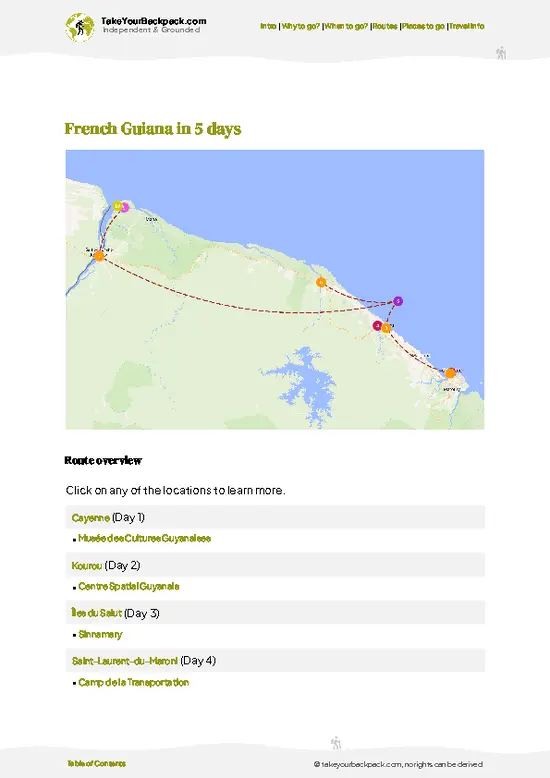
example page 0 from our offline Travel Guide for French Guiana
example page 1 from our offline Travel Guide for French Guiana
example page 2 from our offline Travel Guide for French Guiana
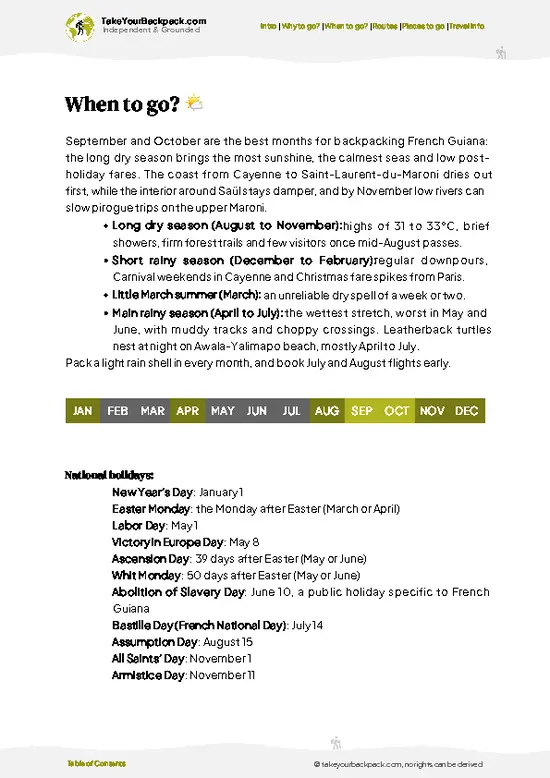
example page 3 from our offline Travel Guide for French Guiana
example page 4 from our offline Travel Guide for French Guiana
example page 5 from our offline Travel Guide for French Guiana
example page 6 from our offline Travel Guide for French Guiana
example page 7 from our offline Travel Guide for French Guiana
Loading the map 🌍
CLICK TO FILTER
towns
villages
landmarks
national parks
hikes
beaches
attractions
festivals
SHOW COUNTRY’S BESTSHOW ALL

✨ Why go?
Ranked #2 national park in French Guiana
Reasons people choose to explore here

Réserve naturelle des Marais de Kaw-Roura suits backpackers who want real wilderness without a multi-day expedition. The big draw is the Kaw marsh, a flooded plain where you drift by boat past hoatzins, herons, kingfishers and black caiman in a few hours, something that is hard to match elsewhere in South America at this price level. The village of Kaw itself, a small settlement on stilts reached by a dirt track and a river crossing, gives you a simple, social base where guides, boat drivers and cooks all know each other, so arranging an outing takes a conversation rather than a booking engine. Self-guided wandering is possible on the forest paths of Kaw Mountain, though the marsh itself is best done with a local, as channels look identical and the water is tricky. Dedicated hammock spots … read more 👉
Réserve naturelle des Marais de Kaw-Roura suits backpackers who want real wilderness without a multi-day expedition. The big draw is the Kaw marsh, a flooded plain where you drift by boat past hoatzins, herons, kingfishers and black caiman in a few hours, something that is hard to match elsewhere in South America at this price level. The village of Kaw itself, a small settlement on stilts reached by a dirt track and a river crossing, gives you a simple, social base where guides, boat drivers and cooks all know each other, so arranging an outing takes a conversation rather than a booking engine. Self-guided wandering is possible on the forest paths of Kaw Mountain, though the marsh itself is best done with a local, as channels look identical and the water is tricky. Dedicated hammock spots mean you can stay on a small budget, and nights spent listening to frogs and nightjars are a big part of the draw. If you like slow, sensory travel and little infrastructure, this is the place.

💡 HighlightsMust-see experiences and standout moments

  1. Kaw marsh by pirogue: The signature experience. Flat-bottomed boats slide through channels of water lettuce and papyrus-like reeds, with herons, ibis and jacanas on every side, and the horizon is huge and open.
  2. Night caiman spotting: After dark, guides shine lights across the water and pick out the reflecting eyes of black caiman, then sometimes lift small ones for a close look. The night chorus of frogs is deafening.
  3. Hoatzin colonies: These shaggy, punk-crested birds nest in the marsh vegetation and are easy to find. They hiss and flap awkwardly, and the young have claws on their wings.
  4. Kaw village: A tiny settlement of wooden houses on stilts at the water’s edge, with a few carbet lodges and a hammock-and-fish-dinner atmosphere. Sunsets over the marsh are very quiet here.
  5. Kaw Mountain forest
… read more 👉
  1. Kaw marsh by pirogue: The signature experience. Flat-bottomed boats slide through channels of water lettuce and papyrus-like reeds, with herons, ibis and jacanas on every side, and the horizon is huge and open.
  2. Night caiman spotting: After dark, guides shine lights across the water and pick out the reflecting eyes of black caiman, then sometimes lift small ones for a close look. The night chorus of frogs is deafening.
  3. Hoatzin colonies: These shaggy, punk-crested birds nest in the marsh vegetation and are easy to find. They hiss and flap awkwardly, and the young have claws on their wings.
  4. Kaw village: A tiny settlement of wooden houses on stilts at the water’s edge, with a few carbet lodges and a hammock-and-fish-dinner atmosphere. Sunsets over the marsh are very quiet here.
  5. Kaw Mountain forest walk: A damp, shaded climb through primary forest where you may hear howler monkeys, see morpho butterflies and spot tiny frogs on the leaf litter. Expect mud and humidity.
  6. The road in and the pirogue landing: The D6 road climbs over Kaw Mountain and ends at a landing on the marsh, where a pirogue covers the last stretch to the village. The slow approach makes the arrival feel earned.
  7. Sunrise on the water: Early boat trips catch mist lifting off the marsh and birds feeding, with fewer insects than later in the day.
Start with the evening pirogue trip into the marsh, because it combines the birds at dusk with the caiman after dark in one outing.
Spotted a mistake or missing something? Contact us.

🌤️ When to go?Seasonal considerations and timing

  • Long Rainy Season (April to mid-July): Peak flooding, with the marshes at their fullest and boats reaching deep channels. Expect daily downpours, 24 to 31°C (75 to 88°F), and muddy paths around Kaw village. Prices stay low and you will often be the only guest.
  • Dry Season (mid-August to November): Water drops, caimans and wading birds concentrate along the channels, and night boat trips are most reliable. Highs reach 32 to 34°C (90 to 93°F). Lodging is scarcer in August, when French school holidays fill the carbets.
  • Short Rainy Season (December to January): Showers come back, with cooler nights near 23°C (73°F). Few visitors.
  • Little March Summer (February to March): A short drier pause with good bird activity and moderate crowds.
Daylight stays close to 12 hours all year, so timing hinges on water … read more 👉
  • Long Rainy Season (April to mid-July): Peak flooding, with the marshes at their fullest and boats reaching deep channels. Expect daily downpours, 24 to 31°C (75 to 88°F), and muddy paths around Kaw village. Prices stay low and you will often be the only guest.
  • Dry Season (mid-August to November): Water drops, caimans and wading birds concentrate along the channels, and night boat trips are most reliable. Highs reach 32 to 34°C (90 to 93°F). Lodging is scarcer in August, when French school holidays fill the carbets.
  • Short Rainy Season (December to January): Showers come back, with cooler nights near 23°C (73°F). Few visitors.
  • Little March Summer (February to March): A short drier pause with good bird activity and moderate crowds.
Daylight stays close to 12 hours all year, so timing hinges on water levels. Book Kaw lodging two to three weeks ahead for July and August.


source: climatestotravel.comJANJanuary: fair for travelingFEBFebruary: fair for travelingMARMarch: fair for travelingAPRApril: fair for travelingMAYMay: fair for travelingJUNJune: fair for travelingJULJuly: fair for travelingAUGAugust: excellent for travelingSEPSeptember: excellent for travelingOCTOctober: excellent for travelingNOVNovember: highly recommended for travelingDECDecember: highly recommended for traveling
when-to-go

✈️ The backpacker research shortcutFrench Guiana Travel Guide

An offline-friendly backpacking guide with optimized travel routes, ranked highlights, transport advice, and the best areas to stay.
example page 0 from our offline Travel Guide for French Guiana
example page 1 from our offline Travel Guide for French Guiana
example page 2 from our offline Travel Guide for French Guiana
example page 3 from our offline Travel Guide for French Guiana
example page 4 from our offline Travel Guide for French Guiana
example page 5 from our offline Travel Guide for French Guiana
example page 6 from our offline Travel Guide for French Guiana
example page 7 from our offline Travel Guide for French Guiana
The digital guide (130 pages) contains:
✅ 31 highlights, ranked by travel appeal
✅ Optimized 2, 3 & 5-day travel routes
✅ Cities, national parks, landmarks, beaches
✅ How to get around
✅ Offline-friendly for travel without Wi-Fi
👉 Click to see all 30+ guide features

📅 Plan smarter in minutes, not weeks
✅ Month by month travel advice
✅ Festivals & national holidays
✅ Budget expectations

🗺️ Go to the right places, skip the overrated ones
✅ Honest pros & cons of destinations
✅ Top hikes, parks & viewpoints
✅ Lesser-known places most travelers miss
✅ Clear “worth it vs skip it” guidance

🛏️ Travel smoothly without rookie mistakes
✅ Best areas to stay
✅ Transport systems explained simply
✅ Common scams & safety advice
✅ SIM cards, money & practical tips

🌍 Understand the country, not just visit it
✅ Culture & traditions
✅ 52 Essential phrases & customs
✅ Festivals worth planning around
✅ Traveler-friendly historical context
✅ Insights that make places more meaningful

📱 Built for real travel conditions
✅ Fully downloadable PDF
✅ Works completely offline
✅ Optimized for phone use
✅ Useful in remote areas & buses
✅ Everything in one place
Stop searching, start planning
Get instant access to your full guide. 30‑day money-back guarantee.
+ Add another guide for just

By proceeding you agree to our terms.
Sent to your inbox immediately after payment • 100% Secure Checkout
Best Backpacking Travel Advisor 2025 tourism awardBest Backpacking
Travel Advisor
2025
What others say about Take Your Backpack Guides:
⭐⭐⭐⭐⭐
Fantastic, amazing amount of information!
⭐⭐⭐⭐⭐
My goodness this is amazing, it's what I've been looking for hats off too you!
⭐⭐⭐⭐⭐
I think this is absolutely BRILLIANT
⭐⭐⭐⭐
Very complete and informative. It's still missing places, but I gotta to commend you
⭐⭐⭐⭐⭐
This is truly amazing, thank you, can't wait to explore it with my kids!
⭐⭐⭐⭐⭐
Awesome resource, thank you!
⭐⭐⭐⭐⭐
This is amazing! Can't wait to explore the ones I haven't seen
⭐⭐⭐⭐
I love this! Well done, great idea.
⭐⭐⭐⭐⭐
Thanks for taking the time to make this gem!
⭐⭐⭐⭐⭐
This might be the best website I've ever seen.
⭐⭐⭐⭐⭐
Congratulations, and thank you so much for your work; it's incredibly valuable.
⭐⭐⭐⭐
In all seriousness I think you did a great job pointing out the important spots
⭐⭐⭐⭐⭐
10/10 very good
⭐⭐⭐⭐⭐
As someone who's only just starting to visit regularly this is awesome, thank you.
⭐⭐⭐⭐
Thank you very much! I'm going to visit my dad, it's going to be very useful!
⭐⭐⭐⭐⭐
This is really cool! We'll be travelling for the first time and this definitely come in handy.
⭐⭐⭐⭐⭐
You are now our minister of culture, congratulations 👨‍💼
⭐⭐⭐⭐⭐
Just wanted to tell you that this is a pearl! Going to follow your recommendations.
⭐⭐⭐⭐⭐
This is so cool. I'll definitely be using the resource for my travels soon.
⭐⭐⭐⭐⭐
This is very impressive! Good work.
⭐⭐⭐⭐⭐
This is an amazing and informative site. Very well done!

🛏️ Where to stay?How to pick the right area

The best base for backpackers is Kaw village itself, the only settlement inside the reserve, on an island of floating-meadow marshes reached by pirogue. Lodging there is simple: a handful of family-run guesthouses and carbets (open-sided wooden shelters) with hammocks, mosquito nets, shared bathrooms and generator-powered or limited electricity. Meals are usually included, built around fresh river fish. Expect to arrange everything by phone or message in advance, since the village has no shops of note and no ATM. Sleeping here puts you on the water for dawn bird trips and for the night caiman … read more 👉
The best base for backpackers is Kaw village itself, the only settlement inside the reserve, on an island of floating-meadow marshes reached by pirogue. Lodging there is simple: a handful of family-run guesthouses and carbets (open-sided wooden shelters) with hammocks, mosquito nets, shared bathrooms and generator-powered or limited electricity. Meals are usually included, built around fresh river fish. Expect to arrange everything by phone or message in advance, since the village has no shops of note and no ATM. Sleeping here puts you on the water for dawn bird trips and for the night caiman outings, which are the main draw.

If you arrive late or want a cheaper start, the town of Roura, about 30 minutes by road from Cayenne, has a few gîtes and small hotels near the departure road for Kaw. Cayenne has the widest choice, from hostel-style rooms to mid-range hotels, and it is where you can rent a car and stock up on food and cash. Camping inside the reserve is not an option, and hammocks are only available in the village carbets. Cacao, a Hmong farming village on the same side of the region, also offers a few guesthouses and a Sunday market.

👛 Costs (as of 19 October 2026)Typical daily expenses

Expect to spend about €135 a day for a backpacker visiting Réserve naturelle des Marais de Kaw-Roura, with boat transfers and guided night trips as the main costs. Everything is priced in euros, and the region is among the pricier in South America.
CategoryBudget RangeLocal Reality
Entrance Fees€0No fee is charged to enter the reserve; you pay only for guided activities and boats.
Accommodation€20 to 35 (hammock carbet); €60 to 90 (room with meals)Kaw village guesthouses are basic. Hammock places are cheaper in low season. The high-season figure used in the total is €30.
Local Transport€25 to 45Return pirogue transfer between the road end and Kaw village. Reaching Roura from Cayenne by taxi or shared car adds about €10 to 20, and a rental car runs €40 to 60 a day.
Guided Activities€30 to 60Night
… read more 👉
Expect to spend about €135 a day for a backpacker visiting Réserve naturelle des Marais de Kaw-Roura, with boat transfers and guided night trips as the main costs. Everything is priced in euros, and the region is among the pricier in South America.
CategoryBudget RangeLocal Reality
Entrance Fees€0No fee is charged to enter the reserve; you pay only for guided activities and boats.
Accommodation€20 to 35 (hammock carbet); €60 to 90 (room with meals)Kaw village guesthouses are basic. Hammock places are cheaper in low season. The high-season figure used in the total is €30.
Local Transport€25 to 45Return pirogue transfer between the road end and Kaw village. Reaching Roura from Cayenne by taxi or shared car adds about €10 to 20, and a rental car runs €40 to 60 a day.
Guided Activities€30 to 60Night caiman outing roughly €30 to 45. Day tours with a guide from Cayenne cost €90 to 130 including lunch.
Food and Supplies€20 to 35Meals in Kaw are often included with lodging. Buy snacks, water and cash in Cayenne or Roura beforehand, as supplies in the village are limited and costly.
Total Daily Budget€135Per person, per day, in high season.
⚠️ Prices can change and everyone travels differently, so take this as a rough guide. Hope it helps you plan your adventure!

🥾 TrailsWhere to hike in Réserve naturelle des Marais de Kaw-Roura: trails for every level

Réserve naturelle des Marais de Kaw-Roura is more about water than walking, but the paths on land are rewarding if you accept mud and heat. Most walks start in or near Kaw village and head into forest, passing fallen trunks, buttress roots, ant trails and the occasional troop of monkeys overhead.
  • Marsh boat trips: Typically two to four hours by pirogue, flat and easy, with birdlife, caiman and floating vegetation. Evening departures are the most popular.
  • Kaw Mountain forest trail: A forest walk of roughly half a day with a steady climb on muddy, root-covered ground. Moderate difficulty, mainly because
… read more 👉
Réserve naturelle des Marais de Kaw-Roura is more about water than walking, but the paths on land are rewarding if you accept mud and heat. Most walks start in or near Kaw village and head into forest, passing fallen trunks, buttress roots, ant trails and the occasional troop of monkeys overhead.
  • Marsh boat trips: Typically two to four hours by pirogue, flat and easy, with birdlife, caiman and floating vegetation. Evening departures are the most popular.
  • Kaw Mountain forest trail: A forest walk of roughly half a day with a steady climb on muddy, root-covered ground. Moderate difficulty, mainly because of humidity and slippery footing. Wildlife includes howler monkeys, agoutis, toucans and many butterflies.
  • Village and shoreline strolls: Short, flat walks of under an hour along the water’s edge, good for birds at dawn and dusk.
Terrain is a mix of open wetland, swamp forest and hill forest, so waterproof footwear that dries fast and long sleeves help. Wildlife is the highlight: black caiman, hoatzins, herons, kingfishers, sloths on rare occasions and a constant soundtrack of frogs and insects. Conditions vary a lot with the rains, as high water opens more channels for boats while low water exposes more mud and shortens routes.
Getting there is the main challenge. Public transport is very limited, so most travelers arrive with a guide, a rental car or a shared transfer arranged from Cayenne, and the last stretch is a rough road. There is no regular bus to the village. Crowds are small, usually a handful of visitors at a time, and guided trips are what keep the experience personal. Entry to the reserve itself is generally covered by the cost of a guide or boat trip, so ask when booking.
⚠️ Hiking info can sometimes be outdated or inaccurate. Before you hit the trail, check the latest conditions with locals. If you do spot anything that's off, I'd love to hear from you, so I can update it for fellow travelers.

🛡️ SafetySafety Tips and Common Scams in Réserve naturelle des Marais de Kaw-Roura

Kaw-Roura is straightforward and low-risk if you go with a local guide, which is how almost everyone visits. The main hazards are heat, sun and mosquitoes. Wear long, light sleeves, bring repellent, and drink more water than feels necessary, since humidity makes you sweat hard even sitting in a boat. Trails around the Kaw mountain are slick after rain, so wear shoes with grip rather than sandals. Black caimans, anacondas and snakes live here, but they are encountered on guided boat outings where the guide keeps distance. Never reach into water, and do not swim in the marshes. Keep hands inside the pirogue and follow the guide’s instructions at night. Bring a headlamp, a rain jacket and dry bags, because sudden downpours soak packs quickly. Phone coverage is patchy beyond Roura, so confirm … read more 👉
Kaw-Roura is straightforward and low-risk if you go with a local guide, which is how almost everyone visits. The main hazards are heat, sun and mosquitoes. Wear long, light sleeves, bring repellent, and drink more water than feels necessary, since humidity makes you sweat hard even sitting in a boat. Trails around the Kaw mountain are slick after rain, so wear shoes with grip rather than sandals. Black caimans, anacondas and snakes live here, but they are encountered on guided boat outings where the guide keeps distance. Never reach into water, and do not swim in the marshes. Keep hands inside the pirogue and follow the guide’s instructions at night. Bring a headlamp, a rain jacket and dry bags, because sudden downpours soak packs quickly. Phone coverage is patchy beyond Roura, so confirm pickup times before leaving the embarkation point. Tell your lodging your plans if you travel independently, and keep valuables out of unattended cars at the road end.

FAQFrequently asked questions about Réserve naturelle des Marais de Kaw-Roura

Two days and one night is the ideal length for Réserve naturelle des Marais de Kaw-Roura. That gives you an afternoon boat trip, a night caiman outing, and a dawn bird-watching session before leaving. A single day trip from Cayenne is possible, about 1 to 1.5 hours by road to the embarkation point plus around an hour by boat each way, but it skips the night wildlife. Add a third day if you want to hike Kaw mountain or paddle the marsh channels.
Going without a car is possible, though awkward. Cayenne has no regular public bus to the Kaw road end, so most backpackers join an organized day tour or book a guesthouse that arranges pickup, usually €25 to 45 return including the pirogue. A shared taxi from Cayenne to Roura costs roughly €10 to 20, but you will still need a transfer for the final stretch. Renting a car in Cayenne at €40 to 60 a day is the most flexible option.
No entrance fee or permit is required to enter Réserve naturelle des Marais de Kaw-Roura, which is a protected area with free access. You pay only for boat transfers from the road end to Kaw village (about €25 to 45 return), guided night trips (€30 to 45) and lodging. Guided visits are strongly advised since the marshes are hard to navigate alone. Local operators and guesthouses handle bookings, and the reserve’s management body can answer rules on activities.
⚠️ Things can change over time, so always validate details locally before you go.

Other French Guianese national parks near Réserve naturelle des Marais de Kaw-Roura

Explore more nearby:


💡 Not sure where to go next?
Create a personalized itinerary for French Guiana including Réserve naturelle des Marais de Kaw-Roura and the places that fit your trip.

Generate my itinerary

👉 Discover all national parks

Or checkout all French Guiana has to offer (think cities, towns, villages, national parks, hikes, beaches, festivals)
Country photo of French Guiana

We 💚 feedbackKey takeaways before you go

Réserve naturelle des Marais de Kaw-Roura pairs well with a few days around Cayenne, the Montsinéry area and the Kourou space center, so you can swap marsh nights for city meals and rocket exhibits. I would book the evening boat trip and stay overnight in a hammock, then carry insect repellent and a headlamp. Skip rushing it as a single stop.

✍️ Help improve this page!
The information on this page is based on in-depth research, insights shared by experienced travelers, and feedback from the local travel community in French Guiana. While every effort is made to keep the information accurate and current, conditions can change — so if you spot anything incorrect or outdated, please get in touch.


🙋‍♂️ Give feedback

👋 Meet the founderWho’s Behind Take Your Backpack?

Johan, backpacker and founder of TakeYourBackpackHi, I’m Johan (Netherlands 🇳🇱), the creator of TakeYourBackpack. Over the past 3 decades, I’ve backpacked through 90+ countries across six continents, gaining extensive experience with independent travel, long-term trips, and overland routes.

This site is built on a combination of firsthand travel experience and carefully curated insights from other backpackers. Many guides are based on places I’ve personally visited, while others bring together tips, observations, and practical advice shared by trusted travelers I’ve met along the way.

The goal is to provide realistic, experience-driven guidance — not generic itineraries — so you can explore destinations with better context, clearer expectations, and more confidence.