×

Gabon🇬🇦 | townsMoandaManganese plateau, company quarter, ore trains, rust-red dust | things to do and best time to go

Explore GambaExplore Bitam

Backpacking in Moanda
🏆 Top picktown ranked #3
By Johan Kruseman 🇳🇱 | Updated November 1, 2026

Franceville, not Moanda, is the capital of Haut-Ogooué province. Moanda is a manganese town, and everything about it follows from the ore. It sits in southeastern Gabon, west of Franceville, on red laterite soil where mine trucks leave a fine rust-colored dust on shopfronts and sandals. Don’t come for polished sights. The mining plateau, the central market with its charcoal smoke and frying plantain, and the tidy company quarter deserve your time. The strip of concrete bars along the main road does not. Reaching the town is easy by Gabonese standards, since both the Transgabonais railway and a paved road serve it. Evenings are quiet, hotels mostly host mine contractors, and you will rarely run into other backpackers. Compared with Franceville, Moanda is smaller, dustier and more industrial, but it is the better launch point for the Oklo area.

Part of Backpacking in Gabon: all 40 places on one map, with routes and the best time to go.
Discover everything you want to know in the 📖 Gabon Travel Guide.


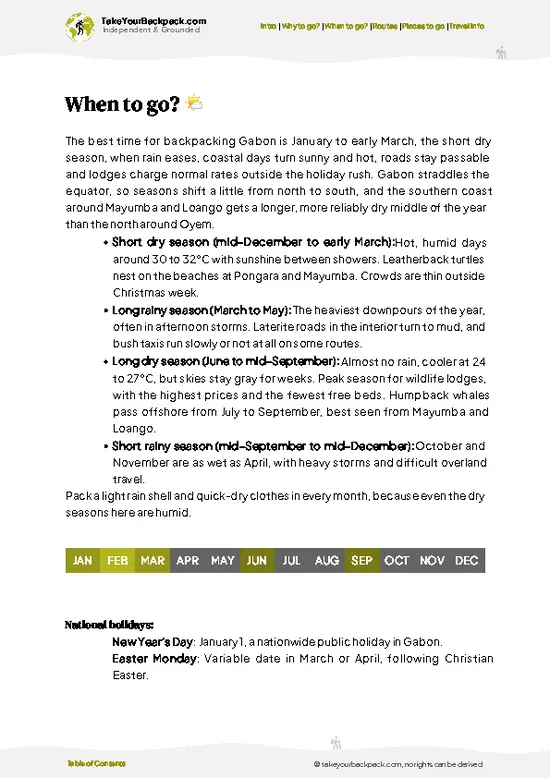
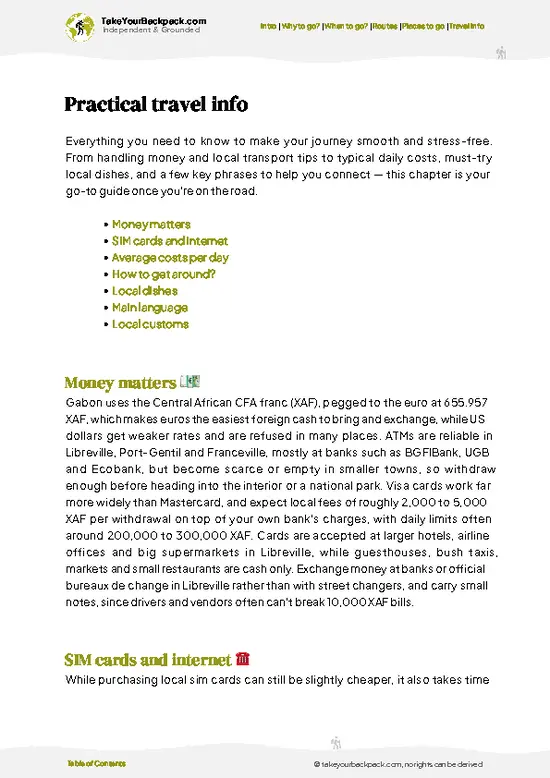
example page 0 from our offline Travel Guide for Gabon
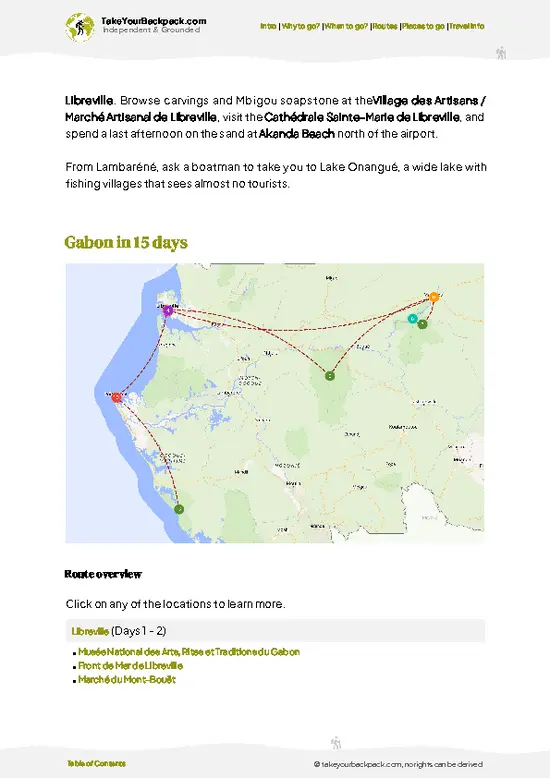
example page 1 from our offline Travel Guide for Gabon
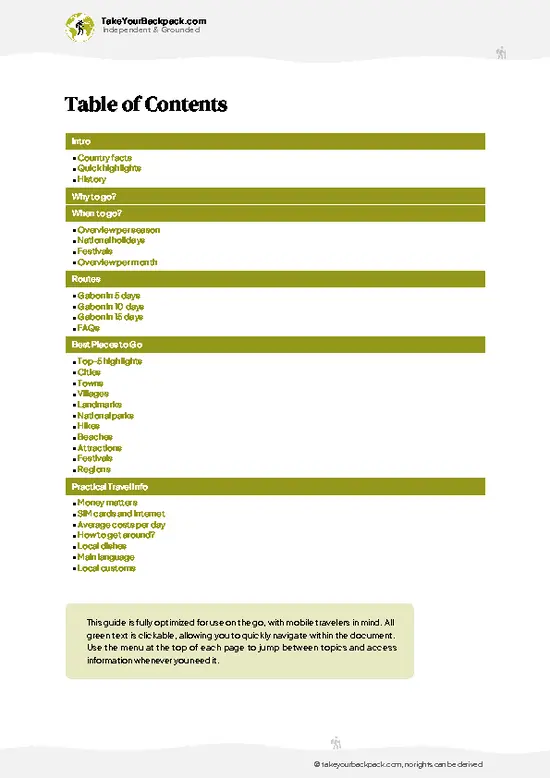
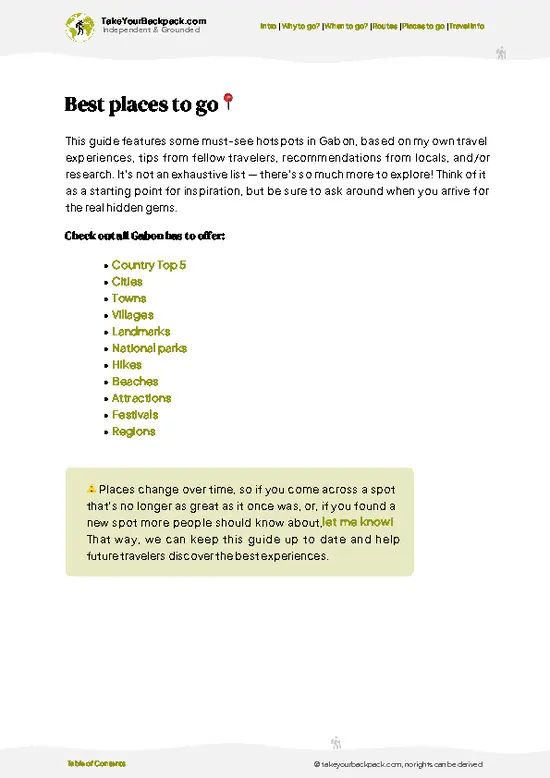
example page 2 from our offline Travel Guide for Gabon
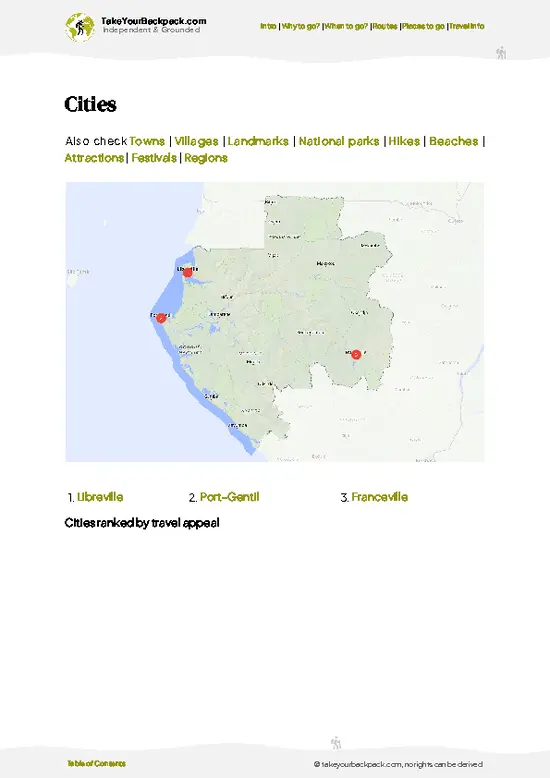
example page 3 from our offline Travel Guide for Gabon
example page 4 from our offline Travel Guide for Gabon
example page 5 from our offline Travel Guide for Gabon
example page 6 from our offline Travel Guide for Gabon
example page 7 from our offline Travel Guide for Gabon
Loading the map 🌍
CLICK TO FILTER
cities
towns
villages
landmarks
national parks
hikes
beaches
attractions
festivals
regions
SHOW COUNTRY’S BESTSHOW ALL

✨ Why go?
Ranked #3 town in Gabon
What sets this place apart

Moanda earns its place on a southeastern Gabon route as a working town that sits close to some of the region’s best day outings. The reasons to stop come down to two or three. Poubara Falls lies about an hour away beyond Franceville, and the Oklo zone, where a natural nuclear reactor operated about two billion years ago, is nearby too. Then there is the town itself, built around the manganese mine on the Bangombé plateau. Seeing a real extraction economy, with ore trains, a company-built quarter and a metallurgical plant, tells you more about modern Gabon than a beach resort does. Most people stay one or two nights. Slow travelers and curious solo travelers who like practical, unpolished places will enjoy it. Social life is thin, with no party scene and few chances to meet fellow backpackers, … read more 👉
Moanda earns its place on a southeastern Gabon route as a working town that sits close to some of the region’s best day outings. The reasons to stop come down to two or three. Poubara Falls lies about an hour away beyond Franceville, and the Oklo zone, where a natural nuclear reactor operated about two billion years ago, is nearby too. Then there is the town itself, built around the manganese mine on the Bangombé plateau. Seeing a real extraction economy, with ore trains, a company-built quarter and a metallurgical plant, tells you more about modern Gabon than a beach resort does. Most people stay one or two nights. Slow travelers and curious solo travelers who like practical, unpolished places will enjoy it. Social life is thin, with no party scene and few chances to meet fellow backpackers, so treat it as a base for outings and a rest between Franceville and the coast, not as a destination to linger in.

💡 HighlightsTop highlights of Moanda

  1. Bangombé Plateau manganese mine viewpoints: The reason Moanda exists. The red-brown plateau is stripped in terraces, and ore trucks and conveyors move constantly. Seeing it from the road edges is free and takes about 30 minutes to an hour. Going inside the operation needs authorization from the company, COMILOG, so arrange it ahead. Early morning has the softest light and least dust.
  2. Moanda Central Market: The best place to see local life. Stalls sell cassava, smoked fish, bushmeat-free vegetables, peppers, fabrics and plastic basins, and the noise is loud and friendly. Go in the morning, when produce is freshest, and allow 1 to 2 hours. Entry is free, and a snack costs well under €2.
  3. Cité Comilog: The company-built residential quarter, with tree-lined streets, matching houses and a calm that
… read more 👉
  1. Bangombé Plateau manganese mine viewpoints: The reason Moanda exists. The red-brown plateau is stripped in terraces, and ore trucks and conveyors move constantly. Seeing it from the road edges is free and takes about 30 minutes to an hour. Going inside the operation needs authorization from the company, COMILOG, so arrange it ahead. Early morning has the softest light and least dust.
  2. Moanda Central Market: The best place to see local life. Stalls sell cassava, smoked fish, bushmeat-free vegetables, peppers, fabrics and plastic basins, and the noise is loud and friendly. Go in the morning, when produce is freshest, and allow 1 to 2 hours. Entry is free, and a snack costs well under €2.
  3. Cité Comilog: The company-built residential quarter, with tree-lined streets, matching houses and a calm that contrasts with the rest of town. A slow 45-minute walk shows how the mine shaped Moanda’s layout and social hierarchy. It is free, and the late afternoon is the most pleasant time.
  4. Moanda railway station: Ore wagons and Transgabonais trains pass here, so it is worth a short stop if you like industrial scenes. Watching the long ore convoys roll in takes 20 to 40 minutes and is free. Ask before taking photos.
  5. Metallurgical complex surroundings: The manganese processing plant stands on the edge of town, and its chimneys and stockpiles of grey-black ore make a striking backdrop. Tours are not routinely offered, so enjoy it from outside the fence in about 20 minutes, with no fee.
Moanda also makes a good base for day trips to Poubara Falls, the Oklo reactor zone, and Lékédi Park, where savanna and forest meet near Bakoumba. Everything on this list is free, and the market costs only what you spend on a snack.
Spotted a mistake or missing something? Contact us.

🏘️ NeighborhoodsWhere things are and how it's laid out

Moanda is a mining town laid out around manganese, so its areas are defined by who lives and works where. Here is how to spend your time.
  • Town center and the main market: This is where you should spend most of your hours. Stalls sell cassava sticks wrapped in leaves, smoked fish, peppers and fried plantain, and the air is thick with charcoal smoke and motorbike exhaust. Everything is within a 20-minute walk, though the midday sun on the red-dust roads is punishing.
  • Poto-Poto and the dense residential quarters: Tin roofs, tiny bars and loud music from open doorways make this the best place for a cold beer and grilled chicken or fish at plastic tables. Go in the late afternoon, when the heat eases and neighbors drift outside. Streets are rutted and muddy after rain, so wear closed shoes.
  • Mining
… read more 👉
Moanda is a mining town laid out around manganese, so its areas are defined by who lives and works where. Here is how to spend your time.
  • Town center and the main market: This is where you should spend most of your hours. Stalls sell cassava sticks wrapped in leaves, smoked fish, peppers and fried plantain, and the air is thick with charcoal smoke and motorbike exhaust. Everything is within a 20-minute walk, though the midday sun on the red-dust roads is punishing.
  • Poto-Poto and the dense residential quarters: Tin roofs, tiny bars and loud music from open doorways make this the best place for a cold beer and grilled chicken or fish at plastic tables. Go in the late afternoon, when the heat eases and neighbors drift outside. Streets are rutted and muddy after rain, so wear closed shoes.
  • Mining company districts (COMILOG area): Tidy, quiet, and tree-lined, with a fenced, institutional feel. Worth a short wander for the contrast, but there is little to eat or do, and I would not give it more than an hour.
  • Edge of town toward the Bangombé plateau and Lekedi direction: Red earth, scrubby savanna and hills open up here, with grit on your teeth from passing trucks. Reaching it on foot is a slog, so take a moto-taxi and walk once you arrive.

⌛️ 1 dayHow to make the most of one day

7:30 AM, Central Market: Start here because the market is liveliest and coolest early, and you can get a breakfast of fried dough or grilled plantain with strong coffee for pocket change. Wander the produce rows and look at the smoked fish. Then take a short taxi toward the mine edge.
9:30 AM, Bangombé Plateau viewpoints: The morning light picks out the terraces and the red earth, and the dust is lighter before trucks reach full traffic. Stay on public roadsides, take a few photos at distance, and watch the conveyor systems at work. It is the reason the town exists, so give it a proper half hour or more.
11:30 AM, Cité Comilog: Walk the quiet streets and shaded avenues of the company quarter. It feels different from the market, planned and calm, and you can see the old colonial-era layout. This … read more 👉
7:30 AM, Central Market: Start here because the market is liveliest and coolest early, and you can get a breakfast of fried dough or grilled plantain with strong coffee for pocket change. Wander the produce rows and look at the smoked fish. Then take a short taxi toward the mine edge.
9:30 AM, Bangombé Plateau viewpoints: The morning light picks out the terraces and the red earth, and the dust is lighter before trucks reach full traffic. Stay on public roadsides, take a few photos at distance, and watch the conveyor systems at work. It is the reason the town exists, so give it a proper half hour or more.
11:30 AM, Cité Comilog: Walk the quiet streets and shaded avenues of the company quarter. It feels different from the market, planned and calm, and you can see the old colonial-era layout. This is not on most itineraries and is the best place to understand the town’s social divide.
1:00 PM, Lunch in town: Find a simple local restaurant for grilled fish or chicken with cassava or rice. Rest through the hottest hours.
3:00 PM, Moanda railway station: Walk or take a short taxi to watch ore wagons and trains. Be discreet with a camera, and ask before photographing staff or equipment.
4:30 PM, Metallurgical complex edge: From the outer roads, look at the stockpiles and chimneys in the softer light. Keep moving along public paths.
6:30 PM, Dinner and early night: Eat grilled fish with pepper sauce at a local spot, then call it a day. Evenings are quiet, and an early night prepares you for an outing to Poubara Falls tomorrow.

🌤️ When to go?Seasonal considerations and timing

Moanda is best in the long dry season from June to August, when rain nearly stops and the hills around Franceville are clear.
  • Long Dry Season (June to August): Days reach 28 to 30°C (82 to 86°F), nights cool to about 17 to 19°C (63 to 66°F), and skies stay hazy but dry. Roads are firm and trips to the plateau are easiest. Daylight lasts roughly 12 hours.
  • Short Rains (September to December): Heavy afternoon storms turn dirt tracks to red mud. Temperatures sit around 24 to 31°C (75 to 88°F) and humidity is thick.
  • Short Dry Season (January to February): A brief break with warm, mostly dry days around 30°C (86°F), good for walking.
  • Main Rains (March to May): The wettest stretch, with downpours that can cut road access. Lodging prices rarely change since the town has few tourists, but mining business
… read more 👉
Moanda is best in the long dry season from June to August, when rain nearly stops and the hills around Franceville are clear.
  • Long Dry Season (June to August): Days reach 28 to 30°C (82 to 86°F), nights cool to about 17 to 19°C (63 to 66°F), and skies stay hazy but dry. Roads are firm and trips to the plateau are easiest. Daylight lasts roughly 12 hours.
  • Short Rains (September to December): Heavy afternoon storms turn dirt tracks to red mud. Temperatures sit around 24 to 31°C (75 to 88°F) and humidity is thick.
  • Short Dry Season (January to February): A brief break with warm, mostly dry days around 30°C (86°F), good for walking.
  • Main Rains (March to May): The wettest stretch, with downpours that can cut road access. Lodging prices rarely change since the town has few tourists, but mining business travel can fill rooms midweek.
Book a room early if you arrive on a weekday, since company visitors take beds first.


source: climatestotravel.comJANJanuary: fair for travelingFEBFebruary: fair for travelingMARMarch: fair for travelingAPRApril: fair for travelingMAYMay: fair for travelingJUNJune: excellent for travelingJULJuly: excellent for travelingAUGAugust: excellent for travelingSEPSeptember: excellent for travelingOCTOctober: fair for travelingNOVNovember: fair for travelingDECDecember: fair for traveling
when-to-go

✈️ The backpacker research shortcutGabon Travel Guide

What the free pages can't give you: ready-made routes, every place ranked, and it works offline. All in 1 guide.
example page 0 from our offline Travel Guide for Gabon
example page 1 from our offline Travel Guide for Gabon
example page 2 from our offline Travel Guide for Gabon
example page 3 from our offline Travel Guide for Gabon
example page 4 from our offline Travel Guide for Gabon
example page 5 from our offline Travel Guide for Gabon
example page 6 from our offline Travel Guide for Gabon
example page 7 from our offline Travel Guide for Gabon
The digital guide (171 pages) contains:-page digital guide:
✅ Ready-made 5, 10 & 15-day routes
✅ All 40 places ranked, so you skip the overrated ones
✅ Works offline, all in 1 guide
✅ Cities, national parks, landmarks, beaches
✅ How to get around
👉 Click to see all 30+ guide features

📅 Plan smarter in minutes, not weeks
✅ Month by month travel advice
✅ Festivals & national holidays
✅ Budget expectations

🗺️ Go to the right places, skip the overrated ones
✅ Honest pros & cons of destinations
✅ Top hikes, parks & viewpoints
✅ Lesser-known places most travelers miss
✅ Clear “worth it vs skip it” guidance

🛏️ Travel smoothly without rookie mistakes
✅ Best areas to stay
✅ Transport systems explained simply
✅ Common scams & safety advice
✅ SIM cards, money & practical tips

🌍 Understand the country, not just visit it
✅ Culture & traditions
✅ 52 Essential phrases & customs
✅ Festivals worth planning around
✅ Traveler-friendly historical context
✅ Insights that make places more meaningful

📱 Built for real travel conditions
✅ Fully downloadable PDF
✅ Works completely offline
✅ Optimized for phone use
✅ Useful in remote areas & buses
✅ All in 1 guide
Stop searching, start planning
Get instant access to your full guide. 30‑day money-back guarantee.


By proceeding you agree to our terms.
Sent to your inbox immediately after payment • 100% Secure Checkout
Best Backpacking Travel Advisor 2025 tourism awardBest Backpacking
Travel Advisor
2025
What others say about Take Your Backpack Guides:
⭐⭐⭐⭐⭐
Fantastic, amazing amount of information!
⭐⭐⭐⭐⭐
My goodness this is amazing, it's what I've been looking for hats off too you!
⭐⭐⭐⭐⭐
I think this is absolutely BRILLIANT
⭐⭐⭐⭐
Very complete and informative. It's still missing places, but I gotta to commend you
⭐⭐⭐⭐⭐
This is truly amazing, thank you, can't wait to explore it with my kids!
⭐⭐⭐⭐⭐
Awesome resource, thank you!
⭐⭐⭐⭐⭐
This is amazing! Can't wait to explore the ones I haven't seen
⭐⭐⭐⭐
I love this! Well done, great idea.
⭐⭐⭐⭐⭐
Thanks for taking the time to make this gem!
⭐⭐⭐⭐⭐
This might be the best website I've ever seen.
⭐⭐⭐⭐⭐
Congratulations, and thank you so much for your work; it's incredibly valuable.
⭐⭐⭐⭐
In all seriousness I think you did a great job pointing out the important spots
⭐⭐⭐⭐⭐
10/10 very good
⭐⭐⭐⭐⭐
As someone who's only just starting to visit regularly this is awesome, thank you.
⭐⭐⭐⭐
Thank you very much! I'm going to visit my dad, it's going to be very useful!
⭐⭐⭐⭐⭐
This is really cool! We'll be travelling for the first time and this definitely come in handy.
⭐⭐⭐⭐⭐
You are now our minister of culture, congratulations 👨‍💼
⭐⭐⭐⭐⭐
Just wanted to tell you that this is a pearl! Going to follow your recommendations.
⭐⭐⭐⭐⭐
This is so cool. I'll definitely be using the resource for my travels soon.
⭐⭐⭐⭐⭐
This is very impressive! Good work.
⭐⭐⭐⭐⭐
This is an amazing and informative site. Very well done!

🛏️ Where to stay?Best areas and accommodation options

The town center near the main market is the best area for a budget bed in Moanda. Beds are few across Gabon’s interior, and proper hostels do not exist, so you will be choosing between small guesthouses and cheap hotels, usually at €15 to 35 a night for a private room with a fan or air conditioning. Staying central puts you within walking distance of food stalls, bars and the taxi stands, and moto-taxis are always around if you arrive late. Noise is the main trade-off. Generators, music from bars and early-morning market traffic mean earplugs help.
The quieter residential streets near the mining … read more 👉
The town center near the main market is the best area for a budget bed in Moanda. Beds are few across Gabon’s interior, and proper hostels do not exist, so you will be choosing between small guesthouses and cheap hotels, usually at €15 to 35 a night for a private room with a fan or air conditioning. Staying central puts you within walking distance of food stalls, bars and the taxi stands, and moto-taxis are always around if you arrive late. Noise is the main trade-off. Generators, music from bars and early-morning market traffic mean earplugs help.
The quieter residential streets near the mining company districts are the second option. They are calmer at night, with fewer bars, better street lighting and a more secure feel, and rooms there tend to be a little pricier, around €25 to 50. The downside is distance. You will need a short taxi ride or moto-taxi for meals and the market, and fewer vehicles run after dark.
Book ahead on weekdays, because business visitors connected with the manganese industry fill the better rooms. Ask about water and power backup before paying, since outages happen. Many places only take cash.

🚌 Getting aroundMoving around without the hassle

Moanda’s center is compact enough to cross on foot in 15 to 20 minutes, but the heat and red dust make walking miserable from late morning, and the mining districts and outskirts are too spread out to cover without wheels. Traffic is light apart from heavy ore trucks that rumble through and leave a fine orange film on everything. There is no real public transport network, so you rely on shared taxis and motorbikes.
  • Walking: Free, and the right choice for the market, the main street and the bar quarters. Go early or after about 4 pm, and carry water. Sidewalks are patchy, and after rain you wade through ankle-deep mud in places.
  • Shared and private taxis: Short rides within town cost about €0.50 to 1 per seat on shared routes along the main road, and about €2 to 4 for a private hire. Cars are
… read more 👉
Moanda’s center is compact enough to cross on foot in 15 to 20 minutes, but the heat and red dust make walking miserable from late morning, and the mining districts and outskirts are too spread out to cover without wheels. Traffic is light apart from heavy ore trucks that rumble through and leave a fine orange film on everything. There is no real public transport network, so you rely on shared taxis and motorbikes.
  • Walking: Free, and the right choice for the market, the main street and the bar quarters. Go early or after about 4 pm, and carry water. Sidewalks are patchy, and after rain you wade through ankle-deep mud in places.
  • Shared and private taxis: Short rides within town cost about €0.50 to 1 per seat on shared routes along the main road, and about €2 to 4 for a private hire. Cars are worn and crowded, with the windows down and music playing. Agree the fare before getting in, and have small notes (paid in CFA francs). They run from about 6 am to roughly 9 pm.
  • Moto-taxis: The fastest and cheapest way to reach the edges of town, about €0.50 to 1.50 per ride. You feel every pothole, and helmets are scarce, so ask the driver to slow down. After dark they are fewer and prices rise.
  • Intercity bus and minibus: Minibuses and buses leave from the gare routière for Franceville, about 1 hour away for roughly €2 to 4, and for Libreville on a long overnight road trip costing about €25 to 40 and taking 10 to 12 hours or more in the rains. Depart early, since vehicles leave when full.
  • Train: The Transgabonais line serves the Moanda area for longer trips toward Franceville and Libreville at around €15 to 40 depending on class. Confirm schedules at the station, as departures are limited.

👛 Costs (as of 1 November 2026)Money, prices, and spending tips

Moanda costs a backpacker roughly €41 a day, and that figure holds even though the town is a mining center with few visitors and almost no hostel scene. Everything is paid in Central African CFA francs, and prices run higher than in neighboring countries because so much is trucked in from Libreville or Franceville.
CategoryBudget RangeLocal Reality
Dorm accommodation€12 to 18 (high season); €10 to 15 (low season)True dorms are rare. Budget travelers take a simple private room in a guesthouse, usually with a fan and a shared or basic private bathroom.
Meals€8 to 14Roadside grills serve grilled fish or chicken with cassava or plantain for about €3 to 5. A sit-down restaurant meal runs €8 to 15. Baguette and coffee stalls handle breakfast for under €2.
Local transport€3 to 6Shared taxis cost about
… read more 👉
Moanda costs a backpacker roughly €41 a day, and that figure holds even though the town is a mining center with few visitors and almost no hostel scene. Everything is paid in Central African CFA francs, and prices run higher than in neighboring countries because so much is trucked in from Libreville or Franceville.
CategoryBudget RangeLocal Reality
Dorm accommodation€12 to 18 (high season); €10 to 15 (low season)True dorms are rare. Budget travelers take a simple private room in a guesthouse, usually with a fan and a shared or basic private bathroom.
Meals€8 to 14Roadside grills serve grilled fish or chicken with cassava or plantain for about €3 to 5. A sit-down restaurant meal runs €8 to 15. Baguette and coffee stalls handle breakfast for under €2.
Local transport€3 to 6Shared taxis cost about €0.50 to 1 per hop within town. A private ride, called a “course”, costs €2 to 4. Motorbike taxis are scarce.
Basic activities/entry fees€3 to 8Most sights, such as the Poubara Falls area and the manganese mine viewpoints, cost little or nothing. Budget a driver or guide fee for outings.
Miscellaneous expenses€2 to 5Bottled water, a local SIM with mobile data, snacks and the odd cold drink at €1.50 to 3.
Total Daily Budget€41Based on a high-season room, local meals and shared taxis.
Carry cash in small notes, since cards are accepted in only a few places and ATMs can be out of service. To save money, eat at the grill stands near the market and split private taxi rides with other travelers.
⚠️ Prices can change and everyone travels differently, so take this as a rough guide. Hope it helps you plan your adventure!

🚌 Day tripsWhere to go beyond the main area

Moanda works as a base for day trips mostly toward Franceville and the surrounding Haut-Ogooué countryside, with roads that are workable in the dry months but slow in the rains. Public transport is limited, so budget for shared taxis and the occasional private hire.
Franceville:
The provincial capital sits about an hour away by road, with a lively central market, a calmer residential side, and better restaurant choices than Moanda. Minibuses and shared taxis cost about €2 to 4 each way, and a full day with lunch comes to around €15 to 25. Leave early, since vehicles depart when full and the last ones back go by late afternoon.
👉 Explore Franceville
Bangombé Plateau:
The red-earth plateau above town opens to wide savanna and views over the mining landscape. Hire a moto-taxi for about €5 to 10 … read more 👉
Moanda works as a base for day trips mostly toward Franceville and the surrounding Haut-Ogooué countryside, with roads that are workable in the dry months but slow in the rains. Public transport is limited, so budget for shared taxis and the occasional private hire.
Franceville:
The provincial capital sits about an hour away by road, with a lively central market, a calmer residential side, and better restaurant choices than Moanda. Minibuses and shared taxis cost about €2 to 4 each way, and a full day with lunch comes to around €15 to 25. Leave early, since vehicles depart when full and the last ones back go by late afternoon.
👉 Explore Franceville
Bangombé Plateau:
The red-earth plateau above town opens to wide savanna and views over the mining landscape. Hire a moto-taxi for about €5 to 10 round trip with a waiting driver. Go in the dry season for firm tracks, and bring water, because there is almost no shade or food.

Poubara Falls:
The falls drop into a pool on the Ogooué just beyond Franceville, with a swimmable stretch and a short walk through forest. Expect around €30 to 50 for a shared or private car round trip depending on your group, and plan for rough roads. Dry season gives the clearest water. Many first-timers leave too late and find themselves racing darkness on the return.

Lékoni Canyons:
The sandstone canyons and the green Lékoni plateau make a striking contrast to the mining landscape, roughly 2 hours from Moanda. A private car costs about €50 to 90 for the day, and shared rides are hard to find. It suits January to February and June to August.

🛡️ SafetyStaying Safe: What Travelers Should Know

Moanda is a fairly calm town where most problems are petty. The market and the bar quarters are the places for extra awareness: keep your phone and wallet in a front pocket, carry only the cash you need and avoid flashing electronics. After dark, streets are poorly lit and potholed, so take a moto-taxi or taxi instead of walking, particularly if you are alone. Solo travelers, including women, generally report few issues, though unwanted attention in bars is possible and a firm, polite refusal works.
The most common annoyance is police and gendarmerie checkpoints along the roads, where officers sometimes ask for documents. Carry a photocopy of your passport and visa, stay patient and courteous, and do not hand over your original unless needed. Drivers and moto-taxi riders may quote inflated … read more 👉
Moanda is a fairly calm town where most problems are petty. The market and the bar quarters are the places for extra awareness: keep your phone and wallet in a front pocket, carry only the cash you need and avoid flashing electronics. After dark, streets are poorly lit and potholed, so take a moto-taxi or taxi instead of walking, particularly if you are alone. Solo travelers, including women, generally report few issues, though unwanted attention in bars is possible and a firm, polite refusal works.
The most common annoyance is police and gendarmerie checkpoints along the roads, where officers sometimes ask for documents. Carry a photocopy of your passport and visa, stay patient and courteous, and do not hand over your original unless needed. Drivers and moto-taxi riders may quote inflated fares to foreigners, so settle the price first. Heavy rain can flood roads quickly, which is a bigger practical risk than crime.

FAQFrequently asked questions about Moanda

Moanda is worth a short visit if you are heading toward Franceville or the Lékoni region, but it is not a destination on its own. Its appeal is the working manganese town atmosphere, a lively market and nearby spots like the Bangombé Plateau. Most travelers stop for one night or two, and Poubara Falls makes the best add-on.
One to two days is enough for Moanda. A full day covers the central market, the bar quarter at dusk and a moto-taxi trip up to the Bangombé Plateau for about €5 to 10. Add a second day if you want to reach Poubara Falls or Lékoni, which need a hired car at roughly €30 to 90.
Moanda can be done as a day trip from Franceville, which is about an hour away by road, with shared taxis and minibuses costing around €2 to 4 each way. That gives you time for the market, lunch and the plateau if you leave early. Last vehicles back go by late afternoon, so an overnight stay is easier if you want an evening in the bars.
⚠️ Things can change over time, so always validate details locally before you go.

Other Gabonese towns near Moanda

Explore more nearby:

  • Bongoville—Omar Bongo’s hometown, oversized avenues, Batéké savanna| 70 km away
  • Koulamoutou—Lolo River, provincial market, red laterite roads| 98 km away
  • Makokou—Ivindo River, park gateway, maquis nights| 238 km away

💡 Not sure where to go next?
Create a personalized itinerary for Gabon including Moanda and the places that fit your trip.

Generate my itinerary

👉 Discover all towns

Or checkout all Gabon has to offer (think cities, towns, villages, national parks, hikes, beaches, festivals)
Country photo of Gabon

We 💚 feedbackSumming up the experience

Moanda trips go wrong when travelers arrive expecting sights, then sit in a hotel waiting for something to happen. Get it right by treating the town as a base. Spend the morning at the market and mine edge, then use the rest of your time for Poubara Falls or the Oklo area. Bring cash, since cards rarely work, and carry a scarf for the red dust.

✍️ Help improve this page!
The information on this page is based on in-depth research, insights shared by experienced travelers, and feedback from the local travel community in Gabon. While every effort is made to keep the information accurate and current, conditions can change — so if you spot anything incorrect or outdated, please get in touch.


🙋‍♂️ Give feedback

👋 Meet the founderWho’s Behind Take Your Backpack?

Johan, backpacker and founder of TakeYourBackpackHi, I’m Johan (Netherlands 🇳🇱), the creator of TakeYourBackpack. Over the past 30 years, I’ve backpacked through 88 countries across six continents, gaining extensive experience with independent travel, long-term trips, and overland routes.

This site is built on a combination of firsthand travel experience and carefully curated insights from other backpackers. Many guides are based on places I’ve personally visited, while others bring together tips, observations, and practical advice shared by trusted travelers I’ve met along the way.

The goal is to provide realistic, experience-driven guidance — not generic itineraries — so you can explore destinations with better context, clearer expectations, and more confidence.