×

The Gambia🇬🇲 | festivalsBanjul Demba Cultural FestivalCapital-island drumming, griot songs, masquerades, street grills | things to do and best time to go

Explore Gambia Bird FestivalExplore Kachikally Crocodile Pool Trail

Backpacking in Banjul Demba Cultural
👍 Recommendedfestival ranked #5
By Johan Kruseman 🇳🇱 | Updated October 22, 2026

Banjul Demba Cultural Festival is a celebration of Gambian heritage that centers on Banjul, the capital, a low island city where the Gambia River meets the Atlantic. Expect drumming that carries down the streets, the smell of charcoal smoke and frying fish, and heat that makes shade a prize. The program draws on the country's ethnic traditions, so you get kora and balafon music, sabar drumming, masquerades, dance troupes and storytelling by griots. The crowd is mostly Gambian families, with a small mix of diaspora visitors, researchers and backpackers. The vibe is communal and loosely organized, with schedules that slide and sound that never stops. Worth going if you want culture you watch and join rather than a staged show; skip it if you need polish and fixed timetables. A first day could start with the morning's central events, then lunch from a street vendor, then a long afternoon of performances until the drums fade after dark.

Discover everything you want to know in the 📖 The Gambia Travel Guide.


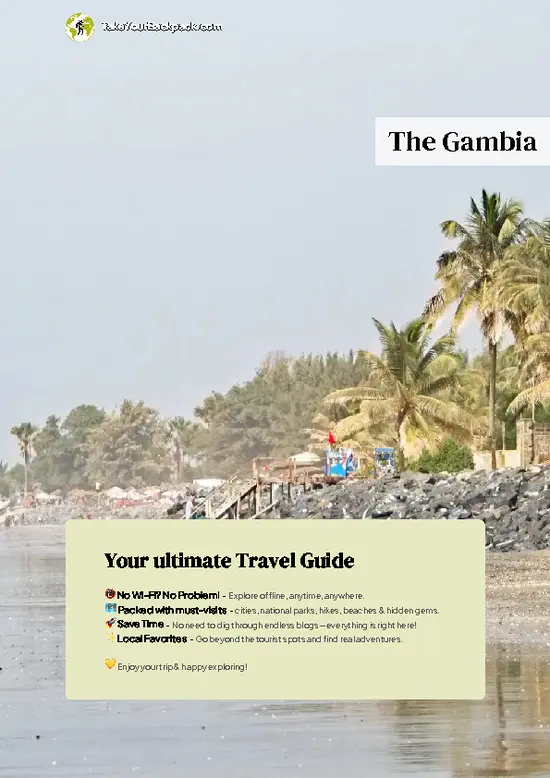
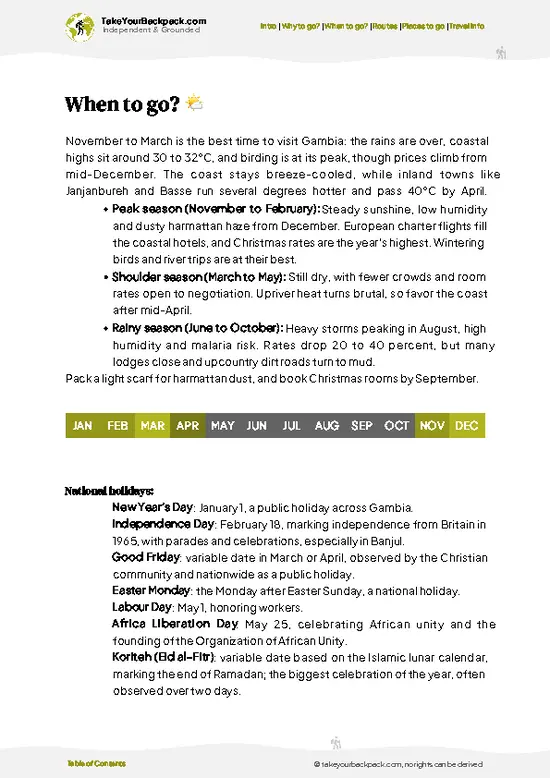
example page 0 from our offline Travel Guide for Gambia
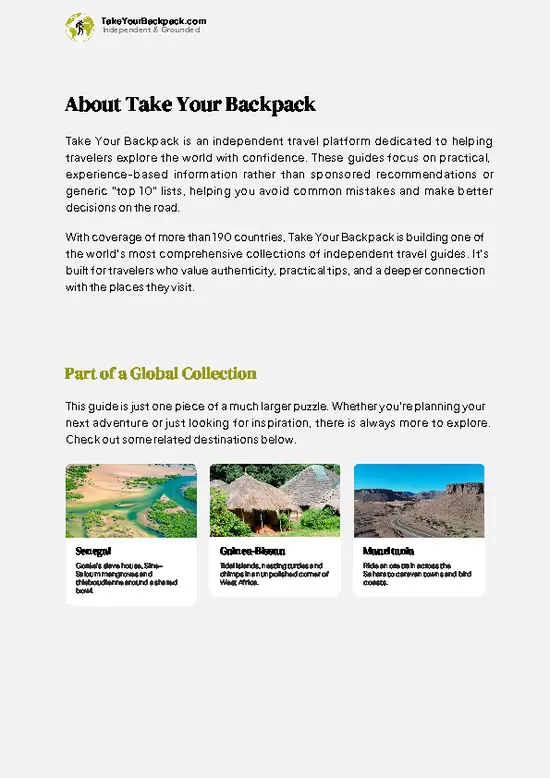
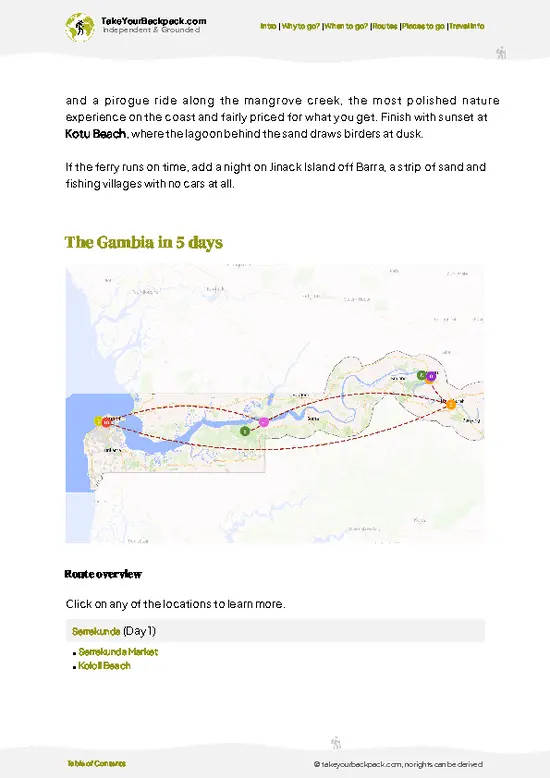
example page 1 from our offline Travel Guide for Gambia
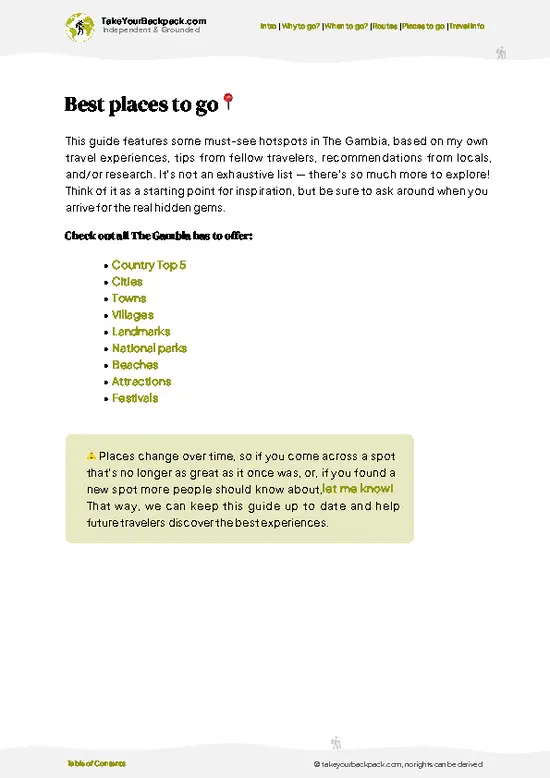
example page 2 from our offline Travel Guide for Gambia
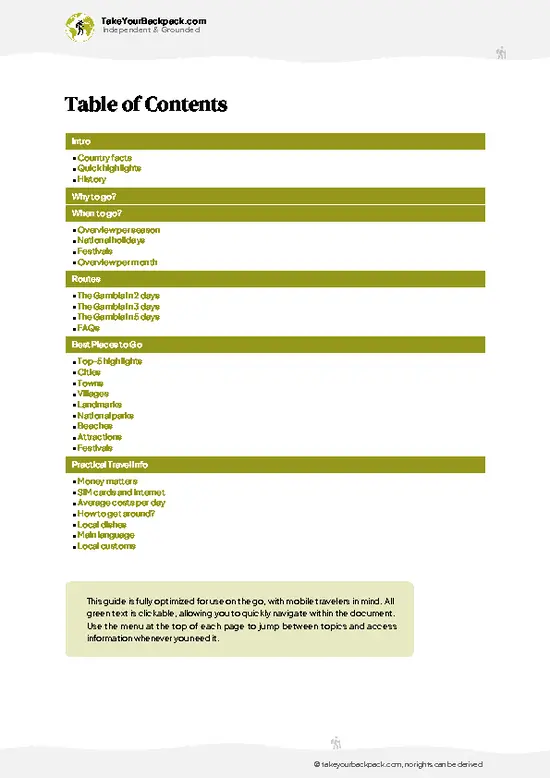
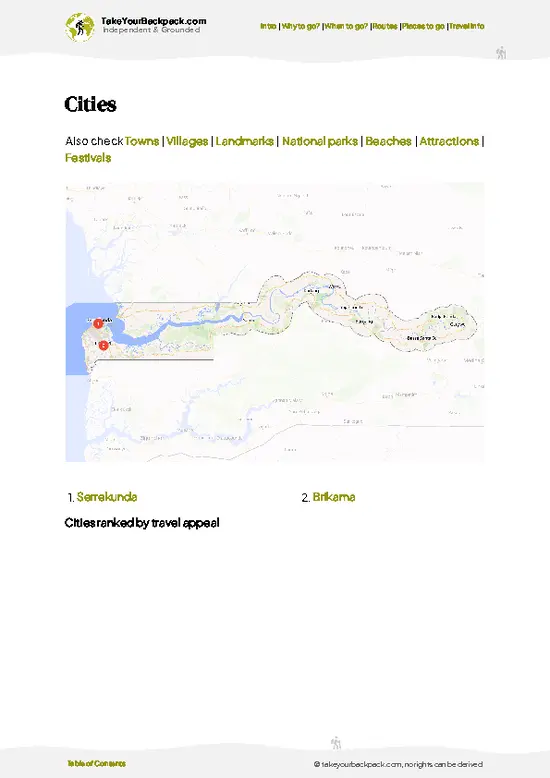
example page 3 from our offline Travel Guide for Gambia
example page 4 from our offline Travel Guide for Gambia
example page 5 from our offline Travel Guide for Gambia
example page 6 from our offline Travel Guide for Gambia
example page 7 from our offline Travel Guide for Gambia
Loading the map 🌍
CLICK TO FILTER
cities
towns
villages
landmarks
national parks
beaches
attractions
festivals
SHOW COUNTRY’S BESTSHOW ALL

✨ Why go?
Ranked #5 festival in The Gambia
The unique appeal for travelers

Banjul Demba Cultural Festival pulls backpackers into the Gambia's smallest, most overlooked capital for a reason: it puts kora players, sabar drummers and masked dancers in one place without the tourist-resort filter. Entry is cheap or informal compared with paid music events elsewhere in West Africa, so your money goes to food, transport and the performers you tip. Most travelers find that the social energy matters more than the stage. You end up sharing a plastic stool with a griot's cousin, being pulled into a dance circle, or being invited to eat from a communal bowl. That kind of access is hard to arrange on an ordinary week. The festival also fits neatly into a longer route: the capital sits beside the Banjul ferry to Barra, which makes it an easy link between the coast and the upriver … read more 👉
Banjul Demba Cultural Festival pulls backpackers into the Gambia's smallest, most overlooked capital for a reason: it puts kora players, sabar drummers and masked dancers in one place without the tourist-resort filter. Entry is cheap or informal compared with paid music events elsewhere in West Africa, so your money goes to food, transport and the performers you tip. Most travelers find that the social energy matters more than the stage. You end up sharing a plastic stool with a griot's cousin, being pulled into a dance circle, or being invited to eat from a communal bowl. That kind of access is hard to arrange on an ordinary week. The festival also fits neatly into a longer route: the capital sits beside the Banjul ferry to Barra, which makes it an easy link between the coast and the upriver trail toward Senegal. Add a few days either side and you have a trip with a real center.

💡 HighlightsDon't-miss highlights and experiences

  1. Kora and balafon performances: Griots play the 21-string kora and the wooden balafon, singing family histories and praise songs. The sound is delicate and rippling, and it is best heard up close.
  2. Sabar drumming and dance: Tall, hand-and-stick drums drive fast, athletic dance. Crowds form circles, and visitors who join in are usually cheered on.
  3. Masquerade appearances: Costumed figures in fiber and cloth move through the crowd, a living part of Gambian ritual tradition. Keep a respectful distance and follow what locals do.
  4. Griot storytelling: Oral history is delivered as song and speech, often in Mandinka or Wolof. Even without the language, the rhythm and audience reactions carry a lot.
  5. Street food and craft stalls: Vendors sell grilled fish, fried snacks, fruit and handmade textiles and carvings.
… read more 👉
  1. Kora and balafon performances: Griots play the 21-string kora and the wooden balafon, singing family histories and praise songs. The sound is delicate and rippling, and it is best heard up close.
  2. Sabar drumming and dance: Tall, hand-and-stick drums drive fast, athletic dance. Crowds form circles, and visitors who join in are usually cheered on.
  3. Masquerade appearances: Costumed figures in fiber and cloth move through the crowd, a living part of Gambian ritual tradition. Keep a respectful distance and follow what locals do.
  4. Griot storytelling: Oral history is delivered as song and speech, often in Mandinka or Wolof. Even without the language, the rhythm and audience reactions carry a lot.
  5. Street food and craft stalls: Vendors sell grilled fish, fried snacks, fruit and handmade textiles and carvings. Buying here is a direct way to support local makers, and bargaining stays friendly.
For a first visit, start with the kora and balafon performances, because they give you the clearest sense of what Gambian musical heritage sounds like before the drumming takes over.
Spotted a mistake or missing something? Contact us.

Things to do around Banjul Demba Cultural Festival

Ratings based on Tripadvisor reviews. When you book through this link, you support our work at no extra cost to you.

🌤️ When to go?When is the celebration of Banjul Demba Cultural Festival?

Banjul Demba Cultural Festival is held in Banjul, the capital of the Gambia, usually around the dry-season months of the year and lasts several days, with events based in the city center and its open grounds; the exact dates are announced locally and can shift from year to year.
  • Best day: Go for the main parade and performance days, when drummers, masquerades and dance groups fill the streets. Quieter weekdays suit craft browsing and conversation.
  • Weather: Days are usually dry and sunny at about 28 to 33°C (82 to 91°F), with cooler evenings near 18 to 22°C (64 to 72°F). Bring a hat, sunscreen, a refillable bottle and a light layer for nights by the river.
  • Booking: Reserve a bed two to four weeks ahead, since Banjul has few rooms. Prices can rise 20 to 40 percent around the main days.
  • Crowds and
… read more 👉
Banjul Demba Cultural Festival is held in Banjul, the capital of the Gambia, usually around the dry-season months of the year and lasts several days, with events based in the city center and its open grounds; the exact dates are announced locally and can shift from year to year.
  • Best day: Go for the main parade and performance days, when drummers, masquerades and dance groups fill the streets. Quieter weekdays suit craft browsing and conversation.
  • Weather: Days are usually dry and sunny at about 28 to 33°C (82 to 91°F), with cooler evenings near 18 to 22°C (64 to 72°F). Bring a hat, sunscreen, a refillable bottle and a light layer for nights by the river.
  • Booking: Reserve a bed two to four weeks ahead, since Banjul has few rooms. Prices can rise 20 to 40 percent around the main days.
  • Crowds and roads: Reach the city before midday. The Barra ferry and the roads in from Serrekunda clog in the late afternoon.
Arrive a day early and sleep near the venue so you are not stuck in the evening traffic.


source: climatestotravel.comJANJanuary: not recommended for travelingFEBFebruary: not recommended for travelingMARMarch: not recommended for travelingAPRApril: not recommended for travelingMAYMay: excellent for travelingJUNJune: not recommended for travelingJULJuly: not recommended for travelingAUGAugust: not recommended for travelingSEPSeptember: not recommended for travelingOCTOctober: not recommended for travelingNOVNovember: not recommended for travelingDECDecember: not recommended for traveling

✈️ The backpacker research shortcutThe Gambia Travel Guide

An offline-friendly backpacking guide with optimized travel routes, ranked highlights, transport advice, and the best areas to stay.
example page 0 from our offline Travel Guide for Gambia
example page 1 from our offline Travel Guide for Gambia
example page 2 from our offline Travel Guide for Gambia
example page 3 from our offline Travel Guide for Gambia
example page 4 from our offline Travel Guide for Gambia
example page 5 from our offline Travel Guide for Gambia
example page 6 from our offline Travel Guide for Gambia
example page 7 from our offline Travel Guide for Gambia
The digital guide (213 pages) contains:
✅ 50 highlights, ranked by travel appeal
✅ Optimized 2, 3 & 5-day travel routes
✅ Cities, national parks, landmarks, beaches
✅ How to get around
✅ Offline-friendly for travel without Wi-Fi
👉 Click to see all 30+ guide features

📅 Plan smarter in minutes, not weeks
✅ Month by month travel advice
✅ Festivals & national holidays
✅ Budget expectations

🗺️ Go to the right places, skip the overrated ones
✅ Honest pros & cons of destinations
✅ Top hikes, parks & viewpoints
✅ Lesser-known places most travelers miss
✅ Clear “worth it vs skip it” guidance

🛏️ Travel smoothly without rookie mistakes
✅ Best areas to stay
✅ Transport systems explained simply
✅ Common scams & safety advice
✅ SIM cards, money & practical tips

🌍 Understand the country, not just visit it
✅ Culture & traditions
✅ 52 Essential phrases & customs
✅ Festivals worth planning around
✅ Traveler-friendly historical context
✅ Insights that make places more meaningful

📱 Built for real travel conditions
✅ Fully downloadable PDF
✅ Works completely offline
✅ Optimized for phone use
✅ Useful in remote areas & buses
✅ Everything in one place
Stop searching, start planning
Get instant access to your full guide. 30‑day money-back guarantee.
+ Add another guide for just

By proceeding you agree to our terms.
Sent to your inbox immediately after payment • 100% Secure Checkout
Best Backpacking Travel Advisor 2025 tourism awardBest Backpacking
Travel Advisor
2025
What others say about Take Your Backpack Guides:
⭐⭐⭐⭐⭐
Fantastic, amazing amount of information!
⭐⭐⭐⭐⭐
My goodness this is amazing, it's what I've been looking for hats off too you!
⭐⭐⭐⭐⭐
I think this is absolutely BRILLIANT
⭐⭐⭐⭐
Very complete and informative. It's still missing places, but I gotta to commend you
⭐⭐⭐⭐⭐
This is truly amazing, thank you, can't wait to explore it with my kids!
⭐⭐⭐⭐⭐
Awesome resource, thank you!
⭐⭐⭐⭐⭐
This is amazing! Can't wait to explore the ones I haven't seen
⭐⭐⭐⭐
I love this! Well done, great idea.
⭐⭐⭐⭐⭐
Thanks for taking the time to make this gem!
⭐⭐⭐⭐⭐
This might be the best website I've ever seen.
⭐⭐⭐⭐⭐
Congratulations, and thank you so much for your work; it's incredibly valuable.
⭐⭐⭐⭐
In all seriousness I think you did a great job pointing out the important spots
⭐⭐⭐⭐⭐
10/10 very good
⭐⭐⭐⭐⭐
As someone who's only just starting to visit regularly this is awesome, thank you.
⭐⭐⭐⭐
Thank you very much! I'm going to visit my dad, it's going to be very useful!
⭐⭐⭐⭐⭐
This is really cool! We'll be travelling for the first time and this definitely come in handy.
⭐⭐⭐⭐⭐
You are now our minister of culture, congratulations 👨‍💼
⭐⭐⭐⭐⭐
Just wanted to tell you that this is a pearl! Going to follow your recommendations.
⭐⭐⭐⭐⭐
This is so cool. I'll definitely be using the resource for my travels soon.
⭐⭐⭐⭐⭐
This is very impressive! Good work.
⭐⭐⭐⭐⭐
This is an amazing and informative site. Very well done!

🛏️ Where to stay?How to pick the right area

Most backpackers sleep in the Senegambia and Kololi strip or in Serrekunda, then reach Banjul by shared taxi or minibus in 30 to 60 minutes depending on traffic. Banjul itself has the shortest walk to the festival, but the choice of beds is small and the city is quiet after dark.
Kololi and the Senegambia area are the social pick. Restaurants, bars and a steady flow of independent travelers make it easy to meet people and split taxis back from the festival. The streets are lit and busy at night, and prices are lower than on the beach front.
Serrekunda is cheaper and more local. It is loud, crowded … read more 👉
Most backpackers sleep in the Senegambia and Kololi strip or in Serrekunda, then reach Banjul by shared taxi or minibus in 30 to 60 minutes depending on traffic. Banjul itself has the shortest walk to the festival, but the choice of beds is small and the city is quiet after dark.
Kololi and the Senegambia area are the social pick. Restaurants, bars and a steady flow of independent travelers make it easy to meet people and split taxis back from the festival. The streets are lit and busy at night, and prices are lower than on the beach front.
Serrekunda is cheaper and more local. It is loud, crowded and market-driven, so it suits you if you like to feel the real Gambia, though you should watch your bag in the market.
Bakau is calmer, with a fishing harbor, a botanical garden and a relaxed crowd of long-stayers. Taxis to Banjul take about 30 minutes.
If you want to be inside the festival atmosphere, book a guesthouse in central Banjul early. Walk with others after dark and take a taxi for the last stretch.

👛 Costs (as of 22 October 2026)How expensive it really is

A day at Banjul Demba Cultural Festival costs roughly US$45 to 85 for an independent traveler, and the budget here assumes US$65 as a realistic daily total.
CategoryBudget RangeLocal Reality
Festival ticketsUS$0 to 5Many street events and parades are free to watch, while some stages or special shows ask a small entry fee at the gate.
AccommodationUS$15 to 35 (high season)Guesthouse rooms in Kololi, Serrekunda or Bakau sit at the lower end. Rooms in Banjul itself cost more during festival days.
Local transportUS$3 to 10Shared taxis and minibuses to Banjul cost a dollar or two each way. A private taxi from the coast costs more, around US$10 to 20.
Food & drinksUS$8 to 18A plate of domoda or benachin at a stall costs US$2 to 4, with juices under US$1 and beer around US$1.50 to 3.
Miscellaneous
… read more 👉
A day at Banjul Demba Cultural Festival costs roughly US$45 to 85 for an independent traveler, and the budget here assumes US$65 as a realistic daily total.
CategoryBudget RangeLocal Reality
Festival ticketsUS$0 to 5Many street events and parades are free to watch, while some stages or special shows ask a small entry fee at the gate.
AccommodationUS$15 to 35 (high season)Guesthouse rooms in Kololi, Serrekunda or Bakau sit at the lower end. Rooms in Banjul itself cost more during festival days.
Local transportUS$3 to 10Shared taxis and minibuses to Banjul cost a dollar or two each way. A private taxi from the coast costs more, around US$10 to 20.
Food & drinksUS$8 to 18A plate of domoda or benachin at a stall costs US$2 to 4, with juices under US$1 and beer around US$1.50 to 3.
Miscellaneous expensesUS$5 to 15Budget for crafts, tips to performers, drinking water and mobile data.
Total Daily BudgetUS$65A comfortable figure for a mid-range backpacker day, with room to spare if you eat at stalls.
⚠️ Prices can change and everyone travels differently, so take this as a rough guide. Hope it helps you plan your adventure!

🍲 FoodLocal Cuisine & Drinks

Expect the smell of charcoal and onion smoke drifting between the stages. Festival stalls and street vendors around Banjul serve the Gambian staples, so you can eat well without leaving the crowd.
Start with domoda, a rich peanut stew with rice, and benachin, the one-pot jollof-style rice with fish or chicken. Yassa, chicken or fish in a sharp onion and lemon sauce, is a good second order. For something quick, grab a fish sandwich or grilled fish straight from the fire, or a bag of fresh peanuts and fried fataya pastries to eat while you watch the dancers.
Drinks lean sweet and cold. Try bissap (hibiscus), baobab juice (known locally as buyi) and ginger juice, which has a real kick. Attaya, strong green tea poured in three rounds, is the social drink, and sitting down with a group of locals … read more 👉
Expect the smell of charcoal and onion smoke drifting between the stages. Festival stalls and street vendors around Banjul serve the Gambian staples, so you can eat well without leaving the crowd.
Start with domoda, a rich peanut stew with rice, and benachin, the one-pot jollof-style rice with fish or chicken. Yassa, chicken or fish in a sharp onion and lemon sauce, is a good second order. For something quick, grab a fish sandwich or grilled fish straight from the fire, or a bag of fresh peanuts and fried fataya pastries to eat while you watch the dancers.
Drinks lean sweet and cold. Try bissap (hibiscus), baobab juice (known locally as buyi) and ginger juice, which has a real kick. Attaya, strong green tea poured in three rounds, is the social drink, and sitting down with a group of locals for it is the easiest way to start a conversation. Beer is sold in the city, though alcohol is less visible at street stalls.
Carry small cash, since stalls rarely take cards. Portions are generous, bowls are often shared from one big dish, and you eat with your right hand or a spoon. Lines are informal, so catch the vendor’s eye and be patient.

FAQCommon questions from travelers

Banjul Demba Cultural Festival is usually held in Banjul during the drier months of the year and runs for several days. Exact dates are announced locally and can change, so check with the Gambia Tourism Authority or local organizers a month or two ahead. Most events are in the city center, about 30 to 60 minutes by road from the Kololi and Serrekunda area.
Attending Banjul Demba Cultural Festival can cost very little, since many parades and street performances are free to watch. Some stages or special shows may charge US$2 to 5 at the gate. A realistic day including a guesthouse bed, shared taxis and stall meals comes to about US$45 to 85.
Banjul Demba Cultural Festival generally does not require advance tickets for its main street events and parades, which are open to the public. Any ticketed shows are usually sold on the day at the gate. The thing to book ahead is a bed, ideally two to four weeks before, because Banjul has few rooms and prices rise around the main days.
⚠️ Things can change over time, so always validate details locally before you go.

Other Gambian festivals near Banjul Demba Cultural

Explore more nearby:


💡 Not sure where to go next?
Create a personalized itinerary for The Gambia including Banjul Demba Cultural and the places that fit your trip.

Generate my itinerary

👉 Discover all festivals

Or checkout all The Gambia has to offer (think cities, towns, villages, national parks, hikes, beaches, festivals)
Country photo of The Gambia

We 💚 feedbackSumming up the experience

Banjul Demba Cultural Festival rewards two or three days, not a rushed afternoon. One day gets you the music, but a second lets you find the smaller performances and the people behind them. I would stay overnight in or near Banjul, bring small bills for tips and snacks, and carry a hat, because the sun is relentless.

✍️ Help improve this page!
The information on this page is based on in-depth research, insights shared by experienced travelers, and feedback from the local travel community in The Gambia. While every effort is made to keep the information accurate and current, conditions can change — so if you spot anything incorrect or outdated, please get in touch.


🙋‍♂️ Give feedback

👋 Meet the founderWho’s Behind Take Your Backpack?

Johan, backpacker and founder of TakeYourBackpackHi, I’m Johan (Netherlands 🇳🇱), the creator of TakeYourBackpack. Over the past 3 decades, I’ve backpacked through 90+ countries across six continents, gaining extensive experience with independent travel, long-term trips, and overland routes.

This site is built on a combination of firsthand travel experience and carefully curated insights from other backpackers. Many guides are based on places I’ve personally visited, while others bring together tips, observations, and practical advice shared by trusted travelers I’ve met along the way.

The goal is to provide realistic, experience-driven guidance — not generic itineraries — so you can explore destinations with better context, clearer expectations, and more confidence.