×

Gambia🇬🇲 | best festivalsExplore the 7 Best festivals in The Gambia

Festivals in Gambia are mostly open-air, drum-driven and free to join, staged on village grounds, riverbanks and beaches rather than in ticketed venues. The Atlantic coast around Serrekunda brings sound systems, dust and easy taxis, while the upriver towns trade comfort for long red-dirt roads and smaller, closer crowds. Backpackers on independent budgets can reach most events by shared bush taxi and gele-gele.

By Johan Kruseman 🇳🇱 | Updated October 23, 2026
Explore the best cities in The Gambia

Why go?Key Factors That Shape the Experience

Gambia is a narrow strip of land hugging the River Gambia, so almost every community sits within a day of the water, and that river shaped its festivals. Mandinka, Wolof, Fula, Jola and Serer neighbors live side by side, which means drumming, masquerade and harvest traditions overlap in a small space, and about 95 percent of people are Muslim, so religious and ancestral customs share the calendar. The dry, harmattan-dusted months suit open-air gatherings, with hazy light and cool nights after sunset.

Travelers should know that infrastructure is basic. Official programs are loose, start times slide by hours, and details often travel by word of mouth, so a local contact or guesthouse owner is worth more than a website. Power cuts and cash-only payments are routine, and heat, dust and loud crowds come with the territory.
Why These Made the Cut
The list of best festivals in The Gambia is created based on energy, traditions, crowd experience, activities, and overall excitement. If you feel a festival is missing in this list, please let us know.

When to go?Timing Your Visit for the Best Experience

Best months and weather: The best months for festivals in Gambia are November to May, because this is the dry season with almost no rain and clear days for outdoor gatherings. Daytime highs run about 30 to 35°C (86 to 95°F), and December to February brings cooler nights near 16 to 20°C (61 to 68°F) and a hazy, dust-laden harmattan sky.
Shoulder and wet season: March to May turns hot, often above 35°C inland, so plan around the early morning and late afternoon. June to October brings roughly 800 to 1,000 mm of rain, mostly July to September. Dirt roads upriver turn to mud, and some ferries and tracks become slow or impassable. December to February is peak season on the coast, when hotel rates can climb 30 to 50 percent and rooms fill up. Upriver areas such as Janjanbureh stay quieter year-round.

festival hoppingTips for Visiting Multiple Destinations

How many days to plan: A trip combining several festivals in Gambia needs 7 to 12 days, because the country is small but roads and ferries are slow. Group the Greater Banjul and coastal area (Serrekunda, Brikama, Kololi) first, where events cluster and transport is frequent, then head upriver along the south bank toward Soma, Georgetown and Basse. Plan 2 to 3 days at each coastal base and 2 days upriver per stop.
Travel times and common mistakes: Banjul to Basse takes about 6 to 8 hours by road, and Serrekunda to Brikama roughly 45 to 90 minutes in traffic. The Barra-Banjul ferry can take 30 minutes to several hours to cross. A common error is packing in too many stops, so allow buffer days. Another is trusting printed dates, so confirm locally, and travel early before midday heat and long shared-taxi waits.

The ListMust-Visit festivals in The Gambia

1 International Roots Festival

Juffureh, Kunta Kinteh Island, diaspora homecoming, Kankurang

Travel by river to Juffureh and Albreda, visit the fort ruins and slave trade museum, and witness libation ceremonies and drumming.

2 Janjanbureh Kankurang Festival

Red-fiber Kankurang, MacCarthy Island, night drum circles, Freedom Tree

Watch a protective masked figure move through island lanes, then follow Mandinka drums to late dance circles near the river.

3 Kartong Festival

Border village, bolong kora, craft workshops, observatory walks

Dance in the village square, try batik or drumming lessons, and cool off with a lagoon bird walk and an empty beach.

4 Gambia Bird Festival

Dawn guides, Abuko forest, Kotu creek, kingfishers

Rise early for guided walks through gallery forest, mangrove creeks and coastal reserves, spotting trogons, herons and kingfishers at close range.

5 Banjul Demba Cultural Festival

Capital-island drumming, griot songs, masquerades, street grills

Join sabar circles in Banjul, hear griots play kora and balafon up close, and eat grilled fish from vendors between afternoon performances.

6 Makasutu Culture Festival

Forest clearings, balafon sets, creek pirogues, mask dancers

Listen to kora and balafon among palms, paddle a pirogue through mangrove channels, and join drum circles after dark.

7 Banjul International Food and Beverage Fair

Domoda plates, baobab juice, smoked bonga, exhibitor booths

Taste peanut stew, smoked fish and cold hibiscus drinks at crowded stalls, then buy spices or honey to carry home.

Loading the map 🌍

Expert viewTips and Advice from Travelers

How many festivals to attend: I advise two or three festivals in one trip. Dates shift, transport is slow, and a full day usually goes to getting there, finding the right village and waiting for the drums to start. Two lets you absorb the dust, the cooking-fire smoke and the call-and-response singing without burnout.
Choosing by travel style: Culture seekers should favor village and traditional events, where you stand a few feet from dancers and elders. Social travelers and music fans are better served by coastal gatherings, with food stalls, easy taxis and a mixed crowd. Those with more time and tolerance for rough roads gain the most upriver, where you may be one of very few outsiders.
Budget: Budget US$25 to 45 a day (about 1,700 to 3,000 dalasi) for guesthouse, meals and local transport. … read more 👉
How many festivals to attend: I advise two or three festivals in one trip. Dates shift, transport is slow, and a full day usually goes to getting there, finding the right village and waiting for the drums to start. Two lets you absorb the dust, the cooking-fire smoke and the call-and-response singing without burnout.
Choosing by travel style: Culture seekers should favor village and traditional events, where you stand a few feet from dancers and elders. Social travelers and music fans are better served by coastal gatherings, with food stalls, easy taxis and a mixed crowd. Those with more time and tolerance for rough roads gain the most upriver, where you may be one of very few outsiders.
Budget: Budget US$25 to 45 a day (about 1,700 to 3,000 dalasi) for guesthouse, meals and local transport. Most festivals are free to enter, though some organized events charge roughly US$5 to 20. A local guide or fixer costs about US$15 to 30 a day and is worth it for translation and introductions. Shared taxis run US$1 to 8 depending on distance, and cash is needed because ATMs are scarce outside the coast.
Safety and etiquette: Crowds are generally friendly, but watch phones and wallets in dense areas. Ask before photographing people, especially masked performers or ritual elements, and expect a small gift or donation to be requested. Dress modestly in covered shoulders and knees, and take a scarf for the dust. Alcohol is limited in more conservative areas. Carry water, sun protection and small notes, since the reward is the moment when a drummer pulls you into the circle.

✈️ The backpacker research shortcutThe Gambia Travel Guide

An offline-friendly backpacking guide with optimized travel routes, ranked highlights, transport advice, and the best areas to stay.
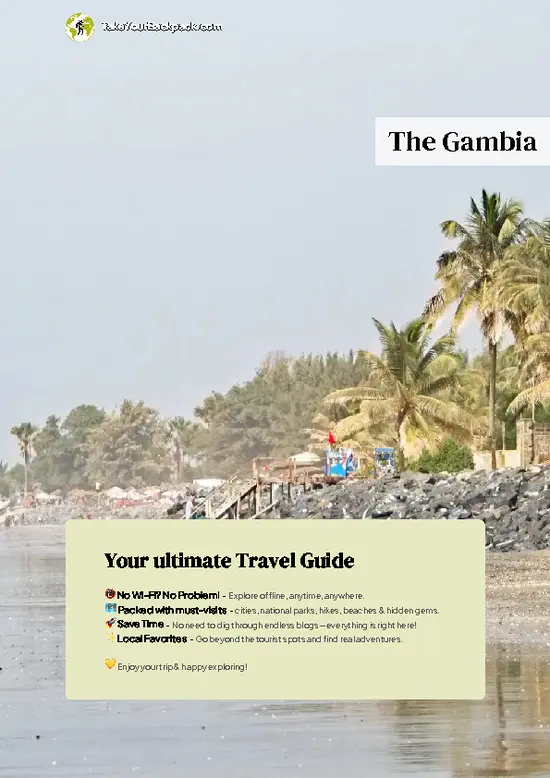
example page 0 from our offline Travel Guide for Gambia
example page 1 from our offline Travel Guide for Gambia
example page 2 from our offline Travel Guide for Gambia
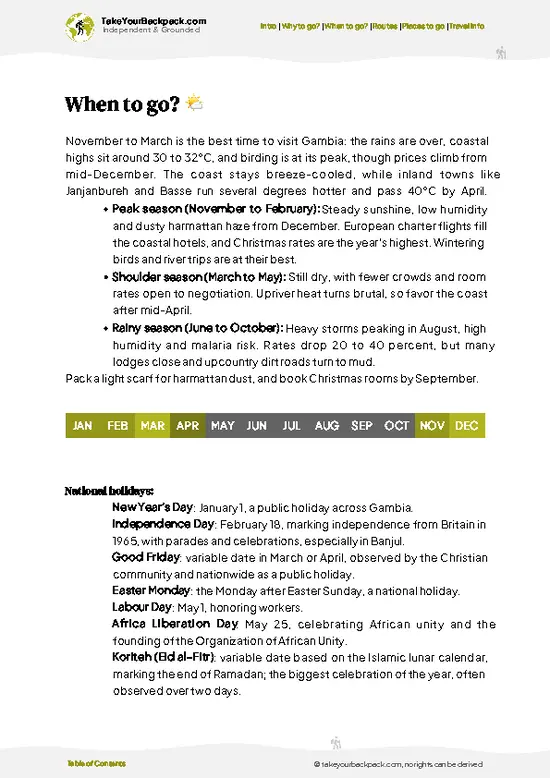
example page 3 from our offline Travel Guide for Gambia
example page 4 from our offline Travel Guide for Gambia
example page 5 from our offline Travel Guide for Gambia
example page 6 from our offline Travel Guide for Gambia
example page 7 from our offline Travel Guide for Gambia
The digital guide (213 pages) contains:
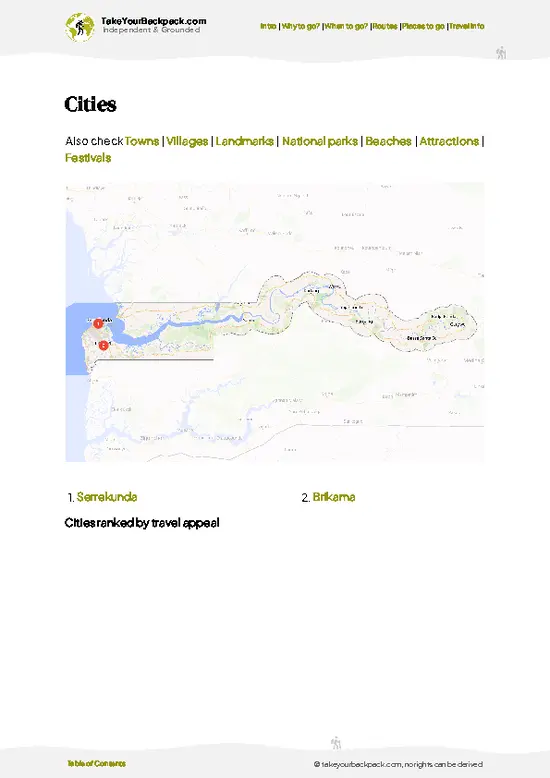
✅ 50 highlights, ranked by travel appeal
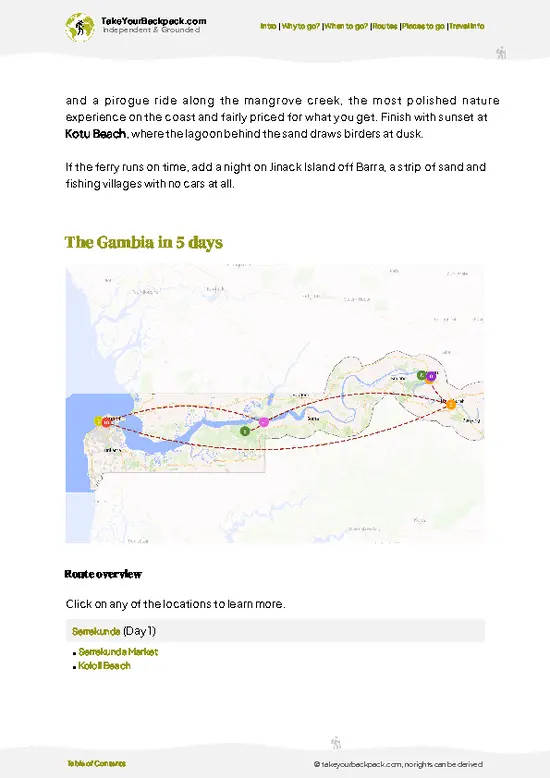
✅ Optimized 2, 3 & 5-day travel routes
✅ Cities, national parks, landmarks, beaches
✅ How to get around
✅ Offline-friendly for travel without Wi-Fi
👉 Click to see all 30+ guide features

📅 Plan smarter in minutes, not weeks
✅ Month by month travel advice
✅ Festivals & national holidays
✅ Budget expectations

🗺️ Go to the right places, skip the overrated ones
✅ Honest pros & cons of destinations
✅ Top hikes, parks & viewpoints
✅ Lesser-known places most travelers miss
✅ Clear “worth it vs skip it” guidance

🛏️ Travel smoothly without rookie mistakes
✅ Best areas to stay
✅ Transport systems explained simply
✅ Common scams & safety advice
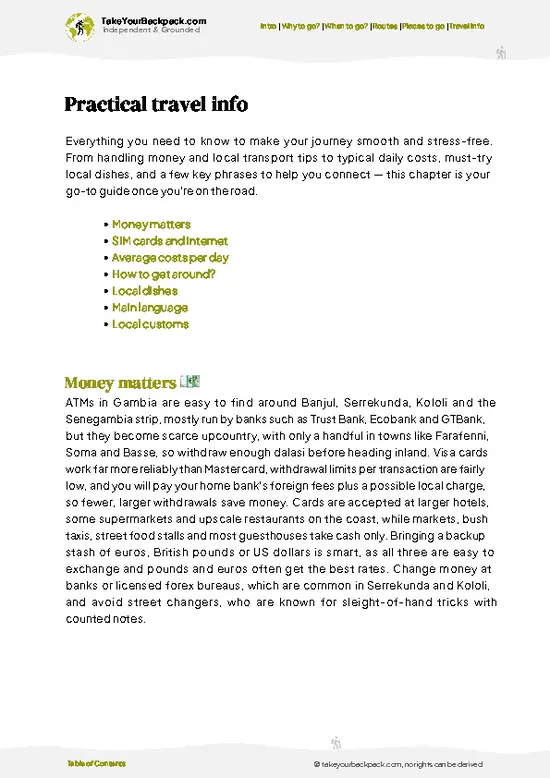
✅ SIM cards, money & practical tips

🌍 Understand the country, not just visit it
✅ Culture & traditions
✅ 52 Essential phrases & customs
✅ Festivals worth planning around
✅ Traveler-friendly historical context
✅ Insights that make places more meaningful

📱 Built for real travel conditions
✅ Fully downloadable PDF
✅ Works completely offline
✅ Optimized for phone use
✅ Useful in remote areas & buses
✅ Everything in one place
Stop searching, start planning
Get instant access to your full guide. 30‑day money-back guarantee.
+ Add another guide for just

By proceeding you agree to our terms.
Sent to your inbox immediately after payment • 100% Secure Checkout
Best Backpacking Travel Advisor 2025 tourism awardBest Backpacking
Travel Advisor
2025
What others say about Take Your Backpack Guides:
⭐⭐⭐⭐⭐
Fantastic, amazing amount of information!
⭐⭐⭐⭐⭐
My goodness this is amazing, it's what I've been looking for hats off too you!
⭐⭐⭐⭐⭐
I think this is absolutely BRILLIANT
⭐⭐⭐⭐
Very complete and informative. It's still missing places, but I gotta to commend you
⭐⭐⭐⭐⭐
This is truly amazing, thank you, can't wait to explore it with my kids!
⭐⭐⭐⭐⭐
Awesome resource, thank you!
⭐⭐⭐⭐⭐
This is amazing! Can't wait to explore the ones I haven't seen
⭐⭐⭐⭐
I love this! Well done, great idea.
⭐⭐⭐⭐⭐
Thanks for taking the time to make this gem!
⭐⭐⭐⭐⭐
This might be the best website I've ever seen.
⭐⭐⭐⭐⭐
Congratulations, and thank you so much for your work; it's incredibly valuable.
⭐⭐⭐⭐
In all seriousness I think you did a great job pointing out the important spots
⭐⭐⭐⭐⭐
10/10 very good
⭐⭐⭐⭐⭐
As someone who's only just starting to visit regularly this is awesome, thank you.
⭐⭐⭐⭐
Thank you very much! I'm going to visit my dad, it's going to be very useful!
⭐⭐⭐⭐⭐
This is really cool! We'll be travelling for the first time and this definitely come in handy.
⭐⭐⭐⭐⭐
You are now our minister of culture, congratulations 👨‍💼
⭐⭐⭐⭐⭐
Just wanted to tell you that this is a pearl! Going to follow your recommendations.
⭐⭐⭐⭐⭐
This is so cool. I'll definitely be using the resource for my travels soon.
⭐⭐⭐⭐⭐
This is very impressive! Good work.
⭐⭐⭐⭐⭐
This is an amazing and informative site. Very well done!

🛏️ Where to stay?Where to Stay: The Gambia Edition

Budget accommodation in The Gambia means small guesthouses, family-run lodges and simple compounds rather than classic dorm hostels, with private rooms typically running US$15 to 35 a night. Kololi and the Senegambia strip have the most choice plus beach access and the liveliest nightlife, though touts are persistent and prices run higher, while Kotu and Fajara are quieter and calmer and Bakau trades polish for a local fishing-town feel close to Kachikally. Banjul itself has few options and goes quiet after dark, so the south-coast villages of Sanyang and Tanji suit you better if you want eco-lodges and empty beaches, at the cost of being far from transport and nightlife.

If you enjoy meeting … read more 👉
Budget accommodation in The Gambia means small guesthouses, family-run lodges and simple compounds rather than classic dorm hostels, with private rooms typically running US$15 to 35 a night. Kololi and the Senegambia strip have the most choice plus beach access and the liveliest nightlife, though touts are persistent and prices run higher, while Kotu and Fajara are quieter and calmer and Bakau trades polish for a local fishing-town feel close to Kachikally. Banjul itself has few options and goes quiet after dark, so the south-coast villages of Sanyang and Tanji suit you better if you want eco-lodges and empty beaches, at the cost of being far from transport and nightlife.

If you enjoy meeting fellow travelers, consider choosing hostels with high ratings for atmosphere. On the other hand, if you prefer having your own space, a hotel might be a better option.

The GambiaExplore Beyond This Category

👋 Meet the founderWho’s Behind Take Your Backpack?

Johan, backpacker and founder of TakeYourBackpackHi, I’m Johan (Netherlands 🇳🇱), the creator of TakeYourBackpack. Over the past 3 decades, I’ve backpacked through 90+ countries across six continents, gaining extensive experience with independent travel, long-term trips, and overland routes.

This site is built on a combination of firsthand travel experience and carefully curated insights from other backpackers. Many guides are based on places I’ve personally visited, while others bring together tips, observations, and practical advice shared by trusted travelers I’ve met along the way.

The goal is to provide realistic, experience-driven guidance — not generic itineraries — so you can explore destinations with better context, clearer expectations, and more confidence.