×

The Gambia🇬🇲 | attractionsTanji Fish MarketBeach landings, smoking kilns, net menders, grilled catch | things to do and best time to go

Explore Albert MarketExplore Brikama Craft Market

Backpacking in Tanji Fish Market
🏆 Top pickattraction ranked #2
By Johan Kruseman 🇳🇱 | Updated October 22, 2026

Tanji Fish Market is where you watch colorful wooden pirogues surge through the surf and unload silver bonga, sardinella and barracuda straight onto a crowded beach. The overlooked part is that the fish is only half the story: just behind the sand, smoking sheds turn the catch into the dried and smoked fish that feeds the region. The market lies on the Atlantic coast, south-west of Banjul, in the Gambia. Come in the late afternoon, because that is when boats return, and the tide and the catch dictate the schedule, not any timetable. Wear shoes you can wash, since the sand is wet and scattered with scales and fish guts. Expect shouting, diesel from outboard motors, woodsmoke that stings your eyes and a sharp, salty reek. Ask before photographing people, as sellers and fishermen live off this beach and many resent being treated as scenery. The entry is free, and the day ends with women hauling basins of fish on their heads up the slope.

Discover everything you want to know in the 📖 The Gambia Travel Guide.


example page 0 from our offline Travel Guide for Gambia
example page 1 from our offline Travel Guide for Gambia
example page 2 from our offline Travel Guide for Gambia
example page 3 from our offline Travel Guide for Gambia
example page 4 from our offline Travel Guide for Gambia
example page 5 from our offline Travel Guide for Gambia
example page 6 from our offline Travel Guide for Gambia
example page 7 from our offline Travel Guide for Gambia
Loading the map 🌍
CLICK TO FILTER
cities
towns
villages
landmarks
national parks
beaches
attractions
festivals
SHOW COUNTRY’S BESTSHOW ALL

✨ Why go?
Ranked #2 attraction in The Gambia
Why visitors keep coming back

Tanji Fish Market is one of the few places on the Gambian coast where you see a working fishery rather than a staged one. Around 200 brightly painted pirogues are hauled in by hand, and you can stand close enough to watch the nets emptied, the fish sorted by species and the buyers bargaining as the catch lands. That return of the boats in the afternoon is the main event, and it is loud, physical and unpolished in a way beach resorts never are.

The second reason is context. The smokehouses behind the beach show how a catch becomes food that travels far inland, and you will understand why fish sits at the center of Gambian cooking, from benachin to domoda. It gives your trip a grounding that sightseeing lists cannot.

It also pairs neatly with the nearby Tanji Bird Reserve and the village's … read more 👉
Tanji Fish Market is one of the few places on the Gambian coast where you see a working fishery rather than a staged one. Around 200 brightly painted pirogues are hauled in by hand, and you can stand close enough to watch the nets emptied, the fish sorted by species and the buyers bargaining as the catch lands. That return of the boats in the afternoon is the main event, and it is loud, physical and unpolished in a way beach resorts never are.

The second reason is context. The smokehouses behind the beach show how a catch becomes food that travels far inland, and you will understand why fish sits at the center of Gambian cooking, from benachin to domoda. It gives your trip a grounding that sightseeing lists cannot.

It also pairs neatly with the nearby Tanji Bird Reserve and the village's small museum, so you can fill a half day on this stretch of coast. For a backpacker who wants to see how ordinary Gambians earn a living, this is a cheap, direct and memorable lesson.

💡 HighlightsEssential experiences to have while visiting Tanji Fish Market

  1. The landing beach at sunrise and midday: This is the main event. Long, brightly painted wooden pirogues surge through the surf and ground on the sand, and men wade in to haul the nets. Fish spill out in silver heaps: bonga, sole, barracuda, snapper. Expect shouting, gulls, wet sand and a strong smell of fish. Arrive when the boats are due in, because an empty beach is just a beach.
  2. The auction and haggling line: Buyers, women traders and restaurant cooks crowd around each catch and bargain in Wolof and Mandinka. Watching how a price gets settled in a few sharp exchanges is a lesson in itself. You can join in for a bag of fresh fish if you have a kitchen, but watching costs nothing.
  3. The smoking sheds: Behind the beach, rows of clay and brick kilns smolder under woven roofs. Women lay out bonga
… read more 👉
  1. The landing beach at sunrise and midday: This is the main event. Long, brightly painted wooden pirogues surge through the surf and ground on the sand, and men wade in to haul the nets. Fish spill out in silver heaps: bonga, sole, barracuda, snapper. Expect shouting, gulls, wet sand and a strong smell of fish. Arrive when the boats are due in, because an empty beach is just a beach.
  2. The auction and haggling line: Buyers, women traders and restaurant cooks crowd around each catch and bargain in Wolof and Mandinka. Watching how a price gets settled in a few sharp exchanges is a lesson in itself. You can join in for a bag of fresh fish if you have a kitchen, but watching costs nothing.
  3. The smoking sheds: Behind the beach, rows of clay and brick kilns smolder under woven roofs. Women lay out bonga on racks over smoking wood, and the air stings your eyes. The smoked fish ends up in markets far inland. Cover your nose with a scarf, and keep your camera lens wiped clean.
  4. The boat-building and net-mending corners: Fishermen repair nets and patch hulls along the upper beach, often in shade under trees. The boats carry hand-painted names, flags and Quranic phrases. It is a quiet counterpoint to the chaos below, and people here are happy to explain how a pirogue is made if you ask politely.
  5. Tanji Bird Reserve edge: The reserve sits just beside the village, with dunes, mangrove and scrub where many bird species gather, including terns and gulls on the shoreline. A short walk from the fish beach gets you away from the noise. Bring binoculars if you have them, and go early when it is cooler.
  6. Tanji Village Museum: This small open-air museum has traditional compounds and exhibits on Gambian life, with a good section on fishing and the region’s ethnic groups. Entry is modest, roughly US$3 to 5, and an hour is plenty. It gives the fishing scene context before or after the beach.
  7. Fresh grilled fish at the beach stalls: Order a fish straight off the day’s catch and eat it charred, with onion, pepper and bread, a few steps from where it landed. It is cheap, simple and far better than any restaurant version along the coast. Wash your hands first and choose a busy stall.
Start at the landing beach when the boats come in, because the auction, the smoking sheds and the stalls all follow from that moment and Tanji Fish Market goes quiet once the catch is sold.
Spotted a mistake or missing something? Contact us.

Things to do near Tanji Fish Market

Ratings based on Tripadvisor reviews. When you book through this link, you support our work at no extra cost to you.

🌤️ When to go?When to go for the best experience

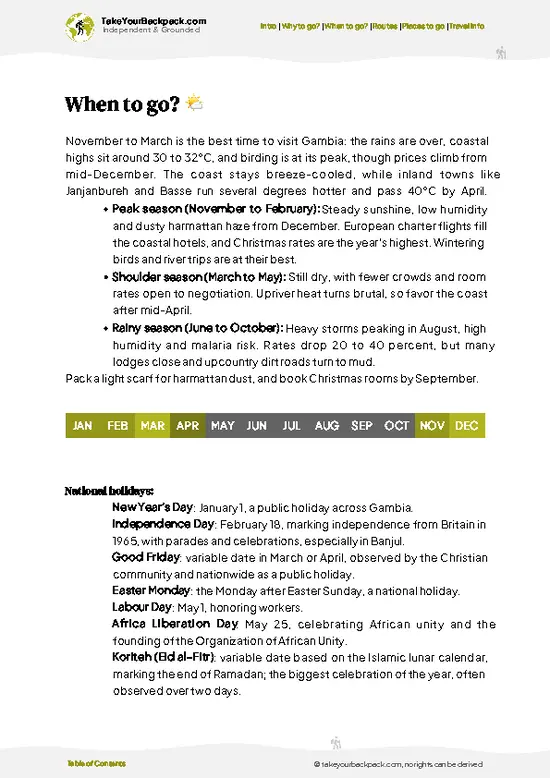
  • Cool Dry Season (November to February): Boats land their catch from early afternoon, and the beach is comfortable to stand on. Days reach 30 to 33°C (86 to 91°F), nights drop to 16 to 20°C (61 to 68°F), and rain is almost nil. Daylight runs about 11 hours, so the afternoon landings finish well before dark. This is the busiest window, with tour groups and higher bed prices in the Kololi and Brufut area.
  • Hot Dry Season (March to May): Expect 32 to 38°C (90 to 100°F) on the sand with little shade. Fish are plentiful, crowds thin, and room rates ease off.
  • Rainy Season (June to October): Storms hit mostly in July to September, with highs of 29 to 33°C (84 to 91°F) and heavy humidity. Roads to the beach turn muddy, some boats stay in port on rough days, and prices are lowest. Daylight stretches to
… read more 👉
  • Cool Dry Season (November to February): Boats land their catch from early afternoon, and the beach is comfortable to stand on. Days reach 30 to 33°C (86 to 91°F), nights drop to 16 to 20°C (61 to 68°F), and rain is almost nil. Daylight runs about 11 hours, so the afternoon landings finish well before dark. This is the busiest window, with tour groups and higher bed prices in the Kololi and Brufut area.
  • Hot Dry Season (March to May): Expect 32 to 38°C (90 to 100°F) on the sand with little shade. Fish are plentiful, crowds thin, and room rates ease off.
  • Rainy Season (June to October): Storms hit mostly in July to September, with highs of 29 to 33°C (84 to 91°F) and heavy humidity. Roads to the beach turn muddy, some boats stay in port on rough days, and prices are lowest. Daylight stretches to about 13 hours.
Arrive between 3 and 5 pm, when the pirogues come in and the smoking racks are running at full tilt.


source: climatestotravel.comJANJanuary: good for travelingFEBFebruary: excellent for travelingMARMarch: excellent for travelingAPRApril: highly recommended for travelingMAYMay: highly recommended for travelingJUNJune: fair for travelingJULJuly: below average for travelingAUGAugust: below average for travelingSEPSeptember: fair for travelingOCTOctober: fair for travelingNOVNovember: excellent for travelingDECDecember: good for traveling
gambia-attraction-tanji-fish-market
© Google |

✈️ The backpacker research shortcutThe Gambia Travel Guide

An offline-friendly backpacking guide with optimized travel routes, ranked highlights, transport advice, and the best areas to stay.
example page 0 from our offline Travel Guide for Gambia
example page 1 from our offline Travel Guide for Gambia
example page 2 from our offline Travel Guide for Gambia
example page 3 from our offline Travel Guide for Gambia
example page 4 from our offline Travel Guide for Gambia
example page 5 from our offline Travel Guide for Gambia
example page 6 from our offline Travel Guide for Gambia
example page 7 from our offline Travel Guide for Gambia
The digital guide (213 pages) contains:
✅ 50 highlights, ranked by travel appeal
✅ Optimized 2, 3 & 5-day travel routes
✅ Cities, national parks, landmarks, beaches
✅ How to get around
✅ Offline-friendly for travel without Wi-Fi
👉 Click to see all 30+ guide features

📅 Plan smarter in minutes, not weeks
✅ Month by month travel advice
✅ Festivals & national holidays
✅ Budget expectations

🗺️ Go to the right places, skip the overrated ones
✅ Honest pros & cons of destinations
✅ Top hikes, parks & viewpoints
✅ Lesser-known places most travelers miss
✅ Clear “worth it vs skip it” guidance

🛏️ Travel smoothly without rookie mistakes
✅ Best areas to stay
✅ Transport systems explained simply
✅ Common scams & safety advice
✅ SIM cards, money & practical tips

🌍 Understand the country, not just visit it
✅ Culture & traditions
✅ 52 Essential phrases & customs
✅ Festivals worth planning around
✅ Traveler-friendly historical context
✅ Insights that make places more meaningful

📱 Built for real travel conditions
✅ Fully downloadable PDF
✅ Works completely offline
✅ Optimized for phone use
✅ Useful in remote areas & buses
✅ Everything in one place
Stop searching, start planning
Get instant access to your full guide. 30‑day money-back guarantee.
+ Add another guide for just

By proceeding you agree to our terms.
Sent to your inbox immediately after payment • 100% Secure Checkout
Best Backpacking Travel Advisor 2025 tourism awardBest Backpacking
Travel Advisor
2025
What others say about Take Your Backpack Guides:
⭐⭐⭐⭐⭐
Fantastic, amazing amount of information!
⭐⭐⭐⭐⭐
My goodness this is amazing, it's what I've been looking for hats off too you!
⭐⭐⭐⭐⭐
I think this is absolutely BRILLIANT
⭐⭐⭐⭐
Very complete and informative. It's still missing places, but I gotta to commend you
⭐⭐⭐⭐⭐
This is truly amazing, thank you, can't wait to explore it with my kids!
⭐⭐⭐⭐⭐
Awesome resource, thank you!
⭐⭐⭐⭐⭐
This is amazing! Can't wait to explore the ones I haven't seen
⭐⭐⭐⭐
I love this! Well done, great idea.
⭐⭐⭐⭐⭐
Thanks for taking the time to make this gem!
⭐⭐⭐⭐⭐
This might be the best website I've ever seen.
⭐⭐⭐⭐⭐
Congratulations, and thank you so much for your work; it's incredibly valuable.
⭐⭐⭐⭐
In all seriousness I think you did a great job pointing out the important spots
⭐⭐⭐⭐⭐
10/10 very good
⭐⭐⭐⭐⭐
As someone who's only just starting to visit regularly this is awesome, thank you.
⭐⭐⭐⭐
Thank you very much! I'm going to visit my dad, it's going to be very useful!
⭐⭐⭐⭐⭐
This is really cool! We'll be travelling for the first time and this definitely come in handy.
⭐⭐⭐⭐⭐
You are now our minister of culture, congratulations 👨‍💼
⭐⭐⭐⭐⭐
Just wanted to tell you that this is a pearl! Going to follow your recommendations.
⭐⭐⭐⭐⭐
This is so cool. I'll definitely be using the resource for my travels soon.
⭐⭐⭐⭐⭐
This is very impressive! Good work.
⭐⭐⭐⭐⭐
This is an amazing and informative site. Very well done!

🛏️ Where to stay?How to pick the right area

Brufut and the Kololi/Senegambia strip are the practical places to sleep, with Tanji village itself offering a few simple guesthouses for those who want to be walking distance from the beach.
  • Tanji and Brufut: Quiet, local, and the closest option. A couple of small eco-lodges and guesthouses sit near the bird reserve and the beach, and you can walk to the landing site in minutes. Evenings are calm, so bring a book and expect shared meals with other guests rather than nightlife.
  • Kololi and Senegambia Strip: The social hub, about 30 to 45 minutes away by shared taxi or private hire. You get the widest
… read more 👉
Brufut and the Kololi/Senegambia strip are the practical places to sleep, with Tanji village itself offering a few simple guesthouses for those who want to be walking distance from the beach.
  • Tanji and Brufut: Quiet, local, and the closest option. A couple of small eco-lodges and guesthouses sit near the bird reserve and the beach, and you can walk to the landing site in minutes. Evenings are calm, so bring a book and expect shared meals with other guests rather than nightlife.
  • Kololi and Senegambia Strip: The social hub, about 30 to 45 minutes away by shared taxi or private hire. You get the widest choice of budget guesthouses and backpacker-friendly bars, restaurants and ATMs, plus easy company if you are traveling solo. Streets are lit and busy at night, though touts can be persistent.
  • Sanyang: A laid-back beach village further south with hostel-style camps, surf and drumming scenes, and a young crowd. It works well if you want a hangout feel and can stomach an extra ride to reach the fish market.
Most backpackers choose Kololi for the sociable atmosphere and take a day trip to Tanji. Rooms near the coast fill up from December to February, so book ahead then.

👛 Costs (as of 22 October 2026)How expensive it really is

Tanji Fish Market costs a backpacker roughly US$32 to 55 a day, with entry itself free and most of the spending going on getting there, fish and a bed.
CategoryBudget RangeLocal Reality
EntryUS$0No ticket for the beach and landing site.
Photo or guide tipUS$1 to 3Local youths may offer to show you around the smoking sheds. A small tip is customary.
Accommodation (high season)US$15 to 25A dorm or basic guesthouse room in Kololi or Brufut. Low season drops to about US$10 to 18.
TransportUS$3 to 10Shared taxis and minibuses from Serrekunda or Brufut are cheap. A private taxi round trip from Kololi runs US$20 to 30 if you split it.
FoodUS$4 to 10A plate of grilled fish with rice or fresh catch bought straight off the boats. Prices are negotiated, so expect to haggle.
Fresh fish to take awayUS$2 to 8Depends
… read more 👉
Tanji Fish Market costs a backpacker roughly US$32 to 55 a day, with entry itself free and most of the spending going on getting there, fish and a bed.
CategoryBudget RangeLocal Reality
EntryUS$0No ticket for the beach and landing site.
Photo or guide tipUS$1 to 3Local youths may offer to show you around the smoking sheds. A small tip is customary.
Accommodation (high season)US$15 to 25A dorm or basic guesthouse room in Kololi or Brufut. Low season drops to about US$10 to 18.
TransportUS$3 to 10Shared taxis and minibuses from Serrekunda or Brufut are cheap. A private taxi round trip from Kololi runs US$20 to 30 if you split it.
FoodUS$4 to 10A plate of grilled fish with rice or fresh catch bought straight off the boats. Prices are negotiated, so expect to haggle.
Fresh fish to take awayUS$2 to 8Depends on the species and size, and the day’s landings. Bring a cooler bag if you are self-catering.
Water and snacksUS$1 to 2Bottled water is sold nearby.
Total Daily BudgetUS$32 to 55For one day including high-season accommodation.
Travelers pay in dalasi, so carry small notes, as vendors rarely have change for large ones.
⚠️ Prices can change and everyone travels differently, so take this as a rough guide. Hope it helps you plan your adventure!

FAQCommon questions from travelers

Allow 1 to 2 hours at Tanji Fish Market if the boats are your main interest. Aim to arrive between 3 and 5 pm, when the pirogues land and women start smoking and drying the fish. Combine it with the nearby Tanji Bird Reserve and the Tanji Village Museum, and you fill a half day.
Tanji Fish Market is worth a visit because entry is free and the working beach is one of the most authentic scenes on the Gambian coast. You will spend perhaps US$2 to 10 on grilled fish or a tip to a local guide, and the colorful boats and smoking sheds make excellent photographs. Expect strong smells and crowds, so wear shoes you do not mind getting dirty.
Tanji Fish Market is about 25 to 30 km south of Banjul and roughly 45 minutes to an hour from Kololi by road. Take a shared taxi or gelle-gelle minibus from Serrekunda toward Brufut and Tanji for around US$1 to 3, or hire a private taxi for about US$20 to 30 round trip. The last stretch is a short walk to the beach, so go in daylight and arrange your ride back before leaving.
⚠️ Things can change over time, so always validate details locally before you go.

Other Gambian attractions near Tanji Fish Market

Explore more nearby:


💡 Not sure where to go next?
Create a personalized itinerary for The Gambia including Tanji Fish Market and the places that fit your trip.

Generate my itinerary

👉 Discover all attractions

Or checkout all The Gambia has to offer (think cities, towns, villages, national parks, hikes, beaches, festivals)
Country photo of The Gambia

We 💚 feedbackFinal thoughts on visiting Tanji Fish Market

Tanji Fish Market has a quiet side most people walk past: the women running the smokehouses, who know every species by smell and will happily explain it if you ask politely. I would skip the rush of the landing for ten minutes and spend it there. Bring small bills, wear sandals you can rinse, and carry a bag for the smoked fish.

✍️ Help improve this page!
The information on this page is based on in-depth research, insights shared by experienced travelers, and feedback from the local travel community in The Gambia. While every effort is made to keep the information accurate and current, conditions can change — so if you spot anything incorrect or outdated, please get in touch.


🙋‍♂️ Give feedback

👋 Meet the founderWho’s Behind Take Your Backpack?

Johan, backpacker and founder of TakeYourBackpackHi, I’m Johan (Netherlands 🇳🇱), the creator of TakeYourBackpack. Over the past 3 decades, I’ve backpacked through 90+ countries across six continents, gaining extensive experience with independent travel, long-term trips, and overland routes.

This site is built on a combination of firsthand travel experience and carefully curated insights from other backpackers. Many guides are based on places I’ve personally visited, while others bring together tips, observations, and practical advice shared by trusted travelers I’ve met along the way.

The goal is to provide realistic, experience-driven guidance — not generic itineraries — so you can explore destinations with better context, clearer expectations, and more confidence.