×

Germany🇩🇪 | townsPassauThree rivers confluence, baroque facades, hilltop fortress | things to do and best time to go

Explore RavensburgExplore Burghausen

Backpacking in Passau
👍 Recommendedtown ranked #17
By Johan Kruseman 🇳🇱 | Updated September 4, 2026

Everyone comes to Passau for the “Three Rivers”—the Danube, Inn, and Ilz colliding in a swirl of postcard blue and green—but the real reason to linger is how the town feels at ground level: cobbled lanes that echo with footsteps, the scent of river mist and bakery yeast, and a pace that’s more exhale than adrenaline. Passau sits at the southeastern edge of Bavaria, a stone’s throw from Austria, and it’s the kind of place that works best as a gentle pause between bigger leaps—Vienna, Munich, Prague—rather than a destination you build your whole trip around. For backpackers, the old town is compact and walkable, with pastel facades and a handful of high-perched viewpoints that reward the climb with wide, cinematic river bends. Hostels are few but friendly, and evenings lean toward slow beers by the water rather than wild nights. Trains and buses are reliable, costs are moderate for Germany, and the vibe is safer and more relaxed than the bigger cities—think less hustle than Regensburg, more character than Linz. Passau is for those who want to catch their breath, not chase the next big thing.

Discover everything you want to know in the 📖 Germany Travel Guide.


Get your Germany guide
140 ranked highlights, routes & tips, works offline (514 pages)
Loading the map 🌍
CLICK TO FILTER
cities
towns
landmarks
national parks
hikes
beaches
attractions
festivals
regions
SHOW COUNTRY’S BESTSHOW ALL

✨ Why go?
Ranked #17 town in Germany
Why visitors keep coming back

Passau draws backpackers primarily because it’s a practical hub where rivers meet and routes converge, not just a pretty postcard. The town’s compact, walkable center means you can drop your pack and explore without the hassle of public transit or taxis. It’s a natural pause between bigger cities like Munich and Vienna, making it ideal for those who want to break up long train rides with a few days of slower pace. Passau’s charm lies in its manageable size and the way it feels like a small town with enough life to keep you engaged but not overwhelmed. You’ll find modest hostels and guesthouses that cater to budget travelers, often with communal spaces that encourage meeting others without the pressure of a party scene. The local food scene is straightforward—think hearty Bavarian fare and … read more 👉
Passau draws backpackers primarily because it’s a practical hub where rivers meet and routes converge, not just a pretty postcard. The town’s compact, walkable center means you can drop your pack and explore without the hassle of public transit or taxis. It’s a natural pause between bigger cities like Munich and Vienna, making it ideal for those who want to break up long train rides with a few days of slower pace. Passau’s charm lies in its manageable size and the way it feels like a small town with enough life to keep you engaged but not overwhelmed. You’ll find modest hostels and guesthouses that cater to budget travelers, often with communal spaces that encourage meeting others without the pressure of a party scene. The local food scene is straightforward—think hearty Bavarian fare and fresh river fish—perfect after a day spent walking along the Danube or gearing up for nearby hikes in the Bavarian Forest. Solo travelers and small groups who appreciate a quieter, social atmosphere will feel at home here. Most backpackers linger for two or three nights, enough to soak in the riverside light and cobbled streets before moving on. Passau isn’t about nightlife or urban buzz; it’s about a grounded, easy stop that fits neatly into a longer journey.
Want to include Passau in your Germany route?
Create a personalized Germany itinerary that includes Passau and the places that fit your trip — based on your travel style, budget, and available time. Get your route in seconds.

Generate my trip

💡 HighlightsKey sights and experiences for travelers

St. Stephen’s Cathedral (Dom St. Stephan)
Step inside and the air changes—cool, faintly scented with candle wax, and echoing with the hush of centuries. Passau’s cathedral isn’t just a landmark; it’s a living instrument. The world’s largest cathedral organ (17,974 pipes, if you’re counting) fills the baroque nave with a sound that vibrates in your chest. Organ concerts (usually midday, April-October) are the best time to visit—arrive early for a seat and let the music do the heavy lifting. Entry is free, but concerts cost around €5. Give yourself 45-60 minutes, longer if you want to linger in the side chapels or climb the steps for a city view.

Veste Oberhaus
The climb up to Passau’s fortress is a rite of passage—steep, yes, but the reward is a panorama that makes the Danube, Inn, and Ilz rivers … read more 👉
St. Stephen’s Cathedral (Dom St. Stephan)
Step inside and the air changes—cool, faintly scented with candle wax, and echoing with the hush of centuries. Passau’s cathedral isn’t just a landmark; it’s a living instrument. The world’s largest cathedral organ (17,974 pipes, if you’re counting) fills the baroque nave with a sound that vibrates in your chest. Organ concerts (usually midday, April-October) are the best time to visit—arrive early for a seat and let the music do the heavy lifting. Entry is free, but concerts cost around €5. Give yourself 45-60 minutes, longer if you want to linger in the side chapels or climb the steps for a city view.

Veste Oberhaus
The climb up to Passau’s fortress is a rite of passage—steep, yes, but the reward is a panorama that makes the Danube, Inn, and Ilz rivers look like they’re converging just for you. The fortress itself is a patchwork of medieval, Renaissance, and baroque architecture, now housing a museum that’s refreshingly hands-on (think: armor you can try, not just glass cases). The air up here is sharper, the wind always a little stronger. Entry is about €5.50, and you’ll want at least 90 minutes to explore the ramparts, museum, and café terrace. Go late afternoon for golden light and fewer crowds.

Altstadt (Old Town) Walking Circuit
Passau’s old town is a tangle of narrow lanes, pastel facades, and the kind of cobblestones that demand real shoes. The best way to experience it is to wander—start at Rathausplatz, duck into tiny shops, and follow the scent of fresh bread to a bakery. You’ll stumble upon hidden courtyards, the glass museum (worth a peek for its Art Nouveau collection, €6), and the rivers’ edge where locals sun themselves. Free, unless you’re tempted by pastries or souvenirs. Two hours is ideal, but you’ll want to slow down and let the rhythm of the place set your pace.

Schaibling Tower (Schaiblingturm)
This round, whitewashed tower stands guard at the tip of the peninsula, battered by centuries of floods and wars. It’s less about what’s inside (usually closed, but sometimes open for art exhibits) and more about the atmosphere: the rush of the Inn, the slap of water against stone, and the sense of standing at the literal edge of town. Best at sunset, when the light turns the river silver. Free, and 20-30 minutes is enough—unless you bring a picnic and watch the boats drift by.

St. Paul’s Church (Paulskirche)
Often overlooked, this church is a pocket of calm just off the main drag. The interior is a riot of rococo—stucco, gold leaf, and ceiling frescoes that reward anyone who bothers to look up. The scent of incense lingers, and if you catch a choir rehearsal, the acoustics are a surprise. Free entry, open daylight hours. Allow 20-30 minutes for a quiet pause.

Just beyond Passau, the Bavarian Forest, the baroque Abbey at Engelszell, and the Danube Gorge at Schlögener Schlinge all make for easy, rewarding day trips—Schlögener Schlinge is my personal favorite for its wild, looping river views and the sense of stepping off the map.
Spotted a mistake or missing something? Contact us.

Things to do around Passau

Ratings based on Tripadvisor reviews. When you book through this link, you support our work at no extra cost to you.

🏘️ NeighborhoodsUnderstanding the local layout

Passau’s compact size means you can quickly get a feel for the town by zoning in on a few key areas, each with its own rhythm and practical perks. Knowing where to base yourself will save you time and energy, letting you soak in the Danube’s unique light and the scent of old stone without unnecessary hassle.

Altstadt (Old Town)
This is the heart of Passau, where the three rivers meet and history clings to every cobblestone. It’s perfect if you want to be in the thick of things—cafés spill onto narrow streets, and the bar scene hums quietly after dark. Walkability is off the charts here; you’ll rarely need public transport. Prices lean a bit higher, but the convenience and atmosphere make it worth it for short stays or if you want to dive deep into local life.

Innstadt
Just across the … read more 👉
Passau’s compact size means you can quickly get a feel for the town by zoning in on a few key areas, each with its own rhythm and practical perks. Knowing where to base yourself will save you time and energy, letting you soak in the Danube’s unique light and the scent of old stone without unnecessary hassle.

Altstadt (Old Town)
This is the heart of Passau, where the three rivers meet and history clings to every cobblestone. It’s perfect if you want to be in the thick of things—cafés spill onto narrow streets, and the bar scene hums quietly after dark. Walkability is off the charts here; you’ll rarely need public transport. Prices lean a bit higher, but the convenience and atmosphere make it worth it for short stays or if you want to dive deep into local life.

Innstadt
Just across the Inn River, this neighborhood offers a quieter, more residential feel with fewer tourists. It’s a good spot for longer stays if you prefer calm evenings and don’t mind a 10-15 minute walk to the Old Town. Accommodation tends to be more affordable here. Public transport links are decent but not essential if you’re up for walking along the riverbanks.

Haid
A bit further out and more modern, Haid is where you’ll find budget-friendly hostels and supermarkets. It’s less charming but practical, especially if you’re on a tight budget or plan to cook your own meals. Public transport is necessary here, with buses connecting you to the center in about 10 minutes. Nightlife is minimal, so it suits early risers or those who want to recharge after busy days.

Innstadt East
This area blends residential calm with easy access to the train station, making it a smart choice if you’re hopping on and off regional trains. It’s quieter than the Old Town but livelier than Haid, with a handful of local pubs and eateries. Prices are moderate, and the walk to the center takes about 15 minutes, offering a balance between convenience and peace.

Choosing your base in Passau is about matching your pace to the town’s flow—whether that’s the buzz of the Old Town or the laid-back edges by the rivers. Each neighborhood offers a different lens on the same riverside charm.

⌛️ 1 dayA smart one-day plan

Passau sits where three rivers meet—the Danube, Inn, and Ilz—giving the town a unique rhythm. The light here plays off the water in a way that makes every corner feel alive, especially in the morning when mist still clings to the riverbanks. This is a place where history and nature aren’t just backdrops; they’re part of the daily pulse.

Start your day with a slow wander through the Altstadt, the Old Town, where baroque facades lean over cobblestone streets. The St. Stephen’s Cathedral is impossible to miss, not just for its size but for the world’s largest cathedral organ inside. If you time it right, you might catch a morning rehearsal or a quiet moment when the light filters through the stained glass, casting colors on the stone floor. Grab a coffee at a café near the Residenzplatz, where … read more 👉
Passau sits where three rivers meet—the Danube, Inn, and Ilz—giving the town a unique rhythm. The light here plays off the water in a way that makes every corner feel alive, especially in the morning when mist still clings to the riverbanks. This is a place where history and nature aren’t just backdrops; they’re part of the daily pulse.

Start your day with a slow wander through the Altstadt, the Old Town, where baroque facades lean over cobblestone streets. The St. Stephen’s Cathedral is impossible to miss, not just for its size but for the world’s largest cathedral organ inside. If you time it right, you might catch a morning rehearsal or a quiet moment when the light filters through the stained glass, casting colors on the stone floor. Grab a coffee at a café near the Residenzplatz, where you can watch locals setting up their market stalls, the scent of fresh bread and roasted coffee beans mixing with the river air.

By afternoon, cross the river to the Innstadt neighborhood. It’s less polished than the Old Town but full of character—think narrow alleys and local shops. Here, skip the usual tourist spots and head to the Veste Oberhaus fortress. It’s a short uphill walk, but the payoff is worth it: panoramic views of the confluence and the town’s red rooftops. Inside, the museum offers a quiet dive into Passau’s military history, a side of the town many miss. Afterward, settle into a riverside beer garden. The light softens as the day cools, and the sound of water lapping against the quay is the perfect soundtrack.

Evening in Passau means winding down with a meal that leans on local flavors—think hearty Bavarian fare with a modern twist. The Hacklberg district, just a tram ride away, is where you’ll find spots favored by locals rather than tourists. It’s quieter, with a relaxed vibe that lets you soak in the town’s slower pace. As night falls, the rivers reflect the glow of street lamps, and the day’s layers settle into a calm you didn’t expect but won’t forget.
Turn your Passau visit into an Germany adventure
Build a complete Germany route with Passau, hidden gems, must-see destinations, and realistic travel times included.

Generate my trip

🌤️ When to go?Choosing the right time of year


  • Topic: Weather and Temperature – Passau’s weather swings with the seasons. From May to September, expect mild to warm days, averaging 15-25°C (59-77°F), perfect for wandering the cobblestone streets without bundling up. Winters, especially December through February, can dip below freezing, hovering around -1 to 3°C (30-37°F), making outdoor exploration brisk and less inviting.

  • Topic: Daylight Hours – Long summer days stretch from late May to early August, with up to 16 hours of light. This extra daylight means more time to soak in the Danube’s glow and the city’s baroque charm. In contrast, December and January offer just 8 hours or less, which can make sightseeing feel rushed and the city quieter.

  • Topic: Crowds – Peak tourist season hits in July and August, when river cruises dock
read more 👉

  • Topic: Weather and Temperature – Passau’s weather swings with the seasons. From May to September, expect mild to warm days, averaging 15-25°C (59-77°F), perfect for wandering the cobblestone streets without bundling up. Winters, especially December through February, can dip below freezing, hovering around -1 to 3°C (30-37°F), making outdoor exploration brisk and less inviting.

  • Topic: Daylight Hours – Long summer days stretch from late May to early August, with up to 16 hours of light. This extra daylight means more time to soak in the Danube’s glow and the city’s baroque charm. In contrast, December and January offer just 8 hours or less, which can make sightseeing feel rushed and the city quieter.

  • Topic: Crowds – Peak tourist season hits in July and August, when river cruises dock and the old town buzzes with visitors. If you prefer a quieter vibe, aim for late April or September, when the crowds thin but the weather still holds.

  • Topic: Seasonal Activities – Summer brings open-air concerts and riverside festivals that animate Passau’s squares. Winter, especially December, transforms the town with Christmas markets, where the scent of mulled wine and roasted chestnuts fills the air—an entirely different, cozy experience.

  • Topic: Price Fluctuations – Accommodation and flights peak in summer, especially July and August, reflecting the influx of tourists. Booking in shoulder months like May or September often nets better deals without sacrificing much on weather or activities.


Pro-tip: Visit in late spring or early fall to catch mild weather, fewer tourists, and better prices—plus, the light in Passau during these months makes every stroll feel like a scene from a classic European film.


source: climatestotravel.comJANJanuary: fair for travelingFEBFebruary: fair for travelingMARMarch: good for travelingAPRApril: highly recommended for travelingMAYMay: excellent for travelingJUNJune: excellent for travelingJULJuly: highly recommended for travelingAUGAugust: highly recommended for travelingSEPSeptember: excellent for travelingOCTOctober: good for travelingNOVNovember: fair for travelingDECDecember: good for traveling
when-to-go

✈️ The backpacker research shortcutGermany Travel Guide

An offline-friendly backpacking guide with optimized travel routes, ranked highlights, transport advice, and the best areas to stay.
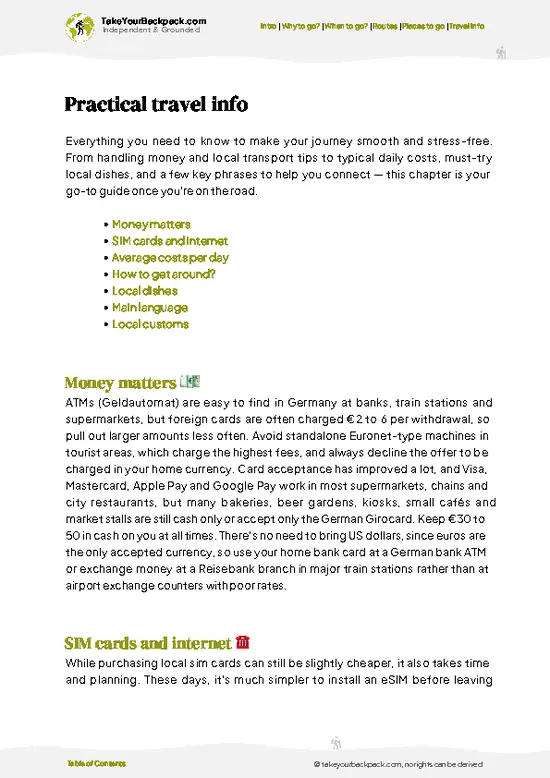
example page 0 from our offline Travel Guide for Germany
example page 1 from our offline Travel Guide for Germany
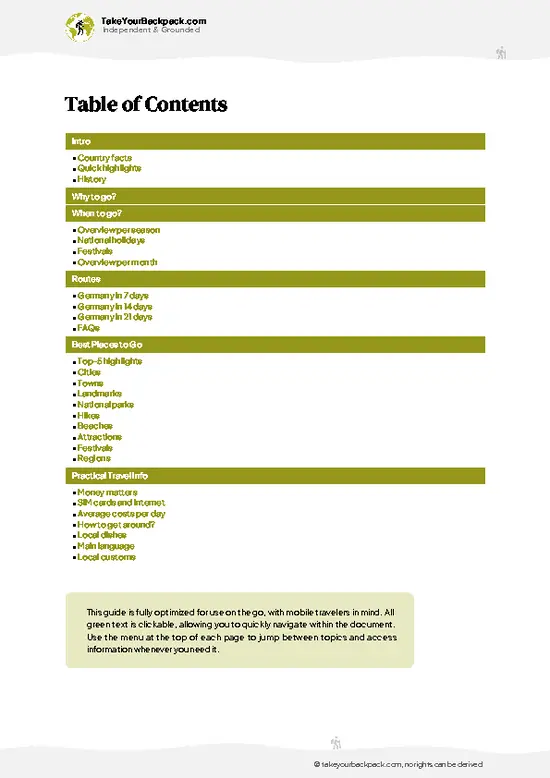
example page 2 from our offline Travel Guide for Germany
example page 3 from our offline Travel Guide for Germany
example page 4 from our offline Travel Guide for Germany
example page 5 from our offline Travel Guide for Germany
example page 6 from our offline Travel Guide for Germany
example page 7 from our offline Travel Guide for Germany
The digital guide (514 pages) contains:
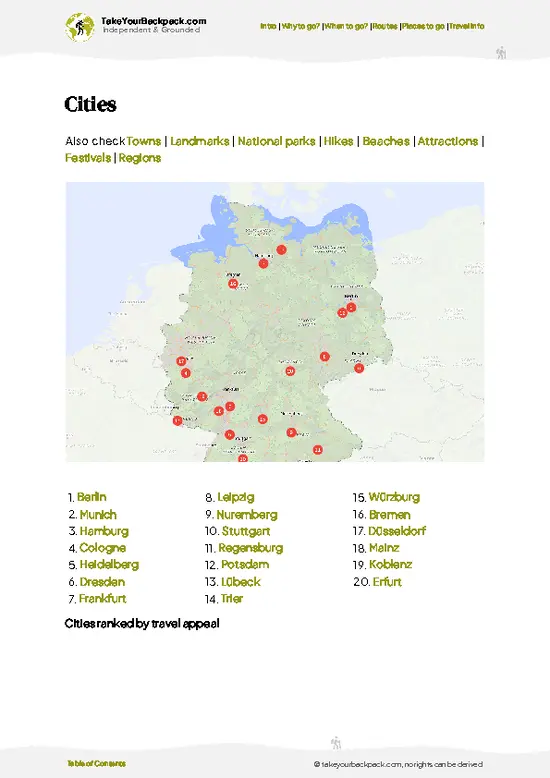
140 highlights, ranked by travel appeal
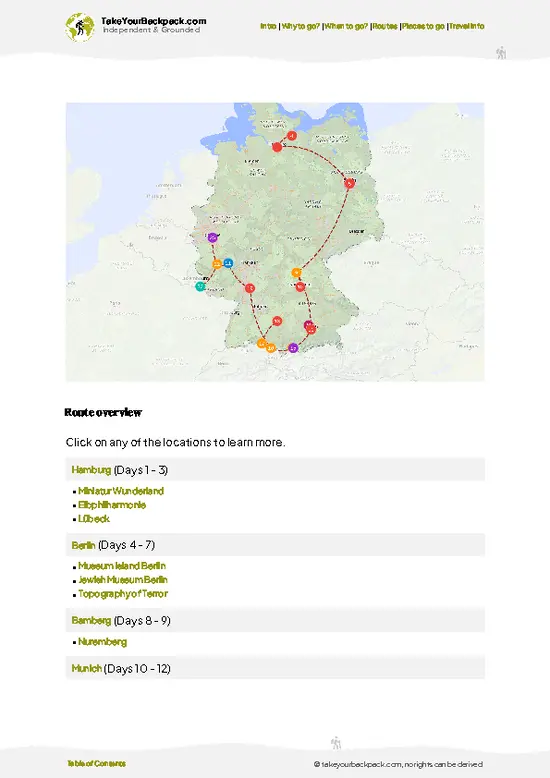
Optimized 7, 14 & 21-day travel routes
Cities, national parks, landmarks, beaches
How to get around
Offline-friendly for travel without Wi-Fi
👉 Click to see all 30+ guide features

📅 Plan smarter in minutes, not weeks
Month by month travel advice
Festivals & national holidays
Budget expectations

🗺️ Go to the right places, skip the overrated ones
Honest pros & cons of destinations
Top hikes, parks & viewpoints
Lesser-known places most travelers miss
Clear “worth it vs skip it” guidance

🛏️ Travel smoothly without rookie mistakes
Best areas to stay
Transport systems explained simply
Common scams & safety advice
SIM cards, money & practical tips

🌍 Understand the country, not just visit it
Culture & traditions
52 Essential phrases & customs
Festivals worth planning around
Traveler-friendly historical context
Insights that make places more meaningful

📱 Built for real travel conditions
Fully downloadable PDF
Works completely offline
Optimized for phone use
Useful in remote areas & buses
Everything in one place
Save weeks of stressful planning
Get instant access to your full guide. 30‑day money-back guarantee.
+ Add another guide for just US$7.80

By proceeding you agree to our terms.
Sent to your inbox immediately after payment • 100% Secure Checkout
Best Backpacking Travel Advisor 2025 tourism awardBest Backpacking
Travel Advisor
2025
What others say about Take Your Backpack Guides:
⭐⭐⭐⭐⭐
Fantastic, amazing amount of information!
⭐⭐⭐⭐⭐
My goodness this is amazing, it's what I've been looking for hats off too you!
⭐⭐⭐⭐⭐
I think this is absolutely BRILLIANT
⭐⭐⭐⭐
Very complete and informative. It's still missing places, but I gotta to commend you
⭐⭐⭐⭐⭐
This is truly amazing, thank you, can't wait to explore it with my kids!
⭐⭐⭐⭐⭐
Awesome resource, thank you!
⭐⭐⭐⭐⭐
This is amazing! Can't wait to explore the ones I haven't seen
⭐⭐⭐⭐
I love this! Well done, great idea.
⭐⭐⭐⭐⭐
Thanks for taking the time to make this gem!
⭐⭐⭐⭐⭐
This might be the best website I've ever seen.
⭐⭐⭐⭐⭐
Congratulations, and thank you so much for your work; it's incredibly valuable.
⭐⭐⭐⭐
In all seriousness I think you did a great job pointing out the important spots
⭐⭐⭐⭐⭐
10/10 very good
⭐⭐⭐⭐⭐
As someone who's only just starting to visit regularly this is awesome, thank you.
⭐⭐⭐⭐
Thank you very much! I'm going to visit my dad, it's going to be very useful!
⭐⭐⭐⭐⭐
This is really cool! We'll be travelling for the first time and this definitely come in handy.
⭐⭐⭐⭐⭐
You are now our minister of culture, congratulations 👨‍💼
⭐⭐⭐⭐⭐
Just wanted to tell you that this is a pearl! Going to follow your recommendations.
⭐⭐⭐⭐⭐
This is so cool. I'll definitely be using the resource for my travels soon.
⭐⭐⭐⭐⭐
This is very impressive! Good work.
⭐⭐⭐⭐⭐
This is an amazing and informative site. Very well done!

🛏️ Where to stay?How to pick the right area

In Passau, the real backpacker sweet spot is the Altstadt—the Old Town. This area sits right where the Danube, Inn, and Ilz rivers meet, flooding the air with a cool, fresh scent that feels like a natural reset after a day on the trail. The cobblestone streets here aren’t just pretty; they’re alive with a steady hum of locals and travelers swapping stories over a cold beer or a steaming pretzel. Staying here means you’re steps away from the main social hubs without the hassle of long commutes. It’s safe, compact, and packed with budget-friendly hostels that cater to solo travelers and groups alike. … read more 👉
In Passau, the real backpacker sweet spot is the Altstadt—the Old Town. This area sits right where the Danube, Inn, and Ilz rivers meet, flooding the air with a cool, fresh scent that feels like a natural reset after a day on the trail. The cobblestone streets here aren’t just pretty; they’re alive with a steady hum of locals and travelers swapping stories over a cold beer or a steaming pretzel. Staying here means you’re steps away from the main social hubs without the hassle of long commutes. It’s safe, compact, and packed with budget-friendly hostels that cater to solo travelers and groups alike. The vibe is relaxed but lively, with enough nightlife to keep you entertained without feeling overwhelmed.

Compared to the quieter, more residential districts like Innstadt or Hacklberg, Altstadt offers a better blend of accessibility and atmosphere. Those neighborhoods are peaceful but can feel isolated if you’re craving connection or easy access to the town’s pulse. Plus, Altstadt’s proximity to the riverbanks means you can catch sunrise reflections on the water or unwind with a riverside walk after a day of exploring. It’s the kind of place where you don’t just sleep—you soak in the rhythm of Passau, making every moment feel earned.

🚌 Getting aroundMoving around without the hassle

Passau moves with the gentle rhythm of a river town, where the Danube, Inn, and Ilz converge in a slow, deliberate dance. It’s not a place of frantic schedules or harsh neon signs demanding your attention. Instead, the town’s pulse is set by the soft clatter of footsteps on cobblestones, the occasional chime of a church bell, and the murmur of water lapping against old stone walls. The light here is a soft gold in the late afternoon, casting long shadows that invite you to slow down and take in the layers of history and life blending seamlessly. Navigating Passau is less about racing against the clock and more about syncing with its steady, unhurried flow. You’ll find that moving through the town is a tactile experience—each step, each turn, revealing a new texture or scent, from fresh bakery … read more 👉
Passau moves with the gentle rhythm of a river town, where the Danube, Inn, and Ilz converge in a slow, deliberate dance. It’s not a place of frantic schedules or harsh neon signs demanding your attention. Instead, the town’s pulse is set by the soft clatter of footsteps on cobblestones, the occasional chime of a church bell, and the murmur of water lapping against old stone walls. The light here is a soft gold in the late afternoon, casting long shadows that invite you to slow down and take in the layers of history and life blending seamlessly. Navigating Passau is less about racing against the clock and more about syncing with its steady, unhurried flow. You’ll find that moving through the town is a tactile experience—each step, each turn, revealing a new texture or scent, from fresh bakery bread to the earthy dampness near the riverbanks. This is a place where transit options aren’t just about getting from A to B—they’re part of the experience, each offering a different way to soak in the town’s character without breaking the bank.


  • Walking: The heart of Passau is compact and eminently walkable, with most sights reachable within 20 minutes on foot. Walking lets you absorb the town’s atmosphere—the scent of brewing coffee, the feel of uneven cobblestones underfoot, and the spontaneous street performances that pop up near the riverfront. It’s free, flexible, and the best way to catch the subtle shifts in light and sound that define Passau’s charm.


  • Local Bus (Stadtbus Passau): Buses run roughly from 6:00 AM to 10:00 PM, with tickets costing around €2 for a single ride. The network covers the outskirts and connects key points like the train station and university. Buses are punctual but can feel a bit cramped during rush hour. Ideal if you’re staying outside the center or want to save time on longer hauls without splurging on taxis.


  • Bicycle Rentals: Renting a bike is a smart move for budget travelers who want to cover more ground without losing the tactile connection to the town. Rentals start at about €10 per day. Passau’s flat terrain and dedicated bike lanes make cycling comfortable and quick, especially along the river paths where the breeze carries the fresh scent of water and greenery.


  • Taxi Services: Taxis are available but pricey for budget travelers, with a typical short ride starting around €7. They’re best reserved for late-night returns or when you’re hauling heavy gear. The comfort and speed are undeniable, but they don’t offer the same sensory immersion as walking or biking.


  • Train Station (Passau Hauptbahnhof): For arrivals and departures, the train station is your gateway. Regional trains connect Passau to Munich and Vienna, with schedules that tend to be reliable but require some planning. Tickets vary widely in price, but booking in advance can snag you deals. The station itself is functional, with a few cafes where you can grab a quick bite while watching the steady flow of travelers—an experience that grounds you in the town’s role as a crossroads rather than a destination stuck in time.

👛 Costs (as of 4 September 2026)Money, prices, and spending tips

Backpacking in Passau, Germany, typically involves moderate daily expenses that balance comfort and budget.
  • Dorm accommodation: Expect to pay around €20 to €30 per night for a bed in a hostel dormitory, which is common for budget travelers.
  • Meals: Budget about €10 to €15 for meals if you mix self-catering with occasional dining at affordable local eateries or bakeries.
  • Local transport: Passau is quite walkable, but local buses cost around €2 to €3 per ride, with daily passes available for about €5.
  • Basic activities/entry fees: Many attractions like museums and historic sites charge between €5 and €10 for entry, with some free options available.
  • Miscellaneous expenses: Allocate around €5 to €10 for extras like snacks, toiletries, or a coffee.
Overall, a daily budget of €50 to €80 should cover a … read more 👉
Backpacking in Passau, Germany, typically involves moderate daily expenses that balance comfort and budget.
  • Dorm accommodation: Expect to pay around €20 to €30 per night for a bed in a hostel dormitory, which is common for budget travelers.
  • Meals: Budget about €10 to €15 for meals if you mix self-catering with occasional dining at affordable local eateries or bakeries.
  • Local transport: Passau is quite walkable, but local buses cost around €2 to €3 per ride, with daily passes available for about €5.
  • Basic activities/entry fees: Many attractions like museums and historic sites charge between €5 and €10 for entry, with some free options available.
  • Miscellaneous expenses: Allocate around €5 to €10 for extras like snacks, toiletries, or a coffee.
Overall, a daily budget of €50 to €80 should cover a comfortable backpacking experience in Passau, balancing affordable lodging, food, transport, and activities.


source: numbeo.com
⚠️ Prices can change and everyone travels differently, so take this as a rough guide. Hope it helps you plan your adventure!

🚌 Day tripsBest day trips from Passau

Passau’s compact charm and strategic riverside location make it a surprisingly savvy base for day trips that stretch your legs and your perspective without demanding overnight stays or complex logistics.

Danube River Cruise to Schlögen

The Danube here isn’t just a river; it’s a slow-moving artery of history and nature. A cruise to Schlögen, about 1.5 hours downstream, offers a chance to watch the river carve through steep, forested hillsides. The boat ride itself is a quiet, sensory experience—cool mist on your face, the scent of pine, and the gentle slap of water against the hull. Budget travelers can snag a round-trip ticket for under €20, making it a wallet-friendly escape. Spring through early autumn is prime time, when the sun hits the water just right and the hills are lush. Many first-timers … read more 👉
Passau’s compact charm and strategic riverside location make it a surprisingly savvy base for day trips that stretch your legs and your perspective without demanding overnight stays or complex logistics.

Danube River Cruise to Schlögen

The Danube here isn’t just a river; it’s a slow-moving artery of history and nature. A cruise to Schlögen, about 1.5 hours downstream, offers a chance to watch the river carve through steep, forested hillsides. The boat ride itself is a quiet, sensory experience—cool mist on your face, the scent of pine, and the gentle slap of water against the hull. Budget travelers can snag a round-trip ticket for under €20, making it a wallet-friendly escape. Spring through early autumn is prime time, when the sun hits the water just right and the hills are lush. Many first-timers miss the return boat’s timing and end up waiting in the small village, so check schedules carefully.


Veste Oberhaus Fortress

A short, steep walk or a quick local bus ride from Passau’s center brings you to Veste Oberhaus, a fortress perched above the city. It’s not just a fortress; it’s a panoramic lookout where the three rivers—Danube, Inn, and Ilz—meet in a swirling confluence of blue and green. The fortress museum is modest but packed with regional history, and the café’s terrace is a perfect spot to soak in the late afternoon light. Entry is around €5, and the climb rewards you with a breeze that cuts through the city’s summer heat. Avoid the midday sun by arriving early or late afternoon.


Schärding, Austria

Just a 30-minute train ride across the border, Schärding is a splash of color and baroque architecture that feels like stepping into a postcard. The town’s main square, lined with pastel facades and ornate gables, invites slow wandering and café stops. Trains run frequently and cost about €10 round-trip, making it an easy, affordable hop. Autumn brings a crispness to the air and fewer tourists, perfect for savoring the local bakeries and riverside views. Many travelers overlook this spot, but it’s a refreshing contrast to Passau’s Germanic vibe.


Bavarian Forest National Park

If you crave a breath of wild air, the Bavarian Forest is reachable by bus in about an hour and a half. This is where the scent of damp earth and pine needles fills your lungs, and trails wind through ancient woods that feel untouched. Entry is free, and you can tailor your hike from gentle strolls to full-day treks. Spring and early summer bring wildflowers and bird songs, while autumn dresses the forest in fiery hues. The common rookie mistake is underestimating the trail difficulty; pack sturdy shoes and enough water to enjoy the forest without rushing.


Each trip from Passau is a chance to layer your experience—whether it’s the slow river rhythm, the sharp angles of a fortress, the charm of a border town, or the deep quiet of the forest. The town’s size means you’re never far from a train, bus, or boat, and that ease turns day trips into seamless extensions of your adventure.
Want to know what more Germany offers?
The Germany Travel Guide describes 140 highlights, from cities to national parks, from beaches to hikes

Get the Travel Guide -

🛡️ SafetyTraveler Safety Guide

Passau is one of those rare European towns where you can feel safe wandering its cobblestone streets well into the evening without the usual urban edge. The old town, framed by the confluence of three rivers, tends to draw a steady but relaxed crowd, so pickpocketing is uncommon but not impossible—especially near busy spots like the main train station or during festivals when the streets pulse with energy. Keep your bag close and avoid flashing valuables; a simple crossbody bag worn in front works wonders here.

Solo travelers will find the nighttime atmosphere calm, but it’s smart to stick to well-lit streets along the riverbanks or near the town center. Avoid the quieter alleys after dark—not because of crime, but because they can feel isolating and dimly lit. Passau doesn’t have a reputation … read more 👉
Passau is one of those rare European towns where you can feel safe wandering its cobblestone streets well into the evening without the usual urban edge. The old town, framed by the confluence of three rivers, tends to draw a steady but relaxed crowd, so pickpocketing is uncommon but not impossible—especially near busy spots like the main train station or during festivals when the streets pulse with energy. Keep your bag close and avoid flashing valuables; a simple crossbody bag worn in front works wonders here.

Solo travelers will find the nighttime atmosphere calm, but it’s smart to stick to well-lit streets along the riverbanks or near the town center. Avoid the quieter alleys after dark—not because of crime, but because they can feel isolating and dimly lit. Passau doesn’t have a reputation for scams, but like anywhere popular with tourists, be wary of overly persistent street vendors or anyone offering unsolicited “guides” or tours. A polite but firm “no, danke” usually ends it.

In short, Passau rewards those who move with quiet confidence and a bit of street smarts, letting you soak in the mellow glow of its baroque charm without distraction.

FAQFrequently asked questions about Passau

Yes, Passau is worth visiting for its unique location at the confluence of three rivers and its well-preserved baroque architecture, including St. Stephen's Cathedral with the largest cathedral organ in the world. It offers a charming old town and river views that make it more than just a stopover.
Two days are sufficient to explore Passau thoroughly, including the old town, the cathedral, the Veste Oberhaus fortress, and a boat trip on the rivers. This allows time to enjoy the local cuisine and some relaxed sightseeing without rushing.
Yes, Passau can be visited as a day trip from nearby cities like Munich or Linz, with train journeys taking around 2 hours each way. A day trip allows you to see the main sights but limits time for in-depth exploration or leisure activities.
⚠️ Things can change over time, so always validate details locally before you go.

Other German towns near Passau

Explore more nearby:

  • Burghausen—longest castle, Salzach river, border views| 62 km away
  • Landshut—Gothic cathedral, Isar riverbanks, medieval bridge| 95 km away
  • Bad Reichenhall—Alpine foothills, salt springs, wellness resorts| 102 km away

💡 Not sure where to go next?
Create a personalized itinerary for Germany including Passau and the places that fit your trip.

Generate my itinerary

👉 Discover all towns

Or checkout all Germany has to offer (think cities, towns, villages, national parks, hikes, beaches, festivals)
Country photo of Germany

We 💚 feedbackWhat to keep in mind

Passau’s charm hits you in the way the Danube, Inn, and Ilz rivers meet—there’s a quiet power in that confluence, a rhythm that pulls you into slow, reflective walks along cobblestone streets. But don’t expect a nonstop party or bustling nightlife; this town leans into calm and history over late-night buzz. If you’re chasing energy, you might find it a bit too serene, but for soaking in genuine riverside vibes, it’s hard to beat.

✈️ When did I visit Germany?
Being a neighbouring country of my home base, I visited Germany many times.

✍️ Help improve this page!
The information on this page is based on my own backpacking experience in Germany, supplemented with up-to-date research and feedback from other travelers. Travel details can change, so if you notice anything outdated or incomplete, feel free to let me know.


🙋‍♂️ Give feedback

👋 Meet the founderWho’s Behind Take Your Backpack?

Johan, backpacker and founder of TakeYourBackpackHi, I’m Johan (Netherlands 🇳🇱), the creator of TakeYourBackpack. Over the past decade, I’ve backpacked through 80+ countries across six continents, gaining extensive experience with independent travel, long-term trips, and overland routes.

This site is built on a combination of firsthand travel experience and carefully curated insights from other backpackers. Many guides are based on places I’ve personally visited, while others bring together tips, observations, and practical advice shared by trusted travelers I’ve met along the way.

The goal is to provide realistic, experience-driven guidance — not generic itineraries — so you can explore destinations with better context, clearer expectations, and more confidence.

Get full Germany guide •
Instant download • 140 highlights • Full Offline guide