v2.webp)
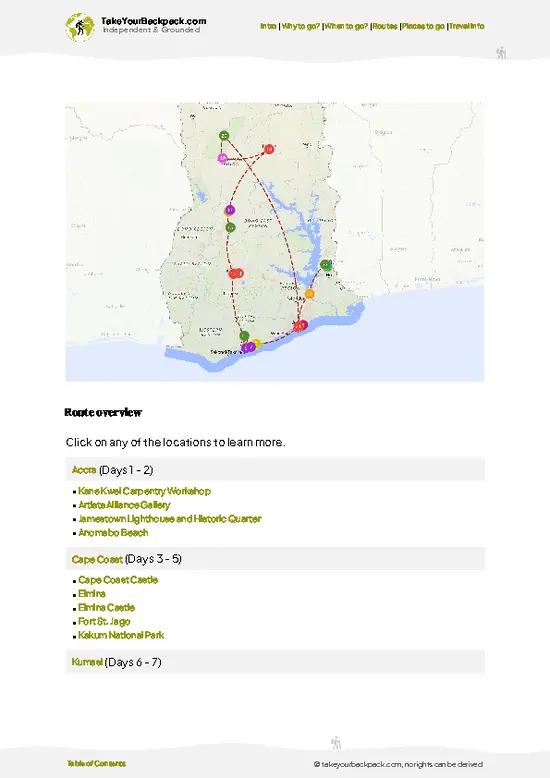
- Akwidaa Beach Walk: A long, mostly empty stretch of golden sand backed by palms and coconut groves. Go early, when fishermen pull in nets and the light is soft, and keep walking to find quiet coves.
- Cape Three Points Lighthouse: The lighthouse marks Ghana’s southernmost point, and the area is often described as the nearest land to the intersection of the equator and the Greenwich meridian. A small fee gets you up for views over the coast and forest. It is a rewarding day out, though the walk or ride there is rough.
- Turtle Watching: During the nesting season, community-run groups guide visitors to see turtles come ashore at night or release hatchlings. Go with a local guide and keep lights off.
- Dixcove and Butre Forts: Short rides along the coast reach old European trading forts at Dixcove and
- Akwidaa Beach Walk: A long, mostly empty stretch of golden sand backed by palms and coconut groves. Go early, when fishermen pull in nets and the light is soft, and keep walking to find quiet coves.
- Cape Three Points Lighthouse: The lighthouse marks Ghana’s southernmost point, and the area is often described as the nearest land to the intersection of the equator and the Greenwich meridian. A small fee gets you up for views over the coast and forest. It is a rewarding day out, though the walk or ride there is rough.
- Turtle Watching: During the nesting season, community-run groups guide visitors to see turtles come ashore at night or release hatchlings. Go with a local guide and keep lights off.
- Dixcove and Butre Forts: Short rides along the coast reach old European trading forts at Dixcove and Butre. Dixcove’s fishing harbor is loud, smoky and colorful, and the forts give context to the Gold Coast’s history.
- Village Seafood Evenings: Nights here mean simple, social meals, with grilled fish, lobster when in season, cold drinks and talk under the stars. There are no clubs, and that is the point.
Spotted a mistake or missing something? Contact us.


 Best Backpacking
.jpg) Hi, I’m Johan (Netherlands 🇳🇱), the creator of TakeYourBackpack. Over the past 3 decades, I’ve backpacked through 90+ countries across six continents, gaining extensive experience with independent travel, long-term trips, and overland routes.
Hi, I’m Johan (Netherlands 🇳🇱), the creator of TakeYourBackpack. Over the past 3 decades, I’ve backpacked through 90+ countries across six continents, gaining extensive experience with independent travel, long-term trips, and overland routes.