×

Ghana🇬🇭 | best beachesExplore the 6 Best beaches in Ghana

Ghana’s coast runs roughly 550 kilometers along the Gulf of Guinea, and the beaches here are working shorelines first: fishing canoes hauled onto warm sand, smoke from fish smokers, drumming from a bar somewhere behind the palms. The Greater Accra strip is loud, easy and priced for weekenders. The Central Region pairs wide sand with slave-trade forts and mid-range guesthouses. The Western Region is quieter, with long empty bays and rougher roads. The Volta coast in the east is the most relaxed. Independent travelers can reach nearly all of it by shared minibus (tro-tro), but expect heat, strong surf and patchy litter.

By Johan Kruseman 🇳🇱 | Updated October 23, 2026
Explore the best attractions in Ghana

Why go?Understanding Their Importance

Ghana is not a resort country, and that is the point. The Atlantic surf arrives in heavy, steady sets, and strong rip currents run along much of the coast, so many beaches are for walking, eating and watching rather than long swims. Warm water, around 25 to 29°C, and a near-equatorial sun make the sand hot by midmorning, with shade mostly coming from coconut palms.

What sets the coast apart is its history. European traders built dozens of forts and castles on these shores, and several are UNESCO-listed, so a beach day often sits beside whitewashed ramparts and dungeons. Today the same shoreline is lived in: fishing communities launch long wooden canoes at dawn, women sell fried plantain and grilled tilapia, and Sunday brings crowds, reggae and church choirs.

Before choosing Ghana for beaches, … read more 👉
Ghana is not a resort country, and that is the point. The Atlantic surf arrives in heavy, steady sets, and strong rip currents run along much of the coast, so many beaches are for walking, eating and watching rather than long swims. Warm water, around 25 to 29°C, and a near-equatorial sun make the sand hot by midmorning, with shade mostly coming from coconut palms.

What sets the coast apart is its history. European traders built dozens of forts and castles on these shores, and several are UNESCO-listed, so a beach day often sits beside whitewashed ramparts and dungeons. Today the same shoreline is lived in: fishing communities launch long wooden canoes at dawn, women sell fried plantain and grilled tilapia, and Sunday brings crowds, reggae and church choirs.

Before choosing Ghana for beaches, know that infrastructure is uneven. Beach bars, eco-lodges and guesthouses are plentiful near Accra and Cape Coast, but thin elsewhere, and cash is still king outside towns. Hawkers can be persistent, and litter washes up in places. Visitors who accept the working-coast character find warmth, welcome and character that polished resort coasts rarely offer.
How the List Was Created
The list of best beaches in Ghana is created based on beauty, vibe, water quality, activities, and surrounding scenery. If you feel a beach is missing in this list, please let us know.

When to go?Optimal Periods for Travel

Best months and the dry season: The best months for Ghana’s beaches are November to March, when the dry season brings clear skies, hot sun and the least rain along the whole coast. Days sit around 30 to 33°C, nights drop to about 23 to 25°C, and the harmattan wind from the Sahara can leave a pale dusty haze in December and January, especially inland and in the north. Seas are strong year-round, but they tend to be a little calmer in these months.
Shoulder seasons: April and the stretch from July to September are good compromise periods. Humidity is high at 75 to 85 percent, and showers tend to arrive as short, heavy bursts rather than all-day gray. Accommodation prices often dip by 10 to 30 percent outside the holidays.
Rainy season: The main rains hit May to mid-July, with a shorter second … read more 👉
Best months and the dry season: The best months for Ghana’s beaches are November to March, when the dry season brings clear skies, hot sun and the least rain along the whole coast. Days sit around 30 to 33°C, nights drop to about 23 to 25°C, and the harmattan wind from the Sahara can leave a pale dusty haze in December and January, especially inland and in the north. Seas are strong year-round, but they tend to be a little calmer in these months.
Shoulder seasons: April and the stretch from July to September are good compromise periods. Humidity is high at 75 to 85 percent, and showers tend to arrive as short, heavy bursts rather than all-day gray. Accommodation prices often dip by 10 to 30 percent outside the holidays.
Rainy season: The main rains hit May to mid-July, with a shorter second spell in September to November. The Western Region is the wettest part of the coast, often with 1,500 to 2,000 millimeters a year, while the Accra and Volta coast is drier, nearer 700 to 900 millimeters. Red-dirt roads turn slick, and some jungle-edge tracks get rough.
Peak periods: Christmas to New Year and Easter weekend fill beach lodges, especially near Accra, so book ahead and expect rates 20 to 50 percent higher.

beach hoppingSuggested Travel Strategies

How many days to allow: A trip linking several Ghanaian beaches needs 7 to 10 days, because roads are slow, traffic around Accra can swallow half a day, and sea-facing stops are best enjoyed unhurried. Allow 2 nights per stop at minimum, and 3 where you want to rest between travel days.
Direction and regional clusters: The sensible shape is a line along the coast. Accra is the main gateway, so many travelers fly in, then head west to the Central Region (around 3 to 4 hours to Cape Coast by road, depending on traffic) and continue to the Western Region (a further 3 to 4 hours to Takoradi, with more to the far-west bays). Going west first and finishing back near Accra suits most flight schedules. The Volta coast sits east of the capital and is best treated as its own loop, around 2.5 to 4 hours … read more 👉
How many days to allow: A trip linking several Ghanaian beaches needs 7 to 10 days, because roads are slow, traffic around Accra can swallow half a day, and sea-facing stops are best enjoyed unhurried. Allow 2 nights per stop at minimum, and 3 where you want to rest between travel days.
Direction and regional clusters: The sensible shape is a line along the coast. Accra is the main gateway, so many travelers fly in, then head west to the Central Region (around 3 to 4 hours to Cape Coast by road, depending on traffic) and continue to the Western Region (a further 3 to 4 hours to Takoradi, with more to the far-west bays). Going west first and finishing back near Accra suits most flight schedules. The Volta coast sits east of the capital and is best treated as its own loop, around 2.5 to 4 hours from Accra by road, or paired with a separate Accra stay.
Planning mistakes: The most common error is trying to cover Accra, Cape Coast, the far west and Volta in one week. That means long hours in hot minibuses and little time on sand. Choose two regions and go deeper. Another mistake is leaving Accra on a Friday afternoon or returning on a Sunday evening, when the highways clog for hours. Leave before 7 a.m. instead. Also leave a buffer on your last day before a flight, since roads and tro-tros rarely keep strict schedules.

The ListThe Best beaches of Ghana

1 Busua Beach

Surf lessons, palm-lined bay, Butre Lagoon, backpacker guesthouses

Book a board at a gentle beach break, then follow the coast to nearby Butre and its fort-topped headland.

ghana-beach-busua-beach
© Google |

2 Kokrobite Beach

Drumming, reggae bars, surf break, beach hostels

Join weekend drum circles and surf sessions on a lively, informal strip, with budget beds and bars a short walk apart.

ghana-beach-kokrobite-beach
© Google |

3 Anomabo Beach

Fishing canoes, Fort William, working shoreline, Cape Coast road

Walk the shore among painted canoes and nets, then climb the old fort above town for a view over the fishing fleet.

4 Ada Foah Beach

Volta River mouth, sandbar, boat transfers, estuary lagoons

Catch a boat across the Volta estuary to a long sandbar where river meets ocean, with quiet lodges and few crowds.

5 Cocoloco Beach

Gated resort strip, sun loungers, Accra day trips, live music

Spend a weekend day on a managed stretch of sand outside Accra, with loungers, a kitchen, and music close at hand.

6 Cape Three Points

Lighthouse, southernmost point, rocky coves, Dixcove nearby

Climb the lighthouse at Ghana’s southernmost tip, then wander the rocky headland where two stretches of coast meet the Atlantic.

Loading the map 🌍

Expert viewExpert Commentary on beaches

How many beaches to visit: Plan on three to four beach stops in a week and a half. Ghana’s coast rewards lingering: the sea is too rough for quick dips, meals arrive on coast time, and a long minibus ride eats a morning. Fewer stops mean more mornings of fishermen hauling nets and afternoons of fresh grilled fish with pepper sauce.
Which kind suits your travel style: Social travelers and short-stay visitors should favor the Accra-area beaches, with bars, live music and easy taxi access. History-minded backpackers do better on the Central coast, where a swim pairs with a fort tour. Anyone wanting solitude, long empty sand and a simple hut should push toward the Western and Volta shores, accepting slower transport and basic food. Surfers and yoga-minded long-stayers usually settle at small eco-lodges, … read more 👉
How many beaches to visit: Plan on three to four beach stops in a week and a half. Ghana’s coast rewards lingering: the sea is too rough for quick dips, meals arrive on coast time, and a long minibus ride eats a morning. Fewer stops mean more mornings of fishermen hauling nets and afternoons of fresh grilled fish with pepper sauce.
Which kind suits your travel style: Social travelers and short-stay visitors should favor the Accra-area beaches, with bars, live music and easy taxi access. History-minded backpackers do better on the Central coast, where a swim pairs with a fort tour. Anyone wanting solitude, long empty sand and a simple hut should push toward the Western and Volta shores, accepting slower transport and basic food. Surfers and yoga-minded long-stayers usually settle at small eco-lodges, where fans, cold showers and sea breeze are the norm.
What it costs: Expect US$25 to 50 a day on the beach circuit (about GH¢300 to 600). Dorm beds or basic rooms run US$10 to 25, a plate of fish or jollof with a cold drink US$3 to 8, and tro-tro fares typically US$2 to 6 per leg. Beach entry fees are often GH¢10 to 50 (about US$1 to 4), and some resort beaches charge more for day use. Fort tickets are usually in the US$5 to 15 range for foreigners. Bring cash, since ATMs thin out away from towns.
Safety and etiquette: The biggest danger is the water. Rip currents are powerful and many beaches have no lifeguards, so swim only where locals do, close to shore, and avoid the sea after heavy rain. Sun is intense, so cover up between 10 a.m. and 3 p.m. Keep valuables out of sight on open sand and never leave a bag unattended while swimming.

Ghana is a deeply religious, courteous country. Greet people before asking for anything, and ask before photographing fishermen or canoes, since some will request a small tip. Sunday mornings can mean church music across the sand, and on some stretches certain days are set aside for sea rituals or rest, so follow local guidance. Dress modestly away from the water, with swimwear kept to the beach. Same-sex affection is not safe to display publicly. Stay polite with hawkers, a smile and a firm no thank you go a long way, and bargain gently for crafts. Treat plastic waste seriously and carry your trash out.

✈️ The backpacker research shortcutGhana Travel Guide

An offline-friendly backpacking guide with optimized travel routes, ranked highlights, transport advice, and the best areas to stay.
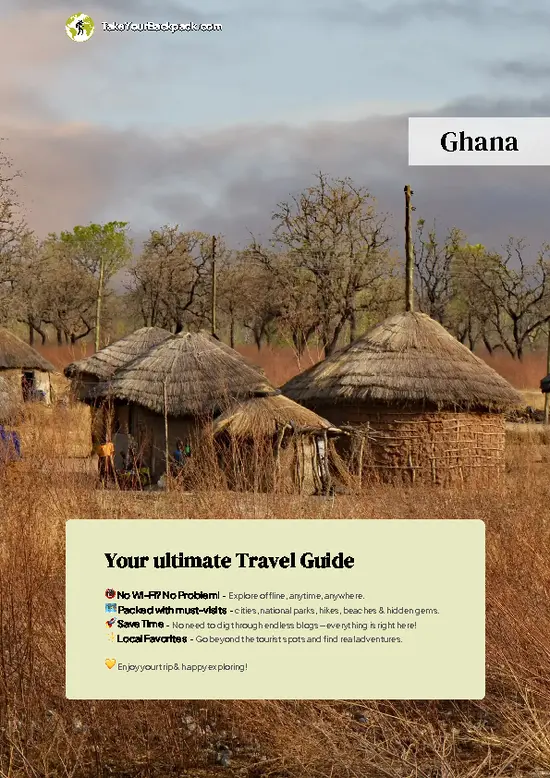
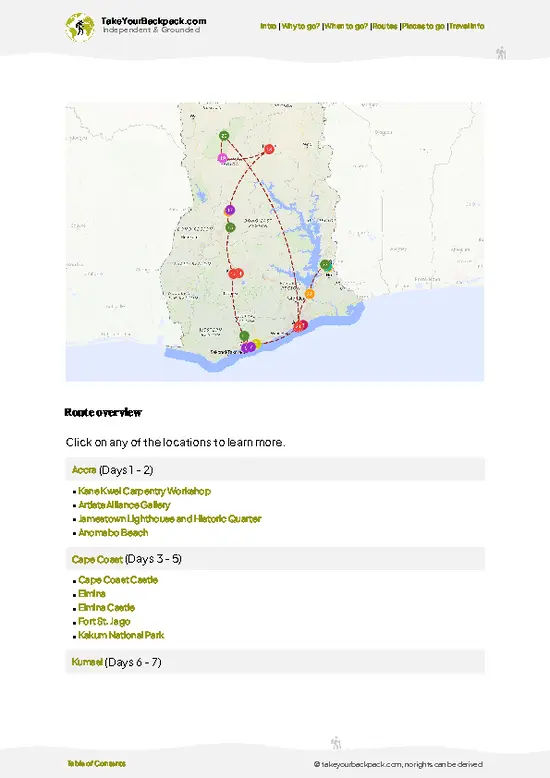
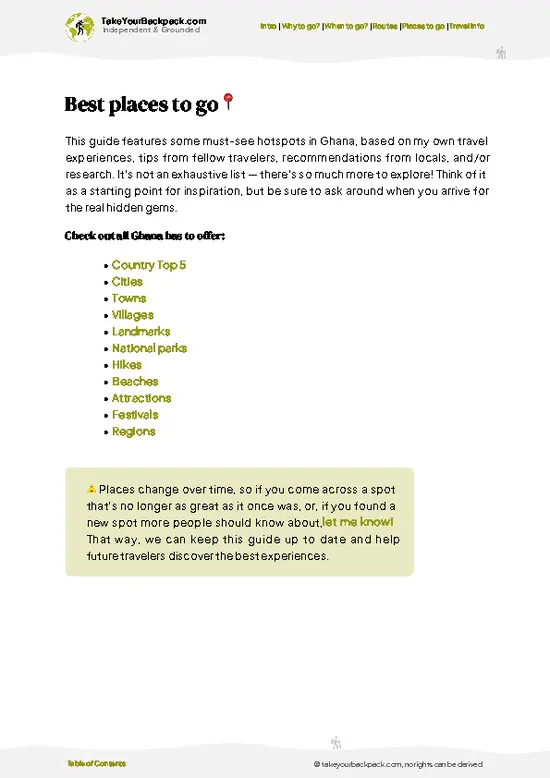
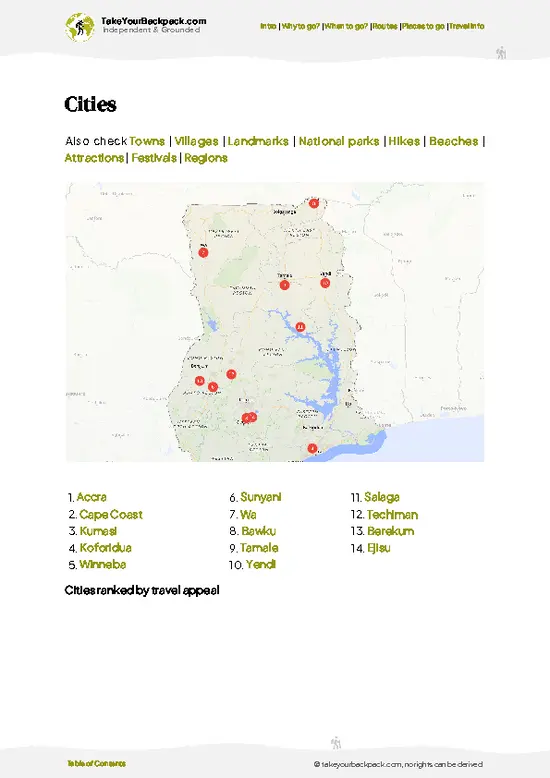
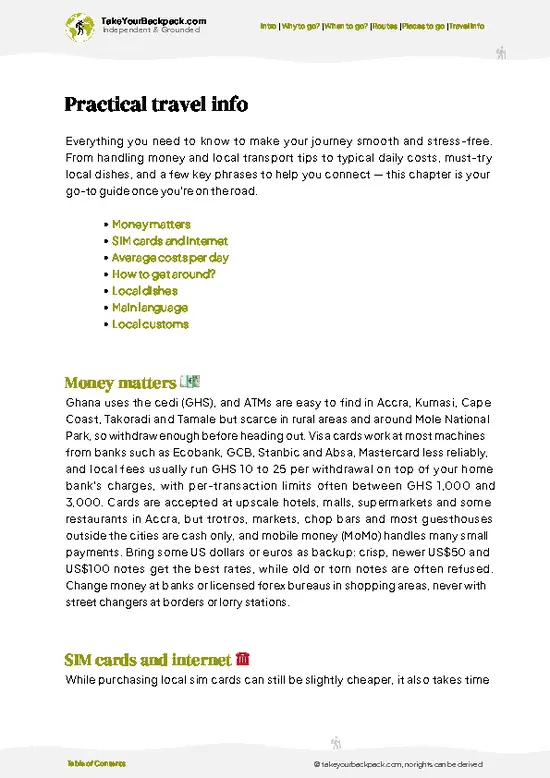
example page 0 from our offline Travel Guide for Ghana
example page 1 from our offline Travel Guide for Ghana
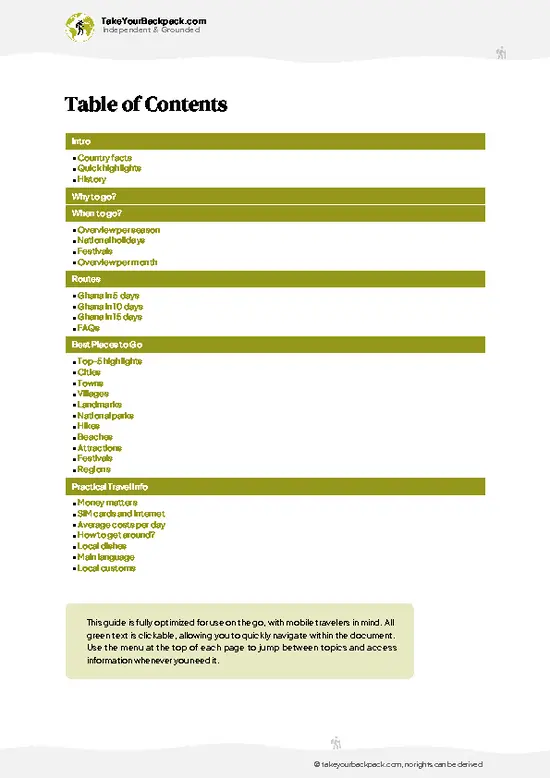
example page 2 from our offline Travel Guide for Ghana
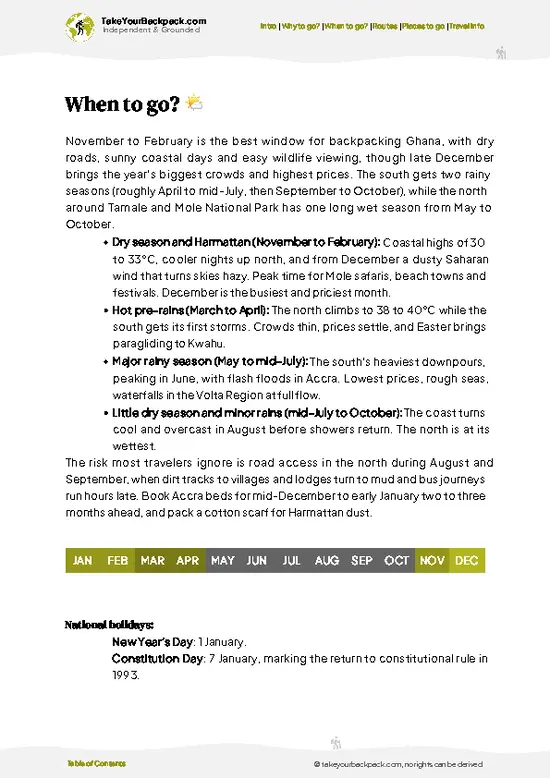
example page 3 from our offline Travel Guide for Ghana
example page 4 from our offline Travel Guide for Ghana
example page 5 from our offline Travel Guide for Ghana
example page 6 from our offline Travel Guide for Ghana
example page 7 from our offline Travel Guide for Ghana
The digital guide (321 pages) contains:
✅ 105 highlights, ranked by travel appeal
✅ Optimized 5, 10 & 15-day travel routes
✅ Cities, national parks, landmarks, beaches
✅ How to get around
✅ Offline-friendly for travel without Wi-Fi
👉 Click to see all 30+ guide features

📅 Plan smarter in minutes, not weeks
✅ Month by month travel advice
✅ Festivals & national holidays
✅ Budget expectations

🗺️ Go to the right places, skip the overrated ones
✅ Honest pros & cons of destinations
✅ Top hikes, parks & viewpoints
✅ Lesser-known places most travelers miss
✅ Clear “worth it vs skip it” guidance

🛏️ Travel smoothly without rookie mistakes
✅ Best areas to stay
✅ Transport systems explained simply
✅ Common scams & safety advice
✅ SIM cards, money & practical tips

🌍 Understand the country, not just visit it
✅ Culture & traditions
✅ 52 Essential phrases & customs
✅ Festivals worth planning around
✅ Traveler-friendly historical context
✅ Insights that make places more meaningful

📱 Built for real travel conditions
✅ Fully downloadable PDF
✅ Works completely offline
✅ Optimized for phone use
✅ Useful in remote areas & buses
✅ Everything in one place
Stop searching, start planning
Get instant access to your full guide. 30‑day money-back guarantee.
+ Add another guide for just

By proceeding you agree to our terms.
Sent to your inbox immediately after payment • 100% Secure Checkout
Best Backpacking Travel Advisor 2025 tourism awardBest Backpacking
Travel Advisor
2025
What others say about Take Your Backpack Guides:
⭐⭐⭐⭐⭐
Fantastic, amazing amount of information!
⭐⭐⭐⭐⭐
My goodness this is amazing, it's what I've been looking for hats off too you!
⭐⭐⭐⭐⭐
I think this is absolutely BRILLIANT
⭐⭐⭐⭐
Very complete and informative. It's still missing places, but I gotta to commend you
⭐⭐⭐⭐⭐
This is truly amazing, thank you, can't wait to explore it with my kids!
⭐⭐⭐⭐⭐
Awesome resource, thank you!
⭐⭐⭐⭐⭐
This is amazing! Can't wait to explore the ones I haven't seen
⭐⭐⭐⭐
I love this! Well done, great idea.
⭐⭐⭐⭐⭐
Thanks for taking the time to make this gem!
⭐⭐⭐⭐⭐
This might be the best website I've ever seen.
⭐⭐⭐⭐⭐
Congratulations, and thank you so much for your work; it's incredibly valuable.
⭐⭐⭐⭐
In all seriousness I think you did a great job pointing out the important spots
⭐⭐⭐⭐⭐
10/10 very good
⭐⭐⭐⭐⭐
As someone who's only just starting to visit regularly this is awesome, thank you.
⭐⭐⭐⭐
Thank you very much! I'm going to visit my dad, it's going to be very useful!
⭐⭐⭐⭐⭐
This is really cool! We'll be travelling for the first time and this definitely come in handy.
⭐⭐⭐⭐⭐
You are now our minister of culture, congratulations 👨‍💼
⭐⭐⭐⭐⭐
Just wanted to tell you that this is a pearl! Going to follow your recommendations.
⭐⭐⭐⭐⭐
This is so cool. I'll definitely be using the resource for my travels soon.
⭐⭐⭐⭐⭐
This is very impressive! Good work.
⭐⭐⭐⭐⭐
This is an amazing and informative site. Very well done!

🛏️ Where to stay?Best Stay Options in Ghana

Ghana has a modest but growing hostel scene, with dorm beds typically around GH₵150 to 300 (US$12 to 25) and basic guesthouse rooms from about GH₵350 (US$30), concentrated mostly in Accra and along the coast. In Accra, Osu puts you on Oxford Street’s bars, cheap chop bars and late nights but comes with noise and heavy traffic, while East Legon and Airport Residential are quieter, leafier and handy for flights yet far from the action and pricier per night. Elsewhere, beachy Kokrobite west of Accra is laid-back and drum-filled on weekends, Cape Coast keeps you walking distance from the castle and the fishing harbor, and Adum in Kumasi is central and cheap but loud and chaotic around the market. … read more 👉
Ghana has a modest but growing hostel scene, with dorm beds typically around GH₵150 to 300 (US$12 to 25) and basic guesthouse rooms from about GH₵350 (US$30), concentrated mostly in Accra and along the coast. In Accra, Osu puts you on Oxford Street’s bars, cheap chop bars and late nights but comes with noise and heavy traffic, while East Legon and Airport Residential are quieter, leafier and handy for flights yet far from the action and pricier per night. Elsewhere, beachy Kokrobite west of Accra is laid-back and drum-filled on weekends, Cape Coast keeps you walking distance from the castle and the fishing harbor, and Adum in Kumasi is central and cheap but loud and chaotic around the market.

If you enjoy meeting fellow travelers, consider choosing hostels with high ratings for atmosphere. On the other hand, if you prefer having your own space, a hotel might be a better option.

GhanaWhere to Go Next

👋 Meet the founderWho’s Behind Take Your Backpack?

Johan, backpacker and founder of TakeYourBackpackHi, I’m Johan (Netherlands 🇳🇱), the creator of TakeYourBackpack. Over the past 3 decades, I’ve backpacked through 90+ countries across six continents, gaining extensive experience with independent travel, long-term trips, and overland routes.

This site is built on a combination of firsthand travel experience and carefully curated insights from other backpackers. Many guides are based on places I’ve personally visited, while others bring together tips, observations, and practical advice shared by trusted travelers I’ve met along the way.

The goal is to provide realistic, experience-driven guidance — not generic itineraries — so you can explore destinations with better context, clearer expectations, and more confidence.