×

Greenland🇬🇱 | best national parksTop-Rated national parks in Greenland

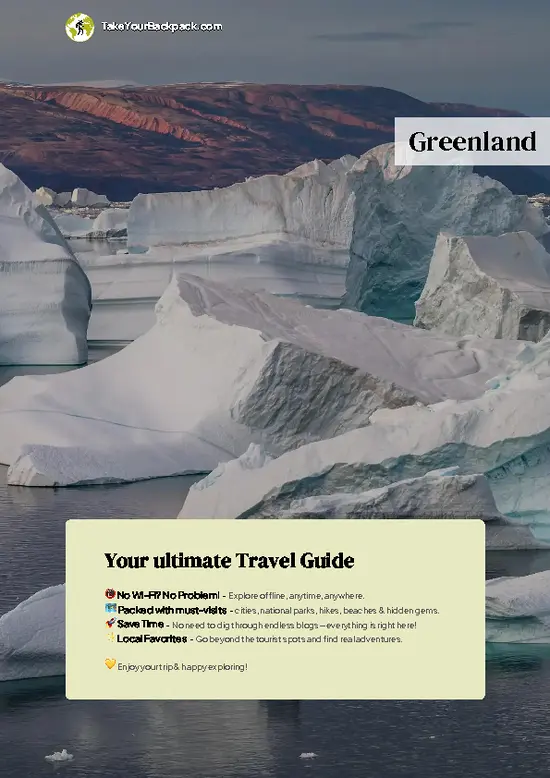
National parks in Greenland are not the signposted, ranger-station affairs you may know from elsewhere. The formally protected parks sit in the far north and northeast, on sea ice, ice-cap margins and tundra where the air smells of cold stone and brine, and the only sound may be a calving glacier thumping a long way off. There are no roads, campgrounds or entry gates. Access means charter flights, expedition ships or helicopters, and costs run into thousands of dollars. The west is different. Towns like Ilulissat and Kangerlussuaq have regular flights, guesthouses, marked trails and a few thousand visitors in summer, which suits independent backpacking on a tighter budget. The northwest feels closest to Inughuit hunting life, with dog sleds and seal skin drying on racks. Pick by how much money, time and self-reliance you can bring.

By Johan Kruseman 🇳🇱 | Updated October 23, 2026
Explore the best hikes in Greenland

Why go?Key Factors That Shape the Experience

Greenland holds the largest national park on Earth, and that single fact explains most of how the category works here. Northeast Greenland National Park covers roughly 972,000 square kilometers, bigger than France and Spain combined, and it has no villages, no roads and no visitor center. Protection here means distance. The country has about 56,000 people, almost all on the southwest and west coasts, so the vast ice-free tundra, fjords and ice cap stay empty without much need for fences or ticket booths.

That shapes what a traveler gets. There is no road network between towns, so every park trip is a boat, helicopter or Air Greenland flight, and weather can cancel any of them. Expect wind that smells of cold stone and salt, the crack and groan of calving ice, the hum of mosquitoes in July, … read more 👉
Greenland holds the largest national park on Earth, and that single fact explains most of how the category works here. Northeast Greenland National Park covers roughly 972,000 square kilometers, bigger than France and Spain combined, and it has no villages, no roads and no visitor center. Protection here means distance. The country has about 56,000 people, almost all on the southwest and west coasts, so the vast ice-free tundra, fjords and ice cap stay empty without much need for fences or ticket booths.

That shapes what a traveler gets. There is no road network between towns, so every park trip is a boat, helicopter or Air Greenland flight, and weather can cancel any of them. Expect wind that smells of cold stone and salt, the crack and groan of calving ice, the hum of mosquitoes in July, and light that stays up past midnight in summer. Sound carries for kilometers because nothing interrupts it.

Culture matters just as much. Land is used by Inuit hunters and fishers for seal, whale and reindeer, and that use continues in and around protected areas. Boats, dog sleds and hunting cabins are working tools, so photograph people only after asking, and never touch meat racks or drying fish.

Before choosing Greenland for its parks, know that facilities are minimal. Trails are often unmarked, huts are few, and rescue can be a day or more away. Polar bears in the north and east mean armed guides or permits are mandatory in some areas. The northeastern park requires an expedition permit and is realistically reached only through organized trips or research logistics. Costs run high because everything is flown or shipped in. In return, you get silence, space and ice on a scale few other countries can offer, with almost no one else around.
Our Approach to Ranking
The list of best national parks in Greenland is created based on landscapes, wildlife, adventure opportunities, facilities, and overall experience. If you feel a national park is missing in this list, please let us know.

When to go?Optimal Periods for Travel

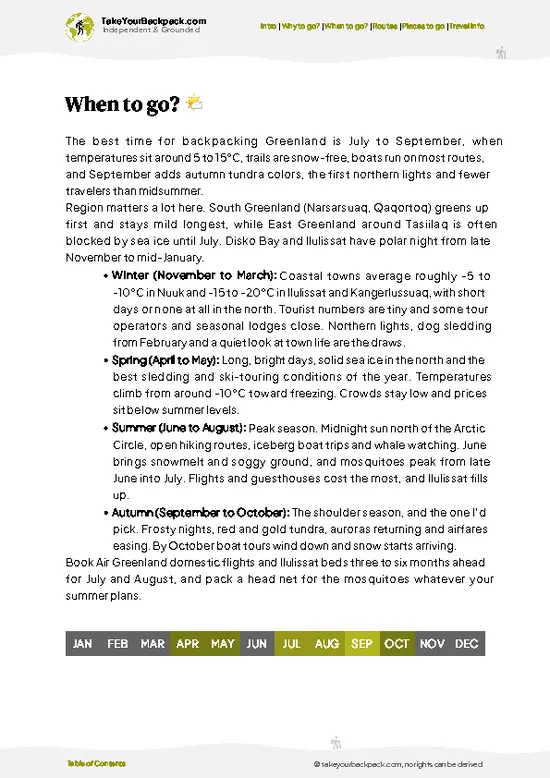
Best months and why: July to early September is the best window for national parks in Greenland, because sea routes open, snow retreats from low ground and daylight runs close to 24 hours in the north. Average daytime highs sit around 5 to 12°C in the west (Ilulissat can touch 18 to 20°C on a still afternoon) and only 0 to 6°C along the northeast coast, where July can still bring sleet.

Shoulder seasons: Late May to June brings snow-patched trails, loud meltwater and midnight sun in the west, with fewer people and lower guesthouse prices, though mud and river crossings slow walking. Mosquitoes peak from late June through July in the west, then fade by mid-August. September offers crisp air, red and gold tundra, and the first northern lights from around mid-month, but days shorten fast and boats … read more 👉
Best months and why: July to early September is the best window for national parks in Greenland, because sea routes open, snow retreats from low ground and daylight runs close to 24 hours in the north. Average daytime highs sit around 5 to 12°C in the west (Ilulissat can touch 18 to 20°C on a still afternoon) and only 0 to 6°C along the northeast coast, where July can still bring sleet.

Shoulder seasons: Late May to June brings snow-patched trails, loud meltwater and midnight sun in the west, with fewer people and lower guesthouse prices, though mud and river crossings slow walking. Mosquitoes peak from late June through July in the west, then fade by mid-August. September offers crisp air, red and gold tundra, and the first northern lights from around mid-month, but days shorten fast and boats thin out. Expedition ships to the northeast generally run late July to early September, when pack ice loosens.

Winter and spring: November to February means polar night in the far north and temperatures of -15 to -30°C in the west, colder inland and in the northeast. Ground transport is limited to sled and snowmobile, and many guesthouses and tour operators close. March to May is the season for dog sledding in the northwest, with bright light off the ice and typical temperatures of -10 to -25°C. Flights are the weak link in any season, since fog, wind and snow ground small planes for a day or more.

Prices and crowds: July and August are peak for flights and rooms, and domestic fares rise noticeably. Book accommodation months ahead. Cruise ships are concentrated in the west from June to September, so the most visited towns feel busier on ship days. Shoulder months cut lodging costs by roughly 10 to 25 percent where places stay open.

national park hoppingSuggested Travel Strategies

How long a multi-park trip takes: A trip linking several protected areas in Greenland needs 10 to 21 days, and the high end is realistic only if you add buffer for weather. Distances are huge and the plane network is thin, so the map lies about how close things are.

Which regions cluster: The west clusters well: Kangerlussuaq, Sisimiut and Ilulissat connect by Air Greenland or coastal ferry, with Nuuk as the main domestic hub. Travel between these hubs runs 45 minutes to 2 hours by air. The far north and northwest are a separate leg. Qaanaaq and Savissivik are reached via Ilulissat or Upernavik by small turboprop and helicopter, usually a full day of connections. The northeast is its own world, reached by charter from Iceland (Akureyri) or by expedition ship from Iceland or Svalbard. Treat … read more 👉
How long a multi-park trip takes: A trip linking several protected areas in Greenland needs 10 to 21 days, and the high end is realistic only if you add buffer for weather. Distances are huge and the plane network is thin, so the map lies about how close things are.

Which regions cluster: The west clusters well: Kangerlussuaq, Sisimiut and Ilulissat connect by Air Greenland or coastal ferry, with Nuuk as the main domestic hub. Travel between these hubs runs 45 minutes to 2 hours by air. The far north and northwest are a separate leg. Qaanaaq and Savissivik are reached via Ilulissat or Upernavik by small turboprop and helicopter, usually a full day of connections. The northeast is its own world, reached by charter from Iceland (Akureyri) or by expedition ship from Iceland or Svalbard. Treat it as a standalone trip, not an add-on.

Direction and time per stop: Fly into Kangerlussuaq from Copenhagen (about 4.5 hours), work north to Ilulissat, then continue to the northwest only if time allows. Allow 3 to 5 days in each western base for boat trips, trail days and a weather spare. The northwest needs 4 to 7 days. The northeast needs 7 to 14 days on a structured expedition.

Planning mistakes: The most common error is tight connections. Fog and wind regularly delay flights by 12 to 48 hours, so book an international departure at least 2 days after your last domestic leg. Another is chasing too many stops, which turns the trip into airport waiting. Choose two regions and give each time to breathe. Travelers also underestimate lead times. Northwest and northeast logistics and permits can need several months, and summer seats on small planes sell out early. Finally, relying on a single transport mode leaves you stranded when the weather turns, so keep ferry and flight options open where the coast allows.

The ListThe Best national parks of Greenland

1 Northeast Greenland National Park

Expedition ships, walrus haul-outs, muskox tundra, Kong Oscar Fjord, floating glacier tongue

Sail past banded fjord cliffs and icebergs to watch walrus on gravel beaches and muskoxen on open tundra, guided on foot by armed rangers.

greenland-national-park-northeast-greenland-national-park
© Google | Daniel Moreno
Loading the map 🌍

Expert viewInsights from Locals and Experts

How many parks to aim for: One protected area is the right number for most backpackers, and two is the ceiling. Greenland rewards depth. A permit-controlled wilderness park needs a week or more by itself, plus a day or two of slack for weather, and moving between regions costs money and time on thin flight schedules. A second stop makes sense only if it is the accessible west, where you can walk and camp independently. The reward is long, quiet days with ice in view and nobody else around, rather than a checklist.

Choosing between kinds of parks: Two kinds exist. The first is the remote, formally protected wilderness in the north and northeast, reached by expedition ship, charter or helicopter. Choose it if you have a big budget, expedition experience or the willingness to join a guided group, … read more 👉
How many parks to aim for: One protected area is the right number for most backpackers, and two is the ceiling. Greenland rewards depth. A permit-controlled wilderness park needs a week or more by itself, plus a day or two of slack for weather, and moving between regions costs money and time on thin flight schedules. A second stop makes sense only if it is the accessible west, where you can walk and camp independently. The reward is long, quiet days with ice in view and nobody else around, rather than a checklist.

Choosing between kinds of parks: Two kinds exist. The first is the remote, formally protected wilderness in the north and northeast, reached by expedition ship, charter or helicopter. Choose it if you have a big budget, expedition experience or the willingness to join a guided group, and want musk ox, walrus, polar bears and silence on a scale nowhere else offers. The second is the accessible west, with marked trails, huts and shelters, and towns for resupply. Choose it if you want to walk under your own power, sleep in a tent for a few nights and be back in a guesthouse with hot coffee afterward. Most first-timers should start there. The hard parts, like wet boots, wind and mosquito clouds, come with a view of ice and tundra in return.

What it costs: Independent travel in the west runs about DKK 900 to 1,600 a day (US$130 to 235), including a tent or hostel bed, self-catered food from Pilersuisoq or Brugseni stores, and local transport. Domestic flights are the big item, usually DKK 1,200 to 4,000 (US$175 to 580) per leg. Boat trips to ice fjords or glacier fronts cost around DKK 500 to 1,200 (US$75 to 175). Guides for day or multi-day trips typically run DKK 1,500 to 3,500 a day (US$220 to 510). Camping stoves, gas and groceries cost more than in Europe, so bring supplies where airlines allow. The remote northern and northeastern parks are a different budget tier. Guided expeditions, ship berths and charters commonly total US$5,000 to 15,000 per person per trip, and permits are arranged months ahead through the Greenland authorities or an operator. The payoff is access to country few people have walked.

Safety on the ground: Weather is the main risk. A calm morning can turn to gale and sleet within an hour, so carry a full waterproof layer, a warm hat even in July and a spare day of food. Rivers swell in afternoon melt, and bog swallows boots. Bring a head net, since mosquitoes in July are relentless. Polar bears are the central concern in the north and northeast. Guides carry rifles, and independent travel there is not advised. Travel insurance should explicitly cover search and rescue and helicopter evacuation, which can cost several thousand dollars. Carry a satellite messenger or rent a satellite phone, as mobile coverage disappears outside towns. Do not walk on glacier ice or near calving fronts without a guide, because waves from collapsing ice can swamp boats and shorelines.

Cultural manners: Greenland is a living homeland, not an empty reserve. Hunting seals, fishing and keeping sled dogs are daily livelihoods. Sled dogs are working animals tethered outside towns, so never approach or feed them. Ask before photographing people or drying meat racks, and keep drones away from hunting areas and settlements, since they scare game and neighbors alike. Greet people with a nod or a simple hello, and accept that a conversation can take its time. Respect hunting catches and local rules on camping near settlements, and pack out every scrap of trash. Done well, you leave with the kind of welcome that only comes from showing respect.

✈️ The backpacker research shortcutGreenland Travel Guide

An offline-friendly backpacking guide with optimized travel routes, ranked highlights, transport advice, and the best areas to stay.
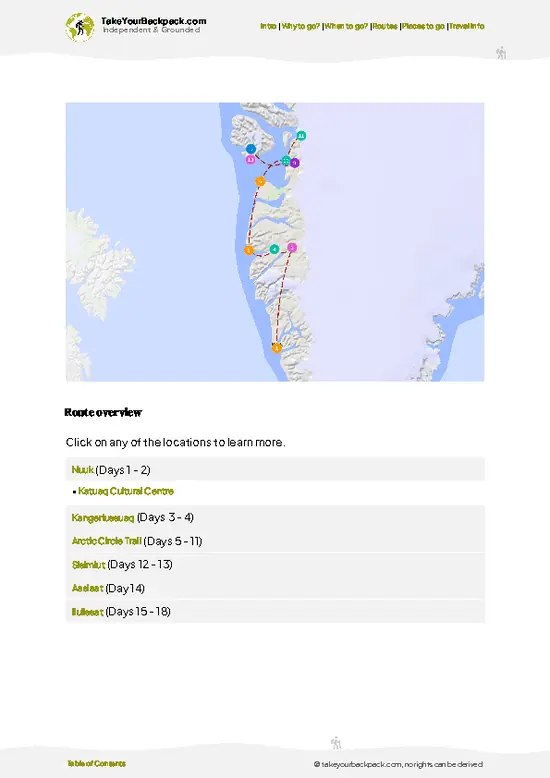
example page 0 from our offline Travel Guide for Greenland
example page 1 from our offline Travel Guide for Greenland
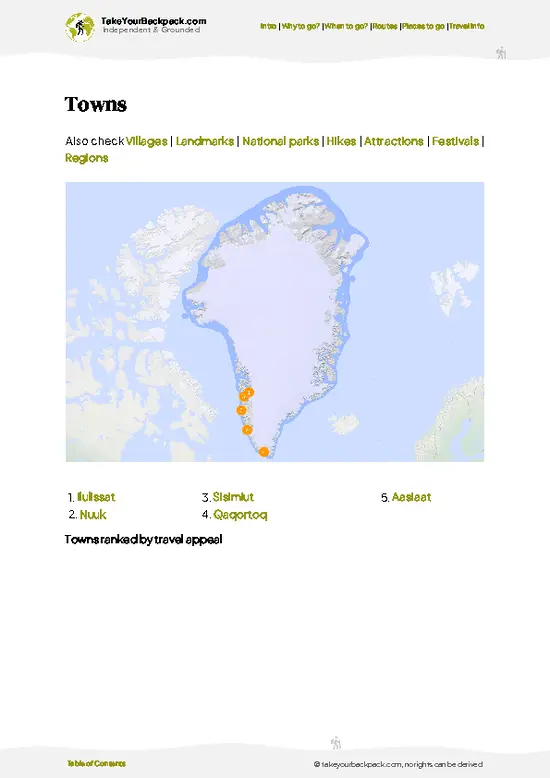
example page 2 from our offline Travel Guide for Greenland
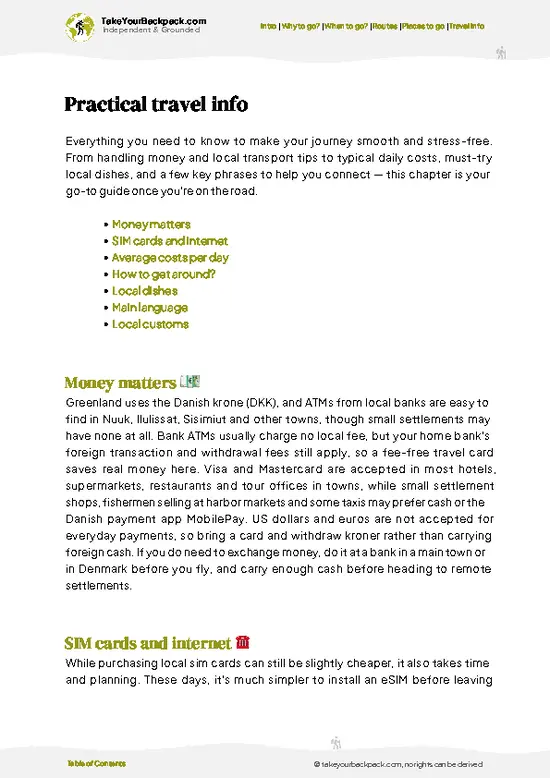
example page 3 from our offline Travel Guide for Greenland
example page 4 from our offline Travel Guide for Greenland
example page 5 from our offline Travel Guide for Greenland
example page 6 from our offline Travel Guide for Greenland
example page 7 from our offline Travel Guide for Greenland
The digital guide (154 pages) contains:
✅ 33 highlights, ranked by travel appeal
✅ Optimized 7, 14 & 21-day travel routes
✅ Cities, national parks, landmarks, beaches
✅ How to get around
✅ Offline-friendly for travel without Wi-Fi
👉 Click to see all 30+ guide features

📅 Plan smarter in minutes, not weeks
✅ Month by month travel advice
✅ Festivals & national holidays
✅ Budget expectations

🗺️ Go to the right places, skip the overrated ones
✅ Honest pros & cons of destinations
✅ Top hikes, parks & viewpoints
✅ Lesser-known places most travelers miss
✅ Clear “worth it vs skip it” guidance

🛏️ Travel smoothly without rookie mistakes
✅ Best areas to stay
✅ Transport systems explained simply
✅ Common scams & safety advice
✅ SIM cards, money & practical tips

🌍 Understand the country, not just visit it
✅ Culture & traditions
✅ 52 Essential phrases & customs
✅ Festivals worth planning around
✅ Traveler-friendly historical context
✅ Insights that make places more meaningful

📱 Built for real travel conditions
✅ Fully downloadable PDF
✅ Works completely offline
✅ Optimized for phone use
✅ Useful in remote areas & buses
✅ Everything in one place
Stop searching, start planning
Get instant access to your full guide. 30‑day money-back guarantee.
+ Add another guide for just

By proceeding you agree to our terms.
Sent to your inbox immediately after payment • 100% Secure Checkout
Best Backpacking Travel Advisor 2025 tourism awardBest Backpacking
Travel Advisor
2025
What others say about Take Your Backpack Guides:
⭐⭐⭐⭐⭐
Fantastic, amazing amount of information!
⭐⭐⭐⭐⭐
My goodness this is amazing, it's what I've been looking for hats off too you!
⭐⭐⭐⭐⭐
I think this is absolutely BRILLIANT
⭐⭐⭐⭐
Very complete and informative. It's still missing places, but I gotta to commend you
⭐⭐⭐⭐⭐
This is truly amazing, thank you, can't wait to explore it with my kids!
⭐⭐⭐⭐⭐
Awesome resource, thank you!
⭐⭐⭐⭐⭐
This is amazing! Can't wait to explore the ones I haven't seen
⭐⭐⭐⭐
I love this! Well done, great idea.
⭐⭐⭐⭐⭐
Thanks for taking the time to make this gem!
⭐⭐⭐⭐⭐
This might be the best website I've ever seen.
⭐⭐⭐⭐⭐
Congratulations, and thank you so much for your work; it's incredibly valuable.
⭐⭐⭐⭐
In all seriousness I think you did a great job pointing out the important spots
⭐⭐⭐⭐⭐
10/10 very good
⭐⭐⭐⭐⭐
As someone who's only just starting to visit regularly this is awesome, thank you.
⭐⭐⭐⭐
Thank you very much! I'm going to visit my dad, it's going to be very useful!
⭐⭐⭐⭐⭐
This is really cool! We'll be travelling for the first time and this definitely come in handy.
⭐⭐⭐⭐⭐
You are now our minister of culture, congratulations 👨‍💼
⭐⭐⭐⭐⭐
Just wanted to tell you that this is a pearl! Going to follow your recommendations.
⭐⭐⭐⭐⭐
This is so cool. I'll definitely be using the resource for my travels soon.
⭐⭐⭐⭐⭐
This is very impressive! Good work.
⭐⭐⭐⭐⭐
This is an amazing and informative site. Very well done!

🛏️ Where to stay?Top Areas to Stay

Greenland has only a handful of true hostels, so budget accommodation here mostly means dorm beds, simple guesthouses, seamen’s homes and campsites, with a dorm bed typically costing DKK 350 to 600 (about US$50 to 85) a night. In Nuuk, staying in Nuuk Centrum puts you within walking distance of the old colonial harbor, the museums and the town’s few bars, while Nuussuaq and Qinngorput are quieter residential districts, mostly private rooms and apartment rentals, where you need the bus to reach anything. Elsewhere, budget beds in Ilulissat cluster in the compact center near the harbor and the Icefjord trails, and Kangerlussuaq has basic lodging right by the airport, handy for connecting flights … read more 👉
Greenland has only a handful of true hostels, so budget accommodation here mostly means dorm beds, simple guesthouses, seamen’s homes and campsites, with a dorm bed typically costing DKK 350 to 600 (about US$50 to 85) a night. In Nuuk, staying in Nuuk Centrum puts you within walking distance of the old colonial harbor, the museums and the town’s few bars, while Nuussuaq and Qinngorput are quieter residential districts, mostly private rooms and apartment rentals, where you need the bus to reach anything. Elsewhere, budget beds in Ilulissat cluster in the compact center near the harbor and the Icefjord trails, and Kangerlussuaq has basic lodging right by the airport, handy for connecting flights but with almost no nightlife; safety is rarely a concern in any of these areas.

If you enjoy meeting fellow travelers, consider choosing hostels with high ratings for atmosphere. On the other hand, if you prefer having your own space, a hotel might be a better option.

GreenlandDiscover the Country

👋 Meet the founderWho’s Behind Take Your Backpack?

Johan, backpacker and founder of TakeYourBackpackHi, I’m Johan (Netherlands 🇳🇱), the creator of TakeYourBackpack. Over the past 3 decades, I’ve backpacked through 90+ countries across six continents, gaining extensive experience with independent travel, long-term trips, and overland routes.

This site is built on a combination of firsthand travel experience and carefully curated insights from other backpackers. Many guides are based on places I’ve personally visited, while others bring together tips, observations, and practical advice shared by trusted travelers I’ve met along the way.

The goal is to provide realistic, experience-driven guidance — not generic itineraries — so you can explore destinations with better context, clearer expectations, and more confidence.