×

Greenland🇬🇱 | best landmarksTop-Rated 4 landmarks in Greenland

Landmarks in Greenland are rarely buildings with ticket booths. They are fjords, ice fields and calving glaciers, plus the Norse ruins and Inuit settlements scattered along a coast with no road between towns. In the southwest and Disko Bay, the ice is loud: cracks like rifle shots, a low groan, then the slap of a wave against a boat hull. Expect cold air that smells of salt and diesel, and light that stays pink for hours in summer. The far south has green, sheep-grazed valleys with turf-walled ruins, while the east is remote, expensive and quiet, reached by costly flights or boats. Access is the main cost: every sight needs a flight, ferry or chartered boat, so independent travelers spend more on transport than on entry, which is usually free or a few dollars. Crowds thin fast outside Ilulissat. Pack for wind, wet boots and long waits.

By Johan Kruseman 🇳🇱 | Updated October 23, 2026
Explore the best national parks in Greenland

Why go?Key Factors That Shape the Experience

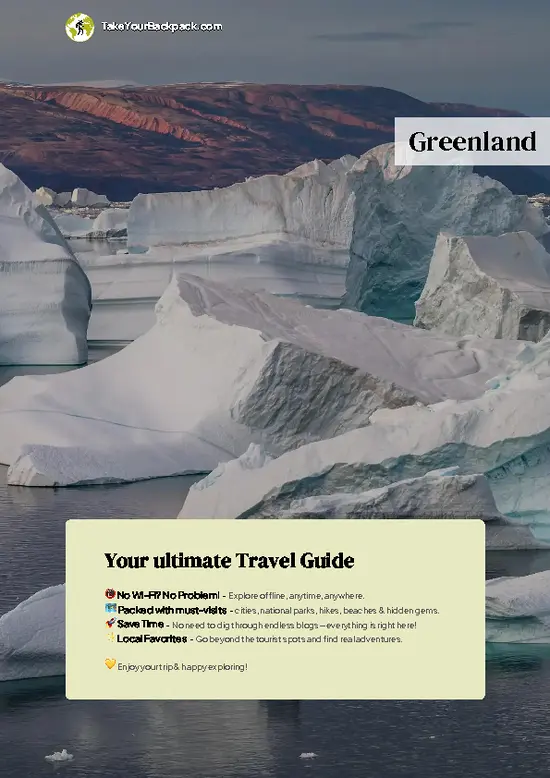
Greenland suits landmarks that are about scale and raw geology rather than monuments. Roughly 80 percent of the island lies under the ice sheet, and its outlets feed fjords where icebergs the size of apartment blocks drift past settlements. Sound is part of it: meltwater trickling inside a berg, the hiss of brash ice against rock, dogs howling at dusk. The cultural layer is real but thin on the ground. Thule Inuit sites and Norse farmsteads survive mostly as low stone and turf foundations, so they reward people who like reading a landscape rather than looking at a facade. Interpretation is limited, and local museums fill in the story.

The constraint is infrastructure. There are no roads between towns, so every landmark depends on flights, ferries or boat charters, and weather cancels them … read more 👉
Greenland suits landmarks that are about scale and raw geology rather than monuments. Roughly 80 percent of the island lies under the ice sheet, and its outlets feed fjords where icebergs the size of apartment blocks drift past settlements. Sound is part of it: meltwater trickling inside a berg, the hiss of brash ice against rock, dogs howling at dusk. The cultural layer is real but thin on the ground. Thule Inuit sites and Norse farmsteads survive mostly as low stone and turf foundations, so they reward people who like reading a landscape rather than looking at a facade. Interpretation is limited, and local museums fill in the story.

The constraint is infrastructure. There are no roads between towns, so every landmark depends on flights, ferries or boat charters, and weather cancels them often. Fog, wind and ice can ground a helicopter or close a harbor with little notice, so schedules need slack. Settlements are small, supplies are flown or shipped in, and prices for food and lodging are high compared with mainland Europe. Many sights lie outside towns, which means guided boat trips or self-led hikes over wet tundra, mosquito-heavy in July. Marked trails exist near the main towns, but beyond them you navigate by map and GPS.

Travelers should also know that respect for local life matters: sled dogs are working animals, drying fish racks and hunting gear are not photo props, and many places are still lived in. If you want ticketed, queue-managed monuments, look elsewhere. If you want cold, quiet, enormous places that change by the hour, Greenland delivers.
Evaluating the Top Choices
The list of best unique sites in Greenland is created based on history or culture, wow factor, atmosphere, quirks, and memorability. If you feel a unique site is missing in this list, please let us know.

When to go?Optimal Periods for Travel

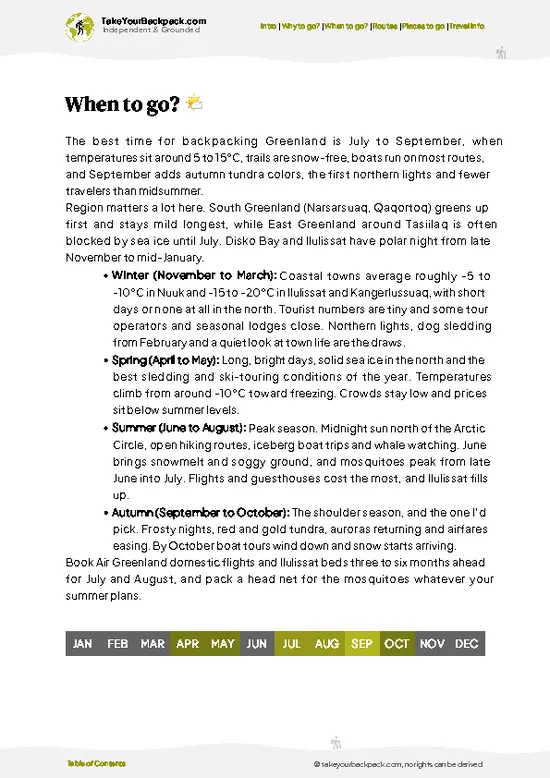
Best months for landmarks: June to August is the best window, because the sea is open to boats, trails are snow-free and daylight runs 20 to 24 hours in most of the country. Daytime highs in Ilulissat and the Disko Bay area sit around 5 to 12°C (41 to 54°F), and Nuuk is similar, with fog and drizzle common. In the south, around Narsaq and Qassiarsuk, July can reach 15 to 18°C (59 to 64°F), and the valleys smell of wet grass and sheep. Mosquitoes peak in July and are fierce on tundra, so a head net earns its place in the pack.
Shoulder seasons: Late May to early June and September are quieter and cheaper. In September the tundra turns red and gold, nights darken enough for northern lights, and temperatures drop to 0 to 8°C (32 to 46°F). Some boat tours and guesthouses reduce hours, and ferry … read more 👉
Best months for landmarks: June to August is the best window, because the sea is open to boats, trails are snow-free and daylight runs 20 to 24 hours in most of the country. Daytime highs in Ilulissat and the Disko Bay area sit around 5 to 12°C (41 to 54°F), and Nuuk is similar, with fog and drizzle common. In the south, around Narsaq and Qassiarsuk, July can reach 15 to 18°C (59 to 64°F), and the valleys smell of wet grass and sheep. Mosquitoes peak in July and are fierce on tundra, so a head net earns its place in the pack.
Shoulder seasons: Late May to early June and September are quieter and cheaper. In September the tundra turns red and gold, nights darken enough for northern lights, and temperatures drop to 0 to 8°C (32 to 46°F). Some boat tours and guesthouses reduce hours, and ferry timetables thin out. In late May, fjords may still hold ice, which can delay sailings. Expect lower prices on lodging and a few fewer visitors in the main hubs.
Winter and peak pressure: October to April brings snow, long nights and temperatures that can fall to minus 15 to minus 25°C (5 to minus 13°F) in the north. Dog sledding and ice-fjord views are possible, but many boat-based sights close and flights are less reliable in storms. Peak pressure falls in July and August, when Ilulissat and cruise-ship days fill tours and beds, so book flights and lodging months ahead. East Greenland has a shorter season, roughly July to September, when Tasiilaq's coast opens.

unique site hoppingSuggested Travel Strategies

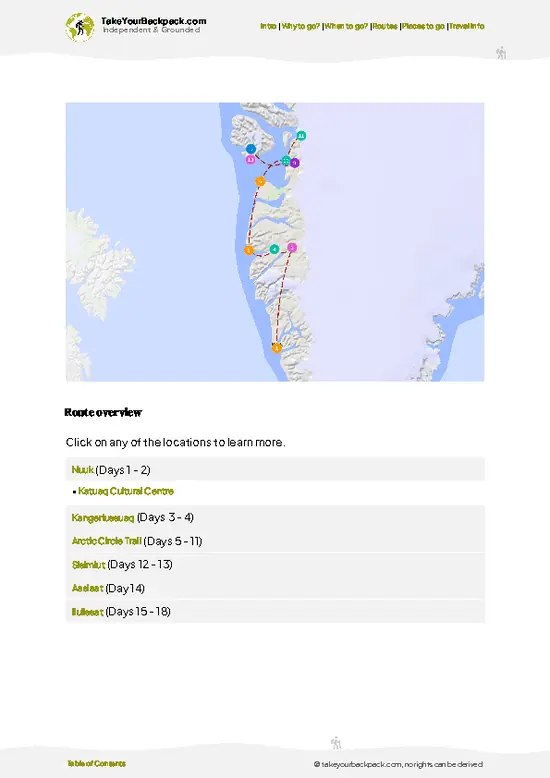
How many days to plan: A trip combining several landmarks in Greenland needs 10 to 14 days, because flights and ferries eat far more time than the sights themselves. The practical shape is one or two regions, not the whole coast. Disko Bay in the west pairs well with Kangerlussuaq and Nuuk, linked by Air Greenland through those hubs. South Greenland, around Narsarsuaq, works as its own cluster, reached by flight from Copenhagen or Reykjavik, and then by boat between Narsarsuaq, Qassiarsuk and Narsaq. East Greenland is a separate trip, reached through Iceland.
Direction and timing: Travel north to south or the reverse, and avoid doubling back. A sensible west coast pattern is Kangerlussuaq, then Ilulissat, then Nuuk, or the opposite, finishing at a hub with the most international connections. … read more 👉
How many days to plan: A trip combining several landmarks in Greenland needs 10 to 14 days, because flights and ferries eat far more time than the sights themselves. The practical shape is one or two regions, not the whole coast. Disko Bay in the west pairs well with Kangerlussuaq and Nuuk, linked by Air Greenland through those hubs. South Greenland, around Narsarsuaq, works as its own cluster, reached by flight from Copenhagen or Reykjavik, and then by boat between Narsarsuaq, Qassiarsuk and Narsaq. East Greenland is a separate trip, reached through Iceland.
Direction and timing: Travel north to south or the reverse, and avoid doubling back. A sensible west coast pattern is Kangerlussuaq, then Ilulissat, then Nuuk, or the opposite, finishing at a hub with the most international connections. Allow 2 to 3 nights in Ilulissat for ice-fjord boat trips and walks, 2 nights in a south Greenland base such as Narsarsuaq or Qassiarsuk, and 2 to 3 in Nuuk. Flights between hubs usually run 1 to 2 hours; boat hops in the south take 30 minutes to 3 hours, with wind chop and cold spray.
Planning mistakes: The most common mistake is packing a tight schedule. Fog and wind cancel flights often, so build a buffer day before any international departure and avoid same-day connections. Another is assuming ferries run daily; most routes operate a few times a week, and some only seasonally. A third is underestimating cost, since each hop can run from about US$150 to 500 by air. Choose fewer bases, stay two nights each, and keep one flexible day per region.

The ListThe Best landmarks of Greenland

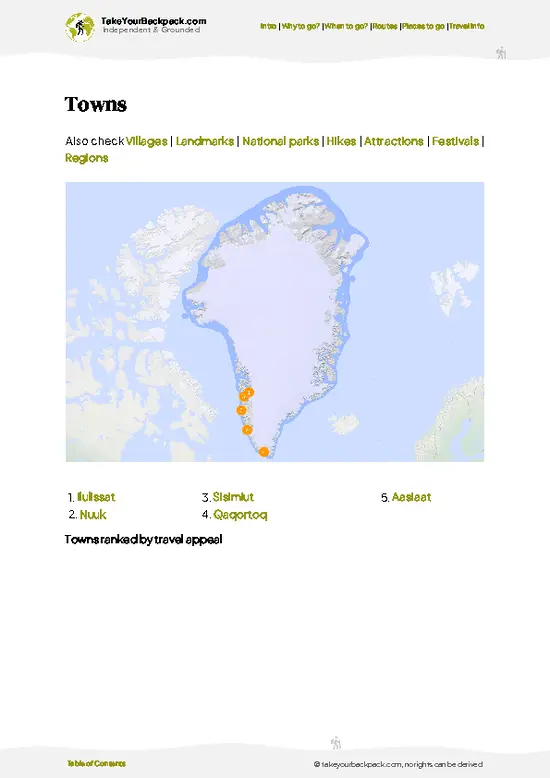
1 Ilulissat Icefjord

Sermermiut boardwalk, glacier front, iceberg boat trips, marked trails

Walk the boardwalk to a ledge above Disko Bay, then board a small boat to pass beneath bergs split open in blue.

greenland-unique-site-ilulissat-icefjord
© Google | Richard Heidemann

2 Uunartoq Hot Springs

Stone-lined pool, iceberg fjord, boat-only island, basic changing hut

Soak in a 34 to 38°C rock basin while icebergs drift past, then take a brisk dip where spring meets sea.

greenland-unique-site-uunartoq-hot-springs
© Google | Wade Galloway

3 Eqi Glacier

Calving ice front, lodge terrace, berg-filled bay, midnight light

Watch a three-kilometer ice wall shed slabs from the lodge deck, then hear the boom arrive a moment after each fall.

greenland-unique-site-eqi-glacier
© Google | Dan Kan

4 Cape Farewell

Granite headland, Atlantic swell, fog-bound cliffs, boat access only

Approach by boat to a sheer granite headland where surf booms in the coves and fog can close the horizon within minutes.

greenland-unique-site-cape-farewell
© Google | Lothar Hildebrandt
Loading the map 🌍

Expert viewInsights from Locals and Experts

How many landmarks to visit: Aim for 4 to 6 landmarks in a 10 to 14 day trip, because transport swallows whole days and weather can strip one out at short notice. Each landmark needs a half day to a full day, plus a buffer. Fewer stops means more time to sit on a cold rock with a thermos and watch the ice shift, which is usually what you came for. Squeezing in 8 or 9 means more airports, more waiting rooms that smell of wet wool and coffee, and less time outdoors.
Prioritizing by travel style: If you want geology and ice, put glacier and iceberg sights first and add one town-based cultural stop. If you prefer history, choose the south, where Norse and Inuit sites sit within short boat rides and farmland walks. Hikers should favor sights reachable on marked trails from a town, where you can … read more 👉
How many landmarks to visit: Aim for 4 to 6 landmarks in a 10 to 14 day trip, because transport swallows whole days and weather can strip one out at short notice. Each landmark needs a half day to a full day, plus a buffer. Fewer stops means more time to sit on a cold rock with a thermos and watch the ice shift, which is usually what you came for. Squeezing in 8 or 9 means more airports, more waiting rooms that smell of wet wool and coffee, and less time outdoors.
Prioritizing by travel style: If you want geology and ice, put glacier and iceberg sights first and add one town-based cultural stop. If you prefer history, choose the south, where Norse and Inuit sites sit within short boat rides and farmland walks. Hikers should favor sights reachable on marked trails from a town, where you can leave at 8 a.m. and be back for a hot meal. If money is tight, choose landmarks you can reach on foot from a hostel or guesthouse, and skip helicopter flights.
What it costs: Budget US$130 to 220 a day for independent travel, including a bed in a hostel, guesthouse or basic room, groceries and some local transport. Sleeping in a tent or hostel dorm and cooking your own food pushes you to the low end. Entry to most outdoor landmarks is free; small museums and heritage sites charge about US$8 to 20. Guided boat trips to the ice or a calving front run about US$80 to 200 per person for 2 to 4 hours, and a half-day guided hike costs about US$100 to 180. Domestic flights between towns cost about US$150 to 500 each way, and local boat transfers about US$30 to 120. Alcohol and fresh produce add up quickly, so shop early at the supermarket in Nuuk or Ilulissat and carry food to smaller settlements.
Safety on the ground: The cold and weather cause most trouble. Wind, fog and sleet can arrive within an hour, so layers matter: wool base, insulated mid layer, a waterproof shell and gloves even in July. Boots with grip help on wet rock and boggy tundra, where each step squelches. Never walk or kayak close to a calving glacier; waves from a collapse can travel far and sound like a distant truck before they hit. Do not walk on sea ice or onto the ice sheet without a local guide. Carry a charged phone, offline maps and a whistle, tell your guesthouse where you are going, and recognize that mobile coverage is limited outside towns.
Cultural considerations: Greenland is home to Kalaallit and other Inuit communities, and many landmarks sit beside living settlements. Ask before photographing people, hunting gear, drying meat or sled dogs, and keep your distance from dogs, which are chained and can bite. Do not touch or move stones at ancient sites, and do not take artifacts. Greet people with a nod or a simple “Aluu,” and treat local guides as the authority on ice and weather: when a captain says the harbor is closed, the trip is off, and a hot cup of coffee in the hostel kitchen makes up for it.

✈️ The backpacker research shortcutGreenland Travel Guide

An offline-friendly backpacking guide with optimized travel routes, ranked highlights, transport advice, and the best areas to stay.
example page 0 from our offline Travel Guide for Greenland
example page 1 from our offline Travel Guide for Greenland
example page 2 from our offline Travel Guide for Greenland
example page 3 from our offline Travel Guide for Greenland
example page 4 from our offline Travel Guide for Greenland
example page 5 from our offline Travel Guide for Greenland
example page 6 from our offline Travel Guide for Greenland
example page 7 from our offline Travel Guide for Greenland
The digital guide (154 pages) contains:
✅ 33 highlights, ranked by travel appeal
✅ Optimized 7, 14 & 21-day travel routes
✅ Cities, national parks, landmarks, beaches
✅ How to get around
✅ Offline-friendly for travel without Wi-Fi
👉 Click to see all 30+ guide features

📅 Plan smarter in minutes, not weeks
✅ Month by month travel advice
✅ Festivals & national holidays
✅ Budget expectations

🗺️ Go to the right places, skip the overrated ones
✅ Honest pros & cons of destinations
✅ Top hikes, parks & viewpoints
✅ Lesser-known places most travelers miss
✅ Clear “worth it vs skip it” guidance

🛏️ Travel smoothly without rookie mistakes
✅ Best areas to stay
✅ Transport systems explained simply
✅ Common scams & safety advice
✅ SIM cards, money & practical tips

🌍 Understand the country, not just visit it
✅ Culture & traditions
✅ 52 Essential phrases & customs
✅ Festivals worth planning around
✅ Traveler-friendly historical context
✅ Insights that make places more meaningful

📱 Built for real travel conditions
✅ Fully downloadable PDF
✅ Works completely offline
✅ Optimized for phone use
✅ Useful in remote areas & buses
✅ Everything in one place
Stop searching, start planning
Get instant access to your full guide. 30‑day money-back guarantee.
+ Add another guide for just

By proceeding you agree to our terms.
Sent to your inbox immediately after payment • 100% Secure Checkout
Best Backpacking Travel Advisor 2025 tourism awardBest Backpacking
Travel Advisor
2025
What others say about Take Your Backpack Guides:
⭐⭐⭐⭐⭐
Fantastic, amazing amount of information!
⭐⭐⭐⭐⭐
My goodness this is amazing, it's what I've been looking for hats off too you!
⭐⭐⭐⭐⭐
I think this is absolutely BRILLIANT
⭐⭐⭐⭐
Very complete and informative. It's still missing places, but I gotta to commend you
⭐⭐⭐⭐⭐
This is truly amazing, thank you, can't wait to explore it with my kids!
⭐⭐⭐⭐⭐
Awesome resource, thank you!
⭐⭐⭐⭐⭐
This is amazing! Can't wait to explore the ones I haven't seen
⭐⭐⭐⭐
I love this! Well done, great idea.
⭐⭐⭐⭐⭐
Thanks for taking the time to make this gem!
⭐⭐⭐⭐⭐
This might be the best website I've ever seen.
⭐⭐⭐⭐⭐
Congratulations, and thank you so much for your work; it's incredibly valuable.
⭐⭐⭐⭐
In all seriousness I think you did a great job pointing out the important spots
⭐⭐⭐⭐⭐
10/10 very good
⭐⭐⭐⭐⭐
As someone who's only just starting to visit regularly this is awesome, thank you.
⭐⭐⭐⭐
Thank you very much! I'm going to visit my dad, it's going to be very useful!
⭐⭐⭐⭐⭐
This is really cool! We'll be travelling for the first time and this definitely come in handy.
⭐⭐⭐⭐⭐
You are now our minister of culture, congratulations 👨‍💼
⭐⭐⭐⭐⭐
Just wanted to tell you that this is a pearl! Going to follow your recommendations.
⭐⭐⭐⭐⭐
This is so cool. I'll definitely be using the resource for my travels soon.
⭐⭐⭐⭐⭐
This is very impressive! Good work.
⭐⭐⭐⭐⭐
This is an amazing and informative site. Very well done!

🛏️ Where to stay?Where to Base Yourself

Greenland has only a handful of true hostels, so budget accommodation here mostly means dorm beds, simple guesthouses, seamen’s homes and campsites, with a dorm bed typically costing DKK 350 to 600 (about US$50 to 85) a night. In Nuuk, staying in Nuuk Centrum puts you within walking distance of the old colonial harbor, the museums and the town’s few bars, while Nuussuaq and Qinngorput are quieter residential districts, mostly private rooms and apartment rentals, where you need the bus to reach anything. Elsewhere, budget beds in Ilulissat cluster in the compact center near the harbor and the Icefjord trails, and Kangerlussuaq has basic lodging right by the airport, handy for connecting flights … read more 👉
Greenland has only a handful of true hostels, so budget accommodation here mostly means dorm beds, simple guesthouses, seamen’s homes and campsites, with a dorm bed typically costing DKK 350 to 600 (about US$50 to 85) a night. In Nuuk, staying in Nuuk Centrum puts you within walking distance of the old colonial harbor, the museums and the town’s few bars, while Nuussuaq and Qinngorput are quieter residential districts, mostly private rooms and apartment rentals, where you need the bus to reach anything. Elsewhere, budget beds in Ilulissat cluster in the compact center near the harbor and the Icefjord trails, and Kangerlussuaq has basic lodging right by the airport, handy for connecting flights but with almost no nightlife; safety is rarely a concern in any of these areas.

If you enjoy meeting fellow travelers, consider choosing hostels with high ratings for atmosphere. On the other hand, if you prefer having your own space, a hotel might be a better option.

GreenlandExpand Your Journey

👋 Meet the founderWho’s Behind Take Your Backpack?

Johan, backpacker and founder of TakeYourBackpackHi, I’m Johan (Netherlands 🇳🇱), the creator of TakeYourBackpack. Over the past 3 decades, I’ve backpacked through 90+ countries across six continents, gaining extensive experience with independent travel, long-term trips, and overland routes.

This site is built on a combination of firsthand travel experience and carefully curated insights from other backpackers. Many guides are based on places I’ve personally visited, while others bring together tips, observations, and practical advice shared by trusted travelers I’ve met along the way.

The goal is to provide realistic, experience-driven guidance — not generic itineraries — so you can explore destinations with better context, clearer expectations, and more confidence.