
×

Guinea-Bissau🇬🇼 | festivalsBissau CarnivalCarnival Tuesday parade, bairro groups, satirical costumes, curbside crowds | things to do and best time to go

Explore Bubaque Music FestivalExplore Festival Cultural de Cacheu

Backpacking in Bissau Carnival
🏆 Top pickfestival ranked #1
By Johan Kruseman 🇳🇱 | Updated October 22, 2026

Bissau Carnival suits travelers who like their festivals homemade, loud and unpolished, and who are happy to work for a good spot on the curb. It is less rewarding if you want ticketed stages, reliable schedules or quiet hotel nights. The carnival takes place in Bissau, Guinea-Bissau’s capital, on the Atlantic coast, and the parade routes run through the city’s main avenues and neighborhoods. It usually falls in February or March around Shrove Tuesday and stretches over several days, with the big parade on Carnival Tuesday. Expect neighborhood groups in handmade costumes, drums and brass, and a crowd that is mostly local families and young people from the city’s bairros. Heat, dust and exhaust hang over the avenues, and the sound system is often distorted and enormous. Costumes lean on satire, masks, raffia, painted faces and recycled materials. Bring small bills, a scarf for dust and patience for late starts. Even the delays have a soundtrack, as drummers warm up in side streets and the smell of charcoal-grilled meat drifts over the crowd.

Discover everything you want to know in the 📖 Guinea-Bissau Travel Guide.


example page 0 from our offline Travel Guide for Guinea-Bissau
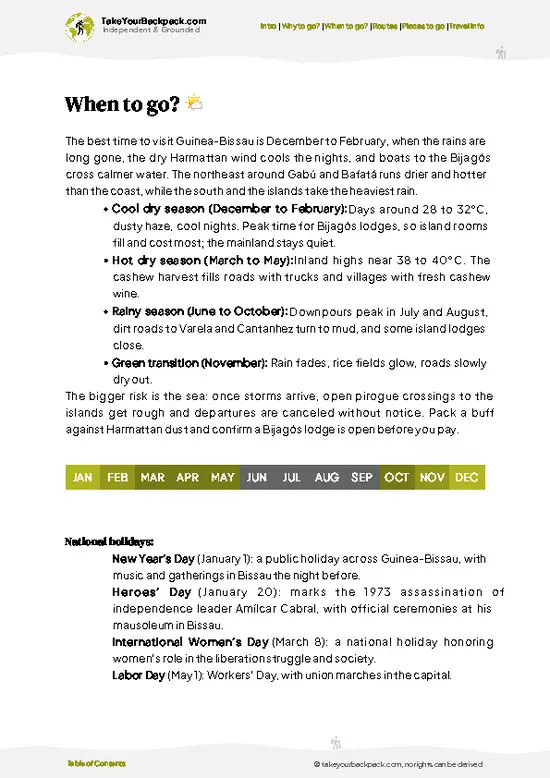
example page 1 from our offline Travel Guide for Guinea-Bissau
example page 2 from our offline Travel Guide for Guinea-Bissau
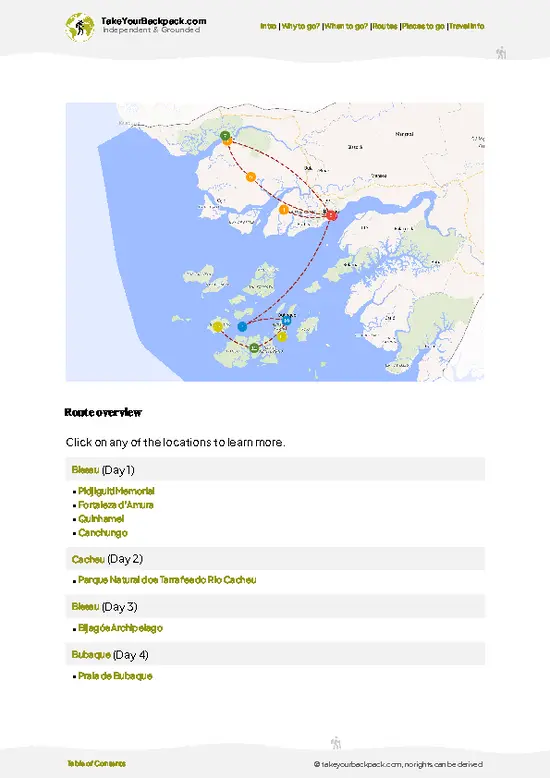
example page 3 from our offline Travel Guide for Guinea-Bissau
example page 4 from our offline Travel Guide for Guinea-Bissau
example page 5 from our offline Travel Guide for Guinea-Bissau
example page 6 from our offline Travel Guide for Guinea-Bissau
example page 7 from our offline Travel Guide for Guinea-Bissau
Loading the map 🌍
CLICK TO FILTER
cities
towns
national parks
beaches
attractions
festivals
regions
SHOW COUNTRY’S BESTSHOW ALL

✨ Why go?
Ranked #1 festival in Guinea-Bissau
What makes it a must-see festival

Bissau Carnival is the one moment when Guinea-Bissau’s capital opens itself to outsiders without any tourist apparatus in between. That is the whole appeal. You stand shoulder to shoulder with locals, and nobody is performing for a camera crew. Groups from different neighborhoods spend months planning satirical costumes and masks, and the street-level commentary on politics and daily life is something you can only read by watching and asking questions. Neighbors will happily explain a costume if you show interest.

It also fits well into a longer West Africa route. Bissau has few headline sights, so the carnival gives the city a clear reason to stop, and it pairs naturally with time on the Bijagós archipelago islands just offshore. Compared with the big carnivals of Brazil or Cape Verde, it … read more 👉
Bissau Carnival is the one moment when Guinea-Bissau’s capital opens itself to outsiders without any tourist apparatus in between. That is the whole appeal. You stand shoulder to shoulder with locals, and nobody is performing for a camera crew. Groups from different neighborhoods spend months planning satirical costumes and masks, and the street-level commentary on politics and daily life is something you can only read by watching and asking questions. Neighbors will happily explain a costume if you show interest.

It also fits well into a longer West Africa route. Bissau has few headline sights, so the carnival gives the city a clear reason to stop, and it pairs naturally with time on the Bijagós archipelago islands just offshore. Compared with the big carnivals of Brazil or Cape Verde, it is small, cheap to attend and free to watch. You will not find crowds of foreign visitors, which means you are often the only outsider in the crowd. Locals notice, and the curiosity is usually warm. Expect to be pulled into a dance line at least once.

💡 HighlightsDon't-miss highlights and experiences

  1. The Carnival Tuesday Parade: The main event rolls through central Bissau with dozens of groups, each with its own drum corps, dancers and costumes. It runs for hours, and it is free to watch from the street. Arrive early to claim a patch of curb, because the best sightlines fill up quickly.
  2. Satirical Costumes and Masks: Groups poke fun at politicians, public life and everyday frustrations, using raffia, painted cloth, papier-mâché and reused materials. Many costumes are handmade rather than bought, so each one looks different. Ask a bystander to explain the joke, since the references are very local.
  3. Drumming and Brass Processions: The sound of the carnival is percussion, with whistles and horns layered over it. Each group has its own rhythm, and you can often hear them rehearsing in side streets
… read more 👉
  1. The Carnival Tuesday Parade: The main event rolls through central Bissau with dozens of groups, each with its own drum corps, dancers and costumes. It runs for hours, and it is free to watch from the street. Arrive early to claim a patch of curb, because the best sightlines fill up quickly.
  2. Satirical Costumes and Masks: Groups poke fun at politicians, public life and everyday frustrations, using raffia, painted cloth, papier-mâché and reused materials. Many costumes are handmade rather than bought, so each one looks different. Ask a bystander to explain the joke, since the references are very local.
  3. Drumming and Brass Processions: The sound of the carnival is percussion, with whistles and horns layered over it. Each group has its own rhythm, and you can often hear them rehearsing in side streets before they join the main route. Standing near a drum line is physical, with the beat felt in your chest.
  4. Neighborhood Bairro Groups: Carnival here is organized by neighborhoods, and the rivalry between them is part of the show. Watching groups arrive with their own banners and followers shows how the city is stitched together socially. Follow one group for a stretch and you will see far more than from a single fixed spot.
  5. Street Food Along the Route: Vendors set up grills and stalls near the crowds, selling grilled meat, fried snacks, fruit and cold drinks. It is cheap and quick, and it is the easiest way to refuel without leaving the action. Carry small bills and stick to food cooked in front of you.
All five can be seen in one long day on the main parade, though catching the build-up in the neighborhoods adds another day.
Spotted a mistake or missing something? Contact us.

🌤️ When to go?When is the celebration of Bissau Carnival?

Bissau Carnival is held in Bissau, usually over the Carnival weekend and Tuesday in February or early March (the date follows Easter, falling 47 days before it), with parades running through the capital’s main avenues, mainly around Avenida Amílcar Cabral and the Praça dos Heróis Nacionais area.
  • Best day: Go on the main parade day, usually the Sunday or Tuesday, when the large groups in homemade masks and costumes arrive and the drumming is loudest.
  • Weather: Dry, hot and dusty, with daytime highs of about 32 to 35°C (90 to 95°F), cooler nights near 20°C (68°F) and almost no rain. Bring a hat, water, sunscreen and a scarf for dust.
  • Booking: Reserve a bed two to four weeks ahead, since central rooms fill and rates rise by roughly 20 to 30 percent.
  • Roads: Reach town the day before. Streets close
… read more 👉
Bissau Carnival is held in Bissau, usually over the Carnival weekend and Tuesday in February or early March (the date follows Easter, falling 47 days before it), with parades running through the capital’s main avenues, mainly around Avenida Amílcar Cabral and the Praça dos Heróis Nacionais area.
  • Best day: Go on the main parade day, usually the Sunday or Tuesday, when the large groups in homemade masks and costumes arrive and the drumming is loudest.
  • Weather: Dry, hot and dusty, with daytime highs of about 32 to 35°C (90 to 95°F), cooler nights near 20°C (68°F) and almost no rain. Bring a hat, water, sunscreen and a scarf for dust.
  • Booking: Reserve a bed two to four weeks ahead, since central rooms fill and rates rise by roughly 20 to 30 percent.
  • Roads: Reach town the day before. Streets close during parades, so walk or use a moto-taxi, and leave the morning after.
Arrive early afternoon on parade day to grab a shaded spot along the route before the crowds thicken.


source: climatestotravel.comJANJanuary: not recommended for travelingFEBFebruary: excellent for travelingMARMarch: not recommended for travelingAPRApril: not recommended for travelingMAYMay: not recommended for travelingJUNJune: not recommended for travelingJULJuly: not recommended for travelingAUGAugust: not recommended for travelingSEPSeptember: not recommended for travelingOCTOctober: not recommended for travelingNOVNovember: not recommended for travelingDECDecember: not recommended for traveling

✈️ The backpacker research shortcutGuinea-Bissau Travel Guide

An offline-friendly backpacking guide with optimized travel routes, ranked highlights, transport advice, and the best areas to stay.
example page 0 from our offline Travel Guide for Guinea-Bissau
example page 1 from our offline Travel Guide for Guinea-Bissau
example page 2 from our offline Travel Guide for Guinea-Bissau
example page 3 from our offline Travel Guide for Guinea-Bissau
example page 4 from our offline Travel Guide for Guinea-Bissau
example page 5 from our offline Travel Guide for Guinea-Bissau
example page 6 from our offline Travel Guide for Guinea-Bissau
example page 7 from our offline Travel Guide for Guinea-Bissau
The digital guide (214 pages) contains:
✅ 48 highlights, ranked by travel appeal
✅ Optimized 2, 3 & 5-day travel routes
✅ Cities, national parks, landmarks, beaches
✅ How to get around
✅ Offline-friendly for travel without Wi-Fi
👉 Click to see all 30+ guide features

📅 Plan smarter in minutes, not weeks
✅ Month by month travel advice
✅ Festivals & national holidays
✅ Budget expectations

🗺️ Go to the right places, skip the overrated ones
✅ Honest pros & cons of destinations
✅ Top hikes, parks & viewpoints
✅ Lesser-known places most travelers miss
✅ Clear “worth it vs skip it” guidance

🛏️ Travel smoothly without rookie mistakes
✅ Best areas to stay
✅ Transport systems explained simply
✅ Common scams & safety advice
✅ SIM cards, money & practical tips

🌍 Understand the country, not just visit it
✅ Culture & traditions
✅ 52 Essential phrases & customs
✅ Festivals worth planning around
✅ Traveler-friendly historical context
✅ Insights that make places more meaningful

📱 Built for real travel conditions
✅ Fully downloadable PDF
✅ Works completely offline
✅ Optimized for phone use
✅ Useful in remote areas & buses
✅ Everything in one place
Stop searching, start planning
Get instant access to your full guide. 30‑day money-back guarantee.
+ Add another guide for just

By proceeding you agree to our terms.
Sent to your inbox immediately after payment • 100% Secure Checkout
Best Backpacking Travel Advisor 2025 tourism awardBest Backpacking
Travel Advisor
2025
What others say about Take Your Backpack Guides:
⭐⭐⭐⭐⭐
Fantastic, amazing amount of information!
⭐⭐⭐⭐⭐
My goodness this is amazing, it's what I've been looking for hats off too you!
⭐⭐⭐⭐⭐
I think this is absolutely BRILLIANT
⭐⭐⭐⭐
Very complete and informative. It's still missing places, but I gotta to commend you
⭐⭐⭐⭐⭐
This is truly amazing, thank you, can't wait to explore it with my kids!
⭐⭐⭐⭐⭐
Awesome resource, thank you!
⭐⭐⭐⭐⭐
This is amazing! Can't wait to explore the ones I haven't seen
⭐⭐⭐⭐
I love this! Well done, great idea.
⭐⭐⭐⭐⭐
Thanks for taking the time to make this gem!
⭐⭐⭐⭐⭐
This might be the best website I've ever seen.
⭐⭐⭐⭐⭐
Congratulations, and thank you so much for your work; it's incredibly valuable.
⭐⭐⭐⭐
In all seriousness I think you did a great job pointing out the important spots
⭐⭐⭐⭐⭐
10/10 very good
⭐⭐⭐⭐⭐
As someone who's only just starting to visit regularly this is awesome, thank you.
⭐⭐⭐⭐
Thank you very much! I'm going to visit my dad, it's going to be very useful!
⭐⭐⭐⭐⭐
This is really cool! We'll be travelling for the first time and this definitely come in handy.
⭐⭐⭐⭐⭐
You are now our minister of culture, congratulations 👨‍💼
⭐⭐⭐⭐⭐
Just wanted to tell you that this is a pearl! Going to follow your recommendations.
⭐⭐⭐⭐⭐
This is so cool. I'll definitely be using the resource for my travels soon.
⭐⭐⭐⭐⭐
This is very impressive! Good work.
⭐⭐⭐⭐⭐
This is an amazing and informative site. Very well done!

🛏️ Where to stay?Choosing the right base

The most practical area for backpackers is the city center around Avenida Amílcar Cabral and the old Bissau Velho quarter, because the parades pass or end within walking distance and you can return on foot after dark rather than hunting for a ride through closed streets. Guesthouses here are small, family-run and used to foreign visitors, which makes it easy to meet other travelers, aid workers and researchers over breakfast or a cold drink on a terrace.
The streets around Praça dos Heróis Nacionais and the port side suit people who want to be near the action, though they are noisy during Carnival … read more 👉
The most practical area for backpackers is the city center around Avenida Amílcar Cabral and the old Bissau Velho quarter, because the parades pass or end within walking distance and you can return on foot after dark rather than hunting for a ride through closed streets. Guesthouses here are small, family-run and used to foreign visitors, which makes it easy to meet other travelers, aid workers and researchers over breakfast or a cold drink on a terrace.
The streets around Praça dos Heróis Nacionais and the port side suit people who want to be near the action, though they are noisy during Carnival week. Light sleepers should ask for a room facing away from the street.
The neighborhoods toward Bairro Ajuda and the road to the airport are a little calmer and have a few more mid-range options with generators, useful because power cuts are common. They are a short moto-taxi or shared taxi ride from the parade routes, so agree on a fare before getting in.
Stay in groups when moving between areas after dark, keep valuables locked up, and carry only small cash into crowds. Solo travelers do best choosing a place with a common area, since that is where tips about where the next parade gathers get passed around.

👛 Costs (as of 22 October 2026)Travel costs and budget guide for Bissau Carnival

Bissau Carnival costs most backpackers about €51 to 109 per day, with the parades themselves free to watch.
CategoryBudget RangeLocal Reality
Festival tickets€0Street parades are free to watch. Some evening events or private parties may charge a small fee of about €2 to 8.
Accommodation€15 to 40 (high season: €25 to 40)Simple guesthouses in the center cost more during Carnival, and rooms with air conditioning or generator power sit at the top of the range.
Local transport€2 to 6Moto-taxis and shared taxis charge by the ride, and fares rise when streets are closed. Agree on the price first and pay in CFA francs.
Food & drinks€6 to 15Street grilled fish and rice dishes cost about €2 to 4, local beer around €1 to 2, and a sit-down meal €5 to 8.
Miscellaneous expenses€3 to 8Bottled water, sunscreen,
… read more 👉
Bissau Carnival costs most backpackers about €51 to 109 per day, with the parades themselves free to watch.
CategoryBudget RangeLocal Reality
Festival tickets€0Street parades are free to watch. Some evening events or private parties may charge a small fee of about €2 to 8.
Accommodation€15 to 40 (high season: €25 to 40)Simple guesthouses in the center cost more during Carnival, and rooms with air conditioning or generator power sit at the top of the range.
Local transport€2 to 6Moto-taxis and shared taxis charge by the ride, and fares rise when streets are closed. Agree on the price first and pay in CFA francs.
Food & drinks€6 to 15Street grilled fish and rice dishes cost about €2 to 4, local beer around €1 to 2, and a sit-down meal €5 to 8.
Miscellaneous expenses€3 to 8Bottled water, sunscreen, small tips to photograph costumed groups and mobile data or phone credit.
Total Daily Budget€51 to 109About €60 for a frugal traveler, rising if you take a private room with air conditioning.
⚠️ Prices can change and everyone travels differently, so take this as a rough guide. Hope it helps you plan your adventure!

🍲 FoodEating & Drinking in Bissau Carnival

Food at Bissau Carnival is street food at its most direct. Vendors set up along the parade routes with grilled fish and chicken over charcoal, served in a bread roll or on a plate with onions and spicy sauce. Look for caldo de peixe and arroz de mancarra (rice with peanut sauce) in simple local eateries nearby, and bags of roasted cashews and peanuts sold by walking vendors.
The drinks are half the experience. Cashew juice is sold cold in plastic bags and bottles, tart and slightly furry on the tongue. Palm wine appears in the crowds and is best sampled in small amounts, while Sagres and Super Bock beers turn up in small bars and kiosks, often warm unless ice is nearby. Sweet bissap (hibiscus) and ginger drinks are alternatives. Choose sealed bottled water.
Pay in cash only, in small notes, … read more 👉
Food at Bissau Carnival is street food at its most direct. Vendors set up along the parade routes with grilled fish and chicken over charcoal, served in a bread roll or on a plate with onions and spicy sauce. Look for caldo de peixe and arroz de mancarra (rice with peanut sauce) in simple local eateries nearby, and bags of roasted cashews and peanuts sold by walking vendors.
The drinks are half the experience. Cashew juice is sold cold in plastic bags and bottles, tart and slightly furry on the tongue. Palm wine appears in the crowds and is best sampled in small amounts, while Sagres and Super Bock beers turn up in small bars and kiosks, often warm unless ice is nearby. Sweet bissap (hibiscus) and ginger drinks are alternatives. Choose sealed bottled water.
Pay in cash only, in small notes, as vendors rarely have change for large bills. Prices are usually negotiable, but at festival stalls asking first and smiling helps. Portions are generous and often shared, so ordering one plate for two is normal. Pick stalls with a steady line and food cooked in front of you, and eat early in the afternoon before supplies run out.

FAQTraveler FAQ

Bissau Carnival takes place in Bissau in February or early March, set by the Easter calendar, with the main parades on the weekend and Tuesday before Lent. Celebrations often run three to four days, with groups gathering along Avenida Amílcar Cabral and the central avenues. Check the exact dates locally, as the program is announced only shortly before.
Attending Bissau Carnival costs very little in entry terms, as the street parades are free. Budget about €40 to 70 per day, with guesthouse rooms at €15 to 40, street meals at €2 to 4 and moto-taxi rides at roughly €1 to 2. Private evening parties may charge €2 to 8.
No advance tickets are needed for Bissau Carnival, because the parades happen in public streets and are free to watch. What you should book ahead is a room, ideally two to four weeks before, as central guesthouses in Bissau fill and raise prices. Arrive the day before the main parade to settle in and scout viewing spots.
⚠️ Things can change over time, so always validate details locally before you go.

Other Bissau-Guinean festivals near Bissau Carnival

Explore more nearby:


💡 Not sure where to go next?
Create a personalized itinerary for Guinea-Bissau including Bissau Carnival and the places that fit your trip.

Generate my itinerary

👉 Discover all festivals

Or checkout all Guinea-Bissau has to offer (think cities, towns, villages, national parks, hikes, beaches, festivals)
Country photo of Guinea-Bissau

We 💚 feedbackKey takeaways before you go

Bissau Carnival will suit curious, flexible travelers who enjoy street parties more than polished shows. If you like talking to strangers and don’t mind a late start, you will have a great time. I would carry a scarf for dust, keep valuables minimal and stay out until the last drum line passes. Pick a central place to sleep so you can walk home.

✍️ Help improve this page!
The information on this page is based on in-depth research, insights shared by experienced travelers, and feedback from the local travel community in Guinea-Bissau. While every effort is made to keep the information accurate and current, conditions can change — so if you spot anything incorrect or outdated, please get in touch.


🙋‍♂️ Give feedback

👋 Meet the founderWho’s Behind Take Your Backpack?

Johan, backpacker and founder of TakeYourBackpackHi, I’m Johan (Netherlands 🇳🇱), the creator of TakeYourBackpack. Over the past 3 decades, I’ve backpacked through 90+ countries across six continents, gaining extensive experience with independent travel, long-term trips, and overland routes.

This site is built on a combination of firsthand travel experience and carefully curated insights from other backpackers. Many guides are based on places I’ve personally visited, while others bring together tips, observations, and practical advice shared by trusted travelers I’ve met along the way.

The goal is to provide realistic, experience-driven guidance — not generic itineraries — so you can explore destinations with better context, clearer expectations, and more confidence.