×

Guinea-Bissau🇬🇼 | best festivalsWhere to Find the 7 Best festivals in Guinea-Bissau

Festivals in Guinea-Bissau are village and community affairs, not ticketed events. Expect drumming, masked dancers and palm wine under red dust and mango shade. The Bijagós islands need boats and patience, while Bissau and the mainland are reachable by shared taxi. Crowds stay small, costs low, and independent travelers fit in best when they arrive humble, flexible and ready for slow, sweaty waiting.

By Johan Kruseman 🇳🇱 | Updated October 23, 2026
Explore the best regions in Guinea-Bissau

Why go?What Makes Them Special

Guinea-Bissau holds more than 20 ethnic groups, among them Balanta, Fula, Manjaco, Papel and Bijagó, and each keeps its own ceremonies tied to initiation, harvest and ancestors. Because the country has little tourism infrastructure, these events remain community-run rather than staged. Drums carry for kilometers, cashew and palm wine ferment in the heat, and the dancing often runs past midnight.

The flip side is logistics. Dates shift with local decisions and the moon, schedules are rarely published, and roads outside Bissau turn to red mud in the rains. Boats to the islands depend on tides. Travelers should arrange a local contact or guide, carry cash in CFA francs, and treat each event as a guest, not a spectator. Carnival in Bissau is the main exception, with a more public, organized feel.
How the List Was Created
The list of best festivals in Guinea-Bissau is created based on energy, traditions, crowd experience, activities, and overall excitement. If you feel a festival is missing in this list, please let us know.

When to go?Best Time to Visit Guinea-Bissau for festivals

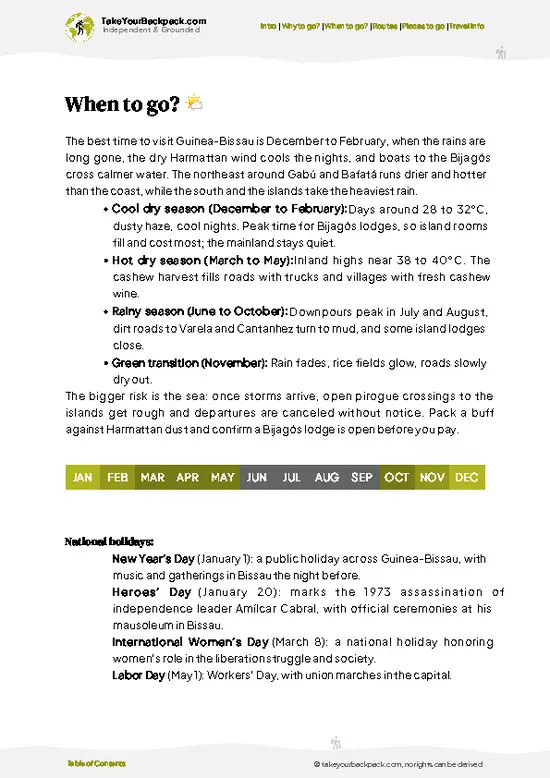
Best months and weather: The best months are December to March, when the dry season brings clear skies, little rain and the lowest mud risk on roads. Daytime temperatures sit around 30 to 35°C, with the harmattan haze softening the light and dust coating everything. Carnival in Bissau usually falls in February or March, so that window is busiest.
Shoulder and rainy seasons: November and April to May are workable shoulder months, hotter and stickier, with 33 to 38°C possible. The rains run June to October, with August often passing 400 mm, and the Bijagós boats and southern tracks become unreliable. Prices for rooms and transport rise modestly around Carnival, and guesthouses in Bissau fill earlier, so book ahead.

festival hoppingTips for Visiting Multiple Destinations

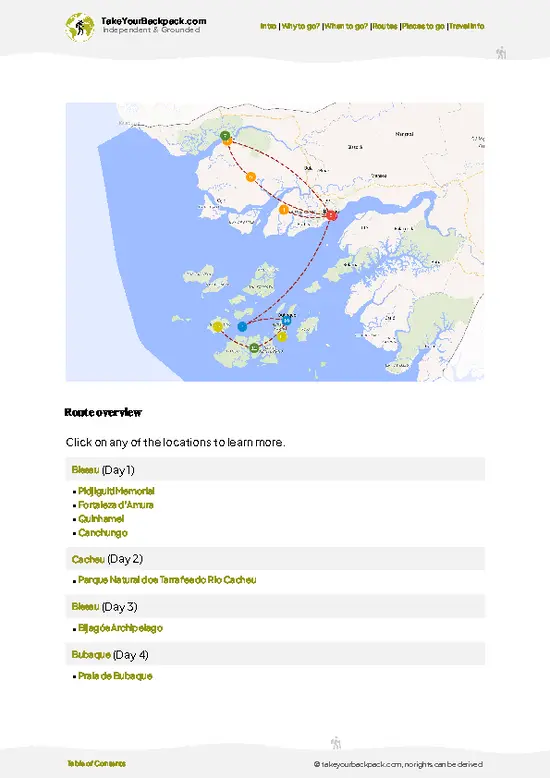
How long to allow: A trip linking several festivals in Guinea-Bissau needs 10 to 16 days, because transport is slow and dates are fluid. Bissau is the hub, and a sensible direction is to start there, then loop through the north and east by shared taxi or minibus toward Bafatá and Gabú, then return and finish on the Bijagós by boat from Bissau.
Time per stop and between regions: Allow 2 to 3 days per stop. Bissau to Bafatá takes roughly 3 to 4 hours, Bissau to Gabú 5 to 7, and the Bijagós ferries and boats take 3 to 5 hours or more depending on tides and the island. The common mistake is cramming stops into tight days. Departures leave only when full, so add buffer days and avoid the rains.

The ListTop festivals of Guinea-Bissau

1 Bissau Carnival

Carnival Tuesday parade, bairro groups, satirical costumes, curbside crowds

Claim a patch of curb early and watch neighborhood groups march through central Bissau in handmade costumes that mock politics and daily frustrations.

2 Bijagós Archipelago Festival

Bijagós masks, island drumming, Bubaque port, saltwater hippos

Follow the drumbeat from Bubaque’s sandy lanes to dancers in carved animal masks, then take a pirogue toward the mangroves of Orango.

3 Bubaque Music Festival

Gumbe stages, sandy lanes, Praia de Bruce, Rubane boat trip

Walk between open-air stages in Bubaque town, recover on a palm-backed beach, and hire a boat to quiet Rubane island between nights.

4 Bissau International Film Festival

Open-air screenings, Lusophone cinema, director Q&As, courtyard nights

Settle onto a plastic chair after dark for films from Guinea-Bissau and Portuguese-speaking Africa, then stay for the debates in the courtyard.

5 Varela Beach Festival

Atlantic sand stage, beach camping, grilled catch, pirogues ashore

Pitch a tent near the dunes, dance to gumbe and tina on the sand, and wake to waves, fishermen and breakfast fires.

6 Festival Cultural de Cacheu

Cacheu fort, gumbé and tina, masked dancers, river waterfront

Stroll from the old Portuguese fort to drumming and masked performances, then end the evening with grilled fish beside the slow Cacheu River.

7 Mansoa Cultural Festival

Ethnic dance groups, djembe circles, cashew fruit stalls, firelit evenings

Stand close to rotating dance groups in red-dust streets, taste bissap and grilled meat from the stalls, and linger as music carries into the night.

Loading the map 🌍

Expert viewExpert Commentary on festivals

How many to attend: Two or three festivals make a good trip. Fewer, deeper visits beat a rushed sweep, because each one needs a day to arrive, a day to attend and a day of slack when the taxi never fills. You get time to sit in the dust, taste grilled fish and cashew juice, and actually talk with people.
Which kind to prioritize: First-timers and lighter budgets suit Carnival in Bissau-style public events, with easy access, street food and loud brass and drums. Travelers wanting ritual and mask traditions should go to village and island ceremonies, where access depends on a local host. Islands cost more and need more patience, and the payoff is firelit dancing with almost no other visitors.
Budget: Plan US$25 to 45 a day for basic rooms, meals and shared transport (roughly 15,000 to 27,000 CFA … read more 👉
How many to attend: Two or three festivals make a good trip. Fewer, deeper visits beat a rushed sweep, because each one needs a day to arrive, a day to attend and a day of slack when the taxi never fills. You get time to sit in the dust, taste grilled fish and cashew juice, and actually talk with people.
Which kind to prioritize: First-timers and lighter budgets suit Carnival in Bissau-style public events, with easy access, street food and loud brass and drums. Travelers wanting ritual and mask traditions should go to village and island ceremonies, where access depends on a local host. Islands cost more and need more patience, and the payoff is firelit dancing with almost no other visitors.
Budget: Plan US$25 to 45 a day for basic rooms, meals and shared transport (roughly 15,000 to 27,000 CFA francs). Add US$5 to 20 per visit for a community contribution or guide, and US$20 to 60 for island boats. Cash only, and bring small notes.
Safety and etiquette: Ask permission before photographing masks or ritual moments, and expect to pay or offer a gift such as kola nuts or drinks. Some ceremonies are closed to outsiders or to women, and the host decides. Avoid alone night walks in Bissau, keep valuables hidden in crowds, and carry malaria prevention, water treatment and a copy of your passport. Political tension can flare around elections, so check current advice.
Dress modestly, accept the offered palm wine in small sips, and let your host set the pace.


✈️ The backpacker research shortcutGuinea-Bissau Travel Guide

An offline-friendly backpacking guide with optimized travel routes, ranked highlights, transport advice, and the best areas to stay.
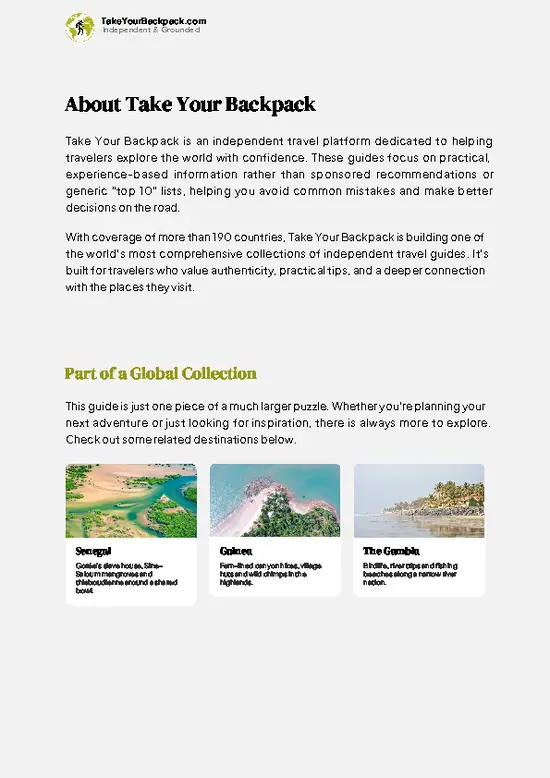
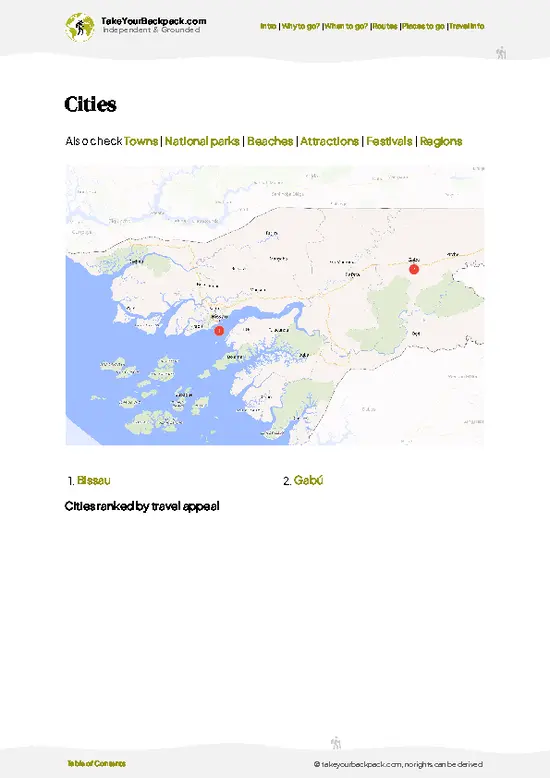
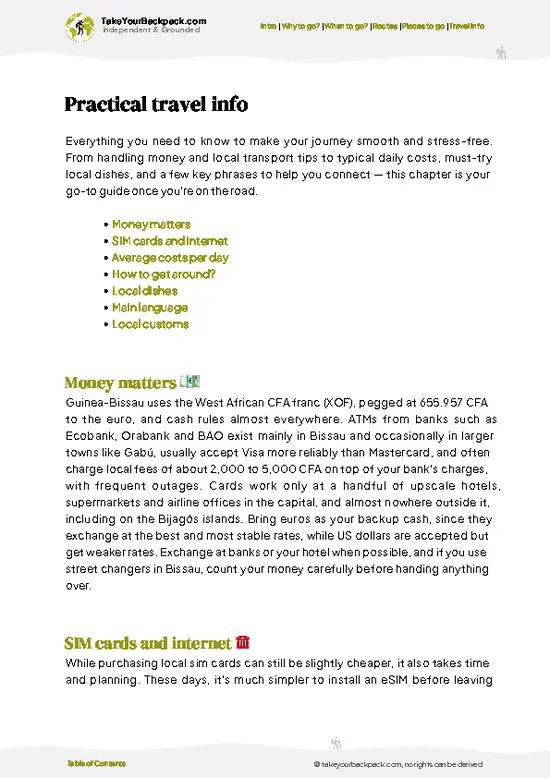
example page 0 from our offline Travel Guide for Guinea-Bissau
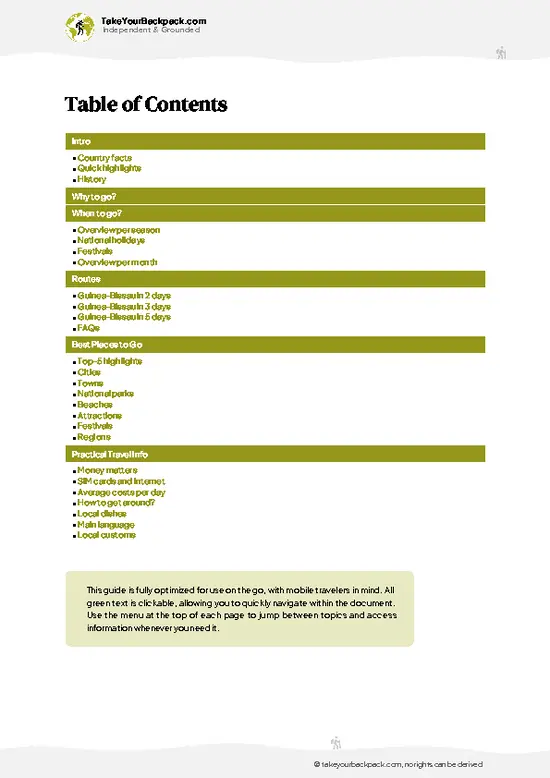
example page 1 from our offline Travel Guide for Guinea-Bissau
example page 2 from our offline Travel Guide for Guinea-Bissau
example page 3 from our offline Travel Guide for Guinea-Bissau
example page 4 from our offline Travel Guide for Guinea-Bissau
example page 5 from our offline Travel Guide for Guinea-Bissau
example page 6 from our offline Travel Guide for Guinea-Bissau
example page 7 from our offline Travel Guide for Guinea-Bissau
The digital guide (214 pages) contains:
✅ 48 highlights, ranked by travel appeal
✅ Optimized 2, 3 & 5-day travel routes
✅ Cities, national parks, landmarks, beaches
✅ How to get around
✅ Offline-friendly for travel without Wi-Fi
👉 Click to see all 30+ guide features

📅 Plan smarter in minutes, not weeks
✅ Month by month travel advice
✅ Festivals & national holidays
✅ Budget expectations

🗺️ Go to the right places, skip the overrated ones
✅ Honest pros & cons of destinations
✅ Top hikes, parks & viewpoints
✅ Lesser-known places most travelers miss
✅ Clear “worth it vs skip it” guidance

🛏️ Travel smoothly without rookie mistakes
✅ Best areas to stay
✅ Transport systems explained simply
✅ Common scams & safety advice
✅ SIM cards, money & practical tips

🌍 Understand the country, not just visit it
✅ Culture & traditions
✅ 52 Essential phrases & customs
✅ Festivals worth planning around
✅ Traveler-friendly historical context
✅ Insights that make places more meaningful

📱 Built for real travel conditions
✅ Fully downloadable PDF
✅ Works completely offline
✅ Optimized for phone use
✅ Useful in remote areas & buses
✅ Everything in one place
Stop searching, start planning
Get instant access to your full guide. 30‑day money-back guarantee.
+ Add another guide for just

By proceeding you agree to our terms.
Sent to your inbox immediately after payment • 100% Secure Checkout
Best Backpacking Travel Advisor 2025 tourism awardBest Backpacking
Travel Advisor
2025
What others say about Take Your Backpack Guides:
⭐⭐⭐⭐⭐
Fantastic, amazing amount of information!
⭐⭐⭐⭐⭐
My goodness this is amazing, it's what I've been looking for hats off too you!
⭐⭐⭐⭐⭐
I think this is absolutely BRILLIANT
⭐⭐⭐⭐
Very complete and informative. It's still missing places, but I gotta to commend you
⭐⭐⭐⭐⭐
This is truly amazing, thank you, can't wait to explore it with my kids!
⭐⭐⭐⭐⭐
Awesome resource, thank you!
⭐⭐⭐⭐⭐
This is amazing! Can't wait to explore the ones I haven't seen
⭐⭐⭐⭐
I love this! Well done, great idea.
⭐⭐⭐⭐⭐
Thanks for taking the time to make this gem!
⭐⭐⭐⭐⭐
This might be the best website I've ever seen.
⭐⭐⭐⭐⭐
Congratulations, and thank you so much for your work; it's incredibly valuable.
⭐⭐⭐⭐
In all seriousness I think you did a great job pointing out the important spots
⭐⭐⭐⭐⭐
10/10 very good
⭐⭐⭐⭐⭐
As someone who's only just starting to visit regularly this is awesome, thank you.
⭐⭐⭐⭐
Thank you very much! I'm going to visit my dad, it's going to be very useful!
⭐⭐⭐⭐⭐
This is really cool! We'll be travelling for the first time and this definitely come in handy.
⭐⭐⭐⭐⭐
You are now our minister of culture, congratulations 👨‍💼
⭐⭐⭐⭐⭐
Just wanted to tell you that this is a pearl! Going to follow your recommendations.
⭐⭐⭐⭐⭐
This is so cool. I'll definitely be using the resource for my travels soon.
⭐⭐⭐⭐⭐
This is very impressive! Good work.
⭐⭐⭐⭐⭐
This is an amazing and informative site. Very well done!

🛏️ Where to stay?Accommodation Highlights

Guinea-Bissau has almost no dedicated backpacker hostels, so budget travelers sleep in simple guesthouses and pensões, with a fan or air-con room usually costing 15,000 to 25,000 CFA (about US$25 to 40) a night. In Bissau, the old port quarter of Bissau Velho puts you within walking distance of the fort, the Pidjiguiti waterfront and the evening bars, but it gets noisy and deserted streets after midnight call for a taxi. The streets around Avenida Amílcar Cabral and Praça dos Heróis Nacionais offer more choice, restaurants and ATMs, while residential Santa Luzia is quieter and calmer but sits a taxi ride from the action. Out on Bubaque in the Bijagós, basic campements and beach huts are the … read more 👉
Guinea-Bissau has almost no dedicated backpacker hostels, so budget travelers sleep in simple guesthouses and pensões, with a fan or air-con room usually costing 15,000 to 25,000 CFA (about US$25 to 40) a night. In Bissau, the old port quarter of Bissau Velho puts you within walking distance of the fort, the Pidjiguiti waterfront and the evening bars, but it gets noisy and deserted streets after midnight call for a taxi. The streets around Avenida Amílcar Cabral and Praça dos Heróis Nacionais offer more choice, restaurants and ATMs, while residential Santa Luzia is quieter and calmer but sits a taxi ride from the action. Out on Bubaque in the Bijagós, basic campements and beach huts are the norm.

If you enjoy meeting fellow travelers, consider choosing hostels with high ratings for atmosphere. On the other hand, if you prefer having your own space, a hotel might be a better option.

Guinea-BissauSee More of Guinea-Bissau

👋 Meet the founderWho’s Behind Take Your Backpack?

Johan, backpacker and founder of TakeYourBackpackHi, I’m Johan (Netherlands 🇳🇱), the creator of TakeYourBackpack. Over the past 3 decades, I’ve backpacked through 90+ countries across six continents, gaining extensive experience with independent travel, long-term trips, and overland routes.

This site is built on a combination of firsthand travel experience and carefully curated insights from other backpackers. Many guides are based on places I’ve personally visited, while others bring together tips, observations, and practical advice shared by trusted travelers I’ve met along the way.

The goal is to provide realistic, experience-driven guidance — not generic itineraries — so you can explore destinations with better context, clearer expectations, and more confidence.