×

Guinea-Bissau🇬🇼 | national parksOrango National ParkSaltwater hippos, Eticoga groves, pirogue creeks, western beaches | things to do and best time to go

Explore João Vieira and Poilão Marine National ParkExplore Bijagós Archipelago

Backpacking in Orango
🏆 Top picknational park ranked #1
By Johan Kruseman 🇳🇱 | Updated October 22, 2026

The pirogue engine cuts out, and suddenly all you hear is mud popping as the tide drains from the mangrove roots, with salt on your lips and a heavy, sulfurous smell rising off the flats. That is the arrival at Orango National Park, in the Bijagós archipelago off the coast of Guinea-Bissau. Saltwater hippos wallow on the shore at Lagoa de Cufada-style edges of the island, and green turtles nest on quiet beaches. Walking is flat and sandy, with palm groves, villages and sacred sites, though shade is scarce and the heat is punishing by midday. Mistakes cost the most here. Boats run on tides and fuel, not timetables, so book your crossing with a buffer day before any flight home. Carry cash, since there are no ATMs, and bring all your water. Choose a local guide in advance, because wandering into sacred forest causes offense. Compared with the mainland’s Cacheu mangroves, Orango is wilder, slower and far harder to reach.

Discover everything you want to know in the 📖 Guinea-Bissau Travel Guide.


example page 0 from our offline Travel Guide for Guinea-Bissau
example page 1 from our offline Travel Guide for Guinea-Bissau
example page 2 from our offline Travel Guide for Guinea-Bissau
example page 3 from our offline Travel Guide for Guinea-Bissau
example page 4 from our offline Travel Guide for Guinea-Bissau
example page 5 from our offline Travel Guide for Guinea-Bissau
example page 6 from our offline Travel Guide for Guinea-Bissau
example page 7 from our offline Travel Guide for Guinea-Bissau
Loading the map 🌍
CLICK TO FILTER
cities
towns
national parks
beaches
attractions
festivals
regions
SHOW COUNTRY’S BESTSHOW ALL

✨ Why go?
Ranked #1 national park in Guinea-Bissau
What makes this national park worth exploring

Orango National Park suits backpackers who like finding their own way, because walking is the main activity and nobody herds you onto a bus. Paths link the villages of Eticoga, Anor and Imbone through palm groves, rice fields and cashew orchards, so you set your own pace and stop wherever a woman is pounding rice or a fisherman is mending nets. Camping and simple village stays keep spending low and put you among the Bijagós, a matrilineal people whose sacred sites you should visit only with a local guide.

The real draw is the wildlife. The park is known for its saltwater hippos, which wade between mangroves and the sea, and for the green turtles that haul up the beaches to lay eggs in the rainy season. Manatees and dolphins also move through the channels. Because wildlife shifts with the … read more 👉
Orango National Park suits backpackers who like finding their own way, because walking is the main activity and nobody herds you onto a bus. Paths link the villages of Eticoga, Anor and Imbone through palm groves, rice fields and cashew orchards, so you set your own pace and stop wherever a woman is pounding rice or a fisherman is mending nets. Camping and simple village stays keep spending low and put you among the Bijagós, a matrilineal people whose sacred sites you should visit only with a local guide.

The real draw is the wildlife. The park is known for its saltwater hippos, which wade between mangroves and the sea, and for the green turtles that haul up the beaches to lay eggs in the rainy season. Manatees and dolphins also move through the channels. Because wildlife shifts with the tides, a self-guided approach with a boatman gives you flexibility that a fixed tour cannot. Independent travelers should expect some improvisation and take it as part of the appeal.

💡 HighlightsTop highlights of Orango

  1. Saltwater hippos at Lagoa de Anhaque: The park’s signature sight. Hippos here live between freshwater pools and the sea, and you watch them from the bank at low light, from a respectful distance, with a guide.
  2. Eticoga sacred forest: The main village on the island holds ceremonial groves tied to the Bijagós queens. Entry is by guide and with permission, and you follow local rules on photos and conduct.
  3. Turtle-nesting beaches: Green turtles come ashore on quiet sand to nest, mostly in the wet season. Walking the beach at night should be done only with rangers and without lights.
  4. Mangrove channels by pirogue: Slow paddling or motoring through tidal creeks brings you close to herons, fish eagles and mudskippers, with the smell of salt mud everywhere.
  5. Palm and cashew forest walks: Shaded sandy tracks
… read more 👉
  1. Saltwater hippos at Lagoa de Anhaque: The park’s signature sight. Hippos here live between freshwater pools and the sea, and you watch them from the bank at low light, from a respectful distance, with a guide.
  2. Eticoga sacred forest: The main village on the island holds ceremonial groves tied to the Bijagós queens. Entry is by guide and with permission, and you follow local rules on photos and conduct.
  3. Turtle-nesting beaches: Green turtles come ashore on quiet sand to nest, mostly in the wet season. Walking the beach at night should be done only with rangers and without lights.
  4. Mangrove channels by pirogue: Slow paddling or motoring through tidal creeks brings you close to herons, fish eagles and mudskippers, with the smell of salt mud everywhere.
  5. Palm and cashew forest walks: Shaded sandy tracks run between villages, and you pass oil palms, baobabs and small rice paddies. The forest is cooler than the beach and good for birds.
  6. Anor and Imbone villages: Small communities where life centers on fishing and farming. Sitting with a family over grilled fish gives a sense of daily Bijagós life that no ceremony can.
  7. Beach sunsets on the western shore: Wide, empty strands with no hotels in sight, ideal for a swim and a slow evening walk.
Allow two to three full days to see all of it, longer if tides or boat schedules delay you.
Spotted a mistake or missing something? Contact us.

🌤️ When to go?Seasonal considerations and timing

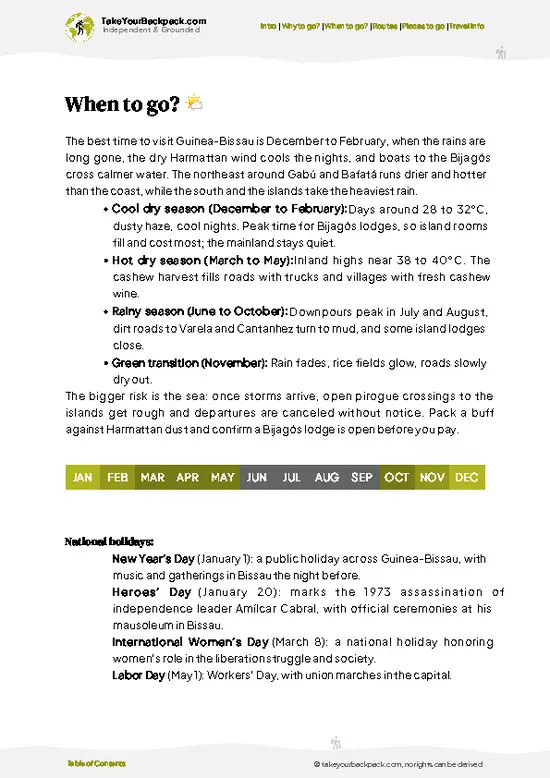
  • Dry Season (November to May): Orango National Park is easiest to reach and walk from late November to April. Days run 30 to 35°C (86 to 95°F), nights drop to 20 to 24°C (68 to 75°F), and the sea is calm enough for the boat crossings from Bubaque. Daylight stays at roughly 11 to 12 hours.
  • Peak Months (December to February): Harmattan haze and cooler mornings make walking comfortable. Lodges on Orango Grande fill up, so book ahead. Prices for boat charters and guided visits are at their highest.
  • Rainy Season (June to October): Expect 28 to 32°C (82 to 90°F) with high humidity, heavy downpours, rough water and many lodges closed. Fares drop, mosquitoes multiply, and some trails to the mangroves and salt-water hippo areas flood.
  • Wildlife Watching: Saltwater hippos are seen year-round, but sea turtles
… read more 👉
  • Dry Season (November to May): Orango National Park is easiest to reach and walk from late November to April. Days run 30 to 35°C (86 to 95°F), nights drop to 20 to 24°C (68 to 75°F), and the sea is calm enough for the boat crossings from Bubaque. Daylight stays at roughly 11 to 12 hours.
  • Peak Months (December to February): Harmattan haze and cooler mornings make walking comfortable. Lodges on Orango Grande fill up, so book ahead. Prices for boat charters and guided visits are at their highest.
  • Rainy Season (June to October): Expect 28 to 32°C (82 to 90°F) with high humidity, heavy downpours, rough water and many lodges closed. Fares drop, mosquitoes multiply, and some trails to the mangroves and salt-water hippo areas flood.
  • Wildlife Watching: Saltwater hippos are seen year-round, but sea turtles nest on Poilão and nearby beaches mainly from roughly July to December, when seas are rough.
Book your boat transfer for a day when the tide suits the crossing; guides plan around it.


source: climatestotravel.comJANJanuary: excellent for travelingFEBFebruary: excellent for travelingMARMarch: excellent for travelingAPRApril: excellent for travelingMAYMay: highly recommended for travelingJUNJune: fair for travelingJULJuly: below average for travelingAUGAugust: below average for travelingSEPSeptember: fair for travelingOCTOctober: fair for travelingNOVNovember: highly recommended for travelingDECDecember: excellent for traveling
when-to-go

✈️ The backpacker research shortcutGuinea-Bissau Travel Guide

An offline-friendly backpacking guide with optimized travel routes, ranked highlights, transport advice, and the best areas to stay.
example page 0 from our offline Travel Guide for Guinea-Bissau
example page 1 from our offline Travel Guide for Guinea-Bissau
example page 2 from our offline Travel Guide for Guinea-Bissau
example page 3 from our offline Travel Guide for Guinea-Bissau
example page 4 from our offline Travel Guide for Guinea-Bissau
example page 5 from our offline Travel Guide for Guinea-Bissau
example page 6 from our offline Travel Guide for Guinea-Bissau
example page 7 from our offline Travel Guide for Guinea-Bissau
The digital guide (214 pages) contains:
✅ 48 highlights, ranked by travel appeal
✅ Optimized 2, 3 & 5-day travel routes
✅ Cities, national parks, landmarks, beaches
✅ How to get around
✅ Offline-friendly for travel without Wi-Fi
👉 Click to see all 30+ guide features

📅 Plan smarter in minutes, not weeks
✅ Month by month travel advice
✅ Festivals & national holidays
✅ Budget expectations

🗺️ Go to the right places, skip the overrated ones
✅ Honest pros & cons of destinations
✅ Top hikes, parks & viewpoints
✅ Lesser-known places most travelers miss
✅ Clear “worth it vs skip it” guidance

🛏️ Travel smoothly without rookie mistakes
✅ Best areas to stay
✅ Transport systems explained simply
✅ Common scams & safety advice
✅ SIM cards, money & practical tips

🌍 Understand the country, not just visit it
✅ Culture & traditions
✅ 52 Essential phrases & customs
✅ Festivals worth planning around
✅ Traveler-friendly historical context
✅ Insights that make places more meaningful

📱 Built for real travel conditions
✅ Fully downloadable PDF
✅ Works completely offline
✅ Optimized for phone use
✅ Useful in remote areas & buses
✅ Everything in one place
Stop searching, start planning
Get instant access to your full guide. 30‑day money-back guarantee.
+ Add another guide for just

By proceeding you agree to our terms.
Sent to your inbox immediately after payment • 100% Secure Checkout
Best Backpacking Travel Advisor 2025 tourism awardBest Backpacking
Travel Advisor
2025
What others say about Take Your Backpack Guides:
⭐⭐⭐⭐⭐
Fantastic, amazing amount of information!
⭐⭐⭐⭐⭐
My goodness this is amazing, it's what I've been looking for hats off too you!
⭐⭐⭐⭐⭐
I think this is absolutely BRILLIANT
⭐⭐⭐⭐
Very complete and informative. It's still missing places, but I gotta to commend you
⭐⭐⭐⭐⭐
This is truly amazing, thank you, can't wait to explore it with my kids!
⭐⭐⭐⭐⭐
Awesome resource, thank you!
⭐⭐⭐⭐⭐
This is amazing! Can't wait to explore the ones I haven't seen
⭐⭐⭐⭐
I love this! Well done, great idea.
⭐⭐⭐⭐⭐
Thanks for taking the time to make this gem!
⭐⭐⭐⭐⭐
This might be the best website I've ever seen.
⭐⭐⭐⭐⭐
Congratulations, and thank you so much for your work; it's incredibly valuable.
⭐⭐⭐⭐
In all seriousness I think you did a great job pointing out the important spots
⭐⭐⭐⭐⭐
10/10 very good
⭐⭐⭐⭐⭐
As someone who's only just starting to visit regularly this is awesome, thank you.
⭐⭐⭐⭐
Thank you very much! I'm going to visit my dad, it's going to be very useful!
⭐⭐⭐⭐⭐
This is really cool! We'll be travelling for the first time and this definitely come in handy.
⭐⭐⭐⭐⭐
You are now our minister of culture, congratulations 👨‍💼
⭐⭐⭐⭐⭐
Just wanted to tell you that this is a pearl! Going to follow your recommendations.
⭐⭐⭐⭐⭐
This is so cool. I'll definitely be using the resource for my travels soon.
⭐⭐⭐⭐⭐
This is very impressive! Good work.
⭐⭐⭐⭐⭐
This is an amazing and informative site. Very well done!

🛏️ Where to stay?How to pick the right area

The best base for Orango National Park is a small community-run camp or lodge on Orango Grande, with Bubaque town as the fallback on the main island group. Inside the park, accommodation is simple. Villages such as Eticoga and Anor offer basic rooms or tents, often in a community-run campement with shared bathrooms, mosquito nets and meals cooked by the host family. Expect roughly €10 to 25 per person with food, and electricity that is limited to a few hours or solar. The park office and local guides can arrange beds, and pre-booking is wise in the December to February peak because capacity is … read more 👉
The best base for Orango National Park is a small community-run camp or lodge on Orango Grande, with Bubaque town as the fallback on the main island group. Inside the park, accommodation is simple. Villages such as Eticoga and Anor offer basic rooms or tents, often in a community-run campement with shared bathrooms, mosquito nets and meals cooked by the host family. Expect roughly €10 to 25 per person with food, and electricity that is limited to a few hours or solar. The park office and local guides can arrange beds, and pre-booking is wise in the December to February peak because capacity is small.
On Bubaque, the gateway island of the Bijagós, you will find more choice. Guesthouses and a few beach lodges run from about €15 to 30 a night for a simple room, with better lodges at €50 to 90. There are small restaurants, a market and boat operators, so it is the sensible place to stock up and arrange the crossing to Orango. Many backpackers sleep here the first night before the boat.
Bissau, the capital, is where most travelers start. Cheap hostels and guesthouses cost roughly €12 to 30, and ferries and charter boats leave from the port. Camping outside villages is not normal, and sacred sites should be avoided; always ask the village first.

👛 Costs (as of 22 October 2026)Money, prices, and spending tips

Budget about €8 to 15 per day for Orango National Park, with a total daily budget of €62 in a typical setup. Prices are lower in the rainy season but fewer lodges are open. Euros are the reference here; travelers pay in West African CFA francs.
CategoryBudget RangeLocal Reality
Park Entrance Fee€8 to 15Paid on arrival, plus a mandatory local guide fee per group
Guide€8 to 15Often shared between several travelers, per day
Accommodation (high season)€10 to 25Basic community camp bed or tent; nets provided, bathrooms shared
Accommodation (low season)€8 to 18Fewer places open and rougher seas limit access
Food€6 to 12Rice, fish and cashew-based meals cooked by the host family; supplies are limited
Local Transport€10 to 25Shared boat transfers from Bubaque are cheaper than private charters; fuel drives
… read more 👉
Budget about €8 to 15 per day for Orango National Park, with a total daily budget of €62 in a typical setup. Prices are lower in the rainy season but fewer lodges are open. Euros are the reference here; travelers pay in West African CFA francs.
CategoryBudget RangeLocal Reality
Park Entrance Fee€8 to 15Paid on arrival, plus a mandatory local guide fee per group
Guide€8 to 15Often shared between several travelers, per day
Accommodation (high season)€10 to 25Basic community camp bed or tent; nets provided, bathrooms shared
Accommodation (low season)€8 to 18Fewer places open and rougher seas limit access
Food€6 to 12Rice, fish and cashew-based meals cooked by the host family; supplies are limited
Local Transport€10 to 25Shared boat transfers from Bubaque are cheaper than private charters; fuel drives up price
Total Daily Budget€62Sum for one day in high season, excluding the mainland boat from Bissau
⚠️ Prices can change and everyone travels differently, so take this as a rough guide. Hope it helps you plan your adventure!

🥾 TrailsHiking Orango national park: highlights and difficulty

Orango National Park has no signposted, numbered trails, so the walks people actually do start from village paths and run on sand and packed earth. Walks are flat, and the challenge is heat and humidity rather than gradient. A local guide is strongly advised, because tracks fork often and sacred areas are off limits to outsiders.
  • Eticoga to the hippo pools: A walk of roughly 2 to 3 hours return through palm forest and open grassland to the water. Easy, flat, with very little shade near the pools. Best at dawn or late afternoon when hippos are active.
  • Eticoga to Anor and Imbone: A half-day to full-day
… read more 👉
Orango National Park has no signposted, numbered trails, so the walks people actually do start from village paths and run on sand and packed earth. Walks are flat, and the challenge is heat and humidity rather than gradient. A local guide is strongly advised, because tracks fork often and sacred areas are off limits to outsiders.
  • Eticoga to the hippo pools: A walk of roughly 2 to 3 hours return through palm forest and open grassland to the water. Easy, flat, with very little shade near the pools. Best at dawn or late afternoon when hippos are active.
  • Eticoga to Anor and Imbone: A half-day to full-day village-to-village route through cashew orchards, rice fields and palm groves. Easy to moderate because of the heat and soft sand, with chances to see monkeys and hornbills.
  • Coastal beach walk: A flat, shadeless stroll of about 1 to 2 hours on firm sand at low tide, with turtle tracks in the nesting season and wading birds along the tideline.
  • Mangrove boat outings: Not a hike but often combined with walks. Pirogue trips of 2 to 4 hours follow the tides and need a boatman who knows the channels.
Wear closed shoes for mud, long sleeves for dusk mosquitoes and carry at least 3 liters of water per person. Reaching Orango National Park requires a boat from Bissau or from another island, so there is no public transport in the usual sense. Boats leave when full or when tides allow, so patience matters. Visitors register with the park authority and pay an entrance fee in the local currency, usually in the range of €5 to 15 a person. Crowds are almost nonexistent, and you may share a beach with only a few other travelers. Rain in the wet season can close tracks and make boat trips rough, so plan for flexibility.
⚠️ Hiking info can sometimes be outdated or inaccurate. Before you hit the trail, check the latest conditions with locals. If you do spot anything that's off, I'd love to hear from you, so I can update it for fellow travelers.

🛡️ SafetyTraveler Safety Guide

Orango National Park is generally calm and low-risk, and the biggest issues are logistical rather than dramatic. Sea crossings in small wooden boats depend on tides and wind, so travel in the morning, wear a life jacket when offered and skip rough-weather departures. Heat and humidity are the main trail challenge: carry 3 liters of water per day, wear a hat and walk in the early morning. Paths are flat and sandy but muddy near mangroves, so sturdy sandals or light shoes with grip work well. Saltwater hippos and crocodiles live in the channels; keep at least 30 meters back, never wade or swim in the creeks and follow your guide. Malaria is a real risk, so take prophylaxis, use repellent and sleep under a net. Guides are required and know the sacred sites, which visitors must not enter or photograph … read more 👉
Orango National Park is generally calm and low-risk, and the biggest issues are logistical rather than dramatic. Sea crossings in small wooden boats depend on tides and wind, so travel in the morning, wear a life jacket when offered and skip rough-weather departures. Heat and humidity are the main trail challenge: carry 3 liters of water per day, wear a hat and walk in the early morning. Paths are flat and sandy but muddy near mangroves, so sturdy sandals or light shoes with grip work well. Saltwater hippos and crocodiles live in the channels; keep at least 30 meters back, never wade or swim in the creeks and follow your guide. Malaria is a real risk, so take prophylaxis, use repellent and sleep under a net. Guides are required and know the sacred sites, which visitors must not enter or photograph without permission. Bring cash in advance, since there are no ATMs, and medical care is far away, so pack a full first-aid kit.

FAQFrequently asked questions about Orango

Plan three to four days for Orango National Park, counting the boat travel. One full day is needed for the crossing from Bubaque, which takes roughly two to three hours, and another for a guided trip to see saltwater hippos near Anor. A third day suits the sacred forest and village walk around Eticoga.
Visiting Orango National Park without a car is the normal way, because there are almost no roads. You reach the Bijagós by ferry or boat from Bissau to Bubaque, then take a hired or shared boat to Orango Grande, roughly two to three hours depending on tide. On the island you walk or go with a guide, and short distances between villages such as Eticoga and Anor are covered on foot.
Orango National Park charges an entrance fee, roughly €8 to 15 per person, and a local guide is required. Fees are paid on the island or arranged through the park office or your lodge, and a small community contribution may be added. Carry cash in West African CFA francs or euros, because there are no card machines and no ATMs on the island.
⚠️ Things can change over time, so always validate details locally before you go.

Other Bissau-Guinean national parks near Orango

Explore more nearby:


💡 Not sure where to go next?
Create a personalized itinerary for Guinea-Bissau including Orango and the places that fit your trip.

Generate my itinerary

👉 Discover all national parks

Or checkout all Guinea-Bissau has to offer (think cities, towns, villages, national parks, hikes, beaches, festivals)
Country photo of Guinea-Bissau

We 💚 feedbackParting advice and final tips

Orango National Park pairs well with a few nights in Bubaque, the archipelago’s transport hub, and a loop through Bissau’s old Portuguese quarter before or after. Build in a spare day for tides and boat delays. I would bring a headlamp with a red setting for turtle nights, plus a dry bag for the pirogue crossings.

✍️ Help improve this page!
The information on this page is based on in-depth research, insights shared by experienced travelers, and feedback from the local travel community in Guinea-Bissau. While every effort is made to keep the information accurate and current, conditions can change — so if you spot anything incorrect or outdated, please get in touch.


🙋‍♂️ Give feedback

👋 Meet the founderWho’s Behind Take Your Backpack?

Johan, backpacker and founder of TakeYourBackpackHi, I’m Johan (Netherlands 🇳🇱), the creator of TakeYourBackpack. Over the past 3 decades, I’ve backpacked through 90+ countries across six continents, gaining extensive experience with independent travel, long-term trips, and overland routes.

This site is built on a combination of firsthand travel experience and carefully curated insights from other backpackers. Many guides are based on places I’ve personally visited, while others bring together tips, observations, and practical advice shared by trusted travelers I’ve met along the way.

The goal is to provide realistic, experience-driven guidance — not generic itineraries — so you can explore destinations with better context, clearer expectations, and more confidence.