×

Guinea-Bissau🇬🇼 | national parksParque Natural dos Tarrafes do Rio CacheuCacheu fort, colonial statues, mangrove pirogues, estuary birds | things to do and best time to go

Explore Bubaque Island Coastal WalkExplore Cantanhez Natural Park

Backpacking in Parque Natural dos Tarrafes do Rio Cacheu
👍 Recommendednational park ranked #3
By Johan Kruseman 🇳🇱 | Updated October 22, 2026

Mangrove roots here rise out of grey-brown mud like knuckles, and at low tide the whole estuary smells of salt and rot. That is the park: a maze of tarrafes along the Cacheu River in the north of Guinea-Bissau, with the old river town of Cacheu as its gateway. The scenery is flat, watery and quiet. Wildlife is real but shy, with hippos, manatees and waterbirds, so you see it by boat at dawn rather than on a trail. Dry-land walking is limited because the ground is tidal; that is why pirogues are the main transport, and why you should hire a local paddler and time trips with the tide. Roads from Bissau are rough, so go by shared taxi and expect delays. Crowds are almost nonexistent. A first day could mean walking Cacheu’s fort in the cool morning, then lunch by the river and an afternoon pirogue run through the channels.

Discover everything you want to know in the 📖 Guinea-Bissau Travel Guide.
Best time to go: November - May
Daily cost: €55 to €106
Duration: 2 to 3 days
Distance: 10 kilometers
Total ascent: 0 meters


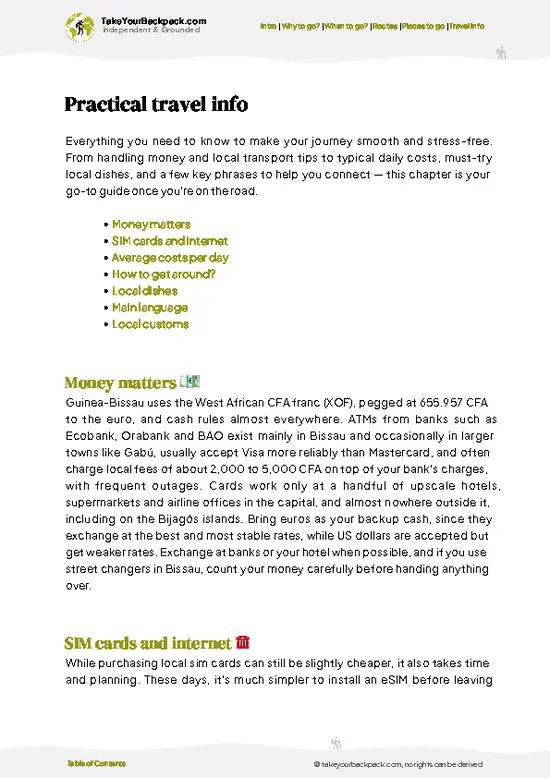
example page 0 from our offline Travel Guide for Guinea-Bissau
example page 1 from our offline Travel Guide for Guinea-Bissau
example page 2 from our offline Travel Guide for Guinea-Bissau
example page 3 from our offline Travel Guide for Guinea-Bissau
example page 4 from our offline Travel Guide for Guinea-Bissau
example page 5 from our offline Travel Guide for Guinea-Bissau
example page 6 from our offline Travel Guide for Guinea-Bissau
example page 7 from our offline Travel Guide for Guinea-Bissau
Loading the map 🌍
CLICK TO FILTER
cities
towns
national parks
beaches
attractions
festivals
regions
SHOW COUNTRY’S BESTSHOW ALL

✨ Why go?
Ranked #3 national park in Guinea-Bissau
What makes it a must-see national park

Parque Natural dos Tarrafes do Rio Cacheu suits backpackers who like finding their own way through places where nobody has built a visitor machine. The Cacheu River estuary is the draw: a protected stretch of mangrove, tidal creek and sandbank where you negotiate directly with boatmen and paddle at your own pace. No tour operator is needed, and a local guide arranged in town usually knows the channels better than any itinerary would.

The second reason is the combination with history. The town of Cacheu sits on the park’s edge, so you can pair mangrove time with the Fortaleza de São Joaquim, a former slave-trading post, in the same visit. That gives a short trip real depth.

Third, the park rewards patience over distance. Birdwatchers, photographers and travelers who enjoy slow water and a … read more 👉
Parque Natural dos Tarrafes do Rio Cacheu suits backpackers who like finding their own way through places where nobody has built a visitor machine. The Cacheu River estuary is the draw: a protected stretch of mangrove, tidal creek and sandbank where you negotiate directly with boatmen and paddle at your own pace. No tour operator is needed, and a local guide arranged in town usually knows the channels better than any itinerary would.

The second reason is the combination with history. The town of Cacheu sits on the park’s edge, so you can pair mangrove time with the Fortaleza de São Joaquim, a former slave-trading post, in the same visit. That gives a short trip real depth.

Third, the park rewards patience over distance. Birdwatchers, photographers and travelers who enjoy slow water and a good silence will get more from a couple of unhurried mornings on the river than from ticking off long hikes. It is basic and takes effort to reach, which is exactly what keeps it unspoiled.

💡 HighlightsKey sights and experiences for travelers

  1. Fortaleza de São Joaquim de Cacheu: The 17th-century Portuguese fort on the river bank is the best-known sight in the area. Thick walls, old cannons and views over the wide water explain why this was a major trading post, and its history as a point of the slave trade makes it sobering.
  2. The colonial statue collection inside the fort: Statues of Portuguese-era figures, removed from public squares after independence, stand in the fort grounds. They make an odd, thought-provoking open-air gallery, worth a slow walk with the shade of the walls.
  3. Pirogue trip through the mangrove channels: Narrow creeks lined with tarrafes close over your head in places. The only sounds are paddles, dripping roots and birds, and the water changes color with the tide.
  4. Hippo spotting on the Cacheu River: Hippos live in
… read more 👉
  1. Fortaleza de São Joaquim de Cacheu: The 17th-century Portuguese fort on the river bank is the best-known sight in the area. Thick walls, old cannons and views over the wide water explain why this was a major trading post, and its history as a point of the slave trade makes it sobering.
  2. The colonial statue collection inside the fort: Statues of Portuguese-era figures, removed from public squares after independence, stand in the fort grounds. They make an odd, thought-provoking open-air gallery, worth a slow walk with the shade of the walls.
  3. Pirogue trip through the mangrove channels: Narrow creeks lined with tarrafes close over your head in places. The only sounds are paddles, dripping roots and birds, and the water changes color with the tide.
  4. Hippo spotting on the Cacheu River: Hippos live in the river system, and boatmen know where they tend to rest. Go early, keep a respectful distance and never approach on the water without your guide.
  5. Waterbird watching on the estuary: Herons, egrets, kingfishers and migratory waders feed on the mudflats at low tide. Dawn and the hours before dusk are best, and binoculars make a big difference.
  6. Mangrove oyster gatherers: Women harvest oysters from the roots at low tide. Watching them work shows how closely local life is tied to the mangroves, and it is polite to ask before photographing.
  7. Cacheu riverfront: The town’s waterfront is a good place to watch fishing boats come and go, and to arrange boatmen for the next day.
Parque Natural dos Tarrafes do Rio Cacheu is easiest when you pair the fort with a late-afternoon pirogue trip, so you see history in the morning heat and wildlife as the tide and light soften.
Spotted a mistake or missing something? Contact us.

🌤️ When to go?Choosing the right time of year

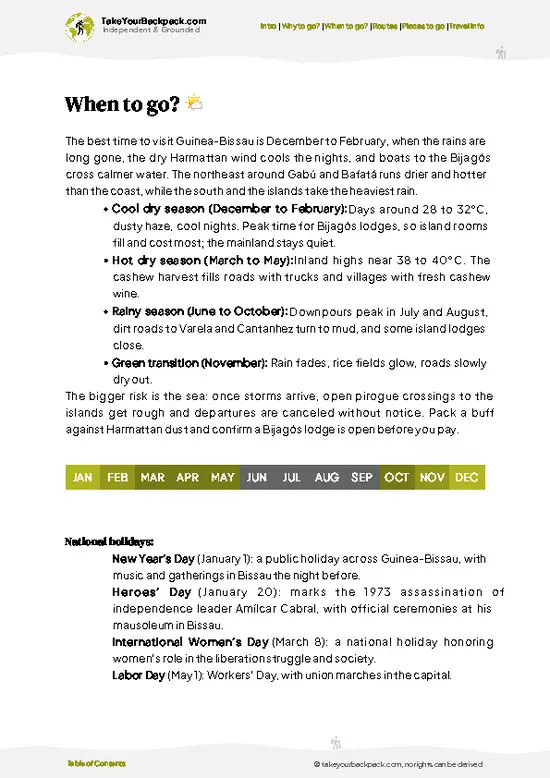
  • Dry Season (November to May): Clear skies and almost no rain make boat trips through the mangrove channels easy. Days reach 30 to 35°C (86 to 95°F), nights drop to 20 to 24°C (68 to 75°F). Daylight lasts roughly 11 to 12 hours.
  • Harmattan Haze (December to February): Dusty winds from the Sahara soften the light and cool the mornings to around 20°C (68°F). Photos get flatter, but walking in Cacheu is more comfortable.
  • Late Dry Heat (April to May): Humidity builds and afternoons feel heavy. Birdlife gathers around the tidal flats at low water.
  • Rainy Season (June to October): Downpours flood laneways and the roads toward Cacheu turn slow and sticky. Temperatures sit at 26 to 31°C (79 to 88°F). Mosquitoes multiply, and some boat operators stop running.
  • Crowds and Prices: Visitors are few in every month.
… read more 👉
  • Dry Season (November to May): Clear skies and almost no rain make boat trips through the mangrove channels easy. Days reach 30 to 35°C (86 to 95°F), nights drop to 20 to 24°C (68 to 75°F). Daylight lasts roughly 11 to 12 hours.
  • Harmattan Haze (December to February): Dusty winds from the Sahara soften the light and cool the mornings to around 20°C (68°F). Photos get flatter, but walking in Cacheu is more comfortable.
  • Late Dry Heat (April to May): Humidity builds and afternoons feel heavy. Birdlife gathers around the tidal flats at low water.
  • Rainy Season (June to October): Downpours flood laneways and the roads toward Cacheu turn slow and sticky. Temperatures sit at 26 to 31°C (79 to 88°F). Mosquitoes multiply, and some boat operators stop running.
  • Crowds and Prices: Visitors are few in every month. Boat hire and guesthouse rates stay fairly steady, with only a small rise around Christmas and the Carnival period in Bissau.
Book your boat and guide a day ahead, and plan the water trip for a rising tide so the channels are deep enough.


source: climatestotravel.comJANJanuary: excellent for travelingFEBFebruary: excellent for travelingMARMarch: excellent for travelingAPRApril: excellent for travelingMAYMay: highly recommended for travelingJUNJune: fair for travelingJULJuly: fair for travelingAUGAugust: fair for travelingSEPSeptember: fair for travelingOCTOctober: fair for travelingNOVNovember: excellent for travelingDECDecember: excellent for traveling
when-to-go

✈️ The backpacker research shortcutGuinea-Bissau Travel Guide

An offline-friendly backpacking guide with optimized travel routes, ranked highlights, transport advice, and the best areas to stay.
example page 0 from our offline Travel Guide for Guinea-Bissau
example page 1 from our offline Travel Guide for Guinea-Bissau
example page 2 from our offline Travel Guide for Guinea-Bissau
example page 3 from our offline Travel Guide for Guinea-Bissau
example page 4 from our offline Travel Guide for Guinea-Bissau
example page 5 from our offline Travel Guide for Guinea-Bissau
example page 6 from our offline Travel Guide for Guinea-Bissau
example page 7 from our offline Travel Guide for Guinea-Bissau
The digital guide (214 pages) contains:
✅ 48 highlights, ranked by travel appeal
✅ Optimized 2, 3 & 5-day travel routes
✅ Cities, national parks, landmarks, beaches
✅ How to get around
✅ Offline-friendly for travel without Wi-Fi
👉 Click to see all 30+ guide features

📅 Plan smarter in minutes, not weeks
✅ Month by month travel advice
✅ Festivals & national holidays
✅ Budget expectations

🗺️ Go to the right places, skip the overrated ones
✅ Honest pros & cons of destinations
✅ Top hikes, parks & viewpoints
✅ Lesser-known places most travelers miss
✅ Clear “worth it vs skip it” guidance

🛏️ Travel smoothly without rookie mistakes
✅ Best areas to stay
✅ Transport systems explained simply
✅ Common scams & safety advice
✅ SIM cards, money & practical tips

🌍 Understand the country, not just visit it
✅ Culture & traditions
✅ 52 Essential phrases & customs
✅ Festivals worth planning around
✅ Traveler-friendly historical context
✅ Insights that make places more meaningful

📱 Built for real travel conditions
✅ Fully downloadable PDF
✅ Works completely offline
✅ Optimized for phone use
✅ Useful in remote areas & buses
✅ Everything in one place
Stop searching, start planning
Get instant access to your full guide. 30‑day money-back guarantee.
+ Add another guide for just

By proceeding you agree to our terms.
Sent to your inbox immediately after payment • 100% Secure Checkout
Best Backpacking Travel Advisor 2025 tourism awardBest Backpacking
Travel Advisor
2025
What others say about Take Your Backpack Guides:
⭐⭐⭐⭐⭐
Fantastic, amazing amount of information!
⭐⭐⭐⭐⭐
My goodness this is amazing, it's what I've been looking for hats off too you!
⭐⭐⭐⭐⭐
I think this is absolutely BRILLIANT
⭐⭐⭐⭐
Very complete and informative. It's still missing places, but I gotta to commend you
⭐⭐⭐⭐⭐
This is truly amazing, thank you, can't wait to explore it with my kids!
⭐⭐⭐⭐⭐
Awesome resource, thank you!
⭐⭐⭐⭐⭐
This is amazing! Can't wait to explore the ones I haven't seen
⭐⭐⭐⭐
I love this! Well done, great idea.
⭐⭐⭐⭐⭐
Thanks for taking the time to make this gem!
⭐⭐⭐⭐⭐
This might be the best website I've ever seen.
⭐⭐⭐⭐⭐
Congratulations, and thank you so much for your work; it's incredibly valuable.
⭐⭐⭐⭐
In all seriousness I think you did a great job pointing out the important spots
⭐⭐⭐⭐⭐
10/10 very good
⭐⭐⭐⭐⭐
As someone who's only just starting to visit regularly this is awesome, thank you.
⭐⭐⭐⭐
Thank you very much! I'm going to visit my dad, it's going to be very useful!
⭐⭐⭐⭐⭐
This is really cool! We'll be travelling for the first time and this definitely come in handy.
⭐⭐⭐⭐⭐
You are now our minister of culture, congratulations 👨‍💼
⭐⭐⭐⭐⭐
Just wanted to tell you that this is a pearl! Going to follow your recommendations.
⭐⭐⭐⭐⭐
This is so cool. I'll definitely be using the resource for my travels soon.
⭐⭐⭐⭐⭐
This is very impressive! Good work.
⭐⭐⭐⭐⭐
This is an amazing and informative site. Very well done!

🛏️ Where to stay?Choosing the right base

Cacheu town is the best base for Parque Natural dos Tarrafes do Rio Cacheu, with a handful of simple guesthouses about €15 to 30 a night for a fan room, often with shared or basic bathrooms. It sits beside the Portuguese-era fort and the river, so you can walk to the park’s main access point and arrange a canoe or motorboat from there. Electricity can be patchy, so bring a power bank and a headlamp.

Inside the protected area itself there are no hotels, and overnight stays depend on informal village hospitality or camping arranged through the park management or community contacts. Do not count … read more 👉
Cacheu town is the best base for Parque Natural dos Tarrafes do Rio Cacheu, with a handful of simple guesthouses about €15 to 30 a night for a fan room, often with shared or basic bathrooms. It sits beside the Portuguese-era fort and the river, so you can walk to the park’s main access point and arrange a canoe or motorboat from there. Electricity can be patchy, so bring a power bank and a headlamp.

Inside the protected area itself there are no hotels, and overnight stays depend on informal village hospitality or camping arranged through the park management or community contacts. Do not count on this without agreeing it in advance.

São Domingos, a larger town on the road north, has more guesthouses and a few places to eat, and works well if you are heading on toward Senegal or the Casamance border. Varela, near the Atlantic coast, has beach lodgings that cost a little more, roughly €20 to 40, and suit people who want sand with their mangroves.

Bissau has the widest choice, from backpacker rooms around €12 to 20 to mid-range hotels. A few days in the capital before heading north lets you stock up on cash, water and snacks.

👛 Costs (as of 22 October 2026)How expensive it really is

A day at Parque Natural dos Tarrafes do Rio Cacheu runs about €55 to 106 for one traveler, with a boat trip making up the biggest share. Prices are paid in West African CFA francs and cash is essential, as there are no card machines near the park.
CategoryBudget RangeLocal Reality
Entrance and community fees€3 to 6Paid in cash to park staff or a guide; amounts are not fixed and receipts are not always issued.
Accommodation (high season)€15 to 30Simple guesthouse room in Cacheu with fan; November to May is busiest, but rooms are rarely full.
Boat and guide€25 to 50Motorboat or canoe for several hours through the mangrove channels; fuel is the main cost, so splitting with others helps.
Local transport€6 to 10Shared taxi or minibus from Bissau toward Cacheu via Bula and São Domingos; departures fill
… read more 👉
A day at Parque Natural dos Tarrafes do Rio Cacheu runs about €55 to 106 for one traveler, with a boat trip making up the biggest share. Prices are paid in West African CFA francs and cash is essential, as there are no card machines near the park.
CategoryBudget RangeLocal Reality
Entrance and community fees€3 to 6Paid in cash to park staff or a guide; amounts are not fixed and receipts are not always issued.
Accommodation (high season)€15 to 30Simple guesthouse room in Cacheu with fan; November to May is busiest, but rooms are rarely full.
Boat and guide€25 to 50Motorboat or canoe for several hours through the mangrove channels; fuel is the main cost, so splitting with others helps.
Local transport€6 to 10Shared taxi or minibus from Bissau toward Cacheu via Bula and São Domingos; departures fill before leaving and the ride takes about 2 to 3 hours.
Food and water€6 to 10Rice with fish or chicken sauce at local eateries; bottled water and snacks cost more away from Bissau.
Total Daily Budget€55 to 106Lower end if you share the boat and eat locally.
⚠️ Prices can change and everyone travels differently, so take this as a rough guide. Hope it helps you plan your adventure!

🥾 TrailsScenic routes and wildlife spotting in Parque Natural dos Tarrafes do Rio Cacheu

Parque Natural dos Tarrafes do Rio Cacheu is a mangrove park rather than a hiking park, so walking means short, flat strolls on firm ground, while the real exploring happens by pirogue. Terrain is tidal mud, sandbanks and creek edges, and the going is slow and hot. Difficulty is low, but humidity and tide timing make planning matter.
  • Fort and town walk: Start at the Fortaleza de São Joaquim, wander the statue grounds, then follow the riverfront and the lanes of Cacheu. It takes about 1 to 2 hours on flat ground and suits anyone.
  • Mangrove pirogue circuit: A boatman takes you from the town landing
… read more 👉
Parque Natural dos Tarrafes do Rio Cacheu is a mangrove park rather than a hiking park, so walking means short, flat strolls on firm ground, while the real exploring happens by pirogue. Terrain is tidal mud, sandbanks and creek edges, and the going is slow and hot. Difficulty is low, but humidity and tide timing make planning matter.
  • Fort and town walk: Start at the Fortaleza de São Joaquim, wander the statue grounds, then follow the riverfront and the lanes of Cacheu. It takes about 1 to 2 hours on flat ground and suits anyone.
  • Mangrove pirogue circuit: A boatman takes you from the town landing into the creeks. Plan 2 to 4 hours depending on tide, passing root tangles, mudflats and open water. Easy, but you sit still in the sun, so bring a hat and water.
  • Dawn wildlife outing: Leave very early to catch birds feeding and a chance of hippos in the river channels. Expect 2 to 3 hours, calm water and cool air, with sightings never guaranteed.
  • Village shoreline stroll: Local paths along the edge of the mangroves lead past oyster gatherers and fishing canoes. Distances are short, mud is common, and sandals will not survive it; wear closed shoes you can wash.
Getting there is the main challenge. Shared taxis and minibuses run from Bissau toward Cacheu on a road in uneven condition, and public transport is slow and fills up before it leaves. Starting early gives you daylight to arrange a boat on arrival. Crowds are rarely an issue, since few travelers come. A modest park or guide charge is normally settled locally with the boatman or at the park office, so carry small cash. Bring insect repellent, sun protection and plenty of drinking water, as supplies in town are limited.
⚠️ Hiking info can sometimes be outdated or inaccurate. Before you hit the trail, check the latest conditions with locals. If you do spot anything that's off, I'd love to hear from you, so I can update it for fellow travelers.

🛡️ SafetyTraveler Safety Guide

The park is straightforward, but it is remote, so preparation matters more than caution. Mangrove channels look alike and tides change depth fast, so go with a local boatman who knows the creeks rather than trying to navigate alone. Wear a life jacket if one is offered, keep bags in dry sacks and sit low in narrow canoes.

Footing is flat but muddy, and tidal flats can swallow a sandal, so pack closed shoes or sturdy sandals. Sun on open water is intense, and shade is scarce: carry a hat, a liter or two of water per person and electrolytes.

Malaria is present, so take prophylaxis, repellent and long sleeves at dusk. Hippos and crocodiles live in West African waterways, so keep hands out of the water and follow your guide on any bank landings. Mobile signal is patchy and medical help is far … read more 👉
The park is straightforward, but it is remote, so preparation matters more than caution. Mangrove channels look alike and tides change depth fast, so go with a local boatman who knows the creeks rather than trying to navigate alone. Wear a life jacket if one is offered, keep bags in dry sacks and sit low in narrow canoes.

Footing is flat but muddy, and tidal flats can swallow a sandal, so pack closed shoes or sturdy sandals. Sun on open water is intense, and shade is scarce: carry a hat, a liter or two of water per person and electrolytes.

Malaria is present, so take prophylaxis, repellent and long sleeves at dusk. Hippos and crocodiles live in West African waterways, so keep hands out of the water and follow your guide on any bank landings. Mobile signal is patchy and medical help is far away, so carry a basic first-aid kit and tell your guesthouse your plans. Ask before photographing villagers.

FAQFrequently asked questions about Parque Natural dos Tarrafes do Rio Cacheu

Two days is enough for Parque Natural dos Tarrafes do Rio Cacheu if you base yourself in Cacheu: one day for a boat trip through the mangrove channels and one for the old Portuguese fort and town. Add a third day if you want a village overnight or birdwatching at dawn. The trip from Bissau takes about 2 to 3 hours each way, so a single day trip is rushed.
Yes, Parque Natural dos Tarrafes do Rio Cacheu is reachable without a car using shared taxis or minibuses from Bissau to São Domingos, then onward to Cacheu, for roughly €6 to 10 in total. Once in Cacheu you explore on foot and by hired boat, which costs about €25 to 50 for a few hours. Plan on departing from Bissau early, as vehicles leave when full and services thin out by afternoon.
Parque Natural dos Tarrafes do Rio Cacheu charges small entrance or community fees, typically around €3 to 6, paid in cash to park staff or your guide. No advance permit is generally needed for ordinary visits, though checking in at the park office in Cacheu is wise before heading out by boat. Carry your passport for police checkpoints on the road from Bissau and bring small CFA franc notes for payments.
⚠️ Things can change over time, so always validate details locally before you go.

Other Bissau-Guinean national parks near Parque Natural dos Tarrafes do Rio Cacheu

Explore more nearby:


💡 Not sure where to go next?
Create a personalized itinerary for Guinea-Bissau including Parque Natural dos Tarrafes do Rio Cacheu and the places that fit your trip.

Generate my itinerary

👉 Discover all national parks

Or checkout all Guinea-Bissau has to offer (think cities, towns, villages, national parks, hikes, beaches, festivals)
Country photo of Guinea-Bissau

We 💚 feedbackParting advice and final tips

Parque Natural dos Tarrafes do Rio Cacheu deserves two nights, not a rushed day trip. That gives you a morning at the fort, one dawn boat trip and one on a different tide, which matters more than it sounds. I would add a spare half day in case transport out is slow, and I would bring a good pair of binoculars.

✍️ Help improve this page!
The information on this page is based on in-depth research, insights shared by experienced travelers, and feedback from the local travel community in Guinea-Bissau. While every effort is made to keep the information accurate and current, conditions can change — so if you spot anything incorrect or outdated, please get in touch.


🙋‍♂️ Give feedback

👋 Meet the founderWho’s Behind Take Your Backpack?

Johan, backpacker and founder of TakeYourBackpackHi, I’m Johan (Netherlands 🇳🇱), the creator of TakeYourBackpack. Over the past 3 decades, I’ve backpacked through 90+ countries across six continents, gaining extensive experience with independent travel, long-term trips, and overland routes.

This site is built on a combination of firsthand travel experience and carefully curated insights from other backpackers. Many guides are based on places I’ve personally visited, while others bring together tips, observations, and practical advice shared by trusted travelers I’ve met along the way.

The goal is to provide realistic, experience-driven guidance — not generic itineraries — so you can explore destinations with better context, clearer expectations, and more confidence.